The Great Debate

The Great Debate: Edmund Burke, Thomas Paine, and the  Birth of Right and Left
© 2013 Yuval Levin
296 pages

The Great Debate uses the war of letters between Edmund Burke and Thomas Paine  to explain the philosophical differences between conservatism and progressivism. Both men were political actors, albiet in different spheres, and both achieved renown during the period of the American and French revolutions. While both the respectable MP Burke and the revolutionary Paine supported the American cause, they broke furiously over the French.  Drawing on each party’s respective works, some written as direct rebuttals to the other, Yuval Levin explores their opposing philosophies in different sections: the meaning of ‘nature’, the role of choice,  reason versus tradition, and so on.

As a pair, they remind me faintly of  John Adams and Thomas Jefferson, with Adams as the cynic and Jefferson the romantic. Burke emerges here as a man constantly aware of human frailties, and desiring to mitigate them as much as possible — chiefly by preserving the structure of government passed down from generation to generation, which he assumes as custom-tailored for its people through the ages — and making marginal, cautious changes as circumstances dictate.  Paine is marked more by idealism, mindful only of the good which we are capable of.  For Paine,  tradition and custom are the mere baggage of time. For him, there are certain principles which, if followed, guarantee freedom and progress. The trick is that these principles have to be built into the foundation, so  virtually everything has to be torn down to make room for them. It is in that vein that he argues that the American states should adopt a tack that would later be embraced by the French: erasing the historical boundaries of distinct places, and instead creating new little subdivisions of the State, purely for administrative purposes. Burke did not see the American revolution as a revolution; he saw Parliament’s recent presumption of absolute powers over the colonies as all-too-new preogative, at odds with the facts of distance and precedent. (For Paine, the Amercan revolution was the start of a global revival, the dawn of an Age of Reason applied politically.)  Paine can see no reason to create internal checks and balances: so long as the beginning principles are sound, there will be no need of conflict.

 For me,  I think back to Adams and Jefferson, and wonder whose vision I trust more — the skeptic of human nature Adams,  who mistrusted too much democracy but refused to own or  hire slaves…or the idealistc Jefferson,  who could sing ‘liberty’ to the heavens but who maintained his own stock of enslaved persons. Give me Adams — his actions have more weight than the prettiest words.  The same goes for Burke and Paine. While I can disagree with Burke time and again, ultimately erring on the side of caution strikes me as as better than ripping apart society and allowing for creatures like Napoleon.  While Levin doesn’t reduce Paine to caricature, the amount of time he gives to Burke — required given Burke’s sheer complexity —  gives the book a Burkean balance.   Paine’s idealism survived as long as it did, I think, because he never held an office of political responsibility. He thus enjoyed the luxury of never having to put his ideas into practice personally, rather like a few other political philosophers of the 19th and 20th century.   I found The Great Debate fascinating  dialogue between two equally sympathetic men, of idealism mixing with cognizance of our limitations.  The title is total oversell, though,  since Paine’s connection with progressivism only appears in the conclusion.

Posted in Politics and Civic Interest, Reviews | Tagged , , , , , , | 2 Comments

Harvest of Empire

Harvest of Empire: A History of Latinos in America
©  2000 Juan Gonzalez
416 pages

Harvest of Empire is a tale of two civilizations, Anglo and Spanish. In general terms, it recounts the history or rather the plight of Latin America, of people and cultures dominated first by European powers, and then by the colonial rebels turned colonial master, the United States.  The author ends by arguing that the United States owes as much its Hispanic tradition as its Anglo, and that it should embrace Hispanic culture  and make amends to foreign policy which has wreaked havoc throughout the eastern hemisphere.  Divided into three parts, Harvest first dwells on the roots of Anglo-American conflict by recounting the age of discovery and rise of American imperialism, moves to the “branches”, in which populations disrupted by war and famine (often linked to American foreign policy) migrate to the United States to seek their fortunes, and then ends with a “harvest” that looks towards a stronger role played by Latino culture in the United States.

 Considering that two of the leading recent  Republican candidates for El Presidente were Cruz and Rubio, ‘los hermanos cubanos’,  there’s no denying the book’s relevance, despite its sixteen years of age. Even though neither are in the running now,  immigration  — the causes and consequences of which are explored here — remains a big-ticket item.  While some of the author’s recommendations (that the United Staces embrace its Hispanic heritage and start promoting and protecting Spanish) are likely to fall flat,  at the very least this review of the United States’ catastrophic record of international meddling in central America might give American leadership pause about supporting future debacles.  More convincing is the authors’ case for settling the matter of Puerto Rico, which for a century has been a bastard, neither  sovereign, nor a territory or a state.  Harvest has a lot to recommend it, first as a general history of Latin America, secondly by focusing on the widely varying experiences of different Latino groups as they moved to the US.  What name recognition does Puerto Rico have with most Americans, other than the film West Side Story? (“Puerto Rico is en America now!”)   The author is right when he points out that the United States is scarcely over two hundred years old, a mere blip in the historical perspective, and the past century of exploitation and dominance by D.C. over Latin America are not likely to last. Latinos will play a larger role in the United States as they continue to migrate here, and will shape D.C’s policy as they achieve political influence — and as the descendants of those who have experienced the consequences of foreign-policy imperialism, they are unlikely to support more of it.

Posted in history, Reviews | Tagged , , , , , , , , , , | Leave a comment

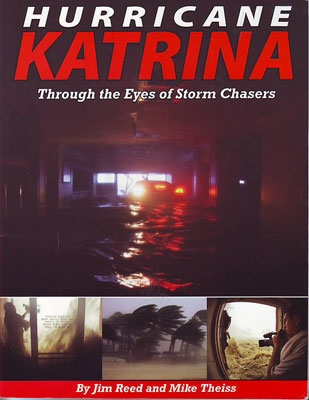
Hurricane Katrina through the Eyes of Storm Chasers

Hurricane Katrina through the Eyes of Storm Chasers
© 2005
96 pages, virtually all photographs

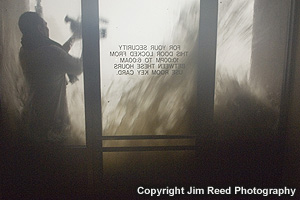
I recently discovered a collection of Hurricane Katrina photography that I thought worth mentioning.  The book collects photos taken by Jim Reed and Mike Theiss, principally in the Gulfport area but also including a handful of shots in Orlando and New Orleans.  Eleven years later, the plight of New Orleans monopolizes any mention of Katrina, but these photographs were amazing.  The storm hit only a year after Hurricane Ivan walloped Alabama, so I watched it approach the coast with dread. Reed and Theiss are lunatics, judging by how close they were to the storm surge and the winds here — though at least once they set up a highly stable and encased camera near the path, then recovered it later. If the only Katrina footage you have seen is of New Orleans, this book is worth looking through.  Gulfport wasn’t merely flooded: the winds, 26-foot storm surge, and ships thrown inland wiped out massive swaths of development. Hotels had their first floors gutted, with only the load-bearing walls intact,  The shots of wind blown trees have a beauty about them, despite the sheer danger they make those of us living anywhere near the Gulf remember.

Posted in Reviews | Tagged | 3 Comments

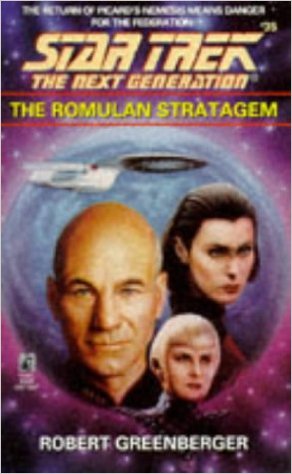
The Romulan Stratagem

The Romulan Stratagem
© 1995 Robert Greenberger
297 pages

A planet on the border of the Federation, Klingon, and Romulan empires has invited the Enterprise to sell its government on Federation membership. When the Big E arrives, however, they find a Romulan warbird waiting for them. The Romulans have also been invited to make a pitch for membership, and their negotiator is no less than Admiral Sela. Sela, who claims to be the daughter of an alternate-universe Tasha Yar, fell from grace after Picard dismantled her last set of nefarious plans, and for her snatching this planet  from under his nose will be sweet revenge. During the week of meetings, however, several deadly explosions implicate the crews of both the Enterprise and Sela’s warship, threatening both powers’ desires. Incredibly, Data finds himself working with Sela to work out what third party is sabotaging the conferences. While this plot thread has considerable interest,  given Data’s intimate history with Yar,  that angle is never pursued. The ending is a departure from the unexpected, but on the whole there’s nothing really remarkable about the book. Ro Laren lends  interest in her comic-relief thread, being assigned to babysit a civilian family after bodily throwing one too many civilians out of her way attracts the Wrath of Riker.  A teenage boy in said family develops a raging crush on Ro, one which she is far too slow to pick up on.  All told, this is enjoyable enough, but I only read it for the characters featured on the cover.

Read it for Ro. Patrick Stewart wants you to.


Posted in Reviews | Tagged , , | Leave a comment

On Free Will

Suppose for a moment, that we define a virtuous act as bowing in the direction of Mecca every day at sunset. We attempt to persuade everyone to perform this act. But suppose that instead of relying on voluntary conviction we employ a vast number of police to break into everyone’s home and see to it that every day they are pushed down to the floor in the direction of Mecca. No doubt by taking such measures we will increase the number of people bowing toward Mecca. But by forcing them to do so, we are taking them out of the realm of action and into mere motion, and we are depriving all these coerced persons of the very possibility of acting morally. By attempting to compel virtue, we eliminate its possibility. To be moral, an act must be free.

Murray N. Rothbard, “Frank S. Meyer: The Fusionist as Libertarian Manquè“. Quoted in Freedom and Virtue.

Posted in quotations, Reviews | Tagged | 3 Comments

Wrath of the Prophets

ST DS9: Wrath of the Prophets
© 1997 Michael Jan Friedman, Peter David, Robert Greenberger
300 pages

On the cover: Nana Visitor as Kira Nerys, Michelle Forbes as Ro Laren

An epidemic is sweeping Bajor, a pestilence born of faulty replicators smuggled in by a young woman desperate to feed her village.  Placed under quarantine, the planet’s peril is so intense that even  renegade Ro Laren emerges from hiding to help transport food there. On Deep Space Nine, Julian Bashir works to find a cure, but every breakthrough is immediately reversed. This is a virus with a deep bench of tricks. In the hopes of expediting matters, two teams are sent into shady markets  to find the source of the replicators and demand some answers.  While Sisko, Odo, and Quark  examine a smugglers’ hub in space,  Major Kira grudgingly accepts the company of Ro Laren on Bajor.

Putting Ro and Kira together is a recipe for fun. Orginally, DS9 was written to include Ro Laren, but Michelle Forbes didn’t want to commit. Another feisty Bajoran was invented to take her place, Kira. But despite being cut from very similar cloth, Ro and Kira are not bosom buddies. As hot-headed and willful officers, they butt heads repeatedly. Ro’s appearance is not welcome by anyone: she deserted Bajor during the occupation to join Starfleet, then went AWOL after Starfleet began pushing around settlers to fulfill the Federation’s foreign policy commitments.  Of course, Ro Laren eventually  does make it to Deep Space Nine, in the relaunch — as the station security chief. The authors are aware of Kira and Ro’s linked origin, even having Ro muse that had things been different, they might have switched places. Despite their similarities — their combativeness, their independence — the two women are different in substantial ways here. Ro is a cynic,  disheartened by Starfleet’s bullying of innocents in regards to the Maquis. Kira isn’t naive, but she’s idealistic: she believes in her fellow Bajorans, and when she realizes how corrupt Bajor’s provisional government is, how even her wartime allies prove to be positively venal, she suffers a crisis of faith made worse by Ro’s attitude. Eventually, through much argument and mortal peril, Ro and Kira become the other’s comrade-in-arms, and by the book’s end they’re standing back to back making fiery speeches at Bajor’s congress. Attagirl, Ro, you did learn something from Picard.

There are other plot points — the chief is worried about his family on Bajor whom he never sees, Dax is mysteriously incompetent, being distracted by a previous host’s experience with a similar plague — and the multitude of angles the story is being chased down probably owes to the fact that there are three authors, all of whom needed something to do. But really, twenty years after this book’s publication the only reason to read it is for the combination of Ro and Kira.

Posted in Reviews | Tagged , , | Leave a comment

Three for One: Robbing Banks and Being Robbed by the Banks

I stumbled upon The Great Taos Bank Robbery at some point last year. What road led me to it I can’t say, but it is a most interesting little book — a combination of folk history, humorous stories, and archaeology.  The subject is New Mexico in general, the quirky characters touted off as exemplars of New Mexico’s eccentrity. Some of the stories are so entertaining and weird that I presumed them fiction, like the title piece about two men who patiently stood in line to rob a bank, only to discover it was a bank holiday. Absurdity ensues, especially as one of the culprits is wearing a dress and a small mound of pancake batter on his face.   There are several serious pieces of archaeology and anthropology in here, though even these have a few lines delivered with the literary equivalent of a straight face. (“The only problem with the report was that it was absolutely wrong.”)

Over the weekend I read Don’t Hurt People and Don’t Take Their Stuff, which proved entertaining if disappointing. It is less a fulsome introduction to the nonaggression principle and classical liberalism, and more a kick in the teeth of a corrupt and ineffective bureaucracy.  It was written in 2013, with the campaign promises of 2012 already unfulfilled and stale; the author anticipated another round of calming lies in 2016 and wanted to wake readers up to the possibility of a third option.  He champions freedom and creativity, loathes the administrative state (full of “gray suited soviets”), and mixes the political feistiness with affectionate rambling on the Grateful Dead and Rush. (The band, not the blowhard.)  Kibbe has a libertarian since high school, so while he’s passionate he doesn’t have the experience made from traveling in other camps that would allow him to connect other views with his arguments.  Still, in political season marked by sneers and street brawls, being reminded of a political philosophy based on peace instead of ambition to control  is refreshing.   The libertarian candidate this year is Gary Johnson, retired governor of New Mexico.

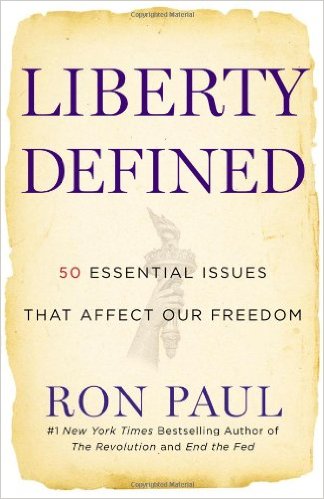
Relatedly, a few weeks ago I read Ron Paul’s Liberty, Defined, which works out what liberty entails in the 21st century. For the author, it is nothing less than the golden rule applied to politics, and he uses fifty issues floating around in the sewage tank of American political debate as examples. These range from abortion to Zionism, with less controversial fare in between. The subjects are alphabetical, without any other structure, which makes it less a definitive argument for liberty and more a collection of policy papers. There are no surprises for someone who is familiar with Ron Paul’s reputation as a staunch libertarian:  naturally, he is against an over-mighty executive, against constantly deploying the military to police other nations, and against  burdensome taxes and irresponsible legislation. Because of the arrangement, it’s hard to imagine a man off the street  picking up the book and reading it through — what’s the hook? I went for it because I knew the author, but because I was familiar with the author, nothing in here was really new.

Posted in Reviews | Tagged , , , , , , , | 5 Comments

TBR Bodycheck

Another week, more solid progress on the TBR. There are a couple of reviews pending. I plan one more big push this week, then a switch to American lit, then another drive to finish this one off!

Taken down!

Coming Attractions

  •  The Obstacle is the Way, Ryan Holiday.
  •  Trucking Country: The Road to America’s Wal-Mart Economy, Shane Hamilton.
  • 10% Human, Alanna Collen.
  • The Great Debate: Edmund Burke, Thomas Paine and the Birth of Right and Left, Yural Levin.
  • .Domesticated: Evolution in a Man-Made World,  Richard Francis.

And (a little) more!

Posted in General | Tagged | Leave a comment

Green, Blue, and Grey

Green, Blue, and Grey: the Irish in the American Civil War
©  2009 Cal McCarthy
325 pages

Three cheers for the red, white, and blue!

For the green flag of Erin so true..

The music of the Civil War reflects the sheer variety of men fought in it; they were not all Americans, but many were recent immigrants from across Europe, who retained their national identities. Germans, for instance, sang the Battle Hymn of the Republic in their own tongue — and the songs of the combative Irish are a genre unto themselves. It was through their music that I first heard references to the Irish revolution of 1798, a bid for independence that would, like the South’s, fail. These references came from Irishmen fighting on both sides of the Civil War, however, and it was to learn more about how Irish immigrants viewed the conflict that I first picked up The Green, the Blue, and the Grey.  It is, however, purely a military history of the various regiments and brigades who were constituted wholly of Irish-Americans. (Two of the most notable are the 69th New York and the 10th Tennessee.) Some were directly recruited from Ireland, occasionally under false pretenses. (Irish laborers were recruited to the US to work for companies which proved fictitious, then shanghaied into the Union army. Welcome to the land of the free, boys.)

The history covers virtually all of the major battles of the conflict — Bull Run, Fredericksburg,  Antietam, Gettysburg, the usual suspects — along with minor ones that I’ve never heard of, like the skirmish of ‘Desert House’.  While the author’s focus is on battles in which Irish forces played a major role, especially when they fought against one another, the filled-in narration is such that this easily serves as a general military review of the Civil War. He covers both theaters and even includes some naval goings-on.   Learning how the Irish interpreted the sectional conflict in the light of Ireland’s own relationship with Britain, however, will wait for another book. The Irish in this book fought for whichever region they  happened to be living in, and at Gettysburg, Catholic and Orange Order immigrants fought side by side.

Some Music of the Irish
“The Irish Volunteer“, David Kincaid. Union.
Song of the Irish Brigade“, David Kincaid. My personal favorite. Southern.
“Kelly’s Irish Brigade“, David Kincaid.  Southern.
We’ll Fight for Uncle Sam“, Union, and set to ‘Whiskey in the Jar‘.
Pat Murphy of the Irish Brigade“, Union.  Performed by Bobby Horton.
The Green, the Red, the White, and Blue“, Derek Warfield.  Southern.  This is an interesting one; it’s a heavily modified version of “Dixie, Land of King Cotton“.
The Southern Wagon (Irish)“. Derek Warfield.  Southern.

These are all high-energy except for “Pat Murphy”, which is mournful. These songs have some of the best lyrics of any in the ACW canon.

Posted in history, Reviews | Tagged , , | 5 Comments

The Orthodox Church

The Orthodox Church
© 1963, 1993 Kallistos (Timothy) Ware
368 pages

Who are the Orthodox? To the extent Americans have heard of them, it is through eastern European immigrant communities. Those who paid marginal attention in western civ might remember something called the Great Schism, in which the western and eastern halves of Christendom declared one another excommunicate. While the Catholic west and Orthodox east have continued to drift their separate ways throughout the centuries, they share the same core tradition. In The Orthodox Church, Kalistos Ware delivers a history of the eastern Orthodox, followed by an introduction to its liturgy and devotional practices. He ends by musing on the possibilities and obstacles to communion between the Orthodox and their closest brethren, the Catholics and Anglicans. Although the history is very much dated now, the book having been written shortly after the Soviet Union collapsed and the suppressed church started to reemerge, Ware’s account of the centuries prior is handled attractively and efficiently.

Although Rome initially persecuted the Christian church, by the third century A.D.it had attracted the attention of the emperor Constantine, who declared it legal.Constantine courted the church himself, though (famously) he would not submit to baptism until he lay on his deathbed. Christianity soon became the state religion of the Roman empire, circling the Med, but as Rome aged and withered, division ensued. Barbarian activity in the Balkans and the eruption of Islam made communication increasingly difficult, and soon a purely administrative division between the empire’s western and eastern halves became a cultural one. The western empire and its church became more enmeshed with the fate of the Franks, crowning their king as Emperor,  Frankish influence would extend to theology, as an addition to the Nicene Creed intended as a rebuttal to a local heresy found favor in the west, eventually being adopted by the pope.

That proved to be a problem, as did the pope’s authority in general, for his claimed jurisdiction over not merely the Roman see, but the whole of Christendom.  The Nicene Creed was adopted by an ecumenical council at Nicea, representing the entire church; it was pounded out in collaborative labor.  One bishop by himself couldn’t alter it simply at will. Ware is remarkably fair-minded about the popes, attributing their beliefs not to villainy or ambition, but to the mere fact that Rome had no western peer.  The pope was the closest thing the west had to a unitive authority, as Charlemagne left behind a mess of warring states.  Secondly, the See of Rome was the only western church with Apostolic credentials, the only one believed to be founded by one of the original followers of Christ. In the east, there were three — Alexandria, Antioch, and Jerusalem – and none were able to claim precedence over the other. The great schism  was thus made possible by the actual divide between the western and eastern parts of the Empire, begun in earnest by the  arguments over how far papal authority extended, and completed when the western Franks sacked Constantinople on the way to yet another crusade.  No forgiveness for this fratricide would follow.

Subsequent chapters cover the conquest of Eastern Rome by the Arabs and later the Turks. The Orthodox church muddled through, largely – it wasn’t until the rise of ISIS that Christians were wholly driven out of places like Iraq and Syria. The most grievous persecutions had a nationalist rather than religious focus – the Armenian genocide, for instance, followed Turkey’s defeat in the Great War.  Following the withering and defeat of Constantinople, Orthodoxy developed new life in eastern Europe, especially in Russia, which wanted to claim itself as the Third Rome. The Russian church would endure its own repression during the Communist years, aside from a brief detente during World War 2.   Turkish  and Russian brutality both drove Orthodox emigrants out of Europe and into the United States, where today it flourishes.

The second half of the book covers Orthodox theology and praxis, both of which more difficult to summarize than politics.   It bears comment on, though, and the Nicene creed is again an example. While the Orthodox objected to the pope single-handedly changing a creed that was created by a congress of the church,  Ware argues that the change itself  also subtly shifted and confused theology.  The change in question was to declare that the Holy Spirit proceeded from the Father and the Son,  which dilutes the role of the Father and makes things more vague. In the essential approach to worship (communal prayer, reading of scriptures, and the Eucharist) the Orthodox and Catholics are very similar,  but there are notable differences. The Orthodox, for instance, worship standing, and most do not employ musical instruments. Icons play a much larger role, being seen as literal windows into heaven ,and used to focus the mind. Mysticism has played a larger role in Orthodox development, as well, though Ware doesn’t comment on the tension between it and western scholasticism.

Covering as it does two thousand years  of history and most of Eurasia, The Orthodox Church is impressively ambitious, yet fairly concise. The church’s fate under Turkish and Soviet domination are dispatched in single chapters, as is the church’s role in the developing civilization of Russia.  It is most helpful in the area of general religious literacy, with a lot of content wrapped up in these 300-odd pages.

Posted in Reviews | Tagged , , , , , | 5 Comments