Enterprise: the First Adventure

Enterprise: the First Adventure
© 1986 Vonda McIntyre
386 pages

Jim Kirk thought he was going places. Not even thirty, he’s been named captain and given the Enterprise, famously captained by Chris Pike. But instead of launching out on an extended five year missions, he’s…transporting the circus? Yes, Starfleet in its wisdom has decided to use a top-of-the-line Starship to transport a bunch of jugglers, magicians, and a menagerie of ill-tempered critters that includes a winged horse, on a tour of several starbases. Fortunately for the plot, they encounter not only a wacky, emotional cousin of Spock, but a rogue Klingon ship out to spite the Federati — wait a minute, is this The Final Frontier?! The wacky Vulcan isn’t going to hijack the ship and take them to meet The God Thing, is he? …anyhoo, as billed this is the First Adventure of the Starship Enterprise. Its primary attraction is that the Enterprise crew first meet each other here, including the teenage Rand and Chekov. The characters’ introductions are on the predictable side: Spock and McCoy argue, Chekov is cheerfully delusional about Russia, Sulu has swords, etc. McIntyre offers some insight into the characters: Rand, for instance, is depicted as an underage teen who joined Starfleet to escape slavery, hence her nervousness.  There’s also appreciable coolness between Kirk and Spock, who interact as distant professionals. Gary Mitchell isn’t the only nod to what adventures follow the crew: Kirk and Spock first bond over 3D chess (a la “Where No Man Has Gone Before”) and there are feline crewmen, a nod to the Animated Adventures. The weirdest thing about the books is the flying horse: how can six limbs be imposed on a four-limb brain? While the early characterization provides some interest for hardcore fans, it’s really not that engaging.

Posted in Reviews | Tagged , , | 2 Comments

The Red Badge of Courage

The Red Badge of Courage
© 1895 Stephen Crane
170 pgs

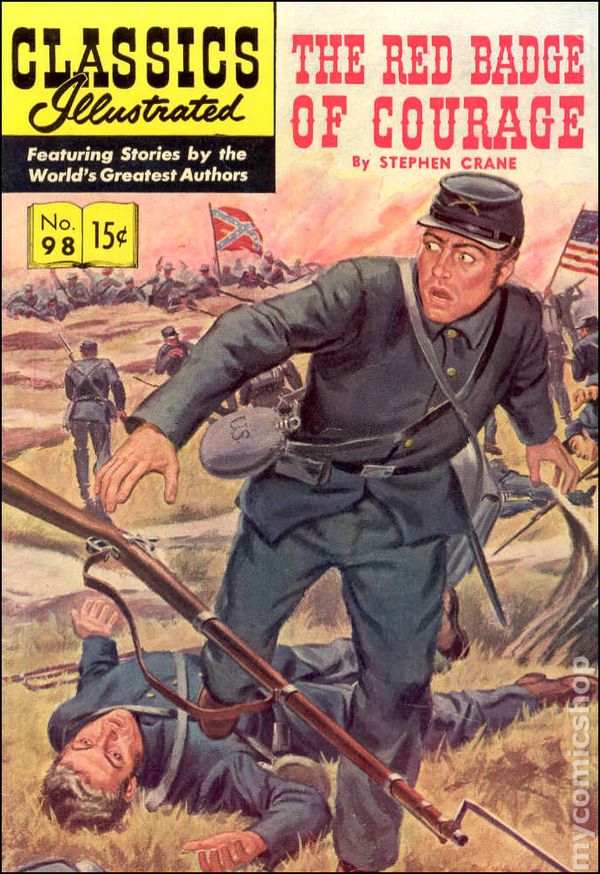
Stephen Crane practically introduced Civil War historical fiction, writing this tale set during a war that was ended six years before his birth. The Red Badge of Courage is the account of a young soldier’s baptism by fire when he eagerly joins Lincoln’s war against the south, wondering — as the day of battle draws near, caught in the grips of nervous anticipation — if he can really pull it off. Will he be a daring soldier, or cower in the face of the enemy? He seems to survive his first brush with the southerners, but when they launch a second attack, an unexpected one, his inner reserve melts, and he flees the line for the safety of the wilderness. There he encounters the dead and dying, sees a friend fall before his very eyes, and responds by ashamedly returning to his regiment, where he distinguishes himself in action against the enemy, losing himself to a kind of battle madness. Crane’s tale combines vivid descriptions of the landscape and battle — the literary depiction of the enemy’s fires reflected in a dark river at night is especially haunting — with inane and repetitive dialogue. It is a pity Crane didn’t live long to refine his craft.

Posted in historical fiction, Reviews | Tagged , , , , , , | 1 Comment

The Obstacle is the Way

The Obstacle is the Way
© 2014 Ryan Holiday
224 pages


Let us say, dear reader, that you have heard of Stoicism, hailed as the go-to philosophy of mental fortitude. You want to read about it. But you don’t want to take on Epictetus or Aurelius in their full, because the one time you peeked into a copy of the Meditations or the Discourses in the local bookstore, it was full of florid Victorian prose.  What if you could have  a Stoicism lite, watered down to a few punchy self-help lines, mixed in with other advice, and illustrated with a variety of various politicians, warriors, and businessmen who faced adversity head-on and triumphed?  Well….here you are, The Obstacle is the Way!  One pinch Stoicism, one pinch life coach, and a spoonful of people more successful than you are. It is energetic, quotable, and  I suspect, forgettable.

 A few concepts from Stoicism wander in: first, the essential tenet that there are things under our power, and things not, and that wisdom lies in only concerning ourselves with that which is under our power, The second is ‘impressions’, or the automatic reactions/judgments our brains create about things, the reactions that cause us more misery than the actual events.  If we have escaped a burning home, we are in no danger; the suffering comes from lamenting over the possessions. We can choose to cease the wailing.  A few  Stoic practices appear, too, like negative visualization — imagining the worst that could befall you, and thinking practically about the consequences in order to steel your brain for what is to come.  To this is added “The Process”, or approaching a problem one step at a time, and other sundry advice that includes the gem, “What Works is Right”.  This section is supported by that contemptible little soundbite from Rahm Emanuel — “never let a crisis go to waste”.   Straying a little close to the ends justifying the means, aren’t we? It rather brings to mind the Reichstag fire or other machiavellian manipulation. Oh,  this advice can be made innocent, translated to truisms like ‘don’t let the perfect become the enemy of the good’, but Holiday cares nothing for context.   That’s the entire problem of the book, actually. The cohesiveness of Stoicism is abandoned altogether, and his attempt at mentioning ethics is tacked on at the end, in a “Oh, yeah, and be nice, because we’re all in this together”.     It’s about as inspirational as a schoolroom public service announcement. (“Just say no, kiddos!”)

The Obstacle is the Way has its merits, in potentially introducing people who view philosophy as academic naval-gazing to its practical benefits.  If any of this advice actually sticks, it would prove fruitful…but like most self-help books,   there’s just one witticism after another and most will float right out. It doesn’t help that the author devotes a section at the end to congratulating his reader for having become a philosopher, a Stoic ubermensch.  What indulgent nonsense!  Stoicism is practiced, not read, and so as rebuttal I offer Epictetus,

“Suppose I should say to a wrestler, ‘Show me your muscle’. And he should answer me, ‘See my dumb-bells‘. Your dumb-bells are your own affair; I want to see the effect of them.
Take the treatise ‘On Choice’, and see how thoroughly I have perused it.’ 

I am not asking about this, O slave, but how you act in choosing and refusing, how you manage your desires and aversions, your intentions and purposes, how you meet events — whether you are in harmony with nature’s laws or opposed to them. If in harmony, give me evidence of that, and I will say you are progressing; if the contrary, you may go your way, and not only comment on your books, but write some like them yourself; and what good will it do you?

Holiday might make a good read for people with a vague interest in taking back control of their emotional life, but if you’re even remotely aware of Stoicism, there’s not much here for you.

For an introduction to Stoicism, the mark to beat is still A Guide to the Good Life: the Ancient Art of Stoic Joy, authored by William Irvine.

Other books of note:
The Consolations of Philosophy, Alain de Botton.
Philosophy for Life and Other Dangerous Situations, which casts an appraising eye on Stoicism among other philosophies, like Epicureanism

The Stoics themselves:

Posted in Reviews | Tagged , | 3 Comments

Our America

Our America: A Hispanic History of the United States
© 2014  Felipe Fernández-Armesto
416 pages

Spain disappears from American history books following the Spanish-American war, in which the tired old empire was given a sound thrashing and retreated from the hemisphere, but Spanish America isn’t a thing of the past.  Its heritage is older than English America, not only because the Spanish arrived first but because Spanish colonialism fused itself with the peoples and culture which it found.  Our America is a history of Spanish America, principally Mexico,  delivered from the rare perspective of a Spaniard raised partially in England.  While not nearly as sweeping as Harvest of Empire: A History of Latinos in the United States,  it offers abounding detail on the Anglo-Spanish struggle for power, first around the Gulf Coast and then later in the southwest as English colonies developed their own identity and ambition.  It is problematic, in that a Spanish Brit spends the book lecturing a American audience on what being ‘American’ is, but the perspective is unusual and at times refreshing.

Fernández-Armesto examines American history not from the east to the west — which is how, in fact, the history of the United States as a government unfolded — but from south to north.  He sees the United States as more colonial than European, and interprets affairs like the Revolution and the Civil War as part of general new-world struggles against colonial power. He sees the South’s bid for independence as very kin to Mexico’s own battles between centrists and decentralists, for instance . As mentioned, Our America’s focus is Mexico and the Southwest, with Cubans and Puerto Ricans receiving scant attention at the very end. Our America is thus more a history of “New Spain” — a label which, prior to the collapse of the Spanish empire during the Napoleonic wars, encompassed both areas.  If Fernández-Armesto actually hailed from Mexico, this could be called a localist history of the United States, rather like a history of the US delivered from the perspective of the South.  The chief weakness of this book is that the author confuses the United States and ‘America’ when he argues that the United States began with Spanish America. While the Euro-American experience as a whole began with Spanish exploration, the ‘United States’ is a government formed by thirteen States along the eastern seaboard of North America, ground never trod by the Spanish.  He also attributes European success in the Americas largely to the ‘stranger effect’ — an effect which included hospitality given to visiting strangers, respectful awe of travelers from afar, and  the inclusion of them in native government to swing local battles for power one way or another.  While it’s a factor to take into account, he completely writes off the ‘guns, germs, and steel’ triad in favor of this social element.

As a general history of Latin America, I think Harvest of Empire superior; but the amount of detail given to Spain and England’s colonial wrangling, and later the American conquest of the southwest, makes it a book of note. It’s certainly gotten my interest in the Spanish colonial period fired up!

Related:
American Colonies, Allen Taylor. Colonial history of Spanish, French, English, Dutch, and even Russian America.
The Earth Shall Weep: A History of Native America, James Wilson
Harvest of Empire: A History of Latinos in America, Juan Gonzales

Posted in history, Reviews | Tagged , , , , , , , , , , , | 1 Comment

Death Comes for the Archbishop

Death Comes for the Archbishop
© 1927 Willa Cather
297 pages

Poor New Mexico — so far from God, so close to the United States. The Pope can’t help the tide of American — and very Protestant — settlement that is sure to follow Polk’s war against Mexico, but the church in the southwest can be strengthened. To that end he dispatches Jean-Marie Latour to Santa Fe, there to serve as bishop.  Aided by his faithful friend, Joseph Vaillant,  Latour tarries with the people of New Mexico for decades before being buried by a doting multitude.  Cather combines beautiful descriptions of the landscape — especially of the Sangre de Cristo mountains — with lovely little stories about the bishop growing to know and love his new parishioners. Theirs is a world of danger, of ferocious storms, unforgiving heat,  occasional Apache raids, and plenty of brigands. Worse yet, the Americans are coming, and as they continue gaining land at Mexico’s expense, the bishop’s province grows, stretching from the Rockies to Mexico. He complains, good-naturedly, that it is hard for a poor bishop on a mule to keep pace with the march of history, with thousands of square miles of responsibility placed under his care.

The bishop and his companion compel interest for their gentleness; while he has come to restore discipline in a land where the priests have taken to siring families instead of nurturing the family of the church, he does not rush in where angels fear to tread. He realizes he is in a wholly new environment, and sees in the Indians — the Apache, the Hopi, the Pueblo, and other peoples who were never reached by Spanish missionaries or forgot them — a civilization with wisdom and conviction as deep as his.  He is awed by the ancientness of the land and the people upon it,  When he is wronged, as he is by a schismatic priest who refuses to accept oversight, he is still quick to forgive.  The sheer abundance of tenderness here, as generously proportioned as the western skies, make it a perfectly lovely read — and all the more when Cather’s brilliant descriptive writing is taken into account, creating an image of the Southwest with beauty that penetrates even the viewers’ bones.

Posted in Reviews | Tagged , , , , , , , , , , | 3 Comments

So You Want to Read about the Revolution

Although I’m reading American literature for Independence Day instead of history, why not share some favorites from previous years’ Independence Day salutes?

Thomas Jefferson, John Adams, and Benjamin Franklin from HBO’s John Adams.

Founding Biographies
John Adams, David McCullough
First Family: John and Abigail Adams, Joseph Ellis
American Cicero: The Life of Charles Carroll, Bradley Birzer
The Cost of Liberty: the Life of John Dickinson, William Murchinson
Alexander Hamilton, Rob Chernow
American Sphinx: the Character of Thomas Jefferson, Joseph Ellis
His Excellency: George Washington, Joseph Ellis

Give me Liberty
Common Sense, Tom Paine
Founding Brothers: the Revolutionary Generation, Joseph Ellis
Chainbreaker’s War: a Seneca Chief Remembers the Revolution, Jeanne Adler
A People’s History of the American Revolution, Ray Ralphael

…or Give Me Death
George Washington’s Secret Six: the Spy Ring that Saved the Revolution, Brian Kilmead
1776, David McCullough

God Save the King
The Men Who Lost America,  Andrew Jackson O’Shaughnessy
The American Tory, ed. Morten Borden and Penn Borden

A More Perfect Union: the Early Republic
American Creation: Triumphs and Tragedies at the Founding of the Republic, Joseph Ellis
Founding Rivals: Madison vs Monroe, Chris DeRose

Fiction
The Fort, Bernard Cornwell
Redcoat, Bernard Cornwell

Books of note but which I don’t have review for are McCullough’s 1776, and Jeff Shaara’s revolutionary war fiction, beginning with The Glorious Cause.  Looking at a list of the books makes me realize I’ve read virtually nothing about the military aspect of the war, aside from 1776.   Something to remedy!

Posted in history | Tagged , , , , | 6 Comments

The Monkey Wrench Gang

The Monkey Wrench Gang
© 1975 Edward Abbey
352 pages

“Three things my daddy tried to learn me. ‘Son’, he always said, ‘remember these three precepts and you can’t go wrong. One, never eat at a place called Mom’s. Two, never play cards with a man named Doc.’
‘That’s only two.’
‘I can never recollect the third, and that’s what worries me.'”

They say you can’t stop progress, but with with plastic explosives, thermite, and a few friends, it’s worth a shot.  The Monkey Wrench Gang is the madcap adventure story of four very disgruntled folk — a brain surgeon with a predilection for chainsawing billboards, a wayward Mormon, a Green Beret out to wage a one-man war, and a lady-type —  who join together to wage a war of sabotage against the industrialists despoiling the Southwest. New Mexico, Utah, Arizona — wherever there’s an unguarded bulldozer, they’ll gum its workings and set it on fire.  Where there’s a bridge built at public expense for private gain, with smoggy air thrown in as a bonus gift, they’ll blow it. And where there’s a dam…they will dream and pray for a way to destroy it. The Monkey Wrench Gang chronicles their private beginnings, their chance meeting at the Grand Canyon, and their joint missions which draw down not only entirely too many helicopters, but the wrath of a bishop of the Mormons, who is working on his gubernatorial prospects and can’t have a bunch of anarchists running around setting fire to his plans.   Time and again they narrowly escape, but eventually things go south. This is a novel for those who see in the wilderness relief from lunacy, who have wished for a “pre-cision” earthquake to topple the godawful constructs that often mar it.

The Monkey Wrench Gang is a adventure novel in which explosive sabotage mixes with similarly fiery dialogue and humor.  A reader who has already encountered Edward Abbey will see him again in these characters; his ardent love for the southwestern wilderness, the thoughtful yearning that it not be ruined, both for its sake and for humanity’s, the contempt for the outsized.  It comes through in his characters’ conversations with one another, in their narrative of their ambitions and plight.  Abbey is sometimes serious, sometimes farcical.  What he takes seriously is the desert wilderness, a vast landscape of breathtaking beauty: what he does not take seriously is ego of man, who thinks he can tame it. Tame it, never — ruin it for others, maybe.  That’s what Abbey and his characters aim against. They are against coal factories puffing vile plumes into the open air of the desert, against power lines and roads that only said factories and mines put to use;  against the invasion of the southwest by ‘consumers” who want to check the Grand Canyon off their list, for whom the desert is not a profoundly moving  — challenging, even — experience, and merely a section of the photo album.   Each of the characters have their separate motives:  the Green Beret is furious that his home is being ruined by the same corporate SOBs who sent him to Vietnam, Seldom Seen Smith has lost his living because of the damned dam damming up the damned river, and the brain surgeon attributes growing health problems to the increasing amount of factories and mines. (The lady-type is involved because she majored in Classic French Literature, and what else are you going to do with that degree but blow up billboards?) .  Mostly, however, there is the conflict between the grand wilderness and the corporate-government complex that has delusions of grandeur but is only a major pain in the tuchus for the common man.  Abbey is, and his characters are shadows, of a kind of anarchism. Not the bomb-throwing type (they carefully set their bombs, no reckless flinging-about), but the kind that rages against the Man, embodied in the corporate-government complexes of power plants, mines, and the like.

I enjoyed The Monkey Wrench Gang,  having long found in Abbey a kindred spirit, at least as far as his small-is-beautiful political convictions and love for the wilderness go. (I hasten to add that I do not share Abbey’s habit of billboard-sawing.)   Although Abbey’s books were written during the dawn of the environmentalist movement, no one will find in him a stereotype. His characters, for instance, enthusiastically litter the highways they hate with beer cans,   because the vista has been so bespoiled that they are really only defacing the defacement.   While the Monkey Wrench Gang isn’t exactly a moral mark to aim at, the dialogue makes this a fun novel, especially if you share Abbey’s preference for decentralization. It’s a nice rebels against the Man sort of tale, at any rate. Abbey is a man to spend time with. What a kick he must have been a few sheets to the wind…

Posted in Reviews | Tagged , , , , , | 3 Comments

O Pioneers!

O Pioneers!
© 1913 Willa Cather
230 pages


The history of every country begins in the heart of a man or a woman.

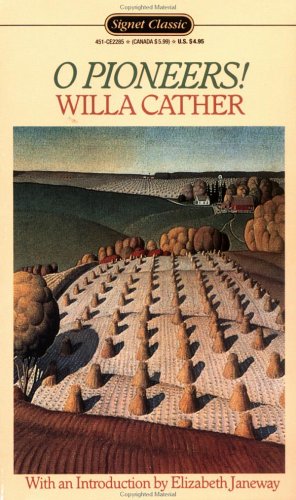
Hannover, Nebraska, is a frontier town on the brink of failing, a temporary camp upon a wild landscape that refuses to give up its bounty. A growing stream of families are selling their land at a loss and retreating back to civilization, there to eke out meager if predictable incomes as employees of someone else.  Alexandra Bergson has been urged to follow them: here she is, managing a homestead and a number of younger siblings on her own, virtually an orphan. For ten years her father labored here, and all he achieved was to pay off debt. But Alexandra loves the land she buried her father in,  senses that the winds will turn, and above all — believes in her father’s dream.  And so, she committs herself to it — managing her resentful brothers, eagerly seeking out new information and carefully experimenting,  Virtually everyone leaves her. In the decades to come she is the core of her family, the creator of its success, whose growing staff of immigrants dote on her.  Her aim in life  is to see to it that at least one of her younger siblings transcend the farm, to gain entry into the professional class by the fruits of her labor.   Young Emil does, and for a time all seems right with the world — but domestic bliss is denied to virtually everyone here. The ending, in which Alexandra seems to realize her vocation at the farm is fulfilled and is reunited with a cherished childhood friend, leaves one feeling slightly…unfulfilled.  It has an air of resignation, almost, but at least the writing and characters make the story worthwhile.

Frontispiece:  Grant Wood’s Fall Planting. Wood is best known for his American Gothic, though my favorite is Spring in Town.

Related:
Hannah Coulter, Wendell Berry

Posted in historical fiction, Reviews | Tagged , , , , , | 4 Comments

White Fang

White Fang
© 1906 Jack London
pp. 1- 101, Tales of the North.

“An’ right here I want to remark,’ Bill went on, ‘that that animal’s familiarity with camp-fires is suspicious an’ immoral.’
‘It knows for certain more’n a self-respectin’ wolf ought to know,’ Henry agreed

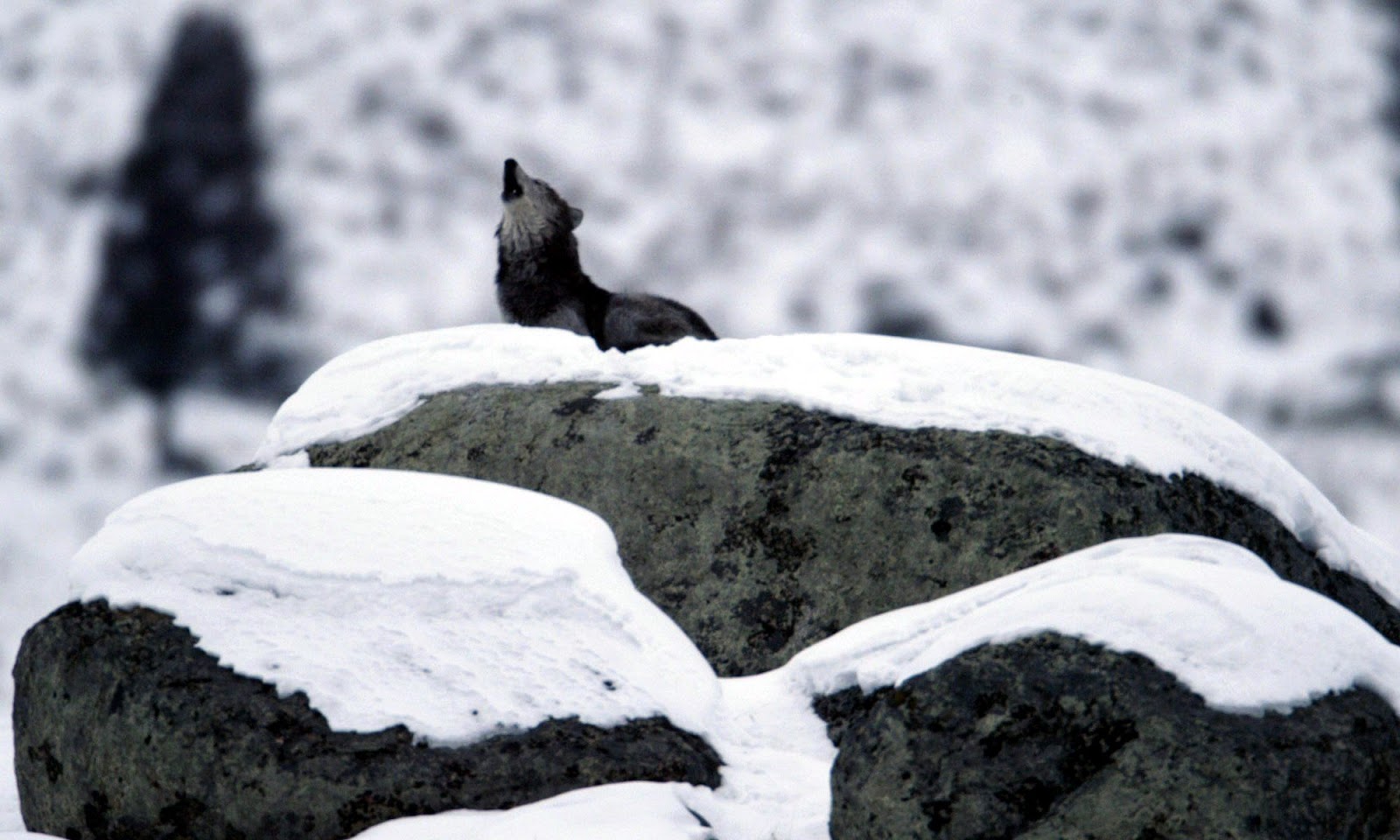
White Fang revisits  the theme of the Wild versus civilization from The Call of the Wild and reverses it.  Whereas in Call a soft California dog was thrown into the Alaskan wilderness and forced to call upon his instincts to survive, finding joy running with wolves after his master is killed,  in White Fang a dog/wolf hybrid is lured from the wild into the camps of man.  First published in Outing Magazine,  the story begins with two men being tracked by an eerie creature, a she-wolf who understands man. It is she who will give birth to a cub, and rear him in a wilderness of even-more dangerous predators like the Canadian lynx,  and it is her own youth spent in an Indian camp that will first introduce the cub to man.  Three-quarters wolf, there is virtually nothing of the dog in him, only a respect for Man’s strength and a willingness to submit to it in exchange for shelter and food.  Yet there is more to man’s relationship with wolves and dogs than sheer animal dominance.

 Here again London touches on Nietzsche’s superman myth, and again rejects it; just as  he did in The Sea Wolf and Martin Eden.   White Fang is shaped by fear, hunger, and rejection to be a creature mighty in strength, desperately cunning, and comfortable only in solitude. He knows one law: kill or be killed, eat or be eaten, intimidate or cower. Every memory of tenderness, either from his cub days or his early adoption by an Yukon native, is erased after he falls into the captivity of dog-fighters.  Yet he is not lost; just as Wolf Larsen was defeated by a man who combined wild strength with moral courage, so too is White Fang’s savagery tamed by persistent and intelligently guided affection,  care that teaches him other laws — care that reignite the what little of the dog exists within him.  Considering that The Call of the Wild was my first novel, and that every single thing I’ve read by Jack London has proven unforgettable, it’s hard to believe White Fang has taken me this long to read. It combines adventure with a narrative that speculates on how a dog might, in coming of age, grow to understand the world. The writing is winsome as usual, dramatic and – occasionally, unexpectedly – with flashes of laughter. (London has given me a most excellent insult — “If you don’t mind me saying, you’re seventeen kinds of damn fool, all of them different, and then some!”)

Related:
The Sea-Wolf, Jack London.

Posted in Reviews | Tagged , , , , , , , | 1 Comment

Desolation Laughing

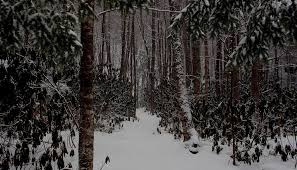
Dark spruce forest frowned on either side the frozen waterway. The trees had been stripped by a recent wind of their white covering of frost, and they seemed to lean toward each other, black and ominous, in the fading light. A vast silence reigned over the land. The land itself was a desolation, lifeless, without movement, so lone and cold that the spirit of it was not even that of sadness. 

 There was a hint  in it of laughter, but of a laughter more terrible than any sadness — a laughter that was mirthless as the smile of the sphinx, a laughter cold as the frost and partaking of the grimness of Infallibility. It was the masterful and incommunicable wisdom of eternity laughing at the futility of life and the effort of life. It was the Wild, the savage, frozen-hearted Northland Wild.

But there was life, abroad in the land and defiant.

White Fang, Jack London.

Posted in quotations, Reviews | Tagged , | Leave a comment