The Journey Home

The Journey Home: Some Words in Defense of the American West
© 1977 Edward Abbey
242 pages

The desert is no place for decent men, which is why Edward Abbey likes it so much. Born on the eastern seaboard,  on a farm between the cities and the woods,  young Abbey was seized by wanderlust and wandered westward. There he found mysterious monoliths, painted deserts, winding canyons penetrated only by the foolhardy, and interminable expanses of prickly plants and even pricklier critters.  Prickly might  well describe Abbey — or irascible, or cantankerous, or resentful, even indolent.  Most of those  terms are self-applied here as Abbey describes first his journey to the American west, his finding a home in Arizona, and his disgust at realizing that Industrial Civilization was following close on his heels.  They ruined the view with power lines, flooded canyons with dams, and filled the air with smoke — and so he writes, not to defend pretty views but to defend the very idea of wildness. Man  is wild, can’t be broken completely — and he needs undisturbed space to go crazy in every once in a while.

There are two reasons to read books by Edward Abbey; the first is for his descriptive writing, which wholly absorbed me when I first read Desert Solitaire years ago. The man is a grumpy poet writing prose; he describes the land like a lover, though he doesn’t use so intimate a language as say, the author of Song of Solomon.   Certainly he finds enough here to wax poetic about. Making cloudbanks marvelous in Desert Solitaire was child’s play; here  he even makes a poisonous tick sound intriguing.   The early book is biographical, but once he arrives at the mountains, they take over, for there are small ranges all over the southwest. The second is for Abbey’s personality, which is…colorful, to say the least, and a delight in small doses.  Rough-hewn is Abbey; there’s no machine-made box to slide him in. He is a passionate loather of big business and big government, but his contempt for the EPA lies in the fact that it isn’t doing enough to curb the industrialization of the west, that it sides with the power plants and oilers over the small ranchers and rambling eccentrics.  His passion borders on reckless. He writes that his motto regarding wilderness hikes is  “be prepared”, but that his practice is to go off half-cocked, daring Nature to do its worst. One story has him utterly destroying his fiance’s brand new gift-from-daddy convertible to transverse a washed-out road. That particular relationship didn’t survive the long hike back. In another account, he follows a mountain lion’s tracks and encounters the fearsome creature, poetry and power in one awe-inspiring package.

What Abbey fears most is the triumph of deary mediocrity. He can appreciate the city, as he does in here in a piece on Hoboken and Manhattan. It’s not a loving appreciation, but he does recognize that urban life has its consolations. But man is too wild a thing for the city, and the city itself can only be endured for long if there is some place to escape to. Abbey likens it to prisoners of Siberia, able to endure their brutal treatment by the sight of the beckoning expanse of forest; never mind that the forest has its own dangers,  it is there — unconquered, open, a warren of escape.   Abbey shudders to see Tuscon and Phoenix marching toward one another, soon to form one long contiguous blob of parking lots  and neon — and not just because their unchecked growth is draining water reserves or concentrating filth, but because it makes escape ever more difficult.  We crave adventure, Abbey writes, danger  — the wilderness offers it.  Abbey If we live in constant security and predictability, we’re effectively living the life of zoo animals.  We climb mountains for the same reason we fill the air with soaring music and vibrant poetry: our souls are restless and craving.  Craving what? Something to do, some meaning, some thrusting of ourselves into reality.

There is a lot to ponder in this slim little collection of essays and bar-room ramblings given life in paper.  Certainly, as far as ‘current’ crises go, the book is dated. I am certain many battles have been lost since the decades since Abbey first discovered the soul-stilling expanse of the west.  Given Abbey’s gruffness here, I would refer new readers to Desert Solitaire...but once a friendlier introduction is made then by all means return here to experience more of that beautiful description, that delightful cussedness, that adventurous what-the-hell-carpe-diem view Abbey took to life, its appeal aided by his thoughtfulness.

Posted in Reviews | Tagged , , , , , , , , | Leave a comment

Ten Novels Outside the United States

Today the Broke and the Bookish queries their readers: what are your favorite books set outside the United States?   For my list, I am purposely avoiding ‘classics’, and am casting my net wide as as not to simply present a list of ten books  by Bernard Cornwell. I am, however, focusing on historical fiction, and not just because my contemporary fiction consists of…er, novels by Michael Connolly and John Grisham.

1. The Blood of Flowers, Anita Amirrezvani. Blood of Flowers gives life to an anonymous artisan of Persian rugs, a young woman who is a master of intricate design. The novel is set in 17th century Persia, near Isfahan, and was the first bit of historical fiction I read outside of Civil War novels.  What really stood out about Amirrezvani’s writing for me was her use of Persian folk stories — this joining together of story and oral history also appeared in her Equal of the Sun.

2. A Far Better Rest, Susan Alleyn.  A Tale of Two Cities told through the eyes of Sidney Carton, set largely in France.

3. December 6th, Martin Cruz. The story of an American who grew up in Tokyo,  and is torn between his two countries as Japan stirs restlessly, drawing Anglo-American ire for advancing into China and threatening their own territories in the South Pacific.

4. A Conspiracy of Paper / The Coffee Trader, David Liss

David Liss has  discovered a niche in the historic business-mystery thriller, with novels set in Age of Discovery-era England and Holland, and featuring those countries’ Jewish communities heavily.  Liss is an aesthetic-conscious writer, using elegant fonts and attempting to invoke the flavor of 17th century conversation in his narrative.

5. The Revolutionist, Robert Littell

A disgruntled son of Russian immigrants returns to his parents’ home when it collapses in revolution. All afire with purpose, Alexander Til becomes a propagandist for the Communists, living in a communal home with some fellow travelers. Virtually all of them become disheartened by the men who emerge from the revolution, by the quick establishment of a new elite; one monster simply breeds another.  Very much the thriller, philosophically interesting, haunting at times, but also funny:

Before the evening was out she had seduced him into seducing her, a conquest that the young Tuohy lived to regret when he discovered, at roughly the same time as the dean, that his latest mistress was the dean’s youngest daughter. Which is how Tuohy, despite his passing grades, came to be expelled from the Columbia University School of Mines.

6. The Lords of the North, Bernard Cornwell.   I’ve been trying to restrain myself in regards to Cornwell. Once he appears on the list he’ll take over it — but The Lords of the North  is possibly my favorite of the Saxon Stories series. The main character, Uhtred, is a Saxon prince turned Danish warlord, adopted by them in his youth. His loyalties are neither to the Danes nor to England, but to his friends — and with good reason, for here he is betrayed by ‘lords’ and abandoned to slavery.  Lords  is the most fatefully dark moment for Uhtred of Bebbanberg, but it is there he is most appealing.

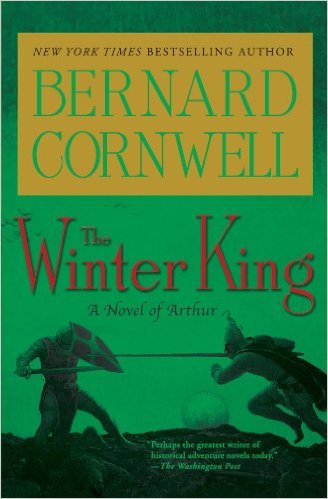
Also by Cornwell: ANYTHING! ..but I also considered including his King Arthur trilogy here, beginning with The Winter King.  The second novel is set near the Celtic holiday of Samhain, and is creepy in the best horror-movie sense.

7. Pompeii, Robert Harris.  In truth, Harris’ Cicero trilogy is more impressive from a creative point of view, as Harris was able to work in Cicero’s courtroom oratory and his philosophic writing into the account of that defender of the Republic’s life. Pompeii, however, has explosions, and towns being buried under ashflows.

8. Roma, Steven Saylor. I was hard-pressed to pick one of the Gordianus books — which one could take precedence over the other?  So let’s bypass our Roman detective altogether for this massive novel,  telling the story of Rome from its beginnings as a meeting ground for salt-traders until the rise of Augustus.

9. The Kite Runner, Khaled Hosseini.   The story of a timid boy who betrays his best friend through cowardice, who later returns to an Afghanistan caught in the grips of the Taliban to redeem himself. It is beautiful, but disturbing. One line in the book — “For you, a thousand times over!” — still carries me away.

10. Here be Dragons, Sharon Kay Penfield. The daughter of King John, married to a Welsh prince to keep the peace…..what can go wrong?  There’s a lot of historical exposition in here for a novel, which — having been a history major, — I didn’t mind, but it’s worth it for the way Penfield handles King John.  You know he’s awful, but he’s the main character’s daddy-dear, so it is possible to look on him with long-developed but now-fading affection.

Honorable mentions:

  • The Mao Case, a detective-mystery with political implications set in China;  
  • Kokoro, a coming of age piece set in  late-Meiji Japan
  • Gates of Fire, a novel of Thermopylae 
  • and
  • Belt of Gold, Ceclia Holland, a rare piece of Byzantine fiction. 
Posted in historical fiction | Tagged , , | 5 Comments

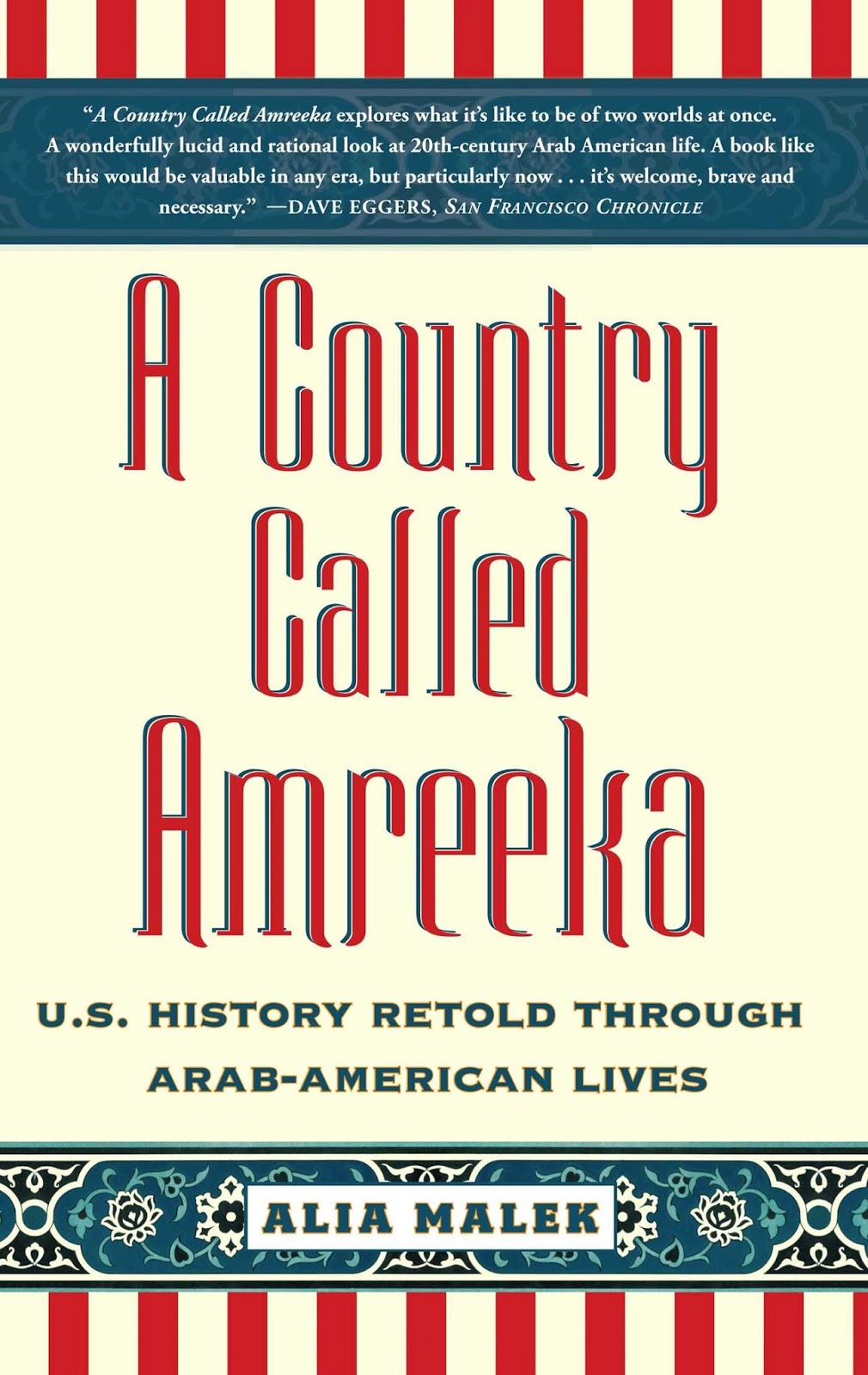
A Country Called Amreeka

A Country Called Amreeka: U.S. History Retold through Arab-American Lives
Alternate subtitle: Arab Roots, American Stories
© 2009 Alia Malek
320 pages

I discovered  A Country Called Amreeka while looking for the film Amreeka, the story of a Palestinian woman who emigrates to the United States with her son Fadi.  (Trailer) Ms. Malek’s book is a history of thousands of men and women who have made the same journey, escaping civil war and poverty by journeying to America.  Ms. Malek does not endeavor to give a survey of Arab immigration to the United States spanning a century, as the title hints she may; instead, she uses the personal stories of various families to visit  20th century American history through their eyes.  The book begins with American factories soliciting immigration from Europe, and unexpectedly receiving it from Greece, Syria, and other areas around the Med’s eastern rim.  Although these first Arabs would draw the wrath of nativists like the Klan for both their appearances and their faith (the Syrians were predominately Catholics),  these first immigrants largely sought assimilation within the American melting pot.  Later and larger waves coincided with the civil rights movement within the United States, and total assimilation was resisted.  America’s foreign policy in the same period gave Arab-Americans from diverse countries a cause to unite around, chiefly opposing the United States government’s unqualified support of Israel.

The collection of stories here has quite a few  strengths; the heavy use of Christian Arabs, which runs against American media stereotypes;   a few interesting tales like an Arab-American soldier in the Iraq war, or the two women who fought fiercely for opposite sides in the Bush-Gore presidential battle. (Set as it was before 2003, how strange now to think of Bush being courted by Arab-American civil associations..)  The book suffers from an over-emphasis on politics,   with more ink devoted to Palestine than the Arab-American immigrant experience.  Considering that the author is a civil rights attorney who once worked in the West Bank, the focus isn’t surprising. Still, more interesting information filters through this repetition: in Michigan, for instance, Arab auto workers went on strike against their union after it began buying Israeli bonds with dues money.  While a book like this is presumably useful to hypothetical Americans who think everyone in the middle east gets around on a camel,  what it mostly amounts to is accounts of Arabs experiencing racism during events like the hostage crisis and the post 9/11 period, and then fighting for Palestine through political activism.  While these are aspects that deserve thought, there is far more to life — and to the immigrant experience — than mere politics.

Posted in Reviews | Tagged , , | Leave a comment

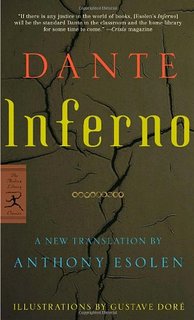
Inferno

Inferno
created 14th century Dante Alighieri
translated © 2002 Anthony Esolen
528 pages

If Dante’s Inferno is to be believed, Hell is mostly populated by Italians.  The first piece in the Divine Comedy, Inferno takes the reader down into the depths of the infernal abyss,  through ring after ring of the damned. Fire is the exception, not the rule down here;  Hell is a vast geography of misery.  The ground is rocky and steep, the air filled with cold and lashing rain, or noxious fumes.  The reader, taking Dante’s place as he wanders off the straight roads of life into the wilderness, is guided through Hell in safety by Virgil — the greatest of all classical poets.

 Inferno contains two things in abundance:  classical allusions and Italian politics.  The world of the Inferno is peopled by characters, beasts, and places that draw on the rich vocabulary of the classical tradition. We see here not only the ‘virtuous pagans’ hanging around a medieval version of the Asphodel Plains, denied entry into paradise but not damned either, but more than a few heroes of the canon. Odysseus is here, condemned as a liar — and so is Brutus, a traitor in the gnawing maw of an angry devil.  My original intent was to read the Inferno as part of a series of medieval history and medieval literature — and considering the amount of Florentine politics here, that may have been helpful. Dante can’t so much as move without tripping over a corrupt pope, an exposed friend, or some hapless Florentine giving a  dire warning about impending civil war. (And I do mean tripping — people are stuck into the ground head first, or trapped in a frozen river with only their heads exposed..) The ranks of the traitors are especially Italian-rich. A little familiarity with medieval cosmology helps in understanding the text — the idea that the universe is a series of spheres, each level nesting inside the other.  Dante also displays an intriguing imagination, creating poetic punishments. (Schismatics who create division within the church or society are themselves divided with an axe to the head.) At the bottom of the pit is a frozen wasteland, with the greatest of traitors entrapped by darkness and ice. The artic winds that create the ice are created by Satan’s wings, constantly beating in his eternal attempt to rise.

When the year’s young in season, 
and the spray washes the sun beams in Aquarius
and the nights dwindle south toward half a day
When the frost  paints a copy on the ground
of her white sister’s snowy image, but
Her feather’s sharpness doesn’t last for long […]   (Canto 24)

 Esolen errs on the side of accuracy rather than rhyme with his translation,  but he does achieve a certain lyric quality and uses footnotes judiciously, creating a text neither confusing nor cluttered. Esolen’s appendices are unusually rich, containing textually similar lines from The Aenid, text from the non-canonical “Vision of St. Paul”, which describes different  degrees of punishments for sinners, and theological writings from Aquinas and Boniface that would have informed Dante’s view.  More extensive notes follow the end of Canto XXXIV, but of course that’s not the end of the story — it continues on the mount of Purgatory.

Posted in Classics and Literary, Reviews | Tagged , , , , , , , , | 8 Comments

Crescent and Star

Crescent and Star: Turkey Between Two Worlds
© 2001 Stephen Kinzer
288 pages

Turkey is an anomaly. For centuries, it was the dreaded foe of Christendom, twice pushing at the very gates of Vienna. After the Great War, when the victorious west disassembled the Ottoman Empire and reduced the Turks to mere Antaolia, it seemed a total defeat — but shortly thereafter, a rare Turkish hero of the Great War led a revolution and established a new Turkish Republic, one that — phoenix like — drove away its exhausted enemies and even reclaimed a foothold into Europe. It was to Europe that the new  lord looked: not as an object of conquest, but an object of emulation. Like Peter the Great,  Mustafa Kemal would make his life’s ambition to modernize and westernize the Turks  whether they wanted it or not.  Using the military to carry forth his will, he declared war on the past: out with fezzes and  zithers, in with fedoras and Bach!  While the other mideastern countries that emerged from the Ottoman disintegration  drifted into tyranny — religious in Afghanistan, secular in Iraq, both in Iran —  Turkey remained anomalous, discretely controlled by a military that had enforced liberalization, and counted itself the enemy of Taliban-style religious rule, but itself imposed limits on democracy and speech.  But the forced liberalization of Turkey at the hands of an illiberal power, the military state, has long since showed its age. Turks today want more from their ‘devlet’, their state, than being patronized; they want genuine democracy, genuine freedom to talk about issues the military order would rather have stay buried.

Crescent and Star  is the product of one man falling in love with Turkey while living there for years for the New York Times;  It combines vignettes about life in Turkey with historical-political reporting, both heavily steeped in obvious affection for Turkey as a whole.  It us romantic and at times naive — Kinzer bubbles that  Turkey could be a world power and admits that portraits of Kemal hang in his office, as they do around Turkey —  but to the total outsider like myself, informative.  Kinzer’s passion for Kemalism is never hidden: he wants Turkey to become not merely a member of the European Union, but a genuine European power. Again and again he asserts the cultural bonds that link Turkey and eastern Europe. Greece and Turkey are divided by political bickering over Aegean islands more than anything else, and towards the end he presents a heartwarming account of trans-Aegean brotherhood in the wake of a series of earthquakes. As one earthquake near Istanbul shattered belief in the devlet’s competency and humanitarian interests, it also shattered belief in malevolent Greeks:  the Greeks were first to come with aide, and when Greece had its own earthquake days later, the Turks responded to that charity in kind — charity in the truest sense of the word, caritas, love in action.  For Turkey to fulfill its destiny, Kinzer writes, the military must acknowledge that its paternalism has kept Turkish domestic politics immature.  Its protective intervention in the past, removing incompetent officials whose blundering were pushing the country toward civil war,  have served their purpose: for Turks to become truly European,  they must be set free to create their own destinies.

Crescent and Star brims over with human interest,  created by personal research. Kinzer lived in Turkey for at least four years during his tenure as bureau chief for the New York Times, and he cultivated a variety of friendships, even hosting a blues radio show in Istanbul.  He interviewed Turks and Kurds extensively, and his obvious love for Turkey is not in the least dampened by the stories of Armenians and Kurds who have suffered at the hand of the state.  The Turks have his affection, not  the Turkish government.  While the book’s optimism — stemming from a quiet Kurdish front and ongoing negotiations with the EU — now dates it,  given how the chaos in Iraq and Syria has turned Turkey’s borders into a war zone,  Kinzer’s account nontheless illustrates how Turkey’s history has given it a pecuilar stamp, a place able to bridge Europe and the middle east not only geographically.  Turkey’s close involvement with the Syrian war, its frequent brushes with the Russians and Irans, make it a country worth knowing about. Considering that a faction within the military attempted to assert itself politically once again, there’s no denying this kind of book’s relevance.

Posted in history, Reviews | Tagged , , , | 2 Comments

TBR: And Then There was One

Dear readers,  we approach the end for the To be Read Takedown Challenge!

Richard Francis’ Domesticated: Evolution in a Man-Made World proved disappointing, not because of the quality of content but the focus thereof.  Although Domesticated sells itself as a work on animal domestication, and does provide natural histories of various animals like pets, horses, camels, pigs, and rodents, a section on human evolution consumes a fourth of the book, and there’s not a non-mammal species to  be found.  Why devote sections to guinea pigs and creatures that aren’t actually domesticated (raccoons) and ignore the 2nd most common foodsource on the planet, the chicken?  The answer lies in Francis seeing humanity as domesticated, too, albeit self-domesticated, and he uses the examples of species like the raccoon to argue that we selected ‘tame’ traits in ourselves, like prosociality.  He mixes the science with entertaining personal accounts, like his misfortunes attempting to ride a camel, and similarly clumsy but appreciated attempts to mix in some cultural history.

If you’ve been playing at home, you’ll know the official TBR list is now down to one item: Trucking Country: the Road to America’s Wal-Mart Economy. There’s a bonus round of sorts consisting of the books I didn’t add to the list at the start, in part to preserve some mystery and in part so it wouldn’t look so daunting.  The bonus round has a mix of law, history, religion, and tech.  The only heavyweight is Trucking Country.  There are some reviews pending.

Taken down!

Liberty, Defined, Ron Paul
Big Box Swindle, Stacy Mitchell
Saving Congress from Itself, James Buckley
Cyber War: The Next Threat to National Security, Richard Clarke
When Asia Was the World, Stewart  Gordon
Tubes: A Journey to the Center of the Internet,  Andrew Blum
The Orthodox Church, Kallistos (Timothy) Ware
Green, Blue, and Grey: The Irish in the American Civil War, Cal McCarthy
Don’t Hurt People and Don’t Take Their Stuff, Matt Kibbe
The Great Debate: Edmund Burke, Thomas Paine and the Birth of Right and Left, Yural Levin.
Freedom and Virtue, ed. George Carey
 The Obstacle is the Way, Ryan Holiday.
Literary Converts, Joseph Pearce
Domesticated: Evolution in a Man-Made World,  Richard Francis
10% Human, Alanna Collen.

Coming Attractions
Trucking Country: The Road to America’s Wal-Mart Economy, Shane Hamilton.

Posted in science | Tagged , , , , , | 2 Comments

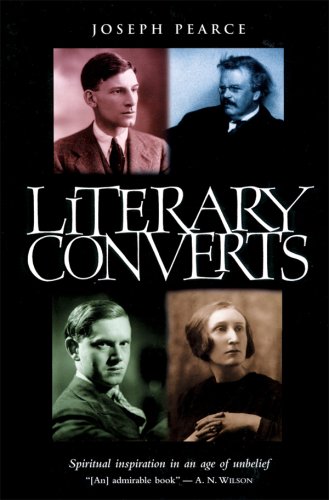
Literary Converts

Literary Converts: Spiritual Inspiration in an Age of Unbelief
© 2000 Joseph Pearce
452 pages


Literary Converts is a historical survey of the ‘second spring’ of Anglo-Catholic literature and all that followed, covering most of the twentieth century.  Its author would call it a history of grace acting through literature, and Joseph knows about the power of literature; his own soul was rescued through it. In his youth he was the publisher of Bulldog, a vicious racial newspaper in the U.K, but while exploring economic debate he encountered Chesterton, and through Chesterton the redemptive power of the Christian faith.   In Literary Converts, he takes on nearly a century of English literary society, focusing on a group of authors  whose paths brought them closer to Rome, even as the rest of society became more secular. While the 32 sections appear to be miniature biographies, they are in fact intertwined; Pearce tells here the story of a multi-generational community, one decade’s converts inspiring the next through literature and personal conversation.  There are many familiar names here, the greatest being G.K. Chesterton, but some have passed into obscurity.  Many caused scandals when they converted, either because of their social status (R.H. Benson, the son of an Anglican archbishop), or because of their long-respected stature as libertines, like Evelyn Waugh.   What did they see in tradition and the Catholic church, amid increasing material prosperity?

 In an age of dehumanizing work and political machines, of eugenics and social ‘darwinism’*,  they saw an institution which insisted on the dignity of the human person, regardless of the ideology of the hour; when populations were being shifted from the fields to the cities, when everything seemed chaotic and new, they saw stability in a  tradition that had weathered the storms of centuries and would, most likely, stand fast through these,As  monstrous factories belched smoke, armed mobs brawled in the streets, and ugliness was enthroned,  they saw in the west’s tradition a preserve of beauty, truth, and love. The work produced by these authors — a lifetime’s worth of reading —  wasn’t mere spiritual dabbling. Chesterton and Belloc, for interest, provided works of political economy in The Servile State, What’s Wrong with the World, and An Outline of Sanity;  T.S. Eliot created The Waste Land, and Christopher Dawson contributed insightful history. Even if they did not join the Catholic church, as was the case with C.S. Lewis and T.S. Eliot, they still drew very near it, and did so through literary engagement – and often through engagement with one another. To read this book is to eavesdrop on a great conversation, a century of  passionate and introspective men and women grappling with the fundamental question of meaning.     

While Pearce is an accessible writer, this is a book of density, and may fall on the obscure side for those who aren’t passionate about — even smitten by — literature.  I only heard of it while listening to Pearce  lecture on the ‘English spring’ following the Romantic period in literature. 

Related:
Surprised by Joy, C.S. Lewis
The Fellowship: the Literary Lives of the Inklings, Phillip Zaleski
The Third Spring: G.K. Chesterton, Graham Greene, Christopher Dawson, and Davis Jones; Adam Schwartz


* With apologies to Charles Darwin, since that pernicious social policy owes its name to Herbert Spencer. 
Posted in Reviews | Tagged , , , , , , , , , | 1 Comment

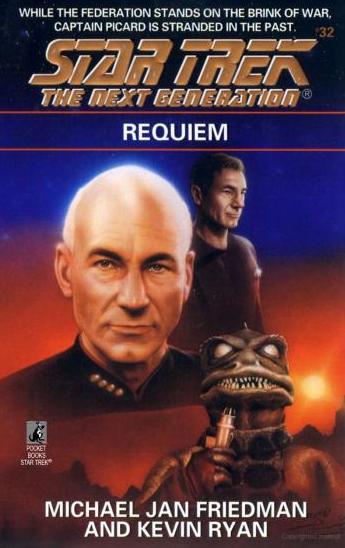
Requiem

ST TNG #32: Requiem
© 1994 Michael Jan Friedman,  Kevin Ryan
277 pages

dun-dun DA DA DA DA DA DA dun-dun DA da!

One hundred years ago, James Kirk of the USS Enterprise arrived at Cestus III to find a Federation colony in flames,  virtually all of its residents destroyed by mysterious attackers.  Kirk soon found himself in direct physical conflict with the attackers, a race of dinosaur-like creatures called the Gorn.    Kirk was able to find a way to conclude the Cestus affair without further bloodshed, and diplomatic overtures followed many decades later. Now, as the Federation and the Gorn try to keep the peace, the Federation’s most experienced negotiator is lost — lost on Cestus III.

Although Requiem begins with a flashback, Picard isn’t lost in the memory of Gorn training scenarios, the historical record, or even his own experience with the Gorn as captain of the Stargazer. He is literally marooned in time, thrown to Cestus III four days before the deadly attack by a mysterious alien artifact in space. (When will Starfleet learn that mysterious artficats floating in space never lead to GOOD things?)    Picard is atonished by the coincidence: on the verge of restoring Federation-Gorn relations, he’s been thrown to their beginning? He’s also riven in conflict: while he knows he can’t fight history, can’t warn the colonists, their experimental power station is on the verge of destroying them in way. Worse yet, having been rescued by the colonists after he was transported through space and time into the middle of a landslide, he has a growing personal attachment to the colonists — and while he’s having moral crises and trying to pass himself off as Dixon Hill,  Merchant Captain and Totally Not a Spy,  Riker is being badgered by Starfleet to produce Picard and get to Gorn, pronto.

I thoroughly enjoyed Requiem, though Friedman and Ryan never explain why it is the Mysterious Alien Artifact threw Picard to, of all places, Cestus III on the eve of the Gorn attack.  Since we have seen other artifacts that can transport users to variety of places in time and space (the Guardian of Forever, for instance), perhaps this is another one — one that is guided by the ‘user’s’ thoughts. Perhaps when Picard activated the time-transport, his thoughts were on Cestus III — hardly surprising given the impending negotiations.   “Arena” is one of my favorite TOS episodes, and so this look at the colony before its destruction succeeds for me. The ‘b’ plot also features Ro Laren being appointed acting first officer, and the book ends with Kirk and company arriving and “Arena” beginning.

It’s got the Stargazer, Kirk, Ro Laren, and the Enterprise-D. What more do you want?

Posted in Reviews | Tagged , , , | 2 Comments

10% Human

10% Human: How Your Body’s Microbes Hold the Key to Health and Happiness
© 2015 Alanna Collen
336 pages

Walt Whitman wasn’t thinking of bacteria when he mused — “I am large, I contain multitudes” — but Alanna Collen could have gotten away with quoting him. She opens her book with the bombshell that ninenty percent of the ‘cells’ in our bodies are actually independent mcirobes, living their own little lives, and devotes the rest of it to exploring what effect that has on our health.  We are less discrete, self-contained individuals, and closer to mobile ecosystems,  in which microbes are an integral part and not just germy villains.  Microbes are not only essential parts of the human body — slimy oil that keeps the body’s engine running smoothly,  aiding in digestion and manufacturing essential elements like Vitamin B12. In some cases, like our own cells’ mitochrondia, we’ve even adopted microbes into the family.  But there’s more to the story of microbes and health, and Collen credits our overzealous germaphobia with many modern diseases.

Semmelweis did humanity and medicine a great favor when he realized the cause of childbed sickness was sloppy sanitation, but we may have taken his prescription too far in treating all microbes as ‘germs’ to be eradicated.  As mentioned, many are necessary to our bodily functions: babies receive helpful bacteria with their mothers’ very milk.   Animal testing has indicated that bacterial species can have intense effects on their host: mice have changed personalities when their respective strains were switched, becoming more outgoing or more reserved; similar effects were observed in populations of lean and chubby mice.  That last is especially of note to an increasingly overweight global population, but there are no easy answers. (While some microbe species allow for the uber-efficient metabolization of food, stealthily increasing our caloric  intake, others produce byproducts that put fat cells on overdrive.)  The fact that our bodies contain many different types of bacteria is important, because they compete with one another. When we disrupt the balance of power with erratic courses of antibiotics, or abruptly and dramatically alter our diets,  nasty strains can dominate to our detriment. Collen attributes a number of ‘western’ or modern diseases to microbial havocincluding allergies and autism.  The section on autism has fantastic human interest: after one four-year old boy suddenly developed it after an ear inefection, his mother devoted herself to research, research the boy’s sister continued decades lafter when she grew up and went to grad school.

10% Human is one of the more engaging pieces of biology writing I’ve ever read, and immensely importance from a personal and public health perspective.  Collen’s’ writing is very personable, never intimidating. She even sneaks in the tiniest bit of toilet humor when she refers to ‘transpoosion’, or transferring one person’s fecal bacteria to another person’s intestines to rebuild a ravaged microbial pool. (The  body has a bacterial backup in the appendix, but sometimes reinforcements are necessary.)  It should be obvious after a half-century of mass dieting and treadmill running than the simplistic calories in vs calories consumed model isn’t adequate for explaining our weight woes, and here I suspect Collen will find a lot of appeal for people.  For me,  10% Human reminds me yet again of how we are not static creatures, built of DNA legos, but dynamic creatures — constantly being remade, not only by our experience, but by the guests in our innards.

Related:

Posted in Reviews, science | Tagged , , , | 8 Comments

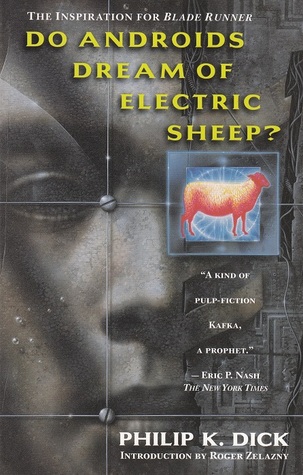
Do Androids Dream of Electric Sheep?

Do Androids Dream of Electric Sheep?
© 1968 Phillip K. Dick
210 pages

In a world ruined by nuclear war, most animals are extinct and most humans who can have fled for the cold, distant colonies of Mars.  Technical civilization has survived, creating artificial pets for people to cherish.  It has also created lifelike androids for people to fear– such constructs are barred from Earth, but still prefer operating on a planet where nuclear fallout is included in weather reports to barren wastelands like Mars.  Androids who escape the colonies to return to Earth are the business of ‘bounty hunters’ like Rick Deckard, who hunt them down and ‘retire’ them —  permanently.   In Do Androids Dream of Electric Sheep?, Deckard takes on the challenge of finding six recent escapees, androids  that so perfectly replicate humans that the conventional diagnostics might not even detect them. The case will, for him, blur the lines between living and dead, between reality and fiction.  It is a thriller which, halfway through, features three characters sitting in a room with trained guns on another,  two convinced of fiction and one knowing the truth. The one isn’t Deckard, nor is it the reader, and the sudden plot turn succeeds magnificently.  The world of Dick’s imagination is fairly dismal: empty buildings, sparsely populated by lonely people who get their emotional life from plugging into a ‘mood organ’ that manipulates their brains. This is part of a new religion, Mercerism, which features heavily in the confusing ending, one in which the reader is left wondering what was real and what wasn’t.   This was a definite success as a thriller, though one that left me missing the safe optimism of Asimov’s robots.

Related:
Asimov’s Robots books, including the slightly more grim books not written by him.

Posted in Reviews, science fiction | Tagged , , , | 6 Comments