Playing to the Edge

Playing to the Edge: American Intelligence in the Age of Terror
© Michael Hayden 2016
464 pages

As someone who became a civil libertarian in response to the increasingly sweeping powers of the surveillance state during the Bush administration, I began reading this as a hostile audience, more or less. I was chiefly interested in the chapter on cybersecurity, although he says very little about it. The book is part memoir-biography, part defense of the privileged powers given to the United States’ intelligence-security programs. While I am still not nor never will be comfortable with the amount of information being collected by these agencies, even if they are staffed by the heroic characters who populate this book under Hayden’s pen, recent books on cyber war have made me realize that that agencies like these have actual national-security priorities, with a focus on malevolent organizations outside the U.S.

Hayden is very good at making the enormous amount of data-collecting sound completely mundane, even benign, and is very cagey with details when a plant is bombed or infrastructure sabotaged via computer viruses. Sometimes interesting and sometimes plodding are his comments on CIA-NSA organization, and the organization of the intelligence community (sixteen agencies, including the intelligence depts of other organizations). There’s the usual attraction in a political memoir in that formidable media personalities are suddenly reduced to ordinary people: Secretary of State Condeleeza Rice becomes “Condie”, the attorney general is “Al”, Hayden himself is “Mikey”…it’s a little touch of intimacy that a vast bureaucracy, far-removed from the concerns of the people as a whole, is usually without. All that said, I still like having Greewalds and Snowdens to keep the government on its toes.

Posted in Politics and Civic Interest, Reviews | Tagged , , , , , | Leave a comment

Rising Sun

Rising Sun
385 pages
© 1992 Michael Crichton

In downtown Los Angeles, in a gleaming tower of Japanese commercial success, a woman lies dead on a boardroom table.  The  grand opening of the Nakamoto Corporation’s downtown skyscraper attracted celebrities and politicians alike, all anxious to impress the Japanese businessmen who play such an important part in the U.S. economy. It was supposed to be a festive occasion, but instead it’s turned into a source of anxiety and dread:  this murder-in-the-office stuff is very bad for publicity. It turns out to be a major source of trouble for the police assigned to investigate, too, because to Nakamoto, business is war…and if trouble-making cops can’t be bribed, they can be ‘removed’.

Rising Sun combines a police procedural with a business thriller, and ends with an ominous note from Crichton that the Japanese are taking over the American economy and we’d better do something.  Published just as the Japanese were drifting into their ‘lost decade’, that warning now makes it seem slightly dated. Despite this, the technological aspect gives the book a solid sci-fi edge;  though set in the 1990s, we see wireless cameras, facial-recognition software,  and image manipulation so intensive that the courts no longer permit imagery as evidence.  Here we have forensic technology long before CSI made it popular,  but most of the character-lecturing is done in regards to Japanese culture, history, and business practices.  I know next to nothing about Japanese economic history, so I don’t know when Crichton leaves history  behind for alt-history here. His 1990s-America is virtually a Japanese economic colony, with only its university system keeping it from being an utter subordinate. So awed by the Japanese are these Americans that Japanese lingo has crept into common usage among the political and business elite, and their power is such that LA cops have a time getting the Nakamoto Corp’s officers to let them investigate.  I was a little suspicious of Crichton’s economic doomsaying; if the Japanese were ‘dumping’ under-priced goods onto the American market, why couldn’t those goods be purchased by American companies and sold as their own?    Crichton’s fear is not quite as irrelevant as it seems, because today we hear the same fears about China. right down to the concern that their ownership of so much  American debt is a national security problem.  Awareness that there must be a line between national security and profitable participation in the global economy has become an issue in the presidential debate this year as well.

Despite being dated in some ways, Rising Sun made for a very interesting read, both as a technologically-savvy police novel ahead of the curve, and as an alt-history piece which features Japanese characters and culture heavily.

Posted in Reviews, science fiction | Tagged , , , , , , | 6 Comments

Airframe

Airframe
© 1995 Michael Crichton
352 pages

What could happen on a plane to leave three people dead, fifty others seriously wounded, and the passenger cabin in ruins?   Why did its pilot only break radio silence shortly before he was due to land in Los Angeles? Thus begins Airframe, a technical mystery from the pen of Michael Crichton, in which one woman  has to scramble to find answers before either her company’s life-saving contract with China falls through or before a union upset ripens into war on the plant floor.   This is the first book I’ve read by Crichton which is not science fiction, although it’s still very much the technical thriller, with a nerd-thrilling abundance of information on aviation and the aeronautics business.   It’s not merely dumped on the reader, but introduced through characters who stand in for the reader and need to have all of the tech-speak around them translated. Airframe isn’t purely technical, as Crichton also develops a business conspiracy angle to make the reader wonder if the accident wasn’t one at all. There’s also a little bit of author-lecture, as Crichton delivers a rolling barrage at television ‘news’, condemned as vapid and sensationalistic. None of the characters are particularly compelling, but in a Crichton novel they rarely are.  It is the pursuit of the mystery, simultaneously learning a great deal about an important aspect of global ‘civilization’, that drives this one. I enjoyed it enormously.

Posted in Reviews | Tagged , , , | 4 Comments

The Director

The Director
© 2014 David Ignatius
384 pages

The first week at a new job is rough for anyone, but what if you’re the new director of the CIA and a German kid off the street just informed you that every agent in Europe is exposed?  Such is the promising hook of The Director, a novel  involving  conspiracies within conspiracies, told through meeting after meeting. The news that the CIA’s internal networks are compromised grows more ominous after the German is found with a Russian bullet in his head, but for most of the work the ‘action’ consists of the Director’s agent flitting from town to town,  reading up on his Globalist British Banking Conspiracy literature and  recruiting a cyber League of Shadows to take down said conspiracy. Everyone else sips mineral water and talks. And talks….and talks…and….talks.  The director also occasionally receives ominous quotations from Cicero.

I found The Director to be utterly tedious, as most of the book consists of people who enjoy hearing themselves talk spinning riddles around the increasingly frustrated director. (He’s not so much an actor as a coordinator, bringing the plot together in his office.)  There are some positive points, however.  Some bits of description leap out; “the cowl of a foreign accent shrouded his voice”. The author, a D.C. journalist, offers an interesting flavor to the hacking conspiracy; early on,  people are recruited into it using references to the Illuminitas trilogy. The author claims this is a cult classic among hackers, and while I can’t vouch for that, this playing-with geek culture is definitely different from the ordinary international thriller. The problem is that all the conversation of this book isn’t all that thrilling. Some of it borders on pompous, as though the characters were straining to be dramatic. I just imagined and pictured them as Hollywood personalities to make it tolerable (and amusing).  There were very few people in this novel I enjoyed reading about — and I certainly had no interest in following them to the supermarket to consider competing brands of Greek yogurt, or to Berlin’s sex-clubbing scene.

Interesting in spots, obscene in others, but on the whole rather dull.

Related:
Trojan Horse, Mark Russinovich.  Also a cyberthriller, but buckets more fun.

Posted in Reviews | Tagged , , | Leave a comment

Devil in the Sky

ST DS9: Devil in the Sky
© 1995 Greg Cox and John Gregory Betancourt
280 pages

In the classic TOS episode, “Devil in the Dark”,  Kirk and the Enterprise were dispatched to a mining colony to discover and put an end to the monster that had been killing the colonists. The ‘monster’ turned out to be a silicon being, a Horta, who was waging a war of self-defense against colonists unwittingly destroying her eggs.   Now a Federation outpost is again imperiled by the Horta, after a mother Horta is kidnapped and her eggs arrive on a freighter to Deep Space Nine as hungry orphans. The Horta had been invited to Bajor to jump-start a dormant mining industry, but she was kidnapped by Cardassians enroute. As Kira, Dax, Bashir are dispatched on a rescue mission into Cardassian territory,  Sisko and the others labor to keep the hungry rock-slugs from literally eating them out of house and home.

The only high point here, really, is Kira and Bashir’s maturing ‘friendship’. Bashir begins as a caricture of himself. His youthful arrogance and total confidence in himself are taken up to eleven, and made all the more obnoxious by Bashir swaggering around like a lady-killer.  Kira, with an established disdain for Bashir’s patronizing view of Bajor, only likes him slightly more than the Cardassians.  Forced to work together to free the Horta from a death camp filled with Bajorans, however,  Bashir matures and Kira starts to find him tolerable. It’s the Bashir-Kira version of that Bashir-O’Brien episode: evidently the key to liking the doctor is facing death with him.

The rest is fairly average: Odo is grumpy and doesn’t like Quark, Quark is scheming, Jake and Nog get into trouble, that sort of thing. There’s at least one nice call back to the original episode, in which the Mother Horta is forced to communicate by writing letters in acid on the floor — not “NO KILL I”, but “FOLLOW ME”.  Sisko takes entirely too long to remember that Bajor has  deserted moons that he can stick the Horta babies on without angering the Bajoran government who have suddenly decided that nope, Horta have no place in Bajor’s delicate ecosystem.

If the first one hundred pages — of Bashir being utterly obnoxious, far more so than he was in the show — can be survived, it’s an enjoyable enough action tale.

Posted in Reviews | Tagged , , , | 2 Comments

Glass Houses

Glass Houses: Privacy, Secrecy, and Cyber Insecurity in a Transparent World
© 2011, 2013 Joel Brenner
320 pages

Glass Houses, originally titled  America the Vulnerable, outlines some of the major ways that private citizens, corporations, and the government itself are exposed to attack through digital measures, and closes with measures to strengthen defenses. While not as sweeping as Future Crimes,  Brenner offers a different kind of insider perspective — the NSA’s.  Brenner was formally the head of counterintelligence, and thus his work primarily concerns itself with national security.  He argues that an ordinary citizen’s desire for privacy, and the government’s own need for secrecy, are essentially the same. (And what about a citizen’s desire for privacy from the NSA?)

*chirp*

Brenner isn’t nearly as fear-inducing as writers like Marc Goodman,  but his piece stands out because of his role within the government. While arguing for better data hygiene, he also criticizes the still-disjointed approach of D.C. to cybersecurity.  There are several ‘cyber’ organizations within the aegis of the government, but all of them have completely different priorities, and none of them truly cover civilian infrastructure that the government relies on. One of the early points Brenner makes is that not only is everyone utterly exposed  to digital threats —  hacking tools are cheap,   marketable, and encouraged by governments  in China and Russia —  but the boundaries between public and private are increasingly gone. Corporations are now under attack by national governments, and the United States relies more and more on private services  for essential functions.   Brenner likens the current division of cyberdefense —  one on military security, one on collecting information about foreign states and securing the information of the government —  to that which prevailed in the armed services before World War 2.  Then, the Army and Navy departments were separate, and rivals:  they are both contained within the Department of Defense and officers commonly serve tours in connection to other branches.

While Brenner doesn’t argue for militarization of non-military departments, he does maintain that closer cooperation is vital. The president’s cybersecurity ‘czar’ does nothing but ineffectually urge everyone to work together, a la Gladhands in West Side Story.  Brenner’s specific policy recommendations don’t involve creating a new Cyber Homeland Security department, though; instead, his measures are more subtle. He suggests that antitrust laws that discourage ISPs and cybersecurity firms from working  more closely together  be relaxed, and that the federal government use its buying power to insist on more security from the equipment and software it uses, dictating to the market a la Wal-Mart. Such a demand will filter through to the consumer market shortly enough.  He also echoes the advice of other books:  disconnecting the control networks of energy companies from the public Internet (Richard Clarke, Cyber War), and companies practicing deliberate and methodical digitial hygiene (various, incl. Swiped).  Companies whose networks contain vital information, for instance, should forbid the use of outside flashdrives, and issue instead encrypted drives which are collected and purged periodically.

Unless the current Dear Leader candidates have savvier advisors than themselves, the outlook of the United States’ cybersecurity remains fairly grim.  Glass Houses is effective citizen awareness — not technical, not long, and with quasi-fictional ‘scenarios’ to illustrate how a cyberattack might look, and how the mere threat of it might alter foreign policy — that stands out especially  for the look into the American intelligence community.  It’s unusual to read a book from the NSA’s perspective,given their secrecy and recurring roles as uber-villain in  other books about data security, but aside from the unapologetically hostile attitude toward Julian Assange, there’s nothing too partisan.  I appreciated Brenner’s prudent recommendations, which are more about incentives and pressure and less about outright coercion.

Related:

Posted in Politics and Civic Interest, Reviews | Tagged , , , , , , , | Leave a comment

The Spanish Frontier in North America

The Spanish Frontier in North America
© 1992 David J. Weber
602 pages

Although American history books will generally mention the early exploration of North America by figures like de Soto,  little attention on the whole is given to the Spanish colonial enterprise. At its height, Spain’s flag flew from the eastern coast of Florida, at St. Augustine, all the way across the continent to Baja California.  That height was reached shortly after the American Revolution, followed by a dramatic decline after the French wars erupted.  While the Southwest still retains its Spanish stamp, in places like the Carolinas or Alabama there’s very little left to remember New Spain by.  The Spanish Frontier in North America offers a history of the Spanish colonial enterprise in North America as it waxed and waned with Spain’s continental ambitions.

Largely a work of politics, Weber devotes some space toward the end on culture, and especially toward how Spain is remembered in architectural styles like Mission Revival.  At its most basic, it is a sweeping history of Europe’s exploration and resettlement of southern North America,  The author contends that understanding American (U.S.) history is impossible without appreciating Spanish America.  It certainly can’t be ignored, especially given Spain’s role in the war for independence, and The Spanish Frontier opens a new world for me in demonstrating not only the expanse of Spanish exploration, but  the amount of conflict between Spain, France, and Britain which unfolded for centuries before the thirteen English colonies ever entered the international arena.  Also of note, and displayed here, are the European powers’  ever-shifting attitudes towards Native Americans, spanning war and marriage. While all three major powers attempted to cultivate their neighboring tribes as trading partners — Spain was also very keen on Christianizing the Pueblos, Hopis, etc. This christening wasn’t simply a religious introduction, either: the intent was to create Europeans out of the Pueblos, in language, farming, and dress.  Ultimately, even the españoles would adopt their diet and architecture to the new climate as the native incorporated European plants and animals into their culture, creating something closer to a dynamic than a one-way cultural conquest.

I found The Spanish Frontier dense but fascinating. I never knew how far north Spanish explorers trekked, creating posts even in the Carolinas, and that they explored deep into the American interior. I was also unaware of the amount of European warfare on the continent prior to the revolution:  Florida  exchanged hands several times!  Similarly eye-raising was the swiftness of Spain’s fall: while it was able to reclaim a lot of lost territory after the Treaty of Paris which ended the American revolution, that brief moment when it stretched from coast to coast was a definite peak: shortly thereafter, Spain fell into succession crises, followed by the French revolution which isolated the colonies from Spain proper. The rising Americans made short work of claiming Florida and pushing across the Mississippi, The author has an odd detachment from European culture, sometimes writing about it as though it were foreign. He informs the readers, for instance, that the Christian rite of initiation is baptism, and that Christians worshiped in places called ‘churches’.  Is he writing to Martians?    Weber’s work has the heft of a textbook, and is copiously researched:  slightly less than half the text consists of notes.   Though it looks intimidating, it seems very valuable as a colonial reference book.

Posted in history, Reviews | Tagged , , , , , , , , | 8 Comments

Mideast Index

(The Pyramids, Shah Mosque, Nile River, Ishtar Gate, and Jerusalem)

Cradle of Civilization: Ancient Mesopotamia

Age of Empires

Dar al-Islam


The Turkish Span: Medieval to Modernity

The Widening Gyre


Fiction

Literature, Memoirs, and Culture
Posted in General | Tagged , | 11 Comments

The Ugly Little Boy

The Ugly Little Boy
© 1991 Isaac Asimov, Robert Silverberg. Based on the 1958 short story by Asimov.
290
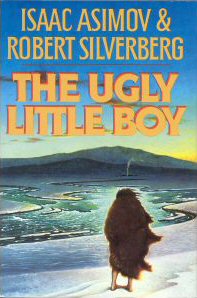
How would you like to babysit a Neanderthal?   Granted, Edith Fellowes didn’t realize that was the job description. She knew she’d be responsible for caring for a small boy from the past — a wild child,  a true savage who could not discern the difference between a salad fork and a dinner fork —  but never did she imagine working with a true Neanderthal. (Besides her boss, anyway.)  A  company called Stasis, Ltd. has developed the technology to pull small articles from the far past and hold them in a stasis bubble for study, and a young Neanderthal has become the unwitting subject of their experimentation.  There are of course ethical issues at hand, but so long as the newspapers continue to describe him as an ape-boy, who will raise qualms about his capture? No one but Miss Fellowes. As the boy’s nurse, his constant companion, his teacher, the closest thing he has to a mother, she sees him not as an experiment but a boy. He is her Timmie, her ward,  a complete person whom she loves despite his jarring looks and growling attempts at English.  Ultimately, when push comes to shove, Fellowes loves Timmie more than she loves her job — and when they try to end the experiment and send him back after years of isolation, she takes matters into her own hands.

Asimov often referred to “The Ugly Little Boy” as one of his very favorite short stories, though it was never one I particularly cared for. Robert Silverberg’s expansion adds much of interest here, as he did with “Nightfall”  and “The Positronic Man“.  The characters are fleshed out greatly, and humanized in the case of Fellowes’ boss Hoskins. Silverberg  includes another sub-story, one that follows Timmie’s increasingly-stressed tribe as their numbers dwindle and they find themselves surrounded by ‘Others’…..us.  This provides an interesting contrast to Asimov’s development of little Timmie; while the original story relied solely on archaeological evidence, Silverburg offers speculation into Neanderthal culture.  Timmie’s tribe doen’t create representational art not because they can’t grasp creating representational images, but because they don’t want to anger the spirits. (Silverberg doesn’t delve much into his Neanderthal tribe’s religion: it seems vaguely animistic with a central Goddess, presumably an earth mother.)  The two stories ultimately intersect at the end,  with a conclusion that invites  speculation*. Silverberg also adds another angle to the story proper, in the form of a political agitator who harries Stasis, Ltd. to make sure they are providing a healthy environment for the child. The agitator, Mannheim, is the sort who sues companies into bankruptcy, so his increasing interest in ‘helping’ the incredibly  well-nurtured but lonely Timmie adds urgency to Stasis, Ltd’s desire to end the experiment.

While the Neanderthal chapters took some getting used to — the characters have names like ‘Dark Wind’, ‘Milky Fountain’, ‘She Who Knows’ —   their conflicts with  the ‘others’ have interest. It is intriguing to reflect that once upon a time there were two distinct kinds of humans, very different from one another physically, but close enough to compete for the same resources and perhaps for even the same dinner dates. Modern research dates the original 1950s facts of Asimov’s story, but Silverberg cushions the blow.  I found the story much more appealing in novel form, but perhaps I merely enjoyed it more these days because I am more sentimental now: I find Fellowes’ passion for Timmie more engaging than the  technological aspect.   To date I’ve thoroughly enjoyed the Silverberg-Asimov expansions of Asimov’s originals, and The Ugly Little Boy is no exception. It made a story I found fair into one which was truly enjoyable.

* Spoiler: Fellowes decides to puncture the stasis bubble and allows herself to be thrown back into time with Timmie. In the novel, they appear in a blaze of light between the increasingly confused and stressed camps of Cro Magnons and Neanderthals, who are immediately awed by her. Is she worshipped as a god? Do she and Timmie go into business as translators?  Do they all get eaten by short-faced bears?   We’ll never know…

(Okay,  no being eaten by short-faced bears. They were a North American thing, and the Neanderthals never got around to doing the pilgrim thing and discovering the new world. They just wandered into the mists of history in Iberia…)

Posted in Reviews, science fiction | Tagged , , , | 5 Comments

Men from Earth

Men from Earth
© 1989 Buzz Aldrin and Malcom McConnell
314 pages

Forty-seven years ago, men from Earth first stepped foot on the moon. There, they left medals commemorating the men of Apollo and Soyuz who perished in this quest for fire in the sky, and a plaque that declared their intentions: “We came in peace for all mankind.”    Buzz Aldrin was one of the first men to step foot upon the grey dust of the lunar surface, and in this account — published in 1989,  twenty years after the triumph of Apollo — he provides a history of the early space race, a memoir of his own time in the Gemini and Apollo programs, and a final thought about the future.

While there is no shortage of astronaut memoirs, Aldrin’s intrigued me at the start because I knew from other books that he  helped create the orbital rendezvous procedures that were practiced in Gemini and essential to pulling Apollo off.  The astronauts weren’t just fighter jocks: advanced degrees were required of any astronaut candidate. While the account of the first-ever lunar landing is interesting in its own right, Aldrin attempts to record the whole of the space race. Not only does he devote early chapters to the beginning of German, American, and Russian rocketry, but throughout the book he follows developments on the Soviet side as well.  He draws from other books here,  then-recent scholarship. While sometimes the supporting authors are forced to speculate, given Soviet secrecy, the look across the iron curtain is most welcome. Both programs were beset with similar problems — not only technical, but political, as program coordinators were being pushed for results by their respective governments for moral and propaganda purposes.

Aldrin’s writing is detailed, but shouldn’t scare off readers who are wary of too much technical detail. The descriptive writing is sound — not poetic, but it’s hard to compete with A Man on the Moon on that note.  One  sight is especially well conveyed, the eerie and abrupt transition of light when Armstrong and Aldrin left the shadow cast by their lander. According to Aldrin, the effect was total: if he stepped out of the shadow and cast his arm behind him back into it, it almost seem to disappear into another realm.  There was no transition between dark and light; when they left the shadow, the blinding drama was though they’d transported from the depths of Carlsbad Caverns into the middle of the Sahara. Also of note here is a final chapter, covering ‘1969-2009’.    Writing in the eighties, when the shuttle fleet was active and routine, with the International Space Station still in the future, Aldrin seemed  disappointed but optimistic. He is wary of the Soviets, who continue to support manned spaceflight. While they would collapse within a year or so of this book being published, these days NASA astronauts still hitch rides with Soyuz up to the ISS, so Aldrin’s concern is not that far off.   Aldrin remains a space booster, recently writing a book encouraging a manned mission to Mars.

Men from Earth is a shorter history of the space race than A Man on the Moon,  but if you’re looking for a history of Apollo as whole it might not satisfy,. He ends with Apollo 11, and some of the most interesting lunar missions — scientific endeavors with go-karts! — were thus not mentioned. Still, for a recap of Mercury and Gemini it’s quite good, and especially so when the coverage of the Russians is taken into account.

Related:

Posted in history, Reviews | Tagged , , , , , | 8 Comments