Like most Americans, I have very little knowledge of the Korean War, outside of knowing Douglas MacArthur’s role there. When this book appeared at the library, published by the Republic of South Korea to honor US veterans of the conflict, it seemed like a good place to start. The book is half-history, half-celebration. Its opening chapters chronicle the invasion of Korea by Japan, and the subsequent split of the country after the Soviets moved in following Japan’s defeat in World War 2. Kim Il Sung, appointed by the communists to be their client boss in the north, attempted (with permission from his masters) to expand into South Korea. and nearly captured the entire peninsula before UN forces arrived. The arrival of the US military and other UN allies reversed Kim’s charge, and were it not for the sudden intervention of the Chinese communists, Kim might have been put out of work altogether before his strange spawn could create a family cult around themselves. The second half of the book is more celebration than history, but shares how the South Korea economy has become a powerhouse, its democracy better rated than even the UN, and its culture an increasing influence in the west — from K-Pop to Samsung electronics. A nation which was nearly completely destroyed in war has, through foreign aid and a free economy, become a full participant in the global community — giving aide and sending soldiers to relieve those in distress.
Although the book isn’t a formal or serious history, I found it helpful in establishing the basic outline of the war. The latter half is…dare I say, heartwarming, what with all the pictures of bright skyscrapers, happy children, and expressions of friendship between Korea and the United States.
Peter Hoffman’s research into the German resistance culminated in a 900-page History of the German Resistance 1933-1945, but this work – simply titled German Resistance to Hitler — is a much smaller overview. In it, Hoffman briefly reviews the major sources of resistance (the Wehrmacht, the Church, and citizen-protesters in the form of students and communists) and addresses why their work never saw fruit. In short: protesters like the social-democrats and communists were disorganized, more interested in fighting among themselves; the Church’s resistance amounted to condemnatory speeches and safeguarding lives; and those in the Army seemed to be cursed with bad luck in their operations.
Hoffman writes that virtually all of these factions shared two great weaknesses: first, they had to resolve within themselves the moral dilemma that came from resisting or undermining their own people, in a state of war surrounded by hostile powers. This was especially difficult for members of the military, whose mission was the defense of the country, who were bound by not only oaths but loyalty to their fellow soldiers. Two, Allied support for the German resistance was nonexistent, and once the war reached a point of no return in the Nazi invasion of Denmark and Norway, the terms of unconditional surrender were discouraging to patriotic if dissident Germans who had no wish to see Germany dismembered further at a peace conference. It was only after the disaster of Stalingrad – which some in the army viewed as criminal negligence — that desperation overrode caution.
Those who have no knowledge of the resistance whatsoever will find Hoffman an attractive author, as he combines a basic overview of the Nazi seizure of power and the war along with resistance to the same. I am definitely interested in reading Hoffman’s more expansive History of the resistance, as even in these few pages he offers some new insights. I thought Valkyrie mostly failed because someone kicked the explosive briefcase further under the table, muffling some of its force, but Hoffman recounts how von Stauffenburg was summoned into the board room before he and a cohort were finished priming the explosives. Only half of the charges were ready, and between that, the misposition under the table, and the architecture of the room itself (not as confined as Stauffenburg had planned for) a strike that would have killed everyone in the room was reduced to one which only gave Hitler ringing ears and a few scratches.
Like many Americans, I first knew the Germans only as the villains of our world wars. It wasn’t until college, when over-full Spanish classes thrust me into a German language course, that I began to discover the real nation in the heart of Europe. A Mighty Fortress recounts German history from their first encounters with Rome until Germany was re-united in the 1990s. Its object is to render an account which is free from the tiresome preoccupation with looking for Nazi forebears. We begin with the partial Romanization of the German tribes, the rise of the Carolingian kingdom, the post-Charlemagne breakup, and the creation of that strange creature, the Holy Roman Empire. The Empire was not a unified state in the model of Rome, but a complex network of kingdoms, fiefdoms, and independent cities, in which a common aristocracy voted for an emperor whose authority varied over the years. (As with the other princes of Europe, the king constantly vied for power against the nobility and the Church.) Throughout the late middle and early industrial eras, central Europe was a common warzone between the powers, and Germans suffered the most — especially during the Thirty Years war. This bloody primed Germans for social caution, so that attempts at imposing French-style revolutionary upsets were largely stymied. Napoleon’s victories over the Empire still imposed a large measure of revolutionary reform, however, and a popular spirit would continue to strengthen from that point on — resisted or managed by the authorities. The master at management — of the mob, of the princes of Europe — was Otto von Bismarck. He perfected the consolidation of German states begun by Napoleon by unifying Germany into an empire in 1871. Although this review of German history covers chiefly political affairs, occasionally an artistic or intellectual personality enjoys the spotlight. They include Martin Luther, Bach, Beethoven, Faust, Kant, Hegel, and Marx. There is also an obligatory “Why Hitler” chapter, in which the author attributes the “barbarian’s” triumph more to the plight of Weimar Germany (crises and an ineffectual government) than to some chronic itch to take over Europe.
Because A Mighty Fortress is such a general survey, it didn’t build much on what I’ve retained from a German history course taken years ago, except in its coverage of the late 20th century. Those who know nothing of German history beyond Hitler may find it informative, but I’m certain there are more readable books out there for that purpose. (Even Nazi-focused books like The Complete Idiot’s Guide to Nazi Germany might be helpful…my respect for Bismarck’s political skills began with that book, over fifteen years ago!) Related: Since it may be playing in your head right now, here’s a recording of “A Mighty Fortress“/”Ein Feste Burg”, as recorded by an audience of three thousand men.
In the first volume of The Gulag Archipelago, Alexandr Solzhenitsyn used his own experience being arrested, interrogated, and sentenced to a work camp to review the origins of the Soviet police state, delving into its underpinnings of detention centers,secret police, and transportation networks.In volume two,after a brief history of the Gulag system, he focuses on camp life – or rather, the slow death of Gulag existence, the death of both spirit and soul. Particular sets of the damned have their own sections within the book – women, children, Communist diehards,even the guards themselves.
Like books written on the Nazi concentration camps,Gulag Archipelago is a catalogue of misery, one that lasted for decade after decade.The monstrous architecture of oppression and humanity began not with the butcher Stalin, but with Lenin himself, as the first instances of forced labor occurred in the early 1920s. The seeds were sown by Marx, who urged that labor was the best response to criminality – ensuring that laggards and reactionaries earned their keep.That keepwas very little; Solzhenitsyn reports meager meals of gruel, largely, with an occasional feast in a roll of black bread. Official Soviet ideology, which the prisoners were expected to express their conviction in, was that forced labor was also a corrective measure, making the condemned into good soviet citizens.(The Soviets’ near coreligionists, the National Socialists, expressed that conviction in three words:Arbeit Macht Frei.)
The easiest summation of Gulag life was that it was miserable in every way. Rations were meager and dismal;physical shelter was poor, and the authorities denied their wards warm clothing. Those being punished for infractions inside the prison (for voicing dissent, making jokes about the authorities,making neutral or positive remarks about capitalism or German equipment ) were even worse off. They might be stripped of clothing entirely and made to ‘rest’ in a damp earthen cell, even in the Siberian winter)The guards were not the only enemies, as the authorities used prisoners against one another. Echoing his remark in volume I that the line between good and evil runs through every human heart,Solzhenitsyn notes that “informers” were not a separate, malicious category of men, craven weasels who would do anything for a leg up.Most were ordinary prisoners being manipulated by the guards,either by the stick (families threatened) or by the carrot. Prisoners could be coaxed into complicity by being asked for more excusable tips, and then later, once their self-respect had been compromised already they would be grilled for information on what prisoners were saying about Stalin, the guards, the Communist state, etc. Solzhenitsyn wryly notes midway that while the Soviets had condemned imperial coercion by force, and capitalist coercion by hunger, in their Gulag system they used and perfected both. (One section early in the book compares 19th century serfdom favorably to the plight of the ‘new’ serfs of communist Russia.)
Although theGulag camps were officially designed for labor, not death – there were no Zyklon-B showers —they were no less efficient at destroying life. In the winter,the mortal remains of prisoners would be stacked up along buildings, the ground too hard for them to be buried in.Not only were most of the prisoners on a near-starvation diet, but they were tasked with brutal work – digging canals and logging.Solzhenitsyn estimated that the death toll in building the White Sea-Baltic canal to have been a quarter of a million people – and for no purpose at all, for the ‘canal’ was too shallow for most ships to transit. It had been done almost for the show of it, a charade of productivity to fulfill the claims of the Five Year Plan. It is for this reason that we might borrow from the Bible: Hitler has killed his millions, but Stalin has killed his tens of millions.
Solzhenitsyn notes throughout the book that the best way to survive the camps was simply to vanish: don’t talk and don’t work when they’re not looking – -both because working hard for extra rations was counterproductive, and because if a prisoner finished their work they were rewarded with…more work.Many people did seize what little pleasures they could: Solzhenitsyn records love affairs blooming in the camps before men and women were segregated, as people grasped at whatever affection they could find.And there were a few guards, he admits, who would look the other way—even if for the most part they acted like dogs, watchful and servile.Perhaps the most interesting set of characters to consider are the Communist prisoners – diehards and loyalists who were arrested because their zeal stepped on the authorities’ toes.The system was a kleptocracy, Solzhenitsyn writes, corrupt from toe to head:anyone placed in a position where they could clip off rations or resources from the unsuspecting (prisoners inside or Soviet subjects outside) would.Those who believed in something earnestly, be they Orthodox Christians or orthodox communists,kept disrupting the cozy pool of corruption.Even in prison, however, the communist ‘loyalists’ insisted that the Party was still good: they had simply made an error, or perhaps local authorities had been compromised by the Germans.One memorable section includes a mock conversation with a die-hard, who has a pat response to every probing question Solzhenitsyn puts to him about the State and its ideology. As with the first volume, this book is more daunting for its size and contents than its writing. Solzhenitsyn’s mood as a writer mocks the authorities and looks for the best he can find in his fellow prisoners, and the translation is perfectly simple. The third volume promises chronicles of escapes, and the death of Stalin.
In about eight hours the business end of Hurricane Nate should roll through my county. Seemingly all of downtown will be closed tomorrow, as we’re expecting much more impact from this than from Irma — in part because it’s headed straight for us, and because we’re on the right side of the storm. Apparently, that’s where all the tornado action is. Here’s hoping for another wash-out, but I wouldn’t bet on it! Just in case there’s a power outage, I have a review of Gulag Archipelago (volume II) scheduled.
“Ghost stories” invariably makes me think of legends and folklore, but Ancestral Shadows is an altogether different anthology. Instead, its stories all feature ghostly characters and themes of redemption, revenge, or realization. The ghosts here are not transparent wraiths, scaring mortals or playing tricks with the furniture. They are in the midst, caught in the veil between the living and the dead, dwelling in their own moments of time. Some are corporeal enough that they believe themselves still living, and the news of their death comes as a surprise to both them and the reader. Ancestral Shadows enmeshes its characters in tradition and place; ghosts are inherently localists, but most of the the living featured here are likewise bound to their villages, family homes, and familiar places. The collection opens, for instance, with a ailing woman who lives in a mostly-abandoned village that is targeted for destruction by the local planning authorities. Living more in her memories than reality, she visits a church graveyard regularly to sweep the tombstones; her distress at the hands of the bully-planner, and devotion to the departed, bring an unexpected ally in the form of a vicar who died mysteriously decades ago. Time makes itself substantial in these stories; in one, a pecuilar man faced with a blizzard breaks into an abandoned home, and experiences a violent moment in the home’s history — but was it a moment etched into the memory of the house, or was it his? The stories are set in the United States, Great Britain, the Italio-Austrian border, and even east Africa, and each draw the reader and the main character deeper into a mystery, until — fully enveloped by it — there is a line dropped, a corner turned, and suddenly both parties realize something that had been hitherto hidden . These stories aren’t written just to envelope the mind in mystery; the clarity of the end-page doesn’t dispel a puzzle so much as it centers the character; before they were lost, now they are found. That’s not to say they’re feel-good parables, for the tales also include moments of vengeance and retribution.
If you can find it, this is an excellent collection of stories, both chilling and thoughtful. I obtained a copy through interlibrary loan.
Every attorney has problematic clients, but few can claim an actual monster. Such is the case with Count Dracula, as young lawyer Jonathan Hawker discovers to his dismay and horror when he arrives at the mysterious count’s manor in Transylvania. The trip was just a bit of business — finalizing the papers for the count’s purchase of land in England. But the Count is a man who the locals fear, who can command the beasts of the earth, and who is never around during the day. Hawker quickly finds himself an effective prisoner, shut up in a foreboding castle full of locked doors and secrets, and when he stumbles through one into the other — discovering that the Count is a vampire, who subsists on human blood — Hawker realizes both he and the City of London are in peril.
For a century-old gothic thriller, Dracula stands up very well. It uses an unexpected format, its story rendered in the letters and diary entries of the participants, who occasionally pool their notes to get the bigger picture. This epistolary approach allows the reader to piece the story together, instead of having all the work done for us by the narrative. (A good bit of the characters’ work is done by Dr. van Helsing, who has a tendency to lecture.) Modern readers of vampires will recognize the creature here, but books like Twilight and In the Forests of the Night divorce the monster from his background. Stoker’s vampire is a creature of Hell, experiencing a corrupted and bastardized version of eternal life; his association with the devil is not merely one of hyperbole, but real to the point that Dracula and his victims are completely disabled by the presence of a Eucharistic wafer. (Not included as vampire traits are a tendency to say “Bleh!” and an obsession with counting. Sesame Street lied to me!)
From its beginnings — the dread-laden arrival in Transylvania, the creeping horror as Hawker and others piece together the truth — until the chase at the end, Dracula remains a very effective thriller.
Inspired by A Thousand Miles from Nowhere, which alternated between writing about driving big trucks and listening to country music….here are eleven country songs about driving trucks! There are more out there, but I’ve collected these over the years. The ones I’ve chosen touch on various aspects of the trucking life — adventure, loneliness, camaraderie, and danger. 1. “Eastbound and Down”, Jerry Reed
East bound and down, loaded up and trucking
We’re gonna do what they say can’t be done
We got a long way to go, and a short time to get there
I’m eastbound, just watch ol’ Bandit run!
This will easily be the most recognized song on this list, as it was written for and used in Smokey and the Bandit, a movie about two truckers bootlegging Coors, trying to get away from an indefatigable and utterly obscene Texas sheriff. It’s a fun song to sing driving through country backroads. Note: the video above uses the music from the movie, set to clips from the movie itself.
2. “Six Days on the Road”, Dave Dudley
Dudley’s voice gives this song a lot of…oomph. His delivery is that of a 20th century cowboy, full of guts and black coffee. A rock version of this was done by a trucking band in 1987.
The ICC is a checkin’ on down the line I’m a little overweight, and my logbook’s way behind But nothin’ bothers me tonight I can dodge all the scales all right Six days on the road, and I’m gonna make it home tonight!
3. “Roll On”, Alabama This song about the wife and children of a driver who spends most of the week away, but calls in nightly until he goes missing during a wintry storm, always resonated strongly with me as the child of a driver.
It’s Monday mornin’, he’s kissin’ Mama goodbye
— he’s up and gone with the sun
Daddy drives an eighteen wheeler, and he’s off on a Midwest run
Three sad faces gather around Mama, askin’ when Daddy’s coming home
Daddy drives an eighteen wheeler, and they miss him when he’s gone
Ah, but he calls `em every night, and tells them that he loves them
He taught `em this song to sing —
“Roll on, highway, roll on along — roll on Daddy, until you get back home.”
4.”Big Wheels in the Moonlight”, Dean Seals A song about the youthful craving for escape and adventure that leads many to driving.
I came from a town that was so small,
you look both ways you could see it all
All I wanted was some way out — every evenin’ I’d slip into town
Stand around by the caution light, watch the big trucks rollin by
For me, it was a beautiful sight….big wheels in the moonlight.
5. “Speedball Trucker”, Jim Croce Croce wouldn’t be described as a country singer, but his “Speedball Trucker” and “Rapid Roy” aren’t out of place in its ranks.
One day I looked into my rearview mirror And coming up from behind Was a Georgia state policeman And a hundred dollar fine He looked me in the eye as he was writin’ me up He said, “Driver, you been flyin — ” — ninety five is the route you were on, it was not the speed limit sign”
6. “Tombstone Every Mile”, Dick Curless
Lamenting a stretch of road in Maine notorious for claiming the lives of drivers. Included here in part for its age, and in part because driving is often dangerous work — especially in winter, or working around mountains.
7.”Bud the Spud”, Stompin’ Tom Conners Canadians have truck drivers, too! And…they sing about potatoes.
It’s Bud the Spud! from the bright red mud
Rollin’ down the highway smilin’
The spuds are big on the back of Bud’s rig
And they’re from Prince Edward Island!
It is the most exciting song about potatoes you will ever hear.
Not an old song, but sharing the pride some drivers (particularly owner-operators) have in their rigs’ physical appearance and maintenance. Chicken lights refer to the string of lights that run the length of rigs — or at least, their trailers. As a bonus: the lyrics include “A trucker’s favorite song is Alabama’s ‘Roll On‘”.
9. “Roll On, Big Mama”, Joe Stampley A fun, rowdy song about the joys of driving.
The feel of the wheel delivers me From a life where I don’t wanna be And the diesel smoke with every stroke Sings a song with every note And ramblin’ is the life I chose Sittin’ here between the doors The yellow line keepin’ time with the things that’s runnin’ through my mind 10. Convoy, C.W. McCall
This is the other big trucking song people know, and even though it’s silly enough that I almost didn’t include it here, I will still enthusiastically sing it if it comes on the radio.
We laid a strip for the Jersey shore and prepared to cross the line We could see the bridge was lined with bears, but I didn’t have a dog-gone dime I said “Pigpen, this here’s the Rubber Duck — we just ain’t gonna pay no toll!” So we crashed the gate goin’ 98, an’ I said let them truckers roll — ten-four!
11. “Driving My Life Away“, Rhett Atkins Another fast song, but one which the title nearly says more than the lyrics — though the verses hint that driving is just constant racing and getting nowhere, with the singer wondering if there’s something better out there.
Bonus: “Truck Driving Man“, Jimmy Martin. Martin is an early country legend, the king of bluegrass.
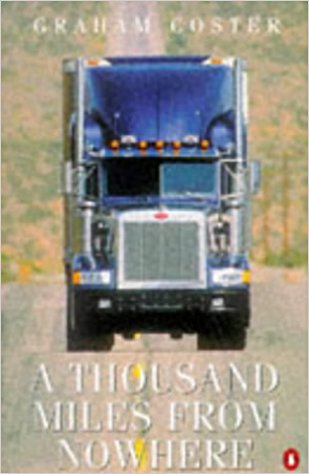
Great literature has been produced from travelers’ tales, from those who walked or rode trains or even drove — but none from a truck, says Graham Coster. In the hopes of filling in a niche, he hitched rides with British and American truckers transversing North American and Europe, to learn about life behind the wheel of a big rig. The memoir is based on three trips undertaken in 1993, but as Coster was not himself a driver, there are only three things he writes about: the drivers, the landscape, and country music. (Also: candy bars. One wonders if Mars, Inc underwrote his trip!) The landscape is almost absent, mentioned only as the background scenery. In Arizona, Coster ruefully notes that his time spent with truckers has altered his perspective: he has visited the state before, noted its beauty, but once embedded in the work routines of a cab it’s nothing more than a low hill with a series of truck stops behind it. The places, unless they are extraordinarily abominable (New York City, the bane of truckers) are all ironed out by the constant transience of driving life. The drivers themselves all make for fun company, swapping stories about experiences on the road and ruminating over friends they’ve lost. In the United States, Coster is more out of his element — praising presidents who truckers loathe, making jokes about people they admire. Ruminations on music, and especially country music, rival the conversations with drivers for page-space. Coaster is intrigued that the drivers he meets in England and Germany both like American country music, and in the US, they seem to listen to nothing else. It’s not an accident that the book takes its title from a Dwight Yoakam piece. Coster likes it well enough himself, though he prefers the country-pop party anthems to the emotional croonings of Hank Williams.
Although this is a topic that greatly interests me, I was completely underwhelmed by this title, in part because I’ve read other memoirs and encountered nothing new. Even if I were reading it for the first time, however, there’s little real information about the trucking industry here: it’s just driving and waiting. For information on Eurasia’s transcontinental routes, Danger: Heavy Goods, a memoir about the England-Saudi Arabia route, is much better…and written by an actual driver.
Well, dear readers, September was a fairly horrific month between the hurricanes and earthquakes and threats of nuclear war, so I hope October is calmer. I usually read a piece of fiction or history associated with Germany at this time of year, and have a series lined up. I’m also featuring some Halloween reading for the first time; I just finished Dracula, and hope to cover Frankenstein later in the month. Until then I’m enjoying a collection of ghostly fiction, and will be starting into the German history soon. I had wanted to read Heart of Europe, a history of the Holy Roman Empire, but it’s close to a thousand pages and I have too many irons in the fire. One potential is A Mighty Fortress, a history of the German people written to rescue the land of poets and thinkers from its twelve years of infamy. Perhaps I’ll enjoy it with a märzen…