Brief note

My wireless adapter failed over the weekend, and I’m expecting a new one in either tomorrow or Thursday. (I’m a typing terror with a keyboard, but my tablet key-fu is only fair.) In the meantime I’ve been reading, so expect the ball to start rolling again pretty quickly!   Lots to come in the areas of science, the digital world, and a bit of business/economics. There’s also some science fiction coming up the pike…think Ed Wood and Joe Haldeman.

Posted in General | 4 Comments

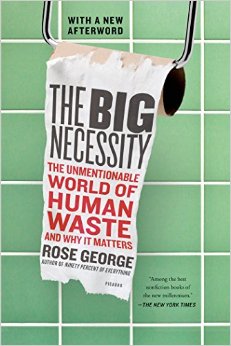
The Big Necessity

The Big Necessity: the Unmentionable World of Human Waste and Why it Matters
© 2008, 2014 Rose George
238 pages

In its initial publication, The Big Necessity may have been an eye-opening look into how many human beings still suffer for want of life-saving sanitation. Already familiar with the sorry state of toilet affairs in parts of the global south, though, I read and enjoyed this more as the story of governments, charitable organizations, private citizens, and small businesses who are steadily working to bring their places to health. The solution is not always technological, although reading about home digesters that convert offal into kitchen gas and fancy Japanese toilets is most interesting. (The digesters are particularly important: not only do they give households a degree of self-sufficiency, they guard against local trees being stripped for fuel, and save China’s rural households money in terms of domestic fuel and fertilizer.) A culture of hygiene must always be fostered, and through means that take into account the local culture. The Big Necessity provides a call to arms,  takes readers into the sewers of NYC and London as well as the  Chinese countryside, and offers a view of toiletry’s cutting edge. A very interesting book all around, then, and with only the faintest whiff of toilet humor — the sole instance of which is that George refers to something as execrable.

George is also the author of Ninety Percent of Everything, known in the UK as Deep Sea and Foreign Going: Inside Shipping.

Related:
Flushed! How the Plumber Saved Civilization, W. Hodding Carter

Posted in Reviews | Tagged , , , , , , , | 5 Comments

A reading on the Presidency: The Ship of State Turns Not Easily

Another reading from The Twilight of the Presidency:

Newton’s first law holds that a body at rest will remain at rest and a body in motion will continue in motion along the same line until acted upon by an outside force. The federal bureaucracy is like that. It can be moved by a determined president. But once the motion has started and the course has been set, the internal momentum of our government’s machinery continues with the implacable determination of an advancing glacier. It also dedicates its powerful capabilities to reinforcing the presidential belief that the original decision was correct. In a very real sense, the machinery has mechanisms that are potent in heading off any desire to change course. […] Whatever argument [the president] gets is unlikely to come from the internal structure of government, and when it does come that way, it is easy for him to  close his ears to it. He may get an occasional argument on how best to carry out a policy; but  rarely, if ever, that the policy he has set should be abandoned.

p. 16, Twilight of the Presidency.  George E. Reedy
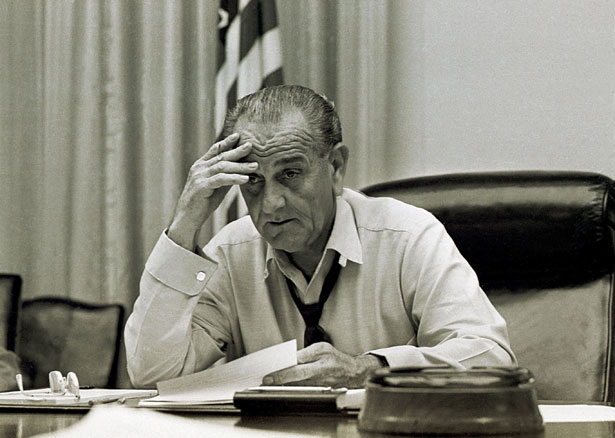
Serving during the Johnson administration, afterwards Reedy wondered how Johnson and other presidents  — intelligent and gifted political manipulators — could engage in ruinous decisions like the Bay of Pigs debacle, Vietnam, and Watergate.  It has proven the most fascinating book of the year so far, and despite its age (published  in the Reagan years) still seems very relevant. 
More to come in the days ahead..
Posted in Politics and Civic Interest, quotations | Tagged , , | 2 Comments

A reading on the Presidency: A Man Divided?

The president really has two jobs. The first that has received is that of his managerial role, his responsibility for handling the nation’s affairs. Coupled with that is his role of personifying the nation and becoming thereby the unifying factor that holds us together.  It its this dual role that makes the presidency so fascinating intellectually. Many problems arise from assigning double duty to the president, and all of them flow from the fact that the two roles are mutually exclusive. To sustain his position as a symbol of unity the president should keep strictly out of politics and out of management of the government. To manage the affairs of government, the president must decide between competing claimants for social and economic advantage. Such decisions cannot be made without dividing people and creating enmities, which blotches the unifying symbol. An astute president can walk a tightrope but for a considerable period of time, but in the end, he cannot win for losing.

pp. 13-14, The Twilight of the Presidency.

I’d never thought about the curious nature of the presidency’s dual role until reading The Once and Future King two years ago.  F.H. Buckley argued in that volume that crown government – that is, rule by a monarchical executive  — had effectively reestablished itself in the United Kingdom, Canada, and the United States in the persons of their prime ministers and president, respectively.  Buckley noted that the American president’s combined offices — Head of State and Head of Government —  have the unfortunate consequence of blunting a lot of criticism by way of automatic deference for his Leader of the Republic aura.

How might the constitutional convention approached a two-office executive, having a President and prime minister, so to speak?   The Speaker of the House is the closest thing we have to a prime minister, but the powers of government were deliberately divided so that Congress could not run amok over people’s liberties as had the House of Commons  It is incredible to think that once Congress’ power was feared; the last time it was a threat to the presidency was during Andrew Johnson’s administration.  But let us suppose the convention was dominated by men who wanted a robust Congress and an impotent president, who made the Speaker the governmental manager and relegated to the office of president mere ritual roles:  the Guardian of the Constitution, perhaps, who made the public holiday speeches and sometimes publicly censured Congress for violations of rights.  Later on, during the Progressive period of the 19th-20th century, it is plausible to think of the office being filled by a man who was less interested in natural law and declared himself instead the Guardian of the People,  scolding Congress for not doing enough to protect farmers against the railroad.

No political system endures without change, and I do not know how long our present scheme will endure. Certainly with the current president elect we are at an interesting moment: we have a man who went to war with his own party establishment, who was elected over their joint rebukes and sneers, a man who has little regard for precedence and propriety. It’s extraordinary. Has a shift of power ever been this contentious in American history?  The closest I can think of is Truman refusing to speak to Eisenhower when they rode in a car together. Has an assuming POTUS ever entered the office with teeth bared,  avowedly hostile to most of the people on the Hill and to the corporate media?  Have the FBI and CIA ever been this involved so close to an election and transition?  I confess that there are moments when I seriously believe we are witnessing the active collapse of what’s left of the Republic.     I speak as someone who is enormously entertained by Trump’s contempt for the media, because I, too, loathe it; ditto for his attitudes toward D.C and the Republican-Democratic  establishment — but as much as I like the idea of the power-caste being so dramatically spited,  I’m a student of the universe.   Strong personalities with a populist base,  going to the mattresses with a corrupt establishment…it never ends well, whether the personality is modern (Hitler or Castro) or historical (Caesar, Napoleon). This story never ends well.   Human beings cannot handle that much power and adulation. Even the adulation is dangerous: look at the many Hollywood celebrities who have destroyed their lives, reveling in license and attention.

Unfortunately, I don’t know that there was an alternate ending.  Clinton would not have been the progressive her fans wanted her to be. She was a fully-vetted member of the power caste, with no career outside the walls of public rule since her teen years. I suspect she would have been predictably but moderately abusive (in the same fashion as Bush & Obama), but remembered most for being the wife of a former president and the first female executive.  Executive power would have definitely increased under her stead,  unless she provoked Russia into a global war, in which case we’d all be dead with glowing bones and the power of the presidency would have been a nonissue.  In the case of Trump, though, who knows?  He might so unnerve Congress that they attempt to check him with law,  or become more powerful through sheer will to action.

The problem with this idea of a president who stands as a unitive figure is that the United States itself so divided. Is there anyone who can count on respect or affection from everybody?  Fred Rogers, maybe, and he’s left us.( Readers Digest suggested that Tom Hanks is the most trusted man in America, which…I completely get. )  One example that particularly concerns me is identity politics, which promotes tribalism and thus counter tribalism.  Whenever there is an overtly defined us and them, hostility erupts: even if the Us begins as a genuinely violated party, their constant pushing against the mass provokes defensiveness and thus creates a more solidified Them, and the two then feed one another’s flames.  This is why I think the Catholics are onto something when they make solidarity a keystone in social conflict resolution:  we must approach one another in charity, as neighbors, and work something out together. We can’t just fight and claim victories from another side, not and remain a nation. On Friday, for instance,  D.C. will be filled with marches — media spectacles that may grow violent. Violence will then beget violence, everyone will choose sides, etc — turning and turning in the widening gyre, that sort of thing.

It is my hope that after Friday, once the current president  is hit with the sheer amount of work expected of him, that he will be so overwhelmed that things will quiet down.  I can’t bet on it, but it’s a possibility:  that chair in the oval office destroys men. Even Trump’s personality may not be able to handle the weight of responsibility bearing down on him there.

=========

Future excerpts from this book won’t turn into essays, I promise — but for all of my wariness and cynicism regarding D.C, there is still a big part of me that believes in Washington and the Republic…and that part of me, the citizen of not just a town but a republic, had to ponder some things.

Posted in Politics and Civic Interest, quotations | Tagged , , | 7 Comments

Dynamite from a Film Student

Last night I discovered a series of video “essays about art”, or artistic case studies, commenting on various films of the last few decades.   So far I’ve enjoyed nearly ten of them, and have been utterly impressed with the quality of his commentary, and the production values of the vids themselves.  I’ve embedded a few below just as a sample of the kind of content he produces.

Gotham: A History of Batman’s City

“Gotham is a city that’s performed; we know it by the stories that happen there, by the spaces generated by encounters in the night. In this view its many versions don’t register as inconsistencies, but cohere into a new way to think of cities, as a site of constant reinvention…as a place that can’t be mapped by its buildings and streets, but by the events, people, and minds that make them.”

Why Prisoner of Azkaban was the Best Movie
“[Consider the director’s] fondness for a moving, often hand-held camera. Just take a quick, sped-up look from this early scene set in the Great Hall. Not a single shot is stationary;  this gives the scene and the film a feeling of forward momentum and establishes a curious camera, but it also lends to the film a sense of unease, an inability to find stable footing. For a  film that is to be haunted by a feared killer throughout, such a style is fitting.”
“Synder could make the Justice League a a out and out comedy,and  it still wouldn’t fix what I see as a fundamental problem in his filmmaking, something that’s really apparent in Batman vs. Superman: his preoccupation, his obsession, with moments at the expense of scene. What do I mean by this? Movie moments are awesome. A really great moment can be transcendent, can leave a deep visual impression on a viewer. They can come to represent a whole new category of feeling. Zack Synder is obviously obsessed with Moments: the film is chock full of them.  Moments when time is slowed down and the composition is just right, when the score swells and the film tries to broadcast a single message: BE AWED. What Batman v Superman really lacks is…scenes. Actual scenes, not just filler between moments. Scenes are hard to define, but what a good scene does is dissolve the actors and soundstage and camera angles into a living, breathing reality. There should be a strong sense of Place, a feeling of Possibility, that the characters who occupy the space could go anywhere within it.   Too often in Batman v Superman, the characters feel awkwardly placed in their scenes. Does anyone get the sense that Clark Kent and Lois Lane actually spend time in the Daily Planet? We visit the Planet eight times, but the longest scene there is only 1:11. The rest are under a minute, often under 30 seconds. This doesn’t feel like a place; it feels like a fraction of a location where people say lines.”
Interstellar: When Spectacle Eclipses Story

Posted in General | Leave a comment

In the Land of the Tiger

In the Land of the Tiger: A Natural History of the Indian Subcontinent
© 1997 Valmik Thapar
285 pages

Imagine a Planet Earth episode focused entirely on India, and then presented in book form. The result is In the Land of the Tiger, which takes readers on a guide through the lush natural landscape of the Indian subcontinent, starting from the mountains and following the rivers to the coast, from there visiting islands before examining other disparate areas of the land.  This volume is replete both with photos and picturesque writing, displaying a soul-stirring variety of animals. Many I had no idea existed, like   the Hoolock gibbon, India’s only ape,  and the pied hornbill.  The expanse of human settlement has pushed many animals into new territories and created interesting adapational behavior: for instance,  although lions typically hunt in prides,  those who live in India’s forested margins must become solo artists. There are also elephants who swim in the open sea between different island. (There is an extraordinary shot of an elephant swimming, taken from below. Talk about perilous photography!)    Land of the Tiger makes more cultural references than Planet Earth or related series did, connecting animals to Hindu religion and folk medicines.   I’ve been slowly guiding through this the past few days, savoring the photos and writing — what a great start for the Discovery of Asia series!

When I finished this book I noticed that Land of the Tiger  was actually a BBC nature series. I was more on the nose than I realized!

\

Posted in Reviews | Tagged , , , , | 6 Comments

Mean Streets

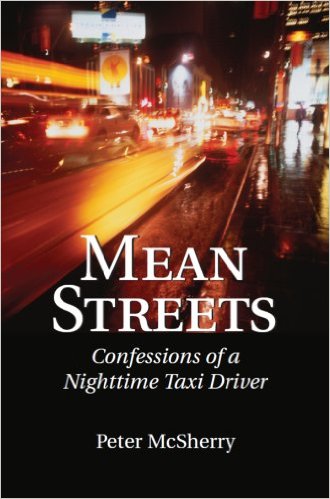
Mean Streets: Confessions of a Nightime Taxi Driver
© 2002 Peter McSherry
256 pages

Mean Streets takes readers into the dark side of Canada, or at least the dark side of Toronto. Ever since the 1970s, Peter McSherry has been driving the night shift at various cab companies,  writing about the strange people and stories the night produces along the way. In this volume many columns he’s submitted to taxi publications are collected and organized in particular categories —  his experiences with drug dealers, prostitutes, and criminals on the lam, for instance, or the shady practices of tax firms — spanning his time driving. McSherry isn’t simply witness to many of these stories, but an unwilling participant in them; he is often threatened or solicited, and in his younger days was known to give chase to people who tried to stiff him on the cab fare.  Being far removed from Canada, I tend to imagine it as a bland, safe sort of place, nice to visit but not that exciting. McSherry’s account certainly presents a different picture! His Toronto is just as grimy and unruly as New York City. with affair after affair recorded here that are worthy of depiction on COPS.   I didn’t realize Canada, or at least Toronto, had the sort of racial strife that still besets the United States, though its came from Britain’s colonial heritage, rather like France’s does today.  Driving a cab was an education for McSherry, too;  originally an idealist who went to school to teach children and believed the best in everyone,  his experiences being cheated by bosses, customers, and city officials alike definitely create a world weariness.  With that, though, comes a genial tolerance both of people’s failings (including his own), though he’s definitely no pushover.   He readily ignores teenagers, drunks, pushy pimps, and others on the street who bitter experience has taught him are more trouble as fares than they’re worth — and if push comes to shove, he’s as ready with a right cross as he is with a kind word. (Melissa Plaut, in her Hack, also learned to discriminate against teenagers, though she felt bad about it.)

Those interested in learning about the business practices of cab companies won’t find too much here beyond the 1970s,  but the memoir has the usual appeal to those who like “a day in the life”  tales or true crime stories.  I noticed that McSherry prefers to drive as an independent contractor, just like Melissa in Hack;  this allows himself and other drivers to work as much or as little as they choose to, depending on their circumstances.

McSherry is, at least of 2014, still writing about driving even as he hits 70.

Related:

Posted in Reviews | Tagged , , , , , | 1 Comment

Related Vids: In the City of Bikes

Welcome to the entry in my Related Vids feature!

Jordan’s book gave fine form to the history and culture of cycling in Amsterdam, but the above video shows off another side.  After a brief history of the bike vs. cars battle (a minute and a half),  this video reviews the ways in which cycling is built into Amsterdam’s public infrastructure, set to happy guitar strumming.

In his Amsterdam history, Jordan commented on the utterly democratic nature of the bike-riding populace, which included every class and age bracket.  This video demonstrates that variety in just the first  minute and a half, including: someone carrying a carpet,  a mom with a baby behind her, a child riding alongside her mom, an elderly person, and several people talking on their cell phones. Forward and rear racks for carrying cargo are ubiquitous. 
If you’re really intrigued, this is a slightly lengthier history of how Dutch cycling infrastructure developed, one which details how Dutch cities pushed back on automobile enroachment. The reasons listed: too many buildings and space given over to the cars, too many pedestrian deaths, and  the oil crisis, 

Posted in General | Tagged , | Leave a comment

In the City of Bikes

In the City of Bikes: the Story of the Amsterdam Cyclist
© 2013 Pete Jordan
448 pages

“It is quite possible that all the bicycles in the world are not in Amsterdam, but you’ll never be able to convince me.”  American tourist, 1956

No sooner had Pete Jordan stepped foot outside the Amsterdam airport than did he nearly get run over by a rushing cyclist.  He met his near-miss with utter delight, for that was precisely why he was in Amsterdam. He’d come as a student to the Netherlands, to study urban design and the role of bikes in Dutch culture.   But the student would become something else, as In the City of Bikes documents his first decade as an Amsterdammer, a man whose career, family, and every joy were nurtured by the closely-knit buildings of this bike-and-canal city, where anything can be walked to but everyone rides bikes instead.  For a reader who sees in Amsterdam hope for humane urbanism,  Jordan’s work is a delight through and through.

Why are the Dutch so crazy for bikes? It’s not a question they’d ask themselves: in a city where over two-thirds of the people use bikes on a daily basis, the elegant little machines are nothing extraordinary. They don’t require helmets, lycra, and a man-against-the-world attitude like cyclists in America bring to the saddle.  Cycles fill Amsterdam — its streets, its sidewalks, its culture.  Early on, Jordan speculates on why the United States and the Netherlands developed so differently in terms of transportation;  he highlights the comparative availability of land, the scale of the American nation, and the abundance of domestic auto manufacturers as key reasons why the United States quickly embraced hordes of automobiles.   Cars only emerged as a serious rival to Dutch bikes in the 1960s, and just as they were provoking serious resistance  from student movements, the nations of OPEC thoughtfully banned oil exports to the Netherlands and bikes made an epic comeback. (This is, I submit, the greatest gift OPEC ever made to humankind.)

In the City of Bikes is essentially a personal approach to Amsterdam and its cycles that mixes in tales of Jordan’s first decade of life in Amsterdam with a narrative history of the city and bicycling.  In the late 19th century, bicycling enjoyed intense support as a short-lived fad in places like the United States, but  the elegant machines had more staying power in a place like Europe with human-scale urbanism and close connections between worthwhile places to be. The Netherlands’ flatness made it especially easy to cycle, so cyclists’ numbers only grew and grew. The cyclists swarmed in such abundance that mayor after mayor despaired of their anarchism; even the Germans, after seizing the Netherlands, were frustrated.  Rule after rule the new overlords posted, and the Dutch ignored them. (Among the objects of Nazi irritation: Dutch cyclists not staying to the right, as well as holding hands and riding two to a bike.  Roads and bicycles are only for transportation, thank you, no joy allowed.) Only when the Nazis began methodically searching and seizing bicycles for use by their own troops did bicycles disappear —  broken down and squirreled away, or tossed into the canal just to spite the greycoats — with the exception of those so badly maintained that even fleeing Nazi officers couldn’t make use of them.

Cycling in Amsterdam is an utterly democratic mode of transportation: every class uses it regularly, and there’s  no real relationship between the wealth of the cyclist and the value of the bike. Parliamentarians and bank executives pedaling to work in their $3000 suits often had the same beaten-up wheels as everyone else. This may owe to Amsterdam’s intense amount of bike-thievery:   Jordan lost three bikes in his first two years there, and with theft that common there’s no point in sinking money into a machine to begin it. (On that note, the black market in bikes is  amusingly perverted; when people have bikes stolen, they simply buy a stolen bike — which is then stolen again. It’s rather like a twisted kind of bike rental.)    Dutch cycling isn’t limited to the young and intense: children grow up on bikes, and bike to school on their own accord. The elderly are mobile — even pregnant women can cycle. Jordan’s wife, for instance, transported herself to the hospital to have her baby, and when she left the place a mother, she returned home by bike.   During bicycling’s first flare of popularity, Queen Wilhelmina was an ardent cyclist and remained so throughout her life, taking great pleasure in pedaling about incognito.

In the City of Bikes is not a guide to bicycling infrastructure. It’s simply a story of humans living well —  Jordan, and the people of Amsterdam as a whole.  It is connected but free, rebellious but highly functional for human needs. If you like the city at its best, or like cycling, or simply have a care for human flourishing, this is a wonderful little book. I loved it before I bought it, I was thoroughly enblissed while reading it, and I already know it’s one I will keep remembering with the thought: this is how life should be.

Posted in history, Reviews | Tagged , , , , , | 8 Comments

The Twilight War

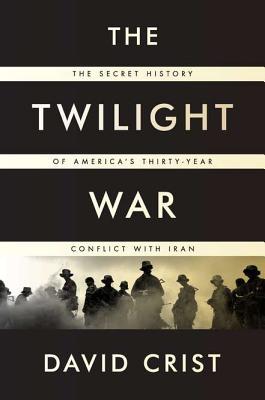
The Twilight War: the Secret History of America’s Thirty-Year War with Iran
656 pages
© 2013 David Crist

 In the presidential campaign of 2008, John McCain made plain what kind of aggressive foreign policy he would pursue by half-singing a chipper little ditty called “Bomb Iran”, to the tune of the Beach Boys classic, “Barbara Ann”. His malice was not even creative, for the song originated as a parody in early 1980. That parody, though, was close to being reality, for throughout the 1980s.  American ships engaged in a quasi-war against Iran, ostensibly to protect the free flow of oil amid the Iraqi invasion of Iran. In The Twilight War, Kevin Crist documents the complete diplomatic and military history of the United States and the Islamic Republic of Iran, from the Carter administration to the the frustrated diplomacy of Barack Obama. Written by the son of a CENTCOM general, it approaches being the American equivalent of Iran and the United States, written by an Iranian aide who appears here in interviews. The Twilight War goes into much more detail on military operations, however.
The essentials of the failed Iran-American relationship are known to most everyone: in 1953, the United States and Britain collaborated to oust Iran’s democratically-elected president, Mossadegh, and later militarily supported the increasingly authoritarian shah until he was thrown out in 1978. Most Americans were blissfully unaware that anyone in Iran had reason to cry foul until student revolutionaries seized the American embassy and held over a hundred American citizens, some of them civilians doing aid work, for over a year. The water was thus poisoned from both wells, leading to bumperstickers and Beach Boy bombing threats in America, and cries of “Death to America!” in Iran. Yet the power-caste in D.C cares little for principle; for them, what mattered about Iran was not that it had abused Americans, or that it had previously been manipulated by the American government: what mattered to the fellows in the Pentagon and Langley field was that Iran stood between the Soviet Union and the oil wealth of the Persian Gulf region. If Iran could be enlisted as an ally against the godless Soviets, huzzah; if not, well…no revolutionary government stays popular, and the invasion plans were already on the books.
Thus the initial approach to Iran was framed within not its Islamic status, but within the frame of the Cold War. The CIA accordingly passed in information to their newly avowed enemy, Khomeini, to help him exorcise the communists and other Soviet sympathizers from his rank. At the same time, however, the CIA and other military intelligence agencies attempted to create networks of informants and agents on the ground Iran, who would lay the groundwork for an invasion if that ever became necessary. What no one expected was Saddam Hussein’s invasion of Iran, which wasted over a million lives over an eight-year period. After Iran survived Hussein’s invasion and prepared to mount its own, the west –- organized by the United States – obliquely but purposely supported the Iraqi cause by selling war material to Saddam and interfering with Iran’s ability to purchase in European markets. More directly, the United States took on a military role in the Persian gulf, protecting oil tankers and other neutral ships from the Iranian military – and ignoringIraqi movements, as they did when an Iraqi fighter fired a missile at the USS Stark. As with the USS Liberty incident, in which Israel nearly destroyed an American ship, the blood in the water was quickly covered over in the interests of diplomacy. Such was the American commitment tin the Gulf that a separate global command, CENTCOM, was created to watch the middle east, and two mobile sea-bases were created in the Gulf itself to respond to Iran’s “guerilla war at sea”.

Later on, after the Soviet Union collapsed, there were moments that the United States and Iran might be able to build upon.The United States’ growing commitment in the middle east, prompted by the Gulf War, created no small amount of resentment and fear in Iran, however. For decades, Iran had been the plaything of the British and Russian empires, then the target of both the American and Soviet spheres of influence, and now the Americans weren’t even settling for fighting through proxies: their tanks were right there, in Saudi Arabia. Terrorism became an increasingly large factor in foreign relations, and the American commitment to both Saudi Arabia and Israel – Iran’s most unfavorite neighbors – continues to be a barrier. More recently, through the Bush and Obama administrations, the prevailing official reason for Iran’s designation as classroom pariah has been its pursuit of nuclear energy and the possibility of that pursuit also allowing Iran to manufacture nuclear arms.  Frankly, I no longer trust the official reasoning of anyone coming out of D.C —  coming of political age in age of Iraq’s phantom WMDs, and continuing to see the United States talk about both sides of its mouth in Syria  — but the growth of the genocide in a bottle club is a serious issue.  Still, as Crist’s account shows, there have been numerous instances when Iran and the United States were making headway, and then one party of the other decided not to follow through in good-faith arrangements.    

Although The Twilight War’s detailed account of military operations and aborted diplomatic deals can sometimes appear overwhelming  in its thoroughness, Iran is not fading in importance.  To the contrary: only recently, an army of Russian, Iranian, and Syrian troops were able to surround ISIS and its allies in Aleppo.  When the United States toppled Hussein’s regime in Iraq in the hopes of creating a democratic opponent of Iran,  Iran’s influence in Iraq instead swelled.  They’re not going away, and after sixteen years of constant war in the neighborhood, Americans aren’t particular enthusiastic about more nation-building games.   This book is a good resource for understanding what has happened so far.  In the light of the seemingly unpredictable Trump, however,  who knows what will happen? (Given Trump’s business ties in Saudi Arabia and his avowed support of Israel, my guess is that he’s more likely to be antagonistic towards Iran than now.) 
Related:
Posted in history, Reviews | Tagged , , , , , | Leave a comment