The Unthinkable

The Unthinkable: Who Survives when Disaster Strikes — and Why
© 2008 Amanda Ripley
288 pages

unthinkable


We all wonder what we would do in an emergency. How would it feel to be onboard a doomed plane, or trapped in a burning building?   Would we panic?   The Unthinkable  combines extensive interviews with the survivors of various disasters and a review of  psychological studies with a fear/panic/disaster-response to share what really happens in a moment of crisis, and what we can do better.

Oddly enough, panic as a reaction isn’t the most common.  Most people involved in an intimate disaster experience a strange kind of disassociation, a sense that whatever is happening is unreal. Some will linger in denial, sitting calmly long after they should have begun taken action.  When they finally do stir to move,  latent instincts for gathering information and belongings further slow responses.  Once in action, fear and adrenaline can kick in, and these can both help or hinder —  increasing speed and stamina, for instance, but at a cost of cognition – and that can lead to sorrow, like fifty people dying in a parked airplane because they were incapable of opening the doors and proceeding out in an  orderly manner when the cabin filled with smoke.

There are those, however, who are not sitting in a stupor, or fumbling clumsily at locks and straps. There are people who, in a disaster recognize  it and begin taking action immediately.   Part of this may owe to genes –  the size of the amygdala is a contributor – but the most pervasive difference-maker is training and preparation.  It’s vital to have a realistic appraisal of one’s environment and the dangers in it, however: people often have a distorted view of what is most likely to happen to them, fearing unusual disasters like nuclear meltdowns far more than more mundane events like kitchen fires or automobile accidents. Those who anticipate what kind of things are likely to happen, those who make a plan — those are the people who, when push comes to shove, are ready to act.  Ripley notes that working-class males overwhelm this category, which she suspects owes to their dominating dangerous jobs that entail anticipating physical threats.

The Unthinkable isn’t a book devoted to celebrating the Few, The Proud, The Possessors of an Internal Locus of Control..   Instead,  following the survey of how we react in disasters,  it  shifts to an argument that American society,  both government and civil structures, have a top-heavy approach to disaster response that discounts and demeans the ability of ordinary people to make a difference, hiding information to prevent panics and keeping response tools reserved for professionals.    In any disaster, it’s the ordinary people on the ground who make the greatest  impact –   they are there long before emergency personnel, present when seconds can make the difference between life and death.  What’s most crucial is awareness and training: People who are aware of the dangers in any situation, and prepared to respond to them,  will at the time of crisis be able to recognize what they’ve trained for and move, based on their prior practice.  Even simply reviewing the safety cards in an airline seat,  or knowing where the emergency exits are when present in an unfamiliar room, can make a decisive difference when something happens.

The Unthinkable is one of the most thoughtful and all-around interesting books I’ve read all year, from the disaster play by plays – heroics included —  to the psychological analysis.   The amount of time spent in the Twin Towers was particularly informative – I had no idea there were any survivors from above the impact zones in either tower, but the South Tower had one stairwell that could be made navigable, and four people were able to make it out before the building was lost. I also didn’t realize that the Port Authority had made some token efforts at disaster mitigation following the 1993 attack, but that these were largely ineffectual: people appointed as fire wardens throughout the building were never given any training, and the procedures promoted were fairly useless —  gather  in a common area and await instructions from The Authorities.   (Instructions like… “The South Tower is secure. Please return to your offices”, which turned hundreds of people following their instincts out of the building into victims  fifteen minutes later.)

Definitely recommended.

Related:
How To Be Your Own Bodyguard, Nick Lane.  A piece of advice common to both of these books is a negative visualization and practice routine, i.e: what could go wrong, and what steps do I need to take to response?  The  mere act of rehearsing what you might do helps when it needs to be done.


Posted in Reviews | Tagged , , | 6 Comments

A Plain Life

A Plain Life: Walking my Belief
© 1998 Scott Savage
224 pages

walk

You have to be careful about working in a library. Sometimes books change your life.  Scott Savage and his wife were both librarians whose environmental interests put them on a path – spurred by books —  altogether different than they would have ever expected for themselves.   For Scott, in particular, it would lead to an eight day pilgrimage to Columbus, Ohio, to surrender his license to drive —  a purpose-filled ritual that for him would seal his decision to  live more deliberately, to drop out of a noisy, frantic, and meaningless consumer existence.  In A Plain Life, Savage reflects on his and his wife’s spiritual journey even as he makes his way to the city through Amish country.

All the answers are not in books, but they can point the way, and so it was that one introduced the Savages to a viable alternative to frenzied consumerism: the Amish.  The plain folk were living proof that the technoid future was not inevitable; it was still possible to live in another way.    The Amish made Scott aware that what he was most yearning for was community – something  most of us in the United States have lost, living as we do in eternal placelessness.    The Amish are not technophobes, but rather a community who thoughtfully consider a given technology’s potential for disruption of their home lives, community health, and spirituality.    Neither Scott nor his wife were religious practitioners, and had consider themselves closed to any Christian tradition – and yet the Amish re-opened that door.

The tradition which the Savages would ultimately embrace, however, was not the Amish but rather the Quaker.  Each chapter follows Scott on his day’s walk, and the text follows his thoughts – sometimes dwelling on the growth of his ‘plain’ practices, sometimes on the history of the area, sometimes on technology and modern life. What brings each day into focus in his religious practice, as he works on memorizing the Beatitudes throughout the sermon; these verses, and his hymns,  often color his thoughts for the day — connecting “blessing are the meek”, for instance,  with a reflection on humility and self-knowledge, connecting also to the places he is traveling through — like a peat island that is disintegrating.

A Plain Life has a lot to say, though how much is heard depends on the audience.  Presumably few people would adopt a life like Scott’s — a home without electricity, for starters — but I imagine a much larger number  would be willing to admit their own dissatisfaction with the atomized lives so many of us lead.  In any case,  a central lesson is that none of us are are free in the sense that we like to think we are, in that we escape the consequences of our actions; our uses of technology shape us, just as they shape our world, and not necessarily for the better.   Scott may have been thinking of how televisions disrupt family life, and how automobiles spur people to continually hunt for satisfaction elsewhere, across the horizon — but  today such inroads are even more invasive, the struggle more close-quarters.  Conversations about technological disruption seem more common,   as people looking for answers as to why politics on every side has gotten more vicious  blame social media.    The tech facilitates abuse, but we’re all the ones feeding the beast.

If Savage rings any interest, I would highly suggest his anthology, The Plain Reader. It’s stayed by my bedside  ever since I read it.

Posted in Reviews | Tagged , , , , | 2 Comments

The book as a squarish chunk of hot smoking conscience

In autumn of 2017, The New Criterion published an article about Aleksandr Solzhenitsyn’s “cathedrals“, his Gulag Archipelago and a series of epic ‘novels’ known as the Red Wheel series. I delayed posting this until I was finished with the trilogy, and promptly forgot about it. Given  that I’m facing two enormous Russians at the end of this year, I thought now would be appropriate to share it.

Some excerpts from the piece:

“In taking literature so seriously, Solzhenitsyn claimed the mantle of a ‘Russian writer,’ which, as all Russians understand, means much more than a writer who happens to be Russian. It is a status less comparable to “American writer” than to ‘Hebrew prophet.’ ‘Hasn’t it always been understood,’ asks one of Solzhenitsyn’s characters, ‘that a major writer in our country . . . is a sort of second government?’ In Russia, Boris Pasternak explained, ‘a book is a squarish chunk of hot, smoking conscience—and nothing else!’ Russians sometimes speak as if a nation exists in order to produce great literature: that is how it fulfills its appointed task of supplying its distinctive wisdom to humanity.”

“Like Gibbon’s Decline and Fall of the Roman Empire, Gulag is literary without being fictional. Indeed, part of its value lies in its bringing to life the real stories of so many ordinary people. When I first began to read it, I feared that a long list of outrages would rapidly prove boring, but to my surprise I could not put the book down. How does Solzhenitsyn manage to sustain our interest? To begin with, as with Gibbon, readers respond to the author’s brilliantly ironic voice, which has a thousand registers. Sometimes it surprises us with a brief comment on a single mendacious word. It seems that prisoners packed as tightly as possible were transported through the city in brightly painted vehicles labeled ‘Meat.’ ‘It would have been more accurate to say “bones”,’ Solzhenitsyn observes.”

“Real people do not resemble the evildoers of mass culture, who delight in cruelty and destruction. No, to do mass evil you have to believe it is good, and it is ideology that supplies this conviction. ‘Thanks to ideology, the twentieth century was fated to experience evildoing on a scale of millions.’

One lesson of Gulag is that we are all capable of evil, just as Solzhenitsyn himself was. The world is not divided into good people like ourselves and evil people who think differently. “If only it were so simple! If only there were evil people somewhere insidiously committing evil deeds, and it were necessary only to separate them from the rest of us and destroy them. But the line dividing good and evil cuts through the heart of every human being.”

Posted in quotations | Tagged , | 4 Comments

Digital minimalism baby steps

A few readers were interested in updates on my experiment in digital minimalism,  so…here goes!   The ground rules I’ve followed have been:

  • Email checked only 2-3 times a day, around meals, preferably not starting until after lunch.
  • Social media limited to an hour after supper,  excepting goodreads because it’s not a timesink
  • No device use in bed or in active company
  • Streaming ends an hour before bed time.

I made a few  changes on my computer and phone to make the experiment more likely to succeed;  I removed app shortcuts for Facebook and Reddit off my phone, and installed an extension on Firefox that allows me to  control whether or not images load on a given pages.  On facebook, I’ve also started unfollowing noise-y accounts.

The results have been….middling to good.  While my digital fasting record has been patchy —  I’ve taken a “quick look” at email/reddit/etc  with my morning coffee more often that I’ve abstained —   I’ve still experienced positive results.  Beyond an uptick in personal productivity (reading or work around the house),   I’m also quickly conscious and aware that the bulk of my time on facebook is wasted browsing, and the only times I’ve hung around have been when I was chatting with a friend. I can avoid that by remembering to use the Messenger app on my computer.   Reddit can be  more productive for me,  mostly because the majority of subreddits I follow are informative rather than casual, r/askreddit being the most prominent exception.  I’ve also been more mindful about my motive in sharing videos or articles on facebook.   Several times I’ve seen or heard something that my first and immediate impulse was to share…but on thinking about it, I decided  — nope!    A quotation from Marcus Aurelius drifted up from memory, reminding me that whatsoever things are good are good in themselves;  I don’t need to share and see little “likes” to savor a moment.

For the next phase,  I think I will remove the facebook app I use (Lite) from my phone entirely, and log out of my account on my browser, so that I cannot easily take a quick peek. 

Someone (Lydia, I believe) also asked for an update in regards to intermittent fasting; I’ve lost ten pounds, although  I think it would have been more had I not been hobbling for two weeks following a strain to my Achilles’ tendon.   My efforts to mix up my exercise have taken me to a local basketball court, where in the mornings I can wile away an hour in the same way I spent many evenings in middle school — shooting hoops and chasing after my many bounced-off errors.    It’s less repetitive and more fun than just walking loops, whether at home or at the gym.  I was honestly surprised by how quickly I adjusted to eating only two meals a day — it was if, all this time, I’ve eaten breakfast more because I was “supposed to” rather than because I needed it.   Halloween has been a challenge, in part because of all the sweets which collect in the library’s break room. It will only get worse by Christmas, and we already have four bags of cookies in addition to the box of leftover Halloween treaties for the kids who stormed through today.


Posted in Reflection | 8 Comments

Turn off, tune out, and drop in

hearth

“If we had a motto, it might be the opposite of the one I heard in the 1960s telling us to ‘turn on, tune in, and drop out’. Our slogan could urge the world to turn off (virtual reality), tune out (advertising and materialism), and drop in (on your neighbors, to let them know it’s time to stop being lonely in America). Drop in – into something more real, more loving, than what you’re currently experiencing.”

My Plain Life: Walking my Belief, Scott Savage

Posted in quotations | 3 Comments

Conquerors

Conquerors: How Portugal Forged the First Global Empire
© 2015 Roger Crowley
364 pages

conquerors

Roger Crowley’s Conquerors is a history that starts with hope and ends in horror, at least of the slasher-film kind. Suffice it to say, if you ever chance to meet a 15th century Portuguese officer while time-traveling, run for your life.     The story opens with Portugal, recently triumphant in its bid to push the Moors back into northern Africa,  joining the hunt for the Indies, but once it finds them…..well, it’s not pretty.

In the 16th century,  Europe was waking up; its princes were no longer warlords,  but instead men with increasing coffers and confidence.  New ideas were opening the doors to prosperity, and creating tools that could create even more. Across the world, the nations of Europe knew, there are spice-kingdoms — but access to them was closed by the Ottoman Empire, now having finally taken Constantinople. What few shipments trickled through the hands of Venetian middlemen through their Arab contacts were enormously expensive.    All those who could afford it wanted to find another way  — and while Columbus decided to sail west, into the great unknown, on a chance that the world was smaller than the experts said it was (it wasn’t), Portugal worked to find a way east,  around a similar great unknown: Africa.     But just as Columbus’ trip west mixed glory and blood, so to did the Portuguese endeavors.

The mayhem begins, as it often does, in mutual misunderstanding.  The Portuguese lived in a world where Europe was constantly under siege from a foreign threat,  with a Moorish hold on southern Iberia and the powerful Ottoman empire controlling most of eastern Europe.  When the Portuguese arrived in the Indian ocean, they brought their fear and battle-rage with them.  Their attempts to purchase spices were undermined by Arab merchants serving as translators, who looked askance at any competition. Instead of viewing this as commercial rivalry, Crowley writes,  the Portuguese saw the merchants through the narrow visor of a war helmet.    Bombards were introduced, and within a short time the Portuguese have declared an all-out war against any Muslim activity in the Indian Ocean, quickly ratcheting up both the numbers of ships they sent and the mound of bloodshed and horror they were willing to inflict on those who did not acknowledge their new lord in the king of Portugal.  The various nations and small states around the Indian ocean, both African and Asian,    were baffled and horrified when the Portuguese began seizing ships — not to take as booty, but simply to destroy.  They also began  imposing a tax and granting safe-conduct passes to friendly ships, with unbelievable arrogance.  Although I already knew there’s nothing like war to completely pull the civilized shroud off a human being – -we are worse than chimpanzees once the fury of battle has overtaken us —  there are plenty of reminders here of humanity at its worse, from the firing of ships with innocent pilgrims aboard (including women and children), to the deliberate torture and desecration of those who would not comply.

On the one hand, Conquerors is  very readable narrative history, especially for readers without a trace of knowledge about the subject; I knew vanishingly little about Portugal beyond its role in the Napoleonic war. The early sections chronicling their determined and often mortal attempts to chart the extent of Africa, and see if there was a way through it or around it, are inspiring. But the bloodshed that follows and dominates most of the history make it feel like a slasher film, with the Portuguese playing the implacable monster that won’t stop hunting the main characters — and once the various powers of the Indian ocean realize they had to fight, things get even bloodier.

Related:

If you want more bloodshed, try John Keay’s The Spice Route, which chronicles not only the wars Portugal raised in the Indian Ocean, but the conflicts that then pursued between Spain and Portugal, then the English and Dutch.    Spice and greed drive human beings barking mad.

Roger Crowley has written other books, including City of Fortune, a history of Venice.


Posted in history, Reviews | Tagged , , , , , , | 8 Comments

Gun Guys

Gun Guys: A Road Trip
© 2013 Dan Baum
353 pages


Why do Americans love guns so much?  Dan Baum knew why he loved them. He was the skinny misfit who was mocked and left behind at summer camp, until he discovered the shooting range – a place where anyone who was willing to learn could become a marksman, even fat kids and runts.  It was there that his lifelong fondness for firearms began, although his background meant that he was well outside American gun culture.  He was a well-heeled liberal Jew from New Jersey, in his own words – – one who loved the kind of things most ‘gun nuts’ hate – taxes,   permissive immigration, and an active federal government.  A journalist by trade, Baum began exploring the country to understand  more about his fellow hobbyists,who  he felt so estranged from otherwise.

Aware that he didn’t exactly look like a good ol’ boy, Baum did his best to blend in by sporting an NRA ballcap, and wearing his vintage pistol instead of keeping it in a bedroom safe. Throughout his travels, he met all kinds of gun owners – hunters, competitive shooters, survivalists,  obsessive collectors, historical reenactors,  and civil rights activists.  Establishing a rapport, Baum searched out in conversation why they liked guns, or why they thought other people did.   He also threw himself into his questions, exploring behavior he wasn’t entirely comfortable with to try and understand it.  He participated in a Texas boar hunt, for instance, with the express purpose of killing as many of the pestilential porcines as possible. One of the more interesting chapters involves a visit to Hollywood, where Baum explores the storage facilities that rent out the weaponry used in movies; the facility includes an exhibit on retired pieces which are famous, like those carried by John Wayne and Clint Eastwood.   One recurring story is the moddability of certain firearms, particularly the AR-15, which one fond owner refers to as “barbie for guys”.

Although Baum heard a great deal about the legal and revolutionary sanctions for an armed citizenry,  the importance of tradition,  admiration for craftsmanship, the need of self defense,  the outsized role of the frontier in American culture, and so on,  it wasn’t until late in the book when his behavioral changes synced with what he was hearing from other gunowners that he had a  revelation of sorts. Wearing a firearm meant living in the presence of death;  however aesthetically attractive a piece might be, however fun it was to fire, a firearm is inherently dangerous; to wear one, to use one, meant becoming a master over one’s own fear of mortality.  Mastering that fear also meant mastering the weapon, learning to use it properly — not only to draw, aim, and fire it, but to read situations and decide when the use of force was appropriate or not.  Although Baum felt stressed and paranoid when he first wore a pistol, as time passed that faded into a constant state of background alertness. He was more  aware of the people around him and his potential responsibility toward them if something happened and he was needed to stand in the gap.  To those accustomed to this feeling of responsibility,  being nagged about guns was personally offensive, like being infantalized.

Baum’s journey took him into a lot of thoughtful territory, and  regardless of where a random reader finds himself on the gun policy spectrum, there’s  something here to consider, as Baum himself struggles with conflicting values. Although by book’s end Baum argues that gun culture has to exercise more communal responsibility , policing irresponsible behavior outside the government (through group mores, organizational regulations, etc),   his journey among the gun guys makes him appreciate the hobby and its enthusiasts more, as well as the difficulties and futility of some proposed legislation.

Posted in Reviews | Tagged , | 5 Comments

Agatha Christie and Tony Soprano

christie

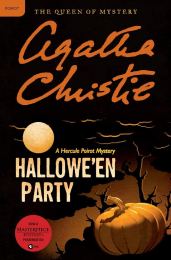
Over the weekend I finished two titles that don’t bear elaborate reviews. First up was Agatha Christie’s Hallowe’en Party,  a murder mystery set during this spooky-fun season.  Not everyone is having fun, though, especially not little Joyce, who – – shortly after announcing that she’d once seen a murder – turned up dead in the apple-bobbing tank.    So a Halloween party for teens turned into an occasion for horror,  and Hercule Poirot was called to the case.  Although the prevailing theory among Joyce’s surprisingly stoic friends and family is that some random mental patient,  turned out from the asylums for lack of beds, broke in and decided to scratch his itch for adolescent murder, Poirot finds this premise unlikely and works on his suspicion that her claim to have seen a murder, and her being murdered, were connected. He therefore is pursuing two cases at once: what did Joyce see, and who was involved who might also be at the party?     The tale is entertaining, though not nearly as interesting as Murder on the Orient Express. 

saymyname


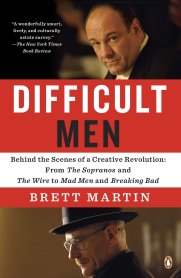
Next up was Difficult Men,  a history of a trend in turn-of-the-century broadcasting that saw serious dramas with troubled characters appear from a haze of episodic shows in which nothing serious ever really happened.   The stars of the show are David Chase and David Simon, the first an innovative if edgy showrunner who initiated a revolution with The Sopranos, and the latter a journalist whose work took him to television, creating The Wire.  Vince Gilligan also appears in the last section of book, with his extraordinary stylistic creation Breaking Bad, but   The Sopranos dominates.   This was a first for me; other books I’ve read about television the past have been Star Trek related.  I count The Sopranos and Breaking Bad as two of the best written shows I’ve ever watched, however – although the first was so violent that it took me ten years to finish the show’s six seasons .    As I sometimes watch videos evaluating films and tv from a production POV – the use of shots, the development of character,  etc – I thought I’d find this generally interesting, but as it was, only the bits on Tony and Walter’s respective dramas held my attention.   Although I’m still interested in reading the books that inspired The Wire (they’ve been on my Amazon list for over a decade!),    I’m not so much interested in watching more gritty television, at least not for a now. 

Posted in Reviews | Tagged , , | 7 Comments

American Rifle

American Rifle: A Biography
© 2008 Alexander Rose
512 pages

rifle

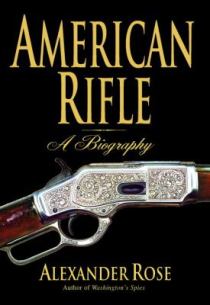
The quintessential American firearm is the rifle,   which through centuries of colonization and growth,  has served in both myth and fact.  I use myth not in the modern disparaging sense, but rather its traditional and valuable sense:   myth as meaning. The rifle is the perfect complement to the American legend of the  ‘rugged individualist’ — whether he’s a sharpshooter,  taking down British officers in the Revolutionary War, or a plains pioneer,  defending his family from wolves or bringing home supper.  American Rifle: A Biography is a fulsome history of how rifles in America evolved and entrenched themselves, and grew both in culture estimation and in technical sophistication.   The rifle’s technical maturation is the book’s primary focus, but culture enters in often, as we learn about the NRA originally organizing to train the American public into marksmen,  and the German military’s influence on American military organization.  German arms also inspired one American rifle, as well as a Soviet piece, the AK-47.  Slowing the book down atimes is the extensive coverage of  sludgy bureaucracy  that new advances had to get through to become the official service weapon of the military, and this sludge becomes progressively thicker throughout the years. It’s thus a… challenging read for the potential reader who isn’t a total rifle enthusiast, and my interest peaked with the M1 Garand.  I spent two months trying to move from 1940 to 2003, through the mire of extensive debates  between Europe and America on what should be the official round of NATO, followed by the problems of the M14.

Related:
American Gun, Chris Kyle


Posted in history, Reviews | Tagged , , | 2 Comments

The Hidden Life of Trees

The Hidden Life of Trees: What they Feel, How they Communicate: Discoveries from a Secret World
© 2016 Peter Wohlleben
288 pages

trees

Joyce Kilmer offered that he had never seen a poem as lovely as a tree —  and I for one can’t remember reading a more fascinating science and nature book for a few years.   Peter Wohlleben is a German forester who began his career not being able to see the forest for the trees. He saw the trees themselves, of course, in their neat and orderly rows so amenable to easy harvesting —  but he didn’t realize how complex and deep a system a natural forest really is.    Neither did I, frankly.   In The Hidden Life of Trees, Wolhleben takes us into a world where trees share information and resources, not only with themselves but with an underground network, a world where trees are less insular  towers and more members of varied and complex local ecosystems.

Let’s start with the coolest part of this book: the mycelial web.  In a natural forest, trees are connected to one another through an underground network of fungi, an underground mesh that allows individual trees, even from different species, to share resources.   Although above ground trees do compete for light, below the dirt is where deals are done.    Trees don’t just swap resources throughout the year, taking turns to support one another as each reaches its strength in different seasons: they also release scents to allow their neighbors to know when predators are around, chewing leaves and branches: enter each tree’s self-defense system, making themselves unpalatable to the predator.  So enmeshed are trees together that when one is stricken by lightning or some plague of bugs,  others may suffer for its absence —  robbed of its particular contributions to the underground exchange.

Although we tend to see individual trees in a forest, Wohlleben argues that trees have relationships, that older trees play a role in their offspring’s lives, if they’re nearby. While we may regard a fast-growing tree as a positive sign, to Wohlleben this is in fact an aberration: in the world of trees,   those saplings that grow slowly under the shadow of their forebears  prove to be the hardiest, while the energic young turks all die fairly quickly. There’s a circle of life in the forest:  even a dead tree feeds and protects its survivors,  making it more difficult for predators like deer to move through the forest, and slowly decomposing into a rich humus that the neighbors draw strength from.

Wolhleben’s book explores far more than this, of course, but learning about the communal relationships between trees fascinated me like nothing else.  The author also explores trees’ live cycles,   and how they “move” their ranges over the year. Other chapters delve into how animals make use of trees,  to the detriment or advantage of the trees themselves.  Wohlleben’s review also includes sections on why urban and transplanted trees struggle, and why it’s hard for humans to understand the slow pace of arboreal evolution. (A ‘natural forest’ takes at least five centuries to truly mature!) It’s all-around fascinating. I’ve long appreciated trees for their beauty and the bounty of life they can support – the birds and squirrels and such  —  but now every bit of them, brims over with new fascination.


Posted in Reviews, science | Tagged , , , , | 7 Comments