A year in space: some quotes and something completely different

Scott Kelly had his brother send him a gorilla suit so he could pull pranks on his coworkers. Pranks look…a little different on the International Space Station.

And now, some quotes.

The space shuttle, fully fueled with cryogenic liquid, creaked and groaned. Soon this sixteen-story structure was going to lift off the Earth in a controlled explosion. For a moment I thought to myself, Boy, this is a really dumb thing to be doing.

We called this abort mode “return to launch site,” and it required the shuttle to fly Mach seven backwards. No one had ever tried this and no one wanted to. (John Young, when he was preparing to command the first shuttle launch, said he hoped never to attempt an RTLS because it “requires continuous miracles interspersed with acts of God.”)

It’s a strange sight, glinting in the reflected sunlight, as long as a football field, its solar arrays spread out more than half an acre. It’s a completely unique structure, assembled by spacewalkers flying around the Earth at 17,500 miles per hour in a vacuum, in extremes of temperature of plus and minus 270 degrees, the work of fifteen different nations over eighteen years, thousands of people speaking different languages and using different engineering methods and standards. In some cases the station’s modules never touched one another while on Earth, but they all fit together perfectly in space.

I tug and push and pull for a few minutes, and finally the hatch cracks open. The reflected light of Earth rushes in with the most abrupt and shocking clarity and brightness I’ve ever seen. On Earth, we look at everything through the filter of the atmosphere, which dulls the light, but here, in the emptiness of space, the sun’s light is white-hot and brilliant. The bright sunshine bouncing off the Earth is overwhelming. I’ve just gone from grunting in annoyance at a piece of machinery to staring in awe at the most beautiful view I’ve ever seen.

At one point I post a picture of one of the zinnias on social media and get back criticism of my botany skills in return. “You’re no Mark Watney,” quips one smart-ass commenter, making reference to the stranded astronaut in The Martian. Now it’s personal.

It’s a great Twitter moment, unplanned and unscripted, and it gets thousands of likes and retweets. Not long after, a reply appears from Buzz Aldrin: “He’s 249 miles above the earth. Piece of cake. Neil, Mike & I went 239,000 miles to the moon. #Apollo11.” There is no good way to engage in a Twitter debate with an American hero, so I don’t.

NASA plans for everything—we even have an early pregnancy test and a body bag.

This is one of the things that some people find difficult to imagine about living on the space station—the fact that I can’t step outside when I feel like it. Putting on a spacesuit and leaving the station for a spacewalk is an hours-long process that requires the full attention of at least three people on station and dozens more on the ground. Spacewalks are the most dangerous thing we do on orbit.

I’m acutely aware that if I become detached and run out of fuel and the station is just one inch from my glove tips, it may as well be a mile. The result will be the same: I will die.

Posted in quotations | Tagged , | 2 Comments

It’s not so lonely out in space: three to celebrate Apollo 11

Fifty-two years ago, men from Earth touched down on the moon and inaugurated a new era in human exploration. I usually re-watch From the Earth to the Moon (a Tom Hanks docu-drama that is in my “Everything is burning but I want to take this with me album, along with Cosmos and Civilisation) for the occasion, but this year I chose to do celebratory readings, first.

H.G. Wells’ The First Men in the Moon, published in 1900, recounts the extraordinary journey of an ambitious prospector and a scientist, who — after the scientist discovers a way to create a metal ‘transparent’ to gravity — fashion a ship to take them to the Moon. Although the scientist Cavor is purely after knowledge for its own sake, his companion Bedford sees the ship as a source for unlimited wealth: think of all the minerals out there waiting to be mined! No sooner have the men landed on the lunar surface, though, have they gotten lost, intoxicated, and …a little tied up by the locals. Wells’ curious title, First Men In the Moon? That’s not a typo; Wells’ moon has life, a civilization existing within its core, and in due course the curious scientist and his avaricious cohort are both in mortal danger, and rather humbled by it. First Men impresses in several regards; Wells seamlessly transitions from technical speculation to social , and considers the human drive to explore (and sometimes, exploit) enroute. Although Wells’ speculations about a lunar atmosphere and life were off, he’s much closer to the mark in anticipating, say, the intense experience of encountering a lunar sunrise, or the stars without the obstructive filter of Earth’s atmosphere. Very much recommended for classic SF fans.

Next up, Scott Kelley’s Endurance. Captain Kelly and a Russian comrade were both part of the Year in Space experiment, in which they spent 365 consecutive days aboard the International Space Station to study the effects of long-term space habitation on the human body, a question studied since the Skylab days. The scientific contribution of Kelly’s mission isn’t the core content here, though, as the data is still being evaluated; instead, Kelly offers a two-part memoir, alternating between his year in space and the life that brought him from being an academic nonstarter to operating on the literal front lines of science — helping service the Hubble and conducting botany experiments of his own, abroad the ISS. Having read Mark Massimino’s memoir so recently, I was amused at the commonalties — their mutual obsession with The Right Stuff and the inspiration of Shackleton’s voyage — but Kelly has an altogether different background from the engineer-turned-astronaut Massimino. Kelly is almost a throwback to the Right Stuff days, approaching NASA via service as a Navy test pilot following service in the Merchant Marine. This memoir is enjoyable, but most of its interest lies in the Year in Space project.

Lastly, a different ‘spaceman’ — a friend’s loving reminiscence of the life of Leonard Nimoy, more popularly known as Spock. Kirk and Spock’s friendship was mirrored in the bond their actors shared, one forged not merely through a three-year stint on a science fiction show, but decades of conventions and shared battles. It’s unusual for an actor to have that kind of bond, Shatner admits at the outset; it’s far more common for actors to become very close on set, and then drift away as soon as the launch party is over. Star Trek‘s unusual history, though — its premature cancellation, its new life in syndication, its return in the eighties and ninenties with more shows and serials — continued to reinforce the working relationship Nimoy and Shatner had established, and over the years it became a personal link; they were tied by affection and history, not merely their resumes. Having previously read (and re-read-, and re-read) I Am Spock, Nimoy’s autobiography, I knew of his attachment to Shatner, and the jokes they were fond of playing on one another, so it was doubly amusing to see Shatner’s take on that history — but Shatner goes into more detail than Nimoy on much of Nimoy’s other work, from poetry to photography. The wonderful thing about Nimoy, Shatner writes, beyond his extraordinary kindness and the seriousness with which he took his work, was his diverse energy: Shatner could never tell what Leonard might be doing in his off-hours — flying a plane, exploring a given subject in a photographic theme, or traveling to the Soviet Union to connect with his distant relatives. Absolutely worth reading for Trekkies, or anyone who admires Nimoy’s work — or merely the character of Spock. I read this immediately after watching For the Love of Spock, which is also very much recommended. Its only problem is it has interviews with JJ Abrahams, which can endured by booing at the screen.

Space Camp will continue with more of the right stuff and a set of two books on a very special vehicle.

Posted in Classics and Literary, Reviews, science fiction | Tagged , , , , , , | 6 Comments

Spaceman

Spaceman: An Astronaut’s Unlikely Journey
© 2016 Mike Massimino
336 pages

All his life, Mike Massimino wanted to be an astronaut. He was six when he saw Neil Armstrong’s famous small step, and he wanted to be out there with the men of Apollo and those who followed.    But the way to the stars, then as now, isn’t a straight line:  unlike, say, becoming a lawyer, there’s no flagged path, with obvious intermediate goals to aim for.  “Mass” was unlikely to ever be an astronaut, anyway – he was a working-class kid from Long Island who had had barely left his neighborhood.  He couldn’t even see that well – so how did he not only find his way into the astronaut corps, but distinguish himself to the point that he was chosen to work on the Hubble Space Telescope – twice?    Spaceman is a memoir of dogged persistence in the face of adversity and mistakes, followed by moving reflections on his time in space, and the meaning space exploration has for the human spirit.    It is far and away the best of the post-Apollo astronaut memoirs,   will be remembered as one of my favorite astronaut books, period, and is a must-read for any space enthusiast, or those who want to be reminded of the fruits of discipline, determination, and sheer  stubbornness.  

“Mass” in his early years is a Joe Average:   liked by everyone, but not particularly distinguished in any other way.    Although he wanted to be an astronaut, it wasn’t a likely possibility – and so he pursued studies as an industrial engineer, but never forgetting his original desire.  He thought perhaps working as a contractor supplying NASA with equipment might be an ideal marriage of the attainable and the dream,   and from there he stumbled his way closer to space — falling often, but always picking himself up and moving forward.  Massinimo inspires the reader throughout the book – in the beginning, through his constant work to recover  from mistakes (enrolling in the wrong program,  failing tests),  soldiering through with help from mentors and frequent viewings of The Right Stuff, —  and in the second half, through his work as a bonafide astronaut. 

Mass offers a detailed ridealong through his application and training process as he rose from Astronaut Candidate to Mission Specialist. All this is of enormous interest to a space junkie, of course, but Mass makes it clear that what he values most about NASA is its sense of camaraderie, the intensity with which astronauts support one another.  The same spirit of brotherhood that was displayed when the Mercury 7 supported John Glenn  when higher-ups threatened to remove him from the roster after he refused to compel his wife to speak with Johnson, was still strong during Mass’s  time with NASA. It was never more clearly shown than in 2003, when Columbia broke apart in the atmosphere while returning to Earth. The destruction of Columbia  especially moved Massimino, because that flight could have been his, as his flight was swapped with 109’s given the higher priority of the job.     

Massimino has a gift for communicating the itch that drives the adventurer, the explorer on – the itch that has led humans to glory and death for millennia, driving us to  launch ourselves into the winds, to  struggle up mountains actively attempting to kill us, and even  to launch ourselves into the void of space.  He sees the astronaut life as a unique blend of scientific and physical exploration — Galileo meets Shackleton. When Massimeno saw the Earth for the first time – seeing it from the distance of the Hubble, and so able to see the full globe in all its splendor —  he was struck with reverent awe.  It’s one thing to be told the Earth is a planet, a fragile bit of dirt hurtling through space,  and quite another to see it.  The dreadful weight of its beauty has a profound effect on Massimino,  and through him we experience pure, overwhelming wonder.  Reading this, I couldn’t help but think of the magisterial A Man on the Moon, by Andrew Chaikan, long my favorite astronaut book and still the king of Apollo memoirs; it’s just that moving.

I can’t imagine Space Camp getting better than this, but next up is Scott Kelly’s Endurance, followed by a little classic SF, and more.

Posted in Reviews | Tagged , , | 7 Comments

Wisdom Wednesday: The choice is yours

As a human being, you have no choice about the fact that you need a philosophy. Your only choice is whether you define your philosophy by a conscious, rational, disciplined process of thought and scrupulously logical deliberation—or let your subconscious accumulate a junk heap of unwarranted conclusions, false generalizations, undefined contradictions, undigested slogans, unidentified wishes, doubts and fears, thrown together by chance, but integrated by your subconscious into a kind of mongrel philosophy and fused into a single, solid weight: self-doubt, like a ball and chain in the place where your mind’s wings should have grown.

(Ayn Rand, Philosophy: Who Needs It? )

Posted in quotations | Tagged , | 3 Comments

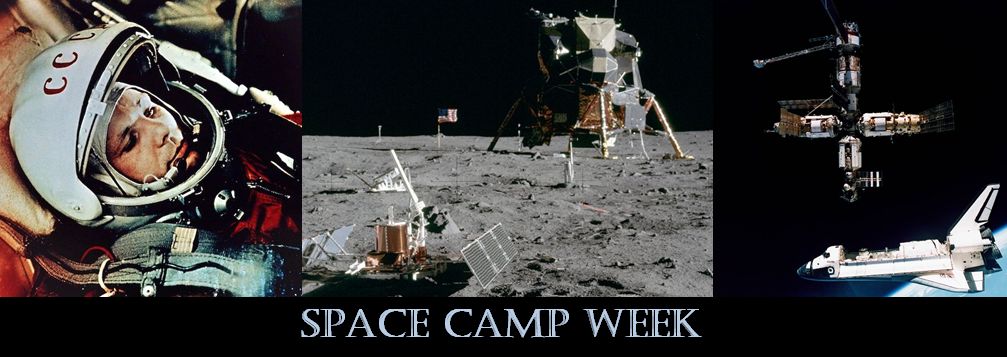
Space Camp!

It’s been ages since I went on a proper astronaut spree (Deke!, 2016), and lately I’ve been feeling the itch. With the Moon landing anniversary right around the corner (literally — it’s a week from today), why not have some fun and make fun week out of it? So….buckle up! What’s in the works? Early SF about the first men on the moon (you’ll never guess what it’s called), a history of the Mercury 7,(who had the right stuff), a modern astronaut memoir, annnnd maybe a few other things.

Previous “Space Camp” Reading


Deke! US Manned Space Flight from Mercury to the Shuttle, Deke Slayton (Mercury-Apollo and onwards)
Two Sides of the Moon, Alexei Leonov and David Scott (Mercury/Sputnik – forward)
Men from Earth, Buzz Aldrin and Malcolm McConnell. (Mercury through to the early Shuttle years.)
A Man on the Moon: The Voyages of the Apollo Astronauts, Andrew Chaikin. THE Apollo history.
Moon Shot: The Inside Story, Alan Shephard and Deke Slayton (Mercury – Apollo)
Lost Moon: The Perilous Voyage of Apollo 13, Jim Lovell (Apollo)
We Could Not Fail: The First African-Americans in the Space Program, Richard Paul and Steven Moss (Civilian/Support – Mercury onwards)
The Ordinary Spaceman, Clayton Anderson (Shuttle-ISS years)
Sky Walking: An Astronaut’s Memoir, Tom Jones. (Shuttle-ISS years)
Riding Rockets, Mike Mullane (Shuttle-ISS)

(“Space Camp” is borrowing its name from the Marshall Space Center’s juvenile and adult education and training programs of the same name…)

Posted in General | Tagged , | 4 Comments

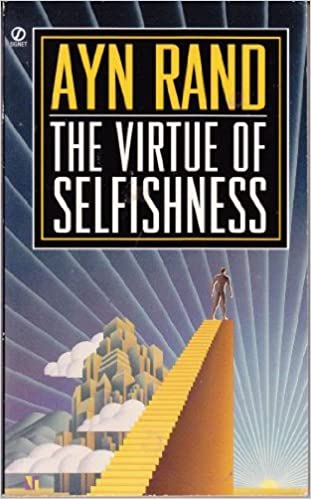
The Virtue of Selfishness

The Virtue of Selfishness
© 1964 Ayn Rand
174 pages

“It is philosophy that sets men’s goals and determines their course; it is only philosophy that can save them now. Today, the world is facing a choice: if civilization is to survive, it is the altruist morality that men have to reject.

How many books and movies have moved audiences by portraying a character who, struggling with persistent unhappiness, is pushed by their despair through to the realization that they’ve been living their life for another’s dream? That they married the man their parents wanted them to marry, even if they didn’t love him — that they became lawyers or doctors because their mom wanted them to, instead of pursuing their own dreams? The essential lesson there, the importance of honoring our inner being — our Self — is one we remind ourselves of frequently. It is in that vein that The Virtue of Selfishness puts forth a case for living in the honest pursuit of rational self-interest.

Like many readers, my initial reaction to Rand’s philosophy of ‘selfishness’ was one of surprise and contempt; based on the connotation the word carries in most cultures. My interest in Man vs State stories led me to her fiction, however, and somewhere amid the argument between Roark and Keating I found myself admitting that I’d misjudged her. Her ideas were far more substantial than expected; so too this title, which serves as a general introduction to Objectivism as a whole. She begins by establishing the importance of philosophy — particularly, epistemology and ethics, or how we come to find out what is true, and how we use it to guide our actions. Ethics, she argues, is not an artifact of human civilization, a code of behavior to keep unruly bipeds in crowded conditions from destroying one another, but the very genesis of progress. Reason is the great tool given to man by nature, our answer to the whale’s size and the tiger’s claws; without its consistent use to suss out the Truth and then act according to its dictates (ethics), we would amount to nothing but less hairy and more angsty apes.

An individual can think, conclude, and act. ‘Society’, being an abstract concept, a name for a collection of individuals, cannot. Rand therefore bases her worldview on the smallest concrete subject possible: the Individual. The Virtue of Selfishness is not a rationalizing defense for bad behavior, but rather defends the integrity of the self and reason against impulse, collectivism, and the ‘altruistic mentality ‘ — the latter being the habit of regarding one’s own existence as meaningless except when engaged in self-suppression on behalf of the tribe or even strangers. Other people do not justify your existence, Rand writes; there is no lasting meaning in identification with tribes, no reliability in following their whims. Joy is achieved through an individual’s dogged pursuit of excellence, through their successes in triumphing over challenges and their own impulses through clear thinking and hard work.

From here, Rand surveys the health of the Individual in the mid-20th century and finds it in very poor health indeed, nearly as oppressed by traditionalism, authority, and irrationality then as it was in previous dark ages. As belief in the old gods faded, the new god of the State and its collective lifeblood, The Nation, took the stage — and the new gods were far more potent than the old, coopting the tools of progress to serve instead the cause of decay. The Universities, too, having once been beacons of light allowing for the conquest of darkness, had fallen prey to postmodern confusion — and turned against the individual, especially the free exchange of economic energy between people that allowed the west to eclipse its own productivity decade after decade.

There is a savage and hard beauty in Rand’s writing, like the lines of a battleship. Far from catering to the worst of the human spirit, self-indulgence, Rand calls the Self forth to battle, summoning the best in us. Her Virtue demands the best from us — sharp thinking, hard work, constant self-evaluation. Her worldview is admirably integrated; the more I read her nonfiction, the more I realize it’s all of a piece. Even as I argued with her in my head (attempting to reconcile individualism and evolutionary psychology, as well as debating the role of the ego in well-being), I can’t help but admire her strength and consistency. She is shocking, but throws a cold and clear light on the world and I find that perspective illuminating despite its shadows.

Current plan: to continue reading Rand’s nonfiction, and then offer a response to her worldview including my reservations. Philosophy: Who Needs It will be next, followed by The Romantic Manifesto.

Posted in Religion and Philosophy, Reviews | Tagged , , | 10 Comments

The Eagle’s Claw

© 2021 Jeff Shaara
352 pages

Lastly, The Eagle’s Claw, a novel of historical fiction about the Battle of Midway.   Midway was one of the battles of WW2, the turning point of the Pacific War that, six months following Pearl Harbor, announced to Dai Nippon that its days in the sun were numbered.  The Japanese planned to seize the Midway Atoll, both as a staging area for a later invasion of Hawaii, and as an opportunity to draw the US carrier fleet into open, so that it might be destroyed and complete the work begun at Pearl.  Unfortunately for Yamamato,  US cryptographers had were reading enough Japanese transmissions to know that something was being planned – allowing US forces to position themselves to ambush the ambushers.  In The Eagle’s Claw,  Jeff Shaara takes us through the weeks before Midway and then through the battle itself, using his and his father’s signature style to put us into the minds of various American and Japanese officers and men, from the code-cracking dungeon to  the dogfights high above the Pacific.  Although the novel rightly lauds Joseph Rochefort’s crypto team for their role in allowing the US Navy to deliver proper vengeance for Pearl Harbor (the Empire lost four of their carriers),   Shaara does not omit the factor of glorious luck – of  dive bombers arriving over the Japanese carrier fleet just as the Japanese were loading ordinance for a second bombing run on the Atoll, and their fighters running on fumes.  Shaara also includes a little scene with John Ford, who had arrived on the Atoll on orders from the OSS.    Definitely of interest to WW2 fiction readers.

Posted in historical fiction, Reviews | Tagged , , , , | 1 Comment

Life, liberty, and the pursuit of literature

My reading in the last week celebrated or at least observed the memory of, the American Revolution, though the books I picked this year proved to be a mildly disappointing lot.

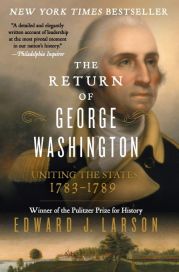
First up was The Return of George Washington, an entry from my Mount Doom Pile, It promised to be a rare biography of the big G, one focusing on his years as an ordinary citizen — neither General Washington nor President Washington, Father of his Country. Four of those six year years, however, were consumed by the debate within the States over the weaknesses of the Articles of Confederation, and the conventions that were called to remedy its faults — the chiefest of which Washington presided over. This is more a history of the Constitutional Convention as seen over the shoulder of ‘the indispensable man’ — a perfectly enjoyable history thereof, except that I read a few accounts of the same thing last year during my quarantine and found the revisit unexpected and repetitive. Those approaching the subject fresh would no doubt enjoy it far more than I did.

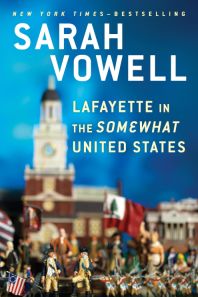
Following up was Lafayette in the Somewhat United States, a historically-inspired stream of consciousness narrative ostensibly grounded in the life of the Maquis de Lafayette, a young Frenchman who came to the States to defend the cause of Liberty against the king. It’s been nearly ten years since I read Vowell; her style mixes historical narrative, travel musings, snotty comments , and abundant political kvetching. Over the years my response to Vowell has range from amusement to annoyance, usually in the same volume; I found this one far more tedious than the rest, in part because I was genuinely interested in the Maquis and wanted to focus on him rather than say, Vowell’s opinions regarding the faux-government shutdowns that marked Obama’s last years in office. Her training in art rather than history is more on display than usual, with several breezy write-offs that had me cocking an eye and pondering if I shouldn’t just move on.

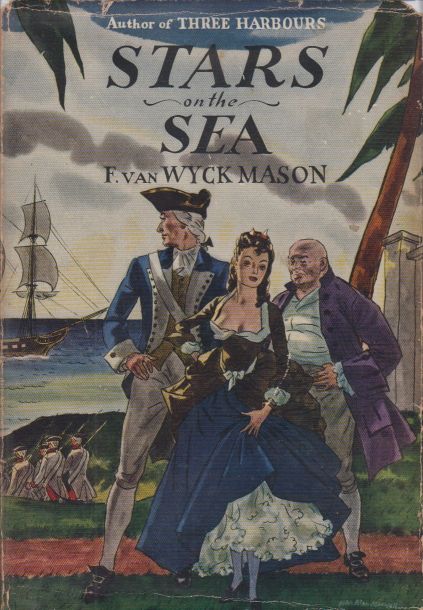
Lastly, and ending on a …well, I can’t say a high note because it’s a depressing-if-well-written novel. Ending on a strong note, let’s say, Stars on the Sea is a novella included in the Roads to Liberty anthology; originally written in the 1930s by a professor of history, it brings to the table superb detail and arresting exposition, as well as a tragic main character. Desire Harmony is a young Quaker woman who loses her family and home when the Brits burn her hometown, and in the process she’s revealed to have a British boyfriend, who knocked her up and then had the graceless luck to get shot. Disgraced, she drifts south to shift for herself, encountering disaster after disaster; meanwhile, her brother Tim joins the fledgling US Navy. The ending was unexpected and…not entirely chipper.

In the coming week, I may do a little more in this vein; The First Conspiracy, about an attempt to knock off Washington (!) , is in my TBR stack, and I’d like to read another of Mason’s books to see if it’s comparable. I’ve also finally found D-Day Girls, so perhaps I’ll finish it..

Posted in historical fiction, history, Reviews | Tagged , , | 4 Comments

Wisdom Wednesday: Memento mori

Posted in quotations | Tagged , | Leave a comment

Top Ten Tuesday: A Reader’s Manifesto

Today’s top ten Tuesday is more of an invitation to reflect —  Jana asks us why we like to read. 

For me, that answer begins with my parents – not only were my siblings and I feted with books growing up, but our parents read to us when we were younger, and we had a family practice of sitting around reading together – my dad with his Louis Lamour, my mom and her Christian romances, my  sisters with Sweet Valley High and Fear Street, and me with…seemingly everything. I even raided my family’s collection,   save for my mom’s Danielle Steele.    

Reading was my chief entertainment:  my parents dropped television from our home in the early eighties, before I was born, and so I grew up either running around the woods,  playing outside, or reading.  I didn’t experience the rival distraction of video games until I received a GameBoy  around fifth grade,  so my childhood was marked by weekly visits to the library and piles of books read. 

In eighth grade my parents bought a computer, and it would slowly grow to dominate my time as I discovered the joys of Encarta Encyclopedia,  the internet, and PC games.  Even so, though, I remained a reader,  though mostly of histories and Star Trek novels.  I couldn’t watch Star Trek (at least until after we had a television during the last seasons of Deep Space Nine),  but I devoured its novels – and scripts, because  I bought two CDs that had all of the scripts for DS9 and TNG on them, as well as the preview trailers for each episode that aired. My Trek experience was uniquely literary: I sometimes ‘remember’ scenes from episodes that never happened, because I saw them only in my head. 

In the early 2000s, I finished high school and community college, and worked in a factory to save money for college.  My appetite for learning only grew after school, and I fed it with podcasts (then the hot new thing)  and piles of books. History, science, economics, philosophy — whatever I could find. In 2007 I started posting about what I was reading on MySpace  — a habit which has grown into ReadingFreely.  If I offer anything I’d like to think it’s the chaotic variety in the end of year pile!

Reading continued to be a crucial part of my life even once I resumed my formal education, and afterward:  I’ve been  out of academia for eleven years, with no plans on returning given the risible  disparity between tuition and value-for-money in the humanities, and were it not for the constant stimulation  and companionship of books (for the right kind invite an author into one’s head for a debate of sorts), I’d  go nuts.  Books, for me, are vital to not only learning about the world, but engaging  with it; they continue to feed my growth as a person. 

When  I die, my epitaph will say: “BUT I WASN’T DONE READING!” 

Posted in General | Tagged , | 7 Comments