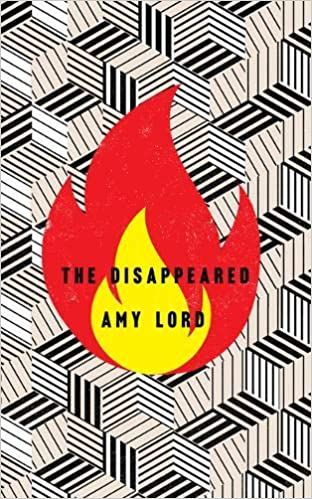
The Disappeared

The Disappeared
© 2019 Amy Lord
368 pages
“I’ve been quiet for years. And where did it get me? Well?’

Clara Winter was only a child when her father disappeared. A poet and English teacher, he made the mistake of criticizing Britain’s new order, the martial rule imposed on it after a terrorist attack at Whitehall. Now, a teacher in her own right, Clara prepares to follow in her father’s footsteps, and will face down the very man who took him from her life in the bargain.

I checked out The Disappeared after spotting it on goodreads because it brought to mind the increasingly frequent issue of books being pulled from marketplaces for being Wrongthink, like When Harry Became Sally. (I immediately imported a copy from a private seller in defiance of Amazon’s attempt to smother dissent.) The Disappeared has little to say on that particular aspect of censorship, however, as its villains are fairly generic Grumpy Military Men who seal Britain off from Europe and institute such rampant bookburnings that Clara’s students have no idea what 1984 is: the book has been cast into the memory hole, as it were. Clare and her boyfriend Simon are both private dissidents, who sneak into a university library with such voluminous holdings that not everything juicy has been banned yet: they attempt to fight the Man in their own way, by offering a secret history course. After Simon is taken by Grumpy Goons in a Grumpy Man Van, the plot accelerates.

The meat of The Disappeared, frankly, is not the spectre of a dictatorship in Britain (thanks to covid, we all get to live in draconian dystopias, with the added joy of smothering ourselves when we’re not avoiding each other), or the message about censorship, but the absolutely twisted family dynamics that poor Clara grew up in. Her stepfather is not just any member of the Authorisation Council: he’s the very man who arrested her father and personally oversaw his long, drawn out interrogation while he was seducing his victim’s effective widow. It gets worse.

I appreciate the core point of The Disappeared, the importance of stories and ideas and the inherent immortality in preventing people from accessing them. Fighting censorship — eviscerating censorship, tying it up and throwing it screaming off a cliff into a pit of spikes and alligators and noseeums — has never been more important than in the 21st century. The story here, though, is generic aside from family dynamics more twisted than anything seen since…oh, Ptolemy XIII and Cleopatra VII. The regime is so nondescript that it’s chief grumpy man is simply the “First General”, and to infuse it with personality I imagined something like the world of V for Vendetta or the televised version of The Man in the High Castle.

The Disappeared is entertaining and relevant, but lacks a certain…oomph.

Related:
Reading Lolita in Tehran, Azar Nafisi. A teacher holding a covert literary course amid a regime that bans Wrongthink.

Posted in Reviews | Tagged , , , , | 5 Comments

Obey little, bake much: The Choice

The Choice
© 2019 Claire Ward
400 pages

There’s always a choice.

“Let them eat cake,” Marie Antoinette supposedly said of the people too poor to buy bread, and the words inspired revolution. The Choice throws that on its head, and makes it rallying cry — LET US EAT CAKE! Set in a dystopian Britain where an insufferably invasive and cloyingly matronizing government headed by Mother Mason has turned everyday life into a misery. The Choice examines how the choices that individuals make enable tyranny — both at the polls and in their lives, as rebellion can begin from the smallest of personal stands. It is a strange mix of Betty Crocker meets 1984, where technocratic control, a saccharine tyrant in pearls, and intense social pressure create an environment depressingly familiar. A most unusual dytstopian novel (it has an award from Good Housekeeping), The Choice strikes a chord.

Set in Britain, the book picks up seven years into the reign of Mother Mason, who was elected on a Health and Decency platform. The circumstances of her rise to power are a little murky, but she’s a literal Health Nazi: sugar and alcohol are verboten, and people who skip leg day at the gym are abducted at the grocery store and taken away. At that grocery store, certain articles like butter are strictly rationed, and to gain access requires submitting to a weigh-in, where agents of the state consider weight and the person’s fitbit activity before permitting them their pat or two. The state is incredibly, obnoxiously intrusive, using deliverymen to spy on people’s homes looking for smuggled-in sugar, constantly pushing citizens to narc on errant behavior, and — above all — forever hectoring, nagging, advising. People are infantalized and treated like toddlers, especially as the book wears on and the main character becomes a rebellious baker.

The Choice has an unusual protagonist in Olivia Prichard, who in another life was an accomplished baker, cake artisan, and small business owner but who now malingers as a frustrated housewife, with no outlet for her creative energy. I appreciate the perspective, though, because Olivia’s plight demonstrates how tyranny and government stupidity affects the common man and woman down to the household level; it also raises the stakes, since unlike Winston Smith Olivia has children who the state can threaten to seize from her if she doesn’t comply. Raising money to smash the state — “Cut the Apron Strings” — through a bake sale is an amusing mix, seditious and wholesome at the same time. Although some aspects of the worldbuilding are unrealistic (the economy of Britain is entirely too healthy given the measures in place ), I like Ward’s twist.

Posted in Reviews | Tagged , , , , , | 7 Comments

Ghost Sub

Ghost Sub
© 2013 Todd Tucker
166 pages

Ghost Sub opens with a scene reminiscent of “There Will Come Soft Rains”: an automated environment, eerily chugging along through its pre-programmed routines, an imitation of life in the midst of death. The USS Boise has gone silent, her crew unresponsive, the ship steaming toward the coast of Hong Kong. Lt. Danny Tabo, whose heroics helped saved the Alabama in Collapse Depth, here returns with his XO to track and intercept the too-silent and too-deep Boise before it finds itself in Chinese waters. It’s a daunting technical challenge, though the mystery of what happened to the boat is not for Tabo and the others to solve, but is instead directly revealed to the reader through flashbacks and hinted at to shoreside medical authorities who hasten to squelch a dangerous and incredibly virulent viral outbreak. The only weakness in the novel is that part of the initial setup is made by two characters being irrational, one of them so incredibly so that it nearly disrupted my immersion. Characterization is still strong, though, and the threat of a pandemic made the novel particularly of interest to a reader in the age of ‘rona.

Posted in Reviews | Tagged , , , , | Leave a comment

July 2021

A month I’d planned to be TBR and American Classics-heavy was instead dominated by the ongoing Space Camp series, though I still managed to squeeze in some technical progress.

Science Survey
The Social Instinct: How Cooperation Shaped the World, Nichola Raihani
The Red Planet, Simon Morden.

We’re now at 7/12 categories filled, since anthropology has already been claimed.

Classics Club Strikes Back:
The First Men in the Moon, Jules Verne


We’re at 9/50. I don’t have any pre-planned August reads for the classics, so — anything goes. The Moon is Down will be first, since I’d intended to read it in July along with The First Men in the Moon. (…it has nothing to do with the moon, though. It’s set during the Baltic states during the opening salvos of WW2.)

Climbing Mount Doom
The First Conspiracy: The Plot to Kill George Washington, Brad Meltzer
The Return of George Washington: Uniting the States, Edward Larson
The First Men in the Moon, Jules Verne

The Unreviewed:
The two science titles will be dealt with this week. The First Conpiracy details at 1776 plot to kill George Washington, and I was very much surprised by the title: this is an incident I’ve never heard of, though I knew some of the connected people through a previously read title on a counterfeiting circle that the Brits were using to weaken rebel currency. Most memorable from this book is the figure of Governor Tyron, the Loyalist governor of New York who at one point was chased out of town and parked himself in the harbor, plotting against Washington and the revolution from there like some 18th century supervillain. The book’s narrative style was too “TV Drama”-esque for me, however.

Purchases
Philosophy: Who Needs It?, Ayn Rand
Please Stop Helping Us, Jason Riley
Star Talk: Everything You Ever Need to Know About Space Travel, Sci-Fi, the Human Race, the Universe, and Beyond, Neil deGrasse Tyson
An Astronaut’s Guide to Life on Earth, Chris Hadfield
Chemistry for Breakfast, Mai Thi Nyugen-Kim

Looking into August: I expect the opening month to be science-heavy, but I’m also starving for fiction, and have a particular appetite for historical fiction or military/technical thrillers.

Posted in General | Tagged | Leave a comment

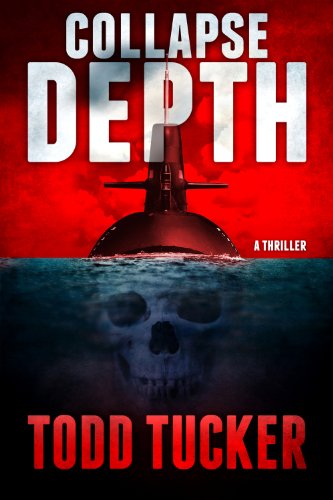
Collapse Depth

© 2012 Todd Tucker
264 pages

“[….] seawater was their only real enemy. Torpedoes and depth charges just allowed the enemy inside.”

The USS Alabama, like the rest of the Trident submarine force, exists for one reason only:   strategic deterrence.   Onboard her are enough nuclear missiles to destroy a dozen or more prominent cities, for use in a nuclear conflict. Her existence is a dark message: it doesn’t matter who strikes first in a nuclear war: no one walks away.   And now…she’s steaming towards Taiwan through a haze of mysterious accidents which threaten to cripple the ship and expose her in waters which the Chinese State considers its own turf.  With two Chinese submarines actively hunting her, the crew of Alabama  have no time to waste in rooting out the traitor in their midst and getting underway.  

Although I’ve watched numerous submarine movies (U-531, Red October, Crimson Tide),   Collapse Depth marks new reading terrain for me.  Tucker alternates between the technical thriller – the running  and personal drama,   almost entirely aboard the ship. Lieutenant Jabo, who at the outset tenders his resignation in preparation for a more lucrative civilian career,  takes center stage,  as the captain relies on him to find out what’s bedeviling their ship. Although he has his doubts about the future of the Trident force’s mission, Jabo is an attentive officer who excels in a crisis —   which is good, because there’s someone aboard who is suddenly obsessed with creating them. Fires, crew poisonings ;  Collapse Depth   borrows on its author’s at-sea experience to deliver a sense of how complicated a modern* submarine is, how easily things can go wrong: additional details about the operation of  nuclear submarine are given to the reader through Jabo’s instruction of a new junior officer.   The crisis only grows until the last few pages of the novel, as the crew desperately fights to save themselves – both from  the deep and from outside enemies.  

Although occasionally checkered with a few copy-editing oversights on the Kindle version   Collapse Depth’s fast story and incredible amount of detail in an unusual setting, make it a promising start.  I look forward to continuing in the series.  

“You’re aware of the name of this ship, aren’t you, Mr. COB?”
“Very aware, sir!”
“It bears a proud name, doesn’t it Mr. COB?”
“Very proud, sir!”
“What is that name, Mister COB?”
“ALABAMA, sir!”
“And what do we say?”
“GO BAMA! ROLL TIDE!

Posted in Reviews | Tagged , , , , | 2 Comments

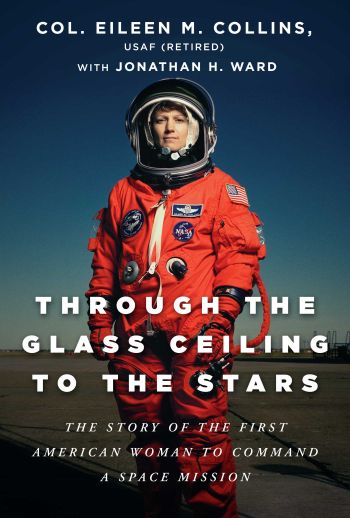
Through the Glass Ceiling to the Stars

Through the Glass Ceiling to the Stars
© 2021 Eileen Collins
314 pages

Eileen Collins was obsessed with flying. Maybe it was an unusual preoccupation for a girl, but her parents – despite their struggles with mental illness and alcoholism – always encouraged her to pursue her own path. Despite a slow start, an unremarkable high school career, Eileen found her drive as she approached the end of her teens….and threw herself onto a path would take her to the US Air Force, and into Earth orbit, an accomplished pilot and well-respected mission commander. Through the Glass Ceiling to the Stars is the remarkable biography of a young woman who overcame the challenges of a difficult, mis-spent youth to become a pioneer in aviation, clearing the way for other women who wished to become military pilots…or even astronauts.

If anything marks Through the Glass Ceiling, it’s dogged hard work. Throughout, Collins takes on enormous workloads and commits herself to being The Best. In retaliation for wasting her high school years on pipe courses, Collins continually challenged herself every year thereafter. She never settled for less: when she realized that the Air Force held women to lower standards of fitness and physical performance than the men, she requested permission to train with the men – not willing to be anything less than she could be. These were not easy years for a woman to pursue a career in the armed forces, particularly the Air Force: not only did Collins experience campus hostility when she wore her ROTC uniform, but the Air Force had only recently opened pilot training to women, and even then it was scrupulously avoiding pilot assignments that would put women anywhere near a combat zone. That made navigating into NASA particularly challenging, because it required pilots to have fulfilled Test Pilot training, and that program’s requirements weren’t readily fulfilled by the support aircraft Collins was allowed to fly as a woman. But even if was just flying a transport, she’d be the best transport pilot imaginable – studying manuals to know her systems in and out, hanging out with the mechanics to absorb information that most pilots overlooked. As it happened, her time spent flying ‘trucks’ was excellent background for the shuttle program.

Getting into NASA when she did was an extraordinarily close thing, between fulling her service obligations to the Air Force and avoiding the age cut-off for the Test Pilot program. Collins’ commitment to excellence and unwavering hard work won her allies, people who realized she had what it took to make go further – she had the right stuff. Collins was often given choice opportunities, like flying in an F-15. After joining NASA, she performed well in her first two missions as a shuttle pilot, and then became the first woman to command a shuttle mission: she was chosen to be the ‘first’ because NASA knew whatever the stress, Collins could handle it. It helped that she had moral support from other pioneers, like Sally Ride – the first American woman in space, and someone who knew the immense pressure Collins was under. Ride reached out to Collins both before her first shuttle mission, and before her first command. Most notably, Collins’ command was the first Shuttle mission following the Columbia post-mortum: she carried not only her crew’s lives, but the future of the program on her shoulders.

Through the Glass Ceiling will rank as one of my favorite astronaut memoirs, though Collins offers more content than just a recap of her missions. Cognizant of her role as a pioneer – being the first woman to fly an F-15, for instance, or command a shuttle – she frequently offers lessons to the reader, and she doesn’t shy away from sharing her mistakes, either. She goes into considerable detail about all the various aspects of her career, which – to any reader fascinated by aviation – makes this a potluck of interesting planes and observations about the challenges of pushing them to the limit. This one is absolutely recommended, especially for parents who want to encourage their teens to go beyond what they think is possible.

Posted in Reviews | Tagged , , , , | 7 Comments

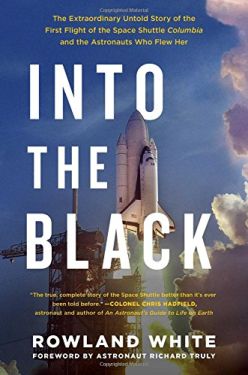
Into the Black

Into the Black: The Extraordinary Untold Story of the First Flight of the Space Shuttle Columbia
© 2016 Rowland White
480 pages


Two decades from Gagarin, twenty years to the day
Came a shuttle named Columbia to open up the way
And they say she’s just a truck, but she’s a truck that’s aimin’ high
See her big jets burning, see her fire in the sky!
(“Fire in the Sky”, Kristoph Klover)

As the Apollo missions neared the completion of their goal, NASA looked ahead and charted a bold new course for the future: a manned research station, a permanent lunar lab, and possibly even a Mars expedition: underpinning it all would be the Space Shuttle, a reusable orbiter capable of landing under its own power. Little of that dream would be realized, in the face of budget competition in the Vietnam War, economic disruption, and waning public interest in bankrolling increasingly grand endeavors* — but NASA wasn’t alone in pushing for greater American versatility in space. From Sputnik on, the Air Force looked to the skies as well….and its own spacetime interests would become a key part of the Shuttle’s story. A comprehensive history of how the shuttle program to be, Into the Black draws on recently declassified material to provide a rare look into early militarization of space.

From the beginning, the United States Air Force had an active interest in developing its own space capabilities, and recruited its own pool of eight astronauts. The “Magnificent Eight” would never get the name recognition of the Mercury 7 (or any recognition at all, for that matter), but many earned astronaut wings flying test planes outside the ‘atmosphere’ envelope, and when Nixon pulled the plug to focus spending on a next-generation surveillance satellite, several of its astronauts were grandfathered into NASA, and became key contributors to the operation of Skylab. (There, they drew on their experience in helping form the Air Force’s decade-long obsession, a Manned Orbiting Laboratory, a project made obsolete in its ultimate purpose by increasingly sophisticated satellites.) More importantly, however, their long experience with near-space planes made men like Dick Truly and Bob Crippen perfect contributors to the development of the Shuttle: when Enterprise and Columbia proved the shuttle’s worthiness as an plane and orbiter, respectively, MOL veterans were side-by-side of Apollo legends like John Young.

Creating a vehicle that could both operate in space effectively and glide safety to Earth in full atmosphere was a daunting, decade-long process, as problems with wing design and insulation were slowly ironed out. (Very slowly:  the attrition of insulating tiles would be a constant problem for the Shuttles).  Not all of the problems were technical; because of the constraints of fly-by-wire, pilots invariably fell into a vertical fishtail that ‘destroyed’ countless flights in the simulators.   Into the Black  comprehensively covers the test-flights both Enterprise and Columbia, the latter to an astonishing degree — but, given the stakes, an understandable one. Columbia entered orbit for the first time already bearing pockmarks from where her tiles had fallen off, and NASA had serious reservations as to whether the orbiter could return safety. Ultimately that was a problem that caught up to the shuttle twenty-two years later.

Although Into the Black tackles technical information to a degree that might spook the most casual reader, for the aviation buff and space enthusiast, it’s a title with an enormous payload. I’ve read a dozen or so space books and have never encountered any information about the Air Force’s MOL program, or even its astronaut pool. The coverage given to the technical development of ‘the space plane’ is also unusually thorough, making Into the Black a remarkably useful book for the enthusiastic student.

*Just one Endeavour, as it turns out, and only to replace a Challenger.

Posted in history, Reviews | Tagged , , , , , | 9 Comments

Oops, I did it again

Last week a publisher contacted me on goodreads about reading one of their soon-to-be-released titles, The Social Instinct. Accessing it meant reviving my old NetGalley account, and before I knew it..

Well, I did say that science would be making a return this month…

Posted in General | 2 Comments

The Philosopher Book Tag

Spotted at Thoughts on Papyrus, and couldn’t resist borrowing!

Thales is considered the first known philosopher. Which text introduced you to philosophy or which text would you like to read to get you into philosophy?

Oddly enough, a sermon from a Unitarian Universalist minister titled “Humanist Spirituality: Oxymon or Authentic Path to Enlightenment?” After leaving my childhood church at age 20, I became a devout reader of books on religion, spirituality, and philosophy — attempting to figure out why people believed what they did, and to see if there was an underlying truth behind all this, a viable way to live on purpose. It was Muder who introduced me to Stoic and Epicurean thought, though I wouldn’t seriously begin to read the Stoics until a year thereafter. Marcus Aurelius’ Meditations were the first philosophical text I ever read.

Which political event or event in history would you like to read more about in fiction?

The American, French, or Russian revolutions — for different reasons. I’m fascinated by the debates during the Founding period, the varying ideas these men had for structuring a government capable of maintaining liberty against internal corruption and external attack. The French revolution unleashed a pandora’s box upon Europe and the world, and of course the Russian one was horrendous but worth knowing more about.

Which book or author forced you to think more critically?

Ravi Zacharias; I was introduced to his podcast in 2006 by a skeptic friend of mine who was interested in my response to his critique of Richard Dawkins. Although at the time I was still devoutly anti-religious, I’d never before heard arguments based in formal logic. Attempting to argue with him in my head forced me to continually check my own statements for underlying assumptions.

Voltaire once said: ” I do not agree with what you have to say, but I’ll defend to the death your right to say it” Which is a popular book everyone seems to love but you didn’t?

Hard one to answer, as most of the books I’ve one- or two-starred were schlock fiction to begin with, like Dan Brown or James Patterson titles. Not exactly philosophical fare!

Hannah Arendt – Doomed controversial even by her friends, Hannah Arendt did not shy away from telling what she thought was true. Name a book that will leave readers uncomfortable, but tells an important story.

The dystopias come to mind — 1984, for its evaluation of the control of language, history, and desire by political powers; Fahrenheit 451, for its depressingly accurate prediction that people were far more comfortable burrowing under the lure of entertainment than to be challenged by books and outside thought; and Brave New World, with its wholesale destruction of the human Person and the manipulation of the masses through pleasure. Of course, The Fountainhead also bears mentioning, forcing readers to consider their own motives and lives.

“You must have chaos within you to give birth to a dancing star.” A wonderful quote from Nietzsche out of “Thus spoke Zarathustra” Which book do you go back to for its beautiful writing?

Alain de Botton and Anthony Esolen, while holding very different worldviews (de Botton is a secular humanist, Esolen an traditionalist Catholic), both have exquisite ways of expressing themselves. A sentence from each, inspired by the airport:

(Esolen) “But when I am in an airport, that most harried image of the eternal tarmac of Hell, crowded without community, noisy without celebration, technologically sophisticated without beauty, and see people engaged in loud conversations not with one another but with a business partner in Chicago or a spouse and children far away, I see not freedom but confinement.”

(de Botton) “I explained — with the excessive exposition of a man spending a lonely week at the airport — that I was looking for the sort of books in which a genial voice expresses emotions that the reader has long felt but never before really understood; those that convey the secret, everyday things that society at large prefers to leave unsaid; those that make one feel somehow less alone and strange.”

Jean-Paul Sartre raised the question “What is literature?” in one of his books. What is good literature for you?

Literature is text that speaks to truth — whether in formal arguments, or stories that bear witness to human universals. Some level of artfulness is required; a flat recital of facts is simply that, something to be parsed rather than read and studied.

Which book did you have to keep pushing through because you really wanted to understand it’s meaning?

The Brothers Karamazov, Dostoevsky. I very much doubt that I succeeded, because I don’t know if the book has a Singular Meaning; it’s replete with arguments about God, man, morality, and the state. Atlas Shrugged is another, because arguably its primary content is argument.

Which are the three philosophers you would love to sit down and have a chat with?

Alain de Botton, C.S. Lewis, and Epictetus. The first two are fantastically interesting, and Epictetus strikes me as the most potentially entertaining of the Stoics — though Seneca and Cicero were probably first-rate party guests.

Posted in Reflection, Religion and Philosophy | Tagged | 2 Comments

Wisdom Wednesday: Stop playing other people’s games

“[….] the system will set out honeypots, for people to get trapped in, the system will set out the ideas of retirement, the ideas of the golden years, providing you benefits, providing you a healthy working environment, WHY? Well, because they want people to work for them. They don’t want people to realize their own dreams and escape. They are going to hire more people and train them. They want to set it up so that you can stick around. Stick around in some sort of unsatisfying world.

It’s up to you to see that video game problem, to see that issue as it comes up on the map. And I think this is the right term, to see all the problems that could potentially be in front of you and calculate your future and also look around on people who didn’t do it, look at the misery they are in, and learn, you don’t want to be like them. And then also look at the people who have kind of taken chances, navigated their way, what did they do differently? What objectivity did they have that maybe you lack, what insights into their own mistakes are they willing to delve into that you are not?

The person who is able to look at himself the closest is going to get the most rational results.”

(Joe Rogan. Podcast episode unknown; I heard this excerpt in a remix made by Akira the Don.)

Posted in quotations | Tagged | 3 Comments