Ready Player Two: Spoiler Free

Ready Player Two
© Ernest Cline
384 pages


Ready Player One remains one of my favorite novels, ever; for me it is the Starburst jellybean of books, a perfect sweet spot between geekery and pop culture. I couldn’t wait to get my hands on Ready Player Two, and glad I am that I work in a library, a position that meant I began reading it before it was officially available in stores. I will do my utmost to deliver a review without spoilers; suffice it to say that RPT is a sequel in the same way that The Force Awakens is a sequel; it’s a flashier story with a very similar plot to the original, and one sometimes more interested in proving its authors hipness than offering the reader a good story. I ended up enjoying it, but 2/3rds through when I began considering what kind of review I’d do, I was about to make a comparison to Star Wars and The Star Wars Holiday Special.

Ready Player Two opens a week after the conclusion of RPO, when Wade discovers that James Halliday, creator of the digital world in which most of society lives and works, had hidden away another piece of revolutionary technology. Halliday urges Wade to be cautious and to consider Very Carefully if he wants to share it with the world: Wade, being a teenager advised by other teenagers, immediately starts to play with it and make it public, with dramatic results. Wade thereby unwittingly triggers both a second Epic Fetch Quest and a new enemy. Although Wade/Parzival would seem to have nothing left to gain by pursing another round of trivia memorization and monster battles (He already has complete control of the Oasis and All of the Money), the new enemy ensures that he does: nothing less is at stake than the lives of his friends and the entire world.

Those who read and enjoyed Ready Player One will feel a strong sense of deja vu as characters once again start prowling around various games and simulations inspired by the programmers’ obsessions, arguing with one another over fine details as geeks are wont to do. Ready Player Two draws on far more pop culture than tech geekery, with varying results; I found some of them absolutely tedious to read about, and some far more interesting. (Featuring prominently: the John Hughes cinematic universe, Prince, and Lord of the Rings). Until the end, frankly, I was largely disappointed in the book: the winsome combination of Ready Player One‘s attractions was off, or just not as magic as it was the first time around, and some of the characters did things without reason, or were being used for Cline’s preachiness to obnoxious effect — particularly Aech, who is That Friend at college who won’t shut up about their pet issue. In the end, however, Cline introduced several elements that mostly made the reading worth it. I don’t know that I’d re-read RPT, but it may add to future re-reads of the original.

Posted in Reviews, science fiction | Tagged | 3 Comments

Too Much Magic: Same arguments, different cover

Too Much Magic: Wishful Thinking, Technology, and the Fate of the Nation
© 2012 Jim Kunstler
336 pages

Twelve years ago, at the urging of my sociology professor, I attended a lecture on Peak Oil and the Future of Suburbia, by a man I realized I’d been sitting very near to at lunch. Jim Kunstler gave me a lot of food for thought that night, though a friend of mine and I agreed that he sounded a bit like a crank. He’s…particularly wound up in Too Much Magic, which rehashes much of what he’s written about before, and adds on some rants that connect, generally, to this volume’s specific grievance: a tech-religion of wishful thinking, in which all of our problems can be resolved through more innovation and technology.

Re-reading my response to that lecture in 2008 makes me realize how Kunstler has a steady, reliable train of thought; occasionally a new car is added, or some new graffiti appears along the side, but it’s the same engine and basic cargo. In The Geography of Nowhere, Kunstler delivered a full broadside against the distortion of American urbanism from big cities and small towns into an endless homogeneous mass full of cheap, fake houses and box stores with a fifteen year lifecycle. He argued that this promotion of sprawl was not only socially disastrous, but financially unsustainable, relying on cheap oil and an economy driven by expansion. In The Long Emergency, he repeated that argument, and argued that peak oil was imminent and that it would combine with climate instability to destroy global civilization as we know it. In Too Much Magic, written after the housing bubble pop and subsequent recession, Kunstler reviews his previous arguments and adds to them his interpretation of the housing bubble’s boom and bust, connecting the decades of cheap credit to his critique of suburban spawl.

When I purchased this, it was with the thought that Kunstler had examined fracking, nuclear energy, and other technological solutions and was offering his review of them; instead, it’s largely an updated retread of Kunstler’s prior arguments, which this time emphasizes how often we ignore reality for our desires, wasting time and energy chasing distractions like the AI singularity. Fracking is addressed, but not nearly to the degree that it should have given Kunstler’s steady focus on peak oil; it’s a short chapter and adds no more than you might find from reading articles at his website. Other alternative energies are dispatched with the same haste. Considering how dramatically fracking has altered the energy landscape in the last ten years (turning the US to a net energy exporter), fracking bears serious consideration. How long of a window did it create for the petroleum economy, and what kind of consequences does that kind of development have for our geologic stability and water/soil health? I don’t know, but Kunstler’s quick write-off of it here was obviously well off the mark.

In short, though I find Kunstler a stimulating and entertaining author, there’s not enough genuinely new content in Too Much Magic to bother with.

Posted in Reviews | Tagged , , , | 6 Comments

Top Ten Tuesday: Thanksgiving

This week’s TTT has a Thanksgiving theme, and it’s a freebie so we can play around with it. I’m going full-throttle stream of thought here.

  1. I’m thankful for bookish friends who aid and abet my addiction, but more importantly, who make public their musings about the books they read. In a hurried, distracted age, I value beyond counting the company of people who can pause and reflect.
  2. I’m thankful for book publishers who are craftsman, not just McDonalds for airplane novels — who publish books with thicker, rough-cut pages, and use font printing that’s rich and makes the book a genuine art piece in its own right.
  3. I’m thankful for authors who inspire me; Isaac Asimov’s boundless curiosity and ability to write a book on anything (science, literature, religion, etymology, history, poetry — you name it) makes him a role model for a generalist like myself.
  4. Authors, continued: Wendell Berry’s deep love for the natural world and his appreciation for how we find part of our purpose in its stewardship
  5. Authors, continued: Bill Kauffman. Oh, where to begin with Kauffman? His celebration of obscure novels, obscurer words, and left-behind places; his cheerful “go to hell” attitude aimed at anyone who gets too big for their britches, his ardent love for little places and the crazy, all-too-human people within them….he’s an author I’d dearly love to hang around with in a bar listening to tell stories.
  6. Authors who take me back into time, full of horses and battle-cries and schemes and high towers to take. Bernard Cornwall is the king!
  7. Authors who provoke me thinking thinking about matters otherwise hidden to me, or help me articulate otherwise ineffable feelings; men like Jim Kunstler Neil Postman, and Anthony Esolen. I may not always agree with them (sometimes I read them just to listen, not knowing my own position enough to say aye or nay) — but they’re always interesting and appreciated.
  8. Authors whose wisdom I need, like Will Durant, C.S. Lewis, Wendell Berry (again – I love WB), who redouble my appreciation for history, literature, creation, etc.
  9. Authors who can cure what ails me, like P.G. Wodehouse. He’s never failed to lift my spirits.
  10. And finally, authors like Alain de Botton who make me realize I’m not the only one who feels the way I do sometimes. The following is from A Week at the Airport.

I explained — with the excessive exposition of a man spending a lonely week at the airport — that I was looking for the sort of books in which a genial voice expresses emotions that the reader has long felt but never before really understood; those that convey the secret, everyday things that society at large prefers to leave unsaid; those that make one feel somehow less alone and strange.

Manishankar wondered if I might like a magazine instead.”

Posted in General | 12 Comments

Selections from “A Grief Observed”

A Grief Observed was not written as a book, but was published as such from four reflective notebooks that Lewis kept while reeling from the death of his wife, Joy. The collection is raw, intimate, and personal; we find Lewis a wounded man, at times both heartbroken and angry, and self-conscious about his despair and anguish. This particular Signature edition comes with an tender introduction from David Gresham, Lewis’ stepson.

“On the rebound one passes into tears and pathos. Maudlin tears. I almost prefer the moments of agony. These are at least clean and honest. But the bath of self-pity, the wallow, the loathsome sticky-sweet pleasure of indulging it — that disgusts me. And even while I’m doing it I know it leads me to misrepresent H. herself. Give that mood its head and in a few minutes I shall have substituted for the real woman a mere doll to be blubbered over.”

“One never meets just Cancer, or War, or Unhappiness (or Happiness). One only meets each hour or moment that comes. All manner of ups and downs. Many bad spots in our best times, many good ones in our worst. One never gets the total impact of what we call ‘the thing itself’. But we call it wrongly. The thing itself is simply all these ups and downs: the rest is a name or an idea.”

“The most precious gift that marriage gave me was this constant impact of something very close and intimate yet all the time unmistakably other, resistant — in a world ,real. Is all that work to be undone? Is what I shall still call H. to sink back horribly into being not much more than one of my old bachelor pipe dreams? Oh my dear, my dear, come back for one moment and drive that miserable phantom away. Oh God, God, why did you take such trouble to force this creature out of its shell if it is now doomed to crawl back — to be sucked back — into it?”

“Feelings, feelings, and feelings. Let me try thinking instead.”

“All reality is iconoclastic. The earthly beloved, even in this life, incessantly triumphs over your mere idea of her. And you want her to; you want her with all her resistances, all her faults, all her unexpectedness. That is, in her foursquare and independent reality. And this, not any image or memory, is what we are to love still, after she is dead.”

Posted in quotations | Tagged , , , | 5 Comments

The Afghan Campaign

The Afghan Campaign: A Novel
© 2006 Steven Pressfield
368 pages

Afghanistan, 330 B.C. Alexander the Great, having toppled the Persian Empire and won eternal glory for himself and his men, now looks with hungry eyes to India. The way to those riches, however, must be forged through the unpredictable expanse of Afghanistan, and even veterans of Alexander’s campaigns will pause at the grim bloodshed waiting for them there. The Afghan Campaign by Steven Pressfield is easily the most visceral account of ancient warfare I’ve ever read, as we witness a young fool who joined the ranks purely to avoid shaming himself in front of his brothers, but who is baptized by blood again and again and becomes a man in full, whose soul is hardened by the violence yet full of love and devotion for his brothers in arms…and his horse. Written only a few years into the interminable American war in Afghanistan, its portayal of that land and the futility of trying to impose outside order on it, brims over with relevance fifteen years later — such is the stupidity (or cupidity) of the DC elite.

I first encountered Steven Pressfield via his excellent Gates of Fire, a story of Thermopylae, and found The Afghan Campaign to be of similar quality. Given its setting in antiquity, I’m not sure how kosher some of the historical facts are — I couldn’t tell you what history books say about the Afghan campaign — but Pressfield provides such a level of fine detail about the little things, like food and clothing, that I was wholly “in” the world he’d created. It’s a harrowing story, with such bloodshed and loss that by its end I felt tempted to read a Vietnam memoir for comparison. Two of the characters can feel themselves being changed by the war; they begin as naifs, hesitant to even strike other men, but once thrown into the the constant hell of Alexander’s campaigns, they change. Not all of their prewar selves is lost, but they become different — bonded to one another instead of dreams of their lost homes and sweethearts, accustomed to nothing but marching and killing, hardened by a hostile landscape filled with implacable enemies whose lust for liberty they cannot help but admire, even is it kills them.

This is stirring, sober reading. The cover speaks volumes. This is twice I’ve tried Pressfield and twice I’ve found his characters and story absolutely enveloping, so I will be continuing to explore his work.

The fact is clear, though no rookie other than Lucas owns the bowels to give it voice, that we have entered a crucible of the soul, of war’s horror, and that it will change us. It has changed us already. Where will it end? Who will we be then? Myself, I feel its weight nightlong inside my skull, as spectacles of slaughter re-present themselves with such ghastliness that I dare not even shut my eyes. “Part of me is dying,” says Lucas. “Something evil grows in its place. I don’t know what it is, but I fear and hate it. I fear and hate myself.”

Posted in historical fiction, Reviews | Tagged , | 5 Comments

V-2

V-2: A Novel of World War 2
© 2020 Robert Harris
320 pages

The Wehrmacht is being pushed from western Europe, and the Waffen-SS is reeling in eastern Europe. The Luftwaffe flies no more. And yet Germany fights on, and the dreams of brilliant young men who once looked to the stars with longing are now corrupted into feeble attempts to spite the Allies by rocket-bombs. Against them, Britain has developed an experimental radar group; coupled with able use of trigonometry, the launch sites of these rockets may be exposed by math even as they hide from cameras. V-2 honors the contribution made by women like Eileen Younghusband, in a story covering the rise of the Mechelen group, pitting them against a frustrated German engineer who at every launch wishes his rockets were pushing humanity into space — not simply crashing through the roofs of Woolworths. Although not as ambitious as Harris’ other works, V-2 succeeds in its portrayal of an often-overlooked aspect of the war.

V-2 hops back and forth across the channel, putting us into the lives of an English WAAF officer, Kay Caton-Walsh, and a German engineer, Dr. Graf. Both are sympathetic sorts; Graf, despite his position in the V-2 program, finds von Braun far too happy to consort with Hitler, and is himself so unconvincing a Nazi that the SS watch him constantly. He and von Braun both were young enthusiasts for pushing humanity into space, but is even the moon a fitting reward for a man’s soul? Kay, too, has a little moral quandry; having taken up with a married wing commander, her efforts to expose the German launch sites carry double weight in proving that she didn’t just sleep her way into the experimental group, but is there through her native talent and willingness to shoulder hard work. Through them and the people they interact with, we experience the war’s deprivations, the social distress it created, and the confused loyalties.

Harris is one of my rare read-without-a-question authors, and though V-2 wasn’t nearly as ambitious and intricate as his other thrillers, I deeply enjoyed the WW2 detail, and the light it shed on the V2 program and Britain’s countermeasures against it. Historical coverage of the V2 program only appears in American history books as a curiosity, or as the prelude in books on the space race, so I was exceptionally interested in the plot here.

Posted in historical fiction, Reviews | Tagged , , , | 9 Comments

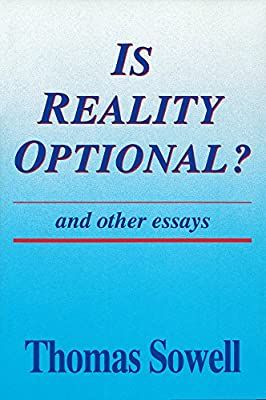
Is Reality Optional?

reality

“The curious task of economics is to demonstrate to men how little they really know about what they imagine they can design.” – F.A. Hayek

From economist and cultural critic Thomas Sowell come this amusingly-titled collection of essays,  loosely gathered under the theme of pointing out inconvenient truths. The title caught my eye because society seems to become more of an obscene cartoon, a farce on the stage,  with every passing year. The essays are  presumably drawn from columns Sowell contributed to newspapers over the years,  spanning the seventies through the nineties, on a spectrum of topics:  sex ed, crime & punishment,  race, sex,  and the virtues of map projections. The title essay opens the book, as Sowell points to various movements within the US which, however well-intentioned in their motives, are unrealistic in their aims —  and irresponsible, as their actions affect not only them, but the public interest.  Also within the collection are sketches, intended as humor, with varying results.

Sowell is first and foremost an economist; I first encountered him via Basic Economics, and he uses economic principles to inform his critiques of society and culture,  particularly the observation that there are no solutions, only trade-offs. this not only means every action taken by a government, business, or person will have negative consequences,  it means we usually have to weigh things in the balance. Do we want safety?   How much safety? How many inconveniences are we willing to endure, how much are we willing to pay?   No two households come to the same balance, and will chose different options depending on how how much risk they’re willing to court, and how much money they’re willing to pay. The balancing act can be applied to anything, and it often appears in the essays — applied in his evaluation of a environmental movement, and its  useless denunciation of both fossil fuels and the only meaningful alternative, nuclear energy. (Solar & wind are not as expensive as they once were, but they’re not serious options for carrying the base load of any modern society.)

There is no point trying to appease the anointed by giving in on some particular issue they raise, because that only shifts the fight to some other issue. The basic underlying problem is that they do not live in the grubby world of trade-offs with the rest of us. They live in the loftier realms of their own minds where “solutions” prevail.

Sowell’s attitude is one of pragmatism and prudence:   it if ain’t broke, don’t fix it. People may experiment on themselves at their leisure, but trying on new social theories every other year is hubristic and irresponsible. Sowell points to the frequent changes in educational theory, in  crime mitigation, etc and to their repeated failures. Too often, he says, we replace what works with what sounds good. This is the third Sowell work I’ve read, and I find him of such great interest that I hope to continue exploring his considerable output as time goes on. Sowell’s perspective is especially powerful when writing on matters of civil rights and race, because he lived through the death of Jim Crow, the arrival of affirmative action, and so on.  As a black intellectual himself, he encountered and triumphed over both racism and ideologies which deny minorities real agency — instead insisting, ever so patronizingly, that they are the state’s wards who need special hand-holding.   (I’ve come to realize in the last ten years that the government acts like some demented jailer in regards to the working class….raising barrier after barrier to prevent people from prospering, like imposing cosmetology licensure requirements on hair-braiders, and then expecting worship when it offers half-cocked solutions to the problems of its own making — like helping the Saudis bomb Yemen, then offering aid to the survivors.  )

Unfortunately, although these essays date from the seventies, only their statistics are dated. Foolhardiness of past decades has been surpassed by even more outrageous social movements  and proposals today today, like the ‘green new deal’, a product so divorced from reality when its details are considered  that only a sheltered politician could propose it, and certain social movements in which mental issues are attempted to be ‘fixed’ by surgeries and chemical bombardment.  To believe that sex is malleable is to believe that reality itself has no substance, that the world can be made to confirm to our will.  It would be nice if we could transform the world that easily,  but reality   is obdurant. Evidenced by Sowell’s writings,   this is not a new problem with the human race, though it’s certainly a greater issue now than ever before.  At least the ancients knew that if one appealed to the gods to give them what they wanted, great sacrifice would be necessary. We seem to think it can happen with the simple passing of legislation, and the liberal application of other people’s money.

Posted in Reviews, Society and Culture | Tagged , | 6 Comments

Mary Roach in bed, Frank Underwood’s crib notes, and a love story for libraries

It’s been a week of …very different books here. First up, Mary Roach’s Bonk: The Curious Coupling of Science and Sex. All of Roach’s previous other works, all mostly-humorous attempts to review the science of taboo or often overlooked subject, have appeared here, and now the set is complete. After beginning with a history of how we have mostly ignored intercourse from a scientific point of view until the last century or so, Roach shares a series of narratives about her traveling across the world to meet various experts in this-or-that. The subjects included are on the niche side of things, and are often unexpected: I learned far more about pigs than I’d expected to. Roach’s works are not generally structured (the exception being Gulp, but a book on the digestive system does come with an obvious ‘tract’ to follow — in one end and out the other), and this is par for the course. If you want more..er, specifics, there are more detailed reviews on goodreads. Awkward and amusing in turn.

dict
Recycling an image! I’m so green.

Next, and one I’ve been dragging my feet through for weeks, is The Dictator’s Handbook, easily the most depressing book on politics I’ve ever read, though its lessons on power dynamics apply equally to any large organization, be it a Fortune 500 company or the Sicilian mafia. The authors open with the suggestion that instead of trying to understand politics through conventional means, ideology and whatever tall tales being paraded about on television, we should view it instead as an exercise in practical, grim self-interest. Politicians pursue whatever course is most personally expedient to them, whatever allows them to pay off their supporters and stay in power. The payoff can be obvious loot, in the case of dictators, or more subtle in the case of democracies. The authors’ core lesson is that we must view political support in terms of essential supporters, influentials, and interchangables; autocracies and corporations that rely on only a small handful of essentials behave very differently from democracies and corporations with larger boards, though the authors caution us against relying too readily on labels: often democracies have an underlying structure that makes the number of essential supporters far smaller than it actually is. In the case of Iran, for instance, the people do choose between opposing candidates — but those candidates were prescreened by the Guardian council. Even in a ‘real’ democracy, though, the savvy politico can get away with an astonishing amount of graft. Instructive and soul-scarring.

Lastly, I read Palaces for the People, which caught my eye instantly given its use of Andrew Carnegie’s description of libraries. Eric Klinenberg concerns himself with “social infrastructure”, or the places that draw people together in a community and allow them to encounter by chance or design, people who are different from them — and build a rapport or even friendships through repeated encounters or casual activities. Drawing on the social science of Robert Putnam (Bowling Alone: The Decline of American Community) and the urban analysis of Jane Jacobs (The Death and Life of Great American Cities), Klinenberg argues that one of the reasons American society is so bitter and divided these days is that support for places like libraries that build community is disappearing. Although he’s primarily thinking of falling public funding for libraries, parks, etc, it sometimes brushes against the Jim Kunstler’s Geography of Nowhere first made this point, though his own scathing rebuke of American sprawl, with its worship of efficiency and isolation, is not cited here. The book hits a sweet spot for me, and not just because libraries are worshiped in nearly every chapter, but it needed more heft, or focus: the most salient lessons of the book apply to the importance of community in general, and place in giving people meaning, support, and identity. Klinenberg looks at only a small piece of a much larger problem. Even so, I greatly enjoyed the new material here, like the role of community in public health; that connection is made several times here, most poignantly in the chapter on the opioid crisis.

Posted in Politics and Civic Interest, Reviews, science | Tagged , , , | 8 Comments

Firefly: Generations

Firefly: Generations
© 2020 Tim Lebbon
384 pages

A map won in a card game, given importance by River’s intuition, Kaylee’s recognition of an old name, and the fact that several people tried to murder Mal to take the map back, leads the crew of Serenity beyond settled space — to the rings of a gas giant where something ancient is waiting for them. Could it be possible that some remnant of Earth that was is still intact? If the rumors are true, and there is a derelict colony ship out there for the salvaging, Mal and the rest could finally get the One Big Score they’ve been needing after months of scraping by. Generations provides a tantalizing look at Firefly’s background in another novel involving the crew, but will be more memorable for its premise than its execution.

The previous three Firefly books all featured strong ensemble showings and an excellent grasp of the crew’s mannerisms and voices. Generations, with a different author at the helm, doesn’t live up to those standards: Book and Inara disappear early on, and while the Firefly folks are definitely recognizable the energy is definitely different. Even Zoe puts in a subdued performance. That said, the premise of the novel was a winner, and I enjoyed seeing Kaylee as someone secretly fascinated by stories of Earth-that-was. For her, the idea of seeing an Earth engine, of walking in corridors deserted for centuries, is awe-inspiring. The plot also connects more immediately to Firefly’s backstory, and at one point the crew are menaced by “Two by Two, Hands of Blue”. I can’t speak for other readers, but I would have been more interested in a plot that was more unique and tied to the derelict, rather than giving River more background. She’s a great character to play with, but she borders on being over-emphasized in the books.

In summation, Generations is enjoyable enough, but not

Posted in Reviews, science fiction | Tagged , | 3 Comments

Whole Earth Disicpline

Whole Earth Disicpline: An Ecopragmatist Approach
© 2010 Stewart Brand
344 pages

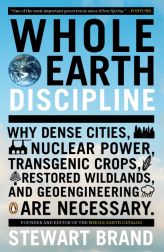
Sustainability is context, not a gadget or a single technology. From Stewart Brand, a lifelong environmentalist and creator-editor of the Whole Earth Catalog, comes this fascinating argument that the environmental movement has for too long been wrapped up in romanticism, rejecting avenues to effective change out of misfounded prejudice — particularly nuclear energy, urbanization, and GMOs. Discipline is a constantly-evolving work, with multiple editions and added content that stray from the original premise, but offers a unique, balanced perspective.

Brand opens with the book by stressing the urgency of action, pointing in particular to positive feedback loops in nature which might quickly accelerate catastrophic environmental & climactic changes too quickly for us to adapt. We must adopt a trident approach: avoidance, mitigation, and amelioration. When one of the largest contributors to emissions (and pollution in general) is the use of coal, shifting to nuclear — with zero emissions and whose lifetime toxic output per person per lifetime amounts to material small enough to fit inside a can of Coke — would have an enormous impact on reducing C02 emissions. Cities and GMOs both tremendously relieve pressure on land and natural systems by allowing us to do more with less, and in the case of cities, innovation and wealth both are increased tremendously, opening options for responding to problems as they appear. If we were to take these seriously as anti-climate tools, we could do far more still: imagine cities with rooftops optimized for reflecting heat instead of absorbing it, or engineered bacteria which could digest and render neutral pollutants. Brand also addresses the criticisms levied against these (nuclear energy and GMOs, as he has not always been a proponent: he confesses to being one of the environmental movement’s most active anti-nuclear proponents in this youth, and it’s only through his study of their case – -including visits to places like Yucca Mountain — that he has changed his mind to argue that nuclear is potential gamechanger. In each chapter, Brand addresses common criticisms of nuclear power, genetic modification, etc, and shares how he came to change his mind based on what he’d studied and observed.

Having previously read titles which argued for the green virtues of both nuclear energy and cities (A Bright Future and Green Metropolis, respectively), I was delighted to find a dyed-in-the-organically-sourced-wool proponent of the same. The book wasn’t as focused as I initially expected, but given the open nature of the book (it’s had multiple editions, and its footnotes are hosted online to ensure currency), that’s not an enormous surprise. The last few sections seem more miscellaneous, and honestly the GMO connection to environmentalism is weak: as someone who used to be more critical of them, I appreciated reading an argument in their favor from someone who had shifted in their opinion. While Whole Earth Discipline is surpassed, content-wise, by the books mentioned previously, it has an unparalleled value in that its author has changed their mind about the issues and can see both sides fairly and argue on facts rather than prejudice and sentiment.

Posted in General | Tagged , , , , , | 4 Comments