Revolutionary Ride

Revolutionary Ride: On the Road to find the Real Iran
© 2017 Lois Pryce
304 pages
There’s 106 miles to Qom, we’ve got a full tank of benzin, half a pack of pistachios, it’s sunny out, and I’m wearing a hijab. Bezan berim!

It was a note from a stranger that took her to Iran, a request from a Habib of Shiraz that she one day visit his home city, to meet the Iran that is not mentioned on the news.  Although the idea of visiting a state where western visitors are often imprisoned as spies wasn’t immediately attractive,  the timing seemed propitious: President Rouhani was then meeting with the United Nations, and the JCPOA was taking shape.  So,  donning a hijab over her hair and hopping aboard the Trans-Orient Express,  Lois headed for a nation that proved to be as complex as it did ancient, there to meet extraordinary people, see a landscape which has inspired poetry for centuries, and tell the state police to f- off.  

Because in recent years Iran’s state department has limited Anglo-American travels to guided tours,  Pyrce unwittingly became one of the last few Britons to ever travel the nation independently. Pyrce brought to her exploration a gung-ho spirit, cheerfully  setting forth despite her unfamiliarity with not only the Persian language, but its alphabet.  This forced her to seek the aide of those around her, who proved more than willing.  Though not knowing what to expect of Iran once she arrived – what would they make of this foreign woman driving an illicit motorbike by herself all over the place? —  Pyrce found herself welcomed, if not with open arms (touching makes the supreme leader cry), with welcome smiles and embarrassing hospitality. The Iranian people’s warmth toward visitors, as recorded in other travel memoirs, is especially well on display here, as Pyrce is treated to meals and given rooms in households over her protestations. Those welcoming her are not just disaffected liberals, young dissidents or old rebels;  they include the conservative and respectable as well as the hip or humble.  

Iran, Pyrce found, is a land of contradictions, too complex for easy summation. Even the individual people she encountered were often unpredictable – the leg-less general, a severe-looking survivor of the Imposed War (Iranians’ name for Iraq’s invasion of Iran that consumed much of a decade), who nevertheless sang to her with a sparkle in his eye, or a young secularist who never the less had a mystic’s appreciation for his heritage.   No one Pyrce broke bread or  quaffed an illicit drink with had a kind word to say about the Islamic Republic;  many waxed nostalgic over the memory of the Shah, whose abuses of power inspired both a revolution and the hostage crisis of ‘79 – ‘81. Most, however, found ways to make life in the regime tolerable: after decades of various prohibitions, there exists a thriving countereconomy,  of  covert satellite TV installers,  suppliers of ardent spirits and forbidden DVDs,  and so on. Although the mullahs’ bullying control over the people has earned them rage and contempt,  Pyce learns that its enforcers are often actively involved in the import of goods that the mullahs have banned – a tidy “baptists and bootleggers” racket. The sanctions imposed by the outside world  may stress and ruin ordinary families, but the government’s agents make a pretty penny through the resultant smuggling.  

Virtually all of Pryce’s experiences in Iran (about a month and a half of motorbiking)  were positive, save some run-ins with government toughs who wanted to throw their weight around;  Pryce’s instincts as to who she could trust or avoid were generally accurate,  though she did  have a bad encounter with one meth-addled man on a lonely highway between Isfahan and Shiraz.   Pryce’s journeys around Persia take us to the great commercial centers of the Safavid age, to the teeming and chaotic capital of Tehran, and to the ancient imperial seat of power, Persepolis. Enroute Pryce touches on various parts of Iranian history and culture – the role of Shiism and Iran’s embrace of its focus on martyrdom;  the checkered legacy of the Shah, and Iran’s troubled history with the west, particularly England and America. The book is thereful doubly useful for those who know nothing of Iran; for me, her  dialogue with so many people was a welcome reminder of our common humanity, despite the differences of culture and the conflicts promoted  by politicians. When states divide people, it is up to the ordinary man and woman to reach through barriers and find the us in the other.  
 
Related: 
Neither East nor West, Christine Bird. Another account of a woman traveling solo throughout Iran, this time in the 1990s;   the Islamic Republic  enjoys more tepid support here than in Pyrce’s time.  Bird, as well as Niall Doherty and Pyrce, confirms how warm Iranians are to visitors.  
Posted in Reviews | Tagged , , | 1 Comment

Eagles at War

Eagles of Rome: Eagles at War
© 2015 Ben Kane
448 pages

Cast from solid gold, and larger than a man could hold in both hands, the eagle was depicted lying forward on its breast. A golden wreath encircled its almost-touching wings, which were raised straight up behind its body. Its open beak and piercing stare gave off a real sense of arrogance. I know my purpose, and what I represent, it seemed to say. Do you, Tullus? Will you follow me, even unto death? Will you protect me at all costs?

Augustus is years from dying, but his Empire’s hopes in greater Germany have a much shorter life expectancy. Summer is ending, and a tenth of his army will soon be making their way to winter quarters. Lying in wait, drawn together by a charismatic Roman officer of German loyalty, are some twenty thousand warriors of diverse tribes. In only a matter of weeks, they will deliver to the Roman Empire its greatest defeat in a thousand-year history. Eagles at War is the magnificent rendering of that battle, which somehow succeeds brilliantly despite its viewpoint characters being not the victors, but the subjects of a confusing massacre.

The principal characters of Eagles at War are Tullus, a centurion; Varus, the likeable if doomed-to-disgrace governor; and of course, Arminius, a German auxiliary who has served Rome for years but only as the prelude to orchestrating her ruin in Germania. Kane portrays all three men as honorable and admirable; Varus here is not an idiot, but a man who enjoyed what he thought was a genuine friendship with a long-serving equestrian, German thought he might be. Tullus is more wary of Arminius, but ultimately he is only a centurion: without evidence, Varus will never accept his doubts of such a friend of Rome, honored by Augustus himself. Arminius, who disappears as a viewpoint character after he becomes the Enemy, must in the first half of the novel thread carefully — finding ways to meet with his allies and arrange the details of the great ambush, while not arousing suspicious. As compelling as the spy drama is, Kane surpasses himself with the extensive portrayal of ambush itself, unfolding across several days as the bedraggled Roman army, strung out, bogged down in mud, and constantly harrassed by the howling, wild Germans, fights an increasingly desperate battle — not for victory, but merely for survival.

I am most impressed with Kane, particularly enjoying his extensive notes at the end that reveal the extent to which he integrated real places and found artifacts into the story, and will be continuing in this series and others by the author. Solid characters, excellent worldbuilding, and effective writing have me hooked.

Related but not remotely comparble:
Give Me Back my Legions, Harry Turtledove. An attempt at the same.

Posted in historical fiction, Reviews | Tagged , , | 6 Comments

Of anthropology, Solzhenitsyn, and a return to the gulag archipelago

If I’ve been quiet as of late, I’ve been bedridden with a severe sinus infection, one that came with headaches so severe that I couldn’t even use my four days off of work to read. Yesterday was the first day in nearly a week I was able to seriously attend to a book! To mark my return to the land of the living, two mini-reviews…

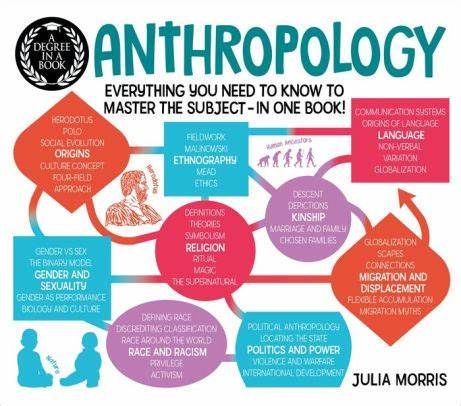
First up, Anthropology: A Degree in a Book, which I read for NetGalleys. My posted review follows:

For those interested in the history of anthropology, the development of its thought, and the areas of most salient interest today, A Degree in a Book: Anthropology recommends itself. It is far more thorough than other books aimed at the layman, like Anthropology for Dummies:: following a general history of the field, the book addresses particularly salient areas of study within anthropology in turn. Each section stresses key concepts and contributors within the field, and the book itself is visually attractive, and never tedious — provided, of course, one is interested in the subject. Even for the non-enthusiast, however, Anthropology is extremely useful, given its careful breakdowns of the subjects and highlighting of those key concepts; a student anxious about reviewing the fundamentals would find this a welcome resource.

“A convict’s thoughts are no freer than he is: they come back to the same place, worry over the same thing continually. “

I like anthropology in general, but I probably should have given that one more thought before I requested it — there’s only so much one can say about a quasi-textbook and not sound like a marketer. Of more personal interest was Aleksandr Solzhenitsyn’s One Day in the Life of Ivan Denisovich. Having read The Gulag Archipelago, I wondered if this might not be overkill; what can one day’s experience in the gulag be like, compared to the decades of suffering and abuse that Solzhenitsyn documented so heroically in the Gulag Archipelago? Yet Ivan Denisovich was Solzhenitsyn’s original attempt to communicate the horrors he’d experienced, and I wanted to see if anything was covered in miniature that we lose when panning out to survey the decades. As its title indicates, the novel simply tells the story of one day in the life of a prisoner, a man who was first captured by the Germans but who then escaped, only to be accused of being a German spy. For this ‘crime’, he was sentenced to a tenner, toiling in a work camp in a gang of mostly-innocents (except for one Moldavian spy), putting his skills as a mason to work. Denisovich and his comrades in suffering are not merely prisoners; they are effectively slaves, bossed around every waking moment of the day with the exception of small slivers at meal time. The prisoners, zeks, are subjected to constant humiliation and suspicion by their overseers — turned out of bed for random counts, forced to strip in the winter to be searched, etc. Their lives are full of misery, and yet — Denisovich goes to bed counting himself a lucky man, at least in the day we spend with him; he avoided being thrown into ‘the hole’, or losing wages being sick; he found a piece of steel he could mold into a tool or utensil at some point, and hid it away without being exposed; he managed to get soup that had some substance to it, instead of simply being water. In the harsh conditions of the gulag, his expectations for what counted as ‘good day’ had shrunk dramatically –and so too his contentment. Shored up by an inner dignity, Denisovich never begs for more or bemoans his fate; he simply makes the most of what he has and goes to bed a contented man — a prisoner, but free in his own way.

Reading Ivan Denisovich threw more light onto the inner being of Solzhenitsyn for me, making a biography I read of him a few months back make more sense in retrospect. Joseph Pearce’s Solzhenitsyn: A Soul in Exile is a unique biography of Solzhenitsyn, its author given the rare opportunity of interviewing the man in the flesh, after he had returned to a Russia between Gorbachev and Putin. Pearce and Solzhenitsyn were drawn together through their mutual love of GK Chesteron, and Pearce believes it was his promise to focus on Solzhenitsyn’s spiritual grounding that convinced the somewhat reclusive author to give him a chance. Solzhenitsyn was not born a critic of the Soviet state; as a young man, he freely joined the Soviet army, and was even approached with the offer of joining the NKVD, the predecessor of the KGB. Some mysterious reservation kept Solzhenitsyn from saying aye, and later on a slight criticism of Stalin was enough to land the young soldier in the gulag system. There, the errant soldier grew in the course of eight years into a philosopher and an implacable critic of the Soviet state. who turned his talents to not only condemning the evils  of the Soviet government, but to defending the best in humanity and his own Russian heritage.  

In prison,  Solzhenitsyn realized how little possessions have to do with a good life, and even out of it he maintained a very simple domicile — keeping in mind, perhaps, Ivan Denisovich’s observation that “The belly is an ungrateful wretch; it never remembers past favors, it always wants more tomorrow.” Solzhenitsyn became deeply religious during his prison years despite his upbringing, and it was that which informed his critique of the his prison years despite his upbringing, and it was that which informed his critique of the materialism that dominated both the socialist  east and the more open, capitalist west.  When the Soviet Union collapsed,  Solzhenitsyn was vindicated – but not especially delighted at the result, given Russians’ wholesale embrace of the worst of the west, its crime and gaudy consumerism. To Solzhenitsyn, western materialism and Soviet materialism were two halves of the same coin; both ignored the inner life of man to feed only his appetites. Those appetites, however, would not be satiated: no one ever consumed their way to lasting contentment. Solzhenitsyn thus urged Russians to think deeply about how to use this opportunity to re-order society, drawing on its own traditions and other democratic thought. He put forth a vision very similar to the distributism of GKC and Hillaire Belloc, with links to E.F. Schumacher’s small is beautiful and Swiss political organization.  (Pearce was converted to Catholicism after becoming enamored of GKC and Belloc’s socio-economic thinking.) Reading Ivan Deniscovich and experiencing the absolute poverty in which Solzhenitsyn lived for eight years made me better appreciate his turn towards a simple life in the decades that followed his freedom.

Coming this week….I still need to collect my thoughts on How Emotions are Made and The Unbroken Thread, which cover emotions and tradition, respectively; I’m mostly done with a novel set during the Germano-Roman grapple…(er, the Roman empire one, not the Nazis-in-post-Mussolini-Italy-one), as well as a couple of books on contemporary American politics. I’m still planning on focusing mostly on TBR and classics this month, with a couple of NetGalley titles thrown in.

Oh, and during my illness I mostly watched Barbaren. It’s a lot of fun if you’re into Latin and German. (And….stabbing.)
Posted in Classics and Literary, Reviews, science | Tagged , , , , , | 5 Comments

9/11/2001

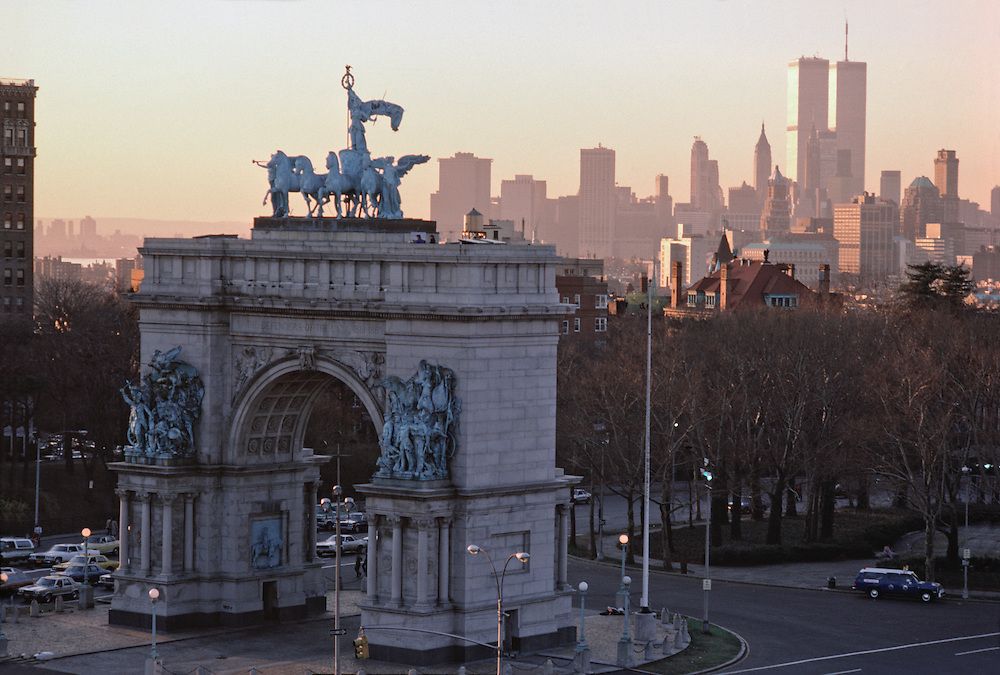
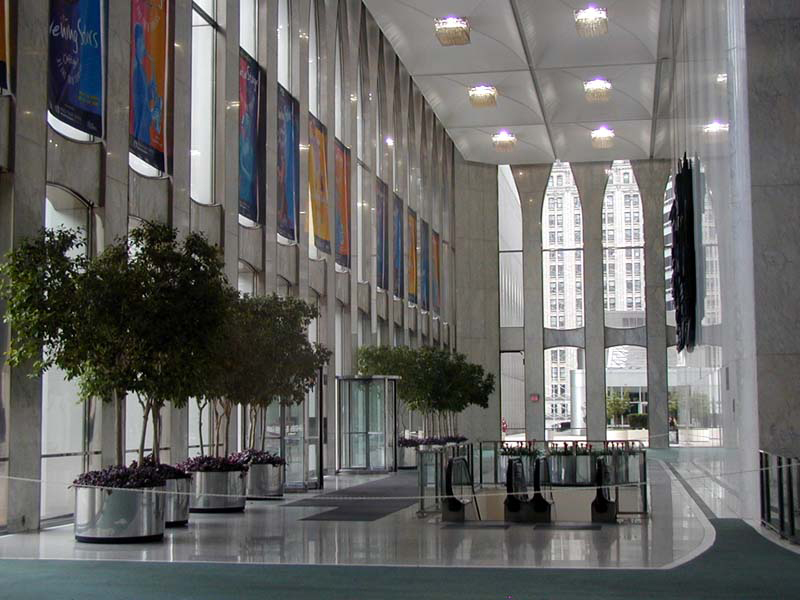
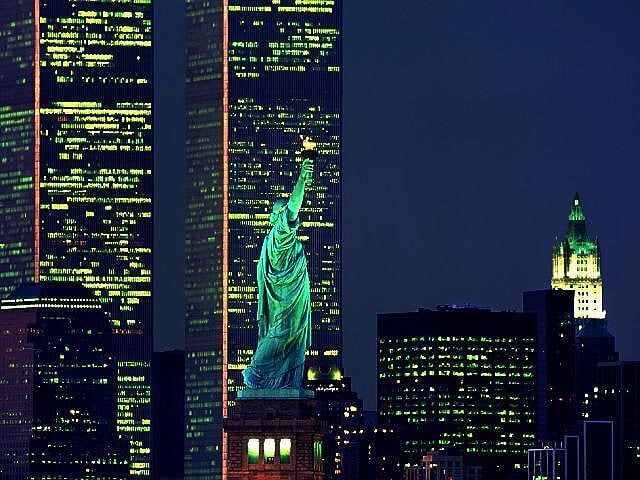
It’s the twentieth anniversary of an attack upon the United States, the details and legacy you’re already familiar with. If you weren’t, I’m sure there’s no shortage of offerings today. Rather than dwell on the mistakes of the past, I’d like to share some photos celebrating the WTC — the buildings, while never aesthetically pleasing, have gained a retrospective beauty now that they’re gone, and my sadness at having never gotten to see them in all their physicality manifests itself in my tendency to collect any photograph I can find of them, particularly of the interior. I take no credit for any of these — I’ve squirreled them away across the span of 20 years, so citing sources is impossible.

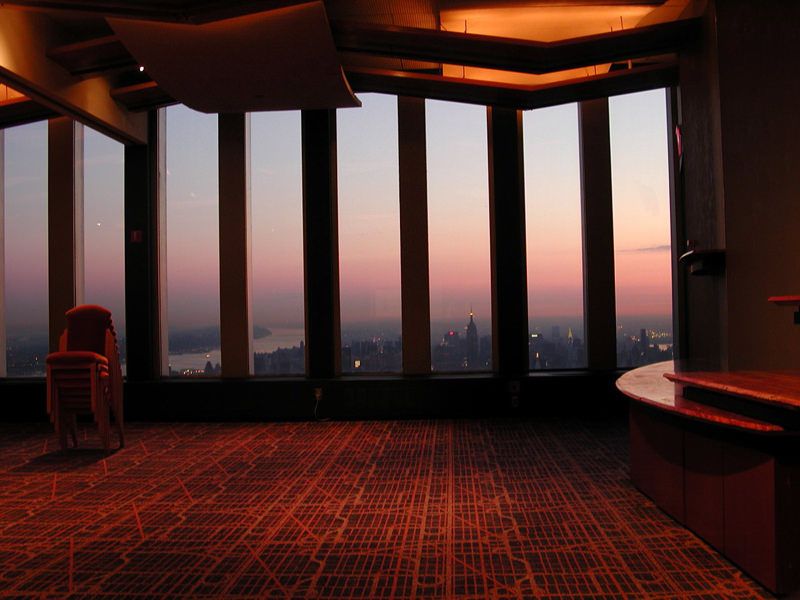
Interior shot from “Windows on the World” restaurant.
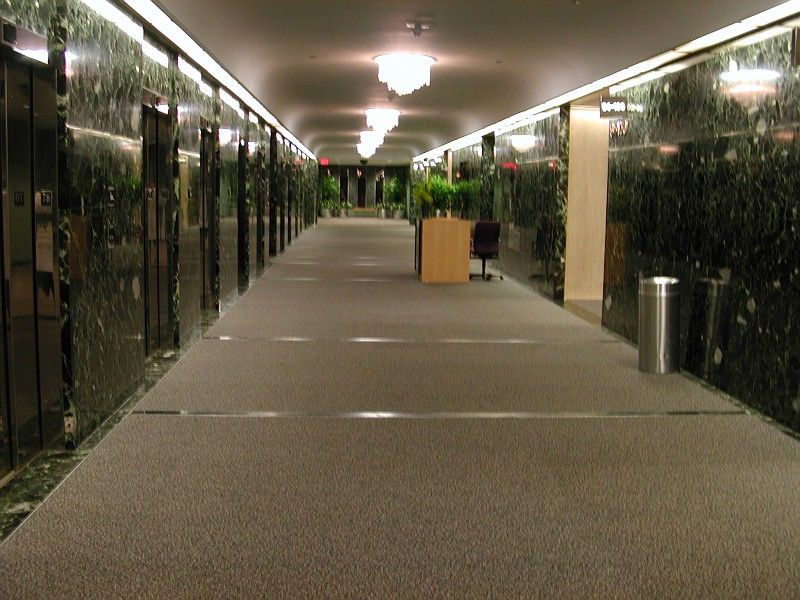
Absolutely mundane, but these are the kind of shots I keep looking for — the ones that show the little details. This is a floor where people transiting from the lower levels to the upper (or the reverse) switched elevators. I found this shot in another collection identified as “Skylobby Floor 78”. There were apparently at least three stages of elevators to pass through to make the full transit, which probably complicated escape efforts both in ’93 and ’01.

If you’re interested, there are some videos on YouTube displaying other people’s collections. I’m including one below as an example.

There’s all kinds of interesting footage online:

“When the complex planned by the engineers is completed, we will have run about 600 miles of cable, made about 3 million connections, and delivered the whole thing to New York, working like a supercomputer. “
Posted in General | Tagged , | 4 Comments

Naked Statues, Fat Gladiators, and War Elephants

Naked Statues, Fat Gladiators, and War Elephants: Frequently Asked Questions about the Ancient Greeks and Romans
© Garrett Ryan
288 pages


For those interested in the life of Greece and Rome beyond senatorial politics and agricultural policy, Naked States offers an absolutely entertaining and unexpectedly detailed look at various aspects of Greco-Roman culture. At first glance, the text is simply a series of essays, written in response to questions — some specific, some general, but this is no dry catechesis. Ryan’s lively explanations run cut cross not only the world of the Greek city-states and the Roman realm, but make occasional forays into Persia and Egypt, as well, illustrating how no part of the classical world existed in a vacuum. The essays end with what the author cheekily frames as an ‘irresponsible short’ history of the classical world for anyone who needs a little context. In short, for those with any interest in the goings-on of Greeks and Romans, this is an absolute delight.

It’s almost impossible to do justice to the variety of content contained herein. Although Ryan’s approach isn’t as tightly organized something like the Gies‘ Daily Life in a Medieval Village, or Ian Mortimer’s wide-ranging social histories of England, it nevertheless succeeds in offering a panoramic view into Greek and Roman life, across classes. Each question opens an entire avenue of consideration: “Were gladiators really fat?” for instance, is answered in an essay covering the entire scope of gladiatorial games in Rome, with an extra focus on their diet. Given how much more information is available about the emperors and upper classes, there’s a slight preponderance of patrician topics, but this isn’t a book just about the aristocrats. Some of its more memorable offerings include a comparative study of how nudism was treated in the classical world, a history of how our delightfully composite calendar got that way, a consideration of slavery in Greco-Roman societies, a survey of how Roman buildings were treated as the western order gave way (plundered, mostly, even the emperor’s tombs), and a comparison of sporting events in both Greece and Rome. (The Romans found the Greek obsession with the Olympics a little weird, except for Nero — he insisted on hosting his own games, in which he ‘competed’ — and won in a chariot race despite falling out of the the chariot and finishing third). Ryan provides a skillful mix of useful, general info and more interesting-but esoteric content, with just enough humor to make it playful but not so much that it veers toward the trivial.

Recommended!

Coming up:
The War that Made the Roman Empire, Ben Kane’s Eagles at War, and some stuff that’s not related to Rome followed by more stuff that’s related to Rome (hopefully). I have both CC and TBR I can tie in to a Roman focus so don’t be surprised if the togas and legions take over in September.

Posted in history, Reviews | Tagged , , , , , , | 5 Comments

The Warehouse

Paxton used to be a man with a promising idea, one that was flourishing in the market — but then The Cloud said “Lower your prices”. The Cloud wasn’t the voice of God, floating in the heavens — but it almost might as well been in the United States, for no merchandiser could hope to find any market whatsoever that The Cloud, Inc didn’t already control. Now he’s a spirit-broken peon, newly employed by The Cloud as a security guard. And….things are about to get a lot worse. One of his fellow new hires, Zinnia, has started work at the Cloud with the sole intent of gathering intelligence on it for her mysterious employers; there has to be a weakness in its systems somewhere they can exploit, and she’s technically savvy and borderline sociopathic, with a gift for manipulating people. Assigned as a warehouse grunt, the frustrated Zinnia sees in lovestruck Paxton the perfect dupe to gain access into the warehouse’s nether regions. This begins this dark look into the very possible future of the United States, where the speculation is solely in the tech used –for the author references abuses already committed by Amazon and Walmart, our friendly neighborhood leviathans.

The Warehouse isn’t just a warehouse: The Cloud operates through massive artificial cities, fully enclosed, which it calls MotherClouds. These massive structures are storage and shipping hubs for the company, but they also have dormitories for their workers, independent power plants, medical facilities, and a promenade that functions rather like a mall. The company town has been resurrected, with all the peonage and debt slavery that that system once entailed. The Cloud enjoys enormous political cloud thanks to its deep pockets and “green initiatives”: its plants, it boasts, are solely run by green power, and thanks to eliminating transportation costs for 30 million people (its peasant-workers, tracked by armband and color-coded by work type so no one can get themselves lost) , it even claims to be on the verge of being carbon-negative. No one is in a position to stop them: most of the world is struggling with flooding coastlines and massive population disruption, so it’s almost nice that someone, somewhere, seems to be so hypercompetent at what they do. Nevermind the fact they’ve built a creepy dystopia where everyone is watched despite a lack of cameras, where human beings are treated like cogs in a factory — interchangeable parts packaging and moving interchangeable parts.

The most chilling part of The Warehouse is that it’s not….entirely fictional. Take the warehouse system, for instance, in which workers are guided to bins by an electronic gadget giving them instructions, where they spend ten hours a day constantly running back and forth, dodging robots that are moving crates, continually judged by their fill quotient. This is literally happening: it was described in Nomadland by Jessica Bruder, when she joined members of Amazon’s “CamperForce” — mobile workers who work for seasons in Amazon’s own warehouse. The monopsonic ways of both Walmart and Amazon — their power to dictate prices to merchandisers, and thus distort market demand just as drug cartels or governments do — and their destruction of small firms that won’t kowtow to them has been documented in books like Cheap: The High Price of Discount Culture. Cheap (or The Walmart Effect, it’s been years) literally mentions a pickle company that was bullied by Walmart, just as another pickle company is bullied here. The only fictional aspects are the characters, very nearly.

As a warning, The Warehouse is creepy and captures the dreary monotony of the daily grind, while at the same time steadily driving forward — the reader wondering who Zinnia is working for, just what is hidden in the underground of the MotherCloud, and when poor Paxton is going to have his heart broken further by his new friend. Although it’s mostly grim, with a possible glimmer of hope at the future, those who enjoy near-future stories or those fascinated by the prospects of tyranny-by-corporation will enjoy it.

Related:
The Circle, Dave Eggers

Posted in Reviews, science fiction | Tagged , , , | 3 Comments

The Moon is Down | The Pearl | The Red Pony

Yesterday I made the mistake of having a sinus headache, and in our Brave New World of Perpetual Hypochondria, I was ordered to the doctor’s office to have my nose jabbed in search of the dreaded Beer Bug. To no one’s surprise (though to my slight disappointment, as I could do with ten days in quarantine), I was announced clear. Anyhoo, I finished three Steinbeck short works and made solid progress on How Emotions are Made before my poor battery died in the Artic wastes of the waiting room.

“But suppose they don’t want to be safe?”
“Then you must think for them.”
Orden said, a little proudly,
“My people don’t like to have others think for them.”

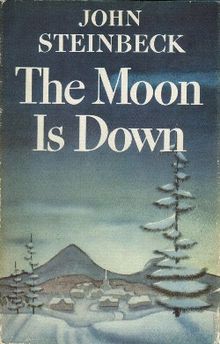
The Moon is Down, which I’d scheduled to read the week of July 20 as a reference to the moon landing (in conjunction with The First Men in the Moon, Jules Verne), proved to have nothing whatsoever to do with the moon. Written in 1942, it’s set in an un-named town with a coal mind and some unexpected German tourists — they’ve arranged a mostly-unchallenged occupation of the town, thanks to the help of a sympathizer who paved the way. The sympathizer expects the occupation to go smoothly, since the people are a pacifistic lot who haven’t had to fight in decades, but both the mayor and the leader of the occupation know better. There is nothing more dangerous than a people accustomed to freedom suddenly having it taken away — and sure enough, a rebellion soon follows. Although the short novel does not tell the entire story of the resistance, it’s in full flower as we depart. The novella has sympathetic characters all around, even the German majordomo — a surprising touch given the tense times in which it was written.

The Pearl is a tragedy that I read several times in high school, and concerns a poor fisherman with an ailing son who discovers what he believes to be the Pearl of the World — an extraordinarily large, captivatingly black pearl. Although he can see nothing in the Pearl but a reversal of fortune — money to save his son, to send him to school, even to buy a rifle! — his wife is more conflicted, seeing too what dangers such a Pearl might bring them. When the fisherman attempts to sell his find in the marketplace and finds that the buyers have conspired to offer him insultingly low prices, things disintegrate fast, and we can only remember Tyler Durden’s warning — the things you own end up owning you.”

The Red Pony is shorter still, and is a series of stories about a young boy being mentored — directly, when his prize pony takes ill, and more indirectly when he meets an interesting character in the wilderness. At this point in the afternoon I was mostly concerned with trying not to succumb to hypothermia and didn’t get a great deal out of the story.

Posted in Classics and Literary, Reviews | Tagged , , , , | 8 Comments

August 2021

Science Survey
A nice month for science:
The Social Instinct, Nicholai Raihani
The Red Planet: A Natural History, Simon Morden
The Call to Antarctica, Leilani Rashida Henry
What’s Eating the Universe? and other Cosmic Questions, Paul Davies (Cosmology)
Hurricane Lizards and Plastic Squid, Thor Hanson
Chemistry for Breakfast, Mai Thi Nguyen-Kim


We’re now at 11/12 categories filled. All I need now is a bit of brains!

Classics Club Strikes Back:
Climbing Mount Doom

…hey, I read lot of books in August. Just….not ones I’m supposed to be reading.

The Unreviewed:
Seeking Christendom: An Augustinian Defense of Western Civilization, Brad Birzer. Still may say something about this; it’s Birzer’s original approach at offering a tribute to several mid-century defenders of the west, in an age of factories, states, and armed ideologies. The approach created several daughter works, including Beyond Tenebrae and Birzer’s biographies of Russell Kirk and Christopher Dawson, two of his subjects here.

Please Stop Helping Us, Jason Riley. Riley examines ways that DC’s policies designed to help black Americans are indirectly undermining them, much as Thomas Sowell or Walter Williams did in their own professional careers. (I keep forgetting to finish and post my review of Williams’ American Contempt for Liberty, which has a heavily focus on the failures of education policies and the black community. These may pair nicely together..)

Like a River Flows. A young author’s tribute to her grandmother, offered as reflective essays and letters written to her. The author is currently teaching in my town, and I suspect she may be invited to host a Lunch at the Library, so I wanted to read her book in case anyone asked about it. I thought it was sweet.

Unread Purchases:
The Warehouse, Rob Hart. The Circle meets Amazon.
The Metatropolis, edited by John Scalzi. An anthology of SF stories set in The City of The Future. Found while looking for new Scalzi titles.

Plans for September:
I’ve got 4 more netgalley titles (two science, two history), so they’ll come first, and then I really need to bunker down on some TBR and Classics Club stuff. The science focus in August helped me very-nearly finish off the Science Survey, and I would have done had I not been distracted by Brad Birzer, The Unbroken Thread, and some Roman fiction.

Posted in General | 11 Comments

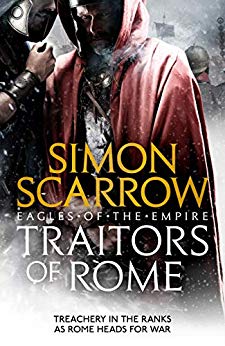
Traitors of Rome

Traitors of Rome
© 2019 Simon Scarrow
351 pages

“Fortune watch over you, sir.”
“She always does. She’s got a thing for me.”

Young Tribune Cato and his grizzled enlisted mentor Macro have come a long way together, from the dismal bogs of Britannia to the even more dismal desert wastes of the eastern border. Across the Euphrates stands Rome’s worthiest enemy, Parthia, and though momentarily distracted by a little internal fracas, it won’t be long before the great powers are at each other’s throats once more. Hoping to delay the outbreak of war, Cato’s general sends him forth on a suicide mission — to cross into Parthia, arrange an meeting with King Vologases, and strike a peace treaty that will give Rome time to better prepare its forces. Cato and Macro, who have thrived as a pair, covering each other’s limitations with their respective strengths, are now isolated: while Cato journeys into the unknown, Macro is charged with leading a force of soldiers into the mountains to put down a rebellion from some insignificant little upstart city. Both soldiers of Rome will soon find themselves in the most desperate of straits. Traitors of Rome marks (for me) a triumphant return of some old characters to a new front.

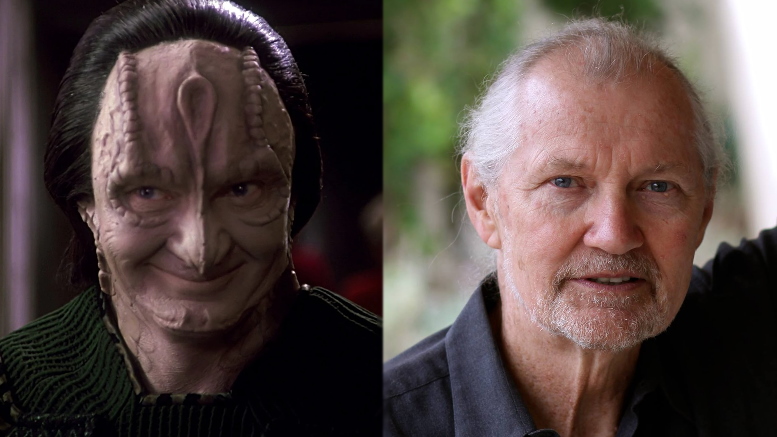
I read the first few Cato and Marco books, set in the conquest of Britain, but lost interest in the constant tribal politics the Romans had to maneuver through to make steady progress; Traitors is set fifteen years after our first meeting with the boys, and they’ve both grown much. The gangly young boy-turned-officer Cato is now an accomplished commander in the prime of his life, with a young son and a broken heart; his mentor Macro is newly married and beginning to wonder if he shouldn’t leave the life of the legion behind to settled down with the Mrs and tend to a farm somewhere. For the time being, both have more pressing matters on their minds: Macro’s expedition into the mountains goes sideways after a broken bridge traps most of his supplies on the wrong side of a river from him, and an aggressive response by the rebels forces his men to bunker down for a brutal winter siege. Cato fares no better, traveling into Parthia alongside an untrustworthy Greek aide who takes a perverse delight in spinning tales (I mentally pictured him as Andrew Robinson, given his Garak-ness), surrounded by Parthians who regard them not as honored ambassadors, but oafish spies. Both men’s character is taxed to the utmost, making Traitors the most memorable Eagles book I’ve read to date. Since the two friends are separated for most of the book, there’s little of the usual humor that comes in their mutual joshing, and between the siege and —- well, another plot development — things get darker than usual. The book is replete with varied battle scenes, though, as the Romans fight across Parthia’s widely-changing landscape.

I shall definitely look forward to more of the boys’ adventures in the east!

Posted in historical fiction, Reviews | Tagged , , , , | 4 Comments

Unsubscribing from romantic-comedy dreams

Within the last month I’ve read two somewhat related titles: No More Mr. Nice Guy and The Unplugged Alpha, both mens-interest books but with different tones.  No More Mr. Nice Guy is written by a psychologist who treats men trapped in self-defeating behavior.   He defines a “Nice Guy” as one who lives solely for the pleasure and approval of others,  and believes that this enervating condition is brought on by abandonment issues in childhood, and the stigma of growing up male in environments now dominated by women – the home and school, primarily.  Constantly castigated for being too rowdy, uninterested in passive education, etc,  boys internalize guilt and deny their own worth as people. The author urges men to embrace their own value, to assess how much of what they believe, pursue, and value is honestly their goals and how much they only pursue because they’ve been told they have to.  Learning this lesson is important not only to do justice to one’s self, but to create genuine relationships with people: Mr. Nice Guys are invariably unhappy and manipulative, and frequently fail in both romance and life in general. The book is replete with breaking-free exercises to reestablish one’s sense of self and to pursue a life that is personally meaningful.  Having read The Virtue of Selfishness,   which is that lesson on steroids, I found this a helpful reminder, and presumably one useful to men stuck in self-loathing ruts. 

On men  pursuing integrity and excellence

Richard Cooper’s The Unplugged Alpha is….rather different, summarizing an entrepreneur-turned-life coach’s  approach to his own life and the clients he advises.   Cooper’s “Entrepreneurs in Cars” channel began by interviewing self-made businessmen who talked about paths to success while showing off the fruits of their labor. Following a brutal divorce and a successive failure in another close relationship, Cooper  branched out into discussing the types of women it was best to avoid: his channel has subsequently grown in that direction,  focusing on  guiding men to investing in themselves, regarding marriage and longterm relationships as useful only in some circumstances – when children are desired, for instance ,or if a man finds a woman who is a genuine complement to his life,  and doesn’t seek to take it over.   Cooper believes in invariable conflict and tension between the sexes: we live, he argues, in a female-first social structure, in which men are regarded as expendable.  Just as men treat women as sex objects, so too do women treat men as success objects: they  are guided by a hypergamous instinct, hunting for the best of men and uninterested in the rest until they themselves have begun losing their own appeal as partners.  This instinct, Cooper argues, means that women have no qualms about dropping a long-term partner to trade up, just as older and wealthier men are known for dropping aging wives for younger models. Men should thus conduct themselves with caution, he advises, avoiding some women altogether – party girls, women with children, women with father issues – and treat others with wariness,  making sure that when a woman enters the picture,  she is there as a partner to better one’s position and not someone who  expects to be treated as a prize to be treasured and put on a pedestal.  To that end, Cooper urges men to continually work on themselves, to maximize their potential and take care of their health– not only will they be happier, but it will empower them in their relationships, knowing they can always pick up another partner if one proves obnoxious.    Although I enjoy some parts of Cooper’s channel, particularly his admonitions to avoid  “loser talk” (enfeebling literature/shows/ideas that promote the idea that one’s problems are always someone else’s fault, and that one is always powerless ), the book was too focused on sex and pick-up theory for me. I liked the  “Take responsibility for your life and stop complaining about other people” part, though – but one can get that through Peterson or Rand without the obsessive focus on sex and supercars.  Next year I may pick Sex at Dawn: Why We Mate and Why we Stray, which Cooper quotes, as my anthropological read to compare his use of its analysis to the facts-as-stated in the book.

Related:
Men on Strike: Why Men are Boycotting Marriage, Fatherhood, and the American Dream, Helen Smith. I read this a few months back but have yet to finish my review of it.

Posted in Reviews | Tagged , , | 6 Comments