May has been a…weird month in my life, that’s all I can say. I’ve obsessively studying for the CompTIA A+ exams, and I started a part-time job driving for the railroad to expedite the whole “buy land and become an eccentric recluse” lifegoal. The month ended with a lot of anarcho-agorist reading. Who knows what June will bring?
Challenge Progress:
Science Survey:
6/12 categories now filled, with Drug Use for Grown Ups and Clean now filling the Wildcard slot.
She Come By it Natural, Sarah Smersh. Less a biography and more of a feminist appraisal of Dolly.
Clean: The New Science of Skin. A brief book that combines a history of soap and skincare with some of what I was looking for, science writing on how our skin is a little ecosystem and that barraging it with harsh chemicals all the time is not a great idea.
No Treason: The Constitution of No Authority, Lysander Spooner. I was planning this for a celebration of rebellion and sedition aimed around Independence Day, but from the opening page I could not stop reading. Comments to come.
Enemies: A History of the FBI, Tim Weiner. A history of the FBI that highlights its role as secret police, more obsessed with watching and arresting political dissidents than functioning as genuine law enforcement. I’ll possibly give it fuller comments.
Alongside Night, J. Neil Schulman. Dystopian novel with an anarchist bent. Heard of this while listening to a podcast over the weekend; began reading it and couldn’t stop. Review to come, possibly along with comments on the movie adaptation. The latter had….limitations.
The Newly Bought:
NONE! I was tempted, dear readers, boy I was tempted….but I looked at the pile of books behind me and said “Nope”.
June Goals
Continue reading only what I already own, supplemented with the odd library book. Read more — I’ve been eliminating competing timesinks. Right now I am in a serious SF mood, so don’t be surprised to see a little of that popping up. Toward the end of June we’ll be shifting to The American Summer, which will feature American classics, American history, etc. It’ll be an expanded version of my annual tribute to the American Revolution.
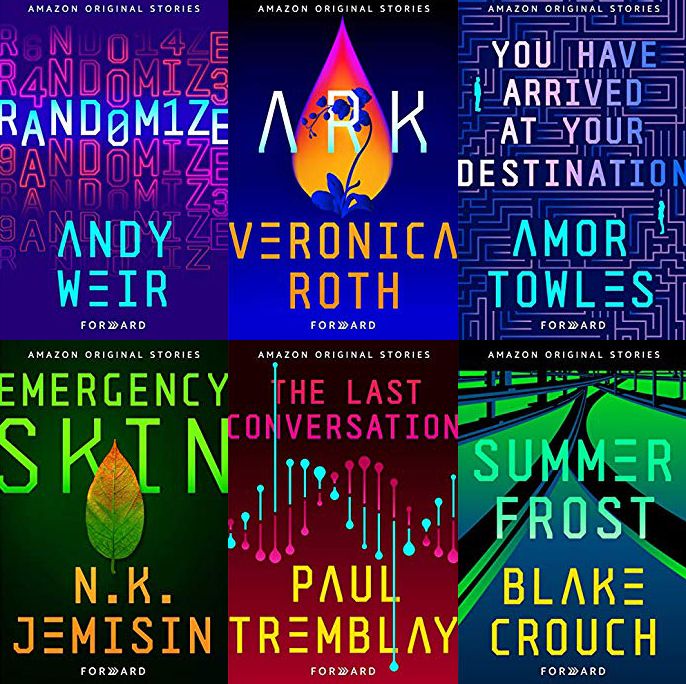
While poking around on Amazon for new releases by Weir, Scalzi, and Doctorow, I encountered the Forward collection, a series of short stories by various authors (most new to me) on near-future SF. They are very short stories, the two longest being 70 and 60 pages, and several are short enough to knock off in a single sitting. The strength of the collection may see me looking for more of some of the authors! All of them are near-future stories, with varied themes: quantum computing, genetic modification, and artificial intelligence marked three of my favorite tales. While they’re so short I don’t want to say too much for spoiling them, I will leave little summaries below.
Randomized, Andy Weir, sees a quantum physicist and her techie husband attempt a casino heist by taking advantage of quantum computing. A very quick future-crime read.
Ark, Veronica Roth. More thoughtful, this takes us to an Earth about to be devoid of all organized life: over the last few decades, humans have fled the planet in the advance of an asteroid impact, and the last ship (loaded with native Earth plants) is preparing to launch. In these last hours, a scientist makes a bittersweet discovery.
Summer Frost, Blake Crouch. Easily my favorite among the lot, it’s also the longest. A video game programmer unwittingly becomes the creator of the world’s first emergent artificial intelligence. It reminded me strongly of both Her and Ex Machina — I hope that doesn’t spoil things too much.
Emergency Skin, N.K. Jemison. And easily my least favorite, Emergency Skin starts off with a very interesting premise: a scout from a colony of human refugees has returned to Earth, to investigate the ruins of the old home planet of the Founders. Not only are there survivors of Earth’s environmental and civilization ‘collapse’, but there’s a twist waiting for the scout — several, in fact. Unfortunately, the interesting concept and worldbuilding is ruined by sanctimonious lecturing; I’ve heard sermons that were less preachy.
The Last Conversation by Paul Tremblay opens with a man waking alone in a recovery room, sans memories and sight and dependent on a comfortingly familiar female voice to guide him back to life. We learn of a pandemic that has swept their community, and which may yet kill him — but there’s a “Ooooooooooooh” twist at the end. My second favorite.
You Have Arrived At Your Destination, Amor Towles. Towles’ is the most thoughtful of the lot, following a dissatisfied man in his middle age as he visits a fertility clinic to finish up his and his wife’s pregnancy planning. The clinic alleges to be able to not only manipulate the expressed genes of their future child, but to predict their future along broad lines. This piece touches on the perennial argument over free will and determination, but it raised the question of man’s agency in a technologically-dominated world to prominence as well.
Quotations
“Why, she had once asked her mother, do you bother to keep anything alive when it’ll all be wiped out by Finis? Her mother had shrugged. Why take a shower when you’re just going to get dirty? Why eat when you’re just going to get hungry? Every flower dies eventually, Sam. But not yet.” – Ark
“She wished she could have told him that life was already full of dread, no matter who you were. That there was nothing you could have that you couldn’t one day lose. That autumn always gave way to winter, but it was her favorite time of year—those fleeting bursts of beauty before the branches went bare.” – Ark
“Well, you can’t love everything equally,” she said. “You just can’t—and if you did, then it’s the same as loving nothing at all. So you have to hold just a few things dear, because that’s what love is. Particular. Specific.” – Ark
“There’s no point in pushing our personalities uphill.” – You Have Arrived at Your Destination
“Okay, we should be ready to power it on,” said Prashant. He looked up at the ceiling. “Kind of a strange room. Were these blue lights always here?” Chen didn’t take his eyes off the computer. “I installed them yesterday. Cool stuff needs cool lighting.” – Randomize
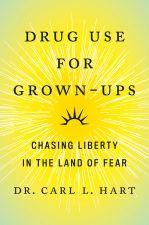
My occasional forays into anarchist literature aside, I’m one of the squarest people you are ever likely to meet, a fellow whose idea of a good time involves comfy chairs, good company, and a cold drink or three. I’ve never consumed anything more interesting than single-malt Scotch, and yet over the years I’ve been increasingly drawn to the controversy over drug policy in the United States, largely thanks to my conviction that the people are not the belongings of the State. Carl Hart argues against the war on drugs from a different angle, however: as a professor of psychology at Columbia University, he has traveled extensively and conducted studies of the effects of various drugs upon the human body and mind. In his experience, he has concluded that appropriately-dosed drug use by responsible, healthy adults carries no risk for addiction, psychosis, etc. It’s a bold claim, and one I was eager to see argued.
Hart did not begin studying the science of drug use in order to defend a habit he had already embraced. Instead, growing up in a Miami riddled with drug use and crime, he sought to help his neighbors escape addiction by understanding drugs’ effects on the mind. Through his studies, he began to doubt the claims made about certain drugs, and in the spirit of scientific enterprise, he experimented himself. Throughout the book, we learn that Hart has used seemingly ever popular recreational drug over the sun – some regularly, some only once – almost always with positive results. (“Almost” because he purposely addicted himself to opioids in to experience withdrawal.) In each case, Hart considers the history of a given substance’s ban, the medical literature (or lack thereof) supporting bans, and then moves into his own surveys and personal experiences. He dissects sloppy studies that have been the basis of policy for years and shares others offering opposing conclusions, either conducted by himself or by colleagues. Most drug users, he argues, enjoy their substance of choice in the same way that others enjoy a drink: it’s done out of honest desire for pleasure, the moment is enjoyed, and they go to work the next morning. He frequently points out the near-identical chemical consistencies of “bad” drugs and licit prescribed narcotic, and asks: if these have the same constitution and same effects, why are some regarded as appropriate for use by responsible adults, and the others regarded a crime on the level of theft, arson, and murder?
Hart believes that a substantial part of the war on drugs, from the earliest bannings around the turn of the 20th century to the present day, stem from racism. Stimulants and opiods were present in all manner of consumer goods in the 19th century: sodas, chewing gum, over the counter medicines, etc. It was not until large waves of immigration began reshaping American cities, bringing with them new consumptive practices (opium dens, for instance) that promoted race-mixing that the force of law and order began a war against what people could put into their own bodies. Hart doesn’t connect the nascent drug war to the tides of the Progressive period, which sought to ‘clean up’ cities and society by bulldozing slums for parking lots, outlawing residential hotels, creating sanitary institutions, and imposing abstinence of all kinds on society at large: he instead focuses on race to the exclusion of everything else. Hart’s discussion of race is a substantial part of the book, as some recent death-by-cop instances have seen the shootings legally exonerated on the basis of the victim’s drug use at the time, to public outcry and mass arson.
Hart does not dispute that drugs can lead to addiction and be culpable in the premature deaths of many. Those who are in mentally fragile states to begin with – who are depressed, groping for meaning, etc – can easily abuse these substances and destroy themselves. These same people are vulnerable to addiction to substances that the state won’t imprison them for decades for holding, however: alcohol, nicotine, sex, take your pick. Because punitive drug laws force so much of the trade into the shadows, further, those seeking pain relief or a good time are forced to conduct business with questionable vendors selling dodgy products, often mixed with other materials that make it difficult to determine safe doses – if tainted dope can be considered safe to any degree. (Historically, the same was witnessed during the United States’ experiment with Prohibition: when booze was driven from the open market, bathtub gin and the like grew in the black market, and poisonings happened frequently.) Adopting an approach like Portugal or Spain, where personal-use possession is not a crime and where it is easy to test the integrity of product, would do much to diminish drug-related deaths. As we saw in Narconomics, safety and quality both increase when the black market is allowed to operate more in the light – though in that case, thanks to the anonymity of the Tor-accessible dark web than through decriminalization or legalization.
Hart’s case is stronger in its science than its presentation, as I found him increasingly difficult to take seriously. The writing is far less informal than one would expect in a book advocating science-based social policies, with gems like “That grown-ass man did not just say that. WTF?” making me wonder if he was composing a book or a tweet. Race, while a massive aspect of the war on drugs, is a particularly sensitive topic for Hart, and it makes him frequently uncharitable and obnoxious: any time a drug-related death-by-cop happens, Hart accuses the reporting citizens or policemen of subscribing to the “crazed coked up n——” myth, going so far as to put those words in people’s mouths. Hart dismisses fears that criminals under the influence of drugs are more aggressive and pain-resistant than sober crooks as mere racism, without considering all of the testable medical claims inherent in those fears, and this particular instance is repeated numerous times throughout the book. It’s cheap, needlessly belligerent, and unprofessional.
Drug Use for Grown Ups was, despite its faults, a singularly fascinating book. I was mildly scandalized when Michael Pollan revealed he had been experimenting with psychedelics (How to Change Your Mind), but will admit to a voyeuristic interest into what drug use is actually like. Pollan and Hart’s cases make me wonder if the claims pushed by the state about inevitable addiction and mind destruction isn’t as overstated as its other sweeping generalizations, misrepresentations, and outright lies. I’ve witnessed too much of the chaotic effects of drugs on vulnerable populations to dismiss safety concerns out of hand, and in the end remain where I am: an advocate against the drug war on the basis of self-ownership, rather than the argued-for harmlessness of drugs when used responsibly. I’m glad to have learned that they aren’t the equivalent for nukes for the brain, but I don’t think I’ll join him and Pollan on Tim Leary’s bus ride…
The New Jim Crow, Michelle Alexander. An analysis of the drug war’s disproportionate effect on the United States’ black population, particularly the poverty and disenfranchisement promoted by mass incarceration
Rise of the Warrior Cop, Radley Balko. A history of police militarization, largely fueled by the drug war. One of the most eye-opening books I’ve ever read, the one that convinced me to look into Waco & Ruby Ridge.
I am presently reading Enemies: A History of the FBI, and encountered this insightful comment by Associate Justice Louis Brandeis, in the Olmstead vs. US (1928) decision.
“The greatest dangers to liberty lie in insidious encroachments by men of zeal, well-meaning but without understanding. [….] Crime is contagious. If the government becomes a law-breaker, it breeds contempt for the law; it invites every man to become a law unto himself; it invites anarchy. To declare that in the administration of the criminal law the end justifies the means — to declare that the government may commit crimes in order to secure the conviction of a private criminal — would bring terrible retribution.” – Associate Justice Louis Brandeis
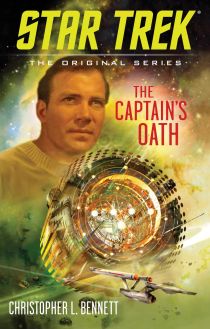
Captain Jim Kirk has just taken command of the USS Enterprise, and already he has a tricky situation on his hands. It should be simple: pick up a team of archaeologists who were investigating a site prior to an extensive terraforming project removing any possibility of exploring the ruins of a destroyed civilization. Three comets are within range of the system, and with a little manipulation they can serve to start making the planet habitable again. The lead archaeologist is a former Starfleet officer, one who served as Kirk’s science officer on his first command, but her intransigence is complicating a delicate timeline. To achieve a solution that satisfies both parties, Kirk must draw on his past experiences and accumulated wisdom, balancing passion and prudence. Bennett incorporates Kirk’s entire command experience into the story, jumping from past to present in succeeding chapters to explore the bond Kirk has with his crew, and the effect they and his previous challenges have had in molding his character. Bennett provides his customary winning mix of solid characterization, Trek adventure, and scientific plausibility.
Captain’s Oath welds together two episodes of Kirk’s earlier history as a captain, fusing them with his unexpected dilemma on the Enterprise’s first voyage under his command. As the interlaced stories develop, so to does the familiar character of Kirk: the reader witnesses him becoming the man we know from the original series. The original show had a perfect trio in Kirk, McCoy, and Spock, as the captain balanced the emotional and dispassionate forces of his two best friends and ablest advisors, but young Kirk had to strike different balances — and was, in fact, the serious, focused one among his early bridge crews! The trials that Kirk endures in his first two commands, which Bennett explores here, do not have perfect resolutions; fate always seems to extract its pound of flesh. They sharpen and season young Kirk, though, giving him better judgment, more confidence in his instincts, more willingness to act beyond the rules and regulations and fulfill the spirit of Starfleet’s orders if not their letter. Kirk’s personableness remains an important part of his character and the book, as his bonds those he’s served with — even those who have left the service — push him to be the best he can be, to never fail in the face of obstacles or frustrations.
Definitely a good one for TOS & Kirk fans, and especially for those interested in the Kirk-Mitchell friendship. Michael Jan Friedman did a trilogy based on Kirk & Mitchell called My Brother’s Keeper.
I’ve been studying for the CompTia A+ certification and entertaining a new lady friend in recent weeks, so my reading and reviewing has gotten a bit…torpid, shall we say. I haven’t been totally absorbed in specs and dates, though:
Make Russia Great Again by Christopher Buckley parodies the Trump administration, being a memoir of a former hotelier tapped as Trump’s chief of staff, there to serve until being arrested for…well, no spoilers. It’s classic Buckley, a mix of vulgarity and farce — fairly appropriate for the Trump years, I suppose, but aside from some mild interest in the plot (involving a rogue AI program sabotaging the Russian elections), the inanity didn’t make for an enjoyable story.
More interesting was Spying on Whales, which didn’t quite live up to its premise despite the promise of the subject. Although the author delves a little into whale behavior and the origins of these magnificent creatures, a lot of the content recorded his paleontology fieldwork, and I found myself just dragging along.
Broke USA: How the Working Poor Became Big Business examines the rise of check-cashing firms, pay-day & title loan joints, tax return loans, and the like — as well as the efforts of those who have checked their growth in places like Ohio. One of the more depressing aspects of managing a computer lab used by the public is witnessing people getting into debt spirals by applying for these things: I’ve tried to run interference over the years by casually pointing out how much they’ll actually be paying at those interest rates, but many people just…plug ahead. Although the book is largely critical of what the author calls “Poverty, Inc”, he does attempt to give some of the proprietors their fair shake, because much of their business does fill holes in the market overlooked by traditional banks — so much so that traditional banks have started getting into this business, and even closing down conventional branches to allow their shadier subsidiaries to move in with the title loans and such. Pleasingly, the book also covers the growth of an alternative-financing credit union that fills that same need without the predatory fees and aggressive collection racket. The book has a faint connection to the subprime collapse of ’07-08.
Speaking of which, I also read Russ Roberts’ Gambling with Other People’s Money, a 2010 analysis of the subprime collapse and the resulting recession. Although the complexities of high finance are still beyond me, Roberts’ essential argument — that corporations’ recklessness was spurred not only by lack of oversight, but because of DC’s track record of continually bailing out banks who made reckless investments –is one I’ve been convinced to over the years. If those who act irresponsibly are sheltered from the consequences, they will continue acting irresponsibly. It’s as true for corporations as for teenagers.
Today I expect to finish Captain’s Oath, by Christopher L. Bennett, a look at the early Captain Kirk. I’m enjoying it tremendously, as it includes a look at Kirk’s formative friendship with Gary Mitchell.
I’ve mostly abandoned/DNFed Devolution, which is supposedly a World War Z type thing about Bigfoot. It’s more of a conventional novel and the beginning was so filled with self-satisfied elites preening over their uber-green eco-village that I just don’t care. I may take another pass it it in October for Halloween-type reading. I’ll also be investigating She Comes by it Natural, a work related to Dolly Parton and the women she inspired.
There’s a white man dead in the quarter, and by sundown there may be another body swinging from the trees. Most of the people in the quarter don’t know why Beau Bauton is lying shot on the ground, but they know there will be reprisal — rage-filled and wrathful violence, blood shed for blood. In a scurry of shouting and running, a plan forms….and when Sheriff Mapes arrives to investigate the murder, he finds a crowd of old men, each carrying a 12 gauge shotgun with an empty #5 shell. The unique standoff draws on decades of warped relationships between white and black, rich and poor, law and community, to turn a day-long staring contest into a short novel riven in tension.
I’ve read three of Gaines’ works before, and each has been a unique experience. A Gathering of Old Men hops from character to character with each chapter, building a full experience of the day through different perspectives: the confusion and terror of a child who doesn’t know what’s going on, but knows it’s bad, and the steady resolve of old men who have been frightened, but who aren’t any more. Every man who gathers there has his own motives for standing: two men fishing are there because they’re ashamed to have never resisted before; another has burned in quiet indignation ever since he came home from the war and was abused for wearing the uniform, as if he was bragging that he’d once killed white men. Others are there because they’d be thought less of if they weren’t. Regardless of their motives, this simple act of solidarity and resistance changes the old script, and a sheriff who wants to be done with this nonsense and go fishing is put into a difficult place. If he brings in the man he ‘knows’ shot Beau, the rest will follow, and there will be a race riot in Bayonne. If he doesn’t do anything, though, the man’s family will come and exercise vengeance. Either way, it’s not a good look for law and order.
For all its brevity, the world of Gathering of Old Men is a complex one. There’s history in the relationships, more than the reader has time to untangle, connections that the story doesn’t dwell but which are important for how the characters respond to one another. Mapes and his suspect Mathu, for instance, have a history together: they’re both looked down on by the Cajuns, and while Mapes may throw his weight around and abuse the other blacks, he knows Mathu to be a man who stand up for himself, and even admires him and enjoys his company. This history, and learning it through witnessing individual interactions, makes it hard for the reader to write off characters: even the dreaded Fix, the churlish master of the Bauton clan who could turn Marshall into a nighmare with a word, proves to be more complicated when we meet him in turn. Having come to Gaines through Wendell Berry, I saw in this novel a lot of resonance with Berry’s own work, with a common theme of the collapse of traditional communities: one of the grievances the black community at the Marshall plantation has with the Bautons (who are new to the area) is that they’ve been steadily buying up parts of the plantation holdings, modernizing them, and pushing out the tenants who worked that land for centuries. The march of the tractor is plowing over them, and removing their history from the land: even their graves are not safe.
With each novel, Gaines surprises me. A Gathering of Old Men is easily my favorite of the three I’ve yet experienced, because he packs such tension and complex background goings-on into a shorter story. His characters, black and white, are moving in their moral quandaries, and unforgettable in the stands they take. Superb.
“Always two there are. No more, no less.” This trilogy is set in the Old Republic — really old Republic, before the Sith order we know is even a thing — and follows a young miner’s growth in the force, embracing the Sith and then brutally transforming the order to make it better obtain its purpose. Although Bane is a villain character, the creator of Star War’s bad-guy-brigade, Karpyshyn nevertheless succeeds in making him sympathetic and his rise to malicious greatness worth reading.
This book features a meeting between Count Dooku/Darth Tyranus and Yoda, during the Clone Wars. I don’t remember much abou the plot, other than the general interest Dooku inherently adds, but one quote from it has lodged in my head for twelve years: “It’s always so easy to avoid other people’s vices, isn’t it?” To me, it’s remained an important reminder to stay mindful of one’s own limits, and not to be self-satisfied because we’re all flawed in different ways.
The original Thrawn books, I hasten to add, the ones that spurred the entire Star Wars extended universe that Disney has thrown out like yesterday’s trash despite the fact that there’s more craft in a chapter of one of Zahn’s books than in Disney’s entire maligiant deposit of ersatz Star Wars. Zahn introduced us to Grand Admiral Thrawn, leading a remnant of Imperial forces after the destruction of the Emperor. Not only is he one of the most interesting villains ever — someone who can interpret the psychology of a people through their art, for instance — but he’s not ‘evil’ despite being on the ‘bad guy side’, and his leadership of the Imperial remnant borders on admirable. Compare that to the odiously superficial ‘first order’, who just exist to sneer and twitch their mustaches. (I have…issues with DisneyWars and stopped watching it in disgust.)
A novelization of the third movie doesn’t sound all that promising, but Stover delivered, adding and expanding scenes and characterization which made up for the film’s weaknesses and made it far more sensible.
Did you ever hear the tale of Darth Plagueis the Wise? ….well, then read it. The novel is more about the rise of Palpatine, but that’s an argument in its favor rather than against it.
As an avid hiker I couldn’t help but be hooked by the story of Emma Gatewood, who in 1955 became the first woman to through-hike the Appalachian Trail. She did so with a minimum of preparation, without much of the gear we’d regard as essential today. Grandma Gatewood’s Walk mixes a history of her exploration of the AT with personal biography, showing how a this tough-minded woman rose from being a victim of domestic abuse into an an inspiration for millions. Although she faced obstacle after obstacle — broken glasses, weary knees, multiple hurricanes, etc — through her own resources, the kindness of strangers, and dogged determination, she made it through.
On a more serious note was The Church Impotent, which seeks to address the question: why is there such a huge gender disparity between religious participation in western Christianity and other Abrahamic religions, like Judaism and Islam? The problem is much older than most recognize, though it’s easy enough to point to a quick falling-away of men in the church since the 1960s. Podle argues that the problem first appeared in Catholicism in the 1400s, where it continued and grew more pronounced, especially in Catholicism’s protestant offspring. The problem is distinctly western, moreover, since Eastern Orthodoxy enjoys heavy participation from its men. Podle attributes this to two events of the middle ages; a newfound heavy emphasis on individual church members as brides of Christ (rather than the Church itself, congregationally, as The Bride), and the divisive role of Scholasticism, which split piety from theology: men’s focus shifted to increasingly skeptical theology, leaving women to make a much larger mark on faith-practices. Although I was disappointed by the book as a whole, in part because there was no exploration of Islam, Judaism, and Eastern Orthodoxy’s masculine attractions, Podle’s work proved absolutely fascinating merely for his initial treatment of masculinity. As it turned out, I’d encountered him before, being quoted in Leaving Boyhood Behind. Podle takes the view that because men begin from a female biological template, the entire masculine raison d’être is to further define and maintain that separation from femininity — necessitating often painful rites of passage in traditional societies, and the contempt boys and men throw at anything which is ‘girly’. Podles suggests that men, not being nourished by an approach to religion that emphasizes passivity and ‘bridehood’, have instead religionized masculinity itself, leading down dark roads like fascism and nihilistic self-destruction.
Switching back to something a little less dire, The Tech-Wise Family is one couple’s sharing of how they attempt to raise their children and themselves to have a healthy relationship with technology, rather than allowing it to dominate their lives. They begin with priorities: emphasizing that the role of the family is to nurture its members into greater characters, and then actively shaping their environment, physically and its schedules, to contribute to that goal rather than detract from it. Our tools frequently ‘nudge’ us in the direction of greater use and consumption: those who wish to live more mindfully must be active about creating our own ‘nudges’ in other directions. Taking a cue from the Amish, they scrutinize what effects habits & tools have on their family culture.I have attended so many family & friend gatherings that consisted of nothing but a group of people staring at their phones in unision that these days it’s hardly worth commenting on. Against that comes the Crouches’ vision of familial flourishing: they create numerous periods throughout the day to practice presence, from dinner to car rides, and focus on creativity and production instead of consumption. Their living room is not dominated by a television, but musical instruments and crafts tables: they sing together, rather than letting everyone slip into private spotify trances. This is important, they write, because human presence nurtures us in ways digital presence never can: those who see us every day, in moments of weakness and strength alike, can through their input and encouragement force us to grow — unlike the internet companion, who only ever sees the curated self, and who can be avoided and ignored with the click of a button. As a Kindle Unlimited title, I wasn’t expecting too much of this, but was happily surprised. It’s artfully written and draws on serious work, like Sherry Turkle’s own bibliography.
April was an unusual month, as I hit ‘pause’ on a few of my themes to focus on English history & literature. Several holds came in this month, though, prompting me to stray a bit from the theme. In the works presently is Jane Austen’s Persuasion, and there will be at least one more English history title coming up in May that I didn’t get to this month.
Challenge Progress:
Science Survey:
Nothing this month because of Read of England. 5/12 categories filled.
We Have Been Harmonized: Life in China’s Surveillance State, Kai Strittmatter. The Tech-Wise Family, Andy Crouch. The Church Impotent : The Feminization of Christianity, Leon Podles. More interesting than I’d anticipated. Grandma Gatewood’s Walk, Ben Montgomery. The story of the first woman to thru-hike the Appalachian Trail in ’56.
I’ll be posting reviews or comments for these within the next few days: I’ve been holding off because of RoE.
The Newly Bought:
The Right Stuff, Tom Wolfe. Thrift store buy. Paradise Lost and Paradise Regained. Thrift store buy, and considerably cheaper than everything else. Paradise Lost will be a CCSB entry. The Day of the Triffids, John Wyndham. Thrift store buy. I’m thinking of doing a SF sweep in October. Star Trek: How Much for Just the Planet? Thrift store buy. Elizabeth’s London, Liza Picard. Amazon, on sale for $4. Dr. Johnson’s London, Liza Picard. Amazon, on sale for $4.
May Goals
To read nothing but books I already own. Fingers crossed!





 Reading Freely