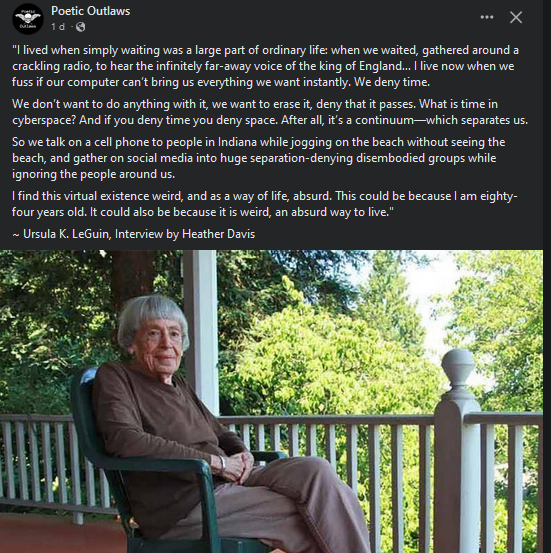
Note to self, read LeGuin

Posted in General | Tagged , | 15 Comments

An Incomplete Census of the Residents of Mount Doom

In the hopes of vanquishing Mount Doom before its height brings it down upon my head and vanquishes me, I’ve  signed up at The Unread Shelf this year. Our first ‘assignment’ is to list all of the books in our TBR pile. I’m just going to list physical books, because those are the ones whose mountainous presence casts a shadow  over my bedroom and life in general. These are also just the ones I can find right now: there are others I know I have, but they’re hiding — like Cancer Ward.   Brace yourself.   The known count (again, physical books only) is 86. Greatly reducing this list is my number-one goal for 2023. Most will be read, but some may just be cast into Outer Darkness (i.e.Goodwill).

History
Revolutionary Characters, Gordon S. Wood
Merchants and Moneymen: The Commercial Revolution, 1000 – 1500. Frances and Joseph Gies
What the Dormouse Said: How the Sixties Counterculture Shaped the Personal Computer Industry,  John Markoff
Faces Along the Bar: Lore and Order in the Workingman’s Saloon, Madelon Powers
Invasion! They’re Coming!  , Paul Carrell. A German history of D-Day
Empire: How Spain Became a World Power, Henry Kamen
The War of 1812, John K. Mahon
The Life of Johnny Reb,  Bell Irwin Wiley
The Caesars, Vol. I:  Julius Caesar
,  Lars Brownworth
The Confederate Reader: How the South Saw the War,  Richard Barkswell  Harwell
The Mississippi and the Making of a Nation, Stephen Ambrose
The Victorians, A.N. Wilson
British Soldiers, American War: Voices of the American Revolution,  Don Hagist
Log Cabin Pioneers: Stories, Songs, and Sayings. Wayne Erbsen
Inside the Klavern: The Secret History of a Ku Klux Klan of the 1920s,  David Horowitz
Crypto: How the Code Rebels Beat the Government, Steven Levy

Science
Skeleton Keys:  The Secret life of Bone,  Brian Switek
The Moral Animal: Why We Are the Way We Are,  Robert Wright
The Sun in the Church: Cathedrals as Solar Observatories,  J.L. Heilbron
This is Your Brain on Music: The Science of a Human Obsession, Daniel Levitin
Why Balloons Rise and Apples Fall: Physics in Bite-Sized Chunks,  Jeff Stewart
Buzz Sting Bite: Why We Need Insects, Anne Sverdrup-Thygeson
Nine Pints: A Journey through the Mysteries of Blood, Rose George

Politics, Society, and Culture
The End of Power:  Why Being in Charge Isn’t What it Used to Be, Moises Naim
Copenhaganize: The Definitive Guide to Global Bicycle Urbanism,  Mikaeel  Colville-Andersen
The Color of Law: A Forgotten History of How Our Government Segregated America, Richard Rothstein
The Parasitic Mind: How Infectious Ideas are Killing Common Sense, Gad Saad
McMafia: A Journey through the Global Criminal Underworld, Misha Glenny
The Dumbest Generation: How the Digital Age Stupefies Young Americans,  Mark Bauerlein
The 99% Invisible City, Roman Mars
Human Habitat: 25 Ways to Think about Greener, Happier Cities,  F. Kaid Benfield
The President’s Club: Inside the World’s Most Exclusive Fraternity
The Supremacists: The Tyranny of Judges and How to Stop It, Phyllis Schalfly. Found in a Little Free Library
The Excluded Americans: Homelessness and Housing Policy, William Tucker
The War Against Boys, Christina Hoff Summers

Religion & Philosophy
Spark Joy, Marie Kondo (THIS WHOLE PILE DOES NOT SPARK JOY)
Beauteous Truth: Faith, Reason, Literature, and Culture. Joseph Pearce
The Pilgrim’s Regress, C.S. Lewis
Paul among the People: the Apostle Reinterpreted and Reimagined in his Own Time, Sarah Ruden. This was literally a case of me reading an article, the article quoting this book, and near-sleep me thinking “I need this”.
The Joyful Christian: 127 Readings, C.S. Lewis.  Editor is not listed but I would assume Walter Hooper.
The Lost Gospel of Judas Iscariot,  Bart Ehrman.  Someone lent this to me five+ years ago. Don’t lend me books or movies without a deadline.  
The Essential Russell Kirk

Other Nonfiction
Life after Google: The Fall of Big Data and the Rise of the Blockchain Economy, George Gilder
The Outlaw Ocean: Journeys Across the Last Untamed Frontier, Ian Urbina
The Glass Cage: Automation and Us, Nicholas Carr
One Life at a Time, Please; Ed Abbey
Adventures with Ed: A Portrait of Abbey, Jack Loeffler
Heart of Darkness and Selections from The Congo Diary, Joseph Conrad
Teaching as a Subversive Activity, Neil Postman.  Found thrifting, acquired because of Postman.
The Letters of Ayn Rand,  ed. Michael Berliner 

Historical Fiction
The Four Winds, Kristin Hannah
Swimming with Serpents, Sharman Burson Ramsey
Genghis: Birth of an Empire, Conn Iggulden
Tuck, Stephen R. Lawhead
Roads to Liberty, F. Van Wyck Mason. A collection of 4 novellas set in Revolutionary America
Blood of Honour, James Holland
Darkest Hour, James Holland
North Star Over my Shoulder, Bob Buck.  WW2 flying novel or something. Found in library bookstore. I see planes, I buy things. It’s sad.
Tucket’s Travels:  Francis Tucket’s Adventures in the West, Gary Paulsen
The Day of Atonement,  David Liss
The Sunne in Splendour, Sharon Kay Penman 

Classics Club Reading List
Ida Elizabeth, Sigrid Undset
Dune, Frank Herbert
My Name is Asher Lev,  Chaim Potok
On the Nature of Things  | De rerum natura, Lucretius. Trans Anthony Esolen
A Tree Grows in Brooklyn, Betty Smith
Paradise Lost, Milton
My Antonia, Willa Cather
All the King’s Men, Robert Penn Warren
Purgatorio, Dante. Trans. Anthony Esolen
Paradiso, Dante. Trans. Anthony Esolen

Other Fiction
The Secret Chord, Geraldine Brooks
The Acts of King Arthur and his Noble Knights, John Steinbeck. (Yes, this exists.)
Serenity: Better Days. Graphic novel. 
First Shift Legacy: A Silo Story.  I don’t know what this is. It’s just in my pile. 
Isaac Asimov’s Inferno, Roger MacBride Allen
Isaac Asimov’s Utopia, Roger MacBride Allen
The Wayward Bus, John Steinbeck
Metatropolis, ed. John Scalzi
The Boys from Biloxi, John Grisham.
The Book Thief, Markus Zusak
Island of the Sequined Love Nun, Christopher Moore.  A Little Free Library pick, one that won me over on the basis of Moore.
Cemetery Road, Greg Iles. Bought for a Christmas gift, but then it got damaged by the struggles of life on Mount Doom.
The Island of Dr. Moreau, H.G. Wells
The Food of the Gods, H.G. Wells

Posted in General | Tagged | 14 Comments

Chasing New Horizons

Chasing New Horizons: Inside the Epic First Mission to Pluto
© 2019 Alan Stearns & David Grinspoon
320 pages

For most of my life, and I’ll warrant for most of yours, Pluto was the Great Unknown in the solar system.  Take any volume on astronomy from the 1990s or early 2000s, and you would find no shortage of pictures or data on everything from Mercury to Neptune, including many moons.  Pluto, though, was an enigma; the best one might find was a photo of a hazy orb, and similarly nebulous guesses at its surface and atmosphere.  Unlike the gas giants who were visited by the Voyager Program  in the 1970s Pluto was  never visited by probes from Earth – until  2015,   when a mission launched in 2006 and planned for decades resulted in the first flyby of the coldest of planets.  Chasing New Horizons is a history of that project,    which had to surmount both technical and political challenges,  which incorporates the complete history of Pluto from its discovery in the 1930s onward.   It’s a stirring story of hope, creative thinking, and sheer cussed determination that have resulted in a boon of wonder and information. 

Pluto was the last planet of the traditional nine to be discovered, and it was done so by a young student named Clyde Tombaugh, at the Lowell Observatory in Flagstaff Arizona.  Lowell himself had predicted the existence of an object in that area,  but it was Tombaugh’s  incredible patience and careful deliberation that exposed that tiny white spot so far away from us and everything else.   It remained a complete unknown even into the late seventies,  when its moon Charon was spotted and the Voyager program began its sweep of the great giants.  Although many young astronomers began thinking about Pluto as the next obvious place to study,   finding the resources to make that happen was a challenge.  Chasing New Horizons  documents multiple missions and approaches in the late eighties and nineties that were in various stages of planning and development when the prospective funding for them disappeared; the most  disappointing of these would have been a mid-1990s collaboration with Russia, in which an American satellite would be launched from a Russian rocket, sharing credit and greatly reducing the costs of a Pluto flyby from the American end.   Russia wanted some marginal financial compensation for the use of the rocket, but US laws at the time made that impossible.  In the early 2000s, though, continued planning passes at a Pluto project resulted in a mission that would both excite the scientists and pass muster with NASA’s accountants, and New Horizons lifted off just in time to be informed that it would be visiting not the smallest planet, but  the biggest of the Kuiper-Belt Objects.   Uh, thanks?  (The authors very much disapproved of the IAU’s decision and called it names.)   The mission of New Horizons’ human team wasn’t over then, though: for the next decade they had to carefully monitor the probe on its way,  responding to technical hiccoughs by improvising on the fly and finding ways to shepherd resources carefully until the probe could arrive and begin taking its surveys. Then, of course, it stopped responding to NASA….but for that story you’ll want to read Chasing for yourself! 

Related:
How I Killed Pluto and Why It Had it Coming,  Mike Brown.
The Pluto Files: The Rise and Fall of America’s Favorite Planet, Neil deGrasse Tyson
“Atop Mars  Hill”, a visit to the Percival Lowell observatory  

Posted in Reviews, science | Tagged , , | 6 Comments

You said it, Threep

Yes, this is a real book. It’s in an Alabama e-book consortium’s catalog. I’m tempted to check it out just so I can read it and post a mercilessly mocking review.

Posted in General | 4 Comments

The World-Ending Fire

The World-Ending Fire: The Essential Wendell Berry
© 2018 Wendell Berry and Paul Kingsnorth
360 pages

What a way to finish 2022, in reading this superb collection of Wendell Berry’s essays.  Berry has published no small amount of essay collections himself, and some of the WEF pieces have previously appeared in those volumes. What distinguishes  Paul Kingsnorth’s World Ending Fire is its comprehensiveness, in  bringing together Berry essays from 1968 onward that cover the full spread of Berry’s thinking – on agarianism, politics, national security, and local culture. It is a fitting tribute to the poet-farmer of Kentucky, for these topics are not individual ones for him, viewed in isolate, but all one of a piece.  There’s no better introduction to his extensive reflection on the fate and future of American life.

In his first nonfiction volume, The Unsettling of America,  Berry connected the ongoing dissolution of agrarian America  to other problems in American life, like the breakdown of American family culture, rising environmental concerns in a polluted and frequently denuded landscape, and the supply chain crises of the industrial economy.   That overarching connection is the foundation for the essays collected in The World-Ending Fire,  that title referring to what Berry calls ‘industrial fundamentalism’.   Without referencing G.K. Chesterton,  without perhaps even  being aware of GKC’s distributist writings,  Berry nonetheless echoes him in his criticism of big capital,   in the concentration of economic production and the revenues thereof into fewer and fewer hands,   in the reduction of human beings into mere biological machines for,   warm-blooded cogs to pull levers and then go home to buy products.   The world-ending-fire has consequences for man, society, and the land:    the difficult but varied and  rewarding work of old has been reduced to the meaningless work of moving a cursor around a screen  in the modern age to pad the revenue pages of someone else ;    industrial titans are far removed from the lands they own and dominate, and unaware or uncaring of the damage they do to it so long as revenue covers it;    and civilization  itself becomes more fragile, dependent on monocultures vulnerable to disease, on complex logistical supply chains.  The family home is reduced to a place where things are consumed, or hoarded, not created;   the family itself disappears in reality, if not in name, as husband and wife are no longer partners in the work, but atomized individuals who have merely made a convenient partnership, and  the moment it becomes inconvenient it will be discarded like an empty soda can, a broken watch, or an unwanted embryo.  Individuals themselves are reduced to subjects, powerless and impotent in the hands of corporations and the state.   Alienation is the chief creation of industrial fundamentalism: man is alienated from the land,  from his labor,  from those around him.  We have fallen from fellow creatures working in communion with one another to  consumers standing in line at Wal-Mart staring at tik-tok at the same time, ‘together’ in place but as far from one another as the stars in their courses. 


The World-Ending Fire is a book deep in thought,  in passion, in meaning. Readers need not agree with Berry on every point, but they will not be able to dismiss him because his criticisms address so much, and at so personal a level. Like Ed Abbey,  who counted him as a friend despite their frequent arguments, he is unboxable –  a critic of the political  left and right,   seeing both as largely married to the same beast – though  there are those on the Old Right,  those who draw from Russell Kirk instead of  Buckley and the neocon & corporate-conmen  who followed him – who would recognize in Berry’s defense of the local and particular,  in his prudence and  deep respect for the continuity of creation – the debt we owe the past and future, being stewards of the present –  an unqualified ally, separated only by his emphasis on creation rather than creator.   He certainly stands more easily among them with the modern left, even environmentalists – for they only envision a world saved by the use of more energy, by more doodads, by more  organization and dictation —  if difficulties must be endured, Other People can endure them.  Certainly not the silk-tie set who fly their jets across the world to lecture the peasants on how un-green they are, who gin up wars and collect their dividends from Raytheon and Hailiburton.  “Sustainability is a context” is not a phrase uttered by Berry, but it is certainly one believed by him;  in these essays we find rebukes of those who believe we can consume our way into greener and happier times, who bemoan the unsustainability of industrial civilization yet do nothing with their lives to reduce their own complicity   – -who do not simplify their lives, who turn on the AC at the first blush of heat,  who do not even bother to start a seed in a pot but are happy to pat themselves on the back for buying Certified Organic at Trader Joe’s.   Berry does not exempt himself from his rebukes;  he is particularly chagrined about his own dependence on automobiles.

As I read Berry, I argue with him myself; I am tugged between opposing values and the facts they arm themselves with. I am someone who started taking some of Berry’s prescriptions long before I ever read him, and yet I am compelled to wonder if there is a way out, a road home, that does not begin with disaster. Even if the long-awaited savior, The Demographic Transition, allowed human numbers to taper down to a level where small-scale agriculture of the kind practiced and advocated by Berry can comfortably feed all, the question remains: would we want it? The problem is that I don’t think so. We are opioid-hooked chimps, but our opiods are a little more than literal. We are addicted to comfort, to easy entertainment, to pretending that the only costs imposed are those appended to the product with a sticky label. Never mind that we are papering over those human costs with petty pleasures — that we turn our creative energy from the real to the virtual, investing time in creating digital worlds instead of restoring and cultivating our own — that we chase pleasures in dance halls and pill bottles and glowing TV screens instead of ordering our lives to create a deep and lasting contentment. Never mind that processed food sabotages our bodies and that we attempt to escape the consequences of our diets and disordered lives with more products, dependent forever on pharmaceutical companies sustained by our continuing ailments. It is only when we stumble upon the Real that we realize how starved we have been — Little Debbies and snapchat streaks compare badly against garden-grown blackberry pies and intimate conversation with a loved one.

I don’t think Berry has all the right answers, but he certainly asks many of the questions that need to be asked. He recognizes much of what has gone wrong, and he offers a taste of the Real — a vision of what we have lost, as a way to working toward its restoration — not only a healthy relationship with this Eden we were told to dress and keep, but toward a truly humane life.

Posted in Reviews, Society and Culture | Tagged , , , , , , , , , | 5 Comments

Tuesday tease: habits

Plus, Kindle books I forgot I owned.

I have struggled with hard habits in my life. I have found these hard habits are only broken by harder habits. Nature abhors a vacuum, meaning I cannot just quit doing something in my life without replacing it with something else. When I am tearing down one habit in my life, I need to simultaneously be threading a new cord of habit. As the new cable becomes strengthened, it guides me, helps keep me making the right decision even in times when I do not want the right path. Intention becomes choice, choice becomes action, action becomes habit, habit becomes character.

Unbroken: Meditations on Suffering in the Right Direction, Jason French

Ten Kindle Titles I Forgot I Owned

In the spirit of New Years’ resolutions and my particular goal to finish off Mount TBR but good, here are ten Kindle titles that I own but will probably ignore this year while prioritizing the physical pile.

ISIS: Inside the Army of Terror, Michael Weiss & Hassan Hassan

The Romance of Religion: Fighting for Goodness, Truth, and Beauty, Fr. Dwight Longenecker

The Story of the Jews, Vol I: Finding the Words. Simon Schama

Alienated America: Why Some Places Thrive While Others Collapse, Timothy Carney

Stuff: Compulsive Hoarding and the Meaning of Things, Randy Frost

The Rise of Big Data Policing, Andrew Guthrie Ferguson

Breaking Bread with the Dead: A Reader’s Guide to a More Tranquil Mind, Alan Jacobs

A Brief History of Earth: Four Billion Years in Eight Chapters, Andrew Knoll

Frozen Hell: The Russo-Finnish Winter War, William Trotter

Europe: A Natural History, Tim Flannery

Posted in General | Tagged , , | 2 Comments

God’s Promise

Years ago when I was a ‘spiritual seeker’ and consuming all manner of spiritual-religious content online, from dharma talks to Catholic apologetics and Asatru podcasts, I found some sermons and choir recordings online from a Unitarian Universalist organization. They had a performance of “God’s Promise” which I found beautiful despite not being anything approaching a believer back then. I saved it, and in time that website disappeared. I’ve been wanting to post it to youtube so people can enjoy it, so…that’s done. The photos in these are taken from my instagram, queencityson, and are mostly from spots in central Alabama. I tried to include just shots that overwhelmed me at the time. The song has been on my mind today as I reflected on the hardships, losses, triumphs, and moments of joy from the last year.

“I never did promise you crowns without trials

Food with no hard sweat, your tears without smiles

Hot sunny days without cold wintry snows

No vict’ry without fightin’, no laughs without woes

All that I promise is strength for this day

Rest for my, worker, my light on your way

I give you truth when you need it, my help from above

Undying friendship, my unfailing love.”

Posted in General | Tagged | 2 Comments

The Best of 2022: Year in Review

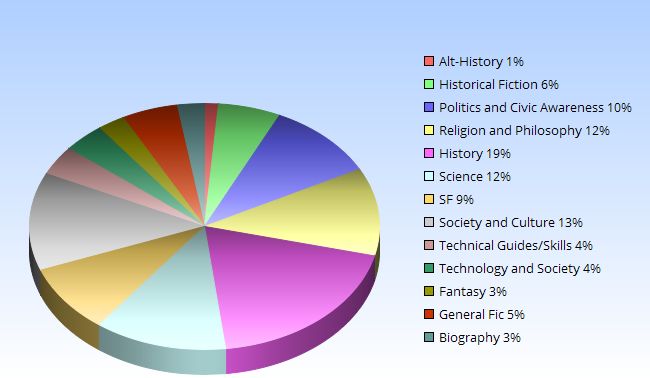
Well, here we are at the close of another year – and what a year it was!  2022 will be one of the more unforgettable years in my life, opening as it did with me on dialysis and the sudden death of a good friend – only to bring blessings like a kidney transplant, unexpected friendships, and a newfound sense of purpose despite ongoing challenges. “A hell of a year,” a friend of mine described it.  Can’t argue there!  Connected to all of this were the books, so let’s yak about that. I hope you’re not stuffed full of Christmas goodies, still, because I brought data pie as usual.

First up, some general stats. Nonfiction crushed fiction this year, with a 70/30 split. Ebooks increased their lead over for-realsies books, at 57/43.  Only 34% of my books were purchased this year;  26% were library books; 20% were Kindle Unlimited titles; and the rest were previously owned, gifts, or (my favorite) “read in the store like a big ol’ cheapskate”. Next year’s mission is to drive books-purchased down further.  Unfortunately, the biggest trend this year was not reviewing books: just over a fifth of the books I read in 2022 don’t have posted reviews, though a number of them have substantial drafts that just need to be finished.

In the world of Kindle, my top five most-highlighted books were:

  • The World-Ending Fire   87
  • Live Not by Lies: A Manual for Christian Dissidents, 62
  • The Second Mountain: The Quest for a Moral Life 60
  • Together: The Healing Power of Human Connection, 46
  • The Politically Incorrect Guide to American History, 46

In January, I had structured goals and specific targets for the Science Survey, the Classics Club, Readin’ Dixie, and the immortal Pile of Doom.     The science survey went well,  each category being filled by September. I’d wanted to end up with 20 books altogether, but only managed nineteen.  The rest of my challenges  were a mixed bag, with only three classics read,  marginal progress at best on Mount Doom,  and a year-end spurt of southern literature instead of a year-long series.  The fight will continue next year!

History lead the pack, as usual .My easy favorite was Bringing Columbia Home: the Untold Story of a Lost Space Shuttle and her Crew, about the recovery process following Columbia’s catastrophic reentry loss in 2003. Being someone who struggles with a lot of political jadedness, the reflex cooperation of civilians and all levels of government to find the bodies of the fallen, and piece together what had happened to America’s first space shuttle*, moved me. The Secret Life of Groceries was also excellent: I’ve read a number of similar books and it stood out among them, covering logistics and marketing as well as food production and processing. Dogfight: How Apple and Google Went to War was another memorable title, though I still disagree with the author’s premise that the two tech giants’ competition will one day end in a general monopoly.

Science had a fine year, though  I was hoping to crack twenty.  The best in this category was An Immense World, by Ed Yong, on  how studying animal sensation can greatly expand our appreciation of this world and its wonders. I’m reminded of that line from “The Circle of Life” — there’s far too to take in here, more to find than can ever be found — because of Yong’s lesson, that animal species all have unique sense-sets and are open to and guided by experiences of the world that other species are absolutely blind to. It was an awe-some book in the literalist sense of that, because it stirred wonder in me like no science read in quite a few years. I can’t not mention the cover and title of Ms. Adventure, my geology read. Great choice on both by her marketing peeps.

Science Fiction had a slow start, but  came out firing with J.M. Berger’s Optimal and getting only better as the year wore on. Dave Eggers’ The Every was  a worthy successor to his chilling satire The Circle, and every book I read by Blake Crouch was an instant favorite. Recursion, Dark Matter, and Upgrade  are all top tens for the year. 

Historical Fiction was good in quality, if not quantity: the star would be Ben Kane’s  Richard the Lionheart trilogy. Excellent stuff!   I also started a World War 2 trilogy by James Holland that I anticipate continuing in 2023.

Society and Culture had an unusually strong year, in part because I’m increasingly concerned about the disintegration of both, and certain trends have pushed me away from let-’er-be-libertarianism to a more  up-men-and-to-your-posts mentality — particularly, the aggressive ‘medical correction’ of children related to transmania, and relatedly the rates of mental disease, substance abuse, and suicide in the United States. Some of the books I read along these lines were Dopesick, Irreversible Damage, Live not by Lies, Porn Generation, The End of Gender, and the Flipside of Feminism.

In Religion and Philosophy, I was delighted to make a return to Alain de Botton, whose On Love proved more relevant than I’d expected when first picking it up. Dangerous Passions, Deadly Sins was an excellent Lenten read, but the year’s favorite was How to Think Like a Roman Emperor. I also studied C.S. Lewis a bit, reading his Letters to an American Lady, and a couple of guides to his The Abolition of Man.

Politics and Civic Awareness had a good year. I enjoyed reading about the growth of people-friendly cities in the Netherlands, England, and New York City, and also read a bit in connection to my social concerns. Andy Ngo’s Unmasked, and Shellenberger’s San Fransicko were notable. The first was on the rise of antifa, and the latter on how housing and substance abuse policies in a few major metro areas not only fail, but exacerbate the problems they’re intended to address.

Other notables: in Southern Literature, I was delighted to return to Wendell Berry’s nonfiction with an excellent anthology of his work, The World-Ending Fire, and finished reading Rick Bragg’s southern stories books. OF course, I can’t close without mentioning Postcards from Ed, one of my very very favorites for the year. More Abbey inbound!

So, what’s up for next year? My standing themes/challenges will continue, of course: the Science Survey, the Classics Club, and Mount Doom. I’m also going to be doing two Big Reads this year, with the books getting the Gulag Archipelago treatment — reviews posted as I finish major milestones of the texts. The Shahnameh will be reviewed in three parts, and The Jewish Annotated New Testament will be reviewed in bits as they suggest themselves. I had planned a massive series called “A Century of Reading” in which I moved, decade by decade, through the 20th century — with nonfiction and fiction for both. I need more time to develop the books for it, though, and more importantly I need to finish Mount Doom before I buy any more bloody books!

New Year’s resolutions?

  1. No new books until serious progress on Mount TBR is made. Yes, even $0.99 Star Trek books count. I didn’t buy any in November and December, and life went on.
  2. Finish reviews for books that I really want to have reviews posted for.
  3. Focus more on ‘good news’ ….or as Perry Como would advise, accentunate the positive. Relatedly, be more active about reading books I’ll disagree with, or books that humanize people (politicians) whose names cause me to spit venom.

[*] Sorry, Enterprise, you don’t count. You were an atmospheric tester only.

Posted in General | Tagged , | 4 Comments

What I Read in 2022

  1. Live Not by Lies: A Manual for Christian Dissidents, Rod Dreher
  2. Brothers and Friends: The Diaries of Major Warren H. Lewis, ed. Clyde S. Kilby
  3. Sex and the Unreal City: The Demolition of the Western Mind, Anthony Esolen (Reread)
  4. It’s Good to be a Man: A Handbook for Godly Masculinity, Michael Foster & Dominic Tennant
  5. The Country Property Buyer’s Guide, Garry Cooper
  6. Alabama Footprints Exploration: Lost and Forgotten Stories, Donna Causey
  7. Nostalgia: Going Home in a Homeless World, Anthony Esolen (Reread)
  8. The Judge’s List, John Grisham
  9. The Equine Legacy: How Horses, Mules, and Donkeys Shaped America, C.S. Purdy
  10. Bitch: On the Female of the Species, Lucy Cooke
  11. The Real Anthony Fauci, Robert F. Kennedy Jr
  12. No Free Lunch: Six Economic Lies You’ve Been Taught and Probably Believe, Caleb S. Fuller
  13. Atomic Awakening: A New Look at the History and Future of Nuclear Power, James Mahaffey
  14. StarTalk: Everything You Need to Know about Sci-Fi, the Human Race, the Universe, and Beyond, Neil deGrasse Tyson
  15. The Betrayal of the American Right, Murray Rothbard
  16. The Secret Life of Groceries, Benjamin Lorr
  17. The Flipside of Feminism, Suzanne Venker |
  18. Living in the Long Emergency, Jim Kunstler
  19. Brave New Home: Our Future in Smarter, Simpler, Happier Housing, Diane Lind
  20. A History of the Future, Jim Kunstler
  21. The Professor in the Cage: Why Men Fight, Jonathan Gotschall
  22. Songs of America, Jon Meacham and Tim McGraw
  23. The Harrows of Spring, Jim Kunstler
  24. How Cycling Can Save the World, Peter Walker
  25. How to Destroy America in Three Easy Steps, Ben Shapiro
  26. Pioneer Priests and Makeshift Altars: A History of Catholicism in the Thirteen Colonies, Fr. Charles Connor
  27. A Hole in the Wind, David Goodrich
  28. Hunting the Eagles, Ben Kane
  29. The Authoritarian Moment, Ben Shapiro
  30. Sooley, John Grisham
  31. Unmasked: Inside Antifa’s Radical Plan to Destroy Democracy, Andy Ngo
  32. Slanted: How the News Media Taught us to Love Censorship and Hate Journalism, Sharyl Attkisson
  33. Jewels of Allah: The Untold Story of Women in Iran, Nina Ansary
  34. Building the Cycling City: The Dutch Blueprint for Urban Vitality, Chris and Melissa Bruntlett |
  35. Eagles in the Storm, Ben Kane
  36. The Devil’s Company, David Liss
  37. Streetfight: Handbook for an Urban Revolution, Janette Sadik-Khan
  38. Ms. Adventure: My Wild Explorations in Science, Lava, and Life, Jess Phoenix
  39. Caesar’s Last Breath: Decoding the Secrets of the Air Around Us, Sam Kean
  40. Reading the Bible Again for the First Time, Walter Borg
  41. Gone with the Wind, Margaret Mitchell
  42. The Treeline, Ben Rawlence
  43. Cancel Culture: The Latest Attack on Due Process and Free Speech, Alan Dershowitz
  44. Irreversible Damage: The Transgender Craze Seducing Our Daughters, Abigail Shrier |
  45. The Manual: Epictetus’ Guide to Stoic Philosophy. Alexander Marchand, Sam Torode, and Epictetus
  46. Drunk Flies and Stoned Dolphins: A Trip through the world of Animal Intoxication, One R. Pagan
  47. Material Girls: Why Reality Matters for Feminism, Kathleen Stock
  48. Dangerous Passions, Deadly Sins: Learning from the Psychology of Ancient Monks, Dennis Okholm
  49. Dr. Johnson’s London, Liza Picard
  50. Sharpe’s Devil, Bernard Cornwell
  51. The Age of Fighting Sail: The Story of the Naval War of 1812, C.S. Forester
  52. Churchill’s Band of Brothers, Damien Lewis
  53. Churchill’s Shadow Raiders, Damien Lewis
  54. Teach Yourself Visually Chrome, Guy Hart-Davis
  55. Teach Yourself Visually Windows 11, Paul McFedries
  56. Windows Command Line Beginners Guide, Johnathan Moeller
  57. The Odin Mission, James Holland
  58. Crusader, Ben Kane
  59. A Sea Unto Itself, Jay Worrall
  60. Bandersnatch: C.S. Lewis, J.R.R. Tolkien, and the Creative Collaboration of the Inklings, Diana Glyer
  61. C.S. Lewis and the Catholic Church, Joseph Pearce
  62. Dogfight: How Apple and Google Went to War, Fred Vogelstein
  63. The Tao of Tranquility, Derek Lin
  64. Cloud Judgment, Kat Wheeler
  65. Optimal, J.M. Berger
  66. No Apologies: Why Civilization Depends on the Strength of Men, Anthony Esolen
  67. Information Doesn’t Want to be Free: Laws for the Internet Age, Cory Doctorow
  68. Warmer: The Way the World Ends, Jess Walter
  69. Warmer: Controller, Jesse Kellerman
  70. How to Destroy Surveillance Capitalism, Cory Doctorow
  71. Warmer: There’s No Place Like Home, Edan Lepucki
  72. Warmer: Boca Raton, Lauren Groff
  73. Warmer: At the Bottom of a New Lake, Sonya Larson
  74. Warmer: The Hillside, Jane Smiley
  75. Dorothy and Jack: The Transforming Friendship of Dorothy Sayers and C.S. Lewis, Gina Delfonzo
  76. SS-GB, Len Deighton
  77. Deja Dead, Kathy Reichs
  78. Star Trek: Collateral Damage, David Mack
  79. How to Think Like a Roman Emperor, Donald Robertson
  80. Star Trek: The Weight of Worlds, Greg Cox
  81. Darwin Comes to Town: How the Urban Jungle Drives Evolution, Menno Shielthuzen
  82. King, Ben Kane
  83. The Sleeping Beauty, Mercedes Lackey
  84. Beauty and the Werewolf, Mercedes Lackey
  85. Shotguns and Stagecoaches: The Men Who Rode for Wells Fargo, John Boessenecker
  86. The Ghost Brigades, John Scalzi
  87. Dark Matter and the Dinosaurs, Lisa Randall
  88. American Sherlock: Murder, Forensics, and the Birth of American CSI, Kate Winkler Dawson
  89. Faith Seeking Freedom: Libertarian Christian Answers to Tough Questions, Norman Horn
  90. Bonaparte’s Invaders, Richard Howard
  91. Death’s Acre: Inside the […] Body Farm, William Bass
  92. Kindred: Neanderthal Life, Live, Death, and Art, Rebecca Wragg Sykes
  93. Letters to an American Lady, C.S. Lewis
  94. The Abolition of Sanity: C.S. Lewis on the Consequences of Modernism, Steve Turley
  95. The Hospital: Life, Death, and Dollars in a Small American Town, Brian Alexander
  96. Bringing Columbia Home: The Untold Story of a Lost Space Shuttle and her Crew, Michael Leinback
  97. The Burning Blue: The Untold Story of Christina McAuliffe and the Challenger Disaster, Kevin Cook
  98. The Apollo Murders, Chris Hadfield
  99. Good Omens, Neil Gaiman and Terry Prachett
  100. Metropolis: A History of the City, Ben Wilson
  101. The Last Colony, John Scalzi
  102. Handprints on Hubble, Kathryn Sullivan
  103. Perpetual War for Perpetual Peace: How We Got to be So Hated, Gore Vidal
  104. Monk Habits for Everyday People, Dennis Okholm
  105. Defending Marriage: Twelve Arguments for Sanity, Anthony Esolen
  106. Porn Generation: How Social Liberalism is Corrupting our Future, Ben Shapiro
  107. Star Trek My Brothers Keeper: Republic, Michael Jan Friedman
  108. Star Trek My Brothers Keeper: Constitution, Michael Jan Friedman
  109. Star Trek My Brothers Keeper: Enterprise, Michael Jan Friedman
  110. Fighting for Space: Two Pilots and their Historic Battle for Female Spaceflight, Amy Shira Teitel
  111. Rachel’s Holiday, Marian Keyes
  112. Terror of Demons: Reclaiming Catholic Masculinity, Kennedy Hall
  113. Be a Man! Becoming the Man God Created You To Be, Fr. Larry Richards
  114. Libertarians on the Prairie, Christina Woodside
  115. You Suck, Christopher Moore
  116. After Humanity: A Guide to C.S. Lewis’ Abolition of Man, Michael Ward
  117. The Kaiju Preservation Society, John Scalzi
  118. Sex Scandal: The Drive to Abolish Male and Female, Ashley McGuire
  119. Babylon: Mesopotamia and the Birth of Civilization, Paul Kriawaczek
  120. Imperial America: Reflections on the United States of Amnesia, Gore Vidal
  121. The Hitchhiker’s Guide to the Galaxy, Douglas Adams
  122. The End of Gender: Debunking Myths about Sex and Identity In Our Society, Debra Soh
  123. The Hacking of the American Mind, Robert Lustig
  124. Johnny the Walrus, Matt Walsh
  125. Ocean Anatomy: The Curious Parts and Pieces of the World Under the Sea, Julia Rothman
  126. Unsettled: What Climate Science Tells Us, What It Doesn’t, and Why it Matters, Steve Koonin
  127. Is This Wi-Fi Organic? Spotting Misleading Science Online, Dave Farina
  128. Marine Combat Correspondent: World War 2 in the Pacific, Sam Stavisky
  129. Saving America’s Amazon, Ben Raines
  130. The Politically Incorrect Guide to American History, Tom Woods
  131. Persuasion, Jane Austen
  132. Overlord: D-Day and the Invasion of Europe, Albert Marrin
  133. Confessions of a Recovering Engineer: Transportation for a Strong Town, Chuck Marohn
  134. Victory in the Pacific, Albert Marrin
  135. A Preface to Paradise Lost, C.S. Lewis
  136. The Second Mountain: The Quest for a Moral Life, David Brooks
  137. Recursion, Blake Crouch
  138. The Lonely American: Drifting Apart in the 21st Century, Jacqueline Olds & Richard Schwartz
  139. Dark Matter, Blake Crouch
  140. The Road to Character, David Brooks
  141. On Love, Alain de Botton
  142. Act of Oblivion, Robert Harris
  143. An Immense World: How Animal Senses Reveal the World Around Us, Ed Yong
  144. Love Your Enemies: How Decent People can Save America from the Culture of Contempt, Arthur Brooks
  145. The Skeptic’s Guide to the Future, Steven Novella et. al.
  146. Survival City: Adventures Among the Returns of Atomic America, Tom Vanderbilt
  147. Out of the Jungle: Jimmy Hoffa and the Remaking of the American Working Class, Thaddaeus Russell
  148. Unstitched: My Journey to Understand Opioid Addiction and How People and Communities can Heal, Brett Ann Stanciu
  149. Life and Death in the Third Reich, Peter Fritzsche
  150. What They Forgot to Teach You in School, Alain de Botton & The School of Life
  151. Bombast: Spinning Atoms in the Desert, Michon Mackedon
  152. Armstrong (Custer of the West #1), H. W. Crocker II
  153. America Walks into a Bar: A Spirited History of Taverns and Saloons, Grogshops and Speakeasies, Christine Sismondo
  154. Afternoons with Harper Lee, Wayne Flynt
  155. Go Set a Watchman, Harper Lee
  156. Atticus Finch: The Biography, Joseph Crespino
  157. Hooked: The Pitfalls of Media, Technology, and Social networking, Gregory Jantz
  158. The Every, Dave Eggers
  159. Together: The Power of Connection in a Sometimes Lonely World, Vivek Murthy
  160. Dopesick: Dealers, Doctors, and the Drug Company that Addicted America, Beth Macy
  161. My Southern Journey, Rick Bragg
  162. Somebody Told Me: The Newspaper Stories of Rick Bragg, Rick Bragg
  163. The Politically Incorrect Guide to the Civil War, H.W. Crocker II
  164. Upgrade, Blake Crouch
  165. San Fransicko: Why Progressives Ruin Cities, Michael Shellenberger
  166. You Are my Sunshine, Sean Dietrich
  167. The Old Man’s Boy Grows Older, Robert Ruark
  168. Lost on Purpose: Adventures of a 21st Century Mountain Man, Patrick Taylor
  169. Postcards from Ed: Dispatches and Salvos from an American Iconoclast,Postcards from Ed Ed Abbey
  170. Between Heaven and Hell: A Dialog Somewhere Beyond Death, Peter Kreeft
  171. Eight Days in the Woods: The Making of the Blair Witch Project, Matt Blazi
  172. How it Went: Thirteen More Stories of the Port William Membership, Wendell Berry
  173. The World-Ending Fire: The Essential Wendell Berry
Posted in General | Tagged , | 1 Comment

Science Survey 2022

Science Survey 2017 | Science Survey 2018 | Science Survey 2019 | Science Survey 2020 | Science Survey 2021

The Science Survey, in effect since 2017, is a structured approach to pop-science reading to maintain a broad general science & nature knowledge and avoid my tendency to run away from the more math-y subjects. I completed this year’s survey relatively early, in September, and am expecting a strong year in 2023. Preview of next year’s list to follow this afternoon..

Cosmology and Astrophysics
Dark Matter and the Dinosaurs, Lisa Randall

Local Astronomy
StarTalk, Neil deGrasse Tyson

Geology and Natural History
Ms. Adventure: My Wild Explorations in Science, Lava, and Life, Jess Phoenix
Ocean Anatomy, Julia Rothman
Saving America’s Amazon, Ben Raines

Chemistry and Physics
Atomic Awakening: The Origins and Future of Nuclear Power, James Mahaffey
Caesar’s Last Breath: Decording the Secrets of the Air Around Us, Sam Kean

Biology
Bitch: On the Female of the Species, Lucy Cooke
An Immense World: How Animal Senses Reveal the Enormous World Around Us, Ed Yong

Flora and Fauna
Drunk Flies and Stoned Dolphins: A Trip through the World of Animal Intoxication, One R. Pagan

Archaeology and Anthropology
Kindred: Neanderthal Life, Love, Death, and Art, Rebecca Sykes
Death’s Acre: Inside the Legendary Forensic Lab, ‘The Body Farm’. Bill Bass & Jon Jefferson

Cognition, Neurology, and Psychology
The Hacking of the American Mind, Robert Lustig

Weather and Climate
Unsettled: What Climate Science Tells Us, What it Doesn’t, and Why It Matters, Steve Koonin

Ecology
The Treeline: The Last Forest and the Future of Life on Earth, Ben Rawlence
Darwin Comes to Town: How the Urban Jungle Drives Evolution, Menno Shiltzhuizen

Thinking Scientifically
Is This Wi-Fi Organic? A Guide to Spotting Misleading Science Online, Dave Farina

Wildcard: (Science Biography, History of Science, Natural History, Science and Health, or Science and Society)
A Hole in the Wind: A Climate Scientist’s Bicycle Journey Across the United States, David Goodrich
The Skeptic’s Guide to the Future: What Yesterday’s Science and Science Fiction Tell Us About the World of Tomorrow, Steven Novella et al

Posted in General | Tagged | 1 Comment