Teaser Tuesday

Today’s tease comes from My Ántonia, by Willa Cather.

On the edge of the prairie, where the sun had gone down, the sky was turquoise blue, like a lake, with gold light throbbing in it. Higher up, in the utter clarity of the western slope, the evening star hung like a lamp suspended by silver chains — like the title page of old Latin texts, which is always appearing in new heavens, and waking new desires in men.

When I closed my eyes, I could hear them all laughing — the Danish laundry girls and the three Bohemian Marys. Lena had brought them all back to me. It came over me, as it had never done before ,the relation between girls like those and the poetry of Virgil. If there were no girls like them in the world, there would be no poetry.

“This old chap will be proposing to you some day, Lena.”
“Oh, he has — often!”
“What?! After you’ve refused him?”
“He doesn’t mind that. It seems to cheer them to mention the subject. Old men are like that, you know. It makes them feel important to think they’re in love with somebody.”

Posted in General | Tagged , , , | 2 Comments

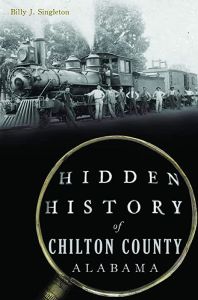
The Hidden History of Chilton County

The Hidden History of Chilton County
© 2022 Billy J. Singleton
144 pages

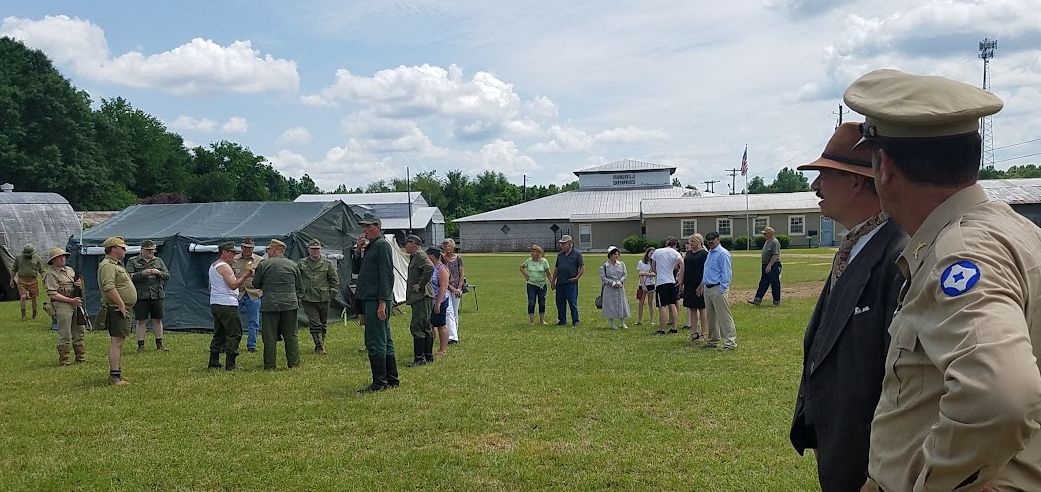
Forget Georgia peaches. The best to be had are in Chilton County, Alabama,  which has been so long proud of its peach orchards that the local water tower, visible from the interstate,   looks like a ripe peach ready to pluck.  The Hidden History of Chilton County uses  lesser-known excerpts from the county’s history to tell its story more generally: you will find no formal political chronicle here, no tables of changing demographic changes or economic production. Instead,  we are treated to little slices of interest, like the Battle of Ebneezer Church connected to Wilson’s Raid; to the creation of the first Peach Fest in Clanton (or as the locals call it, Clantern), to the still largely-unknown internment of German POWs in an old CCC camp;    of bridges to nowhere created by road routes shifting; and  why a field off of First Avenue is marked by three curious pillars.  This is obviously a bit of a niche history, of enormous interest to those who live in Chilton County or have a connection to it, but presumably of limited appeal outside of that despite its great readability. I have family connections here and a professional interest in the county (being a local history librarian), so I enjoyed it all around and learned a few things despite being fairly conversant with the of my county and its neighbors like Chilton. (For instance, the Big Peach is younger than me, and I’d never known about the German POW camp despite visiting another camp last year!) If you ever visit Chilton County, don’t miss Peach Park. Vanilla ice cream and blackberry cider are a delicious combination.

POW Reenactment at Aliceville, AL.
Posted in history, Reviews | Tagged , , | 4 Comments

Whistling Dixie

Sean of the South: Whistling Dixie
© 2015 Sean Dietrich
198 pages

A few weeks back I read The South’s Okayest Writer, a collection of articles by Sean Dietrich. Whistling Dixie is very similar in content and in theme, as this also collects a few score of his short pieces.   Okayest Writer had a more intense theme of people creating beauty and connection despite of, or because of, their suffering.   While that theme echoes often here, there are more miscellaneous pieces as well,   some about the South in general – reflections on southern dialects and euphemisms, for instance.  As with his prior collection, this is fairly intimate:  the shadow cast over his life by his father’s suicide comes up quite a bit. One of the more touching stories in that vein is his recollection of how his boy self fled the funeral and retreated to the back,   taking off his father’s tie and throwing it away.  He was found by another of the men, who – removing his own tie –  ministered  to him in a way that only a man who has also lost his father can.  Several of the pieces are also written in loving tribute to his wife, Jamie, and to the Waffle House.  (He really likes the Waffle House.)   As a whole, the collection is perfectly sweet, though I shouldn’t have read it so close on the heels of The South’s Okayest Writer.

Kindle Highlights

“I look at things,” Jon said. “And I realize I take it all for granted. And then I say to myself, ‘This was it, Jonny boy, this was life, and you missed it. You were too busy paying bills, doing whatever everyone said you SHOULD be doing, instead of all the things that matter.’”
“Like what, Jon? What things matter?” Jon thought for a moment.
“I don’t know. People. Nature. Stars. I mean, look at that moon.” He nodded toward the sky. “It’s so pretty and far away. I never stop and look at it. But it’s right there. See it?” We both got quiet for a few minutes. I couldn’t hear anything but the sound of crickets coming from the woods behind the gas station. I thought about how quick a year goes by. About how fast wrinkles form on the corners of your eyes. About friends who’ve died. About those still alive. About my wife. About the moon.
“Well,” Jon said. “We’re really looking at it now, aren’t we?” Yes. And I think that counts for something.

“Jeezus, Bryant, and Saban,” said the man beside me. “What does my FryDaddy have to do with anything?”

Life is not about fame and fortune. Some folks crave it, but some of the saddest people you’ll ever meet are the ones who attain it. Don’t let that be you. You were made to help.

But if you want to touch something bigger, if you want to know what it means to taste gladness, or understand this thing we call life, well then start right now. To hell with success. Go love someone.

“Dating is about hugging and kissing, and stuff,” remarked five-year-old Bradley. “That’s what girls do, when they finally get boys alone.” And then he squirmed like he’d just eaten a live lizard.
“Have you ever kissed a girl?” I asked. Bradley wrinkled his face and shook his head.
“NO!”
“Why not?” He clutched his mouth.
“HEY!” shouted Beau, an eight-year-old wiseman in the back. “Girls only want your money, and for you to fix their stuff. My dad says all he ever does is fix stuff and lose money.”

Six-year-old Margaret, sneered. “Y’all are just being stupid…”
“Honey,” I interrupted. “We don’t say ‘stupid.’ It’s not nice.”
“Sorry,” said Margaret. “Y’all are being dumb asses.”

Hell is a remote-control away, you can see it any time you want. Which is probably why folks think there’s more hate out there than love. Well, who knows, maybe they’re right. But. I know a Labrador who believes otherwise.

You think about how happiness is a lot like a houseplant. No matter how much you water it, nothing lives forever. Everything is on temporary loan—that includes people.

My Sunday school teacher, Mrs. Reginald—whose beehive hairdo was tall enough to register on most air-traffic radars—had her own thoughts on God. “He’s all-knowing,” she said, looking straight into my eyes. “And he KNOWS who put those frogs in the girl’s restroom toilets.” Maybe he did. But it sure as hell wasn’t Bobby Davis, Robert Laurels, and Sean Dietrich. Because we put them in the sinks.

Posted in Reviews | Tagged , , , | Leave a comment

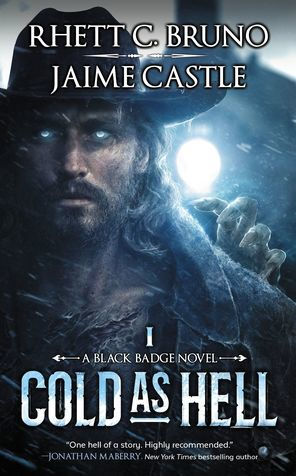
Cold as Hell

Cold as Hell: A Black Badge Novel
© 2022 Rhett C. Bruno, Jaime Castle
Audible narration provided by Arthur Morgan Roger Clark
419 pages | Audible edition ~13 hours

“T-they said you died,” he said. “Got buried. The rider in black who done chased off them outlaws. Saw your grave, I did. Y-y-you . . . was dead.”
“I got better.”

James Crowley was a notorious outlaw and gunman, riding with a band of bank-robbers and highwaymen known as the Scuttlers – until he met his end, and woke to find himself between death and life, with a black star seared onto his chest and a voice in his head. He had become a  Hand of God, a Black Badge,   his mission on Earth to hunt for demonic forces plaguing humanity and to send them back to the icy wastes of perdition.   A unique mix of western and dark fantasy, Cold as Hell mixes familiar scenes of the western (bar fights and stagecoach robberies) with  altered takes on werewolves, yeti,  and other nephilim. A story that begins with a bank robbery reeking ofthe demonic – the culprit having powers beyond mortals quickly escalates into a greater mystery, as the angel who handles Crowley believes that dark forces  are trying to create a direct opening between the world of mortal men, and that of the chaotic wastes of Hell. Its  Audible edition uses the distinctive voice of RDR2’s Roger Clark (better known as Arthur Morgan) to superb effect. 

I must say at the start that I’m incredibly biased to love this book, because I was drawn to it after discovering that Roger Clark – aka Red Dead Redemption II’s Arthur Morgan– did the Audible version,   using a very similar voice to his Morgan character. The attraction was made perfect by this not only being a western, but a western featuring a character with strong parallels to Arthur –  being a not-bad man who fell into a bad life,  drawn in by a charismatic figure he later came to loathe, forced into hiding by said figure developing an appetite for cold-blooded murder, and kept on the crooked path by want of any other skills other than shooting.  (His ex-gang even has minor members with the same names as RDR2’s Van der Lindes!)  There’s immediate appeal for an RDR2-loving reader, then, to imagine Crowley as Arthur, as a man spared Hell for some of his better decisions,  consigned to chase demonic bounties across the west.  Certainly the background is the same: small towns, trains, coaches,  the rapidly-civilizing frontier.  That this is saturated with fantasy –  Crowley having to answer to a mysterious but forceful angel who can speak to him through any mirrored surface,  his foes being more often supernatural creatures who hide in the margins and wide spaces of the west –   adds a thick layer of interest, especially because the authors don’t just drop werewolves de novo into the set of Gunsmoke,  but fuse them with native American mythology –  though the underlying basis is the Biblical declaration that angels ‘knew’ mortal women and began Nephilim, commonly translated as ‘giants’ but used as the source of all kinds of unpredictable beasts here. 

I was completely taken away by Cold as Hell. Yes,  the narration was probably the strongest selling point for me, and I did not help things by listening to this while playing RDR2.  I was so absorbed by the story, though, that I quickly switched to reading it on the Kindle, and despite having finished it I’m looking forward to returning to the story (and to Clark’s narration) by continuing in the audiobook. I will definitely be reading the sequel in May! (Also: Bram Stoker is a character in this.)

“W-w-what are you?” he stuttered.
“The Hand of God. How do you do?”
Posted in Reviews | Tagged , , , , , , | 4 Comments

January 2023 in Review

Well, so ends January — and it’s got the year off to a good start!

The Big Reads:

The Jewish Annotated New Testament: I’ve read through Matthew and began reading some of the accompanying essays, but no major strides just yet.
The Shahnameh. I looked at it several times.

The Science Survey

Chasing New Horizons: Inside the Epic First Mission to Pluto, Alan Stearns and David Grinspoon
Pests: How Humans Create Animal Villains, Bethany Brookshire
Buzz Sting Bite: Why We Need Insects, Anne Sverdrup-Thygeson
Origins: Fourteen Billion Years of Cosmic Evolution, Neil deGrasse Tyson
Dinner on Mars, Lenore Newman

The Classics Club Strikes Back : Year III

I read most of My Antonia and will finish it today.


Readin’ Dixie: 

The Incredible Winston Browne, Sean Dietrich
The South’s Okayest Writer, Sean Dietrich

Climbing Mount Doom  | The Unread Shelf Project  

Read:
People Habitat: 25 Ways To Think About Greener, Healthier Cities, F. Kaid Benfield
Chasing New Horizons: Inside the Epic First Mission to Pluto, Alan Stearns and David Grinspoon
Buzz Sting Bite: Why We Need Insects, Anne Sverdrup-Thygeson
Revolutionary Characters: What Made the Founders Different, Gordon S. Wood
Firefly: Better Days, Joss Whedon
Copenhagenize: The Definitive Guide to Global Bicycle Urbanism, Milhail Colville-Andersen

Posted in General | Tagged | 2 Comments

Top Ten Reasons to Destroy Mount Doom

I’m currently under a book-buying interdict until such time as the mountain of unread books in my bedroom no longer attracts selfie-taking tourists wearing North Face jackets.   As incentive to hastening my conquest of said mountain, though, I’m using today’s TT freebie to list ‘reward books’, those I’ll read once I’ve made significant progress. I’m thinking one of these books every ten TBR titles read.   These are mostly ‘fun’ books..

BUT FIRST! Teaser Tuesday, from Sean Dietrich’s The South’s Okayest Writer.

Nothing lasts. Not hateful things, not good things. Not ugliness, not beauty. Not football games, back pain, or kidney stones. Not newspaper-delivery jobs. Not life. Not death. Not childhood wheelchairs. Not the dirt beneath you. There is one thing that will outlive this cotton-picking universe. You already know what it is. So find a person who needs some. And give it away.

I don’t care what the suits on television say, kid. Don’t believe them. The sod cabins, the longleaf forests, the farmland of our granddaddies. The nurses, EMT’s, teachers, janitors. That’s us.
America doesn’t suck.
Your television does.

And now, the books!

1)  Rome’s Last Citizen: The Life and Legacy of Cato, Mortal Enemy of Caesar, Rob Goodman and Jimmy Soni

2)  Best. Movie. Year.  Ever:  How 1999 Blew Up the Big Screen, Brian Raftery

3) The Sopranos Sessions: A Conversation with David Chase, Matt Zoller Seitz

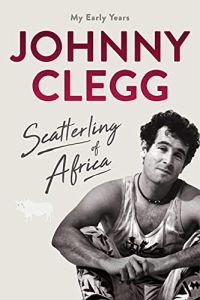
4) Scatterling of Africa: My Early Years, Johnny Clegg.  The autobiography of one of my favorite musicians, a man who broke color lines in South Africa to create several illegal mixed-race bands. Unfortunately Clegg perished in 2019. 

5) All the Wild that Remains:  Edward Abbey, Wallace Stegner, and  the American West, David Gessner 

6) The Boy Crisis, Warren Ferrell. A study on why boys and young men are declining in health,  prospects, etc. 

7) Sea Lab: America’s Forgotten  Quest to Live and Work on the Ocean Floor,  Ben Hellwarth.  One of the Mercury 7 astronauts, Scott Carpenter, was involved with this project. 

8) Roads to Nowhere: What Silicon Valley Gets Wrong about the Future of Transportation, Paris Marx

9) The Life We’re Looking For:  Reclaiming Relationship in a Technological World, Andy Crouch

10) A Brief History of Motion, from the Wheel to the Car to What Comes Next, Tom Standage

Posted in General | Tagged , , | 14 Comments

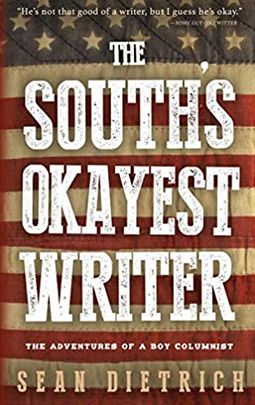
The South’s Okayest Writer

The South’s Okayest Writer: The Adventures of a Boy Columnist
© 2018 Sean Dietrich
241 pages

There is a Japanese art, kintsugi, of putting broken pieces of pottery back together again with gilded paint, with the result that the repaired object is more resplendent than the original. If offered the choice between hardship and ease, between health and pain, most of us would presumably choose ease and health – and yet, there’s something all the more beautiful about a human life that flourishes amid adversity, that endures the bludgeonings of chance and rises to face life once more, head on. Sean Dietrich, in his writing, looks for the beauty that not only remains in broken and disrupted lives, but the beauty that is created in people’s endurance, in their support of one another, in their refusal to bow to that brokenness . In The South’s Okayest Writer, Dietrich collects a few score of his short articles (the kind that appear on his website) , and each strikes the heart in a different way. This is a slim volume to be read with a tissue box at the ready, though in the case of male readers it’s obviously understood that the tissues are there for spontaneous sneezing attacks. (There are three occasions on which a man may shed a tear: when he buries his mama, when he marries off his daughter, or when he loses his dog. Those scenarios all exist here, reader be warned.)   Most of the stories are about the travails and triumphs of ordinary people whom Sean has met throughout Alabama and the Florida panhandle: a coach who changed the lives of the boys he mentored, despite the enormous pain he carried for the loss of his children; a young woman killed in a car wreck, whose organs gave life to another young lady who later invited her donor’s parents to come to her wedding; young people who created lives for themselves despite physical adversities or bad upbringings; and community after community of people who rallied around one another when one of their own had a loss. We find men baking cakes to raise money, or football heroes dedicating their every touchdown to a young baby stricken with leukemia. We find beauty and love amid the suffering, the storm creating the opportunity for such beauty to make itself known. We find ordinary people practicing resurrection. Forget the poison on TV, Dietrich urges – the constant torrent of bad news, of impending doomsday, of the constant assault on your mind that creates cynicism and despair. Look to your neighbors — invest in the stories around you, and play your part in them. These are deeply personal stories, including Dietrich’s own as he and his mother struggled in the wake of his father’s unexpected suicide, when he walked into the woods with a firearm and a troubled soul. They are engaging and powerful, though, pulling me into them completely. I’m very glad to have found Dietrich last year. 

Kindle Highlights:

Nothing lasts. Not hateful things, not good things. Not ugliness, not beauty. Not football games, back pain, or kidney stones. Not newspaper-delivery jobs. Not life. Not death. Not childhood wheelchairs. Not the dirt beneath you. There is one thing that will outlive this cotton-picking universe. You already know what it is. So find a person who needs some. And give it away.

Somewhere south of Montgomery—a girl sings on a barroom stage. She’s college-age. Brunette. Her family plays backup. Her daddy is on bass. Brother plays guitar. She doesn’t do the American Idol act—no vocal gymnastics, no hair flinging. This girl sings Patsy Cline with her eyes closed. A loudmouth in the crowd makes a gross remark. Her daddy stops playing. A man who weighs as much as a Pontiac. I’ve never visited this place before, but I’ve been to hundreds like it. There’s a spot like this on every American rural route. A glowing sign. Trucks parked around a cinderblock building. Broken cigarette machines. My fellow Baptists hate this kind of den. But it’s a good place to find honest lyrics.

I don’t care what the suits on television say, kid. Don’t believe them. The sod cabins, the longleaf forests, the farmland of our granddaddies. The nurses, EMT’s, teachers, janitors. That’s us. America doesn’t suck. Your television does.

She tried out for the school play. I attended her audition. She was nervous, and the smug drama teacher told her she had no talent. I’m a quiet man, but I wasn’t that day. I called the teacher a greasy communist who didn’t love the Lord.

I read the newspaper today. The outlook was bleak. Murders, mass-shootings, nuclear warheads, and bacteria capable of eating a person’s face off. And the nightly-news anchor still has the audacity to wish me a good evening. It’s too bad. Because this old world is more than explosions, cussing congressmen, and BOTOX bodies in dental-floss bathing suits. It’s high-school culinary teachers who give a damn. It’s neighborhood barbecues. It’s animal shelters. Old folks. It’s volunteer uncles who live in spare bedrooms. It’s guitars in rehab homes. It’s singing “You Are My Sunshine.” It’s making someone happy, by God. Even when skies are gray.

More by Sean Dietrich:
You are my Sunshine
The Incredible Winston Browne

Posted in Reviews | Tagged , , , , | 1 Comment

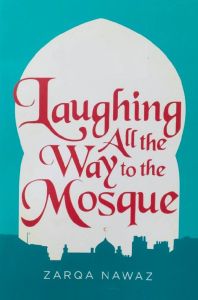
Laughing all the Way to the Mosque

Laughing all the Way to the Mosque: The Misadventures of a Muslim Woman
© 2016 Zarqa Nawaz
240 pages

‘A hit religious comedy show about Muslims worshipping in a broken-down mosque, within a broken-down church, living in a tiny town in the Canadian Midwest?’ said the reporter. ‘I can guarantee you, no one saw that coming.’

In 2007 I stumbled upon a Canadian TV show called Little Mosque on the Prairie, about a small Muslim community in a Saskatchewan town. I found the show delightful on every level, with wonderful character drama, frequent laughs, and interesting shows exploring conflicts within Islam, and between Islam and what passes for western culture these days. Think Vicar of Dibley, but with more religion and fewer allusions to bestiality. I recently found its creator’s memoir, and picked it up hoping for information about the making of the show. While there’s very little about that, Laughing all the Way is entertaining in its own right, being the memoir of a second-generation immigrant who grew up in Canada but within a largely West Asian Muslim community, working to find a fusion between ‘her’ culture and her parents’. These conflicts often informed the storytelling of Little Mosque, though, so fans of the show should find it especially rewarding to read. It’s a coming of age story, as she begins a child and by the end, is taking on serious adult obligations like the washing of the dead.

Nawaz opens up with the usual child-of-immigrants conflicts: young Zarqa wants to fit in with the rest of the kids and wear something other than traditional Punjabi clothes, but her parents resist; she wants to shave her legs and cut her hair, but her parents object. She takes a right turn, however, when she sees someone wearing a hijab for the first time and realizes the potential that Islam has for the perennial struggle between kids and their parents: she can out-Muslim mom and dad! The memoir jumps quite a bit, so we met find her as a young adult guiding the programming of a Muslim summer camp, and already displaying a mix of piety and irreverence. Although her heart’s desire was to become a doctor, Nawaz’ horror of blood and her poor performance in the sciences steered her instead toward journalism, where amid growing Mideastern & Central Asian immigration to the west, and concerns about terrorism, she hoped to tell stories that would otherwise go overlooked. After becoming a mother and taking the Hajj (a full account of which is rendered here), she switches to filmmaking — creating movies that explore issues within Islam, particularly the attempted enforcement of foreign mores onto more westernized Muslim congregations by imported imams. Many of the issues that her own congregation addressed in her young adulthood, like the creation of literal barriers between men and women, were explored in Little Mosque, as well as through Nawaz’ documentary Me and the Mosque. Nawaz touches on differences between West Asian & Arabic expressions of Islam that weren’t addressed during the show, despite its characters including Arab, Nigerian, and Pakistani Muslims. Although touching on many serious topics, this is largely a comic memoir, and thoroughly entertaining. It suffers a bit in its jumping around, and the lack of a general narrative that could tie the excerpts together.

Kindle Highlights:

Again I put the kids into mixed-gender teams and let each team debate the issue. Ibrahim was clearly uncomfortable with this sort of arrangement. ‘I doubt they’ll have sex while debating,’ I assured him.

‘Fine,’ I said. ‘But we take the secret of the origins of this marshmallow bag with us to the grave.’ ‘To the grave,’ he said. ‘Pinkie swear,’ I said, holding out my hand. ‘That’s too forward,’ he said.

The hospital recommended Dr Weiner, who was one of the best circumcision men in the city. As soon as we entered the office, his secretary pounced. ‘The doctor’s name is pronounced “Wayner”, not “Weener”,’ she told me helpfully. Wayner, wayner, wayner.

[T]he girls were young and I felt we had to compete with Christmas, the grandaddy of all religious holidays. Muslims don’t have holiday icons like Santa Claus or Frosty the Snowman, because we have a hysterical fear of worshipping things other than God and our holidays centre around themes like starvation and near-child sacrifice. Abraham’s almost-sacrifice of his son is much harder to celebrate with papier mâché than you might think, so I improvised.

Related:
Funny in Farsi & Laughing Without an Accent, Firoozeh Dumas
Rebel without a Green Card, Sara Saedi

Posted in Reviews | Tagged , , , , , | 2 Comments

Eating on Mars, Cap’n Mal, and organic gardening on steroids

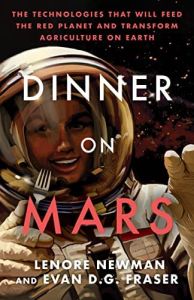
Since twelve men left their mark on the Moon,  humanity has wondered about the prospects of venturing further out, to the Red Planet.  It’s a daunting undertaking, from the journey itself to the prospects for sustaining life on a planet with a marginal atmosphere. Dinner on Mars addresses the prospects for feeding human life on Mars,   using known and novel technologies to bring life from Mars’ red dust.  The author presents the information in the form of an extended discussion between two people,  with some needed narration between the conversation.  The conversation begins with the initial practicalities of carving out room for human life on Mars – literally,  as their scenario sees humans tunneling into Martian mountains to create spaces sheltered from the sun – before moving to the main course,  food.  Shipping enormous quantities of food from Earth to Mars is obviously impractical, given the fuel needed to lift anything off the surface of the Earth.  The authors place much hope in using bacteria and algae as bioengineers and agricultural tools, though they also look to genetic modification and synthetic meat & dairy.   Interesting and engaging enough, though reading this in tandem with Wendell Berry’s critique of industrial food made these prognostications depressing despite the authors’ optimism.   I have no interest in meat that grew somewhere else other than a cow pasture, nor will soy milk ever cross my lips – but knowing how we might feed ourselves far from Earth is a key part of any attempts to explore and use the resources of the solar system. 

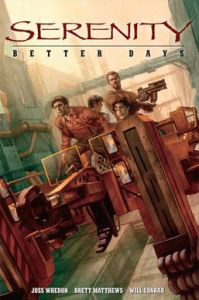
I stumbled upon this Firefly graphic novel a year or so ago in a comic book shop. Written by Joss Whedon,   it’s an enjoyable story that captures the spirit and dialogue of the show well. The art is very well done: I’m not a graphic novel reader, but I liked the style and though it depicted the characters especially well. The story concerns the gang being set up so that an Alliance spec-ops man with a lust for revenge can destroy one of the Serenity’s former browncoats.   As good as the art was, I much prefer the more substantial novel series that’s come out in the last few years.

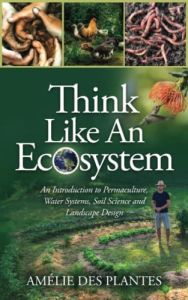
Lastly, Think Like an Ecosystem was one of my first science-y books this year. I say science-y because while it’s deeply informed by ecological thinking, it’s not quite a proper  ‘science’ books. (I’m still claiming it for the Survey, though, in the wildcard category.)   The book is an introduction to permaculture, which  has been on my radar for a while after stumbling upon a podcaster who practices and teaches it. I’d hear him mention principles that were unfamiliar to me from time to time,   and eventually figured out that they were part of an integrated system he employed on its land – but this book introduces everything properly. Permaculture is an intensive approach to the land that has the aim of replicating the results of a natural ecosystem, wherein nothing is waste but instead contributes to the greater growth of the whole.  A given area’s expression of permaculture principles will vary on the area itself, on what natural resources and cycles it’s already exposed to:  permaculture begins with a close, patient, and prolonged study of the area and what is happening.   The book helped me fit together a lot of the odds and ends I heard about on the show, but I’m going to look for some videos to try and better understand how these systems might look.

Posted in Reviews, science | Tagged , , , , , , , | 2 Comments

Revolutionary Characters

Revolutionary Characters: What Made the Founders Different
© 2006 Gordon S. Woods
352 pages

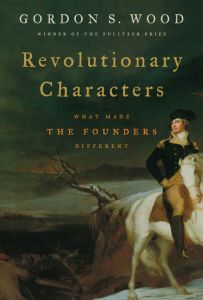
Revolutionary Characters reviews the lives of several of the United States’ founding fathers to examine how the personal strengths and ambitions of these men allowed them to play uniquely essential roles in a pivotal time.   The men so detailed are George Washington, Benjamin Franklin,  Thomas Jefferson, James Madison,  Alexander Hamilton, Thomas Paine, John Adams, and (interestingly) Aaron Burr – the latter included more  for comparison’s sake, as he had many of their advantages but failed to distinguish himself for anything more than shooting Hamilton, praiseworthy as that was.  Wood opens with a review of how the Founders have been alternately venerated and dismissed throughout American history, and his conclusion that Americans need the story of the Founders and the Founding to tie us together as a nation,   since the United States was and remains  a novel country, one based on ideas rather than blood.

Revolutionary Characters is not a collection of minihagiographies, nor is it a train of tedious, unimaginative debunkin hit pieces. Wood examines  the unique lives of each of these men, assaying their strengths and the part they played.   Woods sticks most closely to conventional Founding-Father writing in his opening chapter on Washington, but Washington forces the author’s hand by consciously playing the part of the noble, disinterested leader, and avoiding anything that diminish the icon he was creating of himself.  Most of the founding fathers, bar Burr, were recent arrivals to the ranks of the gentry – and they compensated for their lack of breeding by cultivating themselves,   both their minds and their characters. They took this especially serious as they realized they were driving the creation of something  new in the world, and would be held to especially strict scrutiny.  None was more serious about his study than Washington,  and Woods argues that Aaron Burr’s real treason lay not in trying to create a new republic in the west, but by ignoring all convention of moral responsibility and behaving like a decadent European aristocrat – never giving any  heed to how posterity might regard him, but only to the material gains he could realize and the favors he could call in.  Burr’s inclusion in this book is odd, even though his vices make the others’ virtues more obvious – and so is Thomas Paine’s, for while he was a master propagandist and writer,  he loved not America but revolution,  never taking onto his narrow shoulders the lightest mantle of responsibility.  The chapter on Thomas Jefferson examines him as the strange sphinx that he was, a man who preached liberty and maintained slaves, who idolized agrarianism but created a factory on his own plantation, a man who every iteration of American political thought appears to claim.  In Madison’s chapter, we review his balancing act between the Federalists and the Republicans,  his exercise in moderation overshadowed only by that of John Adams – who threaded a very narrow line between the  Federalists and the Republicans,  and between his rivals Jefferson and Hamilton.  (Adams gets very short shrift in this book, being pushed  towards the end between Paine and Burr, and addressed in a chapter called “The Relevance and Irrelevance of John Adams”.)   Perhaps the most interesting chapter is “The Invention of Benjamin Franklin”, in which Woods argues that Franklin, for all his diplomatic importance,  was  not regarded with favor by most Americans during his life, was almost ignored in his death, and was only uplifted into the pantheon of The Founding Fathers afterwards, when an increasingly commercial class saw in him a figure worth celebrating –  the self-made man. 

Woods writes that the founding fathers were not only relatively new to the gentry and accordingly obsessed with the idea of being proper Gentlemen — sophisticated, educated, cosmopolitan — but who had come to manhood at a time when they could do something truly unique. In an ordinary time they would have lived perfectly admirable lives, but the times presented them an opportunity to be extraordinary. They believed, with varying degrees of optimism and reserve (Jefferson and Adams presiding over those wings), that the creation of the United States would change not only the world, but humanity itself — that the creation of a genuine Republic would usher in a new stage of human development. That faith was tested and sometimes lost as these men grew older, as succeeding generations replaced them, as they realized that the human heart does not shrug off the stamp of Eden lost simply because governmental structures change. However short reality fell from their expectations, though, they were a fascinating bunch of men. I found the book quite interesting, and the author fair-minded in general. I dislike the inclusion of Burr, though, especially since John Adams is pushed into the rear with his company. Adams deserves better!

Related:
Any and all works by Joseph Ellis, including Passionate Sage: The Character and Legacy of John Adams, American Sphinx: The Character of Thomas Jefferson, The Quartet, His Excellency: George Washington, American Creation, and Founding Brothers.
John Adams, David McCullough
The First Congress: How James Madison, George Washington, and a Group of Extraordinary Men Invented the Government. Fergus Bordewich.
Alexander Hamilton, Rob Chernow
American Cicero: The Life of Charles Carroll, Brad Birzer
Founding Rivals: Madison vs Monroe, Chris DeRose

Posted in history, Reviews | Tagged , , , , , , , | 3 Comments