America’s untouchables and baseball

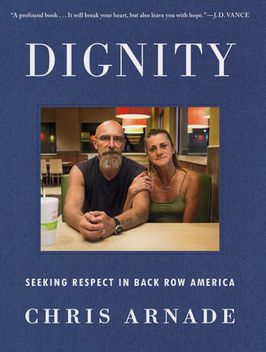
Shortly after the financial implosion of the late 2000s and the beginning of the ‘great recession’, physicist & banker Chris Arnade began long walks around New York City to contemplate the ramifications of his and his ‘industry’s’ reckless speculation and general chicanery. This contemplation was not abstract and intellectual, but all too real as he strayed into parts of the Bronx like Hunts Point that everyone advised him to avoid – -being the province of whores, druggies, and hoods. Quitting his job and ignoring such advice, he began spending his days among modern America’s untouchables, becoming part of their lives even as their stories altered the way he regarded 21st century America’s narrative about itself. Becoming intimately involved with the people at the Point, seeing them as unique persons instead of a class to be dismissed or a problem to be solved inspired him to begin visiting other areas of the country that had been left behind by globalization and willfully ignored by the power-elite of DC and New York. Hanging out in dive bars, fast food restaurants, and churches — places he previously sneered at — he heard still more stories and engaged in largely deep reflection. His account of this five years project is often powerful and insightful, but it has some significant weaknesses towards the end, as part of Arnade’s reformed narrative begin telling the story more than the people themselves. Arnade realizes as his project develops that American society has been totally materialized, reordered purely to serve an economy that an increasingly rarefied few benefit from. The shifting of factories to Mexico, China, etc has not merely forced people out of work: it has destroyed the communities those places were built around. Access is controlled by credentials that are difficult for those from America’s dying places to obtain, and despite the easy advice handed out from the deracinated white-collar elite, it’s not easy to simply leave a place. Not only is moving difficult and expensive, but for those on the margins their Places provide the only support they know — not just family and friends, but the little communities that develop in churches and bars and parks where they can exchange information or provide for one another’s needs. That support isn’t just material, though, it’s emotional and personal: people hang out at the corner and smoke because the people there know and accept them, and don’t treat them as burdensome clients and compel them to navigate arcane mazes of paperwork. In addition, the migratory elite fail to realize that for some people, material goods aren’t the chief end of man. People have strong connections to their places and their people, and will persist in loyalty to them and continue trying to keep them alive. I was impressed by Arnade’s willingness to devote long hours to developing friendships with people who were completely removed from his world, and when he does devote time he develops considerable insight. That approach and level of observation is not consistent, however. As someone born and raised in Selma, Alabama, I looked forward to his visit there with great interest — only to find his time there minimal, and his conversations utterly shallow. When he visited Gary, Indiana and people there declared that all its problems were created by white flight following the first black mayor being elected, I raised a skeptical eye. When he visited Selma and heard the same exact thing, my dubiousness was confirmed — for Selma’s economic decline began long before the election of James Perkins in 2000, and its entire leadership was already predominately black a decade before that, and longstanding companies failed in Selma for the same reason they failed elsewhere: changing economies. Selma was bypassed by the interstates, and places like the American Candy Company fell prey to competition from China. Many of his interviews appeared to have taken place in Selmont, not Selma, and the picture they paint is patronizing and ignorant. Frankly, this insultingly cavalier treatment of one of the most important cities in the Civil Rights movement cast a dark cloud over not only what remained of the book, but what I’d read before. He accepted these claims without question or comment in part because he’d already developed a narrative that the psuedo-meritocratic system created by the elites is especially harmful to minorities and therefore racist. (As usual, the white working class might as well not exist, despite Arnade’s token interviews with a few men near a Trump rally.) Despite the huge pockmarks that erupted there, I still found the book compelling.
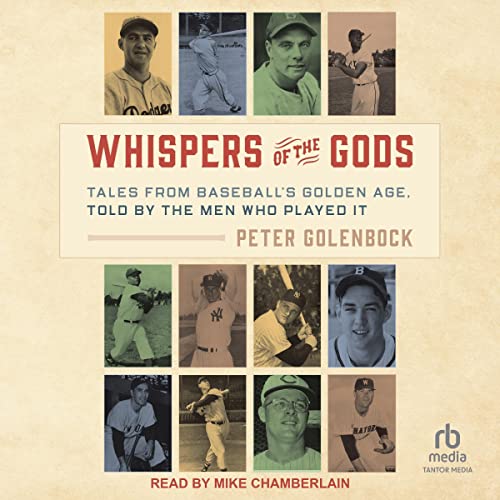
On a lighter note, I recently finished listening to Whispers of the Gods, consisting of interviews with the men who played baseball in the 1940s and 1950s. It’s enjoyable enough, but I was hoping for something like the audiobook of The Glory of their Times, which had the actual interview audio. There are few things better to me than listening to old men telling stories, except maybe watching young women sing. Whispers has the stories but we don’t get the actual men telling them, and the narrator’s use of inflection/emotive emphasis/etc is liable to be very different. The content itself is interesting, though: one player was obsessed with Shoeless Joe and (in his youth) hunted down one of Jackson’s contemporaries to get the real scoop on the Black Sox affair. The contemporary believed that Jackson was used as a scapegoat. I’d also never heard of the Mexican League, which was started by two Mexican businessmen (brothers) and tried to recruit American ballplayers from both the Negro and Major leagues in the U.S. Unsurprisingly, the MLB resisted the poaching of their players, imposing five-year suspensions on any player who tried to cross the Rio Grande. There’s also disagreement between the interviewed players over matters like the introduction of Jackie Robinson: some said there wasn’t any hazing, some said there was hazing but it was the same as any new guy would get to make him prove himself, and others who said Jackie was targeted. World War 2 is a big factor in a lot of these guys’ stories: one man said the first time he saw a major league game, he was pitching it — just a couple of months out of high school. That happened in part because so many of the players went off to war, of course. A lot of these interviews happened for the authors’ other baseball books, so it’s not the deliberately created record that Glory is. If you’re interested in mid-century baseball, this is an entertaining collection of player memories, but it’s not a patch on Glory.
Posted in history, Reviews, Society and Culture | Tagged , , , , , , , , , | Leave a comment

I have questions, Goodreads….

Posted in General | Tagged | 4 Comments

May 2023 in Review

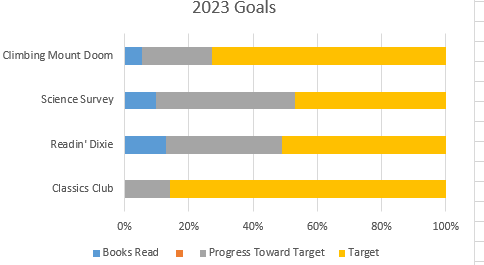
Another month gone, and — well, I’m a little proud of this one, primarily because I FINISHED THE SCIENCE SURVEY! My previous record has been August (2022), so hurrah. The year’s science reading isn’t over, of course, but now I can run away from physics to the loving arms of Mount Doom’s science offerings, which are all about morality, blood, and music. May’s surprises were a strong showing by audiobooks (4), and the apparent arrival of Opening Day at Reading Freely, with three books on baseball read and another two started. One, an audiobook, will be knocked off tonight. I have a strong sentimental attachment to baseball, but this year I’ve had an unusual fixation on it — following the Red Sox more than I usually do, re-watching movies like The Sandlot and The Pride of the Yankees, etc. I’m sure it will fade (most of my spontaneous fixations do), but in the meantime it’s a pleasant and unexpected dish in my book smorgasboard.

Climbing Mount Doom
The Confederate Reader: How the South Saw the War, Richard B. Harwell
The Life of Johnny Reb, Irwin Bell Wiley
Log Cabin Pioneers: Stories and Sayings, Wayne Erbeson
Air: The Restless Shaper of Our World, William Bryant Logan

The Big Reads

I had wonderful intentions. The Shahnameh even rode around in the car with me all month.

Classics Club Strikes Back: Year III

I meant to read Paradise during the Easter season, but now we’re in Pentecost, so that’s a whoopsie. June & July will be all about American lit, though, so I expect this category to spring to life.

The Science Survey
Air: The Restless Shaper of Our World, William Bryant Logan.
Calculating the Cosmos: How Mathematics Unveils the Universe, Ian Stewart
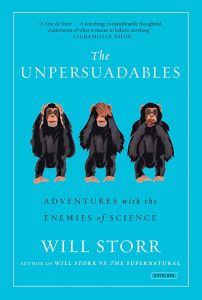
The Unpersuadables: Adventures with the Enemies of Science, Will Storr
Other Minds: The Octopus, the Sea, and the Deep Origins of Consciousness

Readin’ Dixie
Our Man in Charleston, Christopher Dickey
The Confederate Reader: How the South Saw the War, Richard B. Harwell
Baseball in Alabama, Doug Wedge
The Life of Johnny Reb, Irwin Bell Wiley
Log Cabin Pioneers: Stories and Sayings, Wayne Erbeson

Unreviewed:
Johnny Reb: Review in the works.

Other Minds: The Octopus, the Sea, and the Deep Origins of Consciousness. I’d previously heard that octopods were brainy, but I had no idea how fascinating they really were, with dynamic skins which can serve as camouflage, signaling, or conveying emotional states. The author argues that octopods (fun fact: there are three accepted plurals for octopods, the others being octopuses and octopi, but the latter is linguistically inappropriate because it’s a Latin ending stuck onto a Greek word) are conscious, and that given their ancient lineage, that means the great apes were beaten to the punch rather handily. I read this for the insight into consciousness, but was completely distracted by how cool and weird octopods are.

Being Better: Stoicism for a World Worth Living In, Kai Whitling, Leonidas Konstantakos. Read by Liam Gerrard. Ehhhhh. Very basic stoicism mixed with veganism, climate change, etc. Not too long, fortunately.

Coming in June:
Marian and I are doing a buddy read of The Isle of Dr. Moreau, and I’ll start gearing up for my usual salute to the American revolution and American lit.

Posted in General | Tagged | 4 Comments

Adventures with the Enemies of Science

The Heretics / The Unpersuadables: Adventures with the Enemies of Science
© 2014 Will Storr
368 pages

Outside ideas of right-doing and wrong-doing, there is a field. Will Storr will meet you there, because at this point he’s not sure that there’s any other place to be.    We open with Will mingling with Australian fundamentalists,   listening to their views on Creationism and sexual mores with wonder and muted horror.  Though at first writing them off as uneducated, hateful rubes,    Will doesn’t cut bait and run: instead, he lingers, attempting to resolve the conflict between intelligent and loving people, and the ideas and values he finds so objectionable.    His commitment to finding out the answer to why people believe what they do  – to finding the human hiding beneath the  cardboard villain  their  antagonists reduce them to –  marks this book,  charging it with human interest even as the author’s long conversations with philosophers and psychologists invites the reader to explore deeper the mysteries of mind and belief.  This is an utterly, utterly fascinating book on multiple levels –  compelling not only in the interesting-to-horrifying range of ideas that Storr sits down and considers,  but to what he and those he interviewed have to say about how we approach the world.

When I began this book, I thought it would just be a collection of smug-tourism,  of some Poindexter cruising from seances to  neo-Nazi  kaffeeklatsches and informing us of the classical logical fallacies These People are making.    It isn’t.   Storr introduces himself as someone who is quick to judge & ghost others for not having the Right Opinions, but at the same time he’s drawn to those who are utterly marginalized, lampooned or derided for being crazy or evil.    There’s charm about their fight against the mob, even if their causes are weird or abhorrent.   Storr’s curiosity,  sympathy for the intellectually despised,  and commitment to his cause of understanding combine wonderfully here to allow the reader to spend a considerable amount of time  listening to extraordinary ideas – -and then evaluating them  with the help of  a variety of scientists better versed in the field than he.   There’s a lot of back and forth, with Storr serving as middleman: instead of two antagonists squaring off with one another and giving a public performance, we get no-theatrics-all-content conversations with Storr,  Storr then processes the conversations, and subsequently has follow-ups. It’s more intimate, revealing, and conducive to the reader seeing the humanity of all parties involved.  Although I disliked him at first brush, the more time I spent with Storr the more interesting and admirable he became –  a man willing to subject himself to days of silent meditation at a yogi’s retreat, for instance, in an effort to experience something that people kept raving had changed their lives.   Storr is no driveby debunker wheezing “Accccctualllly…..” 

Throughout the book, as readers sit and listen to Storr’s conversations with heretics and authorized agents of The Science alike,    we get deeper and deeper into how the brain constructs its models of reality,   forming beliefs and values,  and how new data are  treated –   invariably,  trimmed and adjusted to fit the existing model.  This  is understandable: the brain’s models have been created over time and at great cost, since brains consume a fifth of the body’s energy reserves. It’s more efficient to tweak what exists than to do a total rewrite:    it is by that logic all of evolution functions, which is why  animal bodies are rife with quirks.  We are storytelling creatures — not merely creatures who tell stories, but creatures who are formed by story, who live through story, who are story. Our memories make us, but they are fragmentary, our narrative knitting them together often imaginative, and the cast of that story subject to our emotional makeup at the time – and people’s stories of themselves can mire them in learned helplessness and depression, or drive them forward.  As Michael Shermer & Jonathan Haidt have both argued in their own books,   we do not begin with a clean slate and, with objective eyes, discern the Facts and build a worldview accordingly. Instead,  our brains develop with an outline of how things are in the womb, with genetic predispositions towards favoring openness or caution: that outline is  further developed  or altered by our childhood experiences, and then our ongoing experiences continue to modify the story.   Storr’s appreciation for mental models and beliefs increases as the book wears on, and his growing awareness of our universally shared weaknesses on this subject  allows him to spend time with people as noxious as say, David Irving, and stare at him not in hatred, but in earnest longing to Understand.    How did a man – a proud Briton –  from a patriotic British family, whose members served in World War 2, come to become Adolf Hitler’s chief defender in the 20th century,  who put his extensive and astonishing command of World War 2 facts to use downplaying if not denying the Holocaust, and attempting to shelter Hitler from any involvement in it?    This is the most extreme example, but throughout the book Storr meets people whose experiences sent them in unexpected ways, and he  takes the reader along to try to understand  his interviewers and  possibly bridge the gap between those who mock them from similar positions of supreme self-surety. 

I am utterly confident that this will be one of my favorite books of the year, given the overwhelming amount of Holy Cow That’s Interesting content here . The science is compelling in itself: I frequently read on the mind,  often from the same source Storr quotes here (Ramachandran & Eagleman), so some of this I was familiar with, but other aspects – like the fact that 30% of our memories are completely fabricated – was new, or had least been forgotten.  What Storr learns investigating specific claims of the heretics is also interesting. We may take it for granted that homeopathy ‘works’ purely on placebo, but when Storr is investigating the claims of homeopathists, he learns from respectable authorities that even prescribed, FDA, “real medicine” depends  partly on the placebo effect, something that sometimes effects the efficacy of name-brand versus generics despite the identical chemical composition.  In a more dramatic example, Valium only appears to work if people know they’re taking it.   Medicine shouldn’t be so flimsy: a chemical introduced to a chemical should have a predictable, reliable reaction – but the brain has its own chemistry  that throws a spanner into the works.    Storr emerges from each adventure with heretics a little altered –  not convinced, not even swayed most of the time, but made to realize that  the truth is a complicated thing. In one chapter, for instance, we meet a community of people who all experience the same thing,  the sensation of tiny little creatures inside their skins and trying to claw their way out. So intense is this sensation that people dig into their skin themselves trying to get the creatures out, and in the end the desperate and now bloody patients turn up little specks or fibers.  Industrial medicine uniformly writes them off as crazy, but  other medical investigators believe that this is a genuine nervous-system misfire issue,  not yet understood, that doesn’t get properly addressed because the victims of it are so easy to write off as nuts. 

This is a wildly interesting and thought-provoking book,  in part because of the author’s intense involvement in the subject: he’s not merely learning about why other people believe strange things, he’s learning about his own susceptibility,   his own stories he’s told himself, and the reader joins his company: we cannot help but engage in reflection right along with him.   This is an intimate encounter not only with the science of belief, but the existence of the Self,   in all its etherealness and mutability.  The Unpersuadables is unforgettable. 

Related:

The Believing Brain, Michael Shermer. 
The Righteous Mind: Why Good People are Divided,  Jonathan Haidt
The Storytelling Animal, Jonathan Gottschall 

Posted in Reviews, science | Tagged , , , , , | 10 Comments

Teaser Tuesday because it is in fact Tuesday and not Monday

I love three-day weekends, but boy do they throw the ol’ internal kenning of time and space off. Today’s top ten Tuesday prompt was ‘things that make me NOT want to read a book’, and I can’t think of much. If it’s a romance, a political campaign book, an exhaustive encyclopedia of paint glazes — then yeah, I probably won’t be reading it. Otherwise my stacks are a potpourri of subjects from parking lots to poop to philosophy.

From Plato, Not Prozac! which after fifteen years I’ve broken down and bought a used copy of:

Philosophical counseling is, in the words of my Canadian Colleague Peter March, “therapy for the sane”. To my mind, that includes just about all of us. Unfortunately, too much of psychology and psychiatry have been aimed at “disease-ifying” (that is, medicalizing) everyone and everything in sight, looking to diagnose each person who walks in the door and find what syndrome or disorder could be the cause of their problems.”

From The Unpersuadables: Enemies with the Enemies of Science:

Behind us, the genuine German was becoming worried that the Polish restaurant would have no space for our party. ‘We have no reservation?’ he said. ‘There are twelve of us!’ ‘I shouldn’t worry,’ said the posh Englishman. ‘The Poles are used to being invaded.’

It is as if the mind of the schizophrenic is suffering from an excess of stories. This, I have come to suspect, is not a coincidence. We humans are creatures of story. And the story of story begins in the unconscious.

I will try to remember, though, that as right as I can sometimes feel, there is always the chance that I am wrong. And that happiness lies in humility: in forgiving others, and in forgiving myself. We are creatures of illusion. We are made out of stories. From the heretics to the Skeptics, we are all lost in our own neural tjukurpas, our own secret worlds. We are just ordinary heroes fighting phantom Goliaths, doing our best in the service of truth when the only thing that we really know are the pulses.

Posted in General | Tagged , | 2 Comments

Meditating while the world burns

I recently asked BingAI to review the works of Marcus Aurelius, Epictetus, Seneca, and Musonius Rufus for me, and then roleplay as a Stoic sage. We then had an interesting conversation on Stoicism, Epicureanism, Buddhism, Taoism, and human flourishing. Then, I asked it to depict a Greco-Roman philosopher sitting in the pose of the Buddha. I tinkered with that prompt a few times, ending with one of said philosopher sitting at night in front of a fire. This one caught my eye because of the fire and apparent ruins in the background. Although this is generated by AI, it’s a reminder that all material things end, but wisdom and virtue endure. (Just…don’t look at his fingers and toes.)

“Death smiles at us all, but all a man can do is smile back.” – Marcus Aurelius
Posted in General | Tagged , | 10 Comments

In the air and across the Cosmos

This month’s science reading served up two surprises, both pleasant.

When I arrived at university and joined the Astronomy Club, which met once a month to aim a giant telescope at the skies and gasp as we saw Saturn’s rings or two blobs of gold and purple emerge from what previously had been a single point of white light, I was surprised to find it operated under the auspices of the math department. In retrospect, that was remarkably stupid of me, since (as this book reminds) astronomy and math are joined at the hip. Our distant forebears studied the skies and realized there were patterns — patterns they could use to track time, to guide planting. Math enabled civilizations like the Greeks to begin constructing an idea of what the world and the cosmos were like, determining the Earth’s spheroid shape long before sailing ships and satellites Math and patterns have continued to allow humans to see what is there before we had any other tools, and Stewart reviews with us how math led us to the theory of universal gravitation, exposed the presence of planets and smaller bodies beyond our optical range, and revealed the presence of dark matter. Much more readable than expected. and an enjoyable review of one of humanity’s best tools for discerning the order of the Cosmos.

Next up was Air: The Restless Shaper of Our World, by William Bryant Logan. I expected this to be something like 18 Miles: The Epic Drama of Our Atmosphere and Weather, but it’s much more of a delightful grab-back. There are indeed sections on weather and climate — how air, unevenly heated and moisturized, is driven into circulation and creates terrifying and wondrous weather across the world — but Logan looks more broadly into how air serves the world, not only by giving animals and plants stuff to breath, but by constituting the platform through which creatures great and small live and move and have their being — giving fungi a way to get around, drawing animals together with pheromones, and filling the world with beauty in the form of birdsong. I love a science book that makes me feel like a kid again, drinking greedily at the inexhaustible fount of wonder that is the natural world, and Logan does that. Even more interestingly, though, he writes with a poet’s quill, using the discussion of natural phenomenon to drift into other discussions. The chapter on pheromones, for instance, turns into a muse on love and living within its mystery. Logan has two other books which I was already interested in (Dirt and Oak), but the varied pleasures of Air mean I’m definitely pursing more of his work.

Next up: Johnny Reb and (hopefully) completing the science survey with consciousness and clean thinking.

Posted in Reviews, science | Tagged , , , , , | 4 Comments

Favorite YouTube Videos

This week’s prompt from Long and Short Reviews is…..favorite youtube videos. I can’t tell you how many hours of YouTube I’ve watched since 2007. Google probably could, but I think I’d rather not know. I had a painstaking list of ten of my favorite videos since 2007, but 8 of them wouldn’t play embedded, so I’m limiting myself to The Favorite and a bonus. The Favorite is a PSA parody and is…well, adorable.

I just wanted to play. I never thought I’D be ‘It’!

This is the oldest video I’ve known and loved on YT. You may have cooties….and not even know it. Fun fact, all the kids in this video are old enough to drink and probably have six g’s in college loan debt by now.

And a bonus, since one of the other videos actually works embedded:

What do you think? Hehehehehe! Woooo!

One of my favorites — the young Mozart taking a piece by the court musician, Salieri, and improvising with it on the fly. It’s not accurate to the facts, but I love hearing Mozart elaborating on the piece on the fly. Masterful acting. I think I’ve seen other versions of this video, but the core is the same. First watched five or so years ago. If your attention span has been destroyed by the internet, the improv bit begins at the three minute mark.

Posted in General | Tagged | 5 Comments

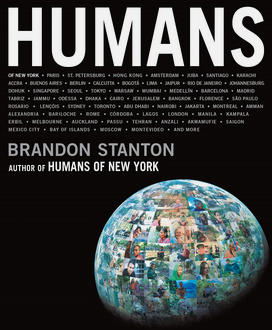
Humans

© 2020 Brandon Stanton
451 pages

Published after the success of Humans of New York, here Brandon Stanton expand his range and deepens his connectivity with the people whose lives he shares in a single photo. In Humans of New York, readers were presented with an array of New Yorkers whose face or dress or energy caught Stanton’s eye. These were supplemented with a caption that combined with the photo to tell a story. In Humans, Stanton shifts into a more studied and intimate approach, asking people about their challenges and suffering and then incorporating that conversation along with the pictures to hit the reader with both barrels. Humans has an international scope, with many interviews coming from various parts of subsaharan Africa, the Middle East and Central Asia, and an outlier or two in Europe and Latin America. Oddly, all of his American interviews are still from New York. Because of Stanton’s starter question — suffering — this collection isn’t overflowing with the warm fuzzies. It’s not a depressing book, but it is a maturer one, demonstrating that joy and triumph are only possible through suffering and hardship. There’s a lot of pathos here — people surviving genocide and living after more intimate losses. Stanton frequently pairs photos and stories: one woman reflects on her abortion, another on how grateful she was that she didn’t pursue one. We meet people who find deepest meaning in their connections with their family and tradition, and others who had to forge their own path. One man leaves his job and falls into poverty, regretting his spontaneity — but another leaves and finds bliss. I enjoyed this, but readers who start it should know that it’s more emotionally demanding and challenging than the of New York original — but in that challenge we are treated to stories of resilience , redemption, and profound meaning.

Kindle Highlights

Honestly, anger is just very addictive. You want to feel angry when you’re suffering. It gives you adrenaline. It gets your endorphins going. It’s a release. It’s a substitute for what you’re missing.

I’m too young to start nuclear disposal because it’s dangerous and I don’t have the proper gloves. But I do recycle and keep plants on my balcony.

I just finished my first year of college. I expected it to be like a nineties movie where I’d sit under trees, read books, and meet a nice boy who’d show me his yacht. But I’m not a good protagonist. My life would be a terrible movie.

Some of my customers ask me: ‘Why don’t you expand your shop? Why don’t you turn it into a café, and start selling Coca-Cola?’ Because that means more staff. More wages. More taxes. More responsibility. I don’t want to weigh myself down. I want to be free. It’s a long time in the ground, my friend.

There’s a line from a Russian poem. It says: ‘We love just once in a lifetime. And spend the rest of our lives looking for something similar.’ I’ve had other girlfriends after Oksana. But I don’t remember their birthday. Oksana’s birthday was July 29.

I’ve fallen in love with literature. I try to read for one or two hours every day. I only have one life to live. But in books I can live one thousand lives.

The quickest way to find a person’s expertise is by learning their struggle. What they’ve battled. What they’ve carried with them the longest. Because it’s what they’ve thought about the most.

I used to be a corporate attorney for Coca-Cola. I worked eighty hours a week. Then one day I asked my boss for a single Friday off and he said no. So I left my dog with my brother and flew to Europe. That was ten years ago. It’s been super——– chill.

Truth feels heavy. It has gravity. It’s usually not floating on the surface.

Adults don’t have an actual life. You can’t go outside. You don’t get to hang out with friends very much. Maybe text a little, but that’s it. You just wake up, get ready for work, then work, then maybe watch a little TV, then go to bed. All of it seems depressing. But apparently everyone has to do it.

My brother shot himself last November. He always viewed himself as my superior. He’d never come to my door when he visited. He’d always wait in the car for me to come out. He had more money, more lovers, more everything. But he was always searching for more. He was never satisfied. My brother was a character. He was a successful character, but he was a character. And that character ended up eating him.

I think you have only one duty in life. You stand up and you go.

My ex-wife got the real estate. And I got my peace.

Posted in General, Reviews | Tagged | 2 Comments

Tuesday things

Welcome to Tuesday! Today’s teaser comes from Air: The Restless Shaper of Our World, and the Top Ten Tuesday topic is “Things That Automatically Make Me Want to Buy a Book“.

[…]it was Darwin who taught us to think in this way. His travels aboard the Beagle confirmed his hunch that the world is not an aggregate of stable individuals, but a network of processes out of which individuals arise and into which they return. The world is a concert that brings forth its own instruments.”

pg. 33, Air: The Restless Shaper of Our World. William Bryant Logan

And now, top ten things that make me want to buy a book. I’m going to try to avoid rehashing the “Top Ten Authors on Autobuy” too much!

(1) Certain authors, like Bernard Cornwell (historical fiction), Anthony Esolen (society, culture, Catholicism), Wendell Berry (culture, farming, rural/household economics), Robert Harris (historical fiction), Joseph Pearce (literature & Catholicism), etc.

(2) Certain narrators. Did Wil Wheaton or Roger Clark perform the narration? Then I’m game to listen.

(3) Authors’ recommendations. I finally dove into Lord of the Rings and P.G. Wodehouse because one of my very favorite authors, Isaac Asimov, mentioned them frequently. Similarly, there are authors who draw on or mention a book, and the weight of my regard for them means automatically taking a look at the book itself.

(4) Good podcast conversations about a book. I listen to podcasts regularly, and some of my favorite books have come because I heard their authors in an extended back-and-forth on something like EconTalk — The Green Metropolis, for instance.

(5) Setting. Near-future science fiction? Count me interested. Medieval Europe? Let me at `em. Dixie or the Southwest? I want to know about it.

(6) Good workmanship on the book itself — especially graceful, classy fonts and deckled-edged pages.

(7) A recommendation from a friend. A lot of books I’ve read over the years here have come from IRL or digital friends — or, people who just dropped by! One of my favorite books, indeed one of my favorite authors, came from someone randomly commenting that if I liked Walden and Civil Disobedience, I’d enjoy Ed Abbey. Boy, was that an understatement.

(8) Promising blurbs. If an author I respect offers a book blurb, or better yet writes the introduction, I’m definitely taking a long and considered look.

(9) If it’s unusual. This applies more for random bookstore finds, but there are some books that are so uncommon — not in terms of how many used copies are online, but just odd or unexpected — that I have to take a chance on it.

(10) Subject. This is extremely broad, so I’ll use it to finish the list. There are a lot of topics I have a strong academic interest in, like World War 2 aviation, or understanding human behavior through the lens of evolutionary biology & psychology. As a citizen, I’m frequently drawn to books that help me understand how we might create a better society together — reading books on transportation and infrastructure, for instance, or how urban planning can induce or stifle human flourishing. Most keenly, though, I’m attracted to books that offer some piercing insight into why things are why they are, or expose something important about modernity that we might be blind to. I’m most drawn to books that defend the human and the humane against modernity, consumerism, and self-worship.

Posted in Reviews | Tagged , | 8 Comments