Hope Never Dies

© 2018 Andrew Schaffer
305 pages

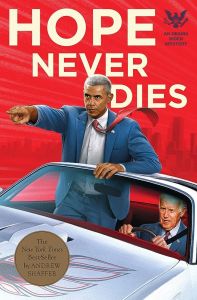
Joe Biden is roused by his faithful pooch, Champ, who hears something Nefarious going on outside. Sallying forth to investigate, Scranton Joe finds a lone (well, lone-ish — there are guards) figure standing in the woods waiting for him. It’s Barack Obama, and he has news to deliver. Joe’s favorite Amtrak conductor is dead, and as Obama snuffs out the last of his Marlboro red, they resolve to get to the bottom of the mysterious death. Sure, they’re not cops. They’re not even private investigators. They’re ex-politicians watching world events in impotent frustration, but maybe they can figure out why a good man is dead, and do so without getting themselves in trouble with Jill, Michelle, a biker gang, and — you know, the actual police.

The novel’s cover alone tells the reader that this is a bit of a silly novel, as it has fun with the Biden-Obama dynamic and the inherent absurdity of high-level politicians doing private investigation. The novel opens with Biden brooding over the fact that Obama is off chumming with celebrities and the like, ignoring his former ally and weekly lunch buddy, and while Biden is excited to work with Obama again, he nurses a grudge throughout the story over his belief that neither Obama nor anyone else takes him very seriously. For him, finding out what happened to his friend is personal, so he pushes down his frustration and resentment to sneak through fences and into dodgy motel rooms. The clues keep telling him that his friend was mixed some genuine skulduggery, and Obama is willing to accept that — but Joe knew the man, gosh-darn it, and he’s not prepared to abandon the man to a line in a police blotter.

The book’s main characters are both its primary draw and its main limitation: without Biden and Obama, all of the book’s humor would be gone, and the author would need to work overtime to create the mix of tension and affection that marks much of the book. However, given that they’re political celebrities who most anyone in the United States is familiar with, Schaffer doesn’t have much liberty with their characters, and they overshadow any potential supporting characters – -though there is one who is interesting enough in her own right that a series about her might be worth reading. Despite the book’s main characters being political figures, there’s not that much politics in the novel itself, though when it does pop up it’s either used intentionally for comedic effect (like Obama’s Data-like tendency to lecture people) or can be used unintentionally for comedic effect as readers who have a longer attention span than the news cycle can laugh at Schaffer’s naivete and one-sidedness. It’s purely Biden-Obama fanfiction, though, so that’s to be expected. One non-political example of the authorial Biden protection comes when a secret service agent tells Biden he acted badly toward the service. . Biden’s response is to own up to it and declare that he didn’t want to get too close to anyone lest they actually die for him. It is entirely possible for a guy to be nice Scranton Joe part of the time, and a bit of a jerk part of the time. People are complicated and rarely consistent.

The ideal audience for this book would be people who liked the Obama/Biden memes, because that dynamic is fused here with a basic mystery-thriller. I found it enjoyable light reading, but if it weren’t for the two leads it would need more work to get into. The basic plot is fine — I could see Michael Connolly doing something with it by adding more muscle, better characters, etc — but it’s quick and shallow and largely just follows in the Biden-Obama wake.

Related:
Murder in the Lincoln Bedroom, Elliot Roosevelt. Part of a series of Roosevelt White House mysteries. I read this but didn’t posted a review beyond commenting on the inherent interest of the 1943 D.C. setting. I remember nothing about it except for the mention of temporary housing for all the new office ladies.
Posted in Reviews | Tagged , , , | 6 Comments

Selected quotes from “41: A Portrait of my Father”

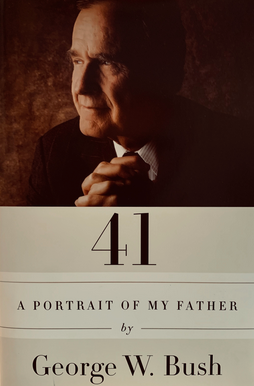
41 is a biography of George H.W. Bush by his son, George W. Bush, and is written with affection, not objectivity. Bush offers that as a disclaimer at the very beginning. This is a tribute, written by a man who was not only the son of his subject, but an ally for decades. Because there’s so much overlap between this and The Last Republicans, I’m not going to precis the book but rather just share some quotations from it. One interesting thing I learned from this, though: George H.W. Bush met Babe Ruth while playing ball at Yale! (Also, fun fact: no vice president has ever pursued and won two full presidential terms. Adams, van Buren, and Bush all lost their reelection bids; Teddy Roosevelt served almost two terms but one of those was McKinley’s, who was shot by a left-anarchist; and LBJ declined to pursue a second term. ) One thing I will take away from this is increased admiration for 41 — who chose to serve in WW2 as an aviator, instead of using his status to escape service or find an easy spot, who struck out on his own, and who erred time and again on the side of principle rather than expediency, courting death threats and boos from his own party as a congressman for his stances against segregated housing and McCarthyism. Bush’s narrative has the usual establishment blinkers.

My grandmother tempered her zeal to win with genuine humility, and she demanded that all her children do the same. She expected grace in victory, good sportsmanship in defeat, and a commitment to “do your best” at all times. She instructed her children to downplay personal accomplishments and share credit with others. And her cardinal rule was that one must never brag. In her view, arrogance was unattractive, and a person with true self-confidence did not need to gloat. “No one likes a braggadocio,” she liked to say.

My father agreed to a first dance but warned Mother it would be the last time he danced in public. Obviously he never dreamed that he would one day have to dance at twelve inaugural balls.

Looking back on it, I can see that the frantic activity was his way of coping with the helplessness he felt. George Bush, the Navy pilot who swam to the life raft and paddled away from death, must have found it unbearable not to be able to do anything to help the girl he loved.

Not every risk my father took in those years paid off. That taught him another lesson: If you refuse to give up, opportunity can arise not only from victory, but also from defeat.

My grandfather considered McCarthy a demagogue and a bully. Prescott Bush was last to speak. “While we admire his objectives in the fight against communism,” he said, “we have very considerable reservations concerning the methods which he sometimes employs.” The crowd booed lustily, but my grandfather was not intimidated. He later rejected a campaign contribution from McCarthy. Years later, when I learned about my grandfather’s stance, I admired his willingness to stand up to extremism. Boston Mayor James Michael Curley once summarized the philosophy of many politicians as, “There go the people. I must follow them, for I am their leader.” Prescott Bush had the courage and integrity to reject that view.

My grandfather’s opponent in 1956 was Thomas J. Dodd, a Democratic Congressman and lawyer. Dodd took a populist line of attack against my grandfather. “I notice Senator Bush seems to have a lot of time to play golf,” he said. “I can’t afford to play golf.” Then someone asked Dodd what his favorite hobby was. He said it was horseback riding. Without missing a beat, my grandfather said, “Well, I congratulate my opponent. I’ve never been able to afford a horse.”

Taiwan lost its UN seat by a few votes, fifty-nine to fifty-five. Several delegates who had promised to support Taiwan either switched their position or abstained from the vote. In a show of sympathy, Ambassador Bush rose from his seat on the floor of the General Assembly and accompanied Taiwan’s disgraced Ambassador, Liu Chieh, out of the UN. They were heckled and jeered on the walk down the aisle. Mother, who had come with Dad to watch the historic vote, remembers delegates spitting at her. The UN, created as an idealistic forum to pursue peace, had become a venue of ugly anti-Americanism.

Mother was infuriated by the negative coverage, and eventually she snapped. After a reporter repeated the latest of many allegations that Dad was a rich elitist, she pointed out that Congresswoman Ferraro and her husband actually had a higher net worth. “That four-million-dollar—I can’t say it, but it rhymes with rich—could buy George Bush any day,” she said. It was a classic Barbara Bush blurt, and she regretted it the moment it left her lips. Mother called and apologized to Geraldine Ferraro, who immediately forgave her. My siblings and I weren’t quite so generous. We took great delight in calling Mother the “poet laureate” of the family.

Throughout his presidency, he had been portrayed on Saturday Night Live by the comedian Dana Carvey, who had honed an impression of Dad that exaggerated his speech patterns, hand gestures, and reputation for “prudence.” To the comedian’s astonishment, Dad called him a few weeks after the election and invited him and his wife, Paula, to stay in the Lincoln Bedroom and then appear at a White House event. The staff was told to gather for an important message from the President. As “Hail to the Chief” played, Dana Carvey walked into the East Room, took the podium, and regaled the audience with his trademark routine. Among other jokes, he created a scene of Dad informing the Secret Service that he planned to go jogging in the nude. The room roared with laughter. The idea was vintage George Bush: He was thinking of others, laughing at himself, and bringing joy to people who were hurting.

“Hi, George, how are you? And there’s Laura. Hi, beautiful.” He lay back contently as Barbara and Jenna rubbed his head. Then he reached out and gently put his hand on Jenna’s pregnant belly. “There’s death,” he said, “and there’s new life.” We all left the room sobbing.

Posted in Politics and Civic Interest, quotations, Reviews | Tagged , , , | Leave a comment

The Last Republicans

© 2017
484 pages

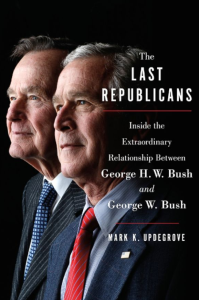
I was interested in reading this book even before my unexpected presidential reading tangent of this last month, in part because of my age: George H.W. Bush was the first president I remember, and holds that title somewhat fixedly in my brain: he is The President just as John Paul II is The Pope, and Elizabeth is The Queen. I came of age during his son’s administration, voting for him in 2004 and then (as I began developing ideas about politics independent of my parents and culture) becoming sharply critical of the expanding police state and the unending war in the middle east: to him I owe both my standing interest in geopolitics and my often strident libertarianism. A joint biography of these two men is somewhat special for me, then, unavoidably saturated with nostalgia from these two formative periods in my life, and the tension that comes from confronting that nostalgia with my adult perspective. It’s an unusual book because of the dual nature of its subject, and their unique relationship: while John Adams was alive to see his son John Quincy take office, he was in his last years during office and could never advise his young scion. Bush paterfamilias and George W., though, were intimately involved in one another’s political lives from the moment H.W. began earnestly seeking an elected office.

The Last Republicans is the story of a unique father and son, whose fraternal bond was made stronger by politics far before Bush the younger ran for office in 2000. Bush senior made history when he became the first vice president to be elected to the presidency since Martin van Buren, and further made history when he saw his son later follow him in office, which had not be done since John Adams’ son John Quincy became the sixth president. Although my grumpy libertarian side would like to dislike George H.W. Bush for his CIA tenure, I’ve never been able to manage it — and I was relieved to learn here that he had no long connection to that organization of spies, coup-installers, and general murderous mischief-makers, but was simply appointed to the top post by President Ford — a bit of a consolation prize for not being asked to join Jerry’s ticket as the vice presidential nominee. George H.W had a difficult time in the Republican party in the late sixties and seventies, as conservatism itself began changing — becoming more militant in response to both Soviet expansion and LBJ’s Great Society, and advancing the fortunes of men like Barry Goldwater, who were not from the respectable Taft-Bush sort of conservatism. The rising neo-cons looked askance at Bush’s breeding, but as I discovered here, he was no mere manor-born son of privilege. He and his wife were azure-blooded, to be sure, but set forth to make their own lives in Texas, where no one cared about their names — raising their small family in modest circumstances. Although Bush would eventually make a fortune in the oil business after learning the ropes as a clerk, he was not content to rest on his laurels and join the boys for cigars and brandy at the club: he was an aristocrat in the Adams-Washington sense, believing strongly in the need to serve the common good. This led him to politics and congressional runs, where his son George — rapidly nearing adulthood — watched and helped his father. Ultimately, Bush senior’s regard in D.C. would grow as a result of appointments (as UN Ambassador, CIA director, etc) before launching him onto the national spotlight alongside Ronald Reagan.

One striking aspect of The Last Republicans is how deeply the Bush children dote on their father: even as they matured into men and women of importance and prominence, they looked on him as a near-demigod. When George W. in his younger years was partying and getting into trouble, all it took from his father was a Look to put the fear of God into him. (George wouldn’t give up the drink entirely until his father began moving deeper into politics: although he’d known he needed to for a while, it was fear of embarrassing his father that really did the trick.) George W. did not have his father’s early drive and motivation: by Updegrove’s account, though he drifted between the worlds of business and politics. As a kid, he dreamt of playing baseball and flying planes, the latter like his father. He ran for office early, and lost (as did his father), but continued to enjoy the challenge and promise of politics despite despising D.C. itself. George W. had an interesting, almost paradoxical realationship with the east coast elite: raised in Texas, he was “more y’all than Yale”, self-conscious and proud about his rural beginning. At the same time, though, he was aware of and accepted his family’s privileged roots — and looked askance at those who were embarrassed about theirs. It was during his father’s presidential runs that George W. committed to politics, pursuing the governorship of Texas and putting him on a path to challenge Al Gore for the presidency in 2000.

As Updegrove tells these men’s stories, he comes back time and again to their father-son relationship. The Bush family was especially devoted to one another because of the death of George’s sister Robin, and her dying goodbye to her family — “I love you more than tongue can tell” — became a refrain when the Bushes were consoling one another, or were facing dire straits like when H.W. was effectively on his deathbed from pneumonia. W’s close attachment to his father only strengthened when he joined the elder Bush on the campaign trail, and their bond increased even further when George W. became president. That office is a responsibility and weight that only other presidents can understand, and the Bushes shared a similar problem with Saddam Hussein, though in W’s case it was more of a potential threat that took on false weight because of the 9/11 environment. (Updegrove uses Hussein merely as a stock villain and does not mention that DC supported his war against Iran throughout the 1980s, which is part of the reason Hussein thought he could get away with invading Kuwait.) George H.W. was, like his son, prepared to rout Hussein’s forces without congressional approval if need be — contra the usual story that H.W. was prudent and his son was impetuous and reckless. Updegrove’s account gives a good impression of how deeply both men sat with the choice to wage war — in George W.’s case, twiceover, and living with the responsibilities when it was revealed that DC’s intelligentsia had mislead the state into war on false pretenses. Though sharing similar burdens and sometimes differing in policy, George H.W. chiefly counseled his son as a father — not giving him advice as a former president, but offering him unwavering emotional support and an open ear.

The Last Republicans is a moving account of their bond, but as its title indicates, it’s not just about the Bushes. Trump is in the the background, always, and Updegrove points out that Trump has been entertaining the political arena for decades, and with a consistent message, and the point of the book is fairly clear: the Bushes were each different kinds of conservatives, George W. being closer to the Goldwater-esque brand that emerged in his youth, but they were in line with the Republican party over the years: they supported DC’s institutions and served as best they could with principle and compassion, believing and working towards the future — a view Updegrove contrasts against Trump’s “dystopian” vision. Updegrove appears to believe that just as the Republican party changed from Bush to Bush that it is continuing to evolve into a party dominated by the more populist nationalism that Trump has consistently championed since the eighties. Populism is an everpresent source of political activity in the United States, sometimes sparking into a roaring fire and then dying away — and while I’m tempted to say that the current populist wave will do that, it’s certainly persisting longer and creating more long-term effects, like the continuing pushback against foreign adventurism. The book ends with an interesting little look at George P. Bush, sometimes considered the next Bush with a bright future in politics, and who is alone among his family in supporting some of Trump’s policies. Although I would have preferred the focus of this book stay properly on the Bushes instead of the author trying to make a political point, they do maintain center stage until the very end. Updegrove’s frequent attempts to insert Trump, some skimming of context, and one fantastically bad misquote* drag down what is otherwise a really good book.

[*] Updegrove has Bush calling Putin on 9/11 to tell him he had better not try to use this as an excuse to declare war on the United States. Not only is this transparently absurd, but if one actually looks for the Andy Card remark this is based on, it’s nothing like that at all.

Coming up: Five Months on Mir, plus more Bush and Biden. I’ve just finished My Name is Asher Lev (what a novel!) but am thinking of posting its review along with a couple of others as part of a Jewish Literature series.

Posted in Politics and Civic Interest, Reviews | Tagged , , , , | 2 Comments

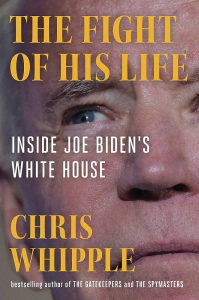
The Fight of his Life

© 2023
416 pages
this is a terrible cover photo

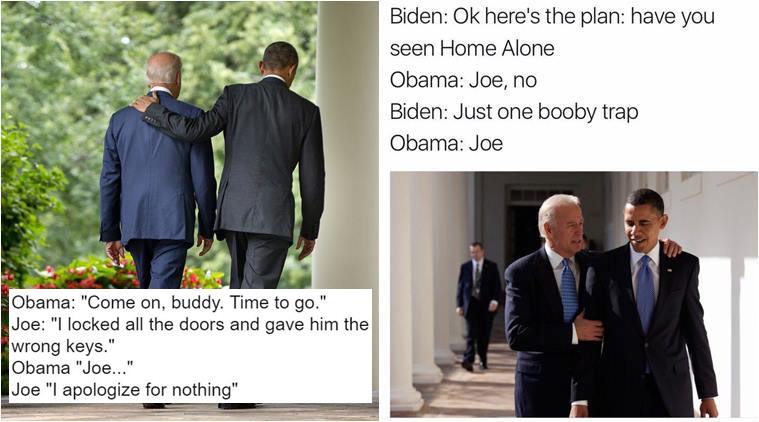
“I’ll tell ya one thing, and I’m not ashamed to say it,” to borrow from my favorite Sopranoes antagonist, Phil Leotardo, “but my estimation of Chris Whipple as an author just plummeted. ” His Gatekeepers, a history and assessment of the office of chief of staff to the president, was one of the most informative and interesting books on the White House I’ve ever read, and I remarked that it was refreshingly nonpartisan. The Fight of his Life is not: it’s more like Bush Country: How George Bush Became the 21st Century’s First Great Leader — While Driving Liberals Insane, but written from the other side of the aisle. It’s essentially a retelling of how Biden responded to events in 2020 – 2022 and what he attempted to get done. I read this chiefly because my opinion of Biden became unhealthily charged after he took office, despite my having liked him as vice president, and my being relieved he was the Democratic nominee. Whipple’s account does a good job of reminding the reader of the humanity of the man behind the desk — but not for anyone else. Anyone opposed to Biden’s programs or policies is a Trump cultist, ‘reality-denier’, etc, and I continued reading only because Whipple had astonishing access to both Biden and his first chief of staff, conducting long interviews (in person and over email) with both, and I wanted to get a better sense of the man in office — not just the character in those golden Obama-Biden memes in the final months of Obama’s administration. It’s telling that of the 28 highlights I made in the Kindle version of this, 25 of them had my added notes, usually factual disputes or my snarky reactions to Whipple’s cavalier narrative. Whipple sharply criticizes the vaccine rollout in 2020, for instance, despite the fact that in March and April of that year, everyone was claiming it could be two years before vaccines were ready, and the fact that this was a novel event. I won’t ever argue that Trump’s administration was not disorganized to the point of incompetence, but I don’t know that any administration could have gotten its act together and started mass distribution so quickly and efficiently as to avoid any criticism whatsoever. Whipple also writes that Trump had transformed the Secret Service into some loyalist praetorian guard, so Biden was afraid to say anything around them — but as Ron Kessler noted in First Family Detail, Biden had an acrimonious relationship with the S.S. even as vice president.

The majority of the book sticks exactly to the establishment line, so unless you don’t watch or read any news at all, and hide away from the world in a remote cabin except for the sending the odd letter-bomb, you’re already aware of what Whipple has to say. The most interesting part of the book came at the beginning, where we find Trump and his supporters in denial about losing the election, so much so that there wasn’t a dedicated transition team: only one man (Chris Liddell) in the administration took on that responsibility, and out of feelings of public duty rather than personal preference. According to Whipple’s account, he wanted to resign repeatedly, especially after January 6, but was urged to remain to “land the plane”, so to speak. Despite Trump’s intransigence and general unhelpfulness, Liddel and the Biden team were able to get the next administration off smoothly on January 20. My next favorite part was Biden telling Putin he’d looked him in the eyes and believed he had no soul, and Putin responding, “We understand each other.” I don’t know if that’s remotely true or not (it sounds too similar to Bush looking Putin in the eyes in 2000 and believing they could work together), but it sounds hilarious. Anyhoo, if you watch CNN or read The Washington Pravda, you already know the majority of what Whipple has to say and how he feels about it.

This book has its merits — Biden trying to use his struggle about his own son’s death to minister to suffering parents, for instance — but they’re overshadowed and marginalized by Whipple writing purely for the MSNBC Book Club.

Posted in Politics and Civic Interest, Reviews | Tagged , , , | 2 Comments

Wednesday blogging prompt: a job I’d be bad at

Today’s prompt from Long and Short Reviews is “A Job You’d Be Bad At“.

I hate when my attention is demanded, especially by some electronic doo-dad.  Call it mindfulness for fixation, but I prefer doing one thing at a time: working on something intently, or reading something intently. I want to be focused, not made to bounce from thing to thing. My phone lives on silent mode,    notifications are disabled for nearly every app on it, and notifications are disabled for everything on Windows that I can find.  I truly,  madly, deeply hate dings and buzzes and the rest of the inescapable cacophony of modernity. I would make, therefore, a very unhappy president of the United States. (That’s assuming I got past the smiling glad-handing stage, which is unlikely. Making polite and meaningless smalltalk in uncomfortable clothes under fluorescent lights for decades? It’s a vision of hell!)

Posted in General | Tagged | 7 Comments

A tease, a tease, a Tues-day tease…

From The Last Republicans:

Afterward, the president-elect, Barbara, George W., Laura, and Barbara and Jenna boarded Air Force One to return to Washington. If Barbara Bush had any glamorous illusions about her new station as first lady in waiting, they dissipated when she rolled up her sleeves to remove wads of toilet paper her seven-year-old twin grandchildren had mischievously jammed into one of the plane’s toilets.

And from The Fight of his Life: The Biden White House:

Presidential transitions are herculean exercises. That’s why Biden’s team needed to start so early. More than 200 members of the incoming White House staff needed to be picked and readied to govern; 1,200 officials chosen and prepped for confirmation by the Senate; another 1,100, who don’t require confirmation, recruited, vetted, and hired; executive orders written, tabletop crisis exercises conducted. Kaufman explained: “If you went to a corporate CEO and said, ‘We’re going to take away the very top managers in your organization. And then we’re going to bring in a whole new team that has to go through an incredibly complicated selection process. Now let’s make it the most complex organization in the history of the world. And then let’s say that every one of your enemies around the world knows you’re at your most vulnerable when you’re turning it over.’ Are you kidding? They’d laugh at you.”

Yes, I’m afraid the presidential kick is still ongoing.

Posted in General | Tagged , | 2 Comments

July 2023 in Review

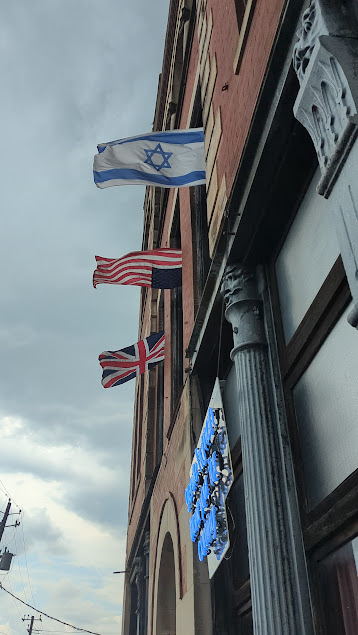
While it’s conceivable that I could finish a book today (I’m halfway through The Last Republicans, and ditto for Off the Planet: Five Months on Mir), I doubt it. I spent the weekend saying goodbye to a friend: the Harmony Club, a Jewish community center turned restaurant/bar turned antiques store and clubhouse, is passing into new ownership tomorrow. I’ve spent every weekend and holiday there for the last three years, hanging out with friends, yakking with tourists, watching birds and bugs and the skies — riding out tornadoes and heartbreak. C’est finis, alas. Those of us who used to gather there helped clean the place out over the weekend, and that will continue a little tonight. The sideshot was taken yesterday, as we took a break from moving to huddle inside while a thunderstorm rolled through the area. July certainly proved to be a different month ’round these parts. My plans for focusing on American lit titles in my Classics Club and Mount TBR endeavors were derailed completely when an early TBR read, The Presidents Club, sent me on a presidential reading tangent that was interrupted only by Space Camp and then Blast from the Past, a fun look at kid lit from the 1990s. It was a very healthy reading month, just…er, not for any of my goals. I’m still have a few more Blast from the Past posts upcoming, but they’ll be mixed in with ‘normal’ reading. (As normal as RF ever is!)

Climbing Mount Doom:
British Soldiers, American War; Don Hagist
The Presidents Club, Nancy Gibbs and Michael Duffy
What the Dormouse Said. I read some of this, then skimmed the rest. Count that as a DNF, I suppose. Lots of characters and more LSD than computers.

Classics Club, Readin’ Dixie, and The Big Reads:

Space Camp:
Space Camp went well, I think, and will be remembered chiefly for Mike Collin’s excellent Carrying the Fire. I expect to see it on this year’s top ten list.

Read but Unreviewed:
The Invisible Man: The Life and Liberties of H.G. Wells. This is a short biography of H.G. Wells that covers a lot of his work, with some odd exceptions, and is sharply critical of Wells’ relentless womanizing. It focuses a bit on Wells’ relationships with other men and women of the age, particularly his public argument about evolution with Hillaire Belloc. Interesting enough but not memorable, I don’t think. An excerpt:

“To-day I’ve motored from Stonehenge, and you may care to know that I polished that off in forty minutes.’
‘Good heavens!’ I gasped, ‘a place that has been puzzling antiquaries for a thousand years!’
‘Very likely,’ he rejoined, ‘but anyhow I’ve settled it to my satisfaction,’ and then, catching sight of my horrified expression, ‘I’ve left a couple of experts behind,’ he added quickly, ‘they have a fussy kind of knowledge that looks well in a footnote.’

The Trump White House was inspired by my presidential reading tangent, but it was less about the Trump White House and more about the Trump Oval Office — specifically, it’s Kessler’s review of Trump’s first year in office, and an introduction to some of the very strong personalities that marked it. Kessler has written several score of books about the presidency and various executive-level offices, and has known Trump personally for over a decade. The book is thus an interesting mix of frank observations about the turbulence of that first year, particularly the undue influence of Trump’s family, and his unorthodox approach while at the same time defending some decisions and comparing the media’s treatment of similar decisions made by prior administrations. It’s a little People Magazine at times, especially when covering the social scene around Palm Beach and the ludicrous wealth concentrated there. Kessler has done a separate book on the Palm Beach scene, so that’s not surprising. His First Family Detail was similarly gossipy, so that just may be his style. Some highlights:

“Every administration has people in it who get White House-itus,” says Robert Gates, a former National Security Council staffer in the White House and a former director of Central Intelligence. “The first giveaway is when a relatively junior staffer has his secretary place calls saying, ‘The White House is calling,’ instead of ‘Joe Schmo from the National Security Council is calling.’ ”

The paradox of Trump was that he could be generous, supportive, and considerate and at other times treat his aides like dirt. In effect, some aides felt, Trump manages through chaos by pounding someone down to the ground to build someone else up for a couple of weeks. While the team-of-rivals game sparks competition, it also stirs resentment among the staff. When it came to his tirades, Trump seemed to lack empathy, aides thought. While Trump could make an aide feel like a million bucks, at other times he seemed incapable of understanding how his humiliation of them made them feel. Yet if Trump treated an aide rudely, an hour later he acted as if nothing had happened, as if the incident had vanished from his brain. Since he did not view the humiliation of an aide as awkward or strange, it did not exist in his head.

Posted in Politics and Civic Interest, Reviews | Tagged , , , , | 6 Comments

Amber Brown and Matilda

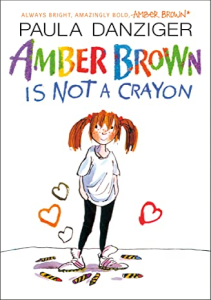
Most of this week’s reading has been of books I read in the 1990s, or at least were books from series I read in the 1990s. I never read Amber Brown, though, possibly because by the time they were published I was too old for them. I wanted to take a look, though, given that the author did the Matthew Martin series. In the first one I tried, Amber Brown is Not a Crayon, we meet the main character, who writes in the first person. The great drama of the book is that her best friend Justin is moving to the other side of the country. I suspect if I’d read this as a kid, I would have strongly sympathized, as I had two best friends move away on me in elementary school, back when we had to resort to letters to stay in touch. (Fortunately the internet arrived and with it, AOL Instant Messenger.) Amber Brown Is Green with Envy was a different story, as it’s about Amber’s problems with her now-divorced parents, her unease with her mother moving on, and her resentment that her dad suddenly wants to be back in her life despite being work-obsessed in her younger days. Divorce and split families was thankfully something I never experienced, save through books. Despite the I could see going back to this series when I do another kidlit sweep, as I like the way “I, Amber Brown, tells stories”.

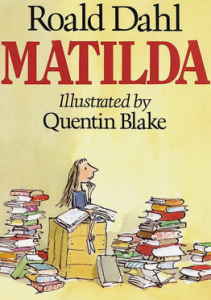
Matilda, with Charlie and the Chocolate Factory, was another re-read. Given that it’s by Roald Dahl, though, absolutely nothing is lost. I understand that Netflix is attempting some drama based on this, but I can’t imagine it rivaling the original movie with Mara Wilson and Danny DeVito. Matilda is the story of a precocious young girl who from an early age exhibits extreme talents in both reading and math, despite the fact that her parents dislike her, regard book-reading as a noxious habit, and would be happy she would sit enthralled in front of the television like normal children. Matilda finds her joys at the local library, reading through Dickens, but it’s when she’s sent off to school that things get interesting. Although Matilda’s teacher Miss Honey is The Best Teacher Ever (sorry, Mrs. Jewls) and recognizes her gifts, the school headmaster is The Worst Ever and tries to stick Matilda in a torture-closet called The Chokey. Simmering with rage, Matilda unexpectedly discovers she has other gifts. When I first read Harry Potter and the Philosopher’s Stone back in 2007,* Harry’s magical talent manifesting itself in times of stress immediately brought Matilda to mind.

Some quotes:

So Matilda’s strong young mind continued to grow, nurtured by the voices of all those authors who had sent their books out into the world like ships on the sea. These books gave Matilda a hopeful and comforting message: You are not alone.

“Fiona has the same glacial beauty of an iceberg, but unlike the iceberg she has absolutely nothing below the surface.”

*The friend manically laughing at the top of that post is the same friend who ran off on me. That was from one of our many AIM convos!

Posted in Reviews | Tagged , | 9 Comments

Charlie and Harriet

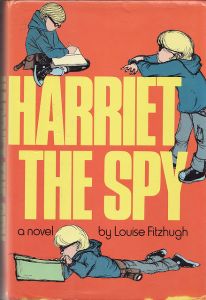
At some point in 1996 or ’97, I got to watch Harriet the Spy. I also began keeping a journal in 1997, which is not an accident, though I found California Diaries at the same time. As part of this week celebrating children’s literature of the 1990s (or at least, children’s books I read in the nineties, never mind when they were published) , I wanted to go back to the original book and see what it was like. I can’t compare the book and movie because I remember nothing about the plot of either, only that Harriet was constantly scribbling in her notebook. Harriet is the only child of a fairly wealthy home (wealthy enough that she has a nanny and a cook!), who wants to know Everything in the world and has a spy route in her town. She’s found different hiding places (trees, dumbwaiters, etc) to access and eavesdrop or watch on them. Harriet would be a menace had she been born in a different time, because she writes down seemingly everything she sees or thinks, and it’s often disparaging of her classmates and neighbors — but reveals a child’s inexhaustible curiosity and frank observations. When her classmates read her notebook, she promptly becomes persona non grata at school, exiled from all social interactions and subject to the slings and spitballs of outrageous fortune. Even worse, her chief ally in the world, her nanny Ol Golly, has gone and fallen in love, so she’s on her own. Harriet doesn’t have much in the way of emotional self-control, so when she engages in a vengeance campaign against her classmates (involving planting frogs in desks, cutting their hair, etc) her parents sent her to a shrink. Things get better, though. This was a….chaotic read, with some good writing, though I wasn’t sure where the story was going.

Janie Gibbs was Harriet’s best friend besides Sport. She had a chemistry set and planned one day to blow up the world.

Harriet was getting tired of standing up and screaming. She wished she could sit down but it wouldn’t have done. It would have looked like giving up.

There is more to this thing of love than meets the eye. I am going to have to think about this a great deal but I don’t think it will get me anywhere. I think maybe they’re all right when they say there are some things I won’t know anything about until I’m older. But if it makes you like to eat all kinds of wurst I’m not sure I’m going to like this.

“[Love] feels…it feels—you jump all over inside…you…as though doors were opening all over the world…. It’s bigger, somehow, the world.”
“That doesn’t make any sense,” said Harriet sensibly. She sat down with a plop on the bed.
“Well, nonetheless, that’s what you feel. Feeling never makes any sense anyway, Harriet; you should know that by now,” Ole Golly said pleasantly.

Her mother came to the door. She looked down at Harriet lying there with the chair on top of her. “What are you doing?” she asked mildly. “Being an onion.” Her mother picked the chair up off Harriet’s chest. Harriet didn’t move. She was tired. […]
“It’s for the Christmas pageant…is that it?” “Well, you don’t think I’d just be an onion all on my own, do you?”

You’re eleven years old which is old enough to get busy at growing up to be the person you want to be.

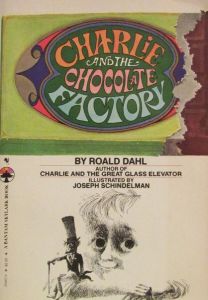
Next up, an old Very-Favorite: Charlie and the Chocolate Factory! I was pleased to discover that my library has a copy of the original edition which I read back in he day, with the same illustrations by Joseph Schindelman that I remember as a kid — and they’re imprinted enough on my mind that neither of the movies really took over the characters in my head, except for Julie Dawn Cole as Veruca Salt. She owned that role. I can’t tell you how many times I read this book as a kid, and its original dramatization is one of the first movies I ever saw, as we watched it in class. I’m sure anyone reading knows the story: our character is Charlie Bucket, who is desperately poor and starving, living with his four grandparents (all of whom are in their ninenties) and his parents (who aren’t old enough to be the kids of 90 year-olds, but this is in a book that involves snozzberries, Ooompa-Loompas, and magic elevators). Willy Wonka, the eccentric genius candymaker, has offered five children a chance to tour his factory — those who find the Five Golden Tickets in his candy bars. Charlie is lucky enough to come across one, and he joins his four fellow tourists for a tour of a wonderful place with a very eccentric owner and guide, one is mischievious and sometimes manic. The other kids have serious character flaws which lead them into ghastly accidents, and soon Charlie is all alone and — well, I’ll not spoil the rest. Wonderful writing. I remember reading James and the Giant Peach and this book’s sequel back in the day.

Everything in this room is eatable, even I am eatable! But that is called cannibalism and is in fact frowned upon in most societies.

Whipped cream isn’t whipped cream at all if it hasn’t been whipped with whips, just like poached eggs isn’t poached eggs unless it’s been stolen in the dead of the night!

Posted in Reviews | Tagged , | 5 Comments

Goosebumps and Boxcar Children

I’m lumping these two together because as much as I liked them as a kid, I wasn’t able to get access to many copies while I was prepping for this project, so I’m limited to one or two books .

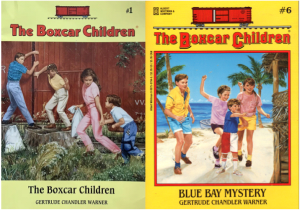
First up, The Boxcar Children. TBC is a funny series because it began as a simple story about four children who were being sent to live with their grandfather after being orphaned, but they’d heard he was a grump who didn’t like them, so they ran away. The book opens with them traveling lonely roads at night, looking for refuge, and soon their foraging leads them into the woods where they find an abandoned boxcar. The book develops into a very mild kind of My Side of the Mountain or Hatchet, with these young kids (Benny is all of four or five) creating a life for themselves in the woods, made possible by the oldest boy Henry walking into town and doing odd jobs like handywork or picking apples. Eventually the kids are reunited with their grandfather, who turns out to be not grumpy at all, but a very nice and understanding fellow who even moves their boxcar to his back yard so they can play in it all they like. From what I understand, the book was so popular that fans demanded more, so the author created a series in which the Alden kids go places and encounter mysteries — and do so with such regularity that when the original author’s series stopped and other people began writing in the series, they made a joke out of it. The first twelve books depict the kids growing and aging, but then after Warner’s death, they become a bit like comic book characters: their ages are rolled back a few books, then frozen while the world changes around them. The books coming out when I grew up involved computers and the like, despite the fact that in the first book, cars aren’t a thing. Seriously, the only vehicles mentioned are horses and wagons. I did not notice that as a kid.

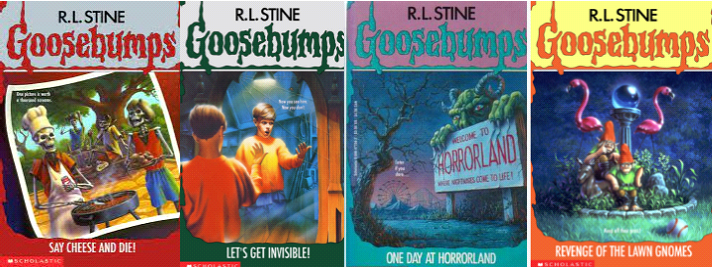
At some point in 1993, my mother made a decision she’d later regret. She saw a book in Food World or wherever called Let’s Get Invisible! and thought it would be a fun choice for her son who always had his nose in a book. Let’s Get Invisible was my introduction to Goosebumps, which I’m confident was The Series of the 1990s. Everyone read Goosebumps, even the jocks who would have only otherwise read baseball cards and the Spalding logo on their sports equipment: the fervour was such that my library hosted a Goosebumps fan club, complete with posters that were blown-up versions of the books. (I vividly remember the Monster Blood II cover, with an overgrown hamster….) Goosebumps was my introduction to not only the horror genre, but staples thereof: most of R.L. Stine’s premises were original to him (monster blood, Horrorland, the haunted mask), but he also incorporated horror traditions like ghosts, mummies, and demon-possessed ventriloquists’ dolls. My parents were increasingly disturbed by the covers over the years. One of the original series’ hallmarks was Stine’s love of structural suspense: each chapter ended with something like a cliffhanger, and at the end of each novel there was a twist, in which the main character has a sickening moment of realization, or the reader realizes the narrator isn’t who they thought. (In one memorable instance, we get Sixth Sense’d.) Stine quickly replaced Beverly Cleary as My Favorite Author, and I began raiding my sisters’ collection of Fear Street novels, which…er, were considerably different in content, as they involved much more murder. Fortunately I don’t remember much about those books, beyond one (Silent Night) that involved a Santa, a toy store, and one of the characters’ hatred of “Little Drummer Boy”.

Some remembered favorites:

Let’s Get Invisible! My first Goosebumps. A mirror is discovered in an attic with an attached light. When the light is turned on, anyone directly in front of the mirror is rendered invisible — leading to the usual childish antics of pranks and spying. The longer one stays invisible, though, the harder it is to come back — and the mirror has its secrets, as the main character learns when his little brother’s mirror-self attempts to trap the little brother in the mirror so that the mirror-self can escape into the real world.

One Day at Horrorland. While lost on an interminable road trip, the Morris family spots a sign for an adventure park they’ve never heard of: Horror Land. Figuring that it’ll be easier to find their way once the restless kids have been properly distracted, the dad pulls in and the fun b- oh, wait. The car just blew up. Well, that was unexpected. After that promising start, the kids go in by themselves to leave the adults to do adult things, like call the insurance company to ask “My car just randomly exploded, is that covered”. The park is not popular, and what other children Lizzie and Luke see are crying. They soon discover why: the rides here are terrifying. Not hah-hah fake scary, more like one-second-away-from-juvenile-cardiac-arrest scary. The scares continue throughout.

The Monster Blood miniseries is one I wanted to revisit, but couldn’t find any ready copies of: it involves a canned toy called Monster Blood that, if eaten, makes the eater grow enormous and go a little beserk. The Haunted Mask was somewhat similar in that the mask attached itself to the wearer and began changing their personality, I think.

The Ghost Next Door has one of my favorite twists in the entire series, and that’s all I can say.

Say Cheese and Die! Very memorable for its cover that featured skeletons bbqing. While exploring an abandoned house, the main character discovers that whenever he takes a photo of someone or something, it develops into a picture of destruction and misery: a shot of a new station wagon, for instance, develops into a shot of that station wagon crumpled from a massive car wreck. Does the camera show the future — or does it dictate it?

Revenge of the Lawn Gnomes. I can’t remember much about this book beyond it featuring lawn gnomes who came alive and did mischief, but I remember one bit of dialogue that freaked me the heck out when reading this as a kid. Do you remember the scene in Toy Story where the toys are trying to scare Sid, and it culminates in Woody doing that uncanny turning-his-head-completely-around thing and saying “…..so play nice….”? That happens here in book form, but the dialogue is — “Not funny, Joe. Not funny at all.”, and it still give me the creeps.

Posted in Reviews | Tagged , , , | 7 Comments