Henry, Beezus, and Ramona

I wish I could tell you when I met Henry, Beezus, and Ramona, but it’s been 30+ years and a child’s early life is full of firsts, too many to hold on to. I do know that it was Ribsy that I found first, a novel with a skinny looking dog on the cover. The story was of that skinny dog getting lost from his boy Henry and then trying to find his way back home. As a boy who loved dogs — who almost always had one, and who pined for one when he didn’t — I devoured the book and was only happy to read more stories about Henry and Ribsy from the library, and when I ran out of Henry stories I moved on to the girls — to that of Beezus, Henry’s friend, and of her kid sister Ramona. I loved these books, constantly re-reading them and remembering odd little details from them decades later — like Henry carrying a box of kittens, of Ramona staring at a clock and trying to figure out the time. They sometimes inspired or informed my own adventures: how many of my attempts to build a fort in the yard (including the one involving post-hole diggers and ending in my finding the water main and..um, “mass irrigating” two lots) were based on Henry and the Clubhouse? For a while I even declared Beverly Cleary my favorite author.
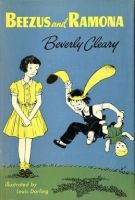
Beezus and Ramona is the original book in this meta-series, I think, introducing us to Beatrice (“Beezus”) and her holy terror of a sister, Ramona. As a boy I would have preferred Henry among the three characters, but it’s Ramona I remember best as an adult. She’s such a chaos-machine that she makes for great fun reading, though I’d pity her parents (and the neighbors) if I knew her in real life. Beezus and Ramona‘s main story is about Beezus about to have her birthday, but Ramona’s creativity and spontaneity cause…erm, challenges, destroying several cakes and invoking a teeny tiny parade of three and four year olds who Beezus is compelled to entertain. I couldn’t have asked for a more memorable return to the series.
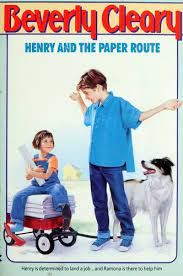
This is the style used in the majority of the books I read back in the 1990s.

In Henry and the Paper Route, we find young Henry pining for a job of his own — not for money, but because it’s a responsibility, and he wants nothing more than taking on something that proves he’s grown up and responsible. When he learns that there’s a spot opening, he hastens to apply — but doesn’t count on running into a litter of the cutest little kittens on the way, kittens that he just has to take care of. He can put them in his pockets and the newspaperman won’t even notice them, right? … well, read and find out. At any rate, Henry has stiff competition for the job from a new arrival — a boy so brilliant he’s creating a robot. But then there’s Ramona, the little anarchic wildcard, and hilarity and exasperation both ensue.
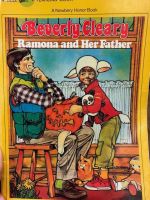
Ramona and her Father, the last in this revisit set, proved to be more serious. It’s later in the series, and Ramona is a slightly less manic kid, closer to ten than four: she’s old enough to be seriously bothered by her father’s being laid off, especially when she learns in class that smoking is bad for you and she sees him doing it a lot. To make matters worse, she’s a sheep in the school play, and her mother (who is now working to provide some income while Mr. Quimby is searching) can’t make a good costume, so she has to settle for an embarrassing sort-of-sheep.
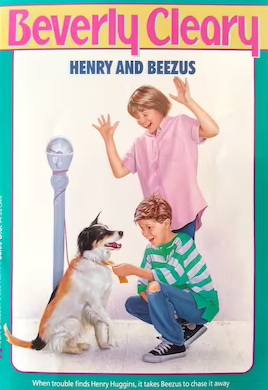
And lastly, in Henry and Beezus we have an earlier story in which Henry also helps with a paper route, but he’s younger still and is tied up pining for his own bicycle. He knows the very one he wants, but it’s $50! Scooter has offered to let Henry take his route for a weekend, which will get him a little money for the bike fund, but faithful pooch Ribsy knows how to fetch so well, that whenever Henry throws a paper out — well, Ribsy brings it right back. In addition to de-training Ribsy to fetch, Henry is also trying to sell hundreds of gumballs he found in an empty lot (….nothing sketchy about that, nope…..) and looking for a beater bike in the meantime. Beezus helps him out at an auction, but lands him a girl’s bike. No boy can be seen cycling without a crossbar!

While I wasn’t able to revisit much of this series (my library hasn’t held on to much Cleary, unfortunately), I enjoyed each of these thoroughly. The appeal of the books hasn’t diminished in the least.
Posted in Reviews | Tagged , | 3 Comments

Wednesday blogging prompt and song of sixes

Today’s blogging prompt from Long and Short Reviews is “A Job I’d Be Good At”, which is…pretty easy.

I’ve been told on multiple occasions in the past twenty years that I’d make a good monk, which is….not surprising given my longstanding practice of simple living, my fascination with intentional communities, and my obsessive interest in religion, philosophy, and meaning. I also love liturgy — both the liturgy of a given religious service, and the way the day, seasons, and year are ordered, like a dance, with both rhythms and variety. I’ve read a few books on practicing Benedictine spirituality and have even attempted to schedule a retreat at St. Bernard’s, but they’re apparently a very popular monastery to retreat to.

From virtue to vice, now a survey appropriated from Seeking a Little Truth, “Sing a Song of Sixes” — or rather, the idea. I saw few other bloggers doing it, and they all have different questions, so I think I can just do what I want.

Six authors I am looking forward to reading more of
Blake Crouch. Terrific SF.
Daniel Suarez. Ditto.
Will Storr. …interesting journalist who explores weirdness. I have a book of his on ghost-hunters but it’s disappeared somewhere. Blasted poltergeists!
Jon Ronson. Ditto.
Rhett Bruno & Jaime Castle. I’ve enjoyed their dark-western fantasy collabs and see that they have a SF book, as well.

Six Books I Recently Previewed on Kindle:
When Computing Got Personal, Matthew Nicholson
How to Forget: A Daughter’s Memoir, Kate Mulgrew
The Painted Veil, W. Somerset Maugham
Sins of the Father: Joseph Kennedy and the Dynasty he Founded, Ron Kessler
Diary of an Apprentice Astronaut, Samatha Cristoforetti. A possibility for next year’s space camp, which would be my first non-Russian European astronaut memoir.
Radical Suburbs: Experimental Living on the Fringes of the American City, Amanda Kolson Hurley

Six Books Currently Checked Out on Kindle Unlimited:
A Voyage Long and Strange: Rediscovering the New World, Tony Horwitz
On Reading Well: Finding the Good Life through Great Books, Karen Swallow Prior
Crazy Like Us: The Globalization of the American Psyche, Ethan Watters
The Moral Landscape: How Science Can Determine Human Values, Sam Harris
Hitler’s American Friends: The Third Reich’s Supporters in the United States, Bradley Hart
Philokalia: The Bible of Orthodox Spirituality, Anthony Coniaris & Stanley Harakas

Six Books I Most Recently Added to my Goodreads Wannaread Shelf
Asperger’s Children: The Origins of Autism in Nazi Vienna
The Call of the Weird: Travels in American Subcultures, Louis Theroux
The Power of Meaning: Finding Fulfillment in a World Obsessed with Happiness, Emily Esfahani Smith
City of Sedition: The History of New York City During the Civil War, John Strasbaugh
Ballpark: Baseball in the American City, Paul Goldberger
Blood Passion: The Ludlow Massacre and Class War in the American West, Scott Martelle

Six Unread Star Trek Books
Star Trek Discovery: Die Standing, John Jackson Miller. A story about Mirror Georgiou.
From Sawdust to Stardust, Terry Lee Rioux. A biography of DeForrest Kelly
Star Trek: Living Memory, Christopher Bennett. There’s some space drama going on and Uhura has lost her memory.
Star Trek: Agents of Influence, Dayton Ward. Riker & co try to make first contact but some randos from the past show up to create drama.
Star Trek Titan: Fortune of War. Riker and co attempt to prevent mysterious alien technology from falling int othe wrong hands.
Star Trek Titan: Sight Unseen, James Swallow. Titan responds to a powerful enemy that can alter the perception of reality itself.

These were all $0.99 deals from last year.

The Six Most Recent Books I Bought in Direct Disobedience To My Own Order Against Buying New Books, Which I Have Not Yet Read and Which are Therefore Contributing to the Problem that is Mount Doom
Live, From New York! An Uncensored History of Saturday Night Live
Astounding: John Campbell, Isaac Asimov, Bob Heinlein, L. Ron Hubbard, and the Golden Age of Science Fiction
Plato, not Prozac! Applying Eternal Wisdom to Everyday Problems
Sons of the Waves: The Common Seaman in the Heroic Age of Sail (Read of England acquisition)
The Stonemason: A History of Building Britain (ditto, and I blame Cyberkitten for it entirely, not my own lack of willpwer)
The Royal Society and the Invention of Modern Science. Another RoE book, but not CK’s fault


Posted in General | Tagged | 13 Comments

Top Ten Teaseday

Today’s TTT is the last ten books we DNFed, but I’m picky about the books I pick up and don’t DNF very often. So, I’m going to wander off the reservation a bit and go with “The Last Ten Books I Previewed on Kindle”. But first, the Tuesday Tease, from The Last Republicans: Inside the Extraordinary Relationship Between George H.W. Bush and George W. Bush.

During those later academic experiences in the Northeast, [George W. Bush] would come to know the children of privilege whose identities were tied up in their family’s wealth and social positions, which engendered a sense of entitlement. His disdain for them—or anyone who was putting on airs, for that matter—came from the West Texas lens through which he saw the world. Among them he would often wield his West Texas persona defiantly. When he was four, his father wrote of him, “Georgie has grown to be a near-man, talks dirty once in a while and occasionally swears. He lives in cowboy clothes.” As he got older, not much changed. At Harvard Business School in the mid-1970s, he would strut around Cambridge in his National Guard flight jacket, beat-up Levi’s, and cowboy boots, a wad of chewing tobacco stuffed in his cheek that he would spit into the paper cup he clutched in his hand. Amid the ivy-strewn environs, his incongruous demeanor asserted, “I’m not one of you. I’m a Texan.”

And now, last ten Kindle previews!

How to Forget: A Daughter’s Memoir, Kate Mulgrew.

The Painted Veil, W. Somerset Maugham

Sins of the Father: Joseph P. Kennedy and the Dynasty He Founded, Ron Kessler.

My Life as an Astronaut, Alan Bean

Confessions of a Recovering Environmentalist and Other Essays, Paul Kingsnorth. Kingsnorth combines Orthodox spirituality & ecology. He has a substack called “The Abbey of Misrule“.

Write it When I’m Gone: Remarkable Off-the-Record Conversations with Gerald R. Ford, Thomas DeFrank

An Immigrant’s Love Letter to the West, Konstantin Kisin

Your Table is Ready: Tales of a New York City Maitre D’, Michael Cocchi-Azzolina

Radical Suburbs: Experimental Living on the Fringes of the American City, Amanda Kolson Hurley

The Call of the Weird, Louis Theroux. Amusing this is the only one of these samples I’ve actually looked at as yet…

Posted in General | Tagged , | 5 Comments

Matthew Martin!

This week’s reading owes its existence to the Matthew Martin books, which I found in my home library and devoured. The star? Matthew Martin (no prizes for guessing that), who the series follows for four years, through the awkward tween stage. I think I found these books just before I hit those years myself, but readily identified with Matthew and found his computer-geekness especially interesting: thinking about these books takes me back to the days of elementary school, of Apple computers, trays with both 5 3/4 & 3 1/2 floppy diskettes, and tractor-feed printers. (The first print-outs I ever saw came from those dot-matrix printers: my best friend found a web site with Star Trek jokes and Klingon expressions in ’96.). I don’t know why, but I wanted to revisit this series and the week’s theme grew around it.

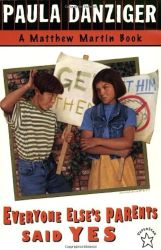
In Everyone Else’s Parents Said Yes, young Matthew is about to hit the big time. Ten. Double digits. He is beyond excited. With his computer, he has created a bounty of lists — the junk foods his health-conscious mother only allows him once a year, the guest list, the complete itinerary that involves Nintendo tournaments and pestering his older sister Amanda — or, as he likes to call her when she’s bothering him, “runt-chest”. (My favorite line from this book, wholly unnoticed reading as a kid: “Matthew, please don’t refer to your sister as runt-chest. In fact, please don’t refer to your sister’s chest at all.”) Matthew’s occasional — okay, constant — pranks against the girls in class result in them forming a group called G.E.T. H.I.M, which makes him the subject of their collective prankery and culminates in their staging a singalong protest outside his house at his birthday party. The nerve of these junior high broads!

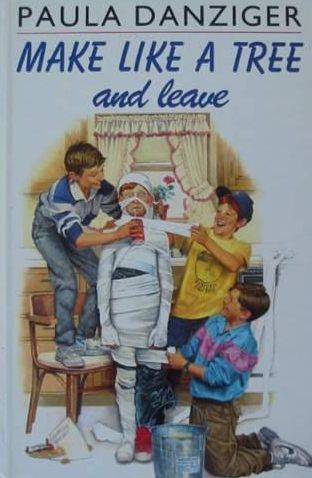
Make Like a Tree and Leave is second in this series, in which the undersized and over-energetic prankster Matthew is dismayed to learn (along with the rest of his class) that one of their elderly neighbors has been badly injured and will have to sell her land to pay hospital bills. The woods she owns are a favorite running-about place of Matthew and his classmates, so the kids decide to start raising funds however they can to help an adult effort to establish a conservancy that will protect the elderly lady’s property. The kids promptly split into girls vs boys teams, but when the two begin sabotaging one another, Matthew acquires a sudden bolt of maturity and argues that The Cause should be more important than fighting. He finds an ally among the girls in Jil!, and all things end happily — except for the child of one of the teachers, who evidently died of polio decades before. That little splash of cold water was not something I noticed reading this as a kid. Also, Matthew inadvertently traps one of his friends in a full-body cast while trying to create an exhibit for their ancient Egypt project.

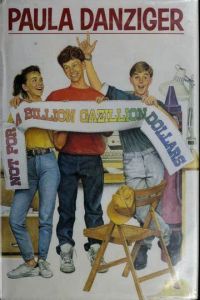
In Not for a Billion Gazillion Dollars, Matthew is bound and determined to get The Best Computer Program Ever. Reading this as a 30-something techie in 2023 is interesting, because it sounds like a networked version of Adobe Photoshop or something similar. Adjusting for inflation, it would cost $400+ today, so small wonder that his parents refuse to pay. His winninginest smile doesn’t prevail, so Matthew resigns himself to making money himself. After he learns that no, he can’t rent out his sister’s room while she’s at college (air bnb doesn’t exist yet, Matthew, wait a couple of decades), and that no, he shouldn’t wander into traffic offering to wash windows for drivers at red lights, Matthew and his besties (Jil! and Josh) stumble upon a venture that combines their mutual strengths: printing and graphic design! It’s here that The Feelings first begin between Matthew and Jil!, something that will be explored in the next book, but which is obvious to their friends even here — Jil! draws out Matthew’s more thoughtful and mature aspects, and she’s a fun character in her own right. My favorite scene is when Matthew is pestering someone with an invisible pair of scissors, and Jil! forces him to hand over the imaginary scissors, whereupon she places them in an imaginary box, locks it with an imaginary key, and then places said key carefully in her pockets. Their mutual friends can only watch and shake their heads.

Next, in Earth to Matthew, we find Matthew and his class preparing for a weekend field trip to the Franklin Institute, a science museum on steroids, and struggling with Feelings more seriously now. One of his classmates, Jil! (she changed the spelling of her name because Jill was just so boring) and he attended a dance together, and now they’re drifting into becoming a pair. Considering that in the first book Matthew was using his computer to create “GIRLS KEEP OUT” signs, and disappointed and bothered by some of his friends’ disinterest in making their own, that’s quite a sea change — but such things happen with puberty. Both kids are struggling with these feelings and the expectations that follow them: are they supposed to be A Couple now? What does that mean when you’re eleven? Their confusion leads to fighting, but by the end they’ve found a place where they can co-exist.

I thoroughly enjoyed going back to this series, and will be holding on to the used copies I found on ebay so I can jump back into the mid-nineties, a time for me that is unique and special and wonderful because it was when I was growing up. I noticed some weaknesses in the writing (a penchant for showing and not telling ) that I wouldn’t have seen as kids, and suspect that this series contributed heavily to my love of puns, considering that wordplay is one of Matthew’s favorite ways to annoy his family, friends, and archenemy Vanessa. (Which is odd, considering that he’s also a terrible speller — but all of his puns are audible ones.) Reading as an adult, I noticed a few little jokes Danzinger included for parents who might have been reading these out loud, and appreciated the moral elements in every story. These tend to be a little obvious, like when the class does an environmental project, or Matthew’s dad tells him about his young-man problems with credit card deb, but there are more subtle ones as well.

Posted in Reviews | Tagged , , | 1 Comment

Blast from the Past: NINETIES KIDLIT WEEK!

Featured so far:
The Henry Huggins / Beezus and Ramona Quimby books
The Matthew Martin series by Paula Danzinger
The Boxcar Children
Goosebumps

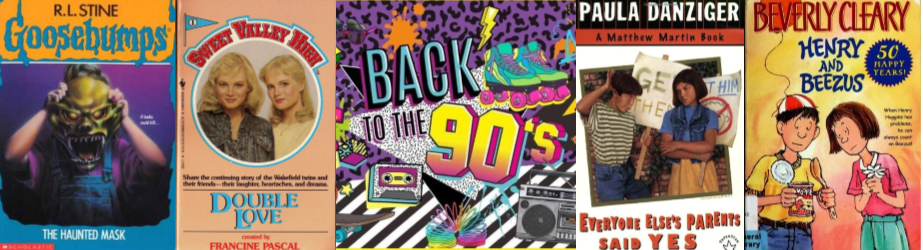
Welcome to a special week here at Reading Freely, in which I’m going to be revisiting some of the books I was reading as a youngun’, with a special emphasis on series that were written during the nineties themselves. Each day will feature a different series, from which I’ve reread some books in the last couple of months. If you didn’t have the good fortune to be a kid in the nineties, this week’s postings may be wack or even lame but for readers my age, or for those who were otherwise exposed to these series (or shared them with your own mini-me’s), hopefully this will be a fun ‘blast to the past’. So…stick a straw in your CapriSun, grab your Fruit by the Foot, take off your sticky candy ring, and settle in for some reading that’s all that and a bag of chips. Feel free to share your own fun kid reads, especially those that were da bomb dot com.

As posts roll out this well, they’ll be featured above. In the meantime, take a look at reviews / look-backs from a few other books I read as a wee bairn.

The Indian in the Cupboard
Where the Red Fern Grows
The Adventures of Tom Sawyer

The Little House on the Prairie
Redwall

Posted in General | Tagged , , | 7 Comments

We Have Capture

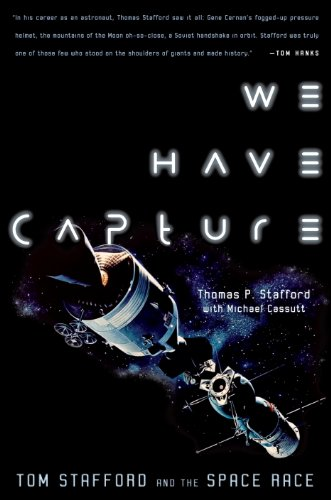
Tom Stafford is the last man of Gemini, having outlived all of his previous colleagues. Born in 1930 on the Oklahoma plains, he sought escape from poverty like many through the armed forces. Though too young for World War 2, he found his home in the newly-made Air Force, and served in Korea before his childhood love of the stars and love for flying the newest and most interesting vehicles prompted him to apply for NASA, where he became a member of the New Nine. (He was a man to hedge his bets, though: he’d applied for Harvard Business School and attended class for all of three days before Deke Slayton rang him up and asked if he was still interested in going to the Moon.) Stafford would fly in both Gemini and Apollo, and develop a name for himself as Mr. Rendezvous after being the first to rendezvous with an object in Earth orbit. Stafford does not dwell on this accomplishment in We Have Capture, but focuses more on his role in American-Soviet relations. Though the other astronauts occasionally met Russian cosmonauts at flight shows and the like, it wasn’t until the Apollo-Soyuz capstone mission that genuine relationships began to grow, eventually culminating in larger projects like the International Space Station. Stafford became close friends with Aleksei Leonov, Russia’s first space-walker, and was able to learn about the Soviet Union’s own mishaps and near misses (Leonov was very nearly killed attempting to return to his capsule), including deaths in their program. He also grew to appreciate the fact that the cosmonauts were ordinary and often likable men, doing their best in a harsh system. As a way of paying tribute to his friend across the ocean, Stafford devotes part of his biography to covering Leonov’s as well, though not to the same degree as Two Sides of the Moon. Stafford went on to greater responsibilities, including commanding his old stomping grounds of Edwards Air Base and Groom Lake, otherwise known as Dreamland or Area 51. (Says Stafford: there are no aliens at Groom Lake. There was, however, a small fleet of Russian planes, obtained through mysterious means.) We Have Capture is a very accessible and personable Apollo memoir, from a man who is solidly straightforward and likable.

That ends Space Camp for this year, though there may be a couple of space books later in the month: I ordered a memoir (Off the Planet) from an American astronaut who spent several months on Mir, and there’s still a lunar novel I’m thinking about trying.

Posted in history, Reviews | Tagged , , , | 4 Comments

Carrying the Fire

© 1979, 2009, 2017 Mike Collins, foreward by Charles Lindbergh (!!!!)

Yet a higher call was calling, and we vowed we’d reach it soon
So we gave ourselves a decade to put fire on the moon
And Apollo told the world, we can  do it if we try —
There was One Small Step, and a fire in the sky!

(“Fire in the Sky“)

When I began actively looking to read more astronaut memoirs a few years ago, I noticed that Mike Collins’ Carrying the Fire was consistently one of the best-reviewed books out there. “That’s odd,” I thought. “Wasn’t he just the guy who circled the block for few day waiting for Neil Armstrong and Buzz Aldrin to stop making history and get ready to come back home?” I decided to give it a try as part of a series of connected memoirs (reading about the same missions from three different astronauts), and — wow. I’ve read a few dozen astronaut memoirs and histories, and this ranks right up there with A Man on the Moon — dogging its footsteps like Buzz Aldrin dogged Neil Armstrong’s. Collins began his career in NASA (after two failed applications) with the Gemini program, and through various bits of happenstance, found himself on the Apollo 11 mission that would make history. Collins doesn’t bother with accounts of his early life, but instead beelines for the meat. What makes Carrying the Fire a standout memoir is Collins’ artful mix of humor, technical explanation, stirring description, and human interest stories. He’s by far the funniest astronaut I’ve read, and unlike many he had priorities other than glory in space — saying “No” to an offer that would have let him walk on the Moon in a later Apollo mission, because he felt he’d put his wife and kids through entirely enough hell already. I am not surprised this book has been re-issued numerous times: the version I read was the 50th anniversary edition.

Mike Collins struggled to make the astronaut grade, in part because he was delayed getting into the test pilot program, and in part because the competition was so fierce. When Collins was vying for a spot in the second astronaut pool (“The New Nine”), he immediately sized up Armstrong and declared that the Navy pilot would definitely fly. Like Elaine Collins a generation later, Collins had to thread a very delicate needle: racking up time flying jets to qualify for NASA, while growing closer and closer to the ever-shrinking age cutoff. Much of Carrying the Fire is what one would expect to find in an astronaut memoir: Collins explains how he came interested in flying, and then space; describes his struggles getting in, and then the training. Collins is a comic, though, and recounts his experiences being probed and prodded not with the serious earnestness of say, John Young, but like a guy at the bar telling a story to amuse his buddies. One of my favorite sections included his analysis of his fellow astronauts, those doomed to die like the Apollo 1 crew excepting. These are both funny and cutting: he describes Aldrin as a man so preoccupied with being mad about not being the first man to walk on the Moon that he forgets to be grateful for being the second. This is not a breezy, off-the-cuff memoir like Riding Rockets, though, because Collins is despite his many laughter-inducing comments, serious about what matters, like the spectre of death they all lived with and the unremitting hard work it took to make a mission a success. He attempts to explain to the reader the technical problems being encountered, and the wholly unprecedented, absolutely weird environments astronauts were working in. Imagine having to solve intellectual and physical problems in an environment that not a single part of humanity’s natural history ever prepared us for. Collins is extremely good at drawing the reader out of the chair and into the astronaut’s flight suit — both through his descriptions, whether they be of Edwards airbase or the sight of the Earth and its patina of an atmosphere, and through the details he provides. Collins often inserts tables and other text ‘illustrations’ directly into the body of the book, sometimes just to amuse the reader with the sheer arcane details NASA was interested in. Collins is simply a fun author, someone whose book I picked up with delight and anticipation every single time — and there’s no hint from him that he was disappointed to come so close to the Moon, and yet not touch its surface. Instead, he enjoyed the demands and challenges of Gemini/Apollo, and savored his experiences there — taking joy in what he had accomplished and seen, instead of moaning about what he had not.

The Apollo book to read is still Neil Chaikan’s A Man on the Moon, but as far as astronaut memoirs go? It’s Mike Collins by, and sorry Alan Shepard for borrowing your phrase, “miles and miles”.

Next up: Tom Stafford’s We Have Capture, and then a special theme week. Or, if I don’t finish in time, a special theme week with a random astronaut memoir in the middle.

Posted in history, Reviews | Tagged , , , , , | 1 Comment

The First Family Detail

© 2014 Ronald Kessler
282 pages

Dan Emmett, in chronicling his career as a member of the Secret Service, harrumphed at those associated with serving the executive branch who got gossipy. It was unprofessional and vulgar, said he. Perhaps, but when the executive is himself unprofessional and vulgar, and living off the public dole in the sums of millions per year (thinking of salary and the various perks of office), I say they’re fair game. The First Family Detail, based on interviews and memoirs of secret service agents past and present, mixes criticism of the Service’s decline along with some fairly gossipy and very entertaining revelations about the men, women, and children who have enjoyed (or tolerated, or despised ) Service protection. These include not only the president and his family, but vice presidents, presidential candidates, and (by their association with the president) various members of DC’s cabal. The ‘serious’ parts of this book address the decline of the Secret Service, due to its politicization (the service competes for funds with other agencies, so it often kowtows to the demands of executives for less protection so as not to make the grand poobah grumpy at them at money-dispensing time), the expansion of its mission to cover non-presidential events like winter Olympics, and a growing culture of corruption and carelessness. Part of this owes to the men themselves: Clinton was such a profligate skirt-chaser that one of his mistresses would arrive as soon as Hillary had left the executive campus, and that this particular mistress was never entered on the books. Biden, as vice president, wanted to maintain his average Joe status by reducing his motorcade, while at the same time making multiple trips back and forth between his private home and D.C. on the public dime, and with such unpredictability that the agency was forced to maintain extra agents and run the ones they had absolutely ragged. Long hours means little time for P.T. or weapons training.

The protectees themselves run the gamut from considerate and respectful (the Bushes, especially Laura, are apparently loved, as are the Obamas) to hostile and abusive (Hillary). Kids who have grown up in the White House change their attitudes over time: Chelsea originally referred to the agents as “pigs”, aping her parents, (this from The Residence, not Kessler) but became a model first daughter as she grew up. Jenna and Barbara Bush were teenage nightmares, frequently attempting to escape from protection and possibly inspiring the several “first daughter gone rogue” films of the 2000s, like Chasing Liberty and My Date with the President’s Daughter.* Some executives varied their behavior depending on if their wife was around: Ronald Reagan was just as personable off-screen and loved to chat with anyone he encountered, but was marshalled a bit by Nancy who regarded her husband as too open & trusting of others and wanted to protect both him and his time. Clinton, meanwhile, was often brusque and inconsiderate, but when by himself liked to smoke a cigar and hang out with the agents. A lot of the information was square in line with other things I’ve read: the absolute abhorrence that was Johnson, Hillary’s vile and dehumanizing abuse of staff, Kennedy and Clinton’s inability to not like act randy chimpanzees (agents would literally steer pretty woman away from areas Billy boy was being transported to), etc. There were surprises, though: Carter and Ford ,who I regard as genuinely good and unpretentious people, apparently had their bad sides: Ford was a bit of a miser, and Carter was far less a man of the people around staff, ignoring them. (Also: despite SNL taunting him as a klutz, Ford remained a nimble athlete in office, and sometimes taunted agents who couldn’t keep up with him on the slopes. Be nice, Jerry.) While presumably no one likes being constantly shadowed and told they can’t do this-or-that (especially when they’re el presidente), some protectees are openly hostile and contemptuous of staff and agents, like Hillary — who insisted staff disappear at her approach, again verified by The Residence. Judging from the agent interviews here, few would want to be around her. Another surprise was Johnson’s own randiness: I’m not surprised that he was a skirt-chaser, but more surprised any woman would consent to be groped by such a repugnant human being, who would consort with mistresses in the presidential suite of Air Force One while his wife sat outside. At least Jack and Bill were young, trim, and charming.

First Family Detail was a fun but gossipy read, something of a guilty-pleasure to go along with the more serious presidential reading of earlier weeks. Given how popular the Bushes are and how disliked the Clintons are in this book, it could very easily be perceived as partisan, but the positive coverage given Obama and the few shots fired at Gerald Ford ameliorate this to some degree. That said, the good nature of the Bushes (’41 and ’43) toward staff and agents, and the more arrogant attitude taken by the Clintons, has appeared in other books so I’m largely satisfied in thinking Kessler’s reportage is in he area of fair-minded.

Coming up: Mike Collins’ excellent Carrying the Fire, and over the weekend Tom Stafford’s We Have Capture. Hoping to finish that one before another theme week kicks off. This year’s space camp deliberately involved the memoirs of three men who worked together (albeit not at the same time — Collins and Young were together on Gemini 10, and Young and Stafford on Apollo 10) to see how accounts lined up or did not.

Some highlights:

Even in summer, Nixon insisted on a fire in the fireplace. One evening after he had left the presidency, Nixon forgot to open the flue damper. “The smoke backed up in the house, and two agents came running,” says a former agent who was on the Nixon detail. “Can you find him?” one of the agents asked the other. “No, I can’t find the son of a bitch,” the other agent said. From the bedroom, a voice piped up. “Son of a bitch is here trying to find a matching sock,” said Nixon.

After he was diagnosed with Alzheimer’s, Reagan remarked, “Well, there must be a positive side to this. Maybe I’ll get to meet new people every day,” former agent Sullivan says. “He tried to make light of it, which is classic Ronald Reagan,” Sullivan observes. “Even though there was bad news, he’d try to put you at ease.”

Biden’s seven-thousand-square-foot home in Greenville, the hometown of many Du Pont family descendants, sits on four acres on a lake. Like the vice president’s home, it has a pool. Biden also owns a small carriage house on his property, where his widowed mother, Jean, lived until she died in 2010. The Secret Service now rents it from Biden for $2,200 a month. [Emphasis added. How I loathe DC.]

When in public, Hillary smiles and acts graciously. As soon as the cameras are gone, her angry personality, nastiness, and imperiousness become evident. During the height of the Monica Lewinsky scandal, a Secret Service uniformed officer was standing post on the South Lawn when Hillary arrived by limo. “The first lady steps out of the limo, and another uniformed officer says to her, ‘Good morning, ma’am,’ ” a former uniformed officer recalls. “Her response to him was ‘F— off.’ I couldn’t believe I heard it.”

[*] Starring Eric from Boy Meets World! One I watched multiple times on VHS back in the day.

Posted in Politics and Civic Interest, Reviews | Tagged , , , , , , , | 3 Comments

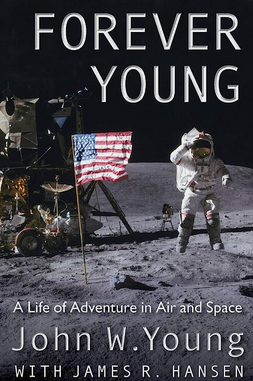
Forever Young


If ever the title “Mr. Astronaut” was given out, it would not go to John Glenn, despite his being the posterboy of Mercury; it wouldn’t even go to Neil Armstrong, who fifty-four years ago today became the first human to step foot onto another world; it would have to go John Young, who served in NASA for four decades. There, the poor but promising young son of a merchant would become an accomplished astronaut and administrator, developing close friendships with men like George H.W. Bush whose path he would have never otherwise crossed. Young began his career in the Gemini program, which saw the United States developing spacecraft rendezvous techniques and spacewalking, and would grow to maturity within it, commanding one of the last Apollo missions and then switching into a managerial role as head of the Astronaut Office. In that office, he oversaw the creation of the Shuttle Program, arguing for a fully-reusable approach but having to settle for the partially reusable system of disposable boosters and reusable space-planes. He piloted the first shuttle mission himself, and would bear the weight of responsibility as NASA attempted to find out what went wrong with Challenger. As an astronaut memoir, Forever Young is unmatched in its 40 year scope, and Young’s administrative position gives him an unusual top-down, analytical view on NASA’s history and technical issues. This makes for thorough but sometimes dry reading, except when he gets a little more fun with critiques of the Apollo 13 movie and the like. Unfortunately for Forever Young, I was reading this in tandem with Mike Collins’ Carrying the Fire, and Collins is such a ball to read that Forever Young (despite its substance) felt more like homework at times. Still, reading about the Gemini 10 mission from the view of both men made its already unprecedented task (reclaiming a payload Neil Armstrong was forced to abandon) even more interesting.

54 years ago today!

Posted in General, history, Reviews | Tagged , , , , , , | 3 Comments

LAS prompt: fun facts

Today’s prompt from Long and Short Reviews is an interesting fact the blogger knows. In keeping with this week’s Space Camp theme, I’m going to throw some astronaut trivia atcha!

And so, some astronaut fun facts from previous and current Space Camp reading:

  • Wally Schirra is the only one of the Mercury originals to participate in the Mecury, Gemini, and Apollo programs. He left Apollo after some tension between the Apollo 7 crew and Houston led to all three of the Apollo 7 crew never flying again.
  • Alan Shepard was the only one of the Mercury seven to walk on the moon. Despite being grounded before the Apollo program launched due to an inner-ear problem, an experimental surgery put him to rights again. Long the head of the Astronaut Office, Shepherd was able to participate in a lunar landing and (in his usual devil-may-care attitude) struck a golf ball from the surface of the Moon. He declared his first shot to be a slice. His fellow Mercury original, Deke Slayton, had also been grounded for medical reasons, but was able to participate in the Apollo-Soyuz mission with Russia.
  • John Young was the longest-serving member of the astronaut corps, beginning in the Gemini program, participating in a lunar landing, and being promoted to head of the astronaut office after Shepherd retired, where he oversaw the shuttle program and flew its first flight himself. He retired after 42 years.
  • The US Air Force was not content to leave space to a civilian ‘science’ program, and had begun their own, complete with eight chosen men. This program was eventually folded into NASA, and unfortunately only one of the ‘magnificent eight’ joined NASA properly. Had the others maintained their interest, their number would have included the first black astronaut, Robert H. Lawrence. Unfortunately, he was killed in a plane wreck in ’67. Three of NASA’s own had died in plane crashes: one because of a birdstrike and two because poor visibility led to the plane crashing into a building while attempting to land.
Posted in General | Tagged , | 10 Comments