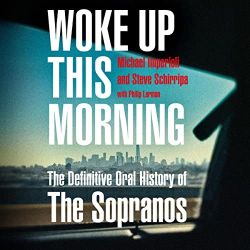
Woke Up This Morning

© 2021
approximately 14 hrs

Ho! Waitaminute. This is a review of a book about The Sopranoes called Woke Up This Morning. It would be wrong to begin it without “Woke Up this Morning”.

Alright, wiseguy, you watched the theme? Good. This thing of ours, it’s no good you go about exploring Sopranoes content without the proper mood-setting. So twenty years ago, David Chase creates a show that’s unlike anything else seen before. I won’t say “or since”, given that we’ve had a few other works of similarly brilliant television, most notably Vince Gilligan’s Breaking Bad — and Gilligan has acknowledged that without The Sopranoes breaking the ground it did, Walter White would have never existed. The Sopranoes was notable, chiefly, for featuring an anti-hero, a mob boss who opens the story by seeing out a psychiatrist to treat a recurring issue of panic attacks. James Gandolfini would deliver a masterful performance as Tony Soprano in the years to come, and he was joined by dozens of other very serious actors whose talents were brought to bear through solid storytelling and tight writing. That storytelling took The Sopranoes into new terrain, as no characters were truly safe from being knocked off — fitting, given the nature of their their work. The show would be notable for the complex emotional and moral ground it covered: Tony’s relationship with his mother, his divide between being a dad to Med and AJ, and being Mr. Mob Boss; his frequent need to choose between friendship and business. The storytelling was artful on multiple levels, like the use of subtle visuals — witness one dead character appearing in a mirror in a scene where the memory of his treachery and death were on the minds of the characters. They don’t see him, but it’s a visual way to express his continuing presence despite his character’s absence. The Sopranoes was the first show to really live up to HBO’s “Home Box Office” name, being filmed as and delivering the weight of a movie. We watched putzi before David Chase gave us the gift of his art.

Woke Up This Morning is an offshoot of a Sopranos podcast created by Michael Imperioli (Chrissie) and Steve Schirripa (Bobby), which like other TV podcasts covered each episode in turn. Woke Up doesn’t take that approach, though, instead beginning with a chapter on The Sopranoes‘ development, and then dealing with each season in turn, with intermediary chapters taking us into the writers’ room or spotlighting minor but memorable characters. The format is of an extended conversation between Michael and Steve, who are frequently joined by other members of The Sopranoes cast’ and glorified crew. The conversation largely sounds natural, but there are parts where it distinctly sounds like a reading, lacking the back-and-forth dynamism and reaction that marks real conversation. There are attempts at making it sound more authentic, with Imperioli and Schirripa getting off-topic, but frankly these were obvious, distracting, and often dumb — especially Imperioli trying to convince Bobb- er, Steve — that dolphins and squids (which are from outer space) are smarter than humans, and Schirripa getting indignant and protesting loudly that he is definitely smartah than a dolphin! This is only a little fly in the soup, though, nothing to go to the don about. Fittingly, given his character’s interest in the TV and film industry, Michael is the one who most frequently explains production concepts that come up in the conversation, like what it means to ‘beat’ a story out. Most everyone from the show makes an appearance here, and it was good to hear them — even if Jamie Lynn Sigler, who played teenage Meadow, just had to remind listeners that she’s now older than Edie Falco (who played her mother) was when the show began. Ooh, madone. The big exceptions are James Gandfolini and Frank Vincente, who have unfortunately died since the show’s airing.

If you’re a Sopranoes fan, there’s no question that Woke Up This Morning is worth your time. Granted, it’s available in a book form, but unless you’re deaf I can’t imagine not wanting to experience this in the intended format — listening to all these people in their rich accents talking with passion about something they and the audience still love. There’s quite a bit to learn here, or to be reminded of: a common theme is that James Gandfolini was a prince of a man, loved by all of his coworkers, even if they found his intensity hard to work with at times. Beyond his dedication to the acting craft, he was a compassionate mentor to the Sopranoes’ younger actors, offering them advice, moral support, and helping them grow to be the best actors they could be. He supported his other costars, as well: during a wage dispute where filming was suspended, Gandfolini personally paid his fellow actors’ salaries during that time. David Chase’s own intensity is also frequently mentioned: he took the stories he was telling very seriously, and The Sopranoes set was not a place for improv, though sometimes actors’ work at giving their characters emotional backstories would be incorporated into their canon background. Some of the actors contributed more to their characters than just giving them life: Tony Siricio was so much like his character, Paulie Walnuts, that when a set was needed for Paulie’s apartment, the production crew visited his own pad and recreated it. The cast of The Sopranoes formed intense emotional bonds with one another, and their delight in being partially reunited here definitely comes across. There’s still a lot to learn about the show, and I loved taking that ride to Jersey with Tony again through this production.

Related:
Difficult Men: Behind the Scenes of a Creative Revolution, Brett Martin. On The Sopranoes and the road to Breaking Bad.

Posted in history, Reviews | Tagged , , , | Leave a comment

Warcross

© 2017 Marie Lu
368 pages

Emika Chen is a young woman, desperately in debt because a past criminal record makes it impossible for her to obtain the kinds of work that she’s developed skills for. What’s she’s good at coding and hacking, and these days that doesn’t just mean sitting in front of a computer wearing a hoody with a PowerShell window open and hitting random keys rapidly while intense Hacking Music plays. She lives a little deeper into the 21st century than we do, and augmented reality is ubiquitous, using glasses that established a direct neural connection with the user: some mega-cities like Tokyo have rebuilt themselves to take advantage of it. A driving force of the economy and culture is a game known as Warcross, which seems a bit like Capture the Flag, but with dynamic environments that can be modified and weaponized by the players. Chen gets by by hunting down people who make illegal bets on the money, and her pen skills have grown to the point that she accidentally thrusts herself into the national spotlight and glitches into a mass-televised game of Warcraft, shutting down the opening ceremonies and driving her into bed in terror that she’s just give herself a life sentence. Instead, she gets a job offer — from the young tech genius turned corporate mogul she’s idolized most of her young life.

I was immediately drawn to this book because of the apparent similarities between it and Ready Player One, with a near-future setting dominated by augmented reality, and driven by a massive culture fixation on a single game. The game itself is interesting, but I don’t quite get why it would become the bedrock of economies and culture the way The Oasis did: The Oasis’ universal appeal lay in its infinite possibilities, whereas Warcross is just a team v team competition. It sounds cool to watch, but to live in? Still, the plot sucked me in pretty quickly. Take a kid who is in problems not largely of her own making (her dad died early, a debtor) who suddenly goes from not being able to pay rent for her glorified closet in New York, to suddenly being invited to Tokyo, where she’s standing cheek by jowl with billionaires and celebrities. Without going into a spoiler territory, the creator of Warcross and the technology sees in Chen an unparalleled talent whose ability to manipulate his game makes her a talent worth snagging. He has a job for her: someone else is trying to hack the annual Warcross Tournament, and he wants answers. This will take Chen into the Dark World, augmented reality’s answer to the Dark Web, and expose her to dangers both real and digital — and it is where she will realize that there’s a deeper layer to the world of Warcross and the neurolinks made than even she realizes.

I didn’t realize going in that this is meant to be a YA book, so there are some bits of shallowness — one relationship emerges rather quickly, and as mentioned I don’t quite buy Warcross as the neurolink’s killer app. Still, I was completely taken in by Chen’s story, and when I reached the end, wholly on the hook, I was dismayed to realize this is part of a duology, because I wanted resolution and the second book isn’t available at my library. There’s an interesting twist at the end, one that seems inexplicable at the moment but which should make for an interesting story further in. While most of the book comes off as a kind of lit-rpg adventure, when Chen begins encountering serious questions about the neurolinks, it grows to the level of genuine SF. I would not be surprised to see this one made a movie — it’s far more adaptable to cinema than RPO was.

Posted in Reviews, science fiction | Tagged , , , , | 10 Comments

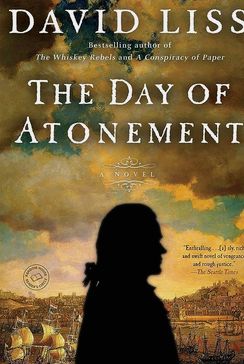
Day of Atonement

© 2015
365 pages

Over a decade ago, young Sebastião Fox was spirited away from Portugal, a freshly-minted orphan. His parents destroyed by the Inquisition, Sebastião came into the care of the now-aged Benjamin Weaver, London’s most accomplished thieftaker. After coming of age and absorbing Weaver’s skills, “Sebastian Fox” purposes to return to Portugal, find the inquisitorial priest who destroyed his father, and return the favor. He finds Lisbon as treacherous as ever, with a maze of personal and social snares to navigate around. Day of Atonement is essentially a Benjamin Weaver novel, with all the danger, mystery, and fascinating historical richness that entails, but with Weaver being literarily reincarnated.

I’ve been reading Liss for over twelve years now, and I don’t anticipate stopping anytime soon. Day of Atonement, like his previous Weaver novels, takes the reader into a setting un-explored by other historical fiction authors, tells the story with an authorial voice that conveys a little bit of that era’s distance from our own, and builds a complex mystery with memorable characters and intense emotional drama. Deep betrayals are part and parcel of a Weaver tale. When Fox returns to Portugal, he is a changed man from the relatively innocent child who was smuggled away, a man who knows and practices violence and regards himself as almost bestial for his rage and past actions — actions the reader does not directly witness His parents and he were “New Christians”, Jews forcefully converted to Catholicism years before but still legally and socially regarded as separate, second-class citizens — not allowed to marry “Old Christians”, for instance, and constantly held under suspicion. Sebastian’s father had dealings that were intended to let their entire family escape, along with Sebastian’s young love Gabriella and her father, but instead the inquisitorial reapers swept down and only Sebastian managed to escape alive — or so he thought. There’s a surprise or two in store, and not necessarily happy ones. Although Sebastian’s goal of finding and isolating the priest responsible for his parents’ death involves a fair bit of delicate maneuvering, Sebastian’s journey in Lisbon becomes increasingly more dangerous after he meets the man who rescued him — a man who himself needs rescuing, but for whom rescue involves generating alliances and funds among New Christians and Old Christian investors — and learns the identity of the man who betrayed his father to the inquisitors. Others spot him as a man of intelligence, talent, and drive, and try working him into their own conflicting schemes for gold and glory.

The Day of Atonement is as fascinating and absorbing as any Weaver tale, though the setting is darker and more inhumane than say, 18th century London, given the hateful social structure arrayed against Porutgal’s Jewry. Unfortunately, I think I’ve plumbed the last of Liss’s historical fiction proper, though he does have another one with fantasy elements.

Note: I had planned to release this review as part of a series on Jewish literature, along with Chaim Potok’s My Name is Asher Lev and Geraldine Brooks’ The Secret Chord, but Chord has wandered off somewhere. Asher Lev will post this weekend.

Posted in historical fiction, Reviews | Tagged , , , , | 2 Comments

Top Ten Stories from Totally Random Pairings

Today’s Top Ten Tuesday is about characters in different books who should team up, which is …difficult for me given that fiction is less than a third of my reading. So, what I decided to do was give Bing a list of 20 characters and ask it to sort them into ten random pairs, and then I shall try to think of a story that would bring those characters together. This should be interesting, spanning so many potential settings and times. Character’s names will link to books they appeared in when applicable. But foist, the ol’ Tuesday Tease:

And then, with the space shuttle turned upside down, and with two large windows making up most of the cockpit’s ceiling, he floated into what felt like a bubble of Heaven. There, filling his eyes with a warm, soft light, was a panoramic view of earth, of white clouds and blue ocean, half of it bright with sun and half of it dark with night.

Out of Orbit

And now, randomness!

Richard Sharpe & Katniss Everdeen
Richard Sharpe is wearing the rifleman’s green, and sent with a unit to investigate a small band of terrorists causing problems. In due time Sharpe is ambushed by the freedom-fighter Katniss, but they have a mutual enemy in one of Sharpe’s superior officers, Simmerson. Recognizing one another as kindred spirits despite being on opposing side, Sharpe and Katniss find a solution that serves both: in a dastardly attack by Katniss and her allies, the Royal Army loses its beloved Colonel Simmerson and his lackies — I mean, aides de camp — but the ‘vigorous defense’ from Sharpe drives Katniss and the other terrorists out of the district, off to plague some other officer.

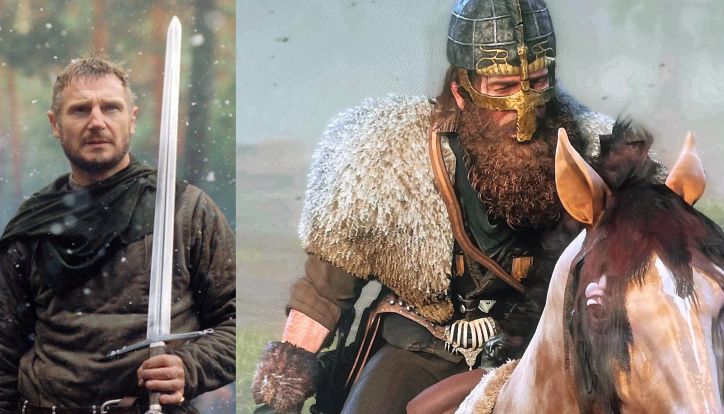
My mental Uhtred is always Liam Neeson, but with more hair and a better beard. And yes, a Viking helmet and axe are part of RDR2’s many secrets.

Uhtred of Bebbanburg and Arthur Morgan
Uhtred of Bebbanburg is on the verge of recapturing his family estate, Bebbanburg, when one of his many friends/allies/people-he-needs-to-make-happy requests his urgent assistance. Uhtred quickly realizes that one way to complete this latest distraction from his eternal quest is to enlist the help of a local outlaw, the blackguard Arthur Morgan. This is a tricky move, for Uhtred knows working with the notorious thief will make King Alfred’s council hate him all the more — and when, quest solved, the king sends an emissary to compel Uhtred to betray Arthur to royal justice, Uhtred instead allows Arthur to escape and once again bids goodbye to the chance for Alfred’s support in retaking his own home. Uhtred is, if nothing else, a man of honor.

Marcus Yallow and Ellie Arroway. Dr. Ellie Arroway has discovered definitive proof of extraterrestial life, but has seen her research squelched by the oppressive government — until it’s unwittingly exposed by social activist/hacker Marcus Yallow, trying to destroy the government’s ability to hoover up everyone’s data. When the truth starts coming to light, Ellie abandons her reserve to convince the public that First Contact has been made, and that the government should devote its resources to exploring the possibility of exploring space instead of building a creepy techno-dystopia.

James Crowley and Idgie Threadgoode. Crowley, Black Badge, dedicated destroyer of supernatural terrors like werewolves and vampires, is seeking the devil in Dixie. Or at least, one of of the devil’s minions, Frank Bennett — who can seduce with his charming words and then turn on those around him. Though alone save for his faithful horse, Timp, Crowley finds an unexpected ally in Idgie Threadgoode, a woman with the mysterious ability to charm bees — and who is already on Frank Bennett’s bad side for urging his wife Ruth to flee the abusive relationship. Together, James, Idgie, and Ruth will drive Bennett back to the abyss from which he came.

Ove and Hermione
When Deatheaters begin taking over a small English town, Swedish expat Ove is first to notice. Faithfully making his morning rounds to ensure all is in order — no recycables in the trash bin, no cars parked on the street — Ove can’t help but notice there are strange people in robes graffiting the streets with arcane symbols. He can’t kill himself while there are such sorts as THESE around in the neighborhood. Fortunately, an intelligent and helpful young woman has just showed up. Together the young witch and the curmudgeonly widower will destroy the Deatheaters’ latest scheme.

Yes, that guy from the original Twelve Angry Men has always been my mental image for Trumbull.

Thomas Trumbull and Dagny Taggert. Thomas Trumbull has deep connections to the US government, particularly its departments of intelligence and defense. DC’s latest plans keep being forcefully opposed by a railroad woman, Dagny Taggert, and thinking she’s the reasonable sort Trumbull invites her to dinner with him and the Black Widowers in New York. Scotch and soda followed by a dinner will lead to good conversation and convince Dagny of the error of her ways, surely. Dagny, knowing the Black Widowers’ penchant for mysteries, proposes one to the club — and as they winnow it out, Trumbull realizes to his horror that Dagny is using it to convince him that DC’s policies are not only misguided, but absolutely evil. Ending the night thoroughly shaken, Trumbull will never sleep peacefully again until he answers the question…Who Is John Galt?

Not T’Prynn, just a random Vulcan from DS9 who isn’t recognizable like T’Pol

Bertie Wooster and T’Pyrnn. When Vulcan spymaster T’Pyrnn’s best agent, Jeeves, is kidnapped, she is forced to put up with his ‘boss’, Bertie Wooster, the man he serves while maintaining his butler undercover identity. Though at first Bertie’s silliness and schemes distract and hamper T’Pyrnn from her serious work of keeping tabs on the Klingons and Tholians, she suddenly realizes that Bertie can be weaponized. Sending him to the Klingons as an ambassador, Bertie soon has the Klingons so mystified and confused that T’Prynn is able to steal a march and inflict great sabotage on the Empire’s dreams of expansion.

Mark Watney and Susan Calvin. Mark Watney is dispatched to Mars to investigate an issue with US Robotics’ operation on the red planet, but things go disasterously wrong and soon Earth is willing to abandon Mars to the mutinous robots, hit it with an EMP, and write Mark off for dead. Susan Calvin becomes his only defender — not because she cares about Mark, but because she recognizes his innovative talents and sheer stubborness are the only hope she has of saving US Robotics.

Ro Laren and Benjamin Weaver. Captain Ro Laren, Commander of Deep Space Nine, inexplicably wakes up to find herself in 17th century England. A fish out of water, she stumbles into trouble almost immediately, but attracts the attention of the mysterious thieftaker/private detective/bounty hunter Benjamin Weaver, who realizes she is not guilty of the crimes she’s accused of, but is nevertheless definitely lying about who she is. Taking a chance, Ro Laren tells Weaver that she’s from the future, and together they work to discover who is truly guilty of the crime she’s been sentenced to death for, and expose them to the public. Then all disappears, and Laren discovers that her chief medical officer had decided she was overworking herself, and had her transported to the holosuites during her sleep with an active program running.

Risika and T’Ressa Chen. Risika is a creature of the night, a vampire who was turned against her will centuries ago. She has fought against the worst tendencies of her kind and roamed the Earth far and wide. One night deep into the 24th century, she witnesses a young Starfleet officer attacked by her old arch-enemy, Aubrey, the evil vampire who destroyed her family and forcefully vampirized her. Intervening at great cost to herself, Risika is then nursed back to health by the very officer whose life she saved, T’Ressa Chen, and together they try to find and finally destroy the ancient adversary.

Posted in General | Tagged , | 19 Comments

PSA: This exists

And it’s awesome. AI version of Roger Clark’s American accent (he’s Australian, mate) as Arthur Morgan singing Lynyrd Skynyrd’s “Freebird”. Manalive. We’re in this interesting window where this stuff is possible and where the copyright law hasn’t caught up yet.

This is definitely going into my “Angry Cowboys” folder of RDR2 and RDR2-related music

More seriously, here is AI-Roger Clark/Arthur Morgan and AI-Rob Weithoff/John Martson singing “Dead Man’s Gun”. THIS IS WAY MORE INTERESTING because of the way Arthur, John, and Jack’s stories merge together. The song plays when Jack is going to avenge his father John’s death at the hands of Agent Milton, who was largely aware of John because he avenged Arthur’s death by killing Micah Bell, so expertly and evilly played by Peter Blomquist. Oh, spoilers. For…..13+ and 5+ year old games respectively.

“Your hand’s upon
A deadman’s gun, and you’re
Lookin’ down the sights
“Your heart is worn
And the seams are torn, and they’ve
Given you a reason to fight
“And you’re not gonna take
What they’ve got to give
And you’re not gonna let ’em take your will to live
Because they’ve taken enough
And you’ve given them all you can give
And luck won’t save them tonight
They’ve given you a reason to fight
“And all the storms you’ve been chasin’
About to rain down tonight
And all that pain you’ve been facin’
About to come into the light
Posted in General | Tagged , | Leave a comment

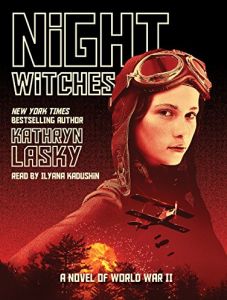
Night Witches

© 2017
205 pages

The German army has invaded deep into Mother Russia, and Stalingrad itself is a battlefield. Young Valentina desperately wants to use her flying skills to defend her city, joining her sister Tatiana in the skies, but her mother forbids her. She is young, much too young to fight — but this is a time of horrors, when children murder children on the altar of the state. When her mother falls to a sniper’s bullet, Valentina makes her way through the ruined city to find her sister and join in the fray. Night Witches is a captivating coming of age story in which a young orphan defies doubts about her age and skills to demonstrate not only her technical skill, but her determination — to find her sister, to defy evil, and to prove what she is capable of.

Although I was slightly aware of the role of that female pilots played in Russia’s resistance to Germany in World War 2, I had no idea how young they could be. The characters here are almost all teenagers, their mentors and captains just having breached the age of 20. This may be intended to be a YA novel, though the themes are not juvenile. Death and terror are frequent, from Valentina creeping through a sniper-filled city, to her realization that the old woman who nursed her back to health after her plane crashed is associated with a Ukrainian militia with Nazi sympathies — and that if the commissars ever learn this, Valentina will be tainted by association as a collaborator despite the dozens of Nazis she’s personally dispatched. Valentina lives up to her name, with its ancient meaning of bravery and strength: she ascends into the inky black to bomb Nazis night after night, but is also willing to stand up to Stalin’s goonie boys in the NKVD. The novel takes its name from the all-female squadrons of light bombers who took advantage of their planes’ build to fly lower than German aircraft could, capable silently descending on German bases like an owl on prey — dropping bombs instead of snatching mice. They were quite effective at destroying supplies, infrastructure, and German morale without the high costs of daytime raids.

Night Witches is a short but wholly absorbing novel about a young woman coming of age in an unenviable time, surrounded by death but doggedly fighting for those whom she loved. I found it in the library bookstore some years ago and am sorry I’m only now getting around to it.

Related:
Marian’s review of The Unwomanly Face of War, an oral history of Soviet female combatants, often young
Fly Girls, Keith O’Brien. On female air pioneers in the US.
Stalingrad: The Fateful Siege, Anthony Beevor

Posted in historical fiction, Reviews | Tagged , , , , , | 4 Comments

Of bones and marooned astronauts

© 2007
320 pages

Out of Orbit proved, despite the small scope of its subject, to be a most interesting and wide-ranging little history. When Columbia disintegrated in the skies above Texas and Louisiana in February 2003, it not only took with it seven lives, but left three men aboard the International Space Station in a heck of a fix. With the shuttle fleet grounded, how were they going to get home? …well, Soyuz. There’s literally a Soyuz parked to the station. This isn’t rocket science, guys. Er — this isn’t brain surgery, guys. Of course, it’s not quite that simple, and the book isn’t that short. It’s actually an ideal book for someone who has little to no knowledge or active interest in the space program, but who finds the thought of three men marooned in orbit sufficiently interesting to start reading — and then get the bug. Rather like Jim Lovell did with Lost Moon, Chris Jones works in partial looks back at the space program from both sides of the Iron Curtain to take us to the creation of the International Space Station, and the hopes of establishing a continuing human presence aboard it. This means not only visiting Apollo, but Skylab and Mir, as well. The result is a little history that begins with human interest hook, and then gets ya all excited and admiring about space exploration, using absorbing, descriptive writing that often puts the reader into the visor and boots of an astronaut facing a crisis far more quickly than the men and women themselves could. It’s good that Jones is able to do this, because the mission itself wasn’t terribly prolonged: another two months were tacked on, but considering that Expedition 6 had planned for a multi-month stay anyway, it’s not exactly the Shackleton expedition. More groceries from the Russians, a little belt-tightening, and bob’s your uncle. The main hitch is that the parked Soyuz available had never made a descent before, and that even if another crew were delivered to relieve Expedition 6, Russia’s Progress capsules weren’t enough to keep a crew supplied: shuttles might have been dismissed as trucks, but like their eighteen-wheeled counterparts on the ground, it was the shuttles that delivered the goods.

A coupla quotes:

Now, should something go wrong—a snapped tether, a hand or a foot restraint breaking free of the hull, the hatch door locking shut—there were only so many outcomes. Now, in all of that wide-open space, your range of possibility was terrifyingly narrow. It would begin, like all knowing deaths, with panic. Probably not a screaming, thrashing panic, because your years of training wouldn’t let you accelerate the process like that—and because you wouldn’t want the voices on the radio to sense the tremors in yours—but there would be panic nonetheless. Your heart rate would rise. Your breathing, as much as you tried to keep it slow and even, would pick up, become shallower. Despite the cold water still running through your long underwear, sweat would start coming out of your forehead, but without gravity it wouldn’t fall. If any drops were somehow shaken loose, they would float around inside your helmet, like the flakes inside a snow globe, until they had gathered enough steam to splash into your visor or bounce back into your face. That’s when you would taste the salt, when you would lick your lips and begin whispering to yourself, looking for angles, for oversights, hanging on to the last living moments of your reason, trying to find a way home.

In addition to its square footage, their home also boasted a gas fireplace, which, because it’s usually plenty hot in Houston, had found a place in the memory banks of each of the families who had seen it. It seemed to most of them like a loopy extravagance. It also had fake logs stuffed into it, which Don couldn’t abide: if he was going to watch something burn, he might as well watch something interesting burn. And so he set about replacing the logs with a diorama of a miniature village, complete with scorched rooftops and panicked residents jumping out of their windows. Whenever he flicked on the gas, the town would appear to go up in smoke—and so, too, did another wisp of his reputation each time a joyless visitor asked to see his latest creation.

© 2019
288 pages

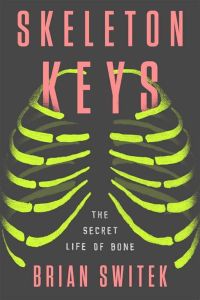
Next up is Brian Switek’s Skeleton Keys: The Secret Life of Bone. I’d originally intended for this to be an October science read (…last year…), along with Nine Pints, but it lingered like its subject, entombed within the murky depths of Mount Doom. Switek is a science blogger and paleontology buff who is usually interested in fossils and dino bones, but here turns his attention to humans. The book begins with a look at bones’ first appearance in the fossil record (chiefly, what would become the spinal column and jaws) before moving onto more underappreciated aspects of them, like their partial plasticity: our bodies can create bones where bones don’t need to be, like from our larynx tissue, and many human cultures have deformed their skeletons, particularly skulls. Although science content is definitely present in Skeleton Keys, Switek leans hard into cultural matters — which, unfortunately, drives the book into politics several times, the most obnoxious of which is when Switek spends several pages trying to insert gender identity ideology into archaeology, and then always tacking on “osteological” to every instance of male & female to attempt to snow the reader into thinking that the current wave of mental problems and hormone chaos (largely limited to middle-class whites) has been part of natural human history alllllllllllllllllllllllllllllllll along. Paging postmodern fauxosophy, your balderdash is leaking into the hard sciences. Switek is remarkably blind to this considering how often archaeology and related sciences’ misappropriation by other political motives (racism, for instance) comes up in the book. Enjoyable enough, but disappointing. The main thing I took away from it is that Richard III had an impressively brutal death.

Posted in Reviews | Tagged , , , , | 2 Comments

Wednesday blogging prompt: strange dreams

Today’s prompt is about a strange dream we’ve had recently. As I write this a week before the actual prompt, I’ve just woken up at three am after a series of odd ones that ran into each other as they do. The first involved attending a neighborhood lecture from Dr. Michael Sugrue, who I encountered over a decade ago. He had an excellent lecture on Marcus Aurelius’ Meditations, so good that I downloaded the audio to listen to on walks and such. I later found more of his work on western philosophy in general, and wish the demands of life didn’t prevent me from diving into his body of lectures in full. I haven’t listened to him recently, but my brain decided “Hey, let’s pretend we’re listening to him give a lecture on rhetoric and communication in that house down the street, and then you’ll play taxi driver to him and a couple of other students on a run for food and musings on nature, particularly flowers.” This shifted into me discovering that there was a sale on Wendell Berry books on Amazon, including one where he recollects his adventures putting various things (stones, cheese cubes, etc) on his neck, and ended up with an imaginary scene from The Sopranoes in which Tony, wearing a grey shirt with a white “W” on it, explains to Dr. Melfi that W stood for Winston, i.e. Winston Churchill, and that he admired Churchill as a leader.

So…yeah. This is Dr. Michael Sugrue if you’d like to listen to his voice, and then listen to the entire lecture because it’s so good.

Posted in General | Tagged | 7 Comments

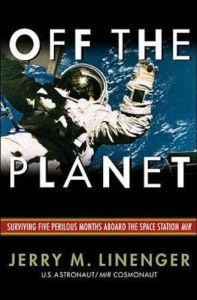
Surviving Five Perilous Months Aboard Mir

© 2000
256 pages

When Jerry Linenger first boarded the Space Station Mir for a five-month stint working with Russia’s finest, the master alarm was blaring. It was a sign of things to come. The aging space station had been continually modified and jury-rigged since its launch and looked nothing like the schematics Linenger was compelled to study in Star City, Russia, and was so unstable that constant user intervention was required to keep it in orbit. Linenger was so used to hearing the master alarm after only a month on board, that when a massive fire that burned so hot Mir itself was melting broke out, he wasn’t disturbed until he saw an entire passageway covered in dark smoke. Off the Planet is one extremely qualified American astronaut’s account of his and several cosmonaut’s months of living in one long emergency. The author is an uber-overachiever — a flight surgeon who trains with Navy SEALS and then becomes an astronaut – -but he’s likable for all that, and writes at a unique time, before the International Space Station became a joint project but when NASA was actively attempting to prepare for sustained cooperation with its former rival.

The mid-late nineties when Linenger was active was an interesting time in NASA’s history: the Shuttle program had recovered from the shock of Challenger and was once again becoming routine, though its work on the International Space Station had not yet begun: the first module would not be launched until 1998, by Russia. Such an undertaking required extensive preparation, and the United States had far less experience in space station operations than Russia: NASA’s two Skylab experiments had been smaller operations, created by using the hull of a Saturn tank. As Linenger quickly learned, living for months aboard a space station required an entirely different temperament than working in active spacecraft like shuttles. Linenger and other astronauts who took turns on Mir (working along with two cosmonauts) were given a crash course in both Russian and the technical specs of Soyuz, Progress, and Mir – – though in the latter case, Linenger found that the station had changed so much that the preparation was useless. Mir in 1997 was…a mess. A literal mess, filled with floating wires, cables, and used containers, despite continuing efforts to evacuate out trash. The onboard systems frequently failed, so inter-station communication was patchy and station-to-ground comms were even worse — and the crew often had to work every day wearing masks to prevent breathing in fumes and metallic particles. Worse yet, Russian ground control was extremely prone to micromanagement, and would often send up new orders on the fly. Linenger and his Russian colleagues were astounded to see the Progress craft that was meant to be burning up in the atmosphere (with their trash) returning to Mir: ground control had decided to test a new docking method without warning, Nevermind that Mir‘s cameras weren’t functioning and that they had no ability to guide the docking, not being able to see a thing. The Progress craft only narrowly missed Mir, and at the speed it was traveling it would have certainly killed the men aboard. Astonishingly, NASA was never informed of any of this, only told that the docking was ‘cancelled’. (Russia also downplayed the massive fire that could have destroyed the station earlier, one that resulted from the O2 containers the men were forced to rely on because of constantly failing environmental systems.) Months later, the experiment was re-attempted and the Progress M-34 did collide with Mir, plowing into the Spektr module and damaging it, a solar panel, and destabilizing Mir as a whole.

When Lineger returned to Earth, he reported being glad he had taken on the challenge, but didn’t enjoy it in the least. Living aboard Mir was five months of continual crisis management and never-ending work: he was even the subject of sleep experiments so that one way or another, he was delivering data 24/7. Off the Planet was enormously educational for me, knowing little about Mir: I was distantly aware of the Shuttle-Mir project, but didn’t know that NASA partially funded Mir modules to keep the Russian space program afloat in orbit. As dangerous and frustrating as Linenger and the other crew’s (American and Russian) jobs were here, I’m glad they stuck it out: learning how to work with one another’s equipment (and manage one another’s bureaucrats) was a necessary part of getting the International Space Station off the ground. If you’re a space fiend, Off the Planet marks itself as a book to find, not only for being a rare look at the Shuttle-Mir project, but also given the author’s unique perspective as a flight surgeon who was distinctly aware of the effects prolonged zero-G was having on his body.

Posted in Reviews | Tagged , , , | Leave a comment

Top Ten Tuesday: Barry and Joey solve a mystery

Today’s Top Ten Tuesday comes from Hope Never Dies, in which Barack Obama and Joe Biden get together to solve a mystery involving a dead Amtrak conductor. Yes, really. It’s goofy but entertaining.

“One call,” I said to my faithful companion, Champ. “Is that too much to ask?” The dog glanced up with indifference. He’d heard it all before. “Just one phone call,” I said. With a snap of the wrist, I sent the dart sailing across the room. It hit its mark, right between Bradley Cooper’s piercing blue eyes. “Eight years.” I plucked the darts from the shredded magazine cover taped to the board. “And not even a gosh-darned postcard.”

Posted in General | Tagged , | Leave a comment