When both sides in a civil war count you as enemy, it’s time to move on.
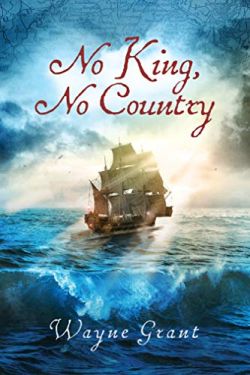
Will Inness fought for Parliament and Cromwell, but now he’s a wanted man. His crime was speaking up for his men, who were owed back pay, and pleading that they be given some land in the country for which they had fought. Cromwell’s diktat is that he arrested and executed as a mutineer, but fortunately a man whose life Will saved during the war has given him a heads up and allowed him an opportunity to escape. So, — to America, where there are a few isolated settlements in Mary Land and Jamestown, where the long arm of the law strains to reach and where the wilderness offers room to vanish. Wayne Grant offers a unique story set in an area of Anglo-American history that is largely ignored by most writers, and pulls it off to good effect.
I checked this out on Kindle Unlimited over a year ago thinking it was a story of the English Civil War: That’s not altogether wrong, but it’s not exactly accurate, either. No King is indeed set during the struggle between Cavaliers and Roundheads, between supporters of the King versus those of Parliament, but after a battle and chase in the early part of the book, we’re looking more at an early colonial thriller with the War as its backdrop. We begin on land, with war and then a manhunt, then move to the high seas where a ship dodges hurricanes and privateers as it ferries passengers to the New World while engaging in a bit of triangle trade at the same time. Will is accompanied by one of his forer men, August Dawes, as well as an African named Jubo who makes his home with the Cherokee nation. Robert Harris used this early-colonial setting for his Acts of Oblivion, which was related but different: there, an agent of the restored monarchy hunted two men who were responsible for the murder of Charles I. Here, two men who both the Royalists and Parliamentarians want to kill are the game, hunted through the dark woods of America. Both the vast strangeness of the landscape, and the presence of hostile tribes like the Seneca, add to the suspense.
No King, No Country was a surprise, but a welcome one. I’m going to try its sequel, The Long Rifles, for cert.
Highlights:
“Ideas have weight, Will. Had Charles not believed in the divine right of kings, he might still sit on the throne today. You and the others on this list harbor an idea that frightens Cromwell and Fairfax and the leaders of Parliament. Men have been put to death for much less.”
“This isn’t your trouble, Gus.” “The hell it isn’t. You always made my trouble your trouble, Will. Ever since we were boys. Do you think I’d not do the same?”
“Breeding is for cattle, not men, Harry. I learned long ago that what separates a commoner from a gentlemen is not blood. It’s money.” For a moment Grey bristled, but then he shook his head and gave Will a rueful smile. “I dare say you may have something there. A gentlemen’s blood looks much the same as a foot soldier’s when they’re both lying dead on the battlefield.”
“Chickahominy?” “It’s another stream that feeds into the James a few miles upriver from Jamestown. It’s a Powhatan name. Lots of them in Virginia. Names that is. Not so many Powhatans anymore.”
Come cheer up, my lads! ’tis to glory we steer, To add something more to this wonderful year; To honour we call you, as free men, not slaves, For who are so free as the sons of the waves?
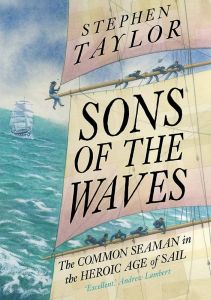
Heave your ship to, boys, deep soundings to take! Sons of the Waves is a celebration not of the gilded brass, not of a handsome oak-forest-falling ships, but of the ordinary — and able — British seaman in the Age of Sail. We visit here the 18th century, when Britain fully established itself as a naval, then world power — sending out ships to conduct science on the high seas, steadily knit the continents together with globalized trade, frustrate the designs of Napoleon, and turn Australia into the world’s largest penal colony. Taylor draws on memoirs, letters, and ship’s logs to deliver a sense of the challenges, deprivations, and pleasures these men experienced, and pays special attention to the conditions which prompted large mutinies like those at Spithead and Nore. Thoroughly readable, it offers a fulsome look at another area of the Age of Sail.
The range of Sons of the Waves is substantial enough to cover most of the 18th and early 19th century, so we encounter Jack Tars amid three wars — or two and a half, depending on closely a reader differentiates the War of 1812 from its mother conflict, the Napoleonic wars. This same range also covers the time when British ships and their mates were complicit in the slave trade to when they became the agents of its eradication. The book begins with the Royal Navy’s rapid expansion in the 18th century as England entered more onto the global stage, covering the conditions of life aboard ship. Some viewed the Navy as worse than prison, for it offered all the limits of prison but with the added risks of sinking and natural catastrophe. Many sailors were forcefully conscripted, or ‘impressed’, by roving gangs who collected men off the street and forced them into service, and they were subject to what one 24th century observer referred to as ‘bad food, brutal discipline, and no women’. Wartime meant the Navy’s needs were especially desperate, and as much as half of the sailing force was conscripted labor — on one boat, Taylor observed, the overwhelming majority of the crew had been impressed, which makes one wondered why they didn’t simply take over the boat. Marines, presumably, but there’s also the matter of men bonding with each other, their ships, and their missions: one ship that had been on the verge of mutiny nevertheless threw itself bodily into Trafalgar. Although Taylor isn’t offering a military history here, Trafalgar was so significant that it receives its own section.
Life at sea, despite its deprivations and the whip, also offered young men adventure and freedom from social mores, especially in far-flung locales like Tahiti. Pleasures to be found there were mixed with the gall of not being paid, the latter especially rough on men who had been taken by press gangs and left their wives and families in the lurch. Until reforms were made, these women were left to support themselves, which tended to get them in trouble given that the easiest options were theft and prostitution. One poor man had completed his voyage and was within a day or two of receiving payment when — thinking the press gangs had met their quota — ventured onto open streets and found himself aboard again. The appallingly low wages and the extreme delays in receiving them fueled discontent that made itsself visible in mutinies. I was inordinately pleased to encounter MY NAME IS CAPTAIN SIR EDWARD PELLEW here, and astonished to learn that he’d risen from the ranks and remained close to them long after he’d been made an officer, working in the masts along with his men. I also enjoyed the occasional American interludes, and was amused to learn that the number of British sailors who deserted to pursue opportunities in America was roughly about the same as the most conservative reckonings of how many Americans were seized on the high seas and inducted into the Royal Navy, a practice that led to war against the States and the mother country yet again.
Sons of the Waves was terrific reading: I’ll definitely take on the Pellew biography now, and I especially appreciate that one of Taylor’s chapters consisted of him analyzing his one of his key sources, extant soldiers memoirs that include some anachronisms given that they were being written decades after the wars at times.
Related: C.S. Forester’s Horatio Hornblower series, set in the Napoleonic wars To Rule the Waves, Arthur Herman. On how the Royal Navy shaped the modern world.
Classics: Oh, it’s Young Adult! Let me guess: a mystery that needs to be solved, a dragon, secret powers, a mIsUnDeStOoD prota- Young Adult: Oh, Classics, let me guess. An old country house, set in England, maybe, unrequited love, someone goes off to war and comes back married to someone else?
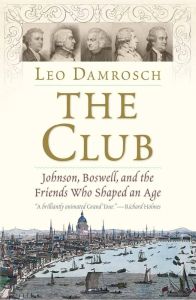
I have an interest in men’s clubs dating back to reading Around the World in 80 Days and The Time Traveler as a kid, and I have no idea why. Boys like clubs and clubhouses as a rule, I think, and the grown-up setting with serious talk and consumption of exotica like ‘mutton’ and ‘brandy’ fascinated me — and this has persisted through the years, with my loving books like the Black Widower series and anything on the Inklings. The Club was therefore of immediate interest to me, especially because of some of its personalities – Johnson, Burke, and Adam Smith. These were men whose professional interests and gifts cut across British society: playwrights, painters, literary experts, politicians, lawyers, and (in the case of Smith) creators of entire fields of study. Leo Damrosch opens with biographies-in-brief of the core members of his study before The Club was conceived and organized, which is interesting in its own right even before these strong personalities gather together and begin discussing politics and literature. Many of the figures were unknowns to me, aside from “I’ve seen that fellow’s name before, I probably should have an inkling of who he is”: these included Boswell himself (whom I know only as the biographer of Johnson), Garrick, a fantastically talented actor and director; and Sheridan. It’s safe to say that Johnson dominates The Club: regardless of the subject matter, Damrosch opens Johnson’s Dictionary to see how his definitions of a subject reflected his views therein. The members of the Club were not uniform in their tastes or political persuasions, which made for an interesting chapter on the Club in the dawn of English empire, and because of the range of their professions, readers are treated to an enormous variety of subjects. We learn about the 18th century theater, Scottish romanticism, the birth of economics, etc. There’s a great deal of historical detail encountered here that I was otherwise unaware of, like the fact that whisky had not yet made it into England, or the fact that Shakespeare editions were so adulterated and edited that even veteran actors didn’t recognize large parts of the originals when they encountered them. This is a girthy but interesting dive into the mid-late 18th century, and has some good-quality prints throughout as well as a fetching cover.
Today’s prompt from Long and Short Reviews is “Books that have been on our TBR the Longest”. I dealt with my physical TBR last year, so I’m going to take a look at my Kindle library, sort by “Oldest”, and take a look at Kindle titles I bought (probably for a $1 or $2) and then forgot about because eBooks are easy to forget about.
(1) Joan of Arc, Hillaire Belloc. There’s a Joan book I own but haven’t read?! Like, zoinks, Scoob!
(2) ISIS: Inside the Army of Terror, Michael Weiss & Hassan Hasan
(3) Hacking ISIS: How to Destroy the Cyber Jihad, Malcolm Nance
(4) AI Superpowers: China, Silicon Valley, and the New World Order, Kai-Fu Lee
(5) Thomas Jefferson, Revolutionary, Kevin Gutzman. I can only assume I bought this and decided to wait for my usual USA! USA! USA! reading in late-June early-July, but then forgot about it.
(6) Trouble is my Business, Raymond Chandler
(7) The Maharajah’s General and The Devil’s Assassin, Paul Fraser Collard. Not sure why I lapsed reading this series.
(8) Star Trek: My Enemy, My Ally, Diane Duane. First of her Romulan series.
(9) Conservatism: An Invitation to the Great Tradition, Sir Roger Scruton.
(10) The Good Shepard, C.S. Forester. Presumably purchased for one year’s Read of England.
Let us travel to a city which, in great part, no longer exists: Tudor London, much of which has been erased by time, fire, and ‘progress’, which holds burying swimming pools under concrete as a capital idea. I first read Picard a few years ago, with her Victorian London, and later visited Restoration London though I neglected to review it. Picard begins here with the physical setting of London, particularly the prominence of the Thames, and moves from a discussion of its bridges and gates into the city proper. After we’ve examined some of its notable buildings, many lost now, we move into the last two thirds of the book, which examine society during the era of Elizabeth.
This is not an easy time to be alive: not only are there the standing medieval threats of disease, war, and being executed for an impressive amount of crimes, but Elizabeth’s is zealous in the defense of her legitimacy and will brook nothing that smacks of disloyalty to the Church of England and thereby to Bess herself. (The law’s consequences are not necessarily logical: some people got death for minor things, while a servant woman who poisoned her bosses had her ears cut off, her forehead branded, and was tied to a post for some time.) I mentioned in the book on Victorian London that the mount of detail Picard brings up is impressive. That’s still the case here: there are extensive section on Tudor-era food and clothing, on sewers and schools, on the growth of the Inns of Court and of the international scene where Elizabeth is vying against the powerful Hapsburg who have holdings clear from Austria to Spain. There’s less content on the poor here than in the Victorian book, possibly because less has survived on them. Oh, they’re here — and they’re in a bad way, because Henry VIII seized all of the monasteries and seized their possessions to enrich himself and his friends, closing schools and shelters that used to house orphans and the poor. (This book provided a partial answer to my question of why people would go into service: many girls who were orphaned were taken to households to be raised as servants: as bad as being a maid working sixteen hour days is, it beats prostitution or death.) The section on the poor is more about their being poor, though, and less about their culture. I was amused to learn that beggars required a license, but not all ‘beggars’ were people dressed in rags and sitting miserably in the street: instead, they could be college students who had spent all of their money on mead parties at the ol’ bear-baiting round, or mariners who had been discharged and, having mysteriously lost their money at the local brothel, were looking for a way to get home.
Happily, Picard devotes a chapter to religion: one of my gripes with Ian Mortimer is that he pretends it doesn’t really exist, which — given the deep union of culture and religion — is inexplicable. Even if one is a strident secularist who doesn’t understand what religion means to people, an attempt should at least be made. I wouldn’t say Picard goes as far as trying to plumb the English religious mind, but she does knowledge its large role in English society – -especially in this period, when priests were required to remind parishioners that if they did anything papey, like pray with beads, they were damned. The dreary curse of Puritanism was also leading paintings and shrines to be destroyed. They hadn’t yet rubbed all of the fun out of life, though — have to wait for Crumwell for that — as this was the age of Shakespeare, and we take a look at leisure activities like games that are proto-sports. Elizabeth’s London is a solid survey of City life in the late-Tudor age, but readers looking for information on society in general should keep in mind that Picard keeps tightly to her subject, to London itself, and so doesn’t address European politics or the Age of Discovery.
To us, many of the flowers in an Elizabethan garden would look more like wild flowers than our carefully hybridised varieties, since modern varieties have been bred to maximise flower size and length of season, often at the expense of perfume. An Elizabethan gardener laid great emphasis on perfume. Arbours had fragrant climbers round them and sweet-smelling flowers and shrubs near them, such as wallflowers, pinks, rosemary and lavender.
All tourists need a phrase-book.Caxton printed Dialogues in French and English in 1483. It was still selling in 1600. The 1589 edition, giving translations from English into Flemish, German, Latin, Italian, Spanish and French, would be a great help to a tourist in an inn. On arrival: ‘My she [female] friend, is my bed made? Is it good?’ ‘Yes Sir, it is a good feather bed, the sheets be very clean.’ ‘Pull off my hose and warm my bed, draw the [bed] curtains, and pin them with a pin. My she friend, kiss me once and I shall sleep the better. I thank you fair maiden . . .’ And when leaving: ‘Where is the maid? Hold, my she friend, there is [a tip] for thy pains.’
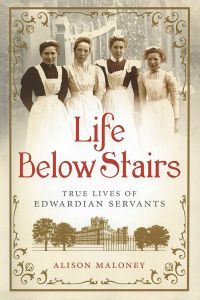
If, like me, you became interested in the goings-on of English servants via Downton Abbey, Alison Maloney opens with a word of caution. Many servants didn’t work in small armies at places like Highclere Castle. Instead, they were thoroughly leavened into society, most frequently found in middle-class homes, and were such a part of society at large that the only class that didn’t employ servants to some degree was the working class itself. That said, however, most of this text is about the staff of the great houses, drawing from oral histories of staff (Forgotten Voices of the Edwardians and Not in Front of the Children) as well as from household management guides and the like. It’s quite readable and has a good range, opening with a diagram of the Downstairs hierarchy (ranging from the Butler to the lower maids and dogsbodies) and then tackling various aspects of servant life in turn: the dynamics between the Household and the staff; the dynamics between the staff themselves; the nature of various duties, and so on. Maloney takes us through an average day in a great house like Highclere, as well as a normal years — punctuated by the summer visit to London for The Season, as well as the holidays. Reading this, I could only wonder how some people managed to stay in service for decades, because the work schedule appears absolutely brutal: up hours before dawn, working late into the evening and sometimes into the next day, depending on the lord’s schedule. Given that industrial England would have surely had opportunities for young people — young men, at least — life in service must have had some attractions or upsides. Surely pride in being connected to a great house wouldn’t suffice for the constant work (Oh, did someone track mud on the steps right after they were scrubbed? Back at it!) or the dehumanizing way servants could be treated, depending on their station: maids were especially ill-treated, and there was as much of a pecking order downstairs as there was upstairs. This was a fascinating social history, though I wish there’d had been more of a look at those in service throughout society, instead of just those attached to the big houses. That may simply reflect the availability of service accounts, though.
There was a….bit of a theme to this month’s movie watching, at least for the ones I watched solo. See if you can guess what it is. I bet you can!
The Scout, 1994. Albert Brooks plays a scout who, after a bad call, is sent to the baseball version of Siberia — rural Mexico – to ‘search’ for talented baseball players. He discovers an extraordinary young man played by Brendan Fraser, who like the Babe and Shohei Ohtani is a ‘double threat’, a man superbly talented in both pitching and hitting. Unfortunately for him, Fraser’s character has certain….ehm, eccentricities. Hilarity ensues. Also, there’s Tony Bennett.
Django Kill… If You Live, Shoot!, 1967. Spaghetti western. I…don’t know what to tell you. Gang rolls into a town, everyone dies.
Benched, 2011. John McGinley, aka Dr. Cox, is a little league baseball coach used to Winning – but then not only does his son & star pitcher leave the time to perform in the school play, but he’s saddled with one of those irritatingly modern and therapeutic parents as his assistant. This is a story of friendship forged amid pain and trial with an additional fathers-and-sons story, set amid a season of kids’ baseball.
Hardball, 2001. Keaneau Reeves owes five figures to two sets of angry bat-wielding bookies, and out of desperation takes a gig as a little league coach in the projects. The result is The Mighty Ducks, if it involved the constant threat of death, lots of profanity, and a hip-hop soundtrack. Supposedly based on a true story, and quite enjoyable until one of the kids was shot. I stumbled on this one while watching some MLB players analyze various baseball movies.
Reservoir Dogs, 1992. A few men try to rob a diamond store. Things do not go well. Lots of Steve Buschemi & Chris Penn, plus some Harvey Keitel.
Major League, 1989. A woman running the business end of the Cleveland Indians wants to move to team to Miami because she doesn’t like bad weather and dead factories (oh, wait, this is pre-NAFTA…) , so she’s fixing things to make the team fall into dead last so attendance will fall and she can use the Indians’ contract with the city to skedaddle. James’ Gammon’s mustache and deep voice has other ideas. So does Charlie “Wild Thing” Sheen.
The Natural, 1984. Robert Redford is a promising young ballplayer on his way to get signed up by the Cubs, but he picks up the wrong woman at a train station and get shot. Fifteen years later, the itch to play ball is still there, and he signs on with the ailing New York Knights, only to be dismissed by manager Wilfred Brimley who is thinking about quitting ball and taking to the airwaves to talk to Americans about diabeetus. He finally gets his shot to prove what he’s capable of, though, and the movie has a smashing good ending. (Not as ‘smashing an ending’ as Bump Bailey, though. Heehee.)
Take Me Out to the Ballgame, 1949. A young Frank Sinatra and Gene Kelly are entertainers and ballplayers. This is Frankie in his first bloom – he hasn’t yet lost his voice (‘52), and hasn’t had his revival courtesy of femme fatale Ava Gardener recommending him to play Maggio in From Here to Eternity (‘53). Entertaining enough, especially as Frankie and Gene have to deal with their new ballclub owner being not only a dame, but a distractingly attractive one who knows the game as good as they do. Based on costumes, it’s meant to be set decades earlier, in the opening decade of the 20th century.
Amy, 2021. Documentary about Amy Winehouse’s life and death. Rough going for an Amy Winehouse fan. I heard her first in 2005 or 2006 and became an insta-fan, and I missed a lot of her downfall in college, until that lurching moment when the news hit that she was dead. Film goes into the role her parasitical husband played in her downfall.
Mad Max Fury Road, 2015. Tom Hardy is someone who is captured by The Guy and all his pasty bald minions. The Guy is sending out a big truck to do something, but surprise! A Fierce Strong Female (Charlize Theron) is using the big truck to spirit out a bunch of The Guy’s sex slaves, and in the resulting fight Tom Hardy joins up with Charlize and her damsels in distress. Together they engage in an Epic Car Chase across a barren wasteland trying to find some oasis, but are disappointed to discover it’s a poisoned swamp. Tom Hardy and Charlize agree that they need to go back to The Guy’s hideout because he has water and such, so there’s another Epic Car Chase in which they kill The Guy and arrive back at The Guy’s hideout and show The Guy’s people his head, and the people are like “Oh! You killed The Guy! You are now The Guy!”. I think maybe I should have seen the movies before this one.
Bad News Bears, 2005. Found this while looking for a way to stream the original, and since I had free access to it via my last day of Paramount, I figured: why not. It’s been too long since I’ve seen the original to compare them, but I enjoyed Thornton’s version of the character enormously. The kid playing Amanda was also solid, though when I searched for her (Sammi Kane Kraft) to see what else she’d been in, I was sorry to see she was killed in an auto accident. I enjoyed the scene of a ‘drunk’ Billy Bob Thornton repeatedly hitting kids with fastballs entirely too much. I think the remake had more sexual humor than the original, given that I don’t remember Walter Mattheau ogling softball players or warning kids to stay away from crack lest they wake up in a prison married to a guy named Bubba Blue tattooing his initials on their butts.
My Blue Heaven, 1990. Steve Martin is a wiseguy in witness protection, who can’t stop running scams – much to the worriment of his FBI handler, Rick Moranis, who really needs to keep him out of prison and out of the morgue so he can testify back in New York. A comedy with romantic elements. Pretty sure this was a rewatch for me, but it’s been so long I’d forgotten pretty much everything.
Michael Collins, 1996. FREEEDOO- wait, wrong movie. Liam Neeson plays Mick Collins, a leader in the Irish republican movement who was killed by members of the same who opposed his backing of a treaty with the Crown. I knew nothing of Collins before this and the movie’s lack of a narrative kept me more or less confused. My buddy and I watching this had no idea who was attacking whom when the tank started shooting people at a soccer match. I read on Wikipedia that the royal forces thought the fellas shooting collaborators had blended into the crowd at the match, but you don’t get that in the movie: it’s just “Oh, hello, you’re doing sports? I’d like to do a repeat of Amritsar now, thanks.” Made me realize that holy wow, do I need to read some Irish history. Perhaps in June I’ll give a week over to it. (April, of course, is England’s, and I have…Plans….for May.)
Bad News Bears, 1976. A rewatch. Still fun. Walter Maltheau is a former ballplayer who has descended into drunkenness and pool cleaning, but accepts some money to coach some kids rejected from the local little league.
Damn Yankees, 1958. An aging real estate agent who dotes on the Nationals and hates the Yankees is tempted by a mysterious figure with supernatural powers, who offers him youth and amazing baseball talent, enough to see that the Nationals beat the damyanks for the pennant race. Oddly enough this is the second baseball musical I’ve seen this month. The big dance scene reminded me a lot of the mambo scene in West Side Story: I imagine that’s Bob Fosse’s influence, since he was the dance choreographer in both. Enjoyed it very much, though there were weak points — especially the musical number about ‘urp’ and the mambo. The best part of the movie was seeing “Boothby” from Star Trek TNG playing Mr. Applegate/Satan. Based on a novella called The Year the Yankees Lost the Pennant.
A good slugga, we haven’t got A good pitcha, we haven’t got A great ball club, we haven’t got Whattawe got? We got heaaaaaaaaaaaaaaaaaaaaaaaaaaaaAAAAAAAAAaaaaaaaaaaaaaart!
It Happened in Flatbush, 1942. Years after his critical error caused the Brooklyn Dodgers to lose a game and the pennant, ‘Butterfingers’ McGuire has returned to his team as manager, struggling against residual resentment and distracted by his attractive new boss. It’s very much a movie about the way communities can dote on their teams, especially the intense affection Brooklyn had for the Dodgers before they went chasing silicon dreams in California. In 1957 the Dodgers would leave Brooklyn for silicon pastures in Los Angeles, in part thanks to Robert Moses being terrible. The Rookie. 2002. Dennis Quaid is a science teacher who once dreamt of playing baseball. After observing him in action, the high school team he coaches challenges him to try again — if they win the pennant. Source of one of my favorite quotes for this month: ” Do you know what we get to do today, Brooks? We get to play baseball.”
Mickey, 2004. A lawyer with tax problems goes on the lam with his son to escape the goonie-boys, using his and his son’s new identities to give his son another year in the little leagues – despite him now being technically too old. Unfortunately, his son’s stellar performance on an already dominant team takes the team to the Little League World Championship, drawing the attention of the aforementioned goonie boys. Screenplay is by John Grisham, who has a cameo.
Syk pike | Sick of Myself, 2023. A disturbing film about a young woman (Signe) who falls into a deep well of narcissism: her need for attention is such that she orders anxiety pills off the black market which she knows will make her break out into a skin rash if she takes too many of them — so naturally, she eats them like skittles. There are papers waiting to be written on her transformation throughout the movie, as she becomes increasingly disfigured by the pills’ side effects: the Gollumization of Smegol is the most apt comparison, I think. (One could also make an allusion to Dorian Gray, but Signe’s inner and outer ugliness mirror one another.) The scenes of her taking photos of her disfigured self to share on social media, her toxic delight in any attention is profoundly unsettling, though it becomes darkly comic at times, as when she and her partner are having sex: his “dirty talk” is telling her how he’s visiting her in the hospital, and if she dies he’ll make sure her dad and her ex-friend Anine can’t come because they didn’t come see her in the hospital, that sort of thing.
Gentlemen Prefer Blondes, 1953. Marilyn Monroe and Jane Russell are two friends with different approaches to relationships (Marilyn is after money, Jane after bodies). Before the boat ride is over, they’ve both sang a lot of songs and gotten married. My first Marilyn Monroe movie, I think.
Jesus Christ Superstar, 1973. Some group of young people travel into the desert and stage an elaborate recreation of Holy Week, with added rock opera elements. It had its moments, but is incomplete: it ends on Good Friday, with none of the joy and wonder of Sunday.
The Sandlot, 1993. The best movie about baseball, boyhood, and summers. Period.
Taxi Driver, 1976. A mentally disturbed and socially awkward veteran who is getting by driving a taxi becomes infatuated with Cybil Shephard, a political campaigner: after disgusts her taking her to a dirty movie (he’s socially oblivious), he hatches a plan to assassinate the man she’s campaigning for, but then encounters a child prostitute (played by Jodie Foster) who he decides to rescue. Fascinating and disturbing.
Little Big League, 1994. A kid whose grandfather owns the Minnesota Twins inherits the ball club after grandfather goes on to extra innings in the big ballpark in the sky, and promptly appoints himself manager. He’s an absolute freak with statistics and strategy, but is soon overwhelmed by the ways the job warps his social life, school responsibilities, etc. Surprisingly good.
Chinatown, 1972. Jack Nicholson is a private eye who is asked to follow a politician who may be cheating on his wife, but realizes sharpish that he’s being used by ne’er do-wells who view the politician as an obstacle. Darker ending. I don’t think I’ve ever disliked any film Jack Nicholson was in.
Trouble with the Curve, 2012. Clint Eastwood is an aging scout whose declining eyesight threatens his ability to work, but his daughter Amy Adams joins him on a scouting trip at the request of John Goodman and they stumble on a major find. Amy Adams is ocassionally distracted by Justine Timberlake playing baseball trivia with her. Enjoyed the actors quite well, and the story was…ok. The ending was very tropey/stereotypical.
MASH, 1970. The original movie. I’ve seen scenes of the show (my grandparents played reruns almost constantly when I was growing up) so I knew all of the characters. Development seemed a bit different — Hawkeye was more of an ass, Hot Lips lost her mettle, etc. Enjoyable enough despite the inexplicable football scene. They’re in the middle of a war and can source uniforms and field posts?!
Field of Dreams, 1989. “Hey, dad, wanna have a catch?” “…..”I’d like that.”
Well, the year is one-fourth spent already. Criminy! March was fairly…all over the place. Didn’t do well with Lenten reading at all, but Opening Day was a solid performance, I think, and I even got a head start on Read of England with two reviews scheduled to roll out.
Classics Club A third of the way through Resurrection by Leo Tolstoy. Thinking of dropping Plutarch from my list and making two substitutions because my library’s copies were ‘permanently borrowed’ and I can’t find the exact editions we had for restocking.
The Unreviewed: Mating in Captivity, a book on managing intimacy and desire in relationships. A rare DNF. The core idea of it was interesting (that attraction is coupled with mystery, and that over-sharing/over-familiarity smother desire), but I was put off by the obsession with sex, to the point that the ‘therapist’ recommended divorce to one couple so they’d find each other interesting again. Emperors and Idiots: literally just finished this Saturday afternoon.



 Reading Freely