Satisfaction Guaranteed

Satisfaction Guaranteed: the Making of the American Mass Market
© 2004 Susan Strasser
348 pages
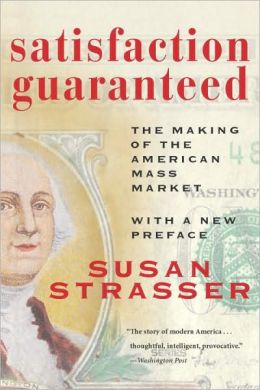
America was born of the frontier, its citizens people who by necessity often manufactured their own household requirements.  This was the case throughout most of the 19th century: even in cities where people could purchase articles like candles and clothing.  But by that century’s end, a revolution was in the process – a consumer revolution in which virtually every household good, from food to cleaning solutions, came from factories. Even more remarkably, however, those goods weren’t even coming from the factories through familiar faces at local groceries: they were entering the lives of people through new mail-order schemes and colossal supermarkets. Satisfaction Guaranteed examines how a few entrepreneurs transformed Americans’ lifestyles and marketplace.

Like Never Done and Waste and Want,   Satisfaction is chiefly focused on social history, and together the three examine various facets of Americans’ transformation from producers to consumers, of how a nation of nominally self-reliant farmers and merchants became one of employee-consumers and big business. Unlike her previous workers, however, here Strasser presents a critical business history, rather like Straight Out of the Oven or Cheap.  To explain the success of the new businesses, she demonstrates to readers how they created completely new business and marketing practices, like ‘market segmentation’ – targeting particular products within a brand to specific demographics.  Another novelty was that of the brand name or trademark, which could be used to build a reputation for quality. They also depended on new technologies and systems, either material (in the form of railroads that allowed for mail-order companies to flower and deliver cheaper goods through volume sales) or legal, like court decisions that made corporations easier to form and much more effective at managing interstate businesses. Strasser places the most emphasis on marketing, however, for it was marketing that introduced Americans to completely new goods (‘Oleomargarine? What kinda cow makes that?), marketing that coaxed them into trying it even when their local grocers didn’t want to stock it, and marketing that gradually lured them into not only using products, but becoming dependent on them. Marketing is why invention is the mother of necessity.

Although Strasser regards consumerism as wasteful, she doesn’t rail against the giants that promote it – indeed, depend on it. There are no villains in this piece, though she’s plainly sympathetic to the small businessmen, like the neighborhood grocers and general store managers, who were at first forced to keep goods on their shelves they had no experience with , and then driven out of business when large chains like A&P Groceries invaded. (Ads of the day directed potentials customers that if their local firms didn’t carry Crisco or the brand in question, they should forward the names and addresses of those firms to the corporation, who would see to it that the goods were offered for retail.)   The new branded products didn’t offer storekeepers much of a profit margin, and eventually corporations began seeing local retailers as obstacles to reaching as broad a customer base as they possibly could – and that was the goal: not meeting needs, but devising any way to create and capture new markets. Whereas once Americans produced things in-house to satisfy their needs, now they were consumers who bought whatever ensnared their interests – and following the ‘credit revolution’, they didn’t even need to be limited by what they could afford.

Strasser’s previous work has been lively yet comprehensive, and Satisfaction Guaranteed largely meets those standards.  Covering the intersection of business practices and lifestyle,  she focuses more on new approaches business management than on lifestyle, the usual center of attention,  which may broaden her audience to those interested in business in general.  This by no means detracts from its appeal as an introduction to the origins of mass consumerism in America, however.

Posted in history, Reviews | Tagged , , , , , , , , , | 1 Comment

Two Fronts

The War that Came Early: Two Fronts
© 2013 Harry Turtledove
416 pages

In Hitler’s War,  Harry Turtledove began a new alternate history of the Second World War, one in which the conflict started in 1938 when Britain and France decided Hitler was being too obvious a budding supervillain in invading Czechoslovakia, and declared war on him for want of anything better to do.  The following years have seen the powers of the world enter into conflicts and alliances with one another, and drop out of them, with ease.  Every dramatic derivation from real life has been reversed, to the point that the series has been a disappointment. But in Two Fronts, Turtledove has produced a military action-adventure novel that’s enjoyable regardless of how similar is setting is to our own.

In 1942, the situation is thus:  Germany is in the midst of a two front war, fighting Britain, France, and the Soviet Union while simultaneously throwing men and material into Africa to bail Mussolini out after Il Duce discovers his new Roman Army is still no match for the crazy Scots defending Egypt. In the east, Japan os still trying to conquer China in total, and is now merrily engaged in a war against the United States, which it initiated by sneak attack. Sound familiar?  That’s pretty much the situation of reality’s World War 2, but with one notable exception: the United States is not at war with Germany. Two Fronts covers the year 1942 in the history of the war that came early, and is is not progressing as one might expect — but the war which is taking place is interesting in its own right, even if it makes little sense.  It is an in-between novel, in which there aren’t any major obvious happenings — though there are a few subtle happenings which will have major consequences for savvy readers — but there is an awful lot of fighting. Turtledove’s cast of characters is as strong and varied as I’ve yet seen from him, with viewpoints from all theaters, countries, and branches of the service: whatever military action readers look for, it’s here. Tanks, infantry, sea, special operations, even a little aviation are included.  (Aerial warfare isn’t downplayed, but bombers are mostly in the background making everyone’s lives just a bit more exciting/miserable.)

Two Fronts sees a few interesting changes hovering around the sides of the action, both involving superweapons. Not only do the Japanese begin to introduce biological warfare into their struggle with the United States (dropping rats filled with the Black Death into Hawaii), but a little project in Tennessee named after Manhattan loses its funding. The implications as the war goes are enormous, but then again I’ve been saying that for four novels, so who knows?  I belatedly realized in reading this that The War That Came Early isn’t so much about  a logical series of events that builds off of the war starting in 1938: rather,  that alteration is only one of many. Turtledove seems to be using the early war as a way to turn the Second World War into a sandbox, in which he can explore what-if scenarios like the failure of the Manhattan Project, or the introduction of ‘secret weapons’ into the field of combat. While I’d prefer the aforementioned logical buildup, this approach has its own merits: it’s like the airships  and steam-powered cars in The Two Georges, an interesting take at what-might have been. It is World War 2 with different toys. This is only problematic in that sometimes the plot doesn’t make sense. For instance, in this 1942, the United States is only fighting Japan. While it’s also sending some resources to Britain and some to Russia to help fight Hitler, the majority of its industrial capacity should be free to be focused squarely on Japan, a Japan which should be weakened by the fact that it decided to invade Russia first. And yet, instead of the United States slowly but surely checking the Japanese advance and swinging a few punches of its own, it’s floundering. Maybe its industrial capacity simply hasn’t hit full war-time mobilization yet since it doesn’t have the added challenge of taking on Hitler, but this amateur-hour performance on their part is bothersome.

Two Fronts is perplexing because I like it. I didn’t expect to like it, because it didn’t address the fact that this history isn’t very ‘alternate’ despite the early start. It may be that the differences are more subtle than I’d expected, and their consequences will take longer to be noticeable as a result.  Despite the fact that the general sequence of events is unchanged I genuinely enjoyed the variety of military action presented here, especially since Turtledove didn’t repeat himself too much. (The exception:  he has decided infantrymen do not like artillerymen, who can kill them without risking being killed in turn. He saw fit to tell the reader this several times. I’m starting to wonder if he doesn’t do this on purpose.)    Perhaps this World War 2 with a twist was just the light reading I was looking for this weekend.

Posted in Reviews | Tagged , , , | 5 Comments

Astronaut Wives Club

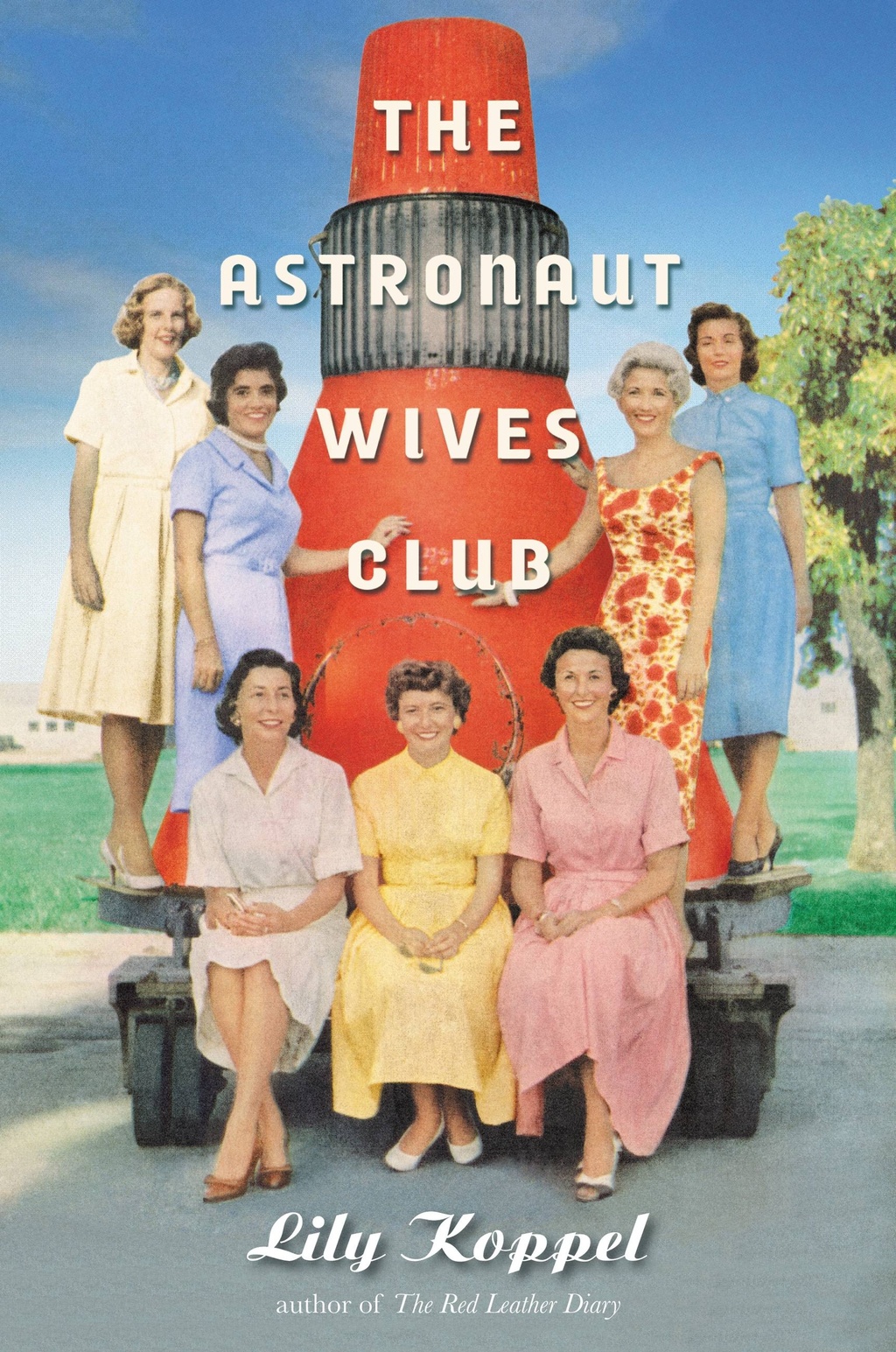
The Astronaut Wives Club
© 2013 Lily Koppell
288 pages

When a gang of test pilots joined the Mercury program, they and those who followed them didn’t have an inkling of what was to come– and their wives, their unwitting partners in an unexpected story — knew even less.   In part, Mercury, Gemini, and Apollo only prolonged the misery they knew as the wives of test pilots: they were married to men who were never home, who had a one in four shot of dying every time they went to work, and whose military career seemed more like juvenile adventurism than noble service.  But when pilots became astronauts, those worried wives became the partners of instant celebrities, subject to more scrutiny than they could have ever anticipated.

The Astronaut Wives Club is the story of the harried women who kept the home fires burning while their men, basking in glory and adulation, put fire in the sky. Lily Koppell is a chatty social historian whose account demonstrates how the ladies of Mercury, Gemini, and Apollo adapted to the new stresses of their celebrity-wife status, whose homes became the backdrops of national dramas every launch, who were accosted in grocery stories by reporters — including news hacks who beat a path to the doors of new widows to ask how they felt about their husbands’ demise, arriving even before the NASA officials who were to respectfully deliver the bad news. In addition to facing the prospect of their husbands dying horribly — running out of air and leaving bodies to circle in lunar orbit forever, perhaps?  —  and living under the public eye, having to keep the home and kids looking shipshape to satisfy the Powers that Be and shut the mouths of gossip columnists — the wives also had to contend with the fact that their superstar husbands were taking an endless stream of “Cape Cookies” to bed. The combination of  cocky, accomplished, and adulated men working in Florida states apart from their wives in Houston, and the presence of young things in miniskirts batting their eyes at the big ol’ heroes — was a bad one for the astronaut’s home lives: few marriages survived the space program.

Although early on Koppell fancies the idea of the story of the astronaut wives being one of American women coming into their own, a link with the feminist movement never strongly materializes:  the manners and mores of the astronaut homes were a decade behind those of the popular culture at large, though ‘progress’ in the form of splintering marriages  increased when it became obvious that NASA didn’t really care if the astronauts cheated, so long  as public scandal was avoided So long as they were landing on the Moon, who cared about serial affairs?   Absent of precedent, and left to fend for themselves by NASA, the astro-wives fell back on one another, relying on one another for moral and personal support. They met in one anothers’ homes to share their worries and woes, especially helpful given that they were under orders not to burden their husbands with anything — hence why Jim Lovell didn’t realize that all three of his children had their tonsils removed until after he and his wife were leaving town. This is more evident in the Mercury program, when there were only seven wives in a tight-knit circle: as their numbers expanded, first with the New Nine and then additional astronaut classes each with a dozen men at least, cohesion faded.  This is sadly true of the book as well. Though it starts out with a clear focus on the response of the Mercury wives to their new role as being to national icons, as more subjects enter the picture, Koppell drifts, and this combined with her casual  approach means the book loses much of its potential punch, feeling scattered by midway.

The Astronaut Wives Club is an interesting  if weak look into the ‘home front’ of the space program, with appeal for readers who want to learn a little more about an aspect of the space race that is only lightly touched on at best elsewhere, or readers interested in the lives of accidentally-famous women. Though based in part on interviews with living astronaut wives, it’s more serviceable as a diversion than a comprehensive treatment of the subjects.

Posted in Reviews | Tagged , , , , | Leave a comment

Two Sides of the Moon

Two Sides of the Moon
© 2006 Alexei Leonov and David Scott
448 pages

Remember the fifties, those fat complacent days when the Future seemed a century away?
Then up went Sputnik, gave the world a butt-kick, and made it clear tomorrow starts today!
‘Beep beep beep’ — hello there! Sputnik sails giggling through the skies
Red flags, red faces jump in the race as the space age begins with a surprise! 
(“Surprise!”, Prometheus Music)

In another setting, Alexei Leonov and David Scott could have been the cause of the other’s death. Fighter pilots from empires at odds with one another, intermittently on the edge of war with the fate of the planet hanging in the balance, they would have surely entered combat against one another had the Cold War ever become hot. But instead, one manifestation of the tension between the United States and the Soviet Union, the Space Race to the moon, made them first respectful rivals, then friends. Two Sides of the Moon is a joint biography of the pair, telling their experience as active participants in the race for the stars. Both men were highly accomplished: Leonov was the first man to walk in space, and Scott commanded Apollo 15, the first explicitly scientific lunar mission.  And yet they regarded the Apollo-Soyuz mission as their greatest achievement, for there they established to all the world their conviction the space race had been the triumph of humanity against the odds and the elements, not one nation or one group of men against another.

Readers will welcome Two Sides of the Moon as a rare look into the Soviet space program, and Leonov is the best man living to deliver an autobiographical account of it, given that everyone more famous than him in the Soviet program is long dead.  Each man takes turns telling his side of the story, from their boyhood days until the culmination of the race in Apollo-Soyuz, in which spacecraft from both powers unite, demonstrating the feasibility of international cooperation, to which the International Space Station is a tribute.  Although their stories are wholly distinct from the other, they do work in references to their shared experiences and this combined effort:  Scott comments upon seeing the Earth from space that they “should have sent an artist”:  Leonov, appropriately enough, was a painter. Another reference is Leonov revealing an early death in the Soyuz program caused by a spark in a pure-oxygen atmosphere, a disaster that the United States experienced for itself when Gus Gussom, Ed White (first American to spacewalk) and Roger Chaffey were killed in a launchpad fire caused by the a spark same flammable, pressurized atmosphere. Their accounts offer comments and comparisons about the two space programs: despite their sensitive nature, information leaked through intelligence services reliably. By the authors’ account, a feeling of cameradie between the astro- and cosmo-nauts established itself early: despite their being opposing military men, the would-be spacefarers from either side of the Iron Curtain were exposing themselves to extraordinary risks, and under extraordinary scrutiny. When one man from one program fell, they all felt it — by this account.   The Soviet program was distinct in being lead in its early years by Sergei Korolev, the “Chief Designer”: Leonov presents him as a driving force behind the Soviet’s organization and planning, and when he died in 1966, their program began faltering. (It didn’t help that by that point, ambitions were truly lunar and new rockets were being introduced into both programs — NASA had far better success with its moon-bound Saturns than the Soviets did with their rockets.)   The American astronauts were wholly unaware of his role in the Soviet program, one of the few complete surprises their joint account reveals.  The book moves more swiftly through the post-Apollo 11 years, mentioning the Salyut project briefly before giving more attention to Apollo-Soyuz, in which the two men both took part.  The book ends with epilogues in which both men comment on the fates of their programs in recent years, and offer musings on what might lay ahead: David Scott offered the idea that nations might have to introduce orbital military patrols to investigate newly-launched satellites.

Two Sides of the Moon  recommends itself to those interested in the space race, chiefly for Leonov’s contributions. Although Scott is a fair writer with helpful technical explanations and many interesting missions, there are so many Apollo biographies out there that his is hard-pressed to rise out among them. Leonov, on the other hand, is nearly alone in offering a Russian view for the English market, and as mentioned easily the best man living to offer an account, given that his close friends like Yuri Gagarin, and his old bosses (including Korlev) are deceased.  Two Sides makes the space race out to be an inspiring struggle between two powers whose accomplishments were noble even if their motives were suspect, and reinforces the fact that despite the distinctions and oppositions in our cultures and beliefs, humans are really not so different from one another: underneath the  suit of the American astronaut and the Soviet cosmonaut is the same human flesh.

“When Apollo 11 had soared away from Cape Kennedy I had kept my fingers crossed. I wanted man to succeed in making it to the moon. If it couldn’t be me, let it be this crew, I thought, with that we in Russia call ‘white envy’ – envy mixed with admiration. […] On the morning of 21 July 1969 everyone forgot, for a few moments, that we were citizens of different countries on Earth. That moment really united the human race. Even in the military center where I stood, where military men were observing the achievements of our rival superpower, there was loud applause.”

p. 247, Alexei Leonov

Related:
Into that Silent Sea, Francis French and Colin Burgess, a history of both programs.
Moon Shot, Alan Shephard and Deke Slayton. Likewise a joint effort, this culminates in Apollo-Soyuz.
“Surprise!”, Prometheus Music. This celebrates Sputnik and the space age; it’s a rather lively tune.

Posted in history, Reviews, science | Tagged , , , , , , , , | 4 Comments

Paleofantasy

Paleofantasy: What Evolution Really Says about Sex, Diet, and How We Live
© 2013 Marlene Zuk
328 pages

Despite its name, Paleofantasy is not a deliberate debunking of arguments for a ‘paleo diet’ and a paleo lifestyle.  Although Zuk does take aim at paleo proponents time and again, her argument approaches the same ideas from a different tack. Rather than assume that people ought to live the lifestyle our bodies evolved to expect, and then look for the science that informs that lifestyle, Zuk first asks:  what does biology tell us about the way our ancestors once lived, and can that information be used to help us today?  Subsequent chapters are a brief survey of the evolutionary heritage of our diet, our sex and childrearing practices, modes of exercise, and health.  The essential point of Paleofantasy is that evolution is an ongoing process: humanity is not a finished product, nor a monolithic species. What is true for some populations doesn’t necessarily hold for others.  Thus, studying the lifestyle of our ancestors isn’t particularly helpful, because they had different lifestyles depending on their local climate, and each made micro-adaptions in its own way.  Two populations of mountain-living people ,in Tibet and the Andres, both adapted to living in such thin air — but in two different evolutionary ways. Her message to those interested in paleo living is this: don’t get carried away.  By all means, don’t overeat and get in a lot of exercise — but do it because it makes sense now, not because the ancestors starved and were active.

Although the book will probably succeed in cooling the jets of the moderately interested, for more ardent practitioners, she will doubtless fall short, and not just because of defensiveness on readers’ part. A staple of paleo nutrition is that grains are of the agricultural devil. Zuk’s is response is to point out that look, we’ve evolved a gene that lets us process starch.  We’ve adapted! Evolution in action.  She does not, however, address the concern of anti-grain readers that while we can eat grain, we shouldn’t because of its insulin-spiking effects and the subsequent relationship with diabetes and obesity.  To borrow an example from her book, also used in Sean Carroll’s The Making of the Fittest: while there are snakes who can survive eating poisonous toads,  that doesn’t mean they should turn poisonous toads into the bedrock of their snake food-pyramid. Likewise, she doesn’t address the rationale that palo-fitness people use in pushing for short, intense workouts, namely that a high level of stress for a short time is better at building bone and muscle than a marginal level of stress done for long intervals.  She simply says “Hey, there are people who have adapted to running really long times.”

Paleofantasy doesn’t necessarily impress, but it does offer a moderating voice to those who can get carried away by the prospect of living like our ancestors to the point of going to bed with a Sounds of the Nighttime Forest CD playing, because that’s what our brains expect.

Related:
Antifragile, Nassim Nicholas Taleb (which includes a section on high-stress short-term exercise)
Wheat Belly, William Davis;  Good Calories Bad Calories, Gary Taubes (on the problems of the modern diet)
Catching Fire: How Cooking Made us Human, Richard Wrangham
Sex on Six Legs, Marlene Zuk.

Posted in General | Tagged , , , , , , , , | Leave a comment

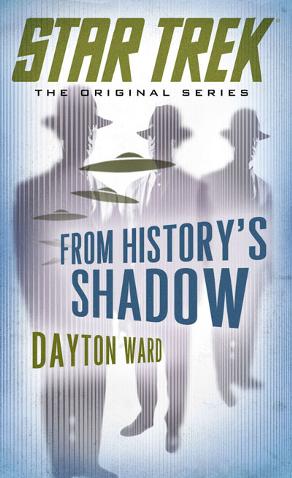
From History’s Shadow

Star Trek: From History’s Shadow
© 2013 Dayton Ward
388 pages
The geocentrists were right: Earth is the center of the universe. Or at least, it was in the 20th century, for how else can you explain how many extraterrestrials, time-traveling or otherwise, there were running around it?  One moment, the USS Enterprise was sailing merrily along, and the next — there were two aliens chasing one another in the cargo bay, both of whom had been living on mid-20th-century Earth for decades, one of whom wanted to destroy Earth’s civilization before it could destroy hers. The other was a Vulcan named Mestral, whose survey ship had crashed and who declined rescue after discovering I Love Lucy. As his goal of peaceful observation conflicted sharply with the other’s goal of triggering an Earth-shattering kaboom, they schemed and fought against one another amid the human space race until their feud ended with their somehow teleporting across space and through hundreds of years. Well, such things happen in the 23rd century, especially to Kirk.  
The story gets more complicated, and more fun, but it began in 1947, in a place called Roswell, when something crashed in the New Mexican desert. The government claimed it was a weather balloon, but rumors couldn’t help but escape that what crashed was an alien ship, and the military was hiding the truth from the public.  From History’s Shadow, set largely in the 20th century, tells the story of the United States’ response to encountering that alien life back in July ’47. As a secret security department devotes itself to investigating reports of UFOs,  they find much more than a series of stories to be debunked. Oh, there are false leads, all right — but then there are the crashed probes and series of mysterious incidents that reveal the truth: there are aliens on the planet, all right, and they’re not all from the same place. Some watch, some help, some sabotage — and there are seven humans serving a mysterious shadow organization from the future which is itself monitoring and countering the aliens.  Mid-20th century Earth is a cosmic meet-and-greet.  
From History’s Shadow is a fantastically fun Star Trek novel that plays with various conspiracy theories of the 20th century. Dayton Ward links several Star Trek episodes from various series into an integrated story, one appealing for its retro appeal think alt-historical fiction), and especially so because it functions as a standalone novel. (As much as I appreciate the integrated quality of the Treklit series these days, it’s a relief to find a novel that doen’t require three more for context!) Although readers will enjoy From History’s Shadow most if they’ve seen “Little Green Men” (DS9) and “Assignment: Earth”,   the episodes are not required reading.  Ward deserves high praise for how smoothly he fit together elements from The Original Series and Enterprise, and delivering a strong Trek novel that is largely told from the perspective of characters completely outside the usual cast of characters,  many being 20th century Americans. Considering how serious the Typhon Pact/Cold War in Space books have been, From History’s Shadow is a welcome easy read, a mystery-adventure alien conspiracy story of the space race, with a Star Trek twist. 
Related:
Star Trek: Department of Temporal Investigations, Christopher Bennett; Star Trek TNG: The Persistene of Memory, David Mack. Both of these take elements from a wide variety of Trek episodes and moves into a single, grand story. 
Assignment: Eternity, featuring Gary Seven and Roberta Lincoln, the latter of whom is a major supporting character in From History’s Shadow. 
Roswell High, Melinda Metz, a series of YA books from the late ’90s and early ’00s about the alien children who survived the Roswell Incident and who live among humans in secret. It inspired a TV show with better characters (in part) but an inferior story: one episode called “The Summer of ’47”  tried to tell what happened.
Posted in Reviews | Tagged , , | 1 Comment

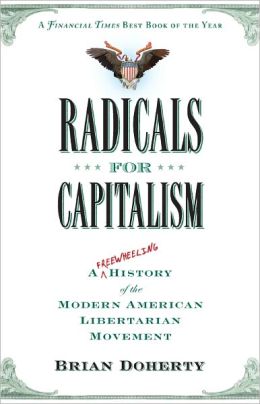
Radicals for Capitalism

Radicals for Capitalism: A Freewheeling History of the Modern American Libertarian Movement
© 2008 Brian Doherty
740 pages

Libertarianism has been in the news recently: Julian Assange referred to its rising wave in the Republican party as America’s best hope for halting the advance of the police state, and Chris Christie (governor of New Jersey and  rumored as a presidential contender in 2016) scoffed at it, causing a bit of a row between him and libertarian-leaning Senator Rand Paul.  American libertarianism is distinct in holding as sacred something the first libertarians regard as suspect: property. While historically, libertarianism was born out of  the left’s distrust for the state, authority, and coercive power — power created by property and the acquisition of wealth — American libertarianism is more a renaming of classical liberalism, of the idea that the government should stay out of the economy and out of people’s lives.  But this survey of American right-libertarianism is not limited to Adam Smith. It is is a work of economics, yes, but realm of thought covered here  delves into questions as old as philosophy: what is a person’s proper relationship with other people?  This expansive volume, which seeks to do for right-wing libertarianism what Russell Kirk did for conservatism in The Conservative Mind,  ranges from the mild, traditional F.A. Hayek to ranting ideologues who dream of being Nietzschean supermen.  Although most helpful in summarizing the contributions and sharing the lives of a wide range of individuals, many of whom history has forgotten entirely, its size may scare many off: at 740 pages, it’s no brief read.  The author, as a contributor to Reason magazine (“Free Minds and Free Markets”) is wholly sympathetic to his cause, of course, but his being a true believer doesn’t diminish the volume’s value:  there is a far wider variety of thought in right-libertarianism than one might expect and Doherty is helpful in analyzing the thoughts of conflicting individuals, discerning their shared beliefs and examining why they later came to oppose one another.  Sometimes the narrative wanders into the realm of the obscure, especially  when discussing economic esoterica, but Radicals largely lives up the the promise of being “freewheeling”.  This is not a question of editing: Radicals isn’t rough around the edges, only written with a deliberate breeziness that seems out of place with the topics being discussed. Referring to “bullshit arguments” and employing ‘natch’ for ‘naturally’  does not inspire confidence in the author’s seriousness.

Radicals for Capitalism briefs readers on the lives of scores of persons, some more significant than others. While Hayek, Ludwig van Mises, and Murray Rothbard are names which get a lot of traffic, ‘furies of liberty’ like Isabel Paterson and Rose Wilder Lane are probably unheard of outside the realm of libertarian historians. The great variety of forceful and opinionated personalities here are generally divided into two groups: economists and philosophers,with some mutual crossover  Whatever their focus, all emphasized the importance of property and the rights of the Individual as supreme. The basic ideas are not new, and Doherty accordingly begins with Enlightenment which birthed classical liberalism. Radicals is a history of how these ideas were fleshed out and expressed in the contexts of their time, as well as passed on to other generations.  The right-wing libertarian movement, judging by this account, seems to have crystallized around opposition to the New Deal. Most of the book’s action takes place in the middling decades of the 20th century, in which the American public became increasingly comfortable with the rising role of the state in their lives (through Social Security, conscription, federal involvement in mortgages, transportation, and food, etc).

 Although the libertarians here often worked together in opposition against the rise of the state, they were hardly monolithic. Some, like Hayek, wrote books debating economic policies, and engaged in weekend conferences and discussion groups (Mont Pelerin Society, Circle Bastiat) to study the problems they faced together, and articulate why they thought government policies ill-considered, others like the Foundation for Economic Education sought to educate the populace more directly, by mailing out pamphlets defending the free market.  Some wrote novels with libertarian themes (Rand,  Robert Heinlein), and still others — entertainingly — infiltrated the radical student left and tried to convert their energy into furthering the libertarian cause. This book was worth reading just for the idea of staid economists s getting high and then waxing poetic about the beauty of liberty — then ditching their suits for fatigue jackets and wandering into riots to fight the Man. (And then there are the many attempts of libertarians to buy islands and build their own nations, which read like a series of wacky Wile E. Coyote misadventures.) While men like Hayek and Mises advocated a marginal role (at best) for the government in economic matters for various reasons (government influence caused corruption, economies are too complex to plan efficiently or fairly, etc), others like Ayn Rand and Rothbard were libertarians for ideological reasons, to the point that Rand berated Mises for being a socialist because he didn’t condemn government economic involvement for the ‘right’ reasons. The infighting sapped their energy, but theirs is still a cause on the march: Reagan and Bush may have only given lip-service to it by the advocates’ standards, but lovers of the “freedom philosophy” were admitted in the court of presidential politics in the form of Milton Friedman and others Although the Libertarian Party (the history of which is chronicled here)  is not presently strong contender for national elections,  the 20th century produced influential libertarian think-tanks like the Cato Institute, and the growth of the Tea Party and Occupy Wall Street both demonstrate a rising popular contempt for the government’s constant intrusions into their lives and business policies.

Radicals for Capitalism is a book to be considered, if carefully. Doherty doesn’t write to convince:  the arguments for libertarian here are not aimed at the reader, but are presented for cross-comparison and examination.  Presumably, those willing to read seven hundred pages on a single subject are sympathetic to it to begin with. Those who are interested in learning about the philosophy will find the history worth their while, and be entertained by the unexpected antics of these personalities along the way. This mostly makes up for the grating effect of some of the thinkers featured, like the dazzlingly self-righteous Ayn Rand, who appears early and never seems go away. (Doherty doesn’t seem particularly sympathetic to her, despite the fixation.)   Rothbard is another mildly obnoxious star, asserting late in the book that children have no right to expect care from their parents, who are perfectly within their rights to let the little parasitic bastards starve.   I was personally impressed by the variety of thought and people featured within the book, and though it grew wearisome, the thoughtful contributions overcame the manic ones, and the book makes it easier to appreciate right-libertarianism as something more than a sinister tool of big business to free itself of restrictions. The men and women chronicled here came by their ideas honestly, they believed them sincerely, and they argued for them passionately. I would still avoid some of them at a dinner party in real life, but an age of bank bailouts and PRISM, even maniacs for liberty can sound sensible. The book would benefit from being a little less freewheeling, and it focuses more on free markets than on civil liberties.

If you want an idea of how across-the-spectrum the book is, RationalWiki’s article on Murray Rothbard is a kind of case study, and is much shorter at one page. (That’s Rational as in part of the modern skeptics movement, not rational as in linked to Reason magazine.)

Posted in history, Reviews | Tagged , , , , , , , , , , , | 3 Comments

This week at the library: economics, law, and the truth about living like cavemen

The previous week’s reads:  The Making of the Fittest, Sean B Carroll | Save the Males, Kathleen Parker | The Righteous Mind, Jonathan Haidt

Dear readers:

This past week I read Trains and Lovers, a short novel in which four men and one woman recount stories of their lives’ great loves to one another. Because of the age of the characters, the stories run from the late 19th to the late 20th centuries. The stories tend toward happy endings, and impart the general idea that love at first sight happens, it makes us do irrational things, and is worth taking chances for.  The tales also incorporate travel into them,  either because people leave their homes behind in pursuit of romance, or because love takes them on unexpected metaphorical journeys.

I’m currently in the middle of Radicals for Capitalism, which I bought because it seemed interesting and was something of a value: 800 pages for $20?, retail?  I’d been hoping to learn more about men like F.A. Hayek and Murray Rothbard, whose names surface a lot in American libertarian writing.  They appeared earlier, but Radicals for Capitalism could carry the subtitle “Ayn Rand in Context”. There’s a distressing amount on her.  The chapter I’m on now is called “The Objectivist Crackup”, so maybe she’ll go away soon.  At work, A People’s History of the Supreme Courtis my lunch-time reading, and when my soul starts flat-lining from all of the economic policy, I’m enjoying Marlene Zuk’s Paleofantasy.  I have two more science books on order: Frans de Waal’s Good-Natured: the Origins of Right and Wrong in Humans and Other Animals, because it was selling $1 used on Amazon and I justified buying it on that and the fact that I have no de Waal in my personal library.  I’m also expecting Two Sides of the Moon,  a collaborative memoir of the Space Right penned by cosmonaut Alexei Leonov, the first man to walk in space, and David Scott, an astronaut who walked on the moon.  A friend lent me Bart Ehrman’s Misquoting Jesus, which I plan on getting into as soon as I’ve wrapped up with Zuk.

Comments are still pending for Neil Shubin’s Your Inner Fish.

Well, happy reading!

Posted in Reviews | Tagged | Leave a comment

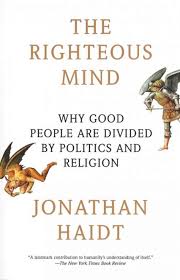
The Righteous Mind

The Righteous Mind: Why Good People are Divided by Politics and Religion
© 2013 Jonathan Haidt
528 pages

The Righteous Mind begins with a question, seriously posed: why  can’t we all get along? To find the answer, Jonathan Haidt delves into the nature of morality, following the pursuit of it from philosophy to evolutionary psychology. Haidt produces three core ideas: one, David Hume was correct in positing that people are more intuitive than rational; two,  moral concerns don’t have a singular source, but fall along six separate axes,  each derived from our natural history, despite being couched in flourished religious and philosophical language; and finally, that morality is double-edged sword, binding us with one another as well as against others. Haidt’s work is impressive in its breadth, drawing on sources as diverse as Plato, Emile Durkheim, and E.O. Wilson, and in its delivery. Though he covers a lot of territory in a compact book, Haidt constantly works to keep readers aware of how all of the ideas discussed connect together.

The grand idea underlying all this is that morality is neither an objective truth that can be deduced via logic by anyone old enough to reason, nor is it completely subjective, an artifact of culture that is deposited into a blank slate of our infant minds. It is instead a product of evolution. Our instincts for morality are kin to our sense of taste:  there are different flavors of moral concern, and each of them played a part in our species’ development. The natural basis for morality is being eagerly explored by scientists like Frans de Waal, who has demonstrated how chimpanzees can empathize with one another, and sense when others are being treated unfairly.  Caring for one another is a mammalian strength, but there is more to morality than care and fairness. There are also senses of loyalty and deference to authority useful to tribes competing against other tribes, and a sense of ‘sanctity’ that buds off our natural feeling of disgust that keeps us away from unhealthy influences. Our instincts may be strengthened by rationalistic arguments or ritual, but neither can conceal their source,  nor operate independently from it.

Haidt sees our moral-political instincts as particularly far-developed as compared to other primates, though. Although alphas in chimpanzee troops do have a political role in mediating disputes, they are not kings: they do not command the tribe to go here or there, or make plans for its future well-being. Haidt believes natural selection has favored our ‘righteous’ (political-religious-moral) instincts in this regard  out of necessity, because for thousands of years we’ve had to regularly deal  with so many of our own numbers:  instincts which promoted order and cooperation were favored, and those populations which most exhibited them flourished, while populations that didn’t disappeared. Religion, too, played a powerful part. In Haidt’s view, we are not merely instinctive creatures who one day stumbled upon culture and started happily passing it down to the next generation like a good stick. We have evolved to be dependent on culture, and this is why religion is such a universal and powerful  trait of human kind.  Religion is first and foremost about morality and keeping the tribe together:  ideological religions like Christianity and Islam are fairly novel.  

These instincts are not part of the past; they are present, with us now.  Haidt examines US political parties by this six-taste model and concludes what while liberals depend strongly on the Care and Fairness feelings, and Libertarians are somewhat obsessively fixated on the Liberty-Oppression axis (which is a ‘new’ taste that developed fully after we’d become tool-users), conservatives draw marginally from each ‘taste’ equally across the spectrum.Like all products of evolution, our righteous instincts are a trade-off. A dog with long legs runs fast, but loses heat more quickly than a short-legged rival — and morality which evolved in the atmosphere of inter-population competition is all about Us vs. Them.  When we rally towards an ‘us’, we draw away from a ‘them’.  In light of that, Haidt ends the book by offering ways people of varying political opinions can argue more constructively. He first asks readers to keep in mind that people who disagree with us may simply be drawing on another set of instincts and beliefs:  you are not the center of the universe, and those who are different from you are not the Evil Villain set against you in some colorful psychodrama. We must labor to discern where people are coming from if we intend to communicate. Secondly, he draws on his own experience as an idealist-turned moderate to detail what liberals, conservatives, and libertarians can learn from one another: markets are magic, but not perfect — and if something isn’t  good for the beehive, it can’t be good for the bee.

The Righteous Mind is  astonishing:  the argument masterfully organized and sympathetically voiced from an author who distills a wide range of research from across the intellectual spectrum into a reflective, wise work.  This is very much recommended.

Related:

Posted in Reviews | Tagged , , , , , , , , , | 9 Comments

A Quick Book Survey

From the Broke and the Bookish:

1. The Book I’m Reading:
I’ve just started Paleofantasy by Marlene Zuk, which casts a critical eye toward arguments that we should live more like pre-agricultural man. I’ve read Zuk before, in Sex on Six Legs, about insects. At lunch I’m reading from A People’s History of the Supreme Court.

2. The Book I Just Finished:
 I last finished  Save the Males, by Kathleen Parker. I found it while looking for books on males and masculinity on Amazon, and it turned up while I was shelving recently returned books at the library. Obviously, Fate wanted me to read the book. I wasn’t too much impressed by it. Better luck next time, Fate.

3: The next book I want to read:
Power, Inc — the Epic Rivalry Between Big Business and Government, David Rothkopf.

4. The Last Book I Bought:
Radicals for Capitalism: A Freewheeling History of American Libertarianism, Brian Doherty.

5. The Last Book I Was Given:

I haven’t gotten it yet, but will receive it next week: Lost Scriptures: Books That Didn’t Make It Into the New Testament, Bart Ehrman.


Posted in General | Leave a comment