
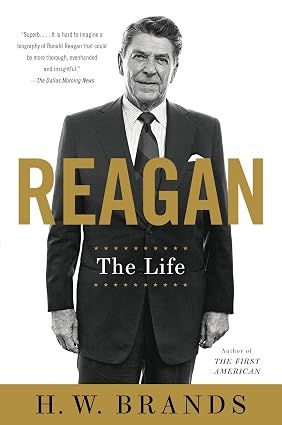
Unlike many of the presidents on this list, I approach Reagan: The Life with a fair bit of familiarity. Reagan was just a name to me until he died in 2004: my parents and I were taking our last vacation together and we arrived in Vicksburg to the news that the president had passed away. I was bothered by their grief enough to look into Reagan, and would read his autobiography as well as start listening to his speeches: to this day, I can still quote portions of “A Time for Choosing”. I tend to like him a great deal as a man, and that’s probably a good thing: I don’t know that I would have survived a thousand pages of H.W. Brands otherwise.
One thing I have learned from my presidential reading project is that I greatly prefer character-oriented books over policy-oriented ones; Brands definitely focuses on the sausage-making aspect of politics, with extensive coverage of Congressional hearings, Cabinet back-and-forths, and press conferences. This is an extremely detailed political biography, which should be attractive to policy wonks but I suspect would struggle with the average reader. I wound up reading this because the leading alternative, Dutch, appears from the outside to be more about its author than its subject!
We meet Reagan as the young son of a struggling alcoholic, a fate that gave Reagan an early sense of insecurity and a drive to make it good. He realized fairly early on that he could entertain people, and that he liked it. He wanted to do more of it. He wanted to go to Hollywood, in fact, and to that end he got into radio as a means of building an audience. Reagan as baseball-announcer is one of those bits of trivia that has endeared me more to him, especially after learning that one night when the telegraph news service failed, Reagan was forced to improvise to keep his radio audience listening; for several minutes he brought to life entirely fictional events until at last the telegraph started transmitting actual details of the game again. Reagan was among the multitude who looked on FDR as a godsend, idolizing him and quoting him for the rest of his life, even as he became a Republican who was more hostile toward the expansion of big government that FDR embodied. To Reagan, FDR embodied optimistic leadership and the willingness to try; that was something Reagan would impart on his own, especially during his presidency when he declared that it was morning in America again.
Reagan was able to put his face before the public through the film industry, both in commercial movies and government work; he often appeared in patriotic war movies. His association with the film industry led to politics in another way when, when as president of the Screen Actors Guild, he defended it against both Communist infiltration and the government’s desire to meddle: he insisted that SAG could and would keep its own house in order. I did not realize until reading this how much Reagan’s ease with the media marked his life; I knew it got him started, as he gave lectures for General Electric (one of them growing into “The Speech”, or his “Time for Choosing” piece that is now a canon of Goldwater-period Movement Conservatism), but even after he’d served as governor he returned to radio. He said people would get tired of him on screen, but not on the radio – and I suspect he knew what he was talking, because Reagan had a superb speaking voice. Like Obama or Roosevelt, I enjoy listening to him even when I disagree with the contents of the speech.
Reagan’s time as a governor appears to be largely marked by fiscal policy and law-and-order. He governed California when student revolts were taking over campuses like UCLA, and he took a hard line on protesters and strikers who threatened the public good; this also marked his presidential tenure, as he fired air-traffic controllers who went on strike under the Coolidgean principle that there was no right to strike against public safety – by any one, at any time, any where. He was not as successful as POTUS in reining in fiscal policy: while he was able to push through changes to the tax code to simplify things, his belief in supply-side economics did not produce the revenue windfalls he’d hoped for. Instead, in conjunction with enormous increases in defense spending, deficits soared.
The largest part of Brands’ coverage of Reagan’s presidency is focused on foreign policy, which was rather lively in the 1980s. The Soviets were waist-deep in Afghanistan; Iraq had attacked Iran and the two powers would throw warm bodies at one another for nearly a decade, both partially supplied by the United States. It was Iran that got Reagan in a bit of trouble, as he authorized selling Iran limited amounts of equipment in order to rebuild relationships with the new regime, as well as pressuring them to twist elbows to release American hostages in Lebanon; because Reagan had a detached leadership style, giving his subordinates objectives and then letting them go, this resulted in Iran being sold arms and the money then being funneled to fight Commies in Nicaragua. Neither selling weapons nor giving money to fight Commies is inherently bad but there were explicit laws against selling weaponry to Iran and supporting the contras in Nicaragua. Brands believes that Reagan’s subordinates genuinely took liberties with their general instructions, but that in the end it never amounted to the Watergate-esque scandal it could have been. Even the designated fall guy for Iran-Contra, Oliver North, was a free man by the mid-1990s. The biggest part of foreign policy, though, was Reagan’s relationship with Mikhail Gorbachev; Gorby came to power as Reagan was being reelected, and both were interested in nuclear arms reduction. They came very close to a commitment at Reykjavík that would have removed both countries’ stockpiles, limited only by Reagan’s commitment to SDI, which Gorby saw as tantamount to weaponizing space.
There is an enormous amount of detail about Reagan’s administration in this book, but as with some other books I was frustrated by not seeing more of the man. Admittedly, that owes in large part to my preference for characters; it’s the reason I’ll read multiple books on minor figures like Franklin Pierce, because I find it fascinating that a former president would willingly make himself a pariah despite his sorrows by repeatedly defending his friend Jefferson Davis. I always like it when I get a glimpse of a president’s inner life, like Truman devotedly reading books on Lee and Stonewall Jackson, or Reagan reading Coolidge biographies: we don’t get that in this book. It’s more about Reagan the politician rather than Reagan the man, and while there’s an awful lot of content, it didn’t quite deliver what I was looking for. Good read on the whole, though. Other audiences may find it absolutely stellar.
Coming up: Launching LBJ and a possible short-round. I’m house-sitting in the deep woods with no internet and anticipate doing a LOT of reading this weekend. I am hoping to take out McKinley (um, not like Czolgosz) and Polk this month so LBJ can get the last hurrah.
Quotations
“In this country, if you decide to play ball and use an umpire, you obey his decisions.”
[Reagan] added that he would be more respectful of the rights of the states. “All of us need to be reminded that the federal government did not create the states; the states created the federal government.
“I believe the government is supposed to promote the general welfare,” [Reagan] quipped, “I don’t believe it is supposed to provide it.”
The MAD concept never made anyone very happy.
‘I have to believe the Russian people are no different from Americans,’ [Reagan] would tell [his son]. ‘Hell, they’re victims of their own government. Why should millions of them have to die, along with millions of our people, because leaders on both sides couldn’t work things out?’
Reagan wasn’t calculating, but he was canny. He was, in his own way, sincere, but he understood the difference between words and actions. Other administrations have played the bad-cop, good-cop routine by assigning the separate roles to different actors. The brooding John Foster Dulles was the heavy in Eisenhower’s administration; smiling Ike was the one the people liked. Zbigniew Brzezinski tried to stiffen Jimmy Carter’s spine; Cyrus Vance sought to make it flexible. Reagan played both roles himself: one in words, the other in deeds. He thundered against Soviet perfidy for the television camera, and he meant everything he said. But the substantive measures he took against the Soviets were remarkably modest.
“A nuclear war cannot be won and must never be fought.”
“Yet Reagan’s insistence on seeing the good side sometimes worked against him. His staff bouyed their boss by sharing favorable responses and arranging appearances before friendly crowds. They told him he ‘done good’ even when he hadn’t. This kept the spring in his step and the smile on his face, but it also kept him from hearing bad news he needed to hear.IN HIS DAYS as chief of staff, James Baker had kept in his files a document titled “Rumsfeld’s Rules.” Donald Rumsfeld had been Gerald Ford’s chief of staff, and he shared with Baker what he had learned in the job. Rumsfeld’s first rule was “Don’t play President.” Twelve pages of additional rules followed, culminating in the last: “Don’t play President.” Baker himself added his own précis of what a chief of staff must never forget: “Nobody elected you.” If Don Regan ever read Rumsfeld’s rules or heard Baker’s version, he didn’t take the lesson.
“I am increasingly convinced of something I knew previously only second-hand,” Gorbachev said. “The president of the United States does not like to retreat.”


