One Year After

One Year After
© 2015 William Forstchen
304 pages
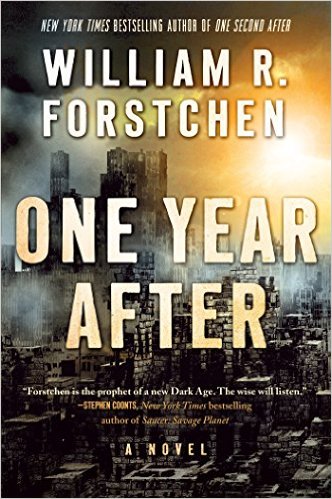
It’s been two years since an EMP blast reduced most of the United States to medieval conditions. After cars and the electrical grid failed, everything went to hell — complete with hordes of the damned, mobs of men and women given over to madness attacking anything in their path. In the aftermath, starvation and disease again reared their heads, killing millions. Colonel John Matherson was a history professor on the Day of the attack, but in the wake of the chaos became the commander of his community’s defensive forces.  He could do nothing against the death of his daughter and other loved ones by disease, but he could fight gangs, and so stand for the rule of law as to prevent his own friends from becoming monsters themselves.  In One Year After, we find Matherson and the town council of Black Mountain attempting to rebuild, nearly on the verge of establishing a electric generator. But beyond the mountains there is a continent of forces fighting for chaos and order, and  the fair city of Black Mountain has caught their eye.  As Matherson attempts to negotiate a peace between his city and a smaller community nearby, the area becomes of interest to a Federal government attempting to reconstitute itself.  Torn between hope that this is a genuine start to national recovery and his fears that the ‘federal administrator’ isn’t on the level,  Matherson and Black Mountain stand cautious, and are ultimately caught up in another life-and-death struggle.

One Second After read like a science-fiction horror story, chronicling a catastrophic breakdown of society; One Year After’s story is far less harrowing, being mostly politics and combat as Matherson works with his neighbors and the government in nearby Bluemont that claims to be the legitimate government.  Black Mountain has weathered the worst of the breakdown, but  its neighbors spell trouble. Not only is there constant feuding between mountain clans that frequently bleeds over into his city, but those warring tribes have caught the attention of the Bluemont government. The United States’  overseas meddling has for once paid off;  the troops and equipment stationed outside of the EMP bursts are alive, kicking, and back in the states to restore order.  At the novel’s opening, a draft has been imposed on the populations in contact with Bluemont, as it is attempting to create an Army of National Recovery to put an end to the multitude of highwaymen and cults now peppering the landscape.  Faint broadcasts from the BBC hint that interesting goings-on are happening around the globe, dropping secret messages to ‘friends in Montreal’ or Prauge, and detailing the ongoing failure of Bluemont to  put down a monster ruling in Chicago while the Chinese occupy California.. As the plot of the book unfolds, Matherson increasingly suspects that this new Federal authority isn’t one worth of trust, and eventually has to make a decision:  conscience or convenience.   Temptation is an ongoing theme here in his social balancing act;  how easy would it be to say to hell with his raiding mountain neighbors, instead of swallowing pride to make a peace with them; how simple his life would be if he would simply throw his lot in with Bluemont. Time and again Matherson hovers between what he believes is right, and what seems right, with Forstchen using cigarettes as a visual clue.  Accept an offered smoke and enjoy immediate satisfaction…but at the price of reviving a long-beaten addiction.

Although One Year After doesn’t  have the immediate punch that One Second After did,  the firefights amid abandoned and repurposed sights of urban decade are well done, especially as they happen alongside Matherson’s frequent soul-searching bouts of tough decision making. I appreciated the nuance here; unlike Patriots,  antagonists are redeemable — even the Feds.
Posted in Reviews, science fiction | Tagged , | 5 Comments

The Battle of the Atlantic

The Battle of Britain
© 1977 Barrie Pitt, series editor William Goolrick
208 pages
Time-Life History of WW2

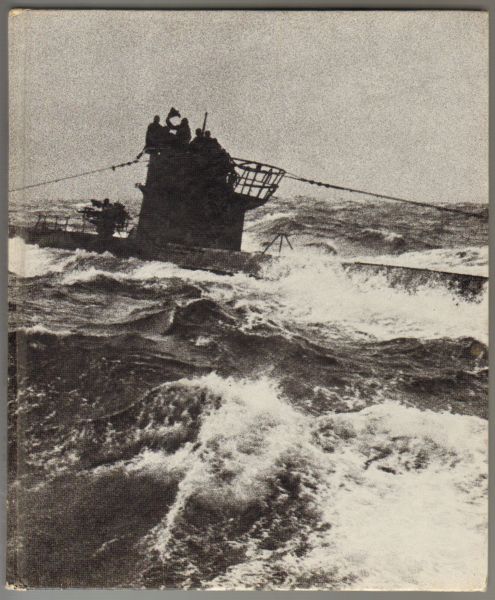
Long before panzers roared through Paris and Stukas littered the fields of France with burned-out machines, the Phony War existed only in name. The months of silence on land in Europe that prevailed between the Allied declaration of war and Hitler’s spring seizure of everything in grabbing distance were loud indeed on the sea — filled with crashing waves as U-boats and raiders  plowed through the waves hunting for supply ships to sink.  So sooner had the war begun than ships inbound to England were being sent to the bottom, and with them precious lives and supplies.  The threat of strangulation by U-boat had imperiled Britain before, during the Great War, but naive trust that future conflicts would abstain from a now verboten weapon  meant Britain’s neck was again on the line. Battle of the Atlantic, part of the Time-Life history of World War 2,  combines full-page spreads and photo essays to deliver a sense of the action and peril at sea, where civilians were military targets and the stakes were never higher for the Allies.

Unlike the Battles of France and Britain, the Battle of the Atlantic stretches out over not weeks or months, but years. Despite catastrophic losses — over half the boats and lives committed by German to the U-boat fleet would be claimed by the sea —  Germany continued producing and sending out submarines against Allied shipping until the very end of the war.  The worst ravages would be over by 1943, but for Britain and her allies, the struggle was uphill. Lessons of the Great War’s  anti-submarine campaigns had to be relearned, and new strategies created as the U-boats came this time not alone, but in radio-coordinated packs.   The convoy system was Britain’s best hope, comprising multiple cargo ships guarded by whatever escorts could be found.  Escorts were not necessarily warships, even aged ones; a fishing trawler equipped with racks for depth charges might qualify for duty.  The U-boat menace could have been even more dire had Hitler committed naval resources to a full undersea fleet, instead of insisting on a ‘balanced’ fleet that involved big and shiny surface ships like the Bismarck, which made for great press but poor strategic weapons.   The Allies also produced new weapons to take down the U-boats, developing shipboard radar that could locate vessels on the surface of the sea, where — despite their name — Unterseebooten spent most of their time.  They also learned to use the U-boats’ frequent radio communication  (vital in coordinating the wolf packs) to triangulate on their position, and began to incorporate airplane patrols to boot.    By the time the German command realized  how advanced British radar had become and began to develop countermeasures,  Germany was waist-deep in Russia and fighting an Allied invasion of Rome. The combination of bitter experience, new tactics, new weapons, and increasingly green and scattered German mariners, broke the wolf packs’ control of the sea.

The Battle of the Atlantic is valuable as a brief overview of the naval war between the Allies and Axis, providing raw data as well as first-hand accounts by both British and German mariners (sometimes from the same battles) to put the reader on the deck of their subjects. There is also a collection of art produced by  sailors who wanted to recreate the scenes burned into their memory, like the despair of huddling lifeboats, watching as their home sinks into the deep. I appreciated the attention given surface ships at the beginning, and the surprising chapter on Caribbean altercations. The data presented is also surprising —  while I knew U-boats patrolled the eastern seaboard of the United States, the amount of tonnage sunk places the seaboard as one of the most perilous places to sail, along with the ‘western approaches’ that paralleled German U-boat bases in France.

Posted in General | Tagged , , , , , , , | 3 Comments

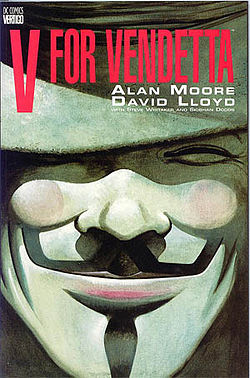
V for Vendetta

V for Vendetta
© 1988 Alan Moore and David Lloyd
300 pages

Remember, remember the Fifth of November.  The Britain of 1998 is a nation that has lost its spirit,. After nuclear war and crop failures, widespread disorder was quelled only by the face of a fascist order, Norsefire.  Controlling the country through ideology, violence, and a computer known as Fate, they rule over a bleak place whose greatest claim to fame is that it at least survived the nuclear war. Vast portions of Earth — including Africa — are simply “not there”.     Enter “V”, however,  a mysterious masked marauder who dreams of inspiring the people of this Airstrip One-in-the-making to revolution. Channeling the story of Guy Fawkes, who was caught attempting to blow Parliament to perdition,  V is at the story’s start engaging in a two-year propaganda campaign involving blowing up symbolic institutions, while at the same time close to finishing a vendetta against people involved in an insidious concentration camp experiment.   The story is much the same as the movie based on it — a woman named Evey falls in with V as a detective named Finch tries to find the man responsible for so much bedlam — but there is significant characterization here completely missed on the big screen. Detective Finch, for instance, nearly destroys his mind with drugs attempting to get a handle on who V is and what he wants.  Although V orates on the distinction between anarchism and chaos — “without rulers” and “without order” —  the story is more effective at communicating the importance of myth to the human imagination, of legends and symbols.  The historical story V appropriates has little bearing to his actual ideal; Guy Fawkes intended no revolution, but the restoration of England’s traditional order against rising Puritanism in Parliament.  What matters to V, however, is that people see and remember him as a revolutionist; ultimately, V himself becomes the symbol.   As much as I like the movie (I watched it three times in two weeks), this graphic novel did a better job reminding me of and supplementing the dramatized version that it did winning me over in its own right.

Posted in Reviews | Tagged , , , , | 3 Comments

Teaser Tuesday

“They believed in the righteousness of their cause, the inevitability of their victory, and the immortality of their young souls. And as they wheeled around to the east and pulled out their Michelin maps of Tunisia, they believed they had actually been to war.”

From An Army at Dawn: The War in North Africa, 1942- 1943. Rick Atkinson.

Posted in General | 3 Comments

A War, a Challenge, and a Goal

I’ve been on a World War 2 kick recently, and have now connected it with the remains of the 2015 Reading Challenge. An Army at Dawn, the first in a nonfiction trilogy about the liberation of Europe from Nazi oppression, begins with the Anglo-American invasion of Africa. I’m halfway through to finishing my Pulitzer-prize winning book, leaving only “A Classic Romance” and “Title with Antonyms” as the only categories needing any real attention.   This 1942 work skews my WW2 set a bit, as I’d been trying to generally follow the course of the war, but no matter. As it continues I’d like to poke into areas of the conflict I know virtually nothing about, like the Nazi/Soviet invasion of Norway/Finland respectively, and the early stages of Axis involvement in Africa.  In 2016 I should return to the Great War, as the titles I listed last year will then be selling cheaper, or at the very least, no longer on the ‘new releases’ shelves and thus barred from interlibrary loan.  
   

My WW2 kick has extended to movies, as well.  In the last couple of weeks I”ve watched two titles new to me:  The Scarlet and the Black, featuring Gregory Peck as an Irish priest hiding Allied P.O.W.s from the Nazis, and Good,  the descent of a German literary professor into Faustian moral degradation.   I bought these two together, intentionally; I knew Good would be utterly depressing, and needed some good old-fashioned heroics to recover from it.   The central character is an professor approached by the SS: they liked his novel about a man who killed his wife to save her from a prolonged and painful death by cancer, and want to enlist his services in promoting the Reich’s euthenasia programs.  Bit by bit he drifts into the Nazi camp, losing his wife and best friend in the bargain, until at movie’s he finds himself supervising a death camp, an SS-skull perched stop his head, and realizes that hell is real and it owns his soul.

..it’s a bit of a downer, so if you watch it I advise you to take my remedy, and follow it immediately with something inspiring or at the very least funny. As the theme of Good was that evil triumphs when good men do nothing, I had in The Scarlet and the Black a good man doing..something, and it’s a true story to boot. (It’s worth watching, incidentally, just for Peck doing an Irish accent.)  I have a few more WW2 movies on the way, including The Battle of Britain,  Run Silent Run Deep, and A Bridge Too Far.

This being November, I’m doing NaNoWriMo for the third year in a row, but it’s nothing serious. I’m doing a…video game fan fic with Maxis as my source material.  It’s really just for fun. Honestly, in the years I’ve done NaNoWriMo I’ve not yet done a proper story. I just sandbox around for 50,000 words and collect my “WINNER!” graphics.

Well, it’ll be an interesting month, that’s for sure!

Posted in Reviews | Leave a comment

Images of America: Selma

Images of America: Selma
© 2014 Sharon Jackson
168 pages

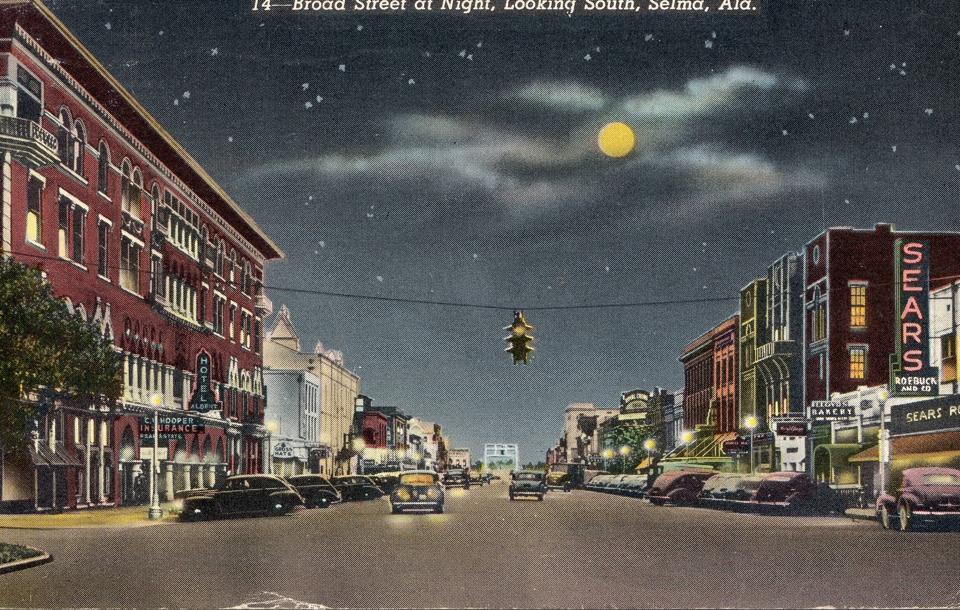
When I heard that the Images of America series had commissioned a book on Selma, I stood midway between excitement and dread. The series offers a pictoral recounting of small-town America, an experience overlooked by standard histories, but Selma for most is less a town and more an image — a memory of violence.  This collection of photographs was done by an author who loves the town, however, and accords her a just tribute.  While not overlooking the role of Selma in the Civil War and the Civil Rights movement,  Images renders a view of the town itself, a booming center of agriculture and wholesale commerce, a place that generations have cared for and loved.   Long before nation-wide political movements decided to use the town to make history, Selma had its own proud history.  Sited upon the bluffs of the Alabama river, it found early success as an agricultural boomtown, and the aggressive pursuit by city fathers of railroads ensured it commercial prosperity throughout the 19th century, surviving even the arson of an invading army during the Civil War.  Selma’s industrial importance to the Confederacy was then second only to Richmond, a fact lost on modern residents who  see it as a chronic small fry.  Selma attracted its fair share of immigrants during the gilded age, especially Jewish families from central Europe, whose shops lined the stretch of the city’s central Broad Street. The city these residents across the generations built was utterly beautiful, and though some of that has faded through the years — the trees lining Broad Street lost to utility poles, the magnificent Hotel Albert deemed too costly to maintain and bulldozed — the city still boasts one of the largest intact historic districts in the nation. There is no shortage of homes whose stately columns and beautiful cornices make one feel like a Goth wandering amid the ancient beauty of Rome.    Selma is not merely a celebration of beautiful architecture and booming enterprise, however. Like another book in this series, Montevallo, this is something of a family album.  People, not buildings, dominate the pages — from city fathers to contemporary politicians, each with their story. Jackson integrates the lives of Selma’s citizens with nation-wide social movements, particularly women’s suffrage and the Civil Rights movement.  Jackson does not shy away from the darker side of Selma’s history, its agricultural expanse going hand-in-hand with a massive population of people held in slavery,  people whose ancestors remained held back by Jim Crow legislation for a full century after the war. Those who fought in ’65 — in both centuries — are honored for defending their homes and and personhood.  Images of America: Selma is markedly balanced and contains photographs that even someone who collects them — someone like me — hasn’t seen.

Posted in history, Reviews | Tagged , , , , | 1 Comment

The Way

The Way: What Every Protestant Needs to Know About Orthodoxy
© 2007 Clark Carlton
222 pages


  If Protestantism is a willful child of the Catholic church, what is it to the Orthodox?  What is the Orthodox faith for that matter, Catholicism with more beards and fewer popes?  The Way  begins with the  unexpected conversion story of its author from a Southern Baptist seminary to a faith thought to be the sole province of Greek and Russian immigrants  before articulating the core aspects of the ancient faith – the Trinity, the Church, and the Eucharist which brings them together – as they stand in relation to the doctrines of most American Christians. Although Protestants defined themselves against the authority of Rome, their doctrinal stands nonetheless render them separate from Orthodoxy – so separate, in fact, that Clarkson believes Protestantism constitutes a separate religion.  In The Way,  readers of all stripes will find an introduction the Orthodox  theology, and Protestants will find a particular challenge to their views on sola scripture and the role of tradition.

After easing readers into the book with his conversion story, which unfolded amid a fundamentalist takeover of a southern baptist college in the 1980s, Carlson shifts to theology.  The Trinity is a crucial concept to Orthodox theology, as it establishes God’s nature as rooted in relationship.  “God is love” does not  simply mean that person called God happens to be loving; His very nature is bound up in the act of the Incarnation, just as the Church’s nature is contained within the Eucharist. The Church, Clarkton writes, is not a body of people who believe the same thing, but a community which shares in the living body of Christ.   In less heady chapters, Carlton argues against sola scripture from various grounds, namely that no one interprets scripture without a tradition; Calvinists read the bible through Calvinism, Lutherans through Lutheranism, Arians Arianism, etc. The Catholic-Orthodox tradition at least has the merit of being the source of the scriptural compilation, as it took several hundred years for a definitive collection to be established by the Church.   The Eastern Orthodox church has no qualms regarding protestant rebellion of papal authority, for they too reject it;  but in Carlton’s view the protestants have erred seriously in rejecting all authority. Scripture alone is insufficient; every heresy has come armed with its chosen scriptural arguments, and the massive variety of commentaries on the scriptures demonstrate how subjective readings can be.  The leadership of the Church resolves heresies not simply by finding scripture, but interpreting them in the light of the Church’s nature. Arianism was a heresy not because it chose the “wrong verses”, but because it effectively denies the Incarnation,  and with it the church’s very life.  If the Bible were so important to Protestantism, why then did they modify it — dropping books as desired?  Christ left a Church, not a book, writes Carlton, and  sola scriptura reduces the Bible to a rule book and Christianity an ideology, while the  Orthodox faith is a life lived in Jesus, through the Eucharist.

Carlton has a talent for making theology comprehensible, though he is an author who frequently bares his teeth, with a contempt borne of familiarity for aspects of modern Protestantism.  Sola scriptura no doubt dies hard, just as strict Constitutionalism dies hard: how easy it is to endue an object with objectivity, in the hopes of satisfying our need for something that is wholly True. But the Bible is not God; it is merely inspired by him, writes Carlton, and to worship it is to commit idolatry. In a finishing touch, Carlton scrutinizes the creeds of Protestant sects to point out what they truly worship, comparing the opening lines of the Nicene Creed (“I believe in One God”) with articles of faith like the Westminister Confession, which open placing scripture at the forefront and then address God.  If nothing else, The Way does much to  demonstrate that the Eucharist was far more important to the early church than a once-a-year knocking back of grape juice does credit.

Posted in General | Tagged , , , | Leave a comment

I Saw it Happen in Norway

I Saw It Happen in Norway
© 1940 C.J. Hambro
292 pages

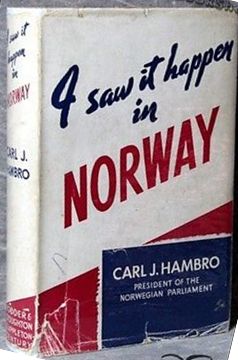
I Saw it Happen in Norway is a rare account of Hitler’s early expansion,  the story of a nation’s downfall told first-hand from a surviving member of its government and published during the war’s dark hour of 1940.  The account exposes Hitler’s war as nothing but naked, brazen aggression from the beginning.  Germany had no historical grudge to settle  or land to ‘redeem’ from Norway as it did with France and Czechoslovakia;  relations between the two northern powers were nothing but amicable.  And yet, in the early spring of 1940, German troops materialized from  false-flagged commercial transport ships, and the Luftwaffe began reducing the land’s cities and towns to ashes. This was more than war; this was treachery.   In I Saw it Happen, a leading member of the Norwegian governments records how he and other officials realized nearly too late that they were being attacked,  and records the first weeks of resistance.  Coordination at first reduced to shambles by the concentrated Nazi attack on Oslo, the Norwegian army nonetheless managed to re-form enough to fight a rear-guard action, allowing the King, the crown prince, and leading officials to  take a government-in-exile out of the country.  The Norwegians were not alone in the defense of their nation, aided by British and French troops who crossed the North Sea in early recognition that the phony war was over.  Before the first month was over, however,  the Wehrmacht’s invasion of France forced Allied retreat and Norwegian recognition that overt military defense would not long be practicable;  without munitions, resistance sustained by the hope that the tide would turn would be Norway’s best option.   Brief as it is,  I Saw it Happen demonstrates how quickly the brutality of World War 2 began, and how immediate heroic resistance could be.

Posted in General | Tagged , , , | 1 Comment

Battle of Britain

Battle of Britain
© 1980 Len Deighton
224 pages

“When I told them that Britain would fight on alone, whatever [the French] did, their generals told their  prime minister and his divided cabinet, ‘In three weeks England will have its neck wrung like a chicken.’  Some chicken!  Some neck!” – Winston Chuchill,

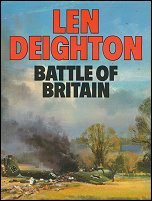
In 1940,   the whole of Europe lay under the flags of brutal  tyrannies, fascist and Soviet alike. Having rolled over France with ease, Hitler bid the English to lay down their arms; acknowledge him as master of Europe, and the struggle would be over.   Hitler, it seems, skipped Napoleonic history altogether;  not only did he miss l’empereur’s blunder in Russia, but the fact that Britain was no stranger to defying a continent arrayed against it.   Such defiance could be broken, however, through force of arms:  Britain’s army had barely escaped the continent via Dunkirk and left much of its equipment behind. Its only hope lay in the Royal Air Force, protecting both the Isle and a Navy shielding convoys and guarding against invasion. Through a long summer, young men took to the air for the frantic defense of their home, fighting a battle so vicious that mere survival counted for victory. The Battle of Britain is justly called, however, for it summoned to action civilian and servicemen alike. As sons and brothers fought in the air, those unable to fight  stood their ground below, watching for the enemy and turning back the flames of war,  both parties enabling Britain to carry on. Len Deighton’s Battle of Britain offers a day-by-day account of the summer and brims over with information valuable to  younger research students and casual readers alike.

Battle of Britain is nearly less narrative than reference material. There is a story here, not nearly as tightly told as With Wings as Eagles,  but delivered ably. What jumps out here is information — orders of battle, tables of planes produced and destroyed,  schematics of Spitfires, Hurricanes, and ME-109s, illustrations of how radar worked on both sides of the Channel,  and gobs of photographs. There are photographs of letters and generous excerpts from after-action reports and diary entries from both sides of the conflict.   The layout is impressive, too; all these graphics are not cordoned off by themselves, or simply stuck in every now and again; Deighton integrates the two, so that a chapter on Operation Sealion begins set against a photograph of German troops practicing beach landings.  There are generous maps, and even full-spread illustrations of a typical RAF base. At times there’s so much competing information that one loses track of the narrative – tables! Photographs! Sidebars! — but only occasionally.

There is a story, however: after a brief history of military aviation during the Great War and afterward, Deighton leads into the months of constant struggle. He focuses more on tactics than strategy, but essentially Dowding’s accomplishment was to prevent the RAF from perishing by attrition. British factories were humming with production, but Germany’s war had been a long time in the making and its Luftwaffe out-gunned the competition. The RAF proved discretion the better part of valor; not by running, but by choosing the best ground and best time to fight. Earlier in the year, at Dunkirk,  British leadership had made the choice to use airmen only sparingly, knowing what lay ahead. Here, too, the RAF is used with caution. Had Fighter Command heeded the impulse to make an all-out defense of the nation, Britain may have very well been “bled white”, its planes exposed and devoured:  instead,  the Germans were allowed to fly in force, and the fighters scrambled to make the best of opportunities, making quick stabs instead of prolonged duels. Deighton also gives generous space to the civilians and troops on the ground, who defended Britain in their own way — spotting the enemy so the RAF could intercept them and restoring order to the chaos German bombs attempted to create.  As summer gave way to fall, the season for invasion passed, and the Germans increasingly distracted themselves by bombing cities. The darkest hour was not yet over, but the RAF had seen the nation through the worst of it.

“I have always loved England, but now I am in love with England. What a people! What a chance! …we shall, by  our stubbornness, give victory to the world.” – Harold Nicolson,  July 1940.

Related:
With Wings Like Eagles: A History of the Battle of Britain,  Michael Korda

Posted in Reviews | Tagged , , , | 3 Comments

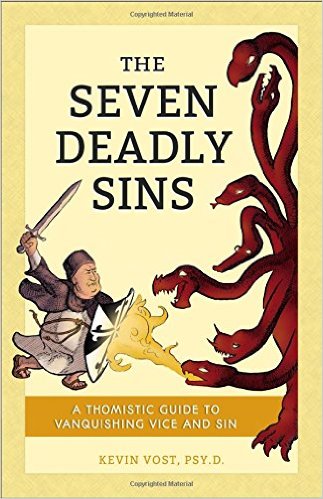
The Seven Deadly Sins

The Seven Deadly Sins: A Tomistic Guide to Vanquishing Vice and Sin
© 2015 Kevin Vost
224 pages

In the first centuries of the Christian epoch, devotees retreated into the desert wastes to flee temptation. Even away from the cry of the maddening crowd, however, they found themselves struggling with the everyday vices of mankind — tendencies toward pride, apathy, lust, envy, gluttony, anger, and sloth, and so on. In an attempt to organize a campaign against them, the monk-progenitors first had  to identify the enemy, creating a list of the chief frailties that all others stemmed from.   These seven enemies of the soul are not uniquely Christian sins;  they are universal problems of the human condition, and Vost draws on classical sources (Aristotle and the Roman Stoics —  Seneca, Epictetus, and Marcus Aurelius) for both insight and remedy.  The remedy is only partially philosophical, however, as Vost also counsels readers to seek help in the sacraments of  the Church, especially Confession and the Eucharist.   Written in three stages, Vost first reviews how these seven in particular were singled out,  shares patristic thought on the progression of vice from initial impulses to behavioral habit, and then offers a “Jacob’s ladder”  route away from downfall.  These include practices useful against every vice, while some are sin-specific.  A few of the ‘rungs’ — an examination of conscience, mental awareness of drifting into vicious habit,  and the deliberate cultivation of each vice’s counter-virtue, could easily be found in a book like A Guide to the Good Life.The master here, however, is not Epictetus, but Thomas Aquinas. It is Aquinas’  study of the desert fathers that produces a list of seven sins, and not eight — and Aquinas who offers advice for remedy, himself bringing together both the Hebrew and Greek wisdom traditions —  harnessing both mindfulness and prayer, contemplation and action, philosophical principle and sacrament.  The Seven Deadly Sins is thus true to its name in being a ‘Tomistic’ guide to vice and virtue, in effect offering laymen a guide into the  theological expanse of Aquinas.  Few people commit great evils,  but we all hindered by the same seemingly minor snares.  It is those small seed which can produce horror if left unchecked, however, and so this tidy little volume seems most valuable in the pursuit of spirituality, especially Christian.

Posted in Religion and Philosophy, Reviews | Tagged , , , , , , | Leave a comment