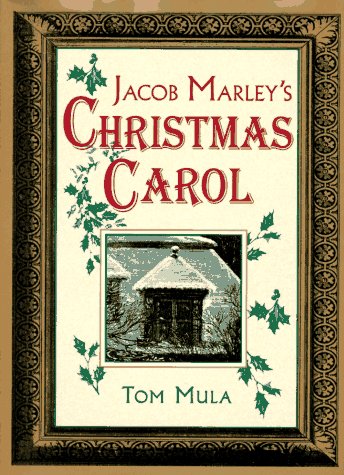
Jacob Marley’s Christmas Carol

Another week gone, another entry from the 2015 reading challenge: earlier I received “Jacob Marley’s Christmas Carol” and couldn’t help reading it waaaay too early. It didn’t take long, being a fifty-page play that’s essentially a retelling of “A Christmas Carol”, with Marley pretending to be the Ghosts of Christmas Past and Present, and being redeemed himself when he tries to take Scrooge’s place when Death appears and Marley believes his own toils with Scrooge have not yet borne fruit.  I didn’t like it nearly as much as I thought I would, in part because it’s so rushed. In Dickens’ original, Marley claims that for many years he has tried to reach Scrooge, but here he dies, learns he’s been a bad boy, and is immediately offered a chance out of foul punishment: he has to save Scrooge.  The play picks up right where A Christmas Carol starts. There’s no seven years of anguish as Marley is tormented by the weight of his selfishness, just the faint realization that all of the scorn he heaps upon Scrooge applies to him as well.  There are nice moments, though: Marley pausing during a speech on Scoorge having forged his chains link by link, yard by yard in recognition that he is damning himself, and some dark comedy when Marley and his guardian angel/demon-thing congratulate one another on a superb Death costume, only  to realize that’s actually DEATH approaching Scrooge.  That does take care of a work set during Christmas, though, so all that’s left is A Classic Romance.  It doesn’t seem hard, but I’m constantly distracted  by war and horses and — I’ve just purchased a book on the electrical grid. I’m not making it easier on myself, am I?

Posted in Reviews | Tagged | 1 Comment

The Horse in the City

The Horse in the City
© 2007 Clay McShane, Joel A. Tarr
242 pages


To the American imagination, horses are the stuff of country dreams, of farms and cowboys. This is a recent conceit, however, as for most of American history humans have shared their cities with a sizable if silent population of beautiful creatures, serving as engines of transportation and industry. They lived in herds of thousands inside the city, housed in stables that covered entire city blocks — to say nothing of their leavings, which covered the streets. They were not thought of as pets, but tools, machines which happened to breathe. Their strength was calculated, their life’s worth counted to the penny, and when electricity arrived, off they trotted into history to be forgotten. The Horse in the City is, in a word, unique; a social and economic history of how horses helped shape the American urban landscape in an age of transformation.

On the backs of horses have been mounted both commerce and war, but The Horse in the City examines equine contributions to peaceable ends alone. Transportation predominates, with horses pulling the carts and wagons that were the lifeblood of commerce, being the very means of exchange. People, too, were transported by horses, but rarely as single riders:  horses tied up at the saloon may be a staple shot of westerns, but in the city most walked or traveled in carriages, either private or in ‘omnibuses’.   Omnibuses were a primitive form of public transportation, generally transporting people (slowly) between the city to a fixed point beyond comfortable walking distance. They didn’t exist as networks, though after trains arrived the lines took on some semblance of greater connectivity.    Most horses pulled two-wheeled carts, not wagons; they were cheaper and made deliveries easier.  Mixed in with the social history are chapters of more scholarly importance, addressing the growth of equine breeding in the United States, the dispersal of stables in select cities, the development of veterinary  medicine, and the agricultural impact of having to feed so many horses.  Horses were the backbone of the economy, supporting a variety of industries directly, and providing the means for all others to be transacted. Their presence prompted city streets to widen; their pounding hooves influenced which materials were used in paving. Horses were not displaced by the industrial revolution; they were part of it. The first rail lines in cities were used not by steam engines, but horsecars replacing the calamitously bumpy omnibuses.When machines became prevalent on the farm, horses did the pulling — machines and horses together displaced human labor long before machines displaced horses.   Ultimately, electricity would out-do the complementary relationship between steam and horses, but the mark of horse hooves lives on

Some exceptional history texts can nearly take a reader back into time, and this is one; so thorough are the authors that the urban world which horses created comes alive. We are there, in streets covered in horseflesh — horses plodding along with their wares, leaving fresh material for the manure industry in their wake, horses  sometimes collapsing in the street under the burden and promptly being carried off to rendering factories, there to continue being grist for the economic mill.  Endings were not always so grisly; horses were often retired to less strenuous occupations. (Their training stuck, however:  horses employed by fire brigades retained the habit of running to their old station at the sound of a firebell, long after leaving the service!)   The grim scenery is countered with more lighthearted imagery, like the joy of sleighing season in winter.    The Horse in the City is excellent  history, with social appeal but loaded with invaluable information to research students of the period, like charts on equine food consumption.

Related:

Posted in history, Reviews | Tagged , , , , , , | 5 Comments

Blitzkrieg

Blitzkrieg
© 1979 Robert Warnick
200 pages

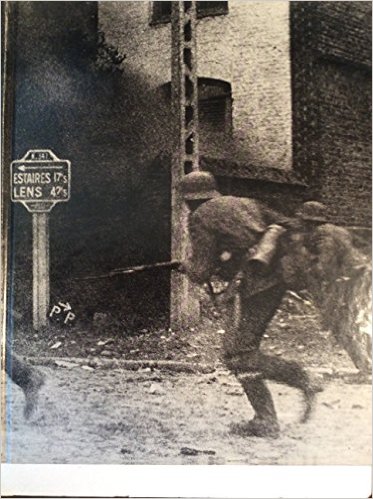
As much as I’d hoped to read Len Deighton’s Blitzkrieg, it’s weeks overdue at the library and I’m ready to close out the first stage of this WW2 reading set.  This volume of the Time-Life history of World War 2 focuses on an area familiar to virtually anyone with an interest in the war; the sudden German attack on Poland, the Allied declarations of war, a winter peace save on the Atlantic and in Soviet-attacked Finland, and an even more terrible assault in the spring that took down Norway, Denmark, the Netherlands, Belgium, and France in a matter of weeks.  This being part of the time-life series, graphics are lavish;  there is a full-scale diagram of the Panzer Mk IV, Germany’s workhorse, and bountiful photographs. Some are even colorized, and depict diverse scenes:  French soldiers playing poker in the Maginot line, Russian soldiers frozen to death in their Finnish foxholes, an English matron serving tea to arriving French solders rescued from Dunkirk and stealing a laugh with them in the midst of the death of all they held dear.  One of the photo essays covers Hitler’s art programs, and would have made this volume quite popular in the schoolroom had anyone known it existed:  aside from a few pieces lionizing strong but docile farmers, most of the prints and sculptures are nudes, and not all of the heroic Greek variety.    Content-wise, this is certainly helpful;  the text plays second fiddle to the photographs, but there are a few surprises in here. The spring invasion should not have been as large a surprise as it was, given that German pilots had crashed-landed in Belgium with sensitive information. The allies disagreed over its validity, however, and mutual distrust between them would weaken Franco-Belgian defense.  I also wasn’t aware that Stalin evicted Germans living in the Baltic states. There are connections to other books in the Time-Life series, like the chapter on the invasions of Finland and Norway. Blitzkrieg gives a better rendering of the British almost-invasion of Noway than Battles for Scandinavia, I think, dwelling more on the strategy.   Blitzkrieg is fine for an outline or survey of the war’s early action, but is most attractive for its full-page photographs, quite large given the proportions of the book.
Having covered the Blitzkrieg, the Battle of Britain, and the war in the Atlantic, it’s time to move on to 1941: bring on Barbarossa and bombers!
Posted in history, Reviews | Tagged , , , , , | 3 Comments

Convoy

Convoy: The Greatest U-Boat Battle of the War
© 1976 Martin Middlebrook
384 pages

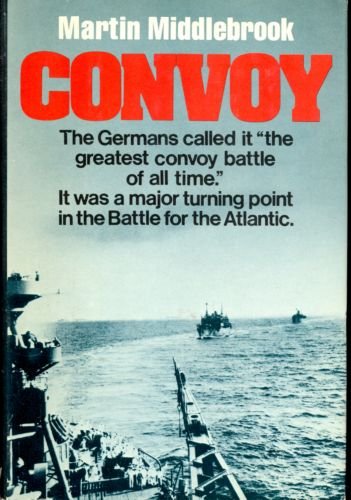
In his memoirs,  Winston Churchill admitted that nothing worried him quite so much as the U-boat menace. Britain could stand alone against a continental menace, but not without supplies from friends and her Empire abroad.  Submarine attacks on merchant shipping broke out almost as soon as war was declared, and reached their peak in 1943 as a massive wolf packs gathered and waited for convoys to appear   After an introduction which gives an intimate introduction to civilian sailors, Allied navy men, and German submariners,  Martin Middlebrook takes readers across the storm-tossed North Atlantic, following two convoys in a running battle with the greatest concentration of U-boats in the war. Dozens of merchant ships sank into the deep,  at little cost to the assailants, and Middlebrook uses the week-long drama as a case study to examine the U-boat threat and Allied responses to it. Though in part a military history, here civilian men and women are heroes as well,  fighting against their own fear and struggling together in the aftermath of attacks to survive.

 By 1943, U-boats were no longer patrolling vast areas of the ocean and pursuing alone any merchantman they came across.  They were strategic weapons, directed and controlled from Europe itself, and fed by intelligence reports that let them know when to expect victims and where.  In response to the Allied strategy of forming convoys — scores of merchant ships flanked by a handful of escorts —   U-boats gathered en masse as well, forming picket lines where they expected a convoy to pass and then converging on it once contact had been made. As its name implies, Convoy is foremost a naval drama, but aviation is an indispensable aspect of the story.  Aircraft were the mortal enemies of submarines, providing effective screens around the coast and depth-charging vessels caught cruising on the surface.  Even B-17s could only range out so far, however, leaving an “air gap” over the mid-Atlantic,a large window of opportunity for U-boats to wreak havoc unmolested. It is in that window of space, the submarine hunting ground, that Convoy sets forth in.

For several days and nights, vast and lumbering ships carrying locomotives, invasion barges, cotton, wheat, and other sundry supplies to Britain lay at the mercy of dozens of U-boats, defended by a mere handful of escorts.   These escorts were not brand new destroyers run by top-rated seaman, either, but sometimes converted civilian ships equipped with depth charges, captained by retired gentlemen who in peacetime commanded only their personal yachts. One craft in the battle was so old that the English declined to borrow it through the Lend-Lease program! The middle section of Convoy follows the constant harrying of the fleet by a formidable gathering of U-boats, and is solid historical journalism; Middlebrook constructs the story based on numerous ships’ logs and survivor accounts. The appeal is not strictly military, however; as so many of the players  are civilians in extraordinary circumstances. Logs from both Allied and German sources are used, and the details and photographs communicate the combatants’  commonality as well. Though divided by war, they are no less united in their human frailty, in their vulnerability on the open oceans and their isolation and loneliness from serving from months on end in ports and waters far from home. The book is most helpful to a student of the period, however, ending with an analysis of the battle. Despite the losses inflicted on the Allies, matters could have been worse;  while the U-boat formation was engaged in confronting these two convoys,  so thick was the Atlantic with traffic that other convoys were able to hustle through other now un-guarded sea lanes.  Within two months’ time, various pieces of Allied anti-submarine warfare would click together; the air gap would be closed with longer-ranging aircraft, and the daunting strength of the U-boat fleet broken.   At the moment recorded here, however, and for the three years preceding it, their hands were at Britain’s very throat, and Middlebrook delivers a sense of peril quite well.

Posted in history, Reviews | Tagged , , , , , , | Leave a comment

The Foxes of the Desert

The Foxes of the Desert
© 1960 Paul Carell
370 pages

When Erwin Rommel was dispatched to Africa to rescue his nation’s ailing ally against the small-but-feisty English Eighth Army, he earned the lasting respect and dread of those commanders tasked with defeating him.  The Desert Foxes delivers the story of the Second World War in Africa from the German perspective, with Rommel’s Africa Korps as its stars. Like the English who humbled an Italian army tasked with rebuilding the Roman empire, Rommel would box out of his weight for  two years until he was finally cornered in Tunisia, but the months between victory and defeat created for ‘the Fox’ a lasting reputation; he is admired even today,  hailed for his chivalry and fighting spirit.  

Although the tanks of the Afrika Korps take center stage, Carell enjoys sharing the wartime version of human interest stories, and occasionally pauses from his storytelling — which indeed it is, being no less fact-laden for its dramatization —  to deliver accounts of commandos or extraordinary aviation heroics.The action here is frantic, pitting hundreds of tanks against one another in single battles.  Momentum shifts from side to side, and several times both forces hang on the verge of utter defeat, both experiencing victory and desperation in their turn. Time is ultimately against Rommel, as British forces in the air choke him off from what few supplies drift his way, but  sheer audacity takes him  all the way to Egypt where at last he breaks on the battle-worn English defense.  The arrival of green American troops fresh off the boat allows for a few more brazen victories, but ultimately the two allied armies corner the Africa Korps in Tunisia, where — denied the possibility of retreat by Hitler’s declaration that they fight to the last bullet — the remnant surrenders.  The fast pace and fascinating little stories (like that of a general, separated from his legs by an explosion, using his last moments of life to pen a page-and-a-half letter to his wife) make for engaging history, and Carell’s German perspective adds additional interest. His book is not simply about the Germans; here, they are the protagonists,  fighting the good fight against the ‘Tommies’. While upholding the Afrika Korps as admirable soldiers and men, Carells’ opinion about Germany’s political leadership is far less friendly. (The word used for Hitler is “maniac”.)    How genuine that contempt is I am not sure, but the book stays well away from Europe and allows the reader to enjoy the narrative of strategy and combat removed from the horror of Nazi-controlled Europe.

Posted in history, Reviews | Tagged , , , , | 1 Comment

War, spam, and more war

Today I finished Spam Nation, a journalistic takedown of the spam industry which is centered in Russia. The book is a strange collection of memoir and journalism on criminal relationships so entangled that I felt like I was reading about the securities market. There’s a fascinating chapter on who actually buys products that are advertised via spam (mostly medicine that’s illegal in Europe or too expensive in the US) and how that market compares to legitimate ones, though most of the book is about two Russian  cybercriminals who dominate the arena, whose infighting over turf exposes their dirty laundry and allows the police and other interests to take them on.  It doesn’t read as neatly as @ War, but it does shed light on a murky corner of the internet. Essentially, these men use viral programs to coopt other people’s computers to send billions and billions of spam messages,  chiefly marketing black market drugs and porn but also launching  other revenue-boosters like scareware, programs that hijack a computer, announce computer infection and bid the victim to buy their security program to get rid of it. I’ve been on the receiving side of those when trying to fix relatives’ computers: they are not fun at all.  (Some disable any executable, including viral protection.)   The book is interesting, though not entirely impressive;  surely these two don’t account for all spam, given how much ‘real’ advertising is done by email these days.  The title is ambitious.

My library is currently packing up some nonfiction books to send to a newly-created rural sister library,  and a lot of books I’ve kinda-sorta wanted to read but haven’t gotten around to because I figured they would be there when I wanted to are on the list.  Trying to read them before they disappear is why I picked up Miracle at Dunkirk a few weeks ago and got into this World War 2 reading kick.

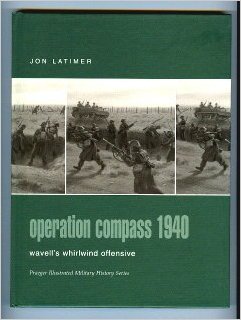
Earlier in the week I read Operation Compass 1940, a short work (80~  pages) on the early war in northern Africa, in which Italian troops set on seizing Egypt were savaged by a far smaller British force on the counteroffensive. The work was strictly military history, with good maps but a fairly narrow scope, focusing just on this particular battle.  The Italian humiliation here seems have prompted the Germans to take Africa more seriously as a campaign ground, so I’m following it with The Desert Foxes by Paul Carell.  It’s a strange work, very sentimental and war-smitten. I looked up the author to see if he’d written anything else, and it turns out he’s an honest-to-God-Nazi.  Oops. I’m still trying to find out how bad an apple he was.

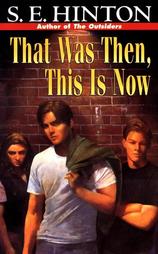
The World War 2 reading will continue for the time being, though I intend on mixing other subjects in.  For instance, I have an interlibrary loan book on order about a band of Irish immigrants who fought in the US-Mexican war…for Mexico!  Another book on the way involves….horses.  As far as the 2015 Reading Challenge goes, once I take down A Classic Romance, that will be it. I have the Christmas read already purchased, and it’s a quickie. (Tease: it’s about Jacob Marley.)  My book with antonyms was That Was Then, This is Now. If I didn’t have a mound of books on the Great War, World War 2, and cities, plus four books in the mail, I might be tempted to re-read everything Hinton.  I still may.   My self-control regarding books is on the anemic side. I know the stories, I just want to encounter the writing again.

“Your mother is not crazy. Neither, contrary to popular belief, is your brother. He is merely miscast in a play. He would have made the perfect knight in a different century, or a very good pagan prince in a time of heroes. He was born in the wrong era, on the wrong side of the river, with the ability to do anything and finding nothing he wants to do.”

(Rumble Fish, S.E. Hinton)

Posted in Reviews | Tagged , , , , , | 1 Comment

That Was Then, This is Now

That Was Then, This is Now
© 1971
160 pages

Mark and Byron were more than best friends; they were brothers. They grew up half-feral, raised by a struggling mom and struck by violence at an early age. Their fond childhood memories included fighting with other ‘greasers’, and staying up all night smoking and drinking to impress chicks. No matter what kind of trouble came their way, Mark and Bryon could charm or wiggle their way out of it…but the magic is wearing off with age.  At sixteen, adulthood is not as far away as it once was, and Bryon in particular is starting to sense his age. He can recall his youthful self in the idiotic young teenyboppers trying to strut their stuff across the street, and is beginning to wonder what the meaning of it all is.  That Was Then, This Is Now is a tragic story of the two boys as they grow apart, divided  by the choices they make and the people they are becoming.  The story is tragic not simply because relationships die, because in the end the narrator is left with nothing but anguished questions.

I read That Was Then countless times in high school, and even today it holds a coveted place in my headboard book shelf.  It’s a short tale full of  emotion, a gritty story of working-class toughs trying to figure out their place in the world. In the early part of the book,  Mark and Bryon drift along aimlessly; they fight, they hustle, they hit on girls. They both seem conscious that their lives are changing, or about to, but Mark resists and hardens himself, while Bryon is taken along by it. He becomes involved with a girl, Cathy, and for once it’s more than chemical infatuation; she becomes his friend in a way that no other girl ever has. For the first time, he’s emotionally engaged with someone who isn’t Mark, who isn’t just a beautiful lion who only cares for himself and his brother.  When Mark and Bryon witness a friend shot down for defending them,  the crack between the two widens.   Bryon begins to feel the weight of consequence, which Mark continues to shrug off, and when Bryon realizes Mark is involved in something so serious it can’t be ignored, he makes a fateful decision to hold his brother accountable.  There is no happy ending, only the realization that some things destroyed can never be rebuilt.

I read everything of Hinton I could find after encountering this book in high school, attracted by working-class characters whose lives were nevertheless completely different than my own sheltered one. (My neighborhood’s idea of a gang war involved mud balls and plums, not switchblades and broken beer bottles.) Some of Hinton’s characters have a vividness about them that despite not having read the books for well over a decade,  they still persist in my memory; That was Then‘s M&M is one such character, unforgettable despite his supporting role.  For the uninitiated, there’s a curious period charm to this as well, set as it is in the early 1970s,  with ample hippies. For me, reading this only restored in sharper detail a story which I’ve never forgotten, even though why its hooks are in me so deep I don’t quite know.

Posted in Reviews | Tagged , , | Leave a comment

Battles for Scandinavia

Battles for Scandinavia
© 1981 John Elton
203 pages
Time-Life History of WW2

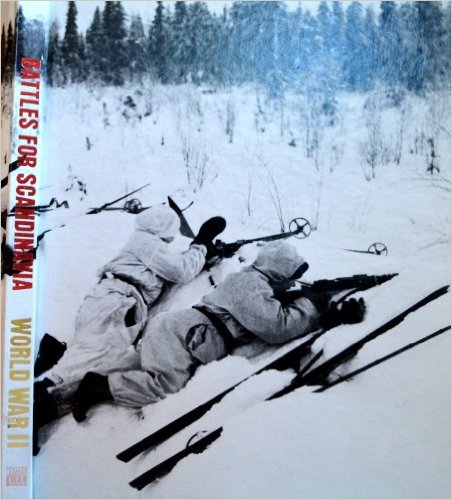
In Battles for Scandinavia, John Elton takes readers into the three nations who had the distinct bad luck to lay between the warring powers of World War 2.  Norway, Sweden, and Finland lay to the north of Germany, the east of Britain, and the west of Russia,  guarding the sea access to both Russia and Germany’s heartland.  In the opening year of World War 2,  Finland and Norway would fall to the Soviets and Nazis respectively, while Sweden armed itself to the teeth and dared the evil empires — “Molon labe!”   Although devoured by separate empires, the Scandinavian nations shared a common plight, and Battles combines three distinct conflicts: Russia’s attempted takeover of Finland, the German seizure of Norway and Denmark, and the shoving match between Germany and Russia that entangled Finland once more. In Battles we see three nations over their heads but resisting as best they can.

I knew little of the Winter War except that Finnish soldiers defending their land from Soviet aggression exacted a heavy price from the invading army, inflicting five times as many casualties as they took. Throughout a savage winter, Soviet ineptitude at fighting in novel terrain and Finnish guerilla tactics that made the most of limited resources made Soviet ambition cost them dearly.  In the end, their sheer weight of numbers did force the Finns into a settlement, but no sooner had a cease-fire been declared there than did German troops launch an invasion of Norway. They were competing with English troops who wanted to seize key ports to prevent their being used to aid the Nazi war effort, but fortunately the Norwegians overlooked that little detail and welcomed any assistance against their new peril.   The English fared well on the high seas, but an attempt to fracture the German offensive at Trondheim ended only in retreat.  Norway would remain Germany’s for most of the war, providing space for airfields and submarine pens to launch attacks against Britain.   Immediately after the conquest of Norway, of course, Germany invaded France and then spent a deadly summer threatening Britain with its own invasion until the weather changed and Germany shifted its focus to invading Russia, instead.    When the devils’ alliance ended with Panzers racing through the rodina, the Germans found an interesting ally — Finland, who had not been conquered, merely temporarily pacified.  The Germano-Finnish invasion put the Allies in a difficult place:  the Finns were counterattacking, not building empire, but Stalin demanded somebody do something to help.  Britain did declare war on Finland, but mercifully never crossed swords with it.  The book is full of little anecdotes, and a favorite is an Finnish soldier who sighs at the English declaration: “We shall have to shave now, we are fighting ‘gentlemen’!”    Finland’s alliance with the Nazis would ultimately backfire, however;  kept alive by English blood and American resources, the Soviets would recover and drive back the Germans. Threatened with Soviet wrath, Finland made a separate peace and found itself ravaged instead by its one-time ally, who slammed the door and burned everything on the way out, with an indignant “Thanks for nothing, ‘comrades-in-arms!”.   Poor Finland — so far from God, so close to nations with dreams of world conquest.

Battles for Scandinavia also covers Sweden and Denmark, though more briefly. Denmark was taken by Germany so quickly that its dazed population woke up to find Germany already in control of the country; only later did resistance break out.  Along among the north countries, Sweden remained free: refusing to entangle itself in alliances, its people and its leaders determined to make themselves as “indigestible” as possible. Sweden became an armed camp,  a nation prepared to fight for its life.  Much of the combat around Scandinavia happened literally around it,  in the sealanes that allowed the Allies to transport war material to Russia. The nearness of combat to the pole made such sea transit doubly dangerous: the Artic seas are harsh and unforgiving, and Allied ships sailed through months wintry gloom under a blackout,  waiting for an enemy to shoot from the dark.The Germans were late to realize the importance of the convoys to Russia, but once they do an extensive chapter on naval warfare follows. As with other Time-Life books, photographs here are ample, and include paintings depicting life in the snowy wastes.  Maps are very good, and the writing well communicates the suffering of men fighting in intense conditions.

Posted in history, Reviews | Tagged , , , , , , , , | Leave a comment

We Who Dared Say No to War

We Who Dared Say No to War: American Antiwar Writing from 1812 to Now
© 2008 Murray Polner, Tom Woods
368 pages

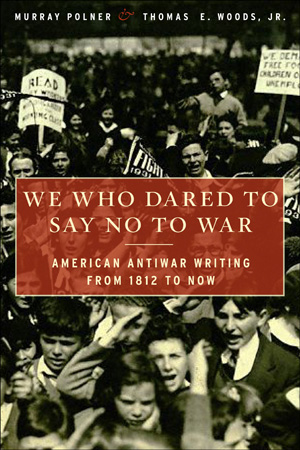
The image of anti-war protesters in America is of the left, especially the student left, haranguing the government for overseas debacles, bloodbaths like Vietnam and Iraq that seem to rival the Trojan War in their length. As We Who Dared Say No to War demonstrates, however,  bipartisan public outcry against government bellicosity has been around since the creation of the Republic.  The joint work of a progressive and a libertarian,  this anthology of anti-war literature demonstrates that war is the enemy of us all, destroying lives and turning governments into monsters.

I’d planned to buy this work years ago purely on the face of it, especially given its unlikely neighbors: Howard Zinn and Russell Kirk, both of whom are represented here. Aside from some more famous names, like President Eisenhower , most of the contributors are nigh-anonymous, largely forgotten by history. Their motivations for opposing war are diverse, but of this collection there are two predominant objections, moral and constitutional.  Arguments opposing the war from the perspective of Christian pacifism pepper the work, from an early piece written to the Confederate president maintaining that Christians cannot be forced to fight a war against God’s commands, to the Berrigan brothers (both Catholic priests) who raised a righteous ruckus during Vietnam, at one point sneaking into a courthouse to burn draft documentation.  Another well-represented motive is Constitutional corruption; both authors decrying the fact that the president has forced the country into war despite the fact that this is Congress’s purview, and those warning that wars are the lethal enemy of democracy and republican government, reliably leading to a worship of the State and the severe curtailing of liberties both civil and political.  Political objections to war run the gamut, from conservatives like Robert Taft denouncing it a menace to public health, to conservatives in the person of Eugene Debs pointing out that wars are invariably fought by a subject class who gain nothing from it but families destroyed and survivors haunted by the horrors of the battlefield.

The book covers every conflict from 1812 ’til the present day, if not by name then by association: The War of 1812, the invasion of Mexico, the Civil War,  the Spanish-American war, the world wars, the “Cold War”, Vietnam,  and the War on Terror, which includes Iraq and Afghanistan.    Early on, a fair bit of the moral objection is patriotic: authors see in the United States an unstained and free republic, one which has never raised the sword except in its own defense.  Do not reduce us, they plead, to the level of the old world,  constantly invading and advancing the flag of conquest. May the stars and stripes, they pray, remain free of the imperial eagle. Alas for them, between Mexico, Cuba, and the Philippines,  under the swagger stick of executives like McKinley and Roosevelt, the great experiment deferred to the familiar path of empire — and even after a momentary retreat during the Depression, it came back for a vengeance after World War 2, and remains with us today.  Of all the wars covered here, World War 2 is addressed most lightly; one author maintains he’s sitting this one out because history seems to indicate the futility of it. How many resources were poured into Europe to defeat the Kaiser in an alleged crusade to make the world safe for democracy, only to release a fouler creature?  We traded Hohenzollern for Hitler;   dispatch him, and what fresh hell do we risk?    There is slight drift from idealism to resignation within the book; the authors are not oblivious to the fact that they were preceded in their arguments by other generations, and eventually one wonders if we’re not damned to the same mistake over and over again.  Our enemy, one author writes, is not fascism,  or even materialism, but the beast within man. Til it be tamed with reason — til, as Plato mused, the love of wisdom commands cities — we will defeat one enemy only to create another.

This is a work brimming with quotability, with utterly delicious surprises.  We find, for instance, Abraham Lincoln denouncing a war started on suspicious grounds only a decade before he becomes the author of a similar conflict.   Later on, a Democratic presidential candidate,  George McGovern, hails the virtue of paleo-conservative arguments against war and chastises Congressional republicans by quoting Edmund Burke and declaring that the legislative chamber stinks of blood.  Though most of the material is primary sources — essays, poems, and songs —  Woods and Polner also provide some narrative introduction to each chapter that provides some cohesion and historical analysis — decrying, for instance,  the rise of liberals eager to wage war in other countries for Wilsonian ends, and the rise of neo-conservatives who abandoning contempt for interventionism and profligate spending to play war across the globe.

Although the subject  here is American anti-war writing, the book commends itself to general reading. The motives and consequences of war affect other nations no less than the United States, a fact born out by the fact that many of the contributors here point to examples in history. The role of war in centralizing power, in corrupting a nation –  enriching defense contractors with the right connections, forcing a disconnect between the morality of home and the  desire of the state — in turning perfectly friendly people into frenzied madmen — is a universal human problem, particularly so in that there is no easy fix. Fighting  is second nature to us,  though at the level of state versus state it is virtually indefensible.  Beyond war,  We Who Dared Say No communicates important values;  moral authority and a state that is kept within its limits by the people.   Unfortunately, it is a work that will never lose relevance…at least, not this side of a coronal mass ejection.  While we can never stop the state’s wars, we can refuse to participate, awaken others to its obscenities, and sap ever so slightly its power.  This is invigorating and encouraging,  demonstrating that parties that disagree on other subjects can come together to resist  and overcome the beast that is war, and the beast it makes of those who surrender themselves to it.

Related:

  • Weapons of Satire, Mark Twain. A collection of Twain’s rebuke of American imperalism in the wake of the Spanish-American war.
  • Voices of a People’s History, ed. Howard Zinn. An anthology of first-hand accounts railing against imperialism among other subjects. 
Posted in Politics and Civic Interest, Reviews | Tagged , , , | 2 Comments

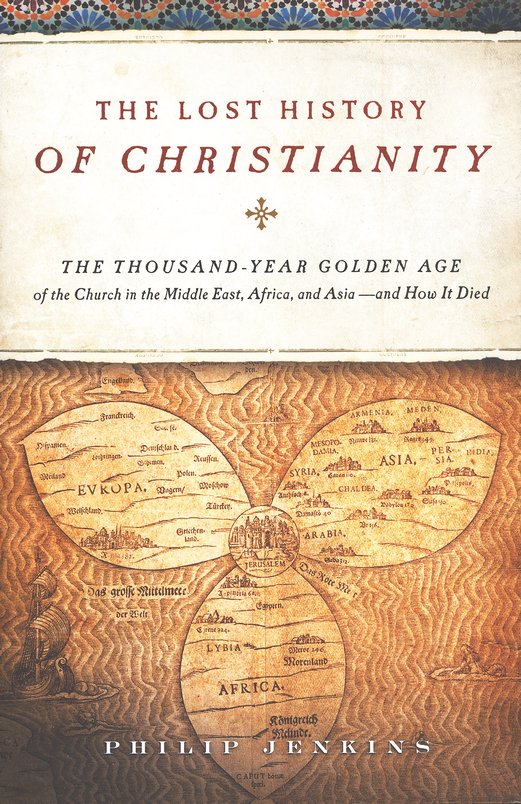
The Lost History of Christianity

The Lost History of Christianity: The Thousand Year Golden Age of the Church in the Middle East, Africa, and Asia — And How It Died
© 2008 Philip Jenkins
315 pages

For the first millennium of the church’s history, Europe was less Christendom than a dismissed backwater. The heart of the faith was its fount in the middle east, where it saturated the landscape and spread through two empires across the vast expanse of Eurasia. Within five hundred years of Christianity’s millennial birthday, however, its reach had vanished, lost in political upheaval and newly arrived competition. Though advertising itself as a history of the global church,   Lost History is principally about religious transformation  in the middle east, with Christianity as its case model. 

There is immediate intrigue in Jenkins’ history merely for the fact that his primary subjects are unrecognizable to most as Christian.  Around the Mediterranean,  Rome — in the person of the emperor — maintained a faith common to all.  Achieving and enforcing orthodoxy was the reason Constantine urged on the Council of Nicaea. Outside the empire, however,  Christianity grew wild, running bramble-like clear to Asia.  Aside from stray missionaries from the Latin and Greek church,  most of the Christians covered here belonged to the Nestorian church,  which retained an orthodox-like hierarchy outside the authority of  the Greco-Roman sphere, with hundreds of metropolitans and bishops. How much of “Christianity” really survives the trek to Asia is a question Jenkins does not pursue, though the mention of a “second Jesus” buried in India allows a lot of room for doubt.   The Nestrian branch found a particularly cozy home in the Persian realm, safe from Orthodux rebuke, but the African church would vanish almost overnight, save for the impressively resilient Copts. 

The rise of Islam set the stage for the middle-eastern church’s downfall, but it was not strictly a matter of religious competition.  Jenkins records Islam and Christianity meshing at first; considering the  power of Arian-like sects which effectively denied the divinity of Jesus,  they shared much more common ground than not. (So much so that medieval personalities denounced Muhammad not as a false prophet, but as a schismatic!) The golden age of  Islam was built on such ground,  flourishing through  the communities of Christian Syrian scribes and researchers.As Islam grew in self-confidence, however, and especially after it began brawling with outside powers, the  Christians within its midst were viewed as suspect. When the Black Death reared its head for the first time, a wave of persecution followed —  Christians playing the part of scapegoat that was assigned to Jews in Europe. When new powers arrived on the scene, like the Mongols and Turks, they frequently inaugurated a new era of religious oppression; the Crusades were a response  to Turkish abuses, not the nigh half-century old occupation of Jerusalem by Islamic forces.  (Interestingly, the Mongols who destroyed the high water mark of golden-age Islam, Baghdad, first persecuted  Islam and then became its champions, persecuting Christians.) Political stress turned into religious persecution again and again, a theme that runs  clear to the 20th century, when an on-the-ropes Turkey decided to rid itself of minorities with suspect loyalties. The Armenian genocide was the result.  Early Christian activity in China and Japan perished after upsurges in nationalism, as well.

This history of religious transformation in the middle east is then used by Jenkins to examine the life of religions in general, their ‘struggle to survive’.  Though Christianity and Islam were rivals, they wore off on one another:  the Eastern Orthodox church’s iconclastic period (that ghastly preview of Puritanism) marks Islamic influence, and mosques modeled themselves on the architecture of churches. Such architectural borrowing went the other way in Spain, where rebuilding churches incorporated elements of Islamic design  into their structure.  Even after Christianity vanished from an area, it left its mark: in rural Turkey, for instance, parents continued to have their children baptized to ensure the blessing of God.  Jenkins  speculates on various reasons regions thrive or perish amid competition; he notes that the church in Egypt became part of the culture, while in other parts of Africa it merely existed as outposts, like Roman military encampments that disappeared when the Romans left. Those churches were sustained from without, rather than from within. Faiths can also hedge their bets by expanding;  when Christianity virtually perished in the middle east, it continued to flourish in Europe; even as it fades in Europe, it grows again in Africa.

All this fairly interesting, though the book has certain frustrations. Belief, for Jenkins, is a moot point;  Nestorian doctrine or what Jacobites practiced, none of this matters. All the reader is really given is politics and labels; there were people here, they called themselves Christians, and then they were killed.  Jenkins has a peculiar understanding of Christianity, announcing to the reader that understanding the early church is impossible because Christianity was driven from its home region.  Since when is Christianity like Temple Judaism or Islam, fixated on a certain patch of earth?  What is revealed is how unimaginative humans are at creating ways to persecute one another:  Just as Christians were made to wear patches identifying them as an underclass and forced to dismount at the approach of a Muslim, so in the 20th century German Jews were made to wear patches and blacks had to vacate the sidewalk at the approach of a white.  One wonders how ubiquitous these shaming behaviors are — did the Japanese practice them in China, for instance? The Lost History of Christianity is certainly relevant, given the ongoing slaughter of innocents at the hands of ISIS. It is a fascinating history of the middle east’s religious evolution,  though of limited use for truly learning about the ancient church outside of Rome and Constantinople.

Posted in history, Reviews | Tagged , , , , , , , , , , , | Leave a comment