Hitler’s Undercover War

Hitler’s Undercover War: The Nazi Espionage Invasion of the U.S.A.
© 1989 William  Breuer
358 pages

Wars are not confined to battlefields, even when the fields of conflict are as wide-open as the open oceans and the very sky itself, as they were in World War 2.  Victories and defeats can be effected in the quiet of the night, by men and women ostensibly noncombatants, whose intelligence and skillful deceit is applied in just the right areas to supply vital information, or sabotage endeavors. Hitler’s Undercover War is a rare history of German intelligence operations  before and during the Second World War, ending only in the total defeat of the Nazi state.   It is doubly a history of the growth of the FBI, from suited cops chasing bootleggers to sophisticated intelligence men vying to out-maneuver devils most devious.  Written by a soldier of the war, heart fully on his sleeve,  it has the immediate excitement of a spy thriller with a most satisfying conclusion.

The story begins long before the rise of the National Socialists, just after the peace of Versailles which concluded the Great War by dismembering Germany’s army and forcing its new civilian leaders to accept the   Allied costs of fighting the war, and responsibility for starting it in the first place.  In an age of constant militarism,  surrounded by powers which hated her, Germany’s disarmament wouldn’t last long. Soon into the 1920s, in fact,  programs were being developed to keep the German army up to speed — through whatever means necessary. If Germans could not refine military aviation at home, they would watch other nations’ progress with great interest….and appropriate it when necessary. This was made easy, Breuer writes, by the fact that the United States was utterly naive in the area of espionage and counter espionage;  at one point Customs agents literally discover a briefcase full of military blueprints, give the nervous man carrying them a stern reminder to come in for questioning next week, and let him go.  The German ‘Abwehr’, its military intelligence group, created separate and later coordinating spy circles to collect and funnel war-related R&;D Germany’s way.

Things grow darker once the Nazis assume power and begin plotting nothing less than world domination. The United States’ status as a nation of immigrants is no less impactful here than it was in the leadup to the Great War, when immigrants of competing parts of Europe protested the thought of their new nation waging war on their homeland.   The Abwehr capitalized on the fact that many Americans were German who still wanted the best for their native land, even if they had left it behind.  The German-American Bund, for instance, led the way in protesting the thought of the United States getting into another of “England’s wars”, labeling Roosevelt a warmonger. They were aided by Nazi agents with press connections, who flooded areas with isolationist propaganda.  Hitler’s intelligence handlers were far quicker to resort to violence; once a man or woman had been vouched as a Good German, worthy of serving the Reich and presented with an offer to spy, they and their family on both continents were threatened with harm if they did not answer the call.  (Such arm-twisting would eventually backfire, when one German-American immediately became a double agent, allowing the FBI to penetrate and take down one especially prominent intelligence cell.)

As the “New Germany”  realized war with the United States was inevitable,  its spy networks widened and readied for direct action. They remained at work tracking military developments, attempting to steal plans and parts for items like the Norden bombsight, and continually forwarding to Germany details on  American troop strength and deployment. Once the war began, however, they began actively attempting to sabotage factories and misdirect shipping. (Shipping information was especially vital given the American lend-lease programs, which sent arms and other equipment to both Britain and the Soviet Union.  With U-boats prowling right off the coast of the Atlantic seaboard, loose lips truly did sink ships.)  On one especially dramatic occasion,  a boatload of Nazi agents disembarked on a beach with trunks of explosives,  with plans to disperse throughout the United States and cause pandemonium by blowing things to pieces. They were partially undone by the fact that a Coast Guard seaman just happened to chance upon them burying their explosive booty and chattering in German.

Hitler’s Undercover War will definitely interest  readers with a taste of intelligence operations;  here we have men creating and applying vintage spy paraphernalia, like matchbooks with secret codes, microfilm captures of confidential documents rolled into pens, and buxom blonde fatales flirting with guards so co-conspirators can do some snooping.  The period charm extends to the unfiltered adoration of the FBI:  J. Edgar Hoover is described as a “lantern-jawed supersleuth” who abstains from dating on the grounds that it will distract him from his work.  His determined avoidance of taking the Mafia seriously, and his antagonist role during the Civil Rights movement make his star shine far dimmer these days, so the Captain American-esque descriptions are little much. To give Breuer’s treatment of him and his team credit, however, they were fighting the Nazis, some of whom were authentic Judases in selling out American troops for money, with no genuine love for the country of their youth  to excuse them.

Related:

  • The Luftwaffe: Creating the Operational Air War, James Corum.  Far more information on how Germany was able to ‘invent’ a modern air force so soon after Hitler’s rise to power, which included sending agents to tour air shows,  reviewing western aviation journals,  experimenting with civilian aeronautics, and even partnering with the Soviets. 
Posted in history, Reviews | Tagged , , | Leave a comment

Downtown

Downtown: Its Rise and Fall (1880 – 1950)
© 2001 Robert Fogelson
544 pages

Just listen to the music of the traffic in the city!
Linger on the sidewalk where the neon signs are pretty
 — how can you lose? 

The lights are much brighter there, you can forget all your troubles, forget all your care…
(“Downtown”, Petula Clark)

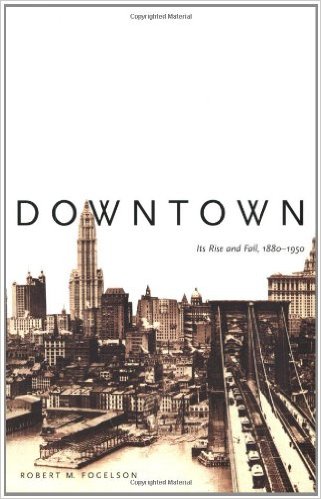
When Petula Clark sang that she knew a place you can go, she may have well been speaking of downtown, for it used to be the place to go. Downtown chronicles the decline of American city centers, from Gilded Age preeminence to steady 20th century decay.  Though ostensibly concerning the local politics of major cities (New York, Chicago, and Los Angeles especially),  this is in a sense a social history, the complete transformation of how Americans lived, shopped, and traveled told through the decline of city centers.  The author writes without any apparent agenda, something of an accomplishment given the central subject of public policy.  Despite the role played by city, state, and the national government in hastening the disintegration of American cities,  even unintentionally, Fogelson’s conclusion is that the state of urban development in the United States has more to do with an instinctual aversion to crowded city centers than public policy.  While that’s an unsatisfactory explanation of suburbia, it doesn’t diminish Downtown as a gold mine of information about the gradual transformation of transportation, housing, and public policy.

A city is nothing less than an economic engine, a place formed by the coming together of producers and merchants to trade. So it was with American downtowns; commercial enterprises preferred to congregate one another. The reasons were simple: prior to telecommunications and rapid transportation,  business transactions were handled in person, and companies preferred to be close to their supporting services — to their bankers and insurance agencies, for instance.  What transportation systems existed at the time favored central locations for streamlined delivery and sales.  Given the eagerness of enterprises to acquire land close to the action downtown for commercial purposes,  land values there rose, and residents who could cashed in to settle in the country.  From those elevated land prices grew elevated buildings, when the arrival of industrial steel manufacturing allowed for it:  landowners wanted to maximize the use of the land they were paying so dearly for, and so the towers soared.  Downtown was not  exclusively commercial;  apartment buildings took equal advantage of the Bessemer process to compete with offices in the climb toward the sky.  Though some city-dwellers complained about the towers blocking light, few attempts to limit the height of buildings took; even what scant regulations appeared were quickly riddled through with variances.

The commericial life of the city would involve political meddling, however.   The attempt of an entire a metropolitan area to conduct its shopping, banking, and theater-going in one relatively small area lead to chronic congestion.  This is a congestion beyond levels appreciable by Americans today, even those who sit in LA traffic jams.  Photos show pedestrians shuffling down sidewalks cheek-to-jowl, trolleys crammed like sardines and the streets utterly filled with these as well as horse carriages, rag-wagons, and delivery carts.  That traffic was the economic life of the city, but the thought of competing in such crowds could fill some with despair: was it really worth it?  What it was worth is a question pursued by city governments who attempted to find some better way of transportation in and to the city center,  either elevated or underground train lines. (Trolleys were nice, of course, but the glorious chaos of city streets meant they were frequently slowed and altogether blocked by pedestrians and carts.)   Such prospects were expensive undertakings for private enterprise, and required considerably more politcking — getting permissions from landowners to dig under them, for instance —  and so city governments themselves often had to take on the burden of attempting them.  The el-lines were not altogether popular, casting a constant gloom over the streets and treating pedestrians to showers of sparks and cinders.   Subways were much more expensive and time-consuming to build, a daunting fact given periodic economic downswings, but little by little the major cities edged into using them.

Change was in the air, however. Frustrated with the chronic congestion of the city center, made worse now by construction in the rights-of-way,  some urbanites  began shopping closer to home when they could.  Soaring land values also tempted start-up businesses into offering their goods outside the city center, as well; other residential areas might not deliver as much traffic, but concentrated near the trolley lines as they were,  a go could still be made.  Soon downtown apartment stores were joining them, sending out colonies — branches — to do business to residents who didn’t want to come to them.  Technology was allowing for more distance between residents and businesses, too;  a man could now telephone his accountant, or extend his traveling range in a relatively cheap automobile.  The arrival of automobiles into the downtown core only worsened congestion, however, consuming much more space than pedestrian traffic, especially when parked. They arrived at the worst possible time, too, when the economic life of American cities was threatened by the worse economic disaster in its history. The Great Depression, which would break the back of American urbanism, arrived in 1929.

The calamitous effects of the Depression were not limited to the economic havoc itself. Land values fell, and under unrelenting property taxes —  constituting the bulk of municipal budgets —   more than a few landowners torn down their towers to build parking lots instead.  Requiring zero labor and taking in fees from automobiles, such holes in the urban fabric were known as ‘taxpayers’.   As people continued to shop on the outskirts instead of the center, downtown merchants decided their problems were two-fold. First, there was there was the problem of accessibility; no one wanted to come downtown because it was too crowded, as Yogi Berra might have put it. Elevated lines were too unpopular, trolleys increasingly in dire straits because of overzealous expansion and a public that didn’t want to pay for the privilege of traveling like a mobile sardine, and subways too expensive.  Secondly,  as the upper and middle classes drifted out of the city into the rail suburbs, they left a vacuum filled with the kind of  riff-raff that scared off good customers.   Who would come downtown when they had to pass through tenement blocks filled with gangs of working men, immigrants, and mobs of un-supervised youngsters?    Several factors conspired against these tenements:   Reform movements, which saw the tenements as unfit for human life; the downtown businessmen, who wanted to distance the rabble from their shoppers, and the government, which needed to create jobs. Together a plan was born:  seize the land,  tear down the tenements, and build things like freeways and ‘modern’  housing projects.  Government involvement was now quite beyond municipalities: the Federal government itself was active in urban areas, deciding what buildings should go and what kind should remain.  FDR’s new government programs effectively encouraged urban decentralization by subsidizing developing outside the city, and impeding  private development within it by refusing such largesse, especially when minorities were involved.  The damage done by this kind of improvement — the erection of wall-like freeways gutting the city and directing activity into the suburbs —  continued to sap the strength of the once dominant city center. It had already fallen from THE place to do business to merely the main place for business; now it lost even that  as the future of America became written in interstates, parking lots, and  strip malls.

Downtown is a a wealth of information, and remarkably varied — covering in different chapters the politics of subway construction or housing policy.  It is a dispassionate obituary, even if it misdiagnoses the  cause of death.

Related:

Posted in history, Reviews | Tagged , , , , , | 3 Comments

Napoleon’s Buttons

Napoleon’s Buttons
384 pages
© 2003 Penny LeCouter


Napeolon’s Buttons is microhistory in the truest sense of the world, a mix of science and history that not only dwells on the historical impact of various substances (cotton, sugar, chloroflourocarbons, silk), but examines the science behind their invention — presenting a diagram of a silk molecule, for instance, to explain why it is so smooth and lustrous.   At times, the connections to global history are a bit of a stretch, as when the author repeats speculation that lead poisoning brought down the Roman empire and leads off with musing over the prospect that decaying lead buttons doomed Napoleon’s winter expedition. At other times, there is no denying the impact;  Britain’s interest in southeast Asia, for instance,  involved three resources of import: opium, caffiene, and tobacco, and as covered by John Keay’s The Spice Trade, interest in nutmeg (among other spices) spurred on the age of discovery.  LeCouter’s  chosen topics interact with one another, however, and the chapter she leads off with (abscorbic acid) informs the latter section on the age of discovery. An era inaugurated by the search for one topic was made possible only through another: if scurvy had continued to claim the lives of European seamen,  such extended voyages would not have been possible.  Buttons combines the usual close-to-home historical interest of works like Salt and An Edible History of Humanity with a strong dose of chemistry.

Posted in history, Reviews, science | Tagged , , , | 1 Comment

The Miracle of Dunkirk

The Miracle of Dunkirk
© 1982 Walter Lord
323 pages

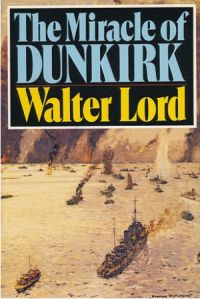
In September 1939, British troops arrived in Europe to defend France against a rapidly expansionistic Nazi regime.  Germany’s leader of six years, Adolf Hitler, had already annexed Austria and Czechslovakia, and following his invasion of Poland, the western powers had no choice but to declare war. For eight months following, however, Hitler’s tanks were quiet, the only action being at sea. In May 1940, however, they sprang into action and with such ferocity that the entire Allied campaign seemed doomed.  Roaring through the Ardennes Forest, thought impassable by tanks, the German blitzkrieg quickly claimed northern France and surrounded entirely the British forces.  As a stream of routed and retreated Franco-English forces converged on what few port towns were yet untaken, their defeat seemed imminent.  But loss was not to be:  the tanks would stop, the  English would regroup, and in a brief snatch of grace they would organize a plan to evacuate the army from France so that it might live to fight another day.  Under the very nose of the Wehrmacht, amid the bombs of the Luftwaffe,  the British admiralty and its merchant marine stole a march and saved not only the British expeditionary force, but over a hundred thousand French soldiers as well. The Miracle of Dunkirk  tells a story of salvation in a dark  hour.

Walter Lord is best known for A Night to Remember  a narrative history of the Titanic disaster based on extensive interviews with survivors. The same style is employed here,  an easy kind of story-telling strengthened by the constant presence of the participants’ accounts.  Like Washington’s retreat from New York,  Dunkirk is a strange duck, a victorious defeat. What most impresses a reader in Miracle is the fact that the admiralty was able to effect a rescue amid so much confusion. The invasion of France  struck through Allied lines so abruptly that unit cohesion was virtually a lost cause.  The cry was, “Every man for himself — make for Dunkirk!”.   At first, Allied command waffled on what to do:  attempt a breakout and  rejoin the French army in the south,  or quit the continent altogether?  Fortunately for free Europe,  they chose discretion.  Equally impressive is how quickly a rescue fleet was cobbled together, made of not just whatever ships of the Royal Navy could be spared, but of whatever could be found that floated. Tugs, barges, ferries, fishing boats, pleasure yachts — the whole of the English marine seemed present.   

Despite the chaos the admiralty had to manage,  some circumstances favored the evacuation. Smoke from burning oil tanks shielded parts of the beach and harbor from Luftwaffe attacks, at least part of the time,  and the German pause had given the BEF time to establish a few strongholds.  When the German advance continued, it was without much of its strength, with far fewer tanks:   most were being re-concentrated and repaired for the drive south.  In the nine days it took for the Wehrmacht to take Dunkirk,  the British marine managed to evacuated over 300, 000 British troops and 100, 000 French troops.  Miracle is replete with fascinating stories, like the presence of Charles Lightoller:  the only officer on the Titanic to survive its sinking, he commanded his ship to France and back, rescuing another generation from the perils of the sea and war.   Lord’s heavy use of first-hand experience and storied style commend Miracle to readers with an interest in learning how the British and free French lived to fight another day at the port of Dunkirk.

Posted in history, Reviews | Tagged , , , , , | 6 Comments

Reads to Reels: The Martian

It has been seven weeks since I ran out of ketchup. 

Last week I stopped at Books-A-Million while waiting for the 3:00 showing of The Martian, and thought of purchasing a shirt — “THE BOOK WAS BETTER THAN THE MOVIE” —  and wearing it to the theater as a joke.  I’m glad I didn’t, because The Martian is a rare movie that not only lives up to the book, but improves upon it in some ways. True, it is a slightly different story, with less explanation-rich attempts to figure out science problems and more emphasis on emotional drama. The science is abundant, but scaled back to a level that movie-goers —  encountering it in quickly-passing lines of dialogue and narration — can appreciate on the fly.  This is a genuine science-fiction movie, however; every problem Watney encounters is of scientific nature.  He is a botanist and biochemist,  a master of ad-hoc engineering. Eventually NASA realizes there’s something alive –and something familiar — on Mars, and attempt a rescue, but they too have problems to puzzle through. So it goes, trial after trial,  one solution leading to another dilemma until at long last the end is reached.  The Martian communicates the emotional drama more than a book,   the anguish read on the faces of his crewmen who realize they left a man behind, the awe of a satellite-monitoring intern who realizes Watney isn’t giving up.  There’s little to no trace of convenient movie physics;  I was especially impressed by the fact that when NASA spots Watney on satellite, they were dealing with very pixelated footage; no CSI-magic to zoom in and enhance! Though this is science fiction, in the end what finally triumphs is the human spirit – Watney’s refusal to give in to apathy, and his crewmates’ decision to take part in a rescue attempt at peril of their own life. In translating The Martian from pageleaves to reels, nothing has been lost save a little gratuitous language — and the reader turned viewer gains astonishing landscapes in the bargain.  Very well done, I think. This adapation of one of my top five favorite books in 2014 is a movie that will no doubt find its way into my DVD collection when it comes out.

Posted in Reviews | Tagged | 3 Comments

Dawn of the Eagles

Star Trek Terok Nor: Dawn of the Eagles
© 2008 S.D. Perry and Britta Dennison
435 pages

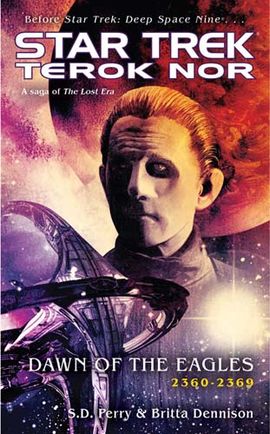
The days are dark for Bajor. More than thirty years into the Occupation, the once-promising Resistance has very nearly been broken by a planet-wide surveillance system that restricts the movement of Bajorans on the surface.  Some of the rebellion’s best leaders have fallen victim to it, and there seems to be little to do but hide in what few caves and similar sanctuaries that remain hidden from the Cardassian state’s sensors.   And yet resistance festers, not only a  stripped Bajor but among the Cardassians as well.  Religious dissidents, ordinary citizens, and even members of the military are weary of the toll occupation has taken on Cardassia:  decades have been squandered in which Cardassia could have fostered a sustainable economy, wasted instead on the short-term remedy of taking Bajoran wealth. But now Bajor is largely ruined and the occupation nearly costing more than it provides — in lives and finances.  Even the architect of despair, Gul Dukat, pays the price for his Pyrrhic victory,  increasingly isolated and made miserable by the fact that no one really appreciates him.  Dawn of the Eagles chronicles the downfall of the Cardassian occupation, completing this epic of Deep Space Nine’s backstory. Mixing the familiar and the new, it is the story of a people’s liberation; the Bajorans, from Cardassia; the Cardassians, from the depravity that Empire has led them to.

Like those before it, Dawn of the Eagle relies on viewpoint characters familiar from the show — Dukat, Kira, Odo — supported by original characters. Many of the threads continue from the preceding books , like the struggle of the resistance (mostly focusing on Kira’s cell) against occupation. Others are new: Odo is a major character here, having left the science lab behind him to search for the meaning of his existence. His skill at mediating disputes, and potential as a weapon in Cardassia’s pocket, attracts Dukat’s eye, and eventually the lonely shapeshifter finds himself as Terok Nor’s security chief,  ostensibly serving Cardassian interests but more often than not indulging a soft spot for the Bajoran oppressed.  Several of the more interesting characters are Cardassian women, all dissidents to one degree or another. One, Natima Lang,  appeared onscreen (…as a dissident, since Cardassia’s government is perennially objectionable), but the others were more or less loyal to the state until their work forced them to confront the fact that they were helping perpetuate evil. (One, for instance,  is a disgraced weapons scientist who realizes the new project she’s been assigned to involves the stealth sterilization of the Bajoran populace.).  That tension — working through the question of how far one takes ‘my country right or wrong’  — makes for a compelling story, and truly sympathetic Cardassians.  This is a fitting end to the trilogy, making the miniseries tie together by ending with some of the same original characters and on the same Bajoran holiday that Night of the Vipers began with.  For Deep Space Nine fans,  this is a true preface and  wholly worth reading.

Posted in Reviews | Tagged , , | 1 Comment

Science TBR

Every time I write down a list of books to go after, I lose the darn thing, so I’m posting this one!

  • 10% Human: How Your Bodies Microbes Hold the Key to Health and Happiness, Alonna Callen
  • Domesticated: Evolution in a Man-Made World, Richard Francis
  • Humankind: How Biology and Geography Shape Human Diversity, Alexander Harcourt
  • Sapiens: A Brief History of Humankind, Yuval Haroni

  • The Invaders: How Humans and their Dogs Drove Neaderthals to Extinction, Pat Shipman
  • Lone Survivors: How We Came to the the Only Humans on Earth, Chris Stringer
  • The Intimate Bond: How Animals Shaped Human History, Brian Fagan
  • Into that Silent Sea: Trailblazers of the Space Era, Francis French
  • The Social Conquest of Earth, E.O. Wilson
  • Moral Tribes: Emotion, Reason, and the Gap Between Us and Them, Joshua Greene

Mostly biology/anthropology, with an odd space book thrown in. Into that Silent Sea is  a special one because I’ve been forgetting it for three years now.  None of these are immediate reads, though I’ll go after at least one before this year is out.  I’m nearly done with my trilogy for the 2015 Reading Challenge, and after that my only real target will be the book with antonyms in the title. After that it’s mopping up, really.

Posted in science | Tagged , | 3 Comments

Night of the Wolves

Star Trek Terok Nor:  Night of the Wolves
© 2008 S.D. Perry and Britta Dennison
458 pages

Eighteen years ago, the Cardassian Union abandoned pretense and formally annexed the planet it had already manipulated and tricked its way into dominating.  Bajor has suffered greatly at the hands of the military dictatorship since, its economy cast into ruins as the Cardassians impose a kind of mercantilism that destroys the environment and shifts most resources to the Union.  Not content to complain and malinger in refugee camps, however, many Bajorans have taken to active rebellion. Hiding in the wilderness, they wage war against the oppressor — and if collaborators get in the way, so be it.  Night of the Wolves, from the pen of an already-accomplished DS9 author, chronicles the Resistance’s emergence as a serious threat to Cardassia’s triumph. It is told principally through the lives of screen-established characters — Gul Dukat, Kira, Ro Laren, Dr. Mora —  while incorporating a few new faces. The heavy use of canon characters, with subtle links to  Deep Space Nine’s episodes, makes Night an ideal Trek series book, easily  read on its own regardless of its place in a trilogy.

While Night doesn’t have the same climatic structure as Day of the Vipers, simply chronicling twelve years of the occupation in which both the resistance and players within it come of age, the depth it adds to established characters makes it a commendable read. The plot threads within don’t intersect too much, but here we see both Kira and Ro’s introduction to the resistance –and for Ro, her motive for seeking a life beyond Bajor, haunted by the fear of falling prey to the idea that the ends justify the means.  Here, too, is Odo’s birth as a sentiment being, his coming of age within a Bajoran-Cardassian science lab.   The pages flew by for me, featuring as they did some of my favorite characters — Dukat, Kira, and Ro Laren — but even some of the new characters with stories independent of the DS9 shows took my interest. One of note is a Cardassian grad student who, after having an Orb experience while attempting to translate the writing on an artifact, travels back to Cardassia and discovers her people’s life prior to the military takeover. Dukat is here in all his pre-Waltz ambiguous glory,  One matter of concern is the early introduction of some characters, namely Damar and Ziyal, and the fact that one character says “The middle of the occupation is no time to be having a child!”.  Unless he’s had an experience with the Orb of Time, which is lost, he probably shouldn’t know he’s in the middle of the Occupation. (To make matters worse, he’s not even in the middle of the occupation; it’s barely a third of the way through.)  This seems to make Ziyal far older than she appears onscreen, and Damar’s career somewhat pathetic. Thirty years before we first see him onscreen, he was still a low-grade glinn worshiping the ground Dukat walks on?  That’s Harry Kim-style career doldrums.

Though not as tight a story as Day, I liked it better —  such is the draw of its characters.

One interesting bit of story: Kira is literally the first Bajoran woman Odo sees. At one point she and her cell sneak into the science lab to do a little sabotage work, and he watches her from his goo tank. 

Posted in Reviews | Tagged , , , | 1 Comment

Day of the Vipers

Star Trek Terok Nor: Day of the Vipers
© 2008 James Swallow

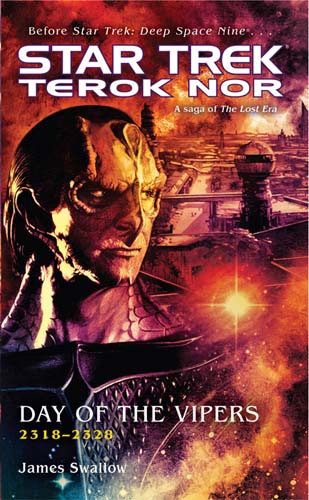
When a Cardassian warship arrived at Bajor carrying the dead bodies of Bajoran traders, that should have counted as ominous. Bajor and Cardassia were distant neighbors without formal contact until the Cardassian military found a Bajoran merchant ship adrift and decided to return the dead home to be laid to rest.  Despite their seeming benevolence, however, within a decade’s time the Cardassians had proven to be very strange friends, the kind who don’t leave people alone and level guns at their head — for their own good, of course. Terok Nor: Day of the Vipers begins a trilogy covering the fifty-year military occupation of Bajor,  being the story of a peaceful planet’s woe, its seizure and plunder.

The Occupation formed the background of Star Trek: Deep Space Nine. In its very first episode, the Federation was invited to Bajor to help pick up the pieces. A ferocious military resistance had sapped Cardassian resources and prompted them to leave, but creating peace between now bitter-enemies would not easy, not when the villains who perpetuated the occupation were for the most part still up and kicking. Chief among them in the series, and here in Day of t he Vipers, is Gul Dukat.  He begins not as a gul, but as a younger subordinate.  Although Dukat is not the only Cardassian viewpoint character, he is the one through whom we see most of Cardasia’s foreign policy effected. Swallow creates an occupation arrived at through subtle measures, mixing in a few familiar faces with a host of new ones.  Dukat and his grey brothers do not arrive with a fleet of warships, roaring demands for surrender; they arrive as friends bearing gifts and ask for nothing but trade in return.   Swallow further develops traces established by Andy Robinson in his A Stitch in Time of Cardassia’s culture before civilization collapse and military takeover created the Cardassia familiar to viewers through ST TNG and ST DS9.  Of particular interest is the use of religious Cardassians: though the Union is a predominately secular state, ruled exclusively by the military and its ethos, a small minority still hold on to Cardassia’s pre-junta traditions. They come in handy; since the Bajorans are devout, the ‘Oralians’ serve as goodwill ambassadors of sort, even though Dukat and the other officers despise their traditional fellow nationals and work for their forceful extinction back home. When the Oralians and Bajorans hit it off, establishing an Oralian embassy of sorts on the planet. Cardassian culture gains a toehold on the planet, one used to great effect despite the acrimony between faith and state.  Bit by bit,  the Cardassians expand their influence on the planet, using the spectre of shared mutual enemies  to accustom the Bajorans to relying on the Cardassian military for protection and ‘guidance’.  The full arrival of the Occupation proper doesn’t arrive until the very end, and the last word — “RESIST!” sets the stage for the birth of the Bajoran rebellion in Night of the Wolves.

I’ve long looked forward to reading this series, Deep Space Nine being my favorite of the Trek shows, and so far it does not disappoint, though the early inclusion of Dukat is strange given how long the Occupation lasted. (He’s also the Dukat whom we’re familiar with, as opposed to a younger man whose personality is still being formed.)   I thought the slow but subtle creep of Cardassia into Bajor was handled well, especially because it was executed not by one man with an evil plan but by several officers who had competing ideas on how best to expand their influence.  As bonus, we get a young Admiral Nechayev and a Welsh ridealong!

Posted in Reviews | Tagged , , | 6 Comments

Called to Serve

Called to Serve: A History of Nuns in America
© 2013 Margaret McGuinness
277 pages

Long before the suffrage and feminist movements allowed women to assume a more publicly active role within society,  women religious were taking an active role in shaping the American landscape.  Although predominately a Protestant country, the United States was never without Catholic citizens,  whether through acquiring land originally settled by France and Spain, or by developing its own through immigration from Italy, Poland, and other parts of Catholic Europe.  The American landscape was for all a great mission, a place to build civilization anew, and  nuns were there nearly from the beginning.

Though some orders restricted themselves to prayer,  more active communities bounded, providing teachers and nurses to areas just being settled, which would have otherwise gone without. The sisters provided religious instruction, naturally, but also taught reading, mathematics, and other educational fundamentals. They also trained people for work, giving the margins of society — impoverished freedmen and immigrants. especially their women —  the resources to begin building a life for themselves. America’s religious sisters were not simply Europeans transplanted to the frontier; their rules of life had to be altered to take the harshness of the wilderness into consideration, though some adaptations were perverse. In the early 19th century,  religious orders owned slaves, for instance, even orders which were filled only with African-American nuns The nuns were far more conscious of the evil nature of slavery, however, ameliorating it as best they could and agitating for abolition much earlier than society at large, or even the Church proper.

Nurturing the margins — the least of these — was truly the prevailing mark of American nunneries.  When contagious disease swept American communities, women religious were often the only people willing to nurse the afflicted, sometimes at the cost of their own lines.  The rapidly urbanizing eastern seaboard provided plenty of diseases to battle, and nuns were at the forefront,   managing Catholic hospitals at every level and developing new methods to prevent infection.  As waves of courageous or dispossessed people from Europe swept America, nuns provided settlement houses that welcomed newcomers and helped them find a place for themselves in a new country. Nuns were strangers themselves, often ridiculed and sometimes even attacked by nativists who feared their papish influence.  Ultimately, though, their extraordinary compassion  and proven talent won respect — and sometimes, even converts.   Despite these accomplishments, however, as the 20th century continued the ranks and influence of religious women fell precipitously, possibly because the gap they served was filled in: religious orders were no longer the sole means of a meaningful career for women, for instance. America’s rising  secularization — both in the sense of diminished religiosity and  the growth of medical, educational, and immigrant-handling government programs — also diminished their attraction. They continue to serve America,  but frequently have been reduced to the rule of mere social activists, instead of the very creators of civil society as they once were.

Posted in history, Reviews | Tagged , , , , , , , , | Leave a comment