Called to Serve

Called to Serve: A History of Nuns in America
© 2013 Margaret McGuinness
277 pages

Long before the suffrage and feminist movements allowed women to assume a more publicly active role within society,  women religious were taking an active role in shaping the American landscape.  Although predominately a Protestant country, the United States was never without Catholic citizens,  whether through acquiring land originally settled by France and Spain, or by developing its own through immigration from Italy, Poland, and other parts of Catholic Europe.  The American landscape was for all a great mission, a place to build civilization anew, and  nuns were there nearly from the beginning.

Though some orders restricted themselves to prayer,  more active communities bounded, providing teachers and nurses to areas just being settled, which would have otherwise gone without. The sisters provided religious instruction, naturally, but also taught reading, mathematics, and other educational fundamentals. They also trained people for work, giving the margins of society — impoverished freedmen and immigrants. especially their women —  the resources to begin building a life for themselves. America’s religious sisters were not simply Europeans transplanted to the frontier; their rules of life had to be altered to take the harshness of the wilderness into consideration, though some adaptations were perverse. In the early 19th century,  religious orders owned slaves, for instance, even orders which were filled only with African-American nuns The nuns were far more conscious of the evil nature of slavery, however, ameliorating it as best they could and agitating for abolition much earlier than society at large, or even the Church proper.

Nurturing the margins — the least of these — was truly the prevailing mark of American nunneries.  When contagious disease swept American communities, women religious were often the only people willing to nurse the afflicted, sometimes at the cost of their own lines.  The rapidly urbanizing eastern seaboard provided plenty of diseases to battle, and nuns were at the forefront,   managing Catholic hospitals at every level and developing new methods to prevent infection.  As waves of courageous or dispossessed people from Europe swept America, nuns provided settlement houses that welcomed newcomers and helped them find a place for themselves in a new country. Nuns were strangers themselves, often ridiculed and sometimes even attacked by nativists who feared their papish influence.  Ultimately, though, their extraordinary compassion  and proven talent won respect — and sometimes, even converts.   Despite these accomplishments, however, as the 20th century continued the ranks and influence of religious women fell precipitously, possibly because the gap they served was filled in: religious orders were no longer the sole means of a meaningful career for women, for instance. America’s rising  secularization — both in the sense of diminished religiosity and  the growth of medical, educational, and immigrant-handling government programs — also diminished their attraction. They continue to serve America,  but frequently have been reduced to the rule of mere social activists, instead of the very creators of civil society as they once were.

Posted in history, Reviews | Tagged , , , , , , , , | Leave a comment

Tom and Viv

Tom and Viv is not based on a book, and I cannot even say that I have read the first bit of T.S. Eliot.  But this movie haunts me in such a way that I figure it’s worth saying a few words about, and since the movie has such obvious literary connections, why not here?  Tom and Viv is a British drama about the first (failed) marriage of Tom Eliot, better known as T.S. Eliot, whose famous work is The Wasteland.  This is an extensive poem I’ve also not read, but I have heard about it, and the sentiment expressed was that the world is going to pot.  I mention The Wasteland because it features in Tom and Viv, as a work of collaboration  between Tom and his wife, Vivienne Haigh-Wood.   The two are from different worlds; Tom is an American poet with no social status whatsoever, while Viv is a society daughter from a line that goes clear back to the Norman conquest.  In the film’s opening lines, Tom’s future brother-in-law Morris ponders that Tom desperately wanted to be English, so infatuated was he by England’s rich traditions. This is unfortunate, because Viv saw in Tom someone who could take her away from high society, allow her to escape it. She had such hope for him  — he lived in the attic of the most hated man in Europe, Bertrand Russell! She didn’t expect that Tom would become utterly respectable, and worse yet through the most ploddingly civilized ways — through ordinary  work at a bank and joining the Church of England.  And for his part, Tom didn’t expect that she was absolutely mental.  What exactly the matter is with poor Viv is never really nailed down; there’s speculation that she’s manic-depressive with unfortunate hormonal balance issues, but more accurate diagnoses don’t emerge until it’s too late for her.  The pair’s whirlwind courtship gives them no clue that one day Tom will be attending dinner parties with Virginia Woolf, or that Viv will be forcing Ms. Woolf out of her taxi at gunpoint and taking it to Tom’s office, where she will pour melted chocolate into the mailbox because TOM NEEDS HIS CHOCOLATE and that wretched secretary won’t let her in.  The movie spans over fifteen years, through which the two make one another steadily more miserable, worsened by the fact that they really do love one another. Or at least they’re devoted to some ideal of the other – the idea that Tom loves Viv is put into question by the fact that he sticks her in a lunatic asylum and never sees her again, going to to marry some other woman and leave her to sit in a garden with other lunatics, baking chocolate cake for the husband she will never see again. Her brother’s no better, wandering off to Africa and never writing.  At the end the viewer is left with two every depressing bits of speculation: Viv and her entire family were made miserable by erratic behavior that could have been ameliorated by medicine, and that Tom was mostly attracted to Viv  for selfish reasons.   I have watched it perhaps four times in the past year, and every time it leaves me sad — yet there is something compelling about the unhappy couple’s contradictory cries of the heart.

Posted in Reviews | Tagged | 3 Comments

Carrie

Carrie
© 1974 Stephen King
199 pages

A word to the wise: if you’re going to execute a horrific public prank on the school outcast, like having her elected prom queen and then dumping a bucket of freezing pig blood on her, make sure she’s not secretly telekinetic. Otherwise, she might trap the entire senior class in a burning gynasium, then become a one-woman reenactment of the Dresden fire bombing just for good measure.

Carrie was Stephen King’s first horror novel, and it is, truly. The title character is Carrie White, a teenage girl raised by a deranged mother who regards anything connected to sex (including the existence of genitals,  curves, and menses) as evil.  Carrie is the soul of psychological isolation, spending much of her time in a locked closet as punishment, and so warped by her mother that she has virtually no way of relating with her peers. She’s also oblivious to the facts of the life, and when she has her period for the first time, it couldn’t come at a worse point: the school locker room, in full view of her school’s clique of Mean Girls. High schoolers being what they are, she is immediately subject to public humiliation. The Mean Girls receive a little comeuppance; they are barred from the prom and one manages to be genuinely remorseful, asking her boyfriend to take Carrie to the prom in her stead. Carrie deserves one night of happiness before high school is over, she thinks — but this moment of good intentions is turned into hell.

Unfortunately for…everyone, at least those outside the funerary trades,  Carrie’s one night of happiness is turned into one of horror when the barred mean girls decide to strike back.  Carrie, who spends the entire book being mentally tormented either by her mother or the bullies, snaps. She has a gift, or a curse, of telekinesis; she can make things happen with her mind.  (Her mother was already crazy before she was born, but having a child whose mood swings manifest themselves as a poltergeist probably didn’t help..)   On the night of the prom, when she is drenched with blood and the entire school laughs at her, with the potential of happiness turned to utter degradation, Carrie decides to wreak havoc.  Whatever fragile grasp she had on sanity evaporates away under the boiling outrage, and she stalks through town blowing things up. Eventually she succumbs to the physical toll her powers took on her body, as well as an injury and even further mental trauma, but not before killing four hundred people and turning a quiet Maine city into a ghost town.

Carrie is fairly gruesome; definitely not the sort of thing I’d read twice, between all the murder, mayhem, and insanity.  Interestingly done, though;  King breaks from his narrative to insert clips of scientific articles, news reports, legal commissions, and survivor accounts that tell more of the story.

Posted in Reviews | Tagged , | 3 Comments

The Kite Runner

The Kite Runner
© 2003 Khaled Hosseini
400 pages

.

The Kite Runner is a stirring story of betrayal and redemption set in Afghanistan as the country is destroyed through revolution, war, and the takeover by Taliban militias.  The novel rests on the relationship between Amir and Hassan, two young boys growing up together in the same household — but separated by class.  Although theirs is a brotherly friendship, it is put to the test by intense social pressure, Amir’s own fears, and the outbreak of war.  As the novel progresses, emotional and physical distance grows between the boys;  Amir, burdened by the shame of not defending his friend as he should when horror lashes out, pushes Hassan away, and eventually Amir and his father emigrate to the United States to flee the destruction of Afghanistan.  Fifteen+ years later, however, when Amir’s father dies, he is called back to Afghanistan to visit an ailing friend of the family, There, in the rubble of his hometown, he must find the courage to atone for the selfishness and cowardice of youth. Once he hid before bullies and allowed others to be beaten for his sake; now he steals into the center of Taliban power to beard the lions in their den and rescue an innocent child.  The endgame has the kind of poetic justice found only in fiction,  with the same monster who tormented Amir and Hassan when they were all boys returning as the chief Talib. However improbable it is in real life, it succeeds wonderfully as a story, delivering the full impact of how Amir has changed since leaving Afghanistan. Few people get to fight their childhood memories so directly, and  it’s utterly satisfying — not the dispatch of the villain, but Amir’s trial by fire. For most of the book, he is a weak character who shies away from responsibility, and  the ending chapters are a gauntlet that makes him honorable.  Although most of the book is tragic, such is made good by the finale.

Posted in historical fiction, Reviews | Tagged , , , , , | 3 Comments

The Lady from Zagreb

The Lady from Zagreb
© 2015 Phillip Kerr
432 pages

            Bernie Gunther was an ordinary police detective in wild, wonderful Weimar until Germany’s economy collapsed and fringe parties swept into power. His police department absorbed by the SS, he wears the uniform of a party and of an ideology he loathes – and does a poor job of even pretending to tolerate. His antipathy for the Party makes a man of Bernie’s talents a useful tool, however, at least to Joseph Goebbels. With no career prospects or political ambition, the detective can be hired for a little bit of innocent work that the master of deceit would prefer to keep concealed from his rivals in evil miniondom, like Himmler.  For instance, Goebbels has his eye on a certain starlet who is waffling on cinema as a career prospect, despite being a Siren-like beauty who is sure to become the continent’s most popular actress.  Officially, of course, the chief of propaganda wants to keep her engaged making films to glorify the fatherland,  but he also has more intimate engagements in mind – the kind that married men have no business in making.   The problem is that the poor dear is distracted by her long-missing father, lost in war-torn Yugoslavia. What he’d like for Gunther to do is pop down to the most hellish place in Europe short of Auschwitz for a spell, find dear old dad, and then report back to Berlin.
Nothing is ever so simple, of course. Gunther has already encountered some soul-harrowing scenes since the Nazis took power in 1933;  he has seen massacres on both the Soviet and Nazi sides of the battle-lines, and  been exposed to the Final Solution in action.  Yugoslavia, however, is a bloodbath to be endured only with the native whiskey,:Gunther’s report makes even Goebbels blanch at the horror of it.  There,  the princes of hell on earth decorate their strongholds with skulls on pikes, and photographs of executions, like something out of a nightmare.  The usual psychological defenses – sarcasm, booze, and cigarettes – don’t quite do the trick. To survive, Gunther counterattacks: he falls in love. If the hormone rush from becoming infatuated with Germany’s foremost sex symbol doesn’t do the trick, then perhaps the thrill of chasing a girl who is not only married, but a mistress-potential for one of the most powerful men in the reich will.  Eventually the action moves to Switzerland,  where Americans mistake Gunther for a German general and hilarity ensues. Amid even more death, however, the piece of a puzzle which has lingered on Gunther’s mind for a year finally falls into place.

The Lady from Zagreb is a very well-done detective novel,  putting its wartime Europe setting to good effect and linking several mysteries together. The humor is biting, as ever;  on learning that a fellow officer is writing yet another novel, Gunther comments that there will always be room in Germany for more novels, provided his countrymen keep burning them. In an early scene, a man is literally killed by Hitler; a bust of Adolf is used  as a bludgeon. Against the backdrop of both the Holocaust and the obscene carnage of Yugoslavia, however, even that humor fails to prevent this from being an utterly distressing novel, set in a land of desecration and filled with horror and manipulation. Not even Gunther’s relationship with Dalia is free from the cloud of horror, unsurprising given Goebbels’ close presence.  Certainly there’s no fault in creativity or research; the book is littered with odd little details that must have been strange research finds, like a U-boat parked on the autobahn; one of Gunther’s escapes is especially captivating.  As thrilling as it is, Zagreb is more than touch dispiriting on the whole, however.

Posted in historical fiction, Reviews | Tagged , , , , , | 4 Comments

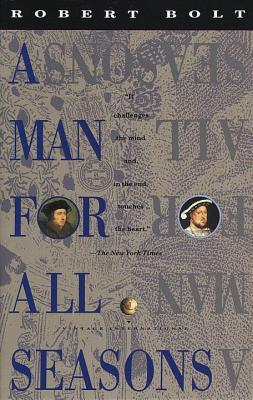
A Man for All Seasons

“A Man For All Seasons”
© 1966 Robert Holt
163 pages

“…the king wants either Sir Thomas More to bless his marriage or Sir Thomas More destroyed.”
“They seem odd alternatives, Secretary.”
            The king wants a son, Sir Thomas – what are you going to do about it?   King Henry, eight of that name and possibly last of the Tudors,  has decided to change wives. His lawful queen, Catherine of Aragon, has so far only given him one long-lived child: a girl, utterly useless for succession purposes.   Convinced that his marriage is cursed, Henry seeks to have it declared null and void by the Pope, but said pontiff is unwilling. He already made special dispensation for Henry to marry his brother’s widow in the first place; now they want to him to un-dispensate?   Anxious to replace Catherine with a younger model, and in fear of dying without a proper heir, Henry decides to resolve the succession  problem via secession.   Assume leadership of the Church  in England, appoint someone pliable as archbishop, and hey presto, instant divorce.    Henry can do nearly what he wants; the Pope may object, but he is across the Channel, and even the Queen’s Hapsburg family doesn’t have the energy to invade England just for marriage counseling.  Henry intimidates both Parliament and the church into giving in, but still—there is an itch of sanction. The compliance of dogs is easy to find; they can be appeased with food or cowed with beatings, and dog-men abound here, epitomized in the person of Richard Rich   What Henry needs to sooth any lingering qualms that he is following the straight and narrow path is approval from a man of virtue and conscience – a man like his Chancellor, Sir Thomas More. But More cannot approve; he is a faithful husband and doting father to several daughters, and a good Catholic who finds Henry’s easy disposal of his wife and the Church’s authority to be utterly alarming.   Choosing discretion as the better part of valor,  More retires from the court in the wake of Henry’s break with the church, but Henry is not content. He and his minions want either More’s sanction, or his destruction.  “A Man for All Seasons” follows the king’s pursuit of More,  a path that ends only with the subject’s martyrdom.   More never explicitly opposes the king’s behavior;  never writes a tract, never denounces him from the chair of office,  never even says a word to his wife.   His silence, however, is forbidding, and the king will not have it.  There can be no law in   England save the King’s – not even More’s private reign over his conscience.   The import of “A Man” is not lost centuries ever the times they portray, nor decades after the play was written. Its championing of conscience against coercion, of moral conviction against swaggering license, remain relevant so long as those in authority continue to pursue their every impulse,  dressing their wrath and lust for power in the clothes of law and demanding obedience. Sophie Scholl lost her head for the same reason More lost his;  they had a better one than the king’s.  More’s stand for conscience was such that the Church of England – which More opposed – hails him as a saint.  Truly he was as Holt describes him, a man for all seasons,  including ours.

Posted in Reviews | Tagged , , | 1 Comment

Anne of Green Gables

Anne of Green Gables
© 1908 Lucy Maude Montgomery          
299 pages

 “Anne, are you killed?” shrieked Diana, throwing herself on her knees beside her friend. “Oh, Anne, dear Anne, speak just one word to me and tell me if you’re killed.”“No, Diana, I am not killed, but I think I am rendered unconscious.”“Where?” sobbed Carrie Sloane. “Oh, where, Anne?

  Anne of Green Gables is chicken noodle soup bound in paper, the heartwarming story of a imaginative girl growing up on the Canadian frontier. Anne is every reader’s ideal companion; she is one of us.  Anne is not content to read good stories; hers is a boundless imagination  that makes the ordinary spectacular;  she names trees,  sees roads to Camelot in humble dirt lanes, and can convert anything into a sweeping story.  She is the embodiment of childish wonder and delight, who is rendered rapturous at the thought of learning about something new, or embarking on an adventure with a friend.  Though orphaned at an early age – she has no memory of her parents, and is adopted by a childless pair of siblings at the novel’s start – Anne’s imagination gives her access to a boundless well of enthusiasm. Although she crashes from misfortune to disaster, she never loses and hope and always gains a bit of character from the experience. Anne’s imagination is not limited to creating stories for she and her friends to act out (Tom Sawyer would be an interesting neighbor for her; what would happen if the rafts they set out on chanced to meet, and Anne’s Arthurian romance collided with Tim’s pirate ship?). Her head is filled with the language of books, and when she reacts she reveals a vocabulary filled gloriously with pomp.  It’s almost a disappointment when she becomes more level-headed assuming the responsibilities of adulthood, but all stories have their proper ending. For Anne, that usually involves hugs, tears, and speeches.   Green Gables is glorious fun;  I wish I’d paid more attention when watching the play in third grade, but I was fairly smitten by the  actress. 

Posted in Reviews | Tagged , , , | Leave a comment

Saint Joan

Saint Joan
© 1924 George Bernard Shaw
160 pages

            
In the darkest hour of the Hundred Years War, a teenage girl re-inspired both a defeated nation and a despondent king to fight again for what was theirs. She — Joan of Arc — would be captured by her enemies and condemned a heretic by the English, but later vindicated by the Church. In 1920, in fact, Joan was pronounced a saint. Shaw’s play no doubt follows on the heels of the news of her canonization.  Scoffing at saintly romanticization of the Maid, Shaw chose to pay tribute to her in his own way, making her an apostle of Whiggism.  “Saint Joan” pays tribute to the Maid’s time in the historical sun, relegating unpleasant battle-and-execution bits  to the background and focusing instead on her conflicts with the silly men she is forced to enlighten. Considering that the title character is burned alive, the play is far funnier than it has a right to be, from the opening scene with a duke arguing with his page almost to the end, where the man Joan made king is visited by the shades of his past after her vindication.   Shaw fills the play with modern conceits; his characters seem to wish they were living in the 1920s instead of the rotten ol’ middle ages. They even invent words like Protestant and Nationalism to describe how Joan makes them feel. 
Shaw’s Joan is more ambiguous than this, however; he endeavors to save her from beatification and her enemies from damnation in the same stroke.  Joan as written is not ‘saintly’ she is cheeky. Assuming familiarity with lords of the realm and lords of the church alike, she gives as good as she gets when they argue her down with reason, or scold her for acting so presumptuously. The irreverent, tomboyish Joan may be the star of the play, but her opponents are no villains. They may be guilty of pious fraud at times, but their arguments seem perfectly sensible, and prompt a reader to wonder just where Shaw’s sympathies lie.  When the churchmen accuse Joan’s patriotic  zeal of threatening to divide Christendom into nations and in so doing, dethrone Christ and allow the world to perish in a welter of war,  the graveyards of the Great War do not seem far removed from Shaw’s mind.  They are less villains than men moved to horror through fear, and happily ere the conclusion is reached they experience the genuine crisis of remorse, repenting in turn.  Although Shaw is just as guilty as having the Maid carry his own standard as any of the old romanticists,  “Saint Joan” succeeds in granting both her and her enemies humanity and redemption.

Posted in Reviews | Tagged , , , | Leave a comment

Forward March

This past week I’ve made further progress on the 2015 reading challenge:

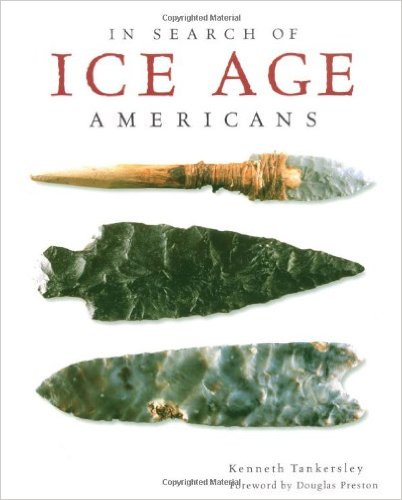
Book on Bottom of To-Read Shelf:  The Search for Ice Age Americans


As many times as I walk past this book in the library, I’ve never broken down to give it a try — until now. The Search  is a history of American archaeology, focusing specifically on the origins of the Clovis people.   Much of the work has been done by amateurs, literal cowboys stumbling upon finds in the wild. The book is principally about the people searching for Clovis, with little information on the culture other than their diet and some social speculation.

Book with Magic: The Two Towers, J.R.R. Tolkien

I read The Two Towers back in high school, for reasons now lost to me. Why, I wonder, would someone disinterested in fantasy try the trilogy, and the middle part no less?   Last September I read The Fellowship of the Ring, however, and this time around the story made much more sense.   The Two Towers collects books “three and four” of the series,  where where the drama to come tremors the surface.  The fellowship of the first book is, like Gaul, divided into three parts: Frodo and Samwise are missing,  Merry and Pippin carted off by Orcs, and the non-hobbits desperately looking for their furry-footed friends.  The epic final battle between the forces of  good and evil is yet to come, but things are already in motion;  both parts of the fellowship move through war zones as orcs and men collide.  As the story unfolds, Tolkien’s rich experience and creativity in philology are on display, treating readers with song and poetry from various cultures. One truly gets the sense when reading The Two Towers that another world is being stepped in to; one with a long, storied history that no character knows in full, but which everyone shares in part. This history makes itself known, a mountain of work casting a shadow across the landscape through which everyone moves, and to which their individual stories contribute.  I’m looking forward to the conclusion, which won’t wait until next September.

What’s next?  With October finally rolling around I can tackle Stephen King’s Carrie, which will be a ‘famous author’s first book’; it seems like Halloween reading.  Before that I may try ‘a book my mother loves’.   I’m going to be taking it easy with a ‘trilogy’ — the two options I have in mind are both Star Trek series.  The big challenges ahead are the book with antonyms in the title, and a Pulitzer; so far, all the interesting winners I’ve found have been enormous.

Posted in Reviews | Tagged , , , | Leave a comment

The Egyptians

The Egyptians
© 1997 Barbara Watterson
368 pages


“We stand where Caesar and Napoleon stood, and remember that fifty centuries look down upon us; where the Father of History came four hundred years before Caesar, and heard the tales that were to startle Pericles. A new perspective of time comes to us; two millenniums seem to fall out of the picture, and Caesar, Herodotus, and ourselves appear for a moment contemporary and modern before these tombs that were more ancient to them than the Greeks are to us. ” (Will Durant, Our Oriental Heritage
The Egyptians surveys the entire course of Egyptian history, from ancient settlements to the 1990s, in a mere 300 pages. Were this not ambitious enough, Watterson does not limit herself to mere politics, but includes separate sections on religion, architecture, law, and economy.  The approach is reminiscent of Will Durant’s symphonic history. Pyramid-like, The Egyptians is bottom-heavy:   two-thirds of the book is devoted to the ancients, with the Roman, Christian, Islamic, and modern periods sharing the last third together. The scale is immense, as it has been Egypt’s fortune or misfortune to be an combatant or an object of interest to nearly every great power around the Mediterranean. Egypt’s longevity is such that she has been conquered by two wholly different Persias, an epoch apart.  In the beginning Egypt was star of her own story, an insular union of two kingdoms fixed on the Nile; after outside invasion by the Hyksos, Egypt overcame her conquerors and became an empire in her own right. The land of the Nile would go the way of all empires, however, falling to Persia, then the Macedonians and their successors — Rome, Constantinople, the caliphate, and Turkey. Through history Egypt has also been the plaything of other empires, like the French and British. Even Hitler attempted conquest, while trying to rescue Italian pretensions of a resurrected Rome.  Aside from a brief interlude during the Islamic civil wars, Egypt had to wait until the 20th century to be ruled by her own people again. Despite the generations of new reigning powers and the trauma they inflicted —  Ptolemies are utterly horrifying in their abuse, what with one king marrying his sister, then his niece, then murdering his own child and sending the body to his sister–wife to taunt her —  Egypt endures. Given the chaos of Egypt in recent years, such resilience is a hopeful sign.  


Posted in history, Reviews | Tagged , , , , , , , , , , | Leave a comment