When the Eagle Hunts

When the Eagle Hunts
© 2002 Simon Scarrow
274 pages

The Emperor Claudius is determined to make good the conquest of Britain, but his supply fleet sleeps with the fishes. The only Romans to survive a wintry crossing of the (English) channel are one officer, one woman, and two small children. Drowning might have been a better fate for them, however, as on shore they fall into the hands of an incredibly gruesome and violent sect of Druids. Used as objects of ransom, the royal family is threatened with death-by-bonfire if Rome doesn’t meet the druidic demands…demands which might compromise the whole expand-the-Empire dream.  Enter the grizzled Centurion Macro and his peach-fuzz faced second, Cato,  who have in the past proven quick enough on their feet to infiltrate barbarians and walk out alive.

When the Eagle Hunts is third in Scarrow’s Roman historical fiction, and features cloak-and-gladus operations more than larger battles.  Not that Hunts is without legion-wide brawls, for the first half of the book features the Second Legion patrolling the border and being brutally harried by the Durotriges.  Scarrow uses this to create a sense of dread about the Black Moon Druids, who expect some deity to arrive and consume the world, beginning with their enemies. The druids wage savage war against anyone who draws close to Rome, and if they spare women and children from being killed in battle, it is only so the captives can be tortuously executed at leisure. Scarrow still provides comic moments, here principally in the Romans’ interaction with their Iceni guide, but Hunts is darker than the previous novels in the series. Of great interest is the role played by a red-haired Iceni named Boudica, who both Macro and Cato have a certain fascination for. She moves like a tiger, a fount of hidden and fierce strength, and she most definitely will feature in this series again, I’m sure.  The druidic horror show also has some interest given that Scarrow penned his afterword on fanaticism and violence  on September 12th, 2001.  Hunts is also a series milestone, a coming-of-age for  young Cato, who must attempt a rescue on his own after Macro is incapacitated.

Posted in historical fiction, Reviews | Tagged , , , , , , , | 1 Comment

The English Resistance

The English Resistance: the Underground War Against the Romans
© 2006 Peter Rex

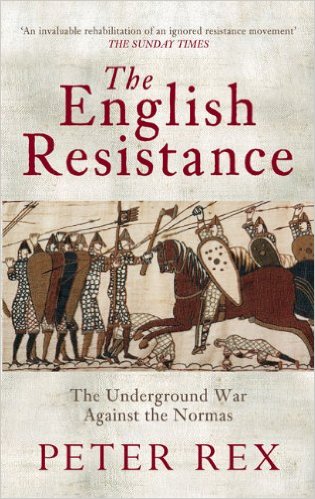
I was scandalized to learn, in seventh grade, that once ages ago, England was conquered. Already I had acquired the mythic conception of England as an indomitable island redoubt, safe from whatever Continental mischief was carrying on. But there, in my book, in 1066, William of Normandy lands, kills the Witan-endorsed successor to the English throne, and installs himself as monarch, with a line that officially lives on today. Peter Rex argues in The English Resistance that William’s assault at Hastings accomplished less than is popularly believed, only giving him the title of king and command of southern England, and that historians have heretofore been too pro-Norman to give the feisty Saxons their due.

1066 was a brutal year for Anglo-Saxon England, with no less than three battles culling its stock of leaders.  The depletion of ranks went a long way towards making southern England putty in William’s hands, especially as he burned down villages that resisted. Bearing as he did a banner blessed by the Pope, the church hierarchy in England favored his cause as well…and considering their lands and knights, the bishops were no small allies. (The lower levels of the church, like the abbeys, were far more resistant to the Norman intrusion.)      In the north, however, the barons were unscathed, and several rebellions against William would erupt from it directly or with its support.  Intriguingly, one of the rebellions had the intent of routing William and establishing an Anglo-Danish state, with an English client-king.  The same death-and-fire approach William used to intimidate the south was leveled against the north with greater ferocity after the Bastard* concluded a siege of the rebels’ marshy stronghold. Much of the north was ‘wasted’, the fields ruined for cultivation.

The English Resistance has more spell in its title than it its execution, because Rex assembles the book in a very odd way.  It opens with commentary on the long-term consequences of the resistance,  leading William to abandon his pretense of an Anglo-Norman state with continuity to the old line, devotes a few chapters to different rebellions mixed with extensive discussion of one rebel’s genealogy, and then to end…introduces the characters of the drama?  Reverse order would seem more appropriate, with the many pages devoted to Hereward. the Wake’s forefathers and descendants left to the book Rex has written on Hereward the Wake. The book tends toward the scholarly, with much discussion of source interpretation,  but there are pockets of drama. I might read one more book by Rex to see how it compares: he has written biographies of Edwin the Confessor, Harold Godwinson, Hereward the Wake, and other figures associated with the conquest. That sort of devoted study promises insights to be had.

Related:
The Fall of Saxon England, Richard Humble
Daily Life in Anglo-Saxon England, Sally Crawford

* A far more entertaining title than “William the Conqueror”, and much less pompous.

Posted in history, Reviews | Tagged , , | 3 Comments

Master and Commander

Master and Commander
© 1969 Patrick O’Brian
411 pages

This morning, in a quiet courtyard, I finished Master and Commander, the first book in Patrick O’Brian’s Napoleonic naval stories.  These have been recommended to me ever since I finished Horatio Hornblower, though O’Brian devotes far more space to technical seafaring matters. He’s aware of this, too, having a sailor explain the workings of the good ship Sophie’s riggings to the newly-arrived surgeon.  The series is reliably referred to as the Aubrey-Maturin series for centering on the friendship between Commander Jack Aubrey and his surgeon, Stephen Maturin. There are other interesting relationships, like the Mysterious Past between Maturin and the lieutenant of the Sophie, Jack Dillon. Both seem to have a connection to the failed and bloodily-repulse Irish Uprising in 1798.  The book follows  Aubrey’s brief stint on the Sophie, which largely involves him chasing potential prizes, almost to the ruin of his ship.  One character comments that Aubrey would have been a better fit  as a pirate a century prior.  Despite his winning audacity, Aubrey’s relationship with his immediate superiors is testy, to say the least. When O’Brian is not attempting to trip or entangle readers in the ropes and riggings of 19th century naval equipment,  he has a lovely hand for description, and I would not be surprised if I sailed with the good captain again. The main attraction for the books other to the naval action is the presence of a natural philosopher, a man fascinated by the world around him.

Posted in historical fiction, Reviews | Tagged , , , , , | 3 Comments

Dickens’ Descent of Desertion

“…the great paradox of morality is that the very vilest sort of fault is exactly the most easy kind. We read in books and ballads about the wild fellow who might kill a man or smoke opium, but who would never stoop to lying or cowardice or ‘anything mean’. But for actual human beings opium and slaughter have only occasional charm; the permanent human temptation is the temptation to be mean. The circle of the traitors is the lowest of the abyss, and the easiest to fall into. That is one of the ringing realities of the Bible, that it does not make its great men commit grand sins; it makes its great men (such as David and St. Peter) commit small sins and behave like sneaks. 

Dickens has dealt with this easy descent of desertion, this silent treason, with remarkable accuracy in the account of the indecisions of Pip.”  

From p. 28 of Critical Essays on Charles Dicken’s Great Expectations, G.K. Chesterton, quoting from GKC’s Charles Dickens.   Another random discovery while poking about in the library’s English literary criticism cases.

Posted in quotations | Tagged , , | 3 Comments

This week: 1066 and all that

A third of the way into April, this year’s Read of England is already a roaring success. It helps that I had a head start in March, of course. The main reason I tried to reserve a block of time last year was to take on Dickens and Austen, since if my regular torrent of reading wasn’t interrupted, the’d never compete. This year the project succeeds: several classics have been spoken for, along with a few minor diversions. Having favored literature so heavily at the start, this week I’ll be relaxing with my usual treats, history and historical fiction, before pushing literature heavy again to close. What’s up next? The English Resistance, most likely, though I’ve also purchased a book on Waterloo by a certain familiar author with the initials, B.C.

Our English pilgrimage so far:

English Classics
Return of the King, J.R.R. Tolkien
Brideshead Revisited, Evelyn Waugh
Great Expectations, Charles Dickens
Lord of the Flies, William Golding
The Invisible Man, H.G. Wells
Jane Eyre, Charlotte Bronte

Other Works Set in England:
My Man Jeeves, P.G. Wodehouse
The Road to Little Dribbling, Bill Bryson

Other Works, by English Authors
Frodo’s Journey, Joseph Pearce
Bilbo’s Journey, Joseph Pearce

Posted in Reviews | Leave a comment

Jane Eyre

Jane Eyre
© 1847 Charlotte Bronte
525 pages

  Years ago an online quiz declared to me that of all the characters in English literature, I was most like…Jane Eyre. It may have been a quiz intended for women, but I had an awful lot of spare time on my hands in high school. Regardless, since that I’ve had a faint interest in reading Jane’s novel, and since I’ve instituted April as English Lit month, why not?   Jane Eyre is the story of a young orphan who must find her way in the world, overcoming both temptation and self-righteousness.  Jane is probably the most personable of the classics I’ve read, using as it does the first-person perspective and beginning not with a storied introduction, but with a seemingly mundane episode in Jane’s life that will set her on her own course.  Charlotte Bronte combines a happy talent for description with wisdom that is neither strident nor impotent.

Jane begins as a ward of her uncharitable aunt, a woman who bemoans the fact that she has been made the guardian of her niece. Rather than bringing Jane up as a member of the family, she instead attempts to reduce Jane to an abused servant.  This injustice so distresses Jane that she collapses in nervous sorrow, and on the advice of a doctor, is sent away to a boarding schools for indigent orphans, where she encounters a saintly young girl who  is an exemplar of virtuous patience and long-suffering.   The young girl perishes, as is the way of saintly mentors, and Jane quickly grows to become a teacher at the school herself.  The real story begins when she, craving something new, advertises for and lands a job as a governess. Her new home is a gloomy place with  an absent master and strange goings-on, some of which won’t be explained until very late in the novel, but presently the owner arrives and things grow steadily more agitated.  Though Jane has no money, no familial connections, and no great beauty, she develops feelings for this Mr. Rochester. Unknown to her,  but fairly obvious to the reader from his wide array of pet names,  Rochester also has feelings for Jane….but things aren’t quite that easy. Rochester isn’t the man he appears to be, and Jane must choose which she prefers: love or honor.

“I will hold to the principles received by me when I was sane, and not mad — as I am now. Laws and principles are not for the times when there is no temptation: they are for such moments as this, when body and soul rise in mutiny against their rigour; stringent are they; inviolate they shall be. If at my individual convenience I might break them, what would be their worth? They have a worth — so I have always believed; and if I cannot believe it now, it is because I am quite insane — quite insane: with my veins running fire, and my heart beating faster than I can count its throbs. Preconceived opinions, foregone determinations, are all I have this hour to stand by: there I plant my foot.”

Mad though she may be with love,  since her friend ‘s death she has attempted to live rightly, and it is that habit of seeking the Good, not merely what feels good or can be rationalized, that keeps her beginning a new life with a mistake.  From there she flees into the country, with resources and again fixing for herself alone, winning friends and admiration for her character and kindness. She discovers long-lost relations and encounters a different kind of proposal before returning to where the story began, for a marvelous conclusion.

Readers today might praise Jane for being an independent woman in the Victorian age, but truth be told she is a remarkable character even in today’s age. She is independent, but not self-obsessed. From an early age she is aware of her own dignity, and respects that of the people who  antagonize her; even when she denies them, thwarts them, she is doing it as much for their sake as hers.  Thus we have independence, but not egotism.  Jane’s strength is her character, her compassion. Unlike Pip, another literary orphan, she is not possessed by her wealth;  it leads her to embrace and strengthen her bonds with those “who knew her when”, not push them away in search of social status.  (She did have the advantage of having escaped her youth, I suppose. Pre-Helen, Jane might have made Pip’s same mistakes.)

Jane Eyre was for me another happy surprise. I intended on reading A Classic. I found myself immediately attached to an admirable and lovely young friend in Jane.

Posted in Reviews | Tagged , , , , , , | 6 Comments

Reads to …er, Reels: War of the Worlds

“…coming this way, about twenty yards from my ri—”

Tonight I turned off the lights and put on a recording of Orson Welles’ 1938 radio dramatization of H.G. Wells’ (confusing, that) The War of the Worlds.  According to a popular urban myth,  the format of this radio-play  so confused and alarmed the listening audience that they began running amok, wandering into the country and firing guns at anything suspicious-like.  While the extent of that panic is greatly exaggerated,  having experienced the play I can appreciate why people might believe the myth.  After an introduction which identifies the novel as its inspiration, the play begins as a period music broadcast which is interrupted periodically by news accounts of strange activity on Mars, then some sort of impact in New Jersey, and then — by golly — the dots are connected.  The interruptions are first routine and annoying (I was rather enjoying “Stardust”, though the version wasn’t close to Glenn Miller’s)  and then increasingly panicked.  The scene in which an on-site reporter arrives at the first impact and witnesses the cylinder begin to open are especially well done, and later we seem to hear a man killed by the Heat Ray on air.   Broadcast interruptions are frequent, as the fictional network officials scramble to keep accurate reporting even as the affair widens. By the time we reach an assumed-dead scientist commenting in a “it’s the world as we know it” fashion, musing over the events of the last several days, the radio-play status of the broadcast is much more obvious. The recording ends with Orson Welles reminding readers that this was a Halloween play, and please do not run amok.  I don’t know how the panic myth started, but I certainly enjoyed listening to the play and experiencing an odd piece of American history.  You can find copies on YouTube, of course.

Posted in Reviews | Tagged , , | 2 Comments

Bilbo’s Journey

Bilbo’s Journey: Discovering the Hidden Meaning of the Hobbit
©  2012 Joseph Pearce
147 pages

The Hobbit begins with the sudden arrival of a pack of dwarves at Bilbo Baggin’s house. Though he is very much the quiet homebody, they have arrived expecting him to both play host an then join them on a dangerous quest – which he does, grudgingly, because he has little choice against a band of strangers and the stern wishes of the wizard Gandalf. His resulting adventure is a coming-of-age story in which the hobbit  learns to look outside his hobbit-hole and appreciate the world at large. Bilbo’s Journey expounds on the moral aspects of this travel into maturity, and sees in its conclusion a Bilbo who has learned to look outside himself.   Pearce relies on Tolkien’s myth-saturated scholarship to stress that the Dragon is not merely a large reptile whose lair was disturbed, but a creature of evil who is utterly craven. The Dragon feasts on innocents and hoards gold not because it is hungry and wishes to put something by for its retirement, but because it is wicked, and its presence makes real our own craven consumerism and selfishness. Tellingly,  when near the end the Dragon is loosed on the town and swoops down, shining in the moonlight, its lone piece of unarmored flesh is its black heart, open to one well-shot arrow.  As with Return of the King, the defeat of the monster is not the end of evil;  the wealth-obsessed dragon sickness leads to a war between various factions, and when Bilbo returns home he finds his distant relations greedily pawing at his own possessions. Having grown throughout the adventure, however, Bilbo is not nearly as wrecked by having lost his ‘precious’ possessions as he once was.  As with Frodo’s Journey, Pearce comments on other aspects of the story – the development of the ring, Thorin’s kingship vs Aragon’s  — but the virtue against evil, charity vs selfishness theme is predominant.   There’s a fair bit of redundancy between this and Frodo’s Journey,  but this one has broader appeal.

Posted in Reviews | Tagged , , , | Leave a comment

My Man Jeeves

My Man Jeeves
© 1919 P.G. Wodehouse
132 pages

“There’s only one thing to do,” I said.
“What’s that?”
“Leave it to Jeeves.”

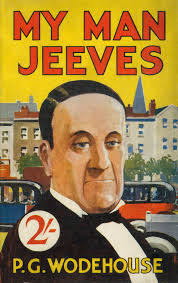
What ho, readers all!   My Man Jeeves renews my acquaintance with young Bertie Wooster, exemplar of the aristocracy in decline.  Bertie has loads of money and no sense in the least, but is saved from the worst of his foibles by the ever-present Jeeves, he of the unrivaled brilliance.  The work gathers a handful of Bertie-and-Jeeves stories,  ranging from the whimsical to the inane.  There are also a couple of stories about Reggie Pepper, a  character who was a prototype for Bertie, and is just about as thick but lacks a Jeeves to see him through.   If he survives, let alone triumphs, it is only through that bit of wisdom that God preserves fools.  The premise is the same in this as in other collections; either Bertie himself, his aunts, or his friends have gotten him into a fix, and Jeeves must contrive to find a way out of it.  Plots thicken, Jeeves stirs, Bertie’s out of the soup and into his recliner to enjoy a whiskey and soda and contemplate the wonder that is his man Jeeves.

In this collection, his friends are typically the culprits.  One notable exception is the arrival at his American apartment of one of his dreaded Aunt Agatha’s friends. She is on a tour of American prisons and wants Bertie to take care of her intensely repressed son, Wilmot. No sooner has mummy dearest run off on business than has Wilmost escaped the apartment to engage as much sordid revelry as he can. This is his one chance to accumulate a storied and sinful past, and he’s intent on making the most of it. It’s up to Bertie to keep him from ruining his health with all-night binge drinking and partying, so naturally the ward winds up in prison. There’s often an element of backfire here;  Jeeves suggests, for instance, that if friend Corky wants his uncle to approve of his girlfriend, that they arrange to impress said uncle with the young lady’s authorship of a book on said uncle’s favorite subject – not expecting the uncle to be so taken with her that he  marries her.  The Reggie stories are all backfire  While Bertie’s scrapes and Jeeves’ ingenuity are fun reading in themselves, as I’ve noted in prior volumes, part of the fun of reading Wodehouse is the writing.  Bertie is an eccentric character and an enthusiastic narrator,  the sort who manages to make sitting in a  chair fun to read about. He’s like laughing gas, nonsensical and with a contagious effect.

Lady Malvern was a hearty, happy, healthy, overpowering sort of dashed female, not so very tall but making up for it by measuring about six feet from the O.P. to the Prompt Side. She fitted into my biggest arm-chair as if it had been built round her by someone who knew they were wearing arm-chairs tight about the hips that season.”


Here, in a sentence, is part of what makes Bertie a ball to read. There’s such energy to his narrative, the way he slings out descriptive fun with a healthy sampling of odd slang, some of it assuredly made up on the spot.  There is no one funnier to read out loud than P.G. Wodehouse, especially if you do it in a Hugh-Laurie-as-Wooster voice.  Even more giggles are to be had from Bertie’s interactions with Jeeves, who reins in his employer’s questionable fashion choices and is often allowed to destroy an offensive article as a reward. While Bertie professes to resent being dominated sartorially by his valet,  Jeeves is such a master at getting Bertie and company out of trouble, getting rid of pink ties and colorful sports jackets are a small price to pay.  If your interest is piqued, My Man Jeeves is available online for free via Gutenberg,  or through Amazon. 

Posted in Reviews | Tagged , , , | 2 Comments

Frodo’s Journey

Frodo’s Journey: The Hidden Meaning of the Lord of the Rings
© 2015 Joseph Pearce
158 pages

Noting that Tolkien’s Lord of the Ring trilogy is rich with symbolism is rather akin to observing that the Pacific Ocean is big. The description is accurate, but weightless. Frodo’s Journey examines much of its symbolism in detail, chiefly elaborating on Tolkien’s observation that it was, “of course, a deeply religious work”. The religion is present not in the trappings of a Church, as with Asimov’s Foundation series, but in the epic’s core story of grace against evil.   Pearce informs his argument by studying the details of the story in the context of Tolkien’s mythic background, drawing from the Simarillion. Although his focus is on Tolkien’s Christian symbolism, Pearce also touches lightly on Tolkien’s love for the language and lore of pre-Norman England.

In the Simarillion, Pearce writes, Tolkien establishes a celestial atmosphere not unlike the Christian one. There is one central deity, the Iluvatar, who creates the Cosmos by conducting music. One heavenly musician refuses to play in harmony, and is struck down to Middle-Earth, but is told that no matter how much discord he attempts to introduce,  the grand master will always restore harmony..  Central to the story of the Lord of the Rings is, of course, the Ring, which is far different from the ring of The Hobbit. There it was a mysterious but powerfully helpful object;  in the Ring trilogy, it dominates the minds and hearts of those who wear it, and exposes them to attack by dark forces.   The ring, writes Pearce, is Sin – not only is it burdensome, but taking it on distances the wearer from the good world which was divinely created, and makes them more visible to the Dark Lord – Sauron,  Morgoth’s chief servant.  The coup de Grace:   according to Return of the King,  the ring was destroyed on March 25, the same day that Catholic tradition maintains was the date of the historic crucifixion.  The whole story has the stamp of Providence on it, writes Pearce, for Gandalf muses that Bilbo was meant find the Ring, so that it might be destroyed.  Although Pearce’s brief work shines a light on many of Tolkien’s other little allusions – the Charlemagne-like crowning of Aragon, the linguistic fun Tolkien has with the “far-seeing” stones that dispirit Sauron’s enemies and have the same etymological structure in Elvish as Television and Fernsehen do in English and German,   the Christian connection is the most broadly developed.

This meaning is not nearly as overt as C.S. Lewis’ own Narnian chronicles,  in which the Christ-figure Aslan announced to the children that he was known by another name in their world, but it definitely registers.  Being as Tolkien was a practicing Catholic, some degree of the inspiration could have been accidental, like the Mary-like veneration of Galadriel, but the use of dates has the stamp of deliberation.  For the Fellowship to have started out on December 25 (by Tolkien’s appendix) and triumphed on the same date of the first Good Friday makes clear that Tolkien was paying homage at the very least.   While this is my first foray in reading books about the Ring trilogy, it won’t be the last, and I’m eager to see if other authors share or differ from Pearce. I’m sure the trilogy has tremendous depths to plumb!

Posted in Reviews | Tagged , , , , , , | 2 Comments