Selections from Musonius Rufus

These are a few passages from Ben White’s modern interpretation of Musonius Rufus’ lessons and fragments.

Prologue:
Of everything that exists, God has put some in our control, some not. He has put the noblest and most excellent thing in our control, the power of using our impressions. When correctly used, this means serenity, cheerfulness, constancy, justice, law, self control – virtue, overall.

From The Good:

If you do a good thing through your hard work, the work passes and the good remains. If you gain pleasure through dishonor, the pleasure will pass, but the dishonor remains.

None of the things which people believe they suffer as personal injuries are an injury or a disgrace to those experiencing them — even being insulted, struck, or spat upon. Disgrace lies not in enduring them, but rather in doing them. For what does the man who accepts insult do that is wrong? It is the doer of wrong who puts themselves to shame.  To be sure — a good person can never be wronged by a bad. “

From Women:

Women and men have the gift of reason from the gods. Both are naturally inclined toward virtue and the ability to acquire it. Both are pleased by good, just, acts, and reject their opposites. If this is true, how can we say that men should search out how they may live good lives, but women should not? Should men be good, but not women? 

Shun selfishness, revere fairness, and, being a human being, wish to help your fellow human — this is the noblest lesson, making those learn it Just. Why is it more appropriate for a man to learn this?  If women should be Just they must learn the same lessons; they are eminently appropriate to the character of each.

From Leadership:
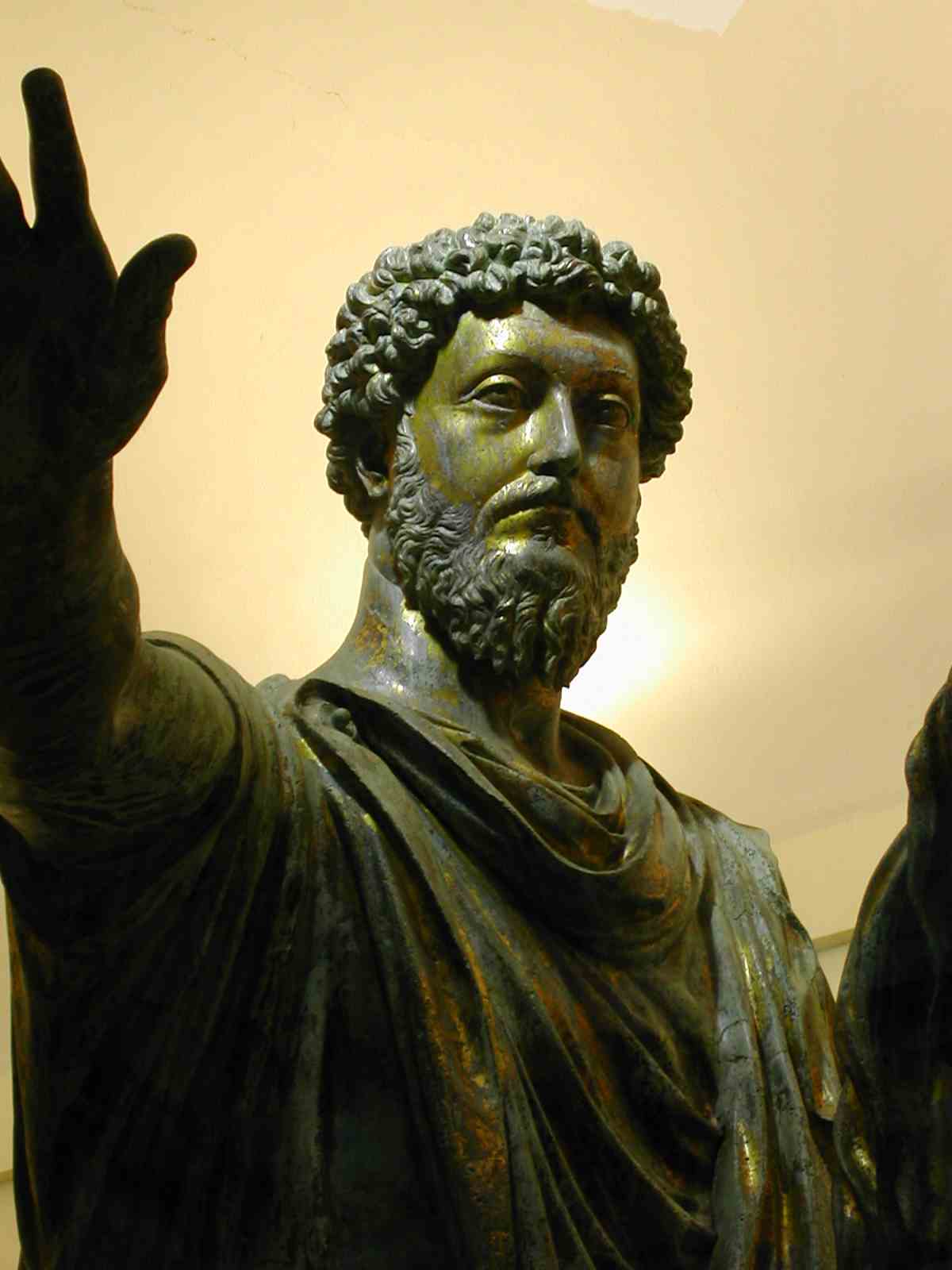
With the exception of philosophy, there is no study that develops self-control. It teaches you to be above pleasure and greed, admire thrift and avoid extravagance — in trains you to have a sense of shame, and to control your tongue – it produces discipline, order, and courtesy – in general, appropriate action. When these qualities are present in an ordinary person, they impart dignity and self-command – if present in a king they make him more godlike and worthy of reverence. 

Courage breeds the fearless, the intrepid, the bold – how else would you acquire these characteristics other than by having a firm conviction that death and hardships are not evil?  For these are the things that unbalance and frighten you — philosophy is the only teacher that they are not evils. If kings ought to possess courage, and they should more than anyone else, they must study philosophy. They cannot become courageous by any other means.

From Resilience:

If you wish to be healthy, you must spend your life taking care of yourself. Reason shouldn’t be cast out after an illness is cured; let it remain in the soul to guard your judgment. The power of reason shouldn’t be compared to medicines, but to healthy foods — it introduces a good frame of mind to those where it becomes habitual. However, when emotions are at their greatest heat, wise words and warnings have barely any effect at all. They are like the scents that revive those fallen in a fit, yet don’t cure the disease.

Anyone will admit how much better it is instead of:
– struggling to win someone else’s wife, struggle to discipline your desires?
– enduring hardship for money — train yourself to want little?
– trying to injure an envied person — ask how to stifle envy?

Hard work and hardship are a necessity for all — both for those who seek better ends and for those who seek the worse — it is ridiculous that those who are pursuing the better are not much more eager in their efforts than those who have small hope of reward for all their pains. 

If we were to measure what is good by how much pleasure it brings, nothing would be better than self-control — if we were to measure what is to be avoided by its pain, nothing would be more painful than lack of self-control.

Virtue isn’t simply theoretical knowledge — it is the practical application, just like the arts of medicine and music. If you wish to become good, you must not only know the precepts conducive to virtue, you must be constantly applying these principles. 

From Marriage:
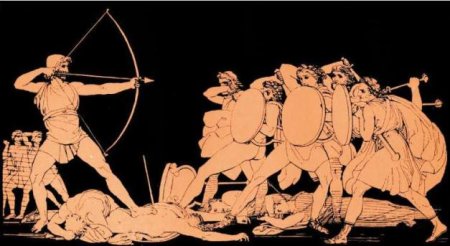
In marriage, there must be above all, perfect companionship and mutual love — both in sickness and in health, under all conditions. It should be with desire for this and children that both enter upon marriage.

If you say that each one should look out for their own interests alone, you represent mankind as no different from the wild animals, born to live by violence and plunder, doing anything to gain some selfish advantage — having no part in a shared life, no part of cooperation with others, no share of any concept of justice.  

It is each man’s duty to consider his own city, making his home a rampart for its protection. But the first step towards this is marriage. Whoever destroys the human marriage destroys the home, the city, the whole human race.

The home or the city doesn’t depend on women or men alone, but their union with one another.

From Obedience

If your father or the archon or even the tyrant orders something wrong, unjust, or shameful, and you do not carry out the order — you are in no way disobeying, as you do no wrong nor fail to do write. Disobedience is disregarding and refusing to carry out good, honourable, and useful orders.

From Food:
Surely a good man should be as robust as a slave; for that reason, Zeno thought he ought to beware of dietary delicacy. If he gave in just once, then he would go the whole way, since when it comes to food and drink, pleasure accelerates its pace alarmingly.

From True Wealth
We shall condemn the treasures of Croesus and Cinyras as deepest poverty. One man alone is rich, the man who has acquired the ability to want nothing, always and everywhere. 

I choose sickness over luxury, for sickness only harms the body — luxury destroys body and soul, bringing with it weakness, feebleness, a lack of  self control, and cowardice.

Posted in quotations | Tagged , , | Leave a comment

Bloodletter

Bloodletter
© 1993 K.W. Jeter
276 pages

Constable Odo has noticed something very strange about the Cardassian freighter docked with Deep Space Nine. Despite its identification as an utterly harmless freighter, dangerous only to the subspace version of bugs splattered on the windshield, there are subtle tells that the ship was created for exclusively military purposes. In fact, the Cardassians mean to establish an outpost on the far end of the Wormhole connecting the Alpha and Gamma Quadrants, compromising Bajor’s own control of the etheral tunnel. While Commander Sisko has expected this kind of move, he’s using it to force Starfleet to …er, increase funding to Deep Space Nine. A quick mission to establish Starfleet’s own permanent outpost on the Gamma side will also get Kira out of his hair, because (1) this is season one and he hasn’t adopted the awesome-bald look, and (2) Major Kira is a Major Pain. No sooner did she let a bunch of Bajoran Wahhabis onto the station than did people start mysteriously dying, and she’s so stubborn that he’s been forced to assume every aspect of station management.

Most of Bloodletter’s oddities are the result of being written in the show’s infancy, back when writers were still relying on the rough-outline series bible to give them general ideas. (“Kira used to be a terrorist, and now she’s an authority figure. Discuss.”) Consequently, to use Kira as an example, her relations with Sisko are a lot more rough than they ever were in the show: she actually interupts and argues with him during staff briefings, which is probably why he’s willing to send her into the gamma quadrant on her lonesome to establish an official Bajoran presence there. She’s not the only one acting not just out of character, but grossly unprofessional: Bashir actually asks Kira out on a date while IN HER QUARTERS. She walks in, ready for a night of listening to fundamentalist Bajoran preachers threatening to purge Bajor of foreigners and red-headed majors, and there’s the doc waiting for her and poking through her bookcases. Other aspects of the book are simply weird: Odo catches wind of the Cardies’ plan because they’ve stopped at DS9 to have ‘impulse buffers’ installed. Starfleet demands that every ship passing through the Wormhole have these buffers installed, because otherwise the ships might kill the beings who live inside the portal. To borrow from Kirk, “Why do the gods need protection from starships?” I’m guessing that was a bit of  series-development speculation that went the way of TNG’s 55 mph warp speed limit.

Jeter used plot elements later employed in the show “Past Prologue”, in which Bajoran jihadists test Kira’s loyalty and their plot involves rudely exploding things near the wormhole. Frankly, I found the odd character-and-plot elements more enjoyable than the actual plot, since obviously Odo would get his man. Bashir receive a bit of odd character background here: he’s a 24th century hipster, rebuilding an old audio system because the sound is sooooooo much better than digital, man. Really intense. It’s not just a quirk, of course; his experience playing with audio helps him with the plot later on.

Posted in Reviews | Tagged , , | Leave a comment

War Drums

ST TNG: War Drums
© 1992 John Vornholt
276 pages

Imagine Lord of the Flies with Klingons, and set the pack of nigh-feral boys against a small community of settlers who only just arrived themselves.  Such is the set up of War Drums, the story of a besieged human colony which solicits the Enterprise’s help. When the people of New Reykjavík broke ground at a stable spot on the strange planet Selva, they didn’t realize it already had residents — a group of Klingon adolescents, marooned as children when their refugee ship crashed here. Now, after months of raids by the Klingons, the humans are lead by a bitter and xenophobic man who prefers the Enterprise’s sensors and phasers to her crew’s diplomatic savvy.   Created by John Vornholt, War Drums is Ro Laren’s first appearance in Treklit, and an interesting predictor of several TNG and DS9 episodes. The main plot — desperate settlers increasingly held in the grips of a fear taking racial overtones, Worf struggling to make contact with the raiders and teach them – -has much human interest, but the obligatory B thread involves imminent geologic catastrophe that is uncovered by Ro and a twelve-year-old colonial girl, Myra.  Truth to be told, I tend to skip through the B-scenes in older Trek books, because they tend to be  engineering problems rendered in complete technobabble. (“The tech is going to go teching tech! We need to tech the tech, quickly! We did it! Now the A plot is safe!) This one features a science investigation with Earth-relatable terms, so it actually merited paying attention to.

 TNG later featured an episode in which Worf tries to connect long-abandoned Klingon youths to their glorious heritage (“Birthright”), and a DS9 episode involved a mostly-human colony with Klingon neighbors (“Children of Time”).  Kudos to Vornholt for predicting that.   He also uses the same exact quote that Picard quotes later on in the episode “Drumhead” — ‘when drums beat, the law is silent’.  (Speaking of:  what with the violent boys, their worship of the Chief, and their obsession with drums and encircling trials, Vornholt had to be drawing on Lord of the Flies!)   I probably wouldn’t have tried this novel but for two things: Ro Laren was on the cover, and John Vornholt penned it.  He’s not a particularly well-known author, but I’m familiar with him from his TNG Dominion War duology, which were the first TNG books I ever read. I read them multiple times, actually, and considering the heavy use of Ro Laren there he’s probably to blame for her being such a favorite character of mine.  She comes off well here, both as action hero and Starfleet scientist; Worf, too, gets some depth beyond “Grrr! Honor! WORF SMASH!”

Unfortunately, I think this is my last TNG novel with Ro Laren on the cover.  All good things…

BONUS POINTS: At one point, Worf literally turns his phaser up to 11.

Posted in Reviews | Tagged , , | Leave a comment

The Better Man

ST: The Better Man
© 1994 Howard Weinstein
294 pages

McCoy: “I should have told you about this in my quarters, not yours.”
Kirk: “Why? Some kind of weird protocol?”
McCoy: “No, I’ve got a better liquor selection.”
Fresh from a refit, the Enterprise has been summoned to the planet Empyrea. Or rather, Dr. McCoy has. In his days as a young officer, he and his captain-buddy Mark Rousseau discovered there an isolationist colony of human beings, dedicated to perfecting their own gene pool. Though the Emyreans were stridently against outside contamination, Rousseau did manage to win permission for Starfleet to set up a science station on the planet to monitor unusual star activity. Shortly after their ship, the Feynman, left Empyrea,  McCoy sought transfer away from both it and his now ex-best friend, Rousseau. Whatever happened? And why have McCoy and Rousseau been asked back?  (Was it a woman? Of course it was a woman. Discover new life and go to bed with it, that’s the StarFleet way!)
The Better Man is a rare TOS book in that McCoy is the primary character, with Kirk stuck on the Enterprise.  Though it takes place two years after The Motion Picture, the plot could have easily fit within the five-year mission:  two main threads quickly emerge, with a third crisis tying them together. When McCoy visited the planet eighteen years ago, he worked with a local scientist, and now — almost  eighteen years later — she has a daughter, just about eighteen years old.  And that’s a problem, because when the child is given her customary bioscan at eighteen to make sure she’s worthy breeding potential, the government is going to realize her daddy is Not of This World. She’ll be sterilized, or worse yet, killed, because that’s the sort of thing that happens when people start controlling others to make things…Perfect.  You get mass killings or reavers,  and so in the fashion of Captain Mal,  people here are aiming to misbehave. Specifically, McCoy manages to get himself kidnapped by the Empyrean Liberation Front, which is even more embarrassing than it sounds: the ELF is one teenager who wants to start a revolution and use McCoy as leverage. 
I found A  Better Man a fun, quick read. Weinstein gets the subtleties of McCoy’s language fairly well, and there’s several fun lines:
===============================================================
McCoy: “Y’know, that day Spock threw that bowl of soup at Christine Chapel will always be one of the highlights of my life.”
Kirk: “I suppose that says something about your life.”
Kirk: “I thought you wanted to have as little to do with them as possible.”

Scott: “I do, sir, I just want it to be my idea — not theirs!”

Scott: “Looks like so-called genetic perfection has doesn’t away with the occasional horse’s ass.”
Spock: “A correct observation, Mr. Scott, if I understand the reference.
Scott: “That y’do, sir.”

Posted in Reviews | Tagged , , | 3 Comments

How to Live

Musonius Rufus on How to Live
© 2012 Ben White
112 pages

Virtus isn’t just for the men any more.  Musonius Rufus is the forgotten Stoic, a man hailed alongside Socrates as nigh-saintly by Origen, but now almost forgotten. More’s the pity, because Rufus didn’t offer just another collection of admonishments to keep in mind what you can control and what you can’t.   What works remain of his are simply known as Lectures and Sayings, recorded not by him but by a student. They apply the lessons of philosophy across the entire experience of human existence, giving modern readers a taste for how broad the day to day lessons of the Stoics actually ran — from the meaning of life to proper beard grooming.

The most extraordinary aspect of Rufus’ teaching for the modern reader is that he maintained that philosophy was fit for women as well as men. The pursuit of virtue and the pursuit of manliness, for the Greco-Roman mind, were one in the same;  virtue was manliness. Not one to be limited by etymology, Rufus argues that women can profit just as well by philosophy as men. They carry the same inner spark, and the fruits of a philosophically-tamed soul are just as salutatory for a woman as man. Does a woman not need courage to defend her young against those who would harm them? Does she not need clear thinking to balance the household accounts, and does she not need self control to maintain peace in the home, and to protect herself against the same foibles of humanity as her husband?

Rufus does not merely maintain that women can be philosophers, too;  given that men and women share the same divine gift, Reason, they can perceive and are thus subject to the same natural law. The same rules apply to everyone, and from them there is no escape. Rufus admonishes men and women alike to practice sex only within the bounds of marriage, and only with one another. Rufus is not a prude;  in regards to pleasure, he is consistent across the board. Don’t wear more clothes than you need; excessive protection from the elements only creates a soft, fragile body, and a frail constitution. Rich foods? Nonsense.  Fruit, cheese, and vegetables — a simple diet is best. Why build a mansion? You only need  shelter from the elements, no need of luxurious colonnades and precious gems.  To fill a home with silver is to fill it with worry;  no thief would take off with wooden cups and earthenware plates.

Another singular aspect of Rufus is his perception of man as a political animal. While Marcus Aurelius often alluded to man being a social creature, his Meditations are largely counsel to himself; Epictetus’ works are the equivalent of philosophical boot camp, focused on the individual steeling himself for life. Seneca, in his letters counseling friends, is convivial, but he is surpassed by Rufus. There are numerous sections in this book which focus on humans in relationship with one another,  with the most important bond being marriage.  For Rufus, the family is the cell upon which society is based: marriage not only renews human life, creating new generations, but it provides its members  one of the vital lessons of life: we are made for one another. Marriage should be engaged not for looks or money, but to be a companion to another — to love, not merely with passion but with will, with duty. Philosophy is the art of life, and to practice it means to discern man’s duty to his creator, to himself, to his fellows with whom he is made to work alongside.

Although I still plan to read a formal translation of Rufus (Lectures and Sayings, Cynthia King) to make sure that Ben White’s adaptation here is faithful, I thoroughly enjoyed this little book by Rufus. His commitment to a simple, authentic life on all fronts is admirable, more  detailed than Epictetus and carrying with it an integrity that Seneca can’t quite muster. Rufus didn’t just write pretty words about how exile was nothing; he practiced it.  Like Epictetus, he makes Stoicism and philosophy matter of day to day life, but these lectures here cover more of the practicalities of human existence than Epictetus’ boot camp does.  Rufus is both challenging and bracing!

Related:

The other Stoics:

Posted in Reviews | Tagged , , , , | 1 Comment

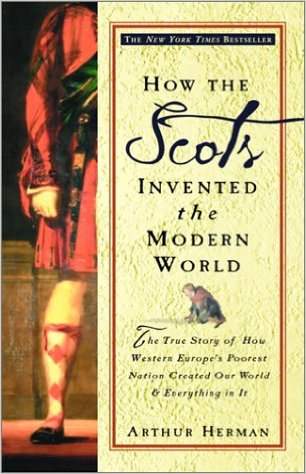
How the Scots Invented the Modern World

How the Scots Invented the Modern World:The True Story of How Western Europe’s Poorest Nation Created Our World and Everything in It 
© 2001  Arthur Herman
400 pages

An elderly patron at the library has adopted me as his go-to source for history books. These days he merely arrives at my desk and announces, “You know what I like. Let’s find something!”. As a reward for my literary services, he decided to lend me one of his books, How the Scots Invented the Modern World.   As it happens, I know very little about Scottish history, except in connection with English and American history — so I dived in, and found it a most interesting book.  At its best, it’s a history and reflection on the Scottish enlightenment, sweeping enough to bring to mind Will Durant’s approach for history.  The author addresses — for starters — religion, philosophy, architecture, politics, economics, and literature. At a middling level, it’s social history of a sort, recounting the Scottish experience in America in a manner very much like previous books I’ve read on the Scots-Irish.  At its most trivial, it is merely a narrative recollection of this Scotsman inventing this and that Scotsman inventing that, and oh, by the way, that fellow invented steamboats in America, and he was born in Scotland.   Fortunately, How the Scots Invented the Modern World is only trivial toward the end.

 The bulk of the book is taken up with Scotland’s intellectual and economic development as a developed and ‘enlightened’ nation, though the author favors those who celebrated Scotland’s romanticized wildness, like Sir Walter Scott.   Some very familiar names, like David Hume and Adam Smith appear here, along with names wholly new to me, like Francis Hutcheson.  These figures do not appear sans context; instead, their arguments are rooted in Scotland’s political history, from the various revolts against Anglicanism and Catholic kings, to Scotland’s matrimonial bond to England.  In the authors view, Scotland was not a victim of empire, but helped author it, and indeed we see Scots exploring Africa,  arguing for a remolding of India in the British form, and penetrating deep into the American interior as Scots-Irish settlers.

I would recommend this book solely on the treatment of Enlightenment-era political philosophy along, as the author is strongest here. That section won me over despite some early black marks, as when he identified a founder of the Jesuits as a figure of the Reformation, and declared that the Protestant revolution made the Bible no longer a closed book.  Now anyone could hear it read, or read it themselves. What were they up to at church in the centuries prior, playing tiddlywinks?  The entire structure of Judeo-Catholic-Orthodox liturgical tradition is based on the reading of scripture! Still, the author managed to redeem himself wonderfully after that.

Related:
The Scotch-Irish:  A Social History,  James Leyburn
Born Fighting: How the Scots-Irish Shaped America, Jim Webb
How the Irish Saved Civilization, Thomas Cahill

Posted in history, Reviews | Tagged , , , | Leave a comment

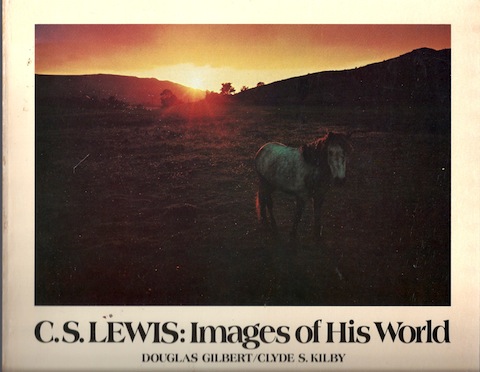
Images of CS Lewis’ World

CS Lewis: Images of his World
© 1973  Douglas R Gilbert, Clyde S Kilby
144 pages

Last year I was tasked with the lamentable duty of weeding our history, literature, and science sections, and so in consequence spent several weeks methodically going through the stacks, book by book, making several discoveries. One,  in regards to literature, evidently my city became CouchPotato-ville in the 1970s. I found book after book which had enjoyed steady attention from the 1930s to the  1960s, but once the 1970s hit — nothing. A precipitous drop off. I suppose everyone started watching Family Feud.  I also encountered a great many books I’d never seen before, like CS Lewis: Images of his World. As the title suggests, it is a photographic treatment of Lewis’ life, illustrating the towns, universities, and pubs wherein he lived, along with some biographical exposition as  extended captions.

Personalities central to Lewis’ life appear here, like his wife Joy, his stepsons, and of course his numerous colleague and fellow writers, namely Tolkien. There are also unexpected supporting characters like his long-term gardener. The latter inspired a character in The Silver Chair, and the book smartly combines letters or biographical narration about Lewis’ life with photographs. A photograph of several young Cambridge students cycling down High Street is the backdrop for a letter in which Lewis details an early social outing, getting together for ‘brekker’ before pedaling off through town. Similarly, his recollection of the many ferry trips from Ireland to boarding schools in England is accompanied by a large photograph of two boys crossing the same ferry, looking at the approaching coast in anticipation.  These shots of others, while illustrating Lewis’ life, don’t appear staged;  there’s at least one fellow on a bicycle who didn’t look pleased at all to find a camera aiming in his general direction, though the intended subject was the street.  There are also photographs of Lewis’ earliest creativity, of his schoolboy notebooks filled with the history of “Animal-Land”, accompanied by little drawings. I’ve been meaning to enjoy this book in full for a few months now, as  I often glance inside it while shelving just to savor the photographs of Cambridge, Oxford, and the Irish countryside. Many of the photographs are only greyscale, but even so they’re delightful. As someone who has read and enjoyed thoroughly his autobiography, I am grateful to have discovered this piece.

Related:
Images of America (Selma, Montevallo) series
Posted in Reviews | Tagged , , , | 8 Comments

Smoking Guns, Sinister Schemes, and Still More Dangerous Blondes

Faced with the specter of a three-day weekend, but late-summer heat still too oppressive to venture out in, I enjoyed a little classic-movie marathon. I mention this here because while it’s not a read-to-reels post, all three movies are based on books (or a play).   The collection gathers The Big Sleep, Dial M for Murder, and The Postman Always Rings Twice.   (It also includes The Maltese Falcon, but I’ve seen it a few times already.) Reader Cyberkitten mentioned that he would be hard-pressed to choose a favorite from among these three, and having watched them I now sympathize. They’re all exceptionally well done.

I began with The Big Sleep, which continues a trend of Humphrey Bogart movies for me. This wasn’t like the rest, though, as they (Across the Pacific, Passage to Marseilles, Action in the North Atlantic) were all WW2 movies.   The Big Sleep was actually filmed and finished before World War 2 was over, but its release was delayed to make room for a few war movies to air. Instead, it’s another detective mystery like The Maltese Falcon.  Bogart is employed by an elderly general to find out who is blackmailing him, and to pay the money if need be. When the blackmailer is mysteriously murdered — lots of murder in this movie — Bogart realizes there’s more to the story, especially when everyone (including the general’s family) insists he drop the issue.  The plot is very complicated, but Lauren Bacall is amazing at being Bogart’s slightly antagonistic client-love interest. Her hautiness is matched only Bogarts’ utter refusal to take anyone’s nonsense seriously. (One of their better scenes here:

Dial M for Murder featured the direction of Alfred Hitchcock, who has never failed to deliver a gripping tale.  M for Murder immediately introduces the reader to a confident seller of sports equipment, Tony Wendice. Though he  seems to dote on his beautiful blonde wife (Grace Kelly!), nevertheless Wendice plans to do her in. In years past, while he was traveling the world playing tennis, she was having a little dalliance with an American criminal novelist. His revenge? To arrange for her murder, via blackmail of a morally dubious classmate, and to use the novelist as his alibi. The perfect crime, but when it goes awry he  seems achieve an even greater revenge by quick thinking  — but the devil is in the details!  Part of the fun is that several important characters are concealing key information from not only the murder-mastermind, but the viewer.  The novelist character adds a certain flair. The ending, when  Wendice closes a door and recognizes that something profound has happened,  has a marvelous touch of class.

Lastly, I finished the weekend out with The Postman Always Rings Twice, which featured neither familiar acting nor  direction. The story begins with a hitchhiker arriving at a roadside cafe and deciding to put in a little work there.  The owner is a happy-albeit-doddering old fellow, Nick, who is married to another beautiful blonde who enters rooms one hip at a time.  I knew  right away she was trouble,  and soon enough she and the hitchhiker have fallen in love and have decided to use Nick’s frequent bouts of drunken stupor to arrange for a fatal accident.  Their first attempt fails, but the second try succeeds…albeit with unwanted results, and soon the two are fighting each other as well as resisting justice — justice that the movie’s end supplies, with an artful level of tragedy.

If I had to choose a favorite, I would select Dial M for Murder; as masterfully performed as Bogart and Bacall’s roles were,   M for Murder’s deceptively straightforward plot won me completely.

Posted in Reviews | Tagged | 4 Comments

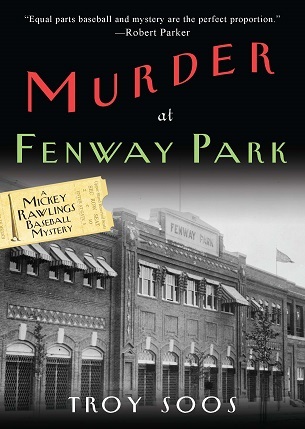
Murder at Fenway Park

Murder at Fenway Park
© 1994 Troy Soos
252 pages

1912, Boston. The Titanic is only a few weeks lost to the North Atlantic bottom, but Mickey Rawling’s mind isn’t on one of the biggest maritime disasters of history. No, he’s just been inducted into the Major Leagues, hired to play with the Boston Red Sox, and his first night he’s stumbled upon a man beaten so badly the victim’s face no longer exists. And then Mickey threw up on it, just for good measure. Murder at Fenway Park is the story of a rookie ball player who turns amateur detective when he realizes the police intend on fingering him for the crime. While the cozy relationship between the Red Sox and the police might protect him during the baseball season, come fall he’ll be left to his own devices.

The first in Trey Soos’ baseball-murder mysteries,  Murder at Fenway takes readers through a violence summer, in which Rawlings rubs shoulders with baseball greats like Ty Cobb,  and does his best — with the aide of a nickelodeon musician and a Socialist working on the garment factory-version of The Jungle —  to figure out who did it before either being arrested or beaten to a pulp by the original murderer.   The writing is sometimes unpolished, but the opening framing device — an old man wandering through the Baseball Hall of Fame, feeling he and the sport have become long-distant strangers, then flashing back to the murder story on seeing the victim on a baseball card — was well executed.  I suspect readers will find the setting more interesting than the mystery, considering how dramatic this era was in baseball. This was the decade that produce legends who gave their names to awards — Cy Young, Ty Cobb — although we’re two years away from Babe Ruth stepping up to the plate. This is technically alt-history, considering that Soos kills off a player who — in reality, died of a heart attack in 1959.

Murder at Fenway Park is by no means amazing literature, but it’s enjoyable if you like early-20th century mysteries, or golden age baseball.

Posted in historical fiction, Reviews | Tagged , , , , | 2 Comments

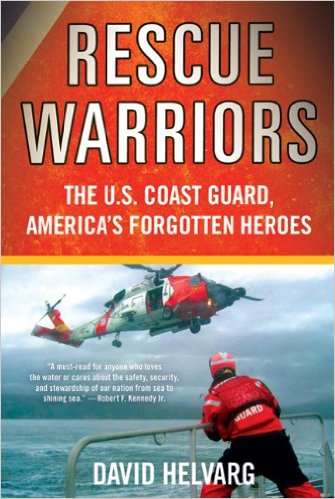
Rescue Warriors

Rescue Warriors: The U.S. Coast Guard, America’s Forgotten Heroes
© 2009 David Helvarg
384 pages

When Katrina devastated the Gulf Coast in 2005, the Coast Guard was the first on the scene, with helicopters in the air saving lives long before FEMA stirred. Though one of the United States’ military branches, the Coast Guard is an unusual institution;  best-known for its high profile search and rescue missions. Far and away the smallest military branch – and the most physically and academically rigorous in terms of its recruiting requirements —  the Coast Guard’s mission takes it far beyond safe and shallow coastal waters.   Rescue Warriors provides both a history of and a tribute to this oft-overlooked service, mixing history of its various missions and interviews with men and women working overtime to preserve lives and keep the coasts safe.

Although the Coast Guard was officially organized in 1915, it prefers to trace its history back to the revenue cutters of George Washington’s administration, which enforced and collected customs and tariff fees.  Another parent organization was that of the lighthouse and lightship service. The present Coast Guard has maintained that duel-purpose organization, simultaneously enforcing maritime law and rescuing those in danger.  Its mission portfolio is vast: in Rescue Warriors,  Helvarg interviews search-and-rescue teams,  drug-enforcement patrols,  counter-terrorism missions, environmental cleanup crews, science stations, and even more.  Helvarg spent time with servicemen and officers from around the United States’ territorial waters: the Gulf Coast,  New England,  California, Alaska, Hawaii, and even (with Canadian ‘permission’) in the Artic northwest passage.  Despite its ‘coast’ guard name,  Coasties may be found throughout the world: their boarding teams are especially relied upon in the Persian Gulf,  boarding local boats (with consent) to ask about  pirate concerns – and fishing for information on parties hostile toward the governments of Iraq and the United States.  (If the Coast Guard being a military branch simultaneously providing law enforcement seems constitutionally questionable, that isn’t surprising given that Wilson presided over their formal creation:  he never met a constitutional curb he wouldn’t drive over.)

The demands placed on the Coast Guard only seem to be increasing: a global economy means more ships to monitor, and with the Artic now open for commercial traffic and industry,  there will be still more ground to cover. The Coast Guard is much smaller than even the closest other service, the US Marines, but the gulf between its responsibilities and resources has demanded a great deal of efficiency. The average age of a Coast Guard ship is thirty-five years, and its officers’ training vessel, the Eagle,  was built in 1936.   That’s resource conservation, though when a helicopter requires 40 hours of maintenance for every hour of flight time…. The reason for the Guard’s physical and mental demands becomes obvious in reading this:  they are operational every day, not simply training for the next big conflict, and they often go against nature at its hairiest – flying helicopters into punishing winds to seek out those in peril on the sea.  They’re also up against human nature: in the opening chapter on rescue operations in Hurricane Katrina,  the Guard’s Seahawk helicopters took ground fire from locals; another man threatened to shoot a helo crew if they didn’t rescue him, and when they dropped people off at a CG station, it was promptly looted –  though the ammunition locker refused to give up its contents.  At least against cartel gunmen, the Coast Guard  is authorized for “Airborne Use of Force”.

Rescue Warriors  makes for encouraging reading, filled with  tales of rescue, of men and women stretching themselves so that others might live.  Helvarg sees the Coast Guard’s historical legacy and current role as exemplary, highlighting the early employment of women in the lighthouse service, and urges that the Coast Guard be given more resources so that it might serve the United States’ expanding needs.   Ultimately, this is a fun read, a mix of history, present-day history stories, and a fair bit of editorializing by the author whenever there is an environmental connection.

Related:
The Heart and the Fist, Eric Greitens. The memoirs of a humanitarian-turned-Navy SEAL, another mix of service and force.

Posted in history, Reviews | Tagged , , , , , | Leave a comment