Fire on the Mountain

Fire on the Mountain
© 1961 Edward Abbey
211 pages

Beneath the shadow of Thieves’ Mountain, Billy Starr has arrived to spend a summer with his grandfather. He has arrived in the middle of a six-month siege, however, one of increasing intensity. The US Corps of Engineers is determined to expand its missile testing range at White Sands (Alamogordo, NM),  and has been generous with the public purse to do it. Virtually every rancher in the area has sold their land to the army — but not Old Man Voeglin. Voeglin’s ranch was established by his grandfather in the 1890s,  defended against the Apache, and has  survived both drought and depression.  Voeglin rarely breaks even on it, but neither the farm nor his will has ever broken. The  army offers money? Threats? Doesn’t matter. Let them shoot the horses, break the fences, run off the cattle: this was the farm that gave life to Voeglin and his father, the place that sustained them.  There’s no money that can buy out Voeglin’s sense of responsibility, nor lessen his indigence that the government would presume to simply seize the land and remove him by force if he didn’t roll over.  So he resists, and with him are his grandson and an old friend. Together they mend the fences, ride out into the brush to find the straying cattle, and continue to tend to the ranch’s everyday needs even as they are watched by Army jeeps and bureaucrats in sweat-soaked suits.

Fire on the Mountain is a short but powerfully written piece pitting man — affectionate and frail — against the implacable will of the Man, personified here in the form of a judge, a marshal, and more than a few soldiers. They are not pitiless executors of a grand plan from above; while the plan itself is pitiless,  its human agents show as much mercy as the pressure pushing them from above can allow. Voeglin’s obdurancy — born of both love for his ancestral home and of contempt for those who would reduce it to test-range debris,  abandoning generations of work to occasionally-bombed fallowness  —  is such that they even decide to let him say, provided he vacates the area during monthly missile tests.  Yet he persists; the same sentimental attachment to the ground and the cause that has allowed him to stand up to neighbors, men with guns, and the entire Cold War might of the US Army,  keeps him from making even the slightest concession. For him, the story ends in heartbreak.  It’s not quite so wrenching for the reader, for the ending has a certain noble appropriateness to it.

Fire on the Mountain has now become the Edward Abbey book I would give to someone who had never read him.  The book builds on devotion, not bitterness  or rancor. His main characters are three men who love the New Mexican wilderness, and their place in it: they are deeply attached to one another. Even when the twelve-year old Billy is put on a train to El Paso to save him from the rage of the marshals, such is his devotion that he escapes the train and navigates his way back to the mountains.  Abbey’s bellicose attitude is still there, reflected most through Voeglin’s utter refusal to back down, but it’s directed at the book’s ‘villains’.  Add to this the writing —  over and over, Abbey’s descriptions mesmerize me, both of the landscape and of the tortuous love the characters have for it.

Comments are welcome, but  I am in the Land of Enchantment until October!
Posted in Reviews | Tagged , , , | Leave a comment

Loose Ends

Roswell: Loose Ends
© 2001 Greg Cox
288 pages

The last person Liz expected to bump into in the depths of Carlsbad Caverns was the man who nearly killed her — would have killed her, had her lab-buddy/secret admirer not been nearby to save her life. He didn’t throw himself in front of a bullet or give her CPR, though, he merely dissolved the bullet and forced her molecules to speed-heal themselves. You can do that sort of thing when you’re an exiled alien king.  Bumping into Grumpy Murderman is a problem, not just because it brings to earth the mental-emotional turmoil that Liz has kept suppressed in the two years since she fell to the kitchen floor, bleeding from the gun — Murderman remembers her, too. He remembers accidentally shooting a girl, even if the papers covered it up, and now that he’s laid eyes on her again he’s determined to find out the truth. But first, he’s gotta blackmail an army test pilot into selling him a briefcase of UFO parts.  Priorities!

The first time I read Loose Ends, when it was released, it confused me — utterly. I’d read Roswell High, of course, multiple times. I’d memorized parts of it — and this Roswell, while featuring a lot of the same characters, was completely different. Who were the “Skins”? Why did Maria keep talking about Czechoslovakians?   I managed to get through the novel, questions aside, and put it in my Star Trek bookcase, there to be forgotten about for well over a decade.  Now I’ve read it again, and — having watched the television show on which this is based — it makes a lot more sense.   One of the reasons I’ve kept the book is because its author, Greg Cox, is more familiarly known to me as an author of Trek books. The language is odd — sort of self-censoring and clunky, as if the publishers didn’t want to be as earthy as the show. “Flying saucer” is used where another F-word might appear in the real world, and sounds really silly in the mouths of teenagers. Similarly awkward is Murderman, whose lines are so wooden they’re petrified. (That’s not really his name, but he’s a scruffy potbelly who shoots people.)

A book like this has limited appeal, I suppose, being written for a teen drama that’s since been forgotten by probably everyone, but if you’re  a fan of the show it has its moments.

Comments welcome, but I’m lost in the desert until October!

Posted in Reviews | Tagged , , | 2 Comments

Send More Idiots

Send More Idiots
© 2014  Tony Perez-Giese
324 pages

“What do you think of El Paso?”

“It’s an armpit.”

“I live here, and I don’t even take offense to that.”


Jon Lennox’ kid brother just disappeared in Mexico. He didn’t run off  with a woman, though, he disappeared in a place where the streets are paved with gunshells and which the neighbors call “Murder City”,  Juarez.   Everyone else has written Chris off as another cartel casualty, even though he was a real estate broker unconnected to the drug trade, but Jon  can’t let it rest.  Setting up shop in a seedy hotel in El Paso, he tries to make connections in the area that will help him discover what became of his brother.  His allies will include a telephone line-woman whose favorite word is “Cállate!”, a disgraced cop, and an Iraq war vet on disability who still lingers in the Fort Bliss area to stay close to his brothers-in-arms.  In pursuit of a man’s rescue, or just a strike back against the leading cartel, the three stumble into unspoken agreements between the American DEA and the lead gunman in Juarez, resulting in several shootouts and a climax at a Star Trek convention.

Send More Idiots is the opposite of bland, beginning in action and never resting. The moments between periods of active danger are filled with heated debate and discussion, as Jon tries to work out his next move and everyone tells him he’s a lunatic who is going to get himself killed.  His allies are no less dangerous:  the cop has his own private revenge motive, the vet’s improvised weaponry has a tendency to electrocute the user, and the linewoman’s cousin is sleeping with the mob. The characters all have a vibrancy to them — they’re audacious, desperate, and completely entertaining. No less lively is the background of El Paso-Juarez,  both gritty in their ways. The narrative frame is also unusual, the story is being delivered by…the missing person. He’s not very active, but every so  often he refers to ‘my brother’ Jon, and we’re reminded, yep – -the object of Jon’s search is the one telling the story, so something is up.  The characters suspect that something’s up with Jon, too: instead of leaving it to the private investigators and police authorities, he’s actively going into narco clubs looking for el jefe. It’s as if he wants to get into trouble, and many of those who know him suspect that this episode for him is a once-in-a-lifetime chance for adventure, an opportunity to stop being the responsible-but miserable lawyer, an obedient husband-and-son, and do something outstanding and courageous.

Send More Idiots is one of the faster-paced novels I’ve read this year, full of comic action. Definitely one to remember..

Comments welcome, but I’m on an adventure of my own until October!
Posted in Reviews | Tagged , , , , | Leave a comment

This Week….in the Land of Enchantment

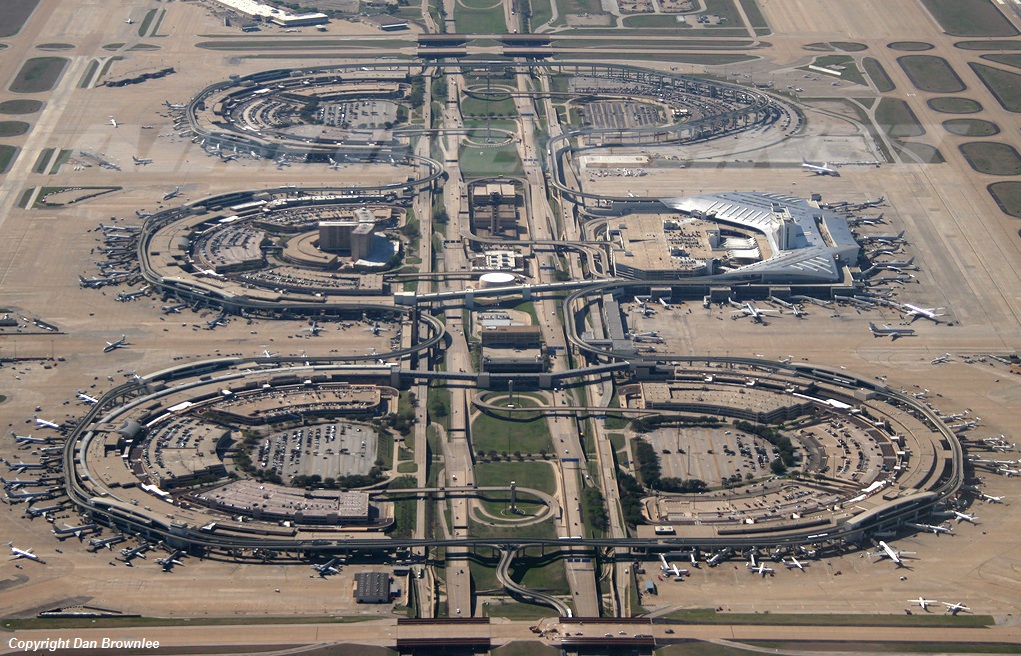
Tomorrow morning, dear readers, I will wake up dark and early and scurry to an airport,   off to spend a week in New Mexico.  In the words of Bilbo Baggins, I am GOING ON AN ADVENTURE!  I have never flown before, never driven in a major city, never traveled alone, and have never even been outside the South.  I’d say I’ve got an interesting week ahead!  Some posts have been scheduled in my absence, and I hope to return in a week with a mind awed and a camera full.  If I do not return — if my plane should unexpectedly land on the side of a mountain, if I am bushwhacked by highwaymen, If I become forever lost in DFW trying to find the right terminal,  or if I am kidnapped by some drug cartel to become their on-staff purveyor of  Anglo-American folk songs —  it’s been a fine nine years. I’m pretty sure I’ll return in one piece, though — and so, until then!

Posted in General | Tagged | 4 Comments

Deke!

Deke! U.S. Manned Space Flight from Mercury to the Shuttle
© 1994 Deke Slayton and Michael Cassutt
352 pages

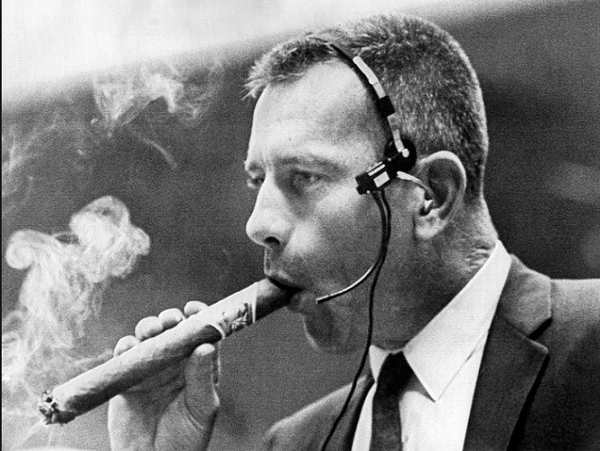
Don Slayton knew he wanted to fly as a kid, but he never imagined going as high as the moon  His story is singular; chosen as one of America’s first astronauts, he was grounded for medical reasons shortly into the Mercury-Gemini programs. Remaining at NASA in hopes of one day restoring his active-duty status, he was charged first with being head of the Astronaut Office, and later still director of Flight Crew Operations. His memoir of the Apollo program thus covers far more ground than one-flight wonders like Scott Carpenter or John Glenn*;  it also provides extensive information about the technical planning of the Apollo missions, Skylab, and the shuttle program.

 Just as the lunar missions were concluding, Slayton’s own mission to return to active service had a happy result: he flew on the last Saturn rocket in the Apollo-Soyuz project. There, he fulfilled a hopeful wish expressed to Alexei Leonov many years prior, that one day they might share a toast in space.  (The material in the “Vodka” bottles was just soup, but it’s the thought that counts.) Slayton left NASA as the space shuttle became its focus,  in part exhausted after now decades of a grueling workload, and in part because Reagan’s new NASA chief was a “horse’s ass”.  (Slayton helped inaugurate the shuttle, being head of the Approach and Landing Tests division during its development.)   Slayton wasn’t grounded after NASA: he took up a hobby of racing planes, and became a leading administrator in a private space venture, developing rockets for commercial liftng. Slayton fell prey to cancer before the book’s publication, but worked on it with his co-author for several years prior to his death.  Alan Shephard’s ‘co-authored’ book with Slayton, Moon Shot, was also published just after Slayton’s death, and I suspect it drew on some of the same interviews. The stories Slayton tells about his time in Russia are identical in both books, right down to the astronauts’ discovery that their rooms were bugged, and their mischievious decision to put Russian ears to good advaantage. (They would comment on how sad it was they lacked something, like a pool table, only to have one arrive days later..)

Slayton’s narration is professional with a hint of irreverence, like the time he hung out ofa helicopter by a rope to collect a goat he’d shot from the air. Tthe men who answered to Slayton’s strigent safety procedures at the Cape would never believe his behavior on his own time.   He goes into enormous detail on matters like how he created the mission schedule, but at moments of high emotion he isn’t communicative. He often speaks of his close friendship with fellow Mercury astronaut Gus Grissom, but when Grissom perishes in a fire (along with Ed White and Roger Chaffey), he can only terseley say that it was the worst day ever.  Cassutt or Slayton supplement the text with the recollections of Slayton’s family or other astronauts, including his son Kent.  These add a human touch and some humor of their own. (Once, Slayton and his son were enjoying a silent game of catch. After being admonished by his wife to talk to his son and bestow some fatherly advice, Slayton pondered and then informed his son to always take a nap and use the head when he had the opportunity. Kent recalls it as one of the funniest moments of his childhood.)  Overall, the memoir delivers a big picture view of the early decades of NASA, from a man who was there at the very beginning.

The Original Capcom

Related:

  • Moon Shot, Alan Shephard and Deke Slayton (forward by Neil Armstrong)
  • A Man on the Moon, Neil Chaikan. Hands down the best Apollo history. 

* Sure, Glenn flew twice, but he wasn’t exactly an astronaut the second time.

Posted in Reviews | Tagged , | 3 Comments

Hillbilly Elegy

Hillbilly Elegy: A Memoir of a Family and Culture in Crisis
© 2016 J.D. Vance
272 pages


Imagine a childhood in which the most stable person in your life once methodically marinated her passed-out drunken husband with lighter fluid, then set him on fire. (She did tell him if he came on drunk again, she’d kill him.)   That was J.D. Vance’s story, born in an Ohio colony of Kentucky hillbillies, whose residents escaped the desperate poverty of the hills but brought its impoverished habits with them.  In Hillbilly Elegy, Vance recounts his turbulent childhood, his difficult coming of age, and the people through by he was able to escape the pit —  primarily his grandmother and the US Marine Corps.

Thomas Sowell’s Black Rednecks and White Liberals introduced me to the idea that a culture of poverty has gripped southern whites and blacks — that their culture is in fact the same, one brought over from Scotland. Vance’s portrayal of that culture is personal and gripping.  It’s rendered through his biography;  hill people are impulsive and violent, with an acute appreciation for family honor that leads to savage reprisals with that honor is offended.  Vance witnessed chainsaws used to counter rude suggestions made toward the family women  — although later on, the brother protecting his sister might later get into a screaming match with her over a trivial issue.   The impulsiveness isn’t limited to reactions against insulting remarks; it also expresses itself in a short-sighted view towards work. A profitable job is abandoned if waking up for it  becomes viewed as a hassle.    When this approach to life fails to produce anything, outside factors are to blame: the boss, the economy, the government. Drugs enter the picture, both as pleasures in themselves and as relief from lives filled with screaming relatives, bad ol’ bosses,  and the threat of poverty. All this creates an enormous amount of chaos in the lives of people, and children raised in it grow up as emotional basket cases,  with no exposure to any other life that might make the shortcomings of theirs visible.

Vance and his sister were exposed to some of the worst of this through their mother, who — despite some vocational accomplishment as a nurse —   fell prey to substance abuse. At least five boyfriends were foisted on her children as make-believe dads, and her go-to solution for dealing with arguments in a car was to drive the car into things — trees, perhaps even others. Vance frequently saw neighbors hauled away by the police, but one night his mother was taken away, too. They only narrowly escaped being dumped on a random family, since their relatives were not licensed state-approved caregivers. For all of his grandmother’s violent temper, she believed he could have a future, and she believed he could achieve whatever he wanted if he worked for it. She urged him not to believe the lie that the odds were stacked against him: the world was his for the taking. Only when he began living with her full time did Vance manage to find some emotional stability and make plans for the future. Those plans included the Marine Corps, which taught him self-control and responsibility, and still later Yale.   Along the way Vance continues reflecting on what these moments in his life were teaching him; Yale, for instance,  illustrated to him the power of social capital, of networking. Submitting resumes and waiting is for the underemployed; those who get ahead do so by virtue of who they know.

Hillbilly Elegy has been creating a stir lately, presumably because people want to understand why Trump is popular.  They’ll probably find something here, like: “Say, Trump blames other people for our problems. That’s what those hillbillies do!”. Of course, all parties blame other people for the problems; that’s politics.  Vance’s book is an eye-opening account of the social life of Appalachia and its Midwest diaspora,  but certain aspects of that culture have much broader appeal.  The complete breakdown of the family is present both here and in accounts of urban poverty. In Ain’t No Shame in my Game, for instance,  Katherine Newman documented young couples from broken families who had received so little education in being an adult that they had no idea how to feed and change their baby.  Human civilization depends on knowledge constantly being passed from the old to the new — without that inculcation, what are we?   Also repeated in both cultures of poverty is the lack of agency — the idea, that people are not in command of their lives but at the mercy of forces greater than they. They are either in thrall to the government, or constantly point the finger at a political party, an ethnicity, etc.  There is no taking ones fate into own’s own hand.  Of course, Vance’s story also illustrates that escaping poverty is no matter of pulling one’s self by the bootstraps: he needed his grandmother teaching him to look toward the future, as he needed the Marines to show him how to work towards it.

Related:

Posted in Reviews | Tagged , , | 3 Comments

America First

America First: Its History, Culture, and Politics
© 1995 Bill Kauffman
296 pages

For slightly over a year prior to the attack at Pearl Harbor, there existed a civic organization of nearly a million people called the America First Committee. It dedicated itself to stymieing the attempts of D.C. and Hollywood to embroil the United States in yet another European war  Despite its name, this book isn’t about them, though Kauffman does honor their heritage in the expanse of people it celebrates here. America First hails writers and politicians commenting on not just foreign policy, but the American spirit.   Here collected are the broadsides and literary stabs of men and women from across the political spectrum, from across the country,  from across income brackets — who have resisted the idea that America needs to be great to be wonderful.  Politically, their concerns are straightforward: they are against foreign wars and against involvement in organizations that jeopardize American sovereignty. This isn’t merely a rehash of Ain’t my America, with added rebukes for NATO;  instead, Kauffman  shares the ardent love of these writers for America in itself via literary reflection. These authors don’t love it for what it could be – a global player, even a global savior – but for what it is, a vast land of beauty and promise, with a healthy individualistic tradition that protects people not only from the state, but the danger of social smothering.

Kauffman begins in the early 20th century, examining the populist and progressive backgrounds of many who later joined America First. They included Amos Pinchot, written out of the Progressive movement for his strident anti-imperialism. (The rough riding-Caesar, Teddy, referred to him as the party’s lunatic fringe.)  Teddy’s pistol-packing  daughter Alice Roosevelt also appears,  vexed at both Wilson’s League of Nations and her cousin’s entire administration. After the war, Kauffman pivots again to literary types — Jack Kerouac and that magnificent son of the desert, Ed Abbey. Another dear fellow, Wendell Berry, is quoted a few times. (One reason I’m so fond of Kauffman, besides his punchy writing filled with words like katzenjammer: we’re both fond of men like those two, plus Dorothy Day.)  Kauffman finishes the book with a section on the contemporary of this ‘peculiar nationalism’, one that wants to celebrate America as America, not as another frustrated and penniless empire. Writing in the early 1990s, he saw in the campaign of Ross Perot great promise. Here at last was a sign that Americans were escaping the bonds of the establishment — and there were other kooky fellows like Pat Buchanan waiting to do their part, too.  (Buchanan is hailed as convert to the cause; while previously supporting military adventures in Grenada, he’s since written numerous books  urging Americans to focus on the home front —  protecting American industry, discouraging immigration, etc.)  Twenty years later, here we are again, faced with the most depressing candidates in American history.

The high point of America First are the long-forgotten authors whom Kauffman exhumes. Hamlin Garland, Amos Pinchot, Harold Frederic — who knows these names, other than Kauffman and his readers?  On the low end, a fair few of the people chronicled here carry  the faint aroma of xenophobia.  To their wholly-legitimate fear of railroad monopolies (who controlled their only means of getting produce to market) and of banks (to whom they were often in hock), they added the specter of immigrants with strange cultures swelling the ranks of New York  voting machines, or surging into the heartland and taking what few opportunities were there.  “Americanism” had its dark side, manifested most obviously in the Klan — who, in their 1920s iteration, seduced many by targeting outsiders. Kauffman doesn’t mention this, and while he always acknowledges racial tinges to populist criticism, he doesn’t dwell on it. He is more interested in the quiet pride and content people can take in simply being home, in taking solace in the simple pleasures like good company and a family recipe for blackberry cobbler.   Kauffman’s own embrace of homebodies from across political camps — he is a localist with an affection for Gene Debs, who always won his conservative hometown’s presidential devotes on the merits of his being a good neighbor —  is well reflected in one chapter’s closing remarks:

Who should ‘run’ America? No one. Or 250 million single individuals.[…] As Americans from Emerson to Mencken have known, following leaders is a fool’s game. Only when we restore to Americans their birthright — local self-government in prideful communities that respect the liberties of every dentist and Baptist and socialist and lesbian and hermit and auto parts dealer — will we remember what it means to be an American, first.”

In commenting on the Harold Frederic novel for which he did a screenplay, Copperhead, Kauffman wrote that the essential tragedy of the story was that its characters had lost sight of the human. They contended against one another not as neighbors, but as ideological nemeses.  That is how the Civil War nearly destroyed their town — not by artillery fire, but by the fire of their self-righteous rage.   While American money and attention is constantly devoted to defending Europe, defending  southeast Asia, managing the middle east,  and policing the seven seas, there’s little time or opportunity for tending to each other.

Related:

Posted in Politics and Civic Interest, Reviews | Tagged , , , , , , , | 4 Comments

Words from little America

“There are many, many Americas — there’s a televised America, one that consists of The View and Katie Couric and Jenner — there’s that America. But then there’s the America I experience, the America you never see on television. It’s the America of little churches and baseball and backyard gardens and such…it’s much more modest, humane, and interconnected. It’s produced most of the good things we have in this country — the most interesting pieces of art, novels, literature, political eruptions…” (Bill Kauffman, interview on Poetry Night at the Ballpark)

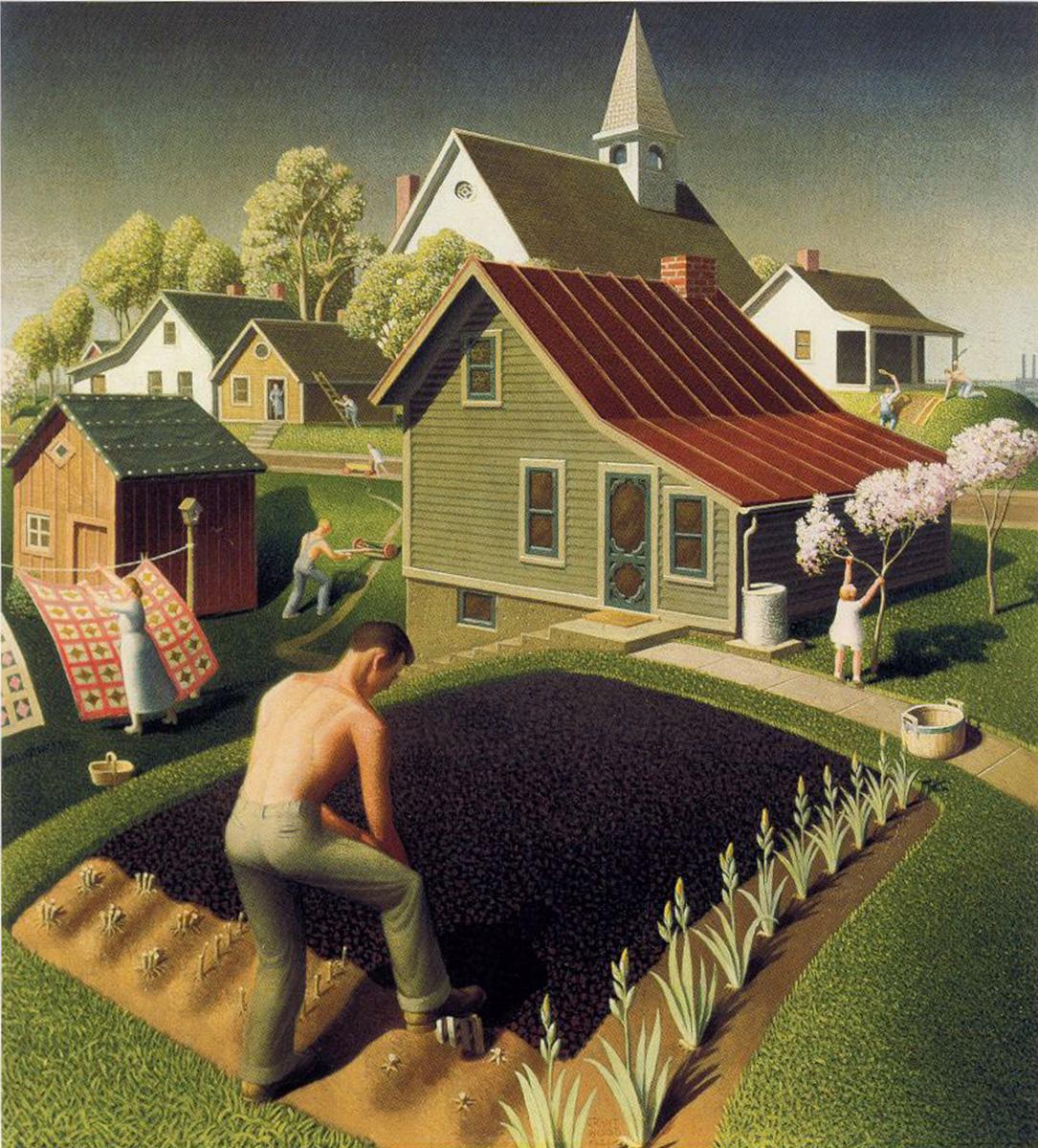
Spring in Town, Grant Wood. Used as the cover for Kauffman’s Look Homeward, America!

And now, selections from yet another Kauffman survey of literature:

“American literature, in order to be great, but must be national, and in order to be national must deal with conditions peculiar to our own land and climate. Every sincere writer must write of the life he knows best and for which he cares most.” (Hamlin Garland, p. 29)

“The privileged classes will profit by this war. It takes attention of the people off economic issues, and perpetuates the unjust system they have put upon us. Politicians profit by this war. It buries issues they dare not meet. What do the people get out of this war? The fighting, and the taxes. What are we going to get out of this war? Endless trouble, complications, expense. Republics cannot go into the conquering business and remain republics.” (Tom Watson speaking of the Spanish-American War, p. 36)

“Liberty is what we’re for, That’s why we’re progressive. We hate the modern increases of governmental powers and functions. We do not want government big. We want it small. That’s why we’re conservative. A true progressive must at this time often be a conservative.”  (William Hard, The Nation, p. 59)

“But for my children, I would have them keep their
distance from the thickening center, corruption
Never has been compulsory, when the cities lie at the
monster’s feet there are left the mountains.”

(Robinson Jeffers, p.73)

“America — the literary map of it, apparently, shows three cities;  New York, Chicago, and New Orleans; then a stretch inhabited by industrious Swedes who invariably (after an edifying struggle) become college professors or rich farmers; then a noble waste still populated by cowpunchers speaking the purest 1870; finally, a vast domain called Hollywood. But actually, there are portions of the United States not included in this favorite chart.” (Sinclair Lewis, p. 122)


“John, it is empire you all want, and it is empire that you have got, and at such a small price when you come to think of it.”
“What price is that?” Hay could tell from the glitter in Adams’ eye that the reply would be highly unpleasant.
“The American republic. You’ve finally got rid of it. For good.”

(pp. 133-134, Gore Vidal. Quoting Empire.)

“The shameful abandonment of early American political values — liberty, decentralism, self-rule — explains, I submit, the strident hostility to Gore Vidal. For Vidal is an authentic champion of a peculiarly American patriotism, vastly nobler than that of the typewriter hawks and blow-dried Republicans of Washington, D.C.

With the countenance of an antebellum aristocrat and a flair for the eloquent savagery once so common in America political writing, Gore Vidal is the avenging wraith of Henry Adams made flesh, merciless in dissecting the Empire-lovers and power-lusting intellectuals. He is the finest writer of our age, […] a polemicist at least the equal — probably the superior — of Mencken and Paine. So let the heathen rage. Vidal’s historical novels and fulgurant essays will outlast his carping contemporaries.”
(Bill Kauffman, 139-140)

“The price of empire is America’s soul, and that price is too high.” (William Fulbright, p. 143)

“Where’re your papers?”
“My what?”
“Your I.D. — draft card, social security, driver’s license.”
“Don’t have none. Don’t need none. I already know who I am.”

(Edward Abbey, p. 158. Quoting The Brave Cowboy)

“Patriotism is not the love of air conditioning or the interstate highway system or the government or the flag or power or money or munitions. It is the love of  country.” (Wendell Berry, p.  163)


“I heard a great laugh, the greatest laugh in the world, and there came this rawhide old-timer Nebraska farmer with a bunch of other boys into the diner; you could hear his raspy crises clear across the plains, across the whole gray world of that day. Everybody else laughed with him. He didn’t have a care in the world and had the hugest regard for everybody. I said to myself, ‘Wham, listen to that man laugh. That’s the West, here I am in the West….It was the spirit of the West sitting right next to me. I wish I knew his whole raw life and what the hell he’d been doing all these years besides laughing and yelling like that. Whooee, I told my soul.”

(Jack Kerouac, p. 170. Quoted from On the Road)

“Our ever loyal press, famously ignorant of history, panicked at the prospect of revolt by the lowing herd of revenue cows, and insisted that this queer [left-right] coalition was a freakish thing, spectacular but brief and (thank God) unstable. It had been whipped up into a frenzy by irresponsible demagogues, and once the dust cleared the kine would revert to kind. A little rebellion now and then isn’t such a bad thing, after all, as long as the dissenters know that it’s just a game and when the morning dawns they’ve got to get up and go to work and do their eight-hour stint as cogs in the great wheel of the interdependent global economy.”
(Bill Kauffman, pp. 187-188, on press reaction to NAFTA resistance.)

“No construct is more holy to the priests of the establishment than the comfy seesaw of Left and Right, with its utterly predictable motions. Those sit astride the plans can be sure of a pleasant ride; they need never fear being thrown. Bullies who threaten the playground, such as Huey Long, Malcolm X, and George Wallace, are disposed of with impressive dispatch.”
(Bill Kauffman, p. 218)

“Who should ‘run’ America? No one. Or 250 million single individuals. Every man a king, every woman a queen, as the martyr Huey Long once sang. […] As Americans from Emerson to Mencken have known, following leaders is a fool’s game. Only when we restore to Americans their birthright — local self-government in prideful communities that respect the liberties of every dentist and Baptist and socialist and lesbian and hermit and auto parts dealer — will we remember what it means to be an American, first.”
(Bill Kauffman, p. 231)

All quotations from:


Notable books:
Caesar’s Column, Ignatius Donnelly
Crumbling Idols, Hamlin Garland
The Adventures of Wesley Jackson,  William Saroyan
The Brave Cowboy, Edward Abbey

Posted in quotations, Reviews | Tagged , , | Leave a comment

Turbulent Skies

Turbulent Skies: The History of Commercial Aviation
© 1995 T. H. Heppenheimer
408 pages

What a century was the 20th, which turned everyday life into the stuff of yesteryear’s science fiction. Who would believe at its dawning that one day people would travel the world primarily through the air, soaring through it in great machines made of iron?  Turbulent Skies is a history of commercial aviation in the United States, Great Britain, and (occasionally) Europe. Part of the Sloan Technology Series, it mixes business and social history with extensive commentary on aviation engineering.  Between the generous expanses devoted to airframe and compressor problems to the play-by-play of mergers and expansion plans, Turbulent Skies is a through bit of reference reading.   The author includes as many diagrams of jet engines as he does of the planes themselves, which I found curious.

Turbulent Skies largely focuses on the United States, with occasional chapters on Britain and a few mentions of French and German development.  The chapter on World War 2 features Germany heavily, but this is not a book of aerial strategy; instead, Heppenheimer records the respective powers’  pursuit of jet technology.  (Germany was able to produce the Me-262, a potential fighter that was thankfully squandered as a light bomber.  Considerable resources were diverted from planes to the V2 bombing programs,  again mercifully.)   What leaps out in Turbulent Skies is how utterly the creature of government air travel is. Unlike trains, which had their origin in commercial mining, the first air-commerce companies in the United States  balanced their budgets on mail contracts.  The world wars were likewise a boon to aviation, producing technologies like radar that were put to use in the consumer market. The amount of airplanes produced for military service and then dumped onto the consumer market likewise produced a multitude of small companies buying planes for pennies and trying to build regional empires.  The government  also bankrolled municipal airports and then forbade city governments from making a fuss about the noise. (Mind your business, peasants…)

With such support behind it, little wonder the airplanes had a quick triumph over their transport rivals, the train companies. (The quickness of aerial ascent is made obvious in the life of Juan Trippe: he created Pan-Am in the early days of aviation, and was still its lord and master when the 747 was created.) Of course, air travel had honest advantages — speed and novelty.  Passenger ships also lost out to the planes, but the industry as a whole survived by shifting its focus to cruises. The seagoing experience, rather than being a comfortable means of transportation, became instead a vacation in itself: the ship was the party.  (Heppenheimer doesn’t mention this, but trains tried doubling-down on luxury, too; unfortunately, toodling along at 30 mph speed limits inside cities isn’t quite as relaxing as cruising the Caribbean.)     The happy days didn’t last forever, though; in the 1970s, oil crises and recession saw some of the mainstays begin to flounder and perish.  The most notable death, prolonged until 1991, was Pan-Am. It  achieved early success by focusing on connecting the United States to the outside world, snagging a government-granted monopoly of the  Central-South American routes.   The recession and energy spike caught Pan-Am at just the wrong time, when it was borrowing billions to launch a vast period of expansion with 747s.  Perhaps it will be revived when we begin passenger service to the Moon.

Though informative, casual readers should be aware this is more about technology and business contracts than the social/human side of air transport.

Related:
Getting There: The Epic Battle Between Road and Rail, Stephen Goddard
The Great Railroad Revolution, Christian Wolmar

Posted in history, Reviews | Tagged , , , , , , , , , | 2 Comments