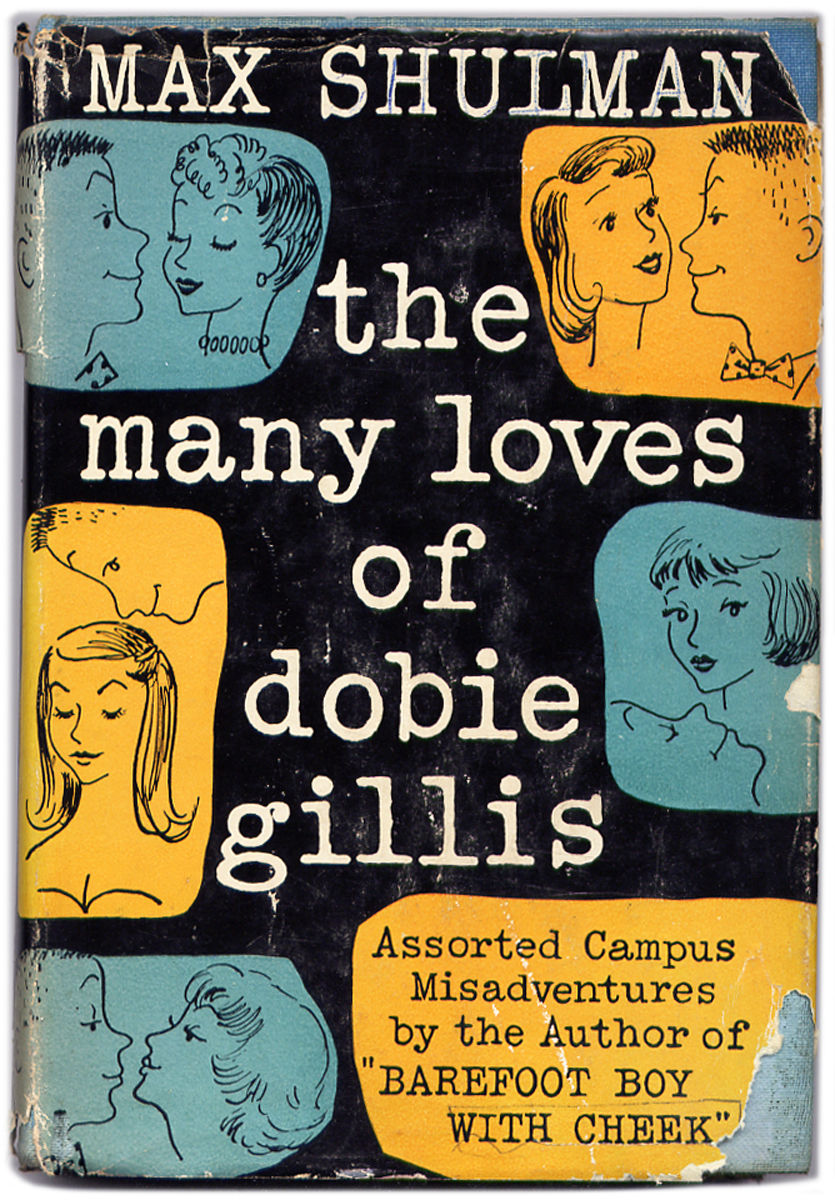
The Many Loves of Dobie Gillis

The Many Loves of Dobie Gillis: Eleven Campus Stories
© 1951 Max Shulman
223 pages

Imagine if PG Wodehouse wrote stories about a girl-crazy freshman at the University of Minnesota, circa late 1940s. That’s kind of what reader will find in The Many Loves of Dobie Gillis. I first read this book in 2003; it was a going-away gift from my high school librarian, who had to discard it but thought I would like it. She was right — I loved it. I loved the silly humor, the archaic slang (“Wow-dow”, “he fractures me”, etc), the presence of this world that was so obviously different from mine. The eleven stories are not sequential, or  integrated; unlike I Was a Teenage Dwarf, the Dobie here is not a fixed character. In one story he may be serious and cunning, and in another he’s apparently been given a dose of ecstasy, nibbling on girls’ fingers and jumping about “like a goat”. He studies, variously, mechanical engineering, law, chemistry, journalism, and Egyptology. Every story pivots on Dobie’s relationship with a girl, and more often than not he’s the one being led around by the ear, a bobby-soxed captain at the helm. Other times his desire to impress or woo a woman lead him astray. These stories are FUNNY — funny for the silly language, for the absurd scenarios, for the tongue in cheek narration. There’s also a lot of physical humor, something that’s hard to pull off in a literary medium. No wonder I took to Wodehouse so strongly when I first read him: he reminded me of this first brush with Shulman, who for me, never lived up to this book , no matter what else I read by him. (A lot of the other stuff was more bawdy than absurd.)

Read The Many Loves of Dobie Gillis. It’ll fracture ya. 

Related:

  • The closest Shulman ever came to matching this book for me was Barefoot Boy with Cheek, another campus-life satire.
  • Love is a Fallacy“. One of the stories is available online.  This is sort of a Frankenstein story in which budding law student Dobie tries teach logic to a girl he’d like to marry…only to have the tables turned on him. 
Posted in Reviews | Tagged , , | 7 Comments

Moundville

I have finally broken ground on this year’s study series with Everyday Life of North American Indians (© 1979), but before I start posting reviews and such I’d like to share some photos from a day trip I took with some friends three years ago. Our destination was Moundville, Alabama, site of the Moundville Archaelogical Park.

The park is the site of an ancient and abandoned city associated with the Mississippian culture. Several sites like these exist in the eastern United States: the largest place is Cahokia, in western Illinois (very near St. Louis, Missouri).  I’ve heard of another mound near Mobile, but it is not accessible by road. “Moundville” was abandoned prior to the arrival of Europeans, much like the city-sites of the Anasazi.  At its height, it may have had a thousand people. As with the Anasazi, it is believed that the inhabitants of this place merged or became the tribes which later lived in the region — in this case, tribes like the Chickasaw.   The park now contains 21 mounds, but early reports refer to 30.
After entering the park at the visitor’s center in the left background of this photo, visitors will see them a wide field  dotted with grassy mounds, with a circular road connecting them. This photo is taken atop the largest mound, considered to be the chief’s by virtue of its size.
There are about 77 steps — I’ve never counted myself, but before I took this shot back in May 2015, a young boy and his father were descending, and the boy counted nosily. I’ll give him the benefit of the doubt!
At the far end of the circle is an air-conditioned museum, which houses artifacts and the expected information about the park, and the possibly political or religious uses of the mounds. 
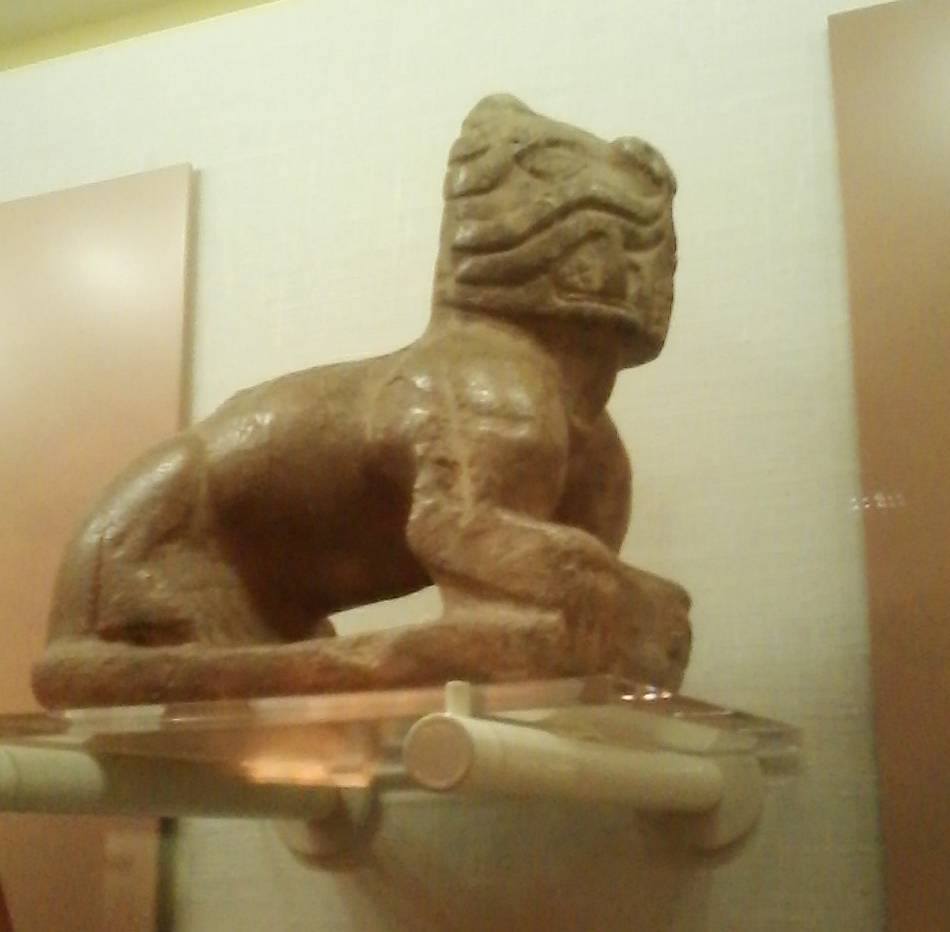
One of the exhibits.
Behind the museum are a few smaller mounds, plus ponds formed from the depressions left from excavating the dirt to build the original mounds.
Another area of the park houses three artificial huts built in the style of residences, and each contain half-melted plastic figures which once resembled humans doing the sort of things one expects museum exhibits to do — burying people, marrying, that sort of thing.  In their melted state they’re rather gruesome.  Enjoy another shot of the placid fields instead!
The Black Warrior River, which the city overlooked and which was its lifeblood, I’m sure. As I stood here I could almost imagine seeing hostile war-boats rounding the curve of the river.  Unlike the Alabama river, the Black Warrior River remains navigable to heavy industrial and commercial traffic. (The Alabama river is so constricted by dams and such that it’s mostly used for pleasure craft and fishing these days.) 
Moundville is intriguing for its mysteries: why did people build it, remain a few hundred years, and then melt away into the forest? Cahokia had a similar fate.  There are just so many stories which have played out across familiar landscapes that have escaped the record completely. All we can do is stare, wonder, and probe the ground for answers.

Posted in Reviews | Tagged , | 4 Comments

The Time Traveler’s Guide to Medieval England

The Time Traveler’s Guide to Medieval England: A Handbook for Visitors to the Fourteenth Century
© 2008 Ian Mortimer
342 pages

Within minutes of being transported to the time of King Arthur,  Mark Twain’s fictional Yankee found himself arrested and facing death.  If only he’d had a copy of Ian Mortimer’s Time Traveler’s Guide to Medieval England,  he could have avoided such peril.  Mortimer’s guide is a winsome social history of the 14th century,  which covers every thing from social structure to city smells to table manners. Herein we are told what to see, what to wear, where to eat, what to do (and more importantly, what not to do — like enjoying a bit of mutton on Fridays).  Now, it’s rather improbable that you or I or anyone else will ever actually have the chance to visit the 14th century, unless we’re doing it at the side of Geoffrey Chaucer in The Canterbury Tales But this book’s real service to the modern reader is to bring the past alive, to guide readers through a remembrance of old England– down its crowded, jostling, feces-strewn streets, through alleys of barking vendors, past parades of solemn clergymen, into hovels and palaces and across plains where knights joust and yeomen farm — to encounter the very real and varied stories which memory has forgotten or abused.  What a delight!

Ian Mortimer is an nigh-unparalleled host to the past, filling a wide table with a treasure of information. What aspect of life are you curious about from the medieval epoch? You will find it here. Clothing? You’re covered, literally, from head to foot, from young boys to old women. (Middle-aged men are not covered too well, wearing alarmingly short doublets that show off their expansive hosiery and ridiculously pointed shoes.)   Are you interested in justice, or the miscarriage thereof? Mortimer reviews the structure of law and order, from the neighborhood tithing-man up to the king’s courts.  Or perhaps you’d like to poke into medieval medicine? …well, you can, but you shouldn’t. It involves treatments of boiled puppies. One of the more interesting and unexpected chapters was on the medieval character.  Medieval men and women lived much more closer to death than we did, but this manifest itself in different ways: a macabre sense of humor, a love for fleeting beauty, and a ready tolerance of heads on pikes outside the public gates.  There are some curious omissions, like religion:   the Church’s social structure appears again and again, of course, from church courts to travelers’ inns runs by monks, and  the bits on custom can’t avoid religious discussion, whether we’re eating fish during Lent or  going to court because it’s always held on this-or-that holiday. The ways people worshiped, however, are not addressed.  Obviously Mortimer couldn’t cover everything, and so much is tackled that it’s a minor fault — but considering how strongly interconnected religion is with everything else, it’s a curious thing to not mention.

On the whole, I was enormously  pleased with this book.  Blame it on watching Men in Tights  as a lad or playing too much Age of Empires, but the medieval epoch is one that has fascinated me  for most of my life.  I used to have a dim view of it, but was cured by encountering Frances and Joseph Gies’ medieval history works, books like Life in a Medieval City and Cathedral, Forge, and Waterwheel  The Gies and Mortimer’s works are obviously close kin, considering how much they intersect, but the Gies wrote several social histories of that sort and weren’t as pressed for space as Mortimer. He delivers an amazing amount of material in just a few hundred pages, but the strength of  this book is not merely its content. Mortimer brings alive the intimate human experiences of the medeval epoch — the despair of  parents losing their families during the Great Plague, the  passion and tenderness of poets and courtesans, and the inescapable sense of Belonging, as peoples’ social ties were everything. Mortimer is also upfront about his sources, whether they’re inklings from the Canterbury Tales, or art, or formal histories, court records, that sort of thing.

I look forward to reading the rest of the books in this series, possibly in April given the English connection.

Related:
The works of Frances and Joseph Gies, especially:
Life in a Medieval City, Life in a Medieval Castle, Life in a Medieval Village,  Cathedral, Forge, and Waterwheel, and The Knight in History.
The Other Side of Western Civilization. Articles on various workaday aspects of the ancient and medieval world.
The Age of Faith, Will Durant

Posted in history, Reviews | Tagged , , , | 6 Comments

Fool’s Errand

Fool’s Errand: Time to End the War in Afghanistan
© 2017 Scott Horton
318 pages

Incredible as it sounds, it is nearly possible for a child conceived in the first week of the US invasion of Afghanistan to have come of age and deploy there himself. He’s out there now, a sixteen  or seventeen- year old waiting for the day when he can fight in his father’s war. The Afghanistan war is an odd one — the United States’ longest war, yes,  but one of its least-cared about:  not popular yet not  protested.  Americans just don’t seem to care about the trillions of dollars burned under the shadow of the Hindu Kush mountains, the thousands of American soldiers killed, or the hundreds of thousands of Afghan civilians killed in attempts to destroy the nebulous enemy.  Fool’s Errand is a case not just against the war, but against apathy.  This war was badly conceived, badly executed, and maintained as a litany of errors, one feeding the fire that the initial invasion intended to squelch. The United States will leave Afghanistan eventually, and the area will collapse into civil war eventually. The only question is how many more lives will be ruined and how many more enemies DC will create in its belabored efforts to fight a hangover by hailing the hair of the dog.

They hate us for our freedoms,  the president said as  American troops marched into Afghanistan, and the wound of 9/11 was still too raw for anyone to question the claim.   9/11 was barbaric and unconscionable and to posit that it was done as a reaction to DCs own policy in the middle east would have seemed like an insult to the innocent slain – even though bin laden and al-Queda’s hatred for the American troops parked in Arab countries, used as bases to constantly bomb Arab citizens, was well documented. Even as the United States moved toward Afghanistan with an objective of overthrowing  the Taliban that had given bin Laden shelter,  the war was not inevitable:  the rulers of Afghanistan then were willing to give bin Laden up,   given to a US ally, but the administration in its heated desire for revenge had no interest in doing anything deliberately.  Instead, American men and material were thrown into the same grave that claimed the armies of Alexander, the Brits, and the Russians.  Homo sapiens is a misnomer.

From there the misery continues: having destroyed the old order, as disagreeable as it was, DC fumbled repeatedly in attempts to create a new one.  It created an effective civil war in the country in its use of one pliable-but-despised tribe to do the governing, and through the breakdown of social order rose the criminal chaos that the Taliban had largely arrested by imposing its own illiberal order.  Oddly, people object to being invaded and bombed, and a relatively small number of scattered al-Queda fighters grew into a native resistance — and the more bombs that fell, the more lives destroyed in an attempt to get the bad guys, the more enraged and distressed men picked up guns and started fighting.  Money gone to train Afghanis to defend their “country” disappeared with the trained troops, who had little real interest in fighting their neighbor insurgents.  The chaos spread across the region as DC tried to intervene in other regimes, and the “war on terror” became a sustained nightmare of bombs for those on the ground, creating new lifetimes of American enemies in the middle east. Osama bin Laden, hiding comfortably, could bask behind his own MISSION ACCMPLISHED banner:  he wanted to draw the Americans into an unwinnable war, and they drove straight into the minefield. (And he’s not the only enemy DC effectively helped:  the Islamic Republic of Iran was once surrounded by armed Sunni states; now those rivals are ruined and Iran has much more influence over the region, to the despair of DC’s partners in crime, the House of Saud.)

Depressing and infuriating, Fool’s Errand tells a full story. There’s the military history of the invasion and growing insurgency, followed by futile attempts to squelch it,  but Horton also dips into the politics of the region and of DC, showing how  the anti-war aims of Obama were frustrated by inertia and the fact that the DC establishment —  the bureaucrats, the lobbyists, and the defense and intelligence contractors who are guaranteed work —  has no interest in bowing to history just yet. They’ll keep sending other people’s children to die and burning other people’s money.

Related:
The author’s podcast, featuring over four thousand interviews with foreign policy analysts, dating to 2003.

Posted in Politics and Civic Interest, Reviews, World Affairs | Tagged , , , , , , , | 19 Comments

Top Ten Books To Be Read….Someday?

This week the Broke and the Bookish- well, now Jana from That Artsy Reader Girl — are discussing books that  have been on  our to-be-read lists for the longest time. Here are the top ten oldest books on my ‘to-read-eventually’ list, based on my Amazon wishlist and my Goodreads to-read shelf.

1. The Horse, the Wheel, and Language: How Bronze-Age Riders from the Eurasian Steppes Shaped the Modern World

One of the first books I ever added to my Amazon wishlist in 2005,  it has not gone under $25-$19 in thirteen years.  I will keep waiting. There are many books and I am a patient miser.

2. Greek Ways: How the Greeks Invented Western Civilization, Bruce Thornton

I keep not bothering with this one because I figure Who Killed Homer?  and The Echo of Greece have covered the area fairly well in my head.

3. Skylab: America’s Space Station, David Shayler
“I want to read something about Skylab again”, I apparently said at one point in 2006.  I’ve read a lot of human spaceflight books since then, but not this one.

4. How to be a Gentleman, John Bridges

I used to be obsessed with manners  in high school, something that came in handy when I graduated uni and started getting invited to dinner parties.   This did make me painfully formal for most of my teens and twenties, but now that I’m trekking into my thirties I have decided that I’d rather be a cowboy, instead. 

5. ST Voyager Spirit Walk, Book One: Old Wounds

…nah….

Added this one back when I experienced Star Trek through its books, not re-watching the television episodes. It’s the first attempt at a Voyager relaunch, but it’s practically never mentioned favorably at TrekBBS.

6. The Meditations of Marcus Aurelius, Annotated and Explained

Added December 2008, which was right about when I was starting to learn about Stoicism.  This one that would be read if there wasn’t so much competition.

7. The Bhagavad Gita According to Gandhi

Added early 2010, when I was intently getting into reading Buddha and Gandhi.

8. Anarchism and Other Essays, Emma Goldman
Added Sept 2010.  I’d already read Red Emma Speaks in February of that year.

9.Coming of Age in the Milky Way, Timothy Ferris

One of the first books added to my TBR shelf on Goodreads when I joined it, based on their  reccomendation. This one that has a better-than-even chance of making it into the “read” pile some day, given that it’s a history of science.

10. The Moral Animal: Why We Are  The Way We Are, Robert Wright

This is one I almost-buy twice a year.

Of this list, the last two have the most chance of actually being read, and a few others have a shot if they’re cheap and I’m in the mood.

Posted in General | Tagged | 14 Comments

Books from a time capsule of sorts

Around Christmas, the technical expertise and beneficence of a friend allowed me to recover the data from a computer of mine from 2004-2008, one that has been offline since that spring when either its power supply or motherboard gave up the ghost.  The machine spanned a transitional point in my life,  from the high watermark of youth, to the beginnings of my adulthood. There are all sorts of artifacts from my life-that-was: saved chats,  scores of MS Works documents, and…Livejournal posts, and I thought it would make an interesting exercise to look through them and see what books I was mentioning in conversation back then.

1. The Paragon, John Knowles

I apparently picked this up in 2005,  following up on my interest in A Separate Peace.  If I ever finished it, I don’t recall a blessed thing about it.

2. Short stories by James Turber

Thurber was mentioned in a psychology text, used in a class that  I hated going to — not for lack of interest in the subject, but because the teacher was new, obnoxious, and dull despite his background as a saxophonist from Las Vegas. I used to sit in the back and read during the lectures. I mention that I went to the library looking for a collection of Thurber’s works, so evidently the text caught my attention better than the teacher.

3. Balance of Power, James Huston

I actually remember this one! Very vaguely. It’s a political-action thriller in which there’s some naval terrorist action, and the President won’t act so the Congress decides to dust off the Constitution and use that clause that allows them to issue “Letters of Marque”, or…engage mercenaries for bounty-hunting.  This was one of the books I was reading in psychology class.  My questionable verdict: “That is one good book”.

4. Ratpack Confidential, Shawn Levy

“It was the ultimate spasm of traditional showbiz–both the last and most of its kind. It was the high point of their lives and a midlife crisis. It was the acme of the American Century and a venal, rancid, ugly sham. It was the Rat Pack. It was beautiful.”

Just one of the many Ratpack and Sinatra-related books I was reading in 2005, along with The Way You Wear Your Hat: Frank Sinatra and the Lost Art of Livin.   I was utterly obsessed with Sinatra, listening to the same two CDs over and over again. (“Sinatra Reprise: The Best is Yet to Come”, and “Classic Sinatra”).

5. Submarine!   I can’t find this book on amazon, but I seem to have purchased it at a mall in Montgomery, Alabama, and described it as a WW2 submariner’s memoirs. I went into the bookstore looking for a book on “zoology”, and mention browsing the gangster nonfiction a bit, including the memoir of Henry Hill.

6. Man of Honor and Bound by Honor, by Joseph and Bill Bonanno — the memoirs of a father and son who were part of the New York mafia. I was a bit obsessed with la cosa nostra in 2004 and 2005.  Both were borrowed from my history professor, whose office I haunted regularly.

7. That Was Then, Then is Now, S.E. Hinton.  I used carry this one in my jacket and read from it whenever I was waiting on something, and I mentioned it  incessantly.  No wonder my copy of the book is so beaten up!

8. Travels with Charley in Search of America, John Steinbeck. I revisited this one in 2010, but I don’t know how my take on it drifted in the five years that passed. (When I mentioned the book the first time, it was quickly overshadowed by chatter about a girl…)

9. British History for Dummies and Shakespeare for Dummies. Both read in  late spring 2005,  in part for leisure and in part to help with a paper on Othello. I used to have a sizable collection of for Dummies and Complete Idiot’s Guide to… books,  as they were cheaper surveys of various historical subjects.

10. The Broker, John Grisham. Another book I read during Psychology after receiving it for my birthday early 2005.

Also mentioned, but never elaborated on, were “a book of sketches from the Larry King Live show”,  and “Men’s Relational Toolbox”.  I assume the latter was self-help about relationships.

Although I wasn’t listing my books back then — and even when I started writing about books on purpose, instead of mentioning them in online journals and in AIM conversations —  I seem to have been a fairly active reader despite the pressures of writing constant papers and struggling with literature like Phaedra.

Posted in General | 4 Comments

The Gulag Archipelago: Volume III

Archipeleg GULag / The Gulag Archipelago, 1918-1956: An Experiment in Literary Investigation
Volume III (of III)
© 1973, 1974 Aleksandr I. Solzhenitsyn
576 pages

Throughout The Gulag Archipelago, Aleksandr Solzhenitsyn has taken readers on a tour of the Soviet concentration camps,  where human beings were tortured, manipulated, and exploited to the hilt.  Now, in volume three, the journey has come to an end.  The bulk of volume three, “Katorga”,  focuses on the Siberian work camps that the Soviets resurrected to punish “Nazi collaborators”, a term loose enough to include anyone who remained in western Russia during the Nazi occupation.    Some two-thirds in,  the monstrous Stalin finally succumbs to the fate he’d inflicted on millions of others, but little changes in the gulag system. Solzhenitsyn then reviews his own release into “exile”, and finally his return to Soviet society.

The second volume of Gulag Archipelago is a prolonged review of the architecture of brutality , both physical and political,  used by the Soviet camps. Reading it was to see a human thrown on the rack and tortured, slowly, and only Solzhenitsyn’s  constant mocking of the authorities, and his stubborn efforts to look for the flickers of hope and grace in his fellow prisoners,  made the spectacle bearable.  In “Katorga”, Solzhenitsyn  also explores another avenue of relief: the constant attempts by prisoners to escape.  Although Siberian camps didn’t have as much physical infrastructure inhibiting escapes (sometimes as little as a wire fence),   their location – in sparsely populated wildernesses without reliable sources of food or fresh water  —  made a flight back to civilization nearly impossible.   Although Solzhenitsyn details many escape attempts, almost all of them end in a bitter return to the camp.  Typically, the escapees’ desperate attempts to obtain water or food create an increasingly chaotic trail of mistakes as they encounter more and more people. (Those who help escaped prisoners were threatened with 25 year gulag terms themselves, so only those with a bitter resentment of the government were willing to take the risk of trusting hungry strangers.)

In the final part of this third volume, Solzhenitsyn details the Soviet use of exile, which was a weapon used against  ordinary civilians as well as those accused of crimes: at the Soviet bureaucracy’s whim, whole populations might be ordered to desert their homes and move across the continent to settle an area that the bureaucracy deemed in need of warm bodies.  Many “exiles” were people who had been targeted for  their  skills or stature in smaller communities, like blacksmiths and millers – condemned as a classes for the abuses of a few. Although the shakeup after Stalin’s demise resulted in a few pardons, the Gulag system remained in place –- and books like Fear no Evil by Natan Sharansky fulfill Solzhenitsyn’s hope that future generations would continue  to expose the continuing system of  injustice that the Soviet state embodied, but which was expressed most transparently in its work camps.    Solzhenitsyn ends with an apology that the book is not edited or expanded more properly:  he was forced to rush it  out of his apartment after the government caught wind that he was writing something subversive. Considering the outstanding quality of the  text as-is, particularly given that it is a work in translation,  one wonders what the finished product might have looked like had Solzhenitsyn had the time he desired. (If he was like some authors, we’d never see it,  the desire for perfection forever pushing off the publication date.)

The Gulag Archipelago is a  warning for the ages about the horrors a government with the best of intentions can inflict on its own people, and a reminder that human beings are not fit to hold power over one another.

Posted in Reviews | Tagged , , , , , | 9 Comments

Poetry Night at the Ballpark

Poetry Night at the Ballpark and Other Scenes from an Alternative America

© 2015 Bill Kauffman
442 pages
 “Lift up your hearts, friends – America ain’t dead yet.”  For thirty years, Bill Kauffman has been blowing raspberries at or haranguing the politics of empire – mocking and condemning all things swollen and centralized, and cheering on the local and small.  This interestingly-titled volume collects a diverse amount of Kauffman’s writings, from  biographical sketches of eccentric American figures to literary reviews, with all manner of opinion pieces in between. It is an anthology that celebrates the little America outside of New York and Los Angeles, the America that breathes when the television is turned off.  If you have read any Kauffman before, or even read a review of Kauffman – or for that matter, the first two sentences of this review –  the general temper won’t  be a surprise. But Poetry Night at the Ballpark, while consistent with Kauffman’s usual spirit,  collects so many different kinds of writing that even his fans will find surprises here, and delivered with his usual fondness for amusing or provocative titles. Some of the sectional collections are definitely unexpected, like a series written about holidays (in which he champions Arbor Day over Earth Day, for instance)  and…some space-themed writing.   The sections called “Pols”, “Home Sweet Home”, and “The America That Lost” are more of his usual fare.  I’ve been reading Kauffman’s columns at the Front Porch Republic and other sources to have seen  and remembered a few of these – a favorite is 2012’s “Who Needs a President?” in which he revisits the antifederalist arguments against an executive office.

In Poetry Night at the Ballpark, Kuaffman introduces a multitude of forgotten individuals, all with their quirks, and recounts stories from American history which have been largely forgotten.  Take those arrogant Roosevelts – T.R.  tried to inflict a new kind of spelling on the entire nation, in one of the first examples of the Oval Office obviously unhinging whoever sat in it.  (Actually, considering the west wing was constructed during Teddyboy’s reign, maybe he was already unhinged and imbued it with his spirit.)    Franklin Roosevelt also moved Thanksgiving hither and yon hoping to create more shopping days for Christmas,  beginning the occasion’s slow  but total conquest by Christmas.  As varied as the essays are, they’re reliably grounded in Kauffman’s love for the small, local, and particular, be it movies or baseball. He begins  in and titles his  book   at the local ballpark , cheering on his hometown’s boys,  but has no use whatsoever for the major leagues, whose local connections are abstract, and who are oriented  towards money than  love of the game;   sports and home intersect in  his section on movies, where he calls for films that tell local stories with a local flavor, and comments at length on Hoosiers as a small-town classic.

I make no secret of liking Kauffman, and for me this book was like encountering him  at a bar and sticking around to  hear some salty stories of odd characters and fun stories, as well as some good old-fashioned belly-aching about the soulless suits in power.  It’s not as focused as his other work, so it’s best read by people who have already encountered Kauffman before – unless a first-timer opens the book in the store, finds themselves drawn in by his playful pen, and has to sit down to experience a bit more.

If you’d like a taste of Kauffman, one of my favorite speeches by him is called “Love is the Answer to Empire” That title links to a written version.

” [Walt Whitman] understood that any healthy political or social movement has to begin, has to have its heart and soul, at the grass roots. In Kansas, not on K Street.

“And it has to be based in love. Love not of some remote abstraction, some phantasm that exists only on the television screen—Ford Truck commercials and Lee Greenwood songs—but love of near things, things you can really know and experience. The love of a place and its people: their food, their games, their literature, their music, their smiles.

“I am a localist, a regionalist. To me, the glory of America comes not from its weaponry or wars or a mass culture that is equal parts stupidity, vulgarity, and cynical cupidity—one part ‘The View,’ one part Miley Cyrus, and a dollop of Rush Limbaugh—rather, it is in the flowering of our regions, our local  cultures. Our vitality is in the little places—city neighborhoods, town squares—the places that mean nothing to those who run this country but that give us our pith, our meaning.”

Posted in Politics and Civic Interest, Reviews | Tagged , , , , , , | 4 Comments

The Chairman

Sinatra: The Chairman
© 2015 James Kaplan
994 pages

Sinatra: “May I? — it’s your stage, figured I’d ask..”
Dean Martin: “Hey, it’s your world! I’m just livin’ in it.”
(The Rat Pack: Live at the Sands)
In 2010, James Kaplan wrote an eight-hundred page volume about a poor kid from Hoboken, who made it good as a singer, seemed to flame out in the early ’40s, and came back with a bang on the silver screen. The kid who was once floored by punches and got back up is now gone, replace by an increasingly wealthy artist-producer who can seemingly get away with anything, and who will remain an icon for the rest of his life, long after  the Beatles and all that follow take over the pop charts.  If The Voice followed ‘Frankie’ from the gutter to the top, The Chairman  is a chronicle of Sinatra’s use and abuse of his cultural and financial power  as the king of entertainment — for even as his behavior became worse under the influence of constant adulation, his growing wealth and legendary status allowed him to get away with the same behavior that nearly ended young Frankie’s career.  This is not a biography for the reader who merely wants to delight in how cool Sinatra was — there are other books for that —  because the Sinatra here is frequently drunk, ugly, and…well, very un-cool. But Kaplan has produced in these two books a definitive biography,  one that dwells at length on Sinatra’s artistry as well as his relationships with others, and the good and bad flow together.  Although its sheer volume nearly exhausted my considerable interest,  at the end I had to count it worth it.

Artistically, Sinatra seems to have peaked in the 1950s:  after that,  both the changing tastes of the music-buying populace,  and Sinatra’s growing age and iconic status cut his edge. He never ceased to take music seriously, and after initially dismissing Elvis and the Beatles as so much noise, he would listen to them attentively in hopes of figuring out why kids liked them so much, but movies were a different story.  Sinatra’s comeback was based on his outstanding performance in From Here to Eternity, and while there would be a few more stellar roles to come,  after Sinatra gained the wealth and stature to start trying to make his own movies, he would produce films that sold through star power alone.  Sinatra couldn’t lose himself in acting the way he did while singing, and as a result a lot of his later movies have characters who are  just Frank Sinatra with a different name; there’s no suspension of disbelief.  On the set, Sinatra was increasingly disinclined to heed direction, and produced a lot of films that were panned by critics and lukewarmly attended, but  let him pal around with his buddies.   He remained committed to music, however, and the main reason I kept plugging along was for Kaplan’s evaluations of different songs and records; aside from his late Capitol years, when Sinatra was utterly resentful of their refusal to let him go to develop his own label,  Sinatra was a consummate professional about not just singing, but musical performance.  Sinatra didn’t just stand in front of a microphone and sing; he played the mic like an instrument, using it to hide his deficiencies and embellish his strengths.  He also experimented with different musical styles, though he was at his happiest giving performances like those of his youth: the singer and a big band behind him, thrilling now grey-haired bobby soxers.

A major part of The Chairman is Sinatra’s relationships with others, as Kaplan covers his string of wives, his panel of good and lose friends, and his allies and enemies.  Sinatra liked to have a good time, preferring to stay up all night drinking Jack Daniels with his friends, and he was rarely without female company whether or not he was married at the time. (Sinatra definitely got around,  often seeing several women simultaneously, and apparently without an attempt to be secretive.) Sinatra’s serial romances weren’t just about having an interesting dinner companion for the evening;  he was ever restless, always looking for someone who could fill a lonely void.  His frequent heartache, particularly the long-burning torch for his second wife Ava, also informed his music, allowing him to sing songs about lost love like no one else.  He was attracted to power and swagger; throughout his life he’d pal around with members of the Mafia, despite being hauled into court several times to be questioned about mob ties.  Sinatra embodied that swagger himself, and without a powerful person to manage him,  he wasn’t far from acting out if someone angered him.  (He once drove a golf cart through a casino window after they changed owners and stopped his line of credit.)  The lure of power also brought him to DC,  as he sought the friendship of JFK, and would later schmooze with Governor Ronald Reagan and President Nixon despite being a Democrat. Kennedy, whose own lechery was on par with Sinatra’s, was the only person whose fame ever rivaled Sinatra’s, but his wife and brother did their best to keep Sinatra away from  Kennedy.  Kaplan also covers the Rat Pack at length, Sinatra’s clan of buddies who made films with him and who for a while took over Las Vegas with their shenanigans. While filming Ocean’s Eleven, they began disrupting and then taking over each other’s shows, to the point that it didn’t matter who was booked: Sinatra, Martin,  or Davis. They’d all wind up on stage together, drinking and carrying on. The jokes and act grew old after a while,  but in the early sixties nothing like this had been seen before.

The Chairman covers Sinatra’s life at length until the early seventies, when he entered into a “retirement” that was shorter than his marriage to the child-bride Mia Farrow. He came back in less than two years,  and would continue to perform until the 1990s…but this last chapter of  his life is a very small part of the book, and mostly chronicles his friends dying and Sinatra himself growing more tired, until his death in 1998.   Kaplan also includes a touching epilogue about a visit to Sinatra’s grave in Cathedral City,  where the larger-than-life singer rests under a very ordinary marker that will probably be completely sun-bleached in another generation. The music, however, will persist.  There many singers who are descended in chaos  after imbibing too much fame and money,  but what they produce overshadows it: that’s definitely the case with Sinatra.   He was a complex man who could give to charities lavishly, with complete anonymity, and then cause a public scandal — but when I listen to something like “Summer Wind”,   all of the tabloid  bits are blown away.  The voice takes over, and I can only marvel at the story of this poor kid from the wrong side of the river who became an icon — and one whose wealth was produced not through dishonest means, like politics and  crime, but through the sheer joy he brought to people who bought his records.  It’s a heckuva story, and in Kaplan’s version, a heckuva read.

Related:
Frank: The Voice, Jame Kaplan. The first part of this definitive biography, The Voice covers Sinatra’s early rise, fall, and rebound, culminating in his award-winning performance in From Here to Eternity
Posted in Reviews | Tagged , , | 2 Comments

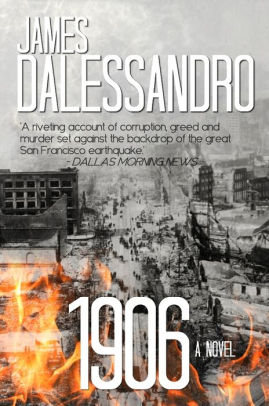
1906

1906
© 2004 James Dalessandro
368 pages

Turn of the century San Francisco was a notoriously corrupt city, filled with vice from the brothels of the Barbary Coast to the opium dens and sex slaves of Chinatown. 1906 is a political thriller  that brings together two brother-cops and an intrepid lady reporter together as they attempt to throw a spotlight onto the den of scum and villainy that is city hall, exposing a political-criminal cabal controlling the city.   And then…history happens, in the form of an earthquake and a fire that destroy city hall and a lot of the city, pitting the corrupt mayor against a slightly deranged general whose solutions all involve shooting or exploding things.   The novel and title both indicate that this is a novel set amid the chaos of the Great San Francisco Earthquake and Fire of 1906, but in reality….the quake hits when the book is nearly over,  and it merely serves as a large-scale plot twist.  Because I was reading this solely for the earthquake and fire angle, I wasn’t too much interested in the seaside skulduggery — especially since one of the cops was this irritating college grad who seemed to have majored in precognition, since he keeps telling people all the mistakes they’re making, apparently armed with information from the future.  Perhaps he’s a time traveler — he wouldn’t be the only one, since another character pines for cars not taking over the street yet, despite their still being rich man’s toys in 1906.  devices that couldn’t roll a mile without a flat tire.

If the potential reader is interested in the actual disasters, there are a couple of very storied histories — Dan Kurzman’s Disaster! The Great San Francisco Earthquake and Fire of 1906 was the volume that ignited my interest. It bubbles over with anecdotes that really bring the calamity to life.  Less anecdotal, but written by a San Francisco citizen, is Edward F. Dolan’s Disaster 1906.

Opera fans may be interested in Enrico Caruso’s steady appearances throughout 1906. He no good a-speaka the English, because he’s-a Italiano.

Posted in historical fiction, Reviews | Tagged , , | 3 Comments