The Indian in the Cupboard (and Return)

The Indian in the Cupboard
© 1980 Lynne Reid Banks
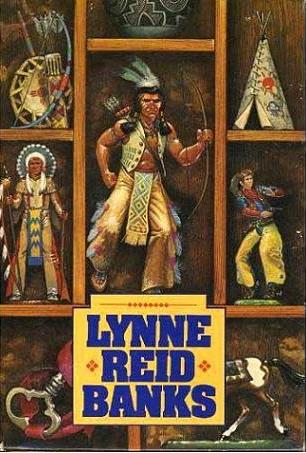
I had to keep watch in the children’s department today, and there bumped into an old friend: Omri, the boy with a seemingly magical cupboard that can turn plastic figures into real, albeit tiny, people.  I can’t remember how young I was when I encountered the Indian in the Cupboard series, though I do remember being puzzled as to why the “dollar” signs looked funny (£).   The story begins when Omri receives a plastic figure of an Iroquois warrior and a cupboard for his birthday.   There’s no key for the cupboard, but oddly one of Omri’s mother’s heirloom keys fits the lock perfectly.   When Omri locks the figure up for safekeeping, however, he’s astonished to hear yelling and muted scraping from within. Somehow, the toy has come alive.  When Omri is able to talk to the figure — now a very animated and angry warrior — he learns that the man is not simply a moving toy, but a real man suddenly ripped from history. The book follows Omri and Little Bear’s evolving friendship, as well as the near disaster that ensues once Omri trusts his friend Patrick with the secret.  Oddly enough, the arrival of this tiny figure from the French and Indian Wars is a pivotal experience for Omri, giving him his first taste of responsibility, an opportunity for wrestling with the morality of his own actions. Ultimately he decides that he doesn’t have the right to play with lives from history like this, and he and Patrick will send back Little Bear and a few others back closing and locking the cupboard door once again.

I loved this series as a child, and I enjoyed it no less today when I decided to revisit the first two books. I remembered much about the story — I should, considering how many times I read the first few books —  but was amused by some of the things I’d forgotten.  The memory of the weird dollar signs, for instance — I didn’t realize the book was set in another country back in the day, and there were some jokes that went over my head because ‘whiskey’ wasn’t a word that I had encountered at age seven, or whenever it was that I found these.  What a delight this book was to me back then, already in love with history — even in fourth grade, my history book was the first one I looked for on the first day of school — and immediately interested in any notion of toys coming to life. One of my favorite childhood books was Elvira Woodruff’s Back in Action,  about a magic kit that brings toys to life and shrinks their owner down to have adventures with them.   This book was genuinely educational, however, as Little Bear behaves nothing like what Omri expects a ‘savage’ to act like. Through Omri and Little Bear, I learned that there were all kinds of different native Americans, that some lived in longhouses and some in tipis, that they fought each other and fought on different sides against  European powers.  Omri becomes fascinated by Iroquois culture, and when in the sequel his friend makes a churlish remark about  the ‘savages’,, it is Omri who chides his friend for not knowing what he’s talking about.

Return of the Indian is more of an adventure than a moral drama — Omri brings Little Bear to life again to tell him some good news, and then learns that the warrior’s village about to be burned and his friend killed, so Omri tries to figure out a way to help out — but is still enjoyable.  There’s so much to appreciate about these two books, but I suppose the days of children playing with little figurines instead of their parents’ phones are passing into memory.

This book appeared in a 2011 Top Ten Tuesday list, “Childhood Favorites”.
Posted in Reviews | Tagged , | 8 Comments

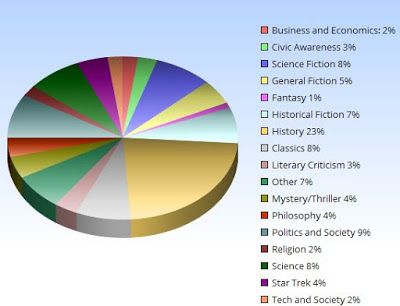
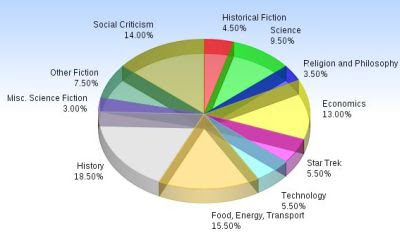
2017’s pie

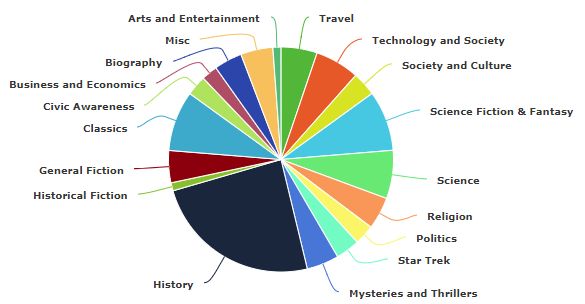
Every year I like to  load up my books-read Excel list, sort it by labels, count everything up, and then make a chart out of it.  Every year’s label sets are a little different, aside from old reliables like History and Science.   Historical fiction is safe, too, even though it was waaaaaay down from previous years.  Fiction in general was down, accounting for roughly 25% of what I read. I used Meta-Chart.com instead of Chartgo, and I’m pleased with the result, except for the font size.  Right now to make it readable I’ve had to expand the chart so that it’s clipping into the sidebar.

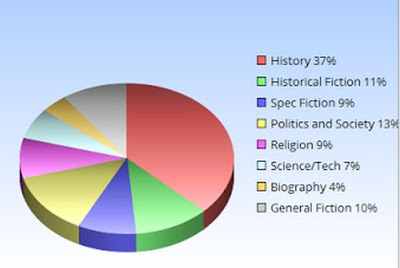
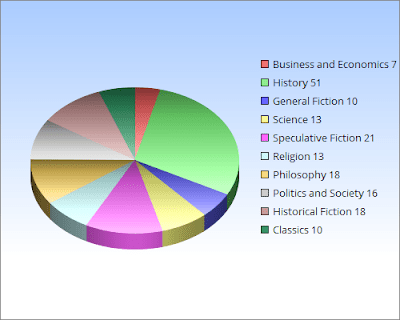
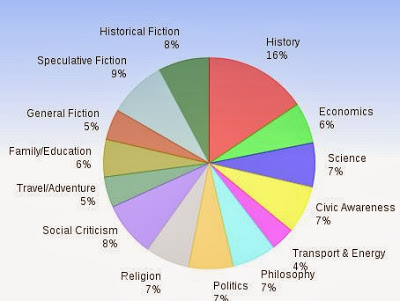
Just for comparison’s sake — 2017 was my ten-year anniversary, so why not? — here are some  previous years’ pie charts.

2016

2015

2014

2013 (my favorite)

2012

Unfortunately, prior to 2012 I was using photobucket or imageshack to host the graph, so those are kaput.

Posted in General | Tagged | 8 Comments

The Truth about Nature

The Truth About Nature:  A Family’s Guide to 144 Myths about the Great Outdoors
©  2014 Stacey Torno and Ken Keller
212 pages

Great news, kids. The tyranny of mom is over: no longer do you have to wait 45 minutes after eating to go swimming. Turns out you can wolf down a hot dog mid-stroke and nary a thing will happen, except for maybe a really soggy hot dog bun. Or…an attack by sea gulls.  That misconception and 143 others are debunked in The Truth about Nature,  which collects misinformation about the natural world passed down from one generation to another, alongside columns like “Strange but True”, or facts that seem outrageous but which are really truth — because that’s just how nature rolls. I stumbled upon this book at the library and was immediately attracted by the cover. It’s written for juvenile audiences, and is written not just to flush out old information but to sharpen scientific appraisal: the authors often charge the reader with evaluating just how they might find out that a particular information is bunk, prompting them to imagine different possibilities and how they might evaluate them  The collected misconceptions themselves range from folk wisdom (“Moss grows on the north side of trees”) to entries that I think were just fudged a bit and thrown in. There’s a section on how clouds aren’t actually white, as they can also be grey — and sometimes, oak trees don’t have acorns, because it’s not the right season.  Well…okay, but that doesn’t strike me as a “myth” in the same way that “touching a toad will give you warts” does.  At least one debunked fact — that rabbits are rodents — was a surprise to me. Turns out they’re lagomorphs. Also, they don’t eat carrots, but I kind of figured. They also don’t sing opera, or foil the engineering schemes of malevolent coyotes.

While this is intended for younger audiences — probably late elementary and early middle —  adult readers who are in the mood for some light reading will also find it enjoyable.

Posted in Reviews, science | Tagged , | 2 Comments

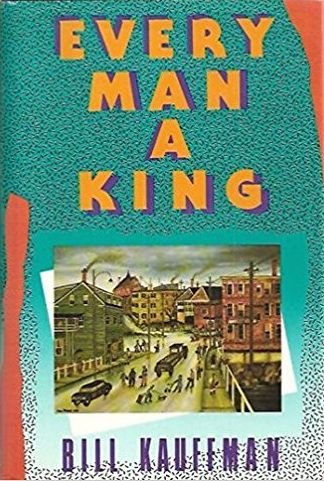
Every Man a King

Every Man a King
© 1989 Bill Kauffman
277 pages

Every Man is a King follows the self-destruction and resurrection of one John Huey Long, a rising star in DC’s intellectual establishment who disgraced himself in a heated television interview. Fired and friendless, Ketchum slunk back to the rathole hometown he thought he’d escaped, planning to die – but instead, he found a new life. One part DC satire, one part homage to crappy hometowns, Every Man a King makes for an odd novel. Its mocking of politicians, the media, and pseudo-intellectuals has easy appeal, of course, and one of the characters is winsomely weird. (Imagine Phillip Seymour Hoffman as an obese fop who wears 1940s suits, carries a cane as a transparent affectation, and who is incapable of not sounding like a 19th century dandy.) I liked the general arc of the novel, the tale of a pretentious jerk being taken and realizing there’s more to life than DC power plays, that real people still live in places that don’t matter to those in government. And Kauffman should be praised for not making this localist defense sentimental in the least: the town Ketchum returns to has been left behind by everyone else, and most of the people are poor, drunk, and angry instead of poor-but-happy farmers enjoying their simple lives far from the big city blues. Most of the action happens in Ketchum’s heart and mind, though, as he slowly realizes what a empty charade life in DC had been anyway, and what a boob he’d become — a man corrupting the memory of his populist grandfather, turning the elder into a fount of folksy proverbs just to add a little flavor to his columns.  Life in Batavia is ridiculous, too, but at least it’s real. Even so, a story of largely internal musing doesn’t have a great deal of activity: Ketchum even manages to avoid barfights despite spending most of his time post DC sitting in one. On the whole the novel was too vulgar and too sedentary for my taste.

Posted in Politics and Civic Interest, Reviews | Tagged , , | 5 Comments

Snowed in

For the second time in as many months, we’ve received a hearty dose of snow and ice. This time seems to have been much more disruptive, as roads have been shut down completely. Last month ice wasn’t too bad, but this morning even speeds of 10 and 15 MPH were too much for vehicles.  The above shot, borrowed from WVTM’s facebook page, is of Interstate 65, south of Alabama’s capital city.  This is an eerie sight for me, because this stretch of interstate always has plenty of traffic.  Downtown Selma was deserted as well, with only emergency services and a few reporters gingerly venturing out.   The arrival of the snow and ice coincided magnificently with Martin Luther King day to result in a five-day weekend for many people.  I’ve been using the time to read, of course, but I also played through Papers Please and have been trying to remember just how I use to beat missions in Commandos: Behind Enemy Lines.   How much of high school did I spend watching German patrols, figuring out the best way to sneak through or neutralize them? Probably too much. 
While I didn’t stir today, this was my view shortly before Christmas. My grandmother says she can’t remember ever having two snows in one winter — it’s a once every ten years kind of thing this far south.
Posted in General | 24 Comments

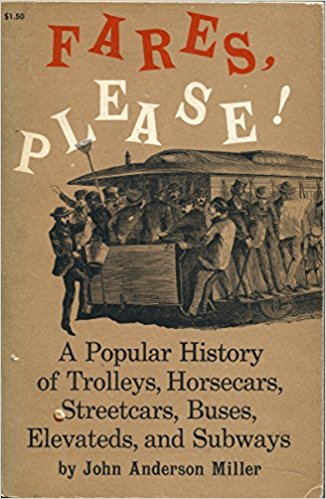
Fares Please!

Fares, Please! A Popular History of Trolleys, Horsecars, Streetcar,s, Buses, Elevateds, and Subways
© 1941, 1960 John Anderson Miller
204 pages

With her high starch collar and her high-topped shoes, 
and her hair piled high above her head
She went to find a jolly hour on the trolley and found my heart instead…

(“The Trolley Song”, written by Hugh Martin and Ralph Blane. I like Frank Sinatra’s version.)

My word, what a charming little book this is. Just look at that cover!  When it was first published, the author could claim with confidence that Americans were the world’s greatest users of public transit. A lot has changed in the eighty years since this history’s first release, but what a history it covers!  Chiefly focused on the United States (but with healthy mentions of London, Paris, and various other systems across the globe),  Miller begins documenting transit services from the first horse-drawn municipal coaches, to the latest invention of the trolley-bus. His history includes a generous amount of photos, as well as illustrations of different mechanisms — although it is as it describes itself, a popular history. The emphasis is on the general, how new ideas were put into practice in different cities, and received by the public.  Along the way, readers witness a number of inventions that failed, or ideas that were embraced and then rapidly abandoned.

The story begins in 19th century America,  at the very beginning when New York was swelling with immigrants and needed some practicable means of expansion. The answer came  in a kind of stage coach that ran only in the city, and as the idea of it became popular, specialized carriages were built for the idea. This kind of evolution happens a lot in Fares, Please: an old technology is tweaked a bit to a new purpose, and then later succeeded by something especially built for that purpose. As omnibuses developed their infrastructure — becoming serious businesses that could afford greater investments — they began running their carriages on rails instead of the open street.  “Horsecars” were the progenitors of the trolley, but it took time for animal power to yield to mechanical.  Eventually they had to because of urban expansion:  as lines’ number and length multiplied, so too did the number of horses required. One New York company had to care for eight thousand horses at its greatest point prior to other means of carriage locomotion.

Eventually other means did take over: cable cars were experimented with, but were relatively expensive and lost ground to electricity after an initial burst of enthusiasm. Some manufacturers experimented with internal-combustion carriages, but electricity — despite fears of public electrocution — won out for sheer economy.  (The first internal combustion engines were not, shall we say, energy-efficient.)  As trolleys began taking over more and more of city streets — say, four lanes of a six-lane road — the residents of particularly crowded cities like New York toyed with the idea of running the trolleys either under the road or over it. Elevated lines were embraced as being easier than subways, but the public tired of having roaring machines overhead blocking out all the light.   Subways were thus developed in a few cities like New York whose density could afford the expense.

Ultimately, it was the rate of expansion that  prompted the original omnibuses to make a comeback:  simply put, they were quicker on their feet. Streetcar lines required a lot of capital investment  (rails, lines,  carriages, support vehicles, etc) and careful planning to expand into new area. Bus companies needed vehicles, a little adjustment to the planning, and they were in business.  Ironically,  streetcar companies were some of the first to adopt buses — either as cheaper ways of providing the same service, or as cost-efficient ways to gather customers in outlying districts to one of the main streetcar lines.  Although buses and private automobiles had gained a lot of ground in recent years,  Miller remains sanguine about mass transit’s hopes going into the 1940s, in part because of the sheer demands of space: one lane of streetcars can carry six times as many people as two lanes of cars, and cities simply don’t have room for everyone to toodle about in a car.  Miller probably never imagined we’d tried to solve that problem by destroying the city — knocking down building after building for parking lots, and then creating automobile-oriented sprawl and leave downtown to rot.  We seem to be moving back in the direction of sanity, dreams of computer-controlled instates full of driverless cars not withstanding.

If you can find a copy of this, it’s a delightful little history. I’ve been trying to find something like it for years.  There is nothing quite like a streetcar to make me think of urban America in its adolescence, roaring with energy and changing every day.

Posted in history, Reviews | Tagged , , , | 5 Comments

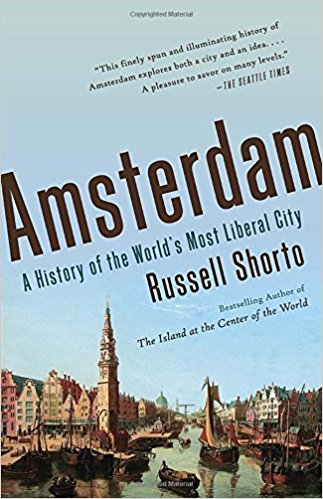
Amsterdam

Amsterdam: A History of the World’s Most Liberal City
© 2013 Russell Shorto
369 pages

In the early 14th century, a group of fisher-folk around the Amstel river came together with a dream: to build a place where people could smoke weed and bicycle to their heart’s content.  And so they built a dam, and canals, and a town, and they called it Amsterdam. And they all lived happily ever after, except for the people who toked and cycled simultaneously, because they fell into the canals.

…well, okay. Not really. But there were fishermen, and there was a dam.  Amsterdam: A History of the World’s Most Liberal City  reviews the history of the city which took its name from that dam, though it focuses more on Amsterdam’s culture of liberality than municipal matters. That culture begins not in the 1960s or even the enlightenment period, but at the very beginning.

Most European cities can point back to a spot of land, the center of the old town, and say “Here is it where it began.”  Not so with Amsterdam, which had to be reclaimed from the sea itself, by dredging rivers, redirecting water through canals, building dykes, and driving massive of wood into the Earth to secure a foundation for buildings.  This effort was a joint private-communal affair, as people worked as a corporation to accomplish and maintain projects, but held the results — the parcels of land raised from the sea–  as private family possessions. Amsterdam’s peculiar origins gave the city a unique character, writes Russell Shorto.  It fell outside the feudal system that governed the rest of western Europe, sharply curbing the influence of any native aristocracy, and priming it to reject them totally when cities grew and political authority became a matter of public debate.  The relatively shallow roots of feudalism’s cultural authority made it much easier to embrace a  social policy of gedogen — a game tolerance of difference or vice, so long as it wasn’t aggressive.  This tolerance made Amsterdam  a refuge for persecuted minorities (exiled Spanish Jews) and minorities who would love to do the persecuting if the shoe was on the other foot (English Puritans). during the medieval-industrial transition

.Amsterdam’s geography meant that it could not be a city with vast estates;  although many of its citizens were staggeringly rich during Amsterdam’s golden age, when it was a trading titan that gave its sister-nation England painful competition,  even the wealthy would live in relatively modest townhouses. The broad outlines of Amsterdamer, or at least Dutch, history may be known — if nothing else, at least the Dutch provinces’ early participation in the Protestant movement, and their war of rebellion against the Spanish Hapburgs.  Amsterdam was slow to be caught up in the protestant tide,  as a medieval miracle made it an object of pilgrimages, and made the city as a whole more Catholic — at least, for a time, before it was quickly supplanted by liberalism. Although the word “liberal” means apparently opposite things on either side of the Atlantic, Shorto holds that both meanings were originally rooted in the supremacy of the individual, and Amsterdam can claim to embody that cause more than any other city.  Compare it to the cradle of Anglo-American democracy, the  home of the House of Commons:  London’s streets once fell under the shadow of cathedrals and the Tower; now they falls under skyscrapers.  Amsterdam, however, is a city not of skyscrapers and massive complexes, but of buildings that have remained at the human scale. Its innards, too, have remained human: its streets are dominated by human figures on bicycles, not oversized for speeding automobiles.

Although this is certainly an enjoyable history of Amsterdam’s contribution to the human existance,  particularly  on its progress at achieving the golden mean between individual and community life,  those who are curious about Amsterdam’s physical expression will probably be a little disappointed. The physical form of the city is covered early on, but after that municipal matters take a distant back seat to the evolving social history. Admittedly, most readers are probably more interested in reading about cars than about canals and such, but I thought it was very odd that Shorto didn’t dwell on the rescue of the ‘human city’ from cars in the 1970s. 

Related:
In the City of Bikes: The Story of the Amsterdam Cyclist, Pete Jordan
The Embarrassment of Riches, Simon Schama. Not one I’ve read yet, but it’s about the Dutch Republic’s golden age.

Posted in history, Reviews | Tagged , , , , , , | 6 Comments

Munich

Munich
© 2018 Robert Harris
354 pages

By this time tomorrow, Adolf Hitler could be dead…

The year is 1938, and Europe is again sliding into war — a war that only one man wants.  The man is Adolf Hitler, who is determined to claim all of Czechoslovakia for the Greater German Reich. He’s already annexed Austria, and sent the French running from the Rhineland.   The little Bavarian  has opposition, however: across the Channel, Neville Chamberlain is working around the clock to keep another bloodbath from erupting, and at home a group of  German officers who worry for their nation’s future are contemplating a little regime change in Berlin .  A last-minute peace conference with hasty security arrangements  might be just the opportunity

Munich must be one of the most famous conferences in western history, remembered in shame as the time when the West hung Czechoslovakia out to dry, and were rewarded with Hitler’s breach of trust when he invaded that country and Poland, anyway.  But a good history teacher, when approaching Munich, will put students in Neville Chamberlain’s chair — a seat from which the future cannot be viewed, a seat that sits in the gloom of memory, the memory of a war that emptied villages and destroyed millions of families not twenty years before. Europe cannot survive another war like that.  Even if the Czechs have to give up their border with Germany, it’s not as if Czechoslovakia is a real country, anyway —  diplomats invented it not twenty years ago.  And so while Britain and France resentfully prepare for war just in case things go wrong, Chamberlain works like a dog to find any way to get Hitler to the table. And he does, via an Italian connection.

Robert Harris uses two men to  deliver this four-day drama: the first is Hugh Legat, a man attached to Chamberlain’s staff who constantly worries that secret from his past will be unearthed as tensions with Germany grow ever greater. The second is Paul Hartmann, a German functionary who serves Hitler by day and helps plan his death by night. Paul and Hugh were Oxford friends,  and Paul hopes to pass information onto England via Hugh that will ensure that the Allies-in-waiting will call Hitler’s bluff. Hartmann wants the war, for if Hitler  takes Germany down that crimson path again, the conspiracy can be justified in giving him the fate that he would inflict on so many others:  death.

Harris succeeds in turning a conference whose consequences are a known fact into a thriller with the potential for upset, and humanizes a figure who — at least in American histories — is depicted as something of a boob.  The Chamberlain of Munich is not a quiescent, cowering figure: he’s resourceful, obstinate, and determined to deny Hitler the war he wants.  Although Munich suffers slightly from the fact that most people know what happened at the conference, it’s still a good thriller, in part because of the espionage and anti-Hitler conspiracy.

Related:

  • Fatherland, Robert Harris.  An alt-history detective novel set in a victorious Germany, where Hitler is set to celebrate his 70th birthday by completing the conquest of Russia…but someone is digging up bones from the past. My introduction to Harris, who has kept me reading since 2008.
  • Garden of Beasts, Jefferey Deaver. Another novel set in  prewar Germany, this time during the “Nazi Olympics”. 
  • Phillip Kerr’s German novels, which always skip around a bit in time but almost always spend time in WW2-era Germany.  Lots of gallows humor, but I have to read him sparingly.
Posted in historical fiction, Reviews | Tagged , , , , | 10 Comments

Fools and Mortals

Fools and Mortals
© 2017 Bernard Cornwell
384 pages

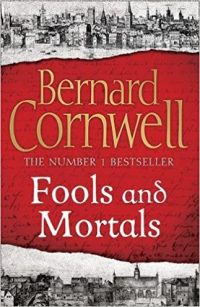
Brevity is the soul of wit, so here’s an attempt at a quick  review.  Bernard Cornwell usually writes war novels, and he’s magnificent at it. But he surely gets tired of it, and every so often he delivers a mystery or something that’s not dashing heroics.   Fools and Mortals is such a book,  a celebration of the birth of western theater and of Shakespeare in general. Our main character is Richard Shakespeare, the struggling younger brother of much-hailed William.  In a age where only men acted on stage, Richard’s days as an actor are seemingly numbered: he’s too old to play most women, as his voice has already broken, but actors abound and male roles are competitive. What’s worse, Will seems to be deliberately mocking Richard’s desire to be taking seriously: his latest  role is a man…pretending to be a woman, and doing it clumsily.   But now isn’t the time for jumping ship: the company is the middle  of rehearsals for a high-profile gig that the Queen might attend, and just showing up at practice gives him a chance to swoon over one of the serving girls.   Besides, he’s too poor to take chances on pay:  Richard already has to make ends meet by nicking small articles and selling them on the side. When the company’s plays are stolen,   Richard’s moody resentment of his brother, not to mention his reputation for having sticky fingers, make him the obvious suspect. To clear his name, save the company’s hides, and perhaps nail a proper male role, Richard decides to find out who stole the plays and get them back.

…and he does, within a few pages.  And then he exits , pursued by a bear.  The drama promised on the front cover is only a small, brief episode within the larger story of Shakespeare trying to deliver “A Midsummer’s Night’s Dream”, and finish his script for “Romeo and Juliet”. It’s not easy, because  secret police keep breaking in to nose around, and why would priest-hunters be bothering an acting company?  Most of the novel’s action takes place in and around rehearsals or performances. Cornwell notes in his afterword that the novel is largely a tribute to the men and women of his local acting company, who have given him so many happy evenings.  Fools and Mortals is thus a celebration of the English stage — a novel that allows readers to experience the England which created and nurtured the likes of Shakespeare. Cornwell’s usual strengths are here, in humor and in a few action scenes (I wasn’t kidding about the bear),  but the weight of the story is its theatrical setting. I enjoyed it well enough, but I’m a regular patron of my local Shakespeare Festival and am thus an ideal audience for this kind of thing. I particuarly liked the way Cornwell included historical flavor: the inclusion of jigs after performances,  for instance, or the use of period slang.  I’m not sure that those who come to Cornwell for his Sharpes and Uhtreds will necessarily like this one, however, given how different it is from his usual work.

Well, so much for brevity. But Polonius was a rubbish advice-giver, anyway.

Related:
Ruled Britannia, another Shakespeare novel. This one is alt-history instead of historical fiction, and has Shakespeare incite  English rebellion against the conquering Spanish empire.
Gallows Thief, Bernard Cornwell. Another non-military work, this one a detective story set in 1817 England.

Posted in historical fiction, Reviews | Tagged , , , , , | 7 Comments

Grocery

Grocery: The Buying and Selling of Food in America
© 2017 Michel Ruhlman
324 pages

Let’s go shopping! There’s a few errands to take care of first — an homage to dad, a quick review of the history of grocery stores — but then, straight to business.  Aisle by aisle, from dried pasta to fresh fish, the way Americans approach food is changing, and Michael Ruhlman’s Grocery shows us how, using — literally — the neighborhood grocery store, the one just down the block from his childhood home.  Ruhlman has a particular passion for food, one inherited from his father — a man who genuinely looked forward to his weekly run to the grocery, one who kept journals of the meals he’d entertained company with — and has turned that into a series of books, including one that took him into chef school.  Here he’s spending his time with the twin brothers who run a series of stores that grew out from their father’s,  one that has continued to stay on top of modern eating trends.

During Ruhlman’s childhood, the grocery store was a place where you bought groceries. Wal-Mart changed that, though, when they invaded the grocery market, and other stores like Target  followed in their wake.  A lot of what a grocery stocks, the stuff in the center aisles, are commodity goods that are the same regardless of where you buy them: a box of Cheerios, say, canned soup, or jar of olives.  The quality doesn’t change from store to store, and it’s hard for a local grocery to compete with prices against the likes of Wal-Mart, let alone Amazon. Their future will lie in offering high-value goods or culinary experiences that can’t be thrown on a truck.   Although Americans cook increasingly less — Michael Pollan speculates gloomily that the next generation may view food prep as weird and alien to their life as milking a cow or beheading a chicken —   we’re still obsessed with food. Part of this is not a healthy obsession, although “health” is the object:  there is an increasing tendency to view food as medicine, buying it based on its advertised health claims rather than its actual quality.   Neither Ruhlman nor anyone he interviews are impressed with the USDA’s track record in declaring foods as “healthy” or unhealthy, having previously damned eggs and butter to the devil’s bin.

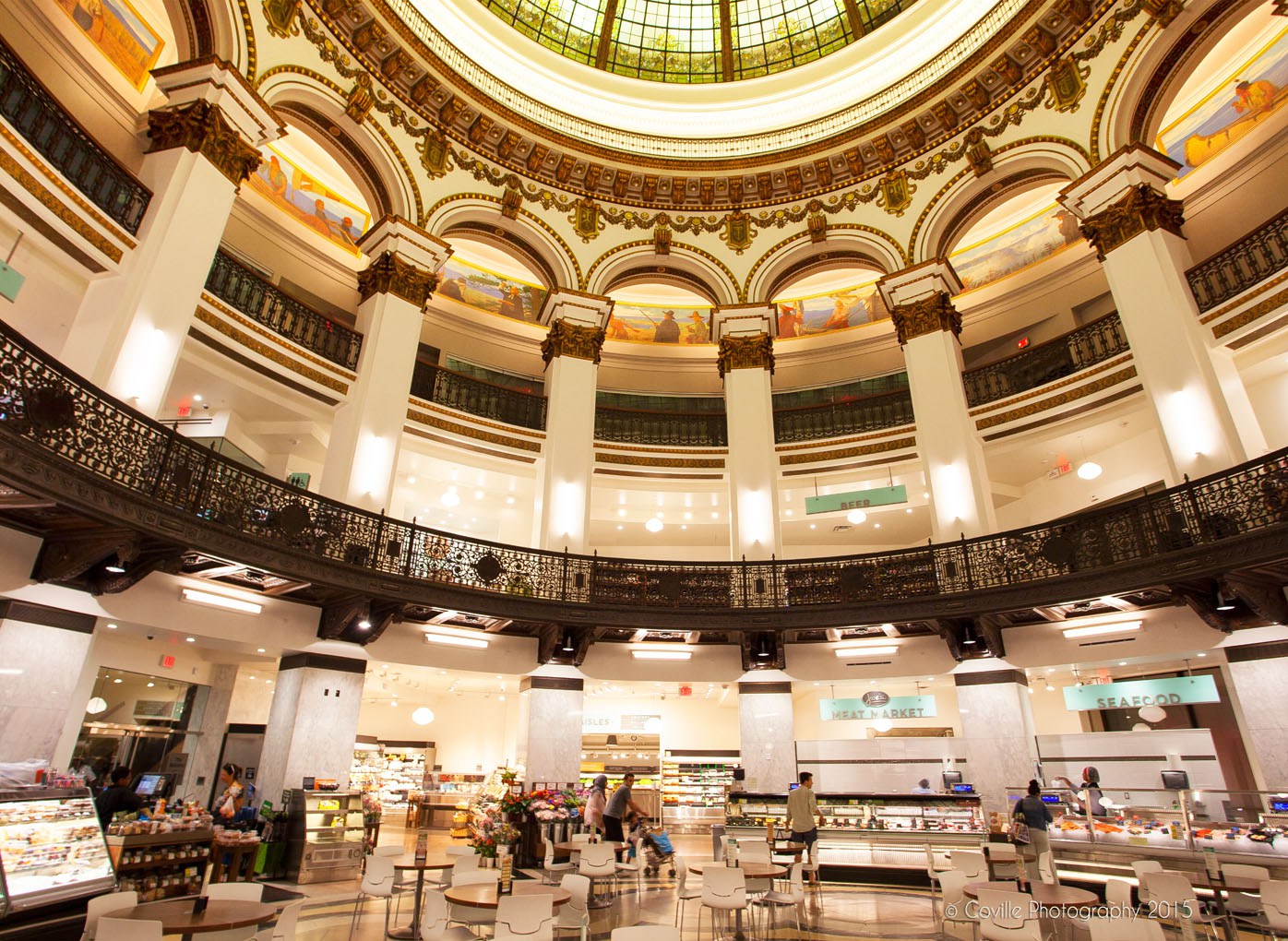
What most people miss is  that no food is “healthy”, Ruhlman writes. Food can be nutritious, but it’s only part of a healthy lifestyle. Even if the granola bars people are so increasingly fond of were unequivocally good for them — and they aren’t, really, given the amount of sugars packed in as preservative —  people need varied diets and physical activity to be “healthy”.   Still, what the market demands is what it gets: the Heinen brothers visit organic expos and look for genuinely nutritious snacks they can introduce in their stores,  but they’re mostly beholden to what people demand…be that Cheerios or free-range lambchops.  Happily, the market in general is shifting to favor organics and local produce, so the absence of spring fruit in winter is no longer a deal breaker for people who visit the store.   Grocery stores are having to go beyond food, too:  the Heinen brothers  have long emphasized  health in the products they stock, and their most recent store (in a renovated Beaux Arts bank) has a restaurant and bar.  This is not not unique to the Heinen brothers, as other chains like Trader Joes have experimented with coffee houses and the like;  from the surviving neighborhood grocers to WalMart,  prepared food is an increasing part of the grocery store’s stock in trade. What is unique to the Heinens is that they have a doctor on staff, one who vets the quality of their produce and health departments, and who gives community seminars about food and wellness.

Grocery has a lot of topics thrown in the buggy — the history of grocery stores,  critiques of our modern diet, insight into the marketing and purchase decisions of grocers —  and some of it may be repetitive if you’ve been reading an author like Michael Pollan.  The store he chose has a unique character, and I enjoyed learning about the brothers’ business and their attempt to contribute to a fresh food culture in their part of Ohio. Also, I have to be a fan of anyone who takes a beautiful but abandoned building and turns it into a community center, at a big risk to themselves.

The Heinen’s latest corner grocery, the revived Cleveland Trust building.
Inside the store. The book includes a section on how the brothers had to reconcile its architecture with the unique demands of a grocery store. 

Related:

Posted in Reviews | Tagged , , | 5 Comments