Fools and Mortals

Fools and Mortals
© 2017 Bernard Cornwell
384 pages
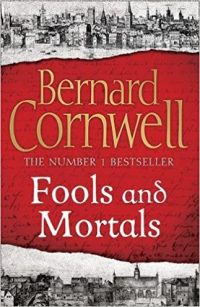
Brevity is the soul of wit, so here’s an attempt at a quick  review.  Bernard Cornwell usually writes war novels, and he’s magnificent at it. But he surely gets tired of it, and every so often he delivers a mystery or something that’s not dashing heroics.   Fools and Mortals is such a book,  a celebration of the birth of western theater and of Shakespeare in general. Our main character is Richard Shakespeare, the struggling younger brother of much-hailed William.  In a age where only men acted on stage, Richard’s days as an actor are seemingly numbered: he’s too old to play most women, as his voice has already broken, but actors abound and male roles are competitive. What’s worse, Will seems to be deliberately mocking Richard’s desire to be taking seriously: his latest  role is a man…pretending to be a woman, and doing it clumsily.   But now isn’t the time for jumping ship: the company is the middle  of rehearsals for a high-profile gig that the Queen might attend, and just showing up at practice gives him a chance to swoon over one of the serving girls.   Besides, he’s too poor to take chances on pay:  Richard already has to make ends meet by nicking small articles and selling them on the side. When the company’s plays are stolen,   Richard’s moody resentment of his brother, not to mention his reputation for having sticky fingers, make him the obvious suspect. To clear his name, save the company’s hides, and perhaps nail a proper male role, Richard decides to find out who stole the plays and get them back.

…and he does, within a few pages.  And then he exits , pursued by a bear.  The drama promised on the front cover is only a small, brief episode within the larger story of Shakespeare trying to deliver “A Midsummer’s Night’s Dream”, and finish his script for “Romeo and Juliet”. It’s not easy, because  secret police keep breaking in to nose around, and why would priest-hunters be bothering an acting company?  Most of the novel’s action takes place in and around rehearsals or performances. Cornwell notes in his afterword that the novel is largely a tribute to the men and women of his local acting company, who have given him so many happy evenings.  Fools and Mortals is thus a celebration of the English stage — a novel that allows readers to experience the England which created and nurtured the likes of Shakespeare. Cornwell’s usual strengths are here, in humor and in a few action scenes (I wasn’t kidding about the bear),  but the weight of the story is its theatrical setting. I enjoyed it well enough, but I’m a regular patron of my local Shakespeare Festival and am thus an ideal audience for this kind of thing. I particuarly liked the way Cornwell included historical flavor: the inclusion of jigs after performances,  for instance, or the use of period slang.  I’m not sure that those who come to Cornwell for his Sharpes and Uhtreds will necessarily like this one, however, given how different it is from his usual work.

Well, so much for brevity. But Polonius was a rubbish advice-giver, anyway.

Related:
Ruled Britannia, another Shakespeare novel. This one is alt-history instead of historical fiction, and has Shakespeare incite  English rebellion against the conquering Spanish empire.
Gallows Thief, Bernard Cornwell. Another non-military work, this one a detective story set in 1817 England.

Posted in historical fiction, Reviews | Tagged , , , , , | 7 Comments

Grocery

Grocery: The Buying and Selling of Food in America
© 2017 Michel Ruhlman
324 pages

Let’s go shopping! There’s a few errands to take care of first — an homage to dad, a quick review of the history of grocery stores — but then, straight to business.  Aisle by aisle, from dried pasta to fresh fish, the way Americans approach food is changing, and Michael Ruhlman’s Grocery shows us how, using — literally — the neighborhood grocery store, the one just down the block from his childhood home.  Ruhlman has a particular passion for food, one inherited from his father — a man who genuinely looked forward to his weekly run to the grocery, one who kept journals of the meals he’d entertained company with — and has turned that into a series of books, including one that took him into chef school.  Here he’s spending his time with the twin brothers who run a series of stores that grew out from their father’s,  one that has continued to stay on top of modern eating trends.

During Ruhlman’s childhood, the grocery store was a place where you bought groceries. Wal-Mart changed that, though, when they invaded the grocery market, and other stores like Target  followed in their wake.  A lot of what a grocery stocks, the stuff in the center aisles, are commodity goods that are the same regardless of where you buy them: a box of Cheerios, say, canned soup, or jar of olives.  The quality doesn’t change from store to store, and it’s hard for a local grocery to compete with prices against the likes of Wal-Mart, let alone Amazon. Their future will lie in offering high-value goods or culinary experiences that can’t be thrown on a truck.   Although Americans cook increasingly less — Michael Pollan speculates gloomily that the next generation may view food prep as weird and alien to their life as milking a cow or beheading a chicken —   we’re still obsessed with food. Part of this is not a healthy obsession, although “health” is the object:  there is an increasing tendency to view food as medicine, buying it based on its advertised health claims rather than its actual quality.   Neither Ruhlman nor anyone he interviews are impressed with the USDA’s track record in declaring foods as “healthy” or unhealthy, having previously damned eggs and butter to the devil’s bin.

What most people miss is  that no food is “healthy”, Ruhlman writes. Food can be nutritious, but it’s only part of a healthy lifestyle. Even if the granola bars people are so increasingly fond of were unequivocally good for them — and they aren’t, really, given the amount of sugars packed in as preservative —  people need varied diets and physical activity to be “healthy”.   Still, what the market demands is what it gets: the Heinen brothers visit organic expos and look for genuinely nutritious snacks they can introduce in their stores,  but they’re mostly beholden to what people demand…be that Cheerios or free-range lambchops.  Happily, the market in general is shifting to favor organics and local produce, so the absence of spring fruit in winter is no longer a deal breaker for people who visit the store.   Grocery stores are having to go beyond food, too:  the Heinen brothers  have long emphasized  health in the products they stock, and their most recent store (in a renovated Beaux Arts bank) has a restaurant and bar.  This is not not unique to the Heinen brothers, as other chains like Trader Joes have experimented with coffee houses and the like;  from the surviving neighborhood grocers to WalMart,  prepared food is an increasing part of the grocery store’s stock in trade. What is unique to the Heinens is that they have a doctor on staff, one who vets the quality of their produce and health departments, and who gives community seminars about food and wellness.

Grocery has a lot of topics thrown in the buggy — the history of grocery stores,  critiques of our modern diet, insight into the marketing and purchase decisions of grocers —  and some of it may be repetitive if you’ve been reading an author like Michael Pollan.  The store he chose has a unique character, and I enjoyed learning about the brothers’ business and their attempt to contribute to a fresh food culture in their part of Ohio. Also, I have to be a fan of anyone who takes a beautiful but abandoned building and turns it into a community center, at a big risk to themselves.

The Heinen’s latest corner grocery, the revived Cleveland Trust building.
Inside the store. The book includes a section on how the brothers had to reconcile its architecture with the unique demands of a grocery store. 

Related:

Posted in Reviews | Tagged , , | 5 Comments

Top Ten Tuesday: Books I Meant To Read But Didn’t Actually

This week the Broke and Bookish are tackling books they meant to read last year, but didn’t. Well, so am I.

1. India: A History & China: A History, John Keay

These were on the short list for last year’s Asian history review, buuuut I wound up reading about modern China and India instead.  Their time will come.

2. Anti-Tech Revolution: Why and How,  Ted Kaczynski

So…early last year Ted Kaczynzki’s publishers asked if I would like a free copy of Ted’s new book in exchange for a review.   Once I recovered from the sheer weirdness of being asked to review the Unabomber’s book, I said…well, sure!  I figure they used Goodreads readers of Ed Abbey’s Monkey Wrench Gang to find prospective reviewers, since that novel is about eco-bombers.

And er, for the record, I don’t endorse sending people bombs in the mail.   It’s against the nonaggression principle and everything.  Also, the postage on bombs is through the roof these days.

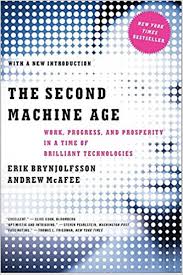
3. The Second Machine Age: Work, Progress,  and Prosperity in a Time of Brilliant Technologies; Erik Brynjolfsson and Andrew McAfee

This is a Kindle Unlimited book I checked out in..May? June?  Eesh. 

Related: Rise of the Robots,  something still on the “Get around to it” list. Not to mention Nicholas’ Carr’s The Glass Cage, and a lot of other tech books..

4. The Gulag Archipelago, Volume III

This is the shortest and least depressing volume, which ostensibly would make it the easiest to read.  When its time came around, though, I was trying to make  up for  falling behind in one of my challenges.

5. Gut: The Inside Story of Our Body’s Most Underrated Organ
and This is Your Brain on Parasites


Both of these were purchased during a science sale for Kindle books, along with Kingpin, I Contain Multitudes,  Dark Matter and the Dinosaurs, and Survival of the Sickest. I’m not sure why Kingpin (a book on cybercrime) qualified, but a sale is a sale.

6. The Great Famine and The Cultural Revolution, Frank Dikotter

I kept accidentally alternating books about Soviet misery and Chinese misery and decided “Yep, I am not reading any more Frank Dikotter this year. Too many dead people.”

7. The First Family: The Birth of the American Mafia, Mike Dash

I read half of this before the digital loan ended and it went poof.  I’ll go after it again.

8. Ring of Steel: Germany and Austria-Hungary at War, 1914-1918, Alexander Watson

I checked this out in October, but there was too much going on, and…well, as with Dikotter I’d just had my share of mass murder for the year. 

9. Bikin’ and Brotherhood, David Charles Spurgeon

Bikers are inherently cool, but I’m also interested in gang psychology. The “brotherhood” part of this title keeps me pondering buying this one now or later. So far it keeps getting pushed to “later”.

10. Alone Together: Why We Expect More from Technology and Less from Each Other, Sherry Turkle

This one has been on my “to read eventually” list ever since it came out.   Maybe this will be the year.

Posted in General | Tagged | 13 Comments

Peaceable Kingdoms

Star Trek, The Fall: Peaceable Kingdoms
384 pages
© 2013 Dayton Ward

Nearly two months have passed since the most popular and widely respected president in Federation history was publicly assassinated, but in that time her temporary replacement has not been standing strong, offering a  reassuring presence to a troubled people.  Instead, he’s been losing friends and alienating people in a misguided effort to renew the Federation as a galactic superpower. With a declared object of making Starfleet a force to be reckoned with, he has instead begun corrupting it by ignoring the chain of command, creating black-ops squads and playing hell with Starfleet schedules by using them for his off-the-books wetwork. Frustrated and wary of his commander in chief’s motives, Fleet Admiral Akaar has recalled Captain Riker, promoted him to admiral, and is relying on him to be the one trustworthy man in his office. Riker has thus become the point man in an effort to find out what el presidente is up to. Together, he, Captain Picard, and their respective crews will unearth a few skeletons and put the Federation to rights again. A tale of action and intrigue, Peaceable Kingdoms takes The Fall out on a good step, if not one as strong as previous titles in the series.

The Enterprise has been hovering out of sight for most of this series, consigned by the president to keep station at Ferenginar. It’s an obvious misuse of the Federation flagship and its most seasoned captain, not to mention a fairly crappy place for shore leave. Who wants to take their liberty on a swamp-planet? Now the Big E is entering center stage, however, dispatching Dr. Crusher and a few others on a secret mission to an abandoned world where some secrets are buried, there to follow up on one of Riker’s leads. They’l have to contend with the president’s schemes, though. A welcome relief here is T’Ryssa Chen, who since the Borg War books has added some humor to the Enterprise . She’s an oddly irrepressible half-Vulcan with a smart mouth, who a mellowing Picard tolerates with paternal affection. Given the tension of these books — what is with that title, anyway? Are we anticipating the fall of the Federation? The Typhon Pact? — her sass evens things out a bit. The series as a whole has been good about leavening the drama with laughs, though.

Peaceable Kingdoms is an enjoyable end to a great series, and its end is a hopeful one — assuring readers that after the bloodshed and horror of the Great Borg War, and the constant tension of the Cold War in Space, Starfleet is about to commend another grand era of exploration

Posted in Reviews | Tagged , , | 2 Comments

Lessons from a Lemonade Stand

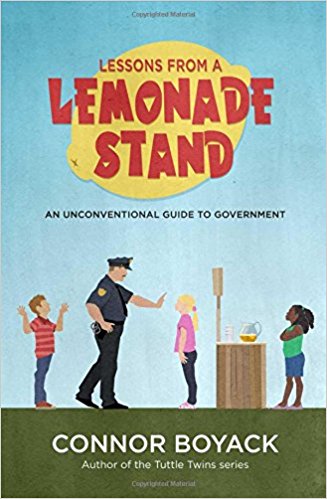
 Lessons from a Lemonade Stand: An Unconventional Guide to Government
© 2017 Connor Boyack
145 pages

Who knew  lemonade was a gateway drug to anarchism?   Beginning with the true story of several girls who were bullied and fined by their local Officer not-so Friendly because they were selling delicious beverages without a permit from the city, Connor Bayack asks readers old and new a question: what does it mean to be lawful? Where do laws come from, and what happens when laws support oppression, or suppress something innocent or even good?   In a short work that draws from Frederic Bastiat, Hannah Arendt, and Monty Python,  Lessons from a Lemonade Stand is an education in law, and rights, as well as an appeal for youngsters to go forth and smash the state.  Or at least, sell lemonade and braid hair without a license.

Although Lessons from a Lemonade Stand  is written for teenagers,  the content is by no means juvenile,  exploring as it does the nature of law, rights, and the legitimacy of government. Drawing on Frederic Bastiat’s The Law, Boyack argues that everyone has natural rights which exist regardless of any government or other person’s respect of them, and that natural law exists to protect these rights.  Because the natural law is based on the respect and protection of these rights, laws cannot violate them and retain their own legitimacy.  The same is true for governments, which are organized to protect these rights: its existence is predicated on those rights being respected, and thus it cannot do what is unlawful for the people who created it do.  Legitimacy also requires consent, since the government has no life beyond what its members give it.  There is then a difference between something being bad because it violates  natural rights – theft and murder being the two most obvious —  and something being bad because some entity, be it a gang or a federal regulatory board,  has declared it bad.   Similarly, there is a difference between the natural rights guarding life, liberty, and property, and the statutory  ‘rights’ created by governments, which vary widely from place to place and often involve infringing upon the natural rights of others. Having established the difference between violations of the natural vs statutory law, Boyack then reviews a heroes panel of people, many of them young, who have stood for what was ‘right’ against the government’s actions.  They stood in the US, in Germany, in Egypt, in Pakistan – across the world, people recognize that just because the  ‘government’ says something is right doesn’t make it so. Even those with the best of intentions can go dead wrong when they violate the rights of others.

There’s a lot of information compressed in this little book and it’s full of real-world examples that will add a little fire to the blood. I’d never heard of Helmuth Hübener, the youngest boy (17) to ever be sentenced to  death by the ‘people’s court’ in Nazi-controlled Berlin. The moment when a person realizes that truth and right exist independent of authority — that police, or teachers, or politicians can be absolutely wrong — is the moment that a person begins their own journey as an independent thinker and human being.  Although I’m in the choir a book like this is preaching to,  I also found its review of law helpful.

Connor Boyack is head of the Libertas Institute, which in Utah exists to fight the lemonade police and others. In addition to organizing legislative challenges to casual tyranny, Boyack also writes children’s books about the principles of economics, politics, and liberty. My favorite title is The Tuttle Twins and the Road to Surfdom.  His illustrator is Elijah Stanfield.

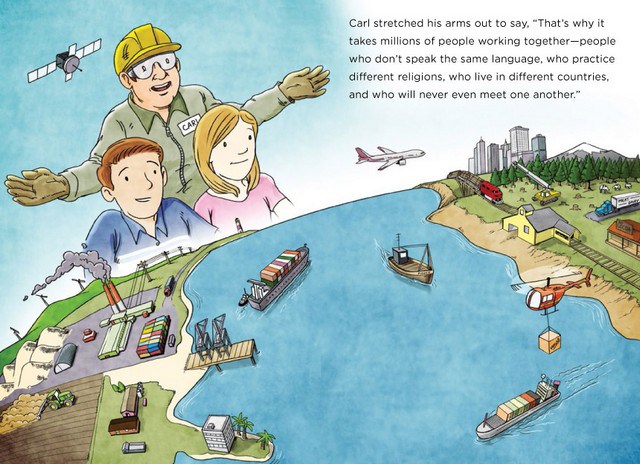
From The Tuttle Twins and the Miraculous Pencil, based on Leonard Reed’s “I, Pencil“.
“Must the citizen ever for a moment, or in the least degree, resign his conscience to the legislator? Why has every man a conscience, then? I think that we should be men first, and subjects afterward. It is not desirable to cultivate a respect for the law, so much as for the right”. – Henry David Thoreau, “On Resistance to Civil Government”

Posted in Politics and Civic Interest, Reviews | Tagged , , , , | 6 Comments

The Poisoned Chalice

Star Trek the Fall: The Poisoned Chalice
© 2013 James Swallow
395 pages

Without warning or reason, the starship Titan – specialized for deep space exploration – has been recalled and ordered to patrol…Earth. Captain Riker has been promoted to admiral and shoved in an office, while several members of his command crew have disappeared on secret missions that not even the Fleet Admiral knows about. Who’s giving orders around here? It’s a troubled time in the Federation, with one head of state assassinated only weeks before, and the president pro temp acting in ways that make Chancellor Gowron look compassionate and conscientious. More mystery and more stress are not what the Federation needs….but they do make for another great novel in The Fall series.

Schemes are the name of the game here, as everyone is Up to Something. The fleet admiral suspects the president is up to something, Riker suspects the fleet admiral is up to something, and the crews of two starships suspect Riker is up to something. Commanders Tuvok and Nog know they’re both being put up to something, because they and a few other officers have been ordered to the middle of nowhere to meet a group of mercenaries who are obviously up to no good. But what is going on? All these secret goings-on are the ripples around the schemer in chief, President Pro Tempore Ishan Anjar. Anjar was chosen not for manifest competence, but to assure Bajor – in the light of the Federation’s growing ties with Cardassia – that Bajor’s history was not forgotten, and its place is secure. Throughout this series he’s proven himself to be petty, mean, obnoxious, and other sundry adjectives, prolonging crises for political gain. That is coming to a head, however, and things are unraveling.

The Poison Chalice brims over with intrigue and terse conversations, with a healthy bit of action and a little comedy as well. I was spellbound, still enjoying the drama of Starfleet officers wrestling with questions of conscience and duty, and can’t wait to see how this ends. I hope it involves Anjar getting a right sound lecture from Picard.  Or a right sound backhand from Worf — I’m not particular.

Posted in Reviews | Tagged , , | 8 Comments

Podcast of the week: Amazon, Google, and Facebook as the new monopolies

Last Monday, EconTalk posted an interview about the ‘new monoplies’,  in which host Russ Robert spoke with Matt Stoller about the increasing danger of Google, Facebook, and Amazon.  Stoller is of the opinion that three companies are not only so large that they’ve consumed their respective markets, but they’re starting to overshadow political spheres as well.  Roberts was more concerned about the effect that Google and Facebook had on controlling and filtering available information, and asserting that there’s never been a better time to be a producer . One vital point that Stoller makes is that these companies have grown so enormously, so quickly, that they’re not even aware of everything that’s happening under their aegis; he points to the alleged Russian use of facebook to propagate fake news. Another key point is that these companies are increasingly unavoidable; even if someone is an absolute crank who insists on running Tor and using DuckDuckGo as their search engine,  software like Google is used as the basic infrastructure of some institutions: Stoller uses the example of a father who tried to keep his kid off of YouTube, only to be thwarted by the fact that his kid’s school used free Chromebooks from Google — and with those books, Google’s services. 

Although Stoller faltered a bit under questioning, the interview came to mind immediately when I read an article from Wired UK that Amazon and Facebook will soon be allowed (in European and UK markets) to conduct inter-personal financial transactions, like a bank.  We’re getting closer to The Circle, it seems. The link above directs readers to the episode highlights page, just in case someone is curious but doesn’t have time to listen to a hour-long conversation.

Posted in General | Tagged , | 2 Comments

A Ceremony of Losses

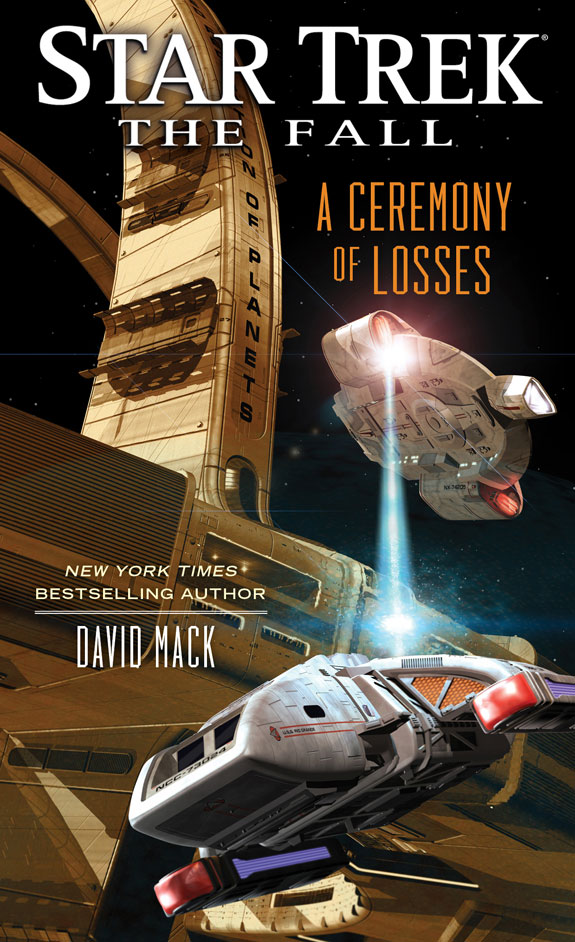
Star Trek the Fall: A Ceremony of Losses
© 2013 David Mack
353 pages

“I’m a ship captain, doctor. Risk is my business.”
“…you’re an un-armed, one-man freighter.”
“Okay, delivering cargo is my business. But I’m trying to diversify.”

Now this is a way to start 2018!   When Julian Bashir’s vacation is interrupted by a Ferengi delivering a message from an old comrade in hiding, the good doctor has no idea his finest hour is  upon him. He is asked to receive stolen biological data, and from the noise therin produce a pattern that might save a people from extinction.  It won’t be easy:  the data is considered highly sensitive by three governments, one of which might kill Bashir for trying to use it, and even if he finds a cure, his career with Starfleet will be over.   Still struggling with his conscience over his actions in a sanctioned but bloody bit of intelligence work (Zero Sum Game), Bashir knows responding to this forlorn plea is both the right thing to do, and an opportunity for personal absolution. If he can obtain the missing pieces and coax some of Starfleet’s finest geneticists into helping him, a  people might be saved — and if it costs him his career, his freedom, or his life, Bashir is determined to deliver.  A Ceremony of Losses is  the best Trek book I’ve read in years, a thriller that smartly combines political  and personal drama, humor, and action in a tight story full of moral dilemmas.

A little backstory is required to fully enjoy A Ceremony of Losses, but that’s to be expected in the third book of a series. The Andorians are an odd species in that they have four sexes, all of which are required to produce a single offspring. Even Treklit published in the Enterprise era hinted that the Andorians were drifting toward extinction, their reproduction woes magnified by a buildup of recessive genes that were causing chronic miscarriages.  Between the Borg War and the ordinary passage of time, the Andorians have come to a crisis point: they’ll be extinct in a generation if something isn’t done.   In Paths of Disharmony, the revelation that the Federation’s ban on genetically engineering sentient lifeforms, and its sequestration of any data that would aide such a project, had hidden information and tools that might be used to help Andoria resulted in that planet — one of the original founding worlds — seceding from the Union.   Now, in The Fall, Andoria is under an embargo by the Federation, who suspects its leadership is being manipulated by the Typhon Pact, a confederacy of villains.  The banned information and tools are what Bashir needs, but it will take more minds than his to find a cure, and even when he does the political leadership of both Andor and the Federation are playing games.  Bashir has to find a way to obtain the data and do lab work without triggering any security measures, and once he’s exposed he may have to burn a lot of bridges trying to get the results to the right people on Andoria.

One of the greatest aspects of this novel is its persistent moral drama. Bashir and his comrades aren’t civilians, they’re Starfleet officers who have sworn to obey their orders, even if their orders come from an absolute ass of a president .  Bashir, Captain Ro, Captain Ezri Dax, and others all have to decide how far they can toe the line, and when they’ll step over the edge. It makes for fantastic drama because characters readers know and like are working in opposition to one another,  each trying to follow their conscience as best they know how, wrestling with themselves as one another. Creating believable, sustainable drama in this fashion is a lot more challenging than using obvious Bad Guys to provoke the plot, though most of the politicians here are decidedly unsympathetic antagonists.   What makes it even better is that there are real consequences for these characters’ decisions: this isn’t like one of the shows, where some stern admiral pops on to lecture Kirk or Picard for being naughty, then gamely allows that the results have been worth it.  Some characters will have to face the music with only a clean conscience at their back.

Oh, and this book is only .99 cents on Amazon, along with the other books in The Fall series.

Posted in Reviews | Tagged , , | 7 Comments

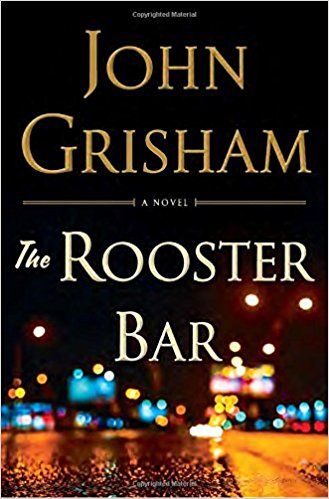
The Rooster Bar

The Rooster Bar
© 2017 John Grisham
352 pages

The third year of law school is supposed to be the easiest, but for Todd,  Mark, and Zola…eh, not so much. Their best friend just committed suicide, leaving behind a tangled web of conspiracy on his apartment wall. Zola’s Senegalese parents were just picked up by customs for deportation,  the guys’ families are likewise unstable, they’re all unemployed, and between them they owe over half a million dollars in student loans.   Not that all that debt has given them anything in return:  half of their school’s graduates fail the bar exam, a fact they’ve picked up on much too late. They’re all a semester away from graduation, and after that loom the licensing exam and impossible loan payments   With the banks holding all the aces, what’s left to do but kick over the table? 

 Todd and Mark have an idea:  stop going to law school, and start going to the courthouse to hustle cases, small fry that they can do cash jobs for, under assumed identities.  With all of the lawyers crawling around DC, like rats in a landfill, who would know they didn’t have licenses? They’ll use their last student loans as startup money, hit the streets, and see if they can’t scrape up a living.  They were headed for bankruptcy anyway, so why not go for broke? The Rooster Bar follows the two guys (and Zola,  who is distracted by her family and dubious about the scheme to the point that she never nets any cases) as they embark on a life of deceit, fraud, and confidence games,  though one of them has a bigger fish in mind. The same company that owns their diploma mill also owns the bank they borrowed the money from, through the usual legal shell game that protects them from antitrust suits.  The guys would love to take vengeance on the racket, not just for ruining their lives but from driving their friend to suicide. Surely there’s a way.

Well, yes. It seems implausible, but as Grisham points out in his afterward, he played fast and loose with the facts for the story’s sake.  (“Especially the legal stuff,”says he.  That’s nice to know when it’s a novel about the legal profession.)   Although  this is a fresh story — and an interesting one, as readers see the characters having to learn the ropes — the way it develops is not too dissimilar from The Litigators, in that some characters’ ambitious idea goes…awry in a Wile E. Coyote fashion. Just like the Coyote, however, repeatedly falling off of cliffs, blowing up bombs next to their heads, and launching themselves into the stratosphere  doesn’t stop Todd and Mark from rebounding.

The Rooster Bar is more memorable than The Whistler,  but I’d still put it near the bottom of the second tier, as far as Grisham books go. Good title, though.

Posted in Reviews | Tagged , , | 5 Comments

Announcing: Peoples of the Americas

In the past few years I’ve explored the Middle East and Asia; for 2018, I am moving closer to home with “Peoples of the Americas”.  With it, I hope to remedy my ignorance of the United States’ southern neighbors (save Mexico and Cuba), as well as learn about a few native  American tribes who are a blank to me…the Chinook being one example.

The plan: open the year by visiting a few  Amerindian tribes in North America, move into a treatment of the Aztec, Maya, and Inca, and then follow up with histories of various nations in the Caribbean, as well as Central and South America. If time permits, we may even visit that most exotic of American nations, Canada.

Although this, along with the Classics Club, will be my focus this year,  I’m just going to fool around in January and ease into the new year with light reading in the form of Star Trek, books on cities, that kind of thing.

Posted in General | Tagged , , , | 6 Comments