Review in the dark

Sad news,  dear readers: my modem has perished.  I lost power last night and when the lights popped back on, my modem did not rise from the dead like the rest. Repeated attempts to reboot it and an hour or so with ATT’s people and robots indicated that the aging modem had just given up. So, while I wait for the postman to bring me a replacement, I’m sans internet.   That will give me the opportunity to finish the book I’m currently reading, Walter Isaacs’ biography of Steve Jobs, but in the meantime I’ve also read a few others.   In the last week I finished two books which I haven’t reviewed yet,and I’ll use my downtime (and the lack of distractions) to give them their due.    For the moment, however, I’ll comment on Pinpoint: How GPS Is Changing Technology, Culture, and Our Minds, which I just read via interlibrary loan.   After a history of how GPS came to be,   Greg Milner  explores its unexpected applications in fields like earthquake response, and comments on modern phenomenon like “death by GPS”,  in which people willfully hurtle themselves into dangerous situations because they trust the voice of a computer more than their common sense.  Although the book is perfectly interesting in what it covers, and well executed there,  I had expected from the title more emphasis on how our personal expectations — “our culture and our minds” —  were being remolded by the ability to locate seemingly everything  with exacting precision.  Using coordinate systems is a great change from the way humans instinctively deliver directions, but that break can be observed with a paper map:   when I travel and get a little lost,  I find few people who are willing to orient themselves even on the map I’m using.  (I insist on printing out full-page maps, not just directions, because I want to know where I am.  It comes in handy.) They insist on giving me local references instead.  Pinpoint is nice, just not as probing as I thought.   I’ve got another interlibrary loan book on the way, though: The One Device, a history of the iPhone, and perhaps a examination of how radically transformative smartphones in general have been.

Posted in Reviews | 8 Comments

Control

ST Section 31: Control
© 2017 David Mack
304 pages

“…if I’m correct, going to war with Section Thirty-one can only end badly for you. Either you will lose, and you and all your friends will suffer gruesome fates I’d rather not imagine; or you will win—and in so doing, end up inflicting more harm than good upon your beloved Federation.”

For four years, Julian Bashir has yearned to destroy the malicious intelligence-and-covert ops organization known as Section 31 from the inside.  A rendezvous with a desperate journalist in the frozen wastes of Andor, however,  makes him realize more than ever that he is over his head.   Running in the background of the entire Alpha Quadrant’s technical infrastructure, from replicators to warp cores and shuttle transports is a common code, creating a massively distributed superintelligence which is monitoring and reporting — but reporting to whom?  This AI no doubt has some connection to Section 31, which always seems several steps ahead of its opponents, but how can they be defeated when the very substance of Federation civilization is reporting for it?   The truth, as ever, is even more frightening…

Many Trek books are great adventure stories, and some are beautiful bits of drama; the true talents of modern Trek literature are equally able to provide horror and comedy.  Control distinguishes itself, however, by its timeliness.   The world of Control is not a fantasy, but rather one we are building  day by day. Something very much like Control in the real world was already explored by Daemon, Daniel Suarez’s cyberthriller, and those who remember its plot may steal  a march on the main characters here. Although Bashir and his fellow fugitive, his lover and fellow S31 double agent Sarina,  seek refuge and help from trusted sources, no place within the Alpha Quadrant is safe for long, because no matter what they do, Bashir and his friends always seem to be playing right into Section 31’s hands.   Mack excels in torturing characters emotionally,  and that’s supplied here with one prominent death and another character psychologically crushed. The ending was…surprising at first, but carries  its twist.

For those who have been fascinated by Section 31 since their introduction in “Inquisition”,  Control explores their past and delivers the final reckoning with them. While it seems a little rushed, the twist ending also indicates that another game is still afoot.

Related:

  • A brief clip from “Inquisition“, the episode of Deep Space Nine in which Section 31 was introduced, and another clip from “Inter Arma Enim Silent Leges”,  when Bashir learns that someone he admires and respects. Episodes like these are why I believe Deep Space Nine is far and away the best Trek series, not only for its deep bench of complex characters, but the serious moral issues it explored. This wasn’t something that slowly developed, either, but was present from the start — just see the first-season episode “Duet“, in which a Cardassian who was a lowly clerk during the occupation assumes the identity of his murderous boss, Gul Darheel, just so that he can be exposed and put on trial — thereby allowing Cardassia to face its guilt and redeem itself for its past injustices.
  • Daemon, Daniel Suarez
Posted in Reviews | Tagged , , , | 10 Comments

Disavowed

ST Section 31: Disavowed
© 2014 David Mack
304 pages

“Murder is murder, regardless of whether it is committed by an individual, a group of persons, or the state.” – Disavowed, David Mack

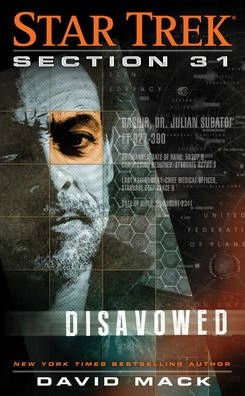
Disavowed is the brilliant result of multiple spy plots intersecting one another, bringing together the standard and ‘mirror’ universes. Following Rise like Lions, a political entity much like the Federation has established itself in the Mirror Universe, and is strengthened by a hidden  organization called Memory Omega.  Established by Emperor Spock to conceal itself and to become a galactic puppetmaster, Memory Omega functioned rather like Hari Seldon intended the Second Foundation to function in his attempt to shorten the galactic dark age and create a second Republic.   Because of Omega,   the nascent Commonwealth has tremendous weapons at its disposal — weapons the Breen of the standard universe have caught wind of, and are planning a covert invasion of the mirror universe in order to steal.  Section 31, the amoral organization which pledges itself to protect the Federation without sanction  or oversight, which previously nearly effected genocide by turning Constable Odo into a Typhoid Marry,  is intent on preventing the Breen from gaining this kind of advantage — and to help scotch the Breen’s plan, they are putting Julian Bashir — who is helping them only because of the threat the Breen might pose with these weapons — into play.  But there’s always another level of conspiracy,  and before this one runs its course we’ll see a Dominion invasion of the mirror Alpha Quadrant, a beloved character on trial, and a faction who are even better at pulling strings than Section 31. This is, in short, a very cool book.

Many years ago one of Trek lit’s best miniseries hit the shelves: Section 31, telling stories of  that very interesting organization as it acted in TOS, TNG, DS9, and VOY;  I was very glad to see their return,  especially under the able pen of David Mack. Mack here writes a sequel to both Rise like Lions and The Fall series, bringing two universes together, and allows us to spend time with a lot of beloved characters who are long gone in the standard universe, but still active in the mirror. People like Weyoun, that merry villain, and Eddington — a rebel in one universe, an admired head of state here.  And not to mention Saavik, whether you’re imagining her as Kirstie Alley or Robin Curtis.  We get glimpses of some of Section 31’s toys,   there are the expected allusions (“Not good enough, damn it, not good enough! — thank you, Captain Picard), and a fair bit of comedy to balance out what is one edge of the seat moment after another.  Bashir, for instance, is entering Section 31’s service as a double agent; he intends to work for them only to bring them down, and so does his girlfriend. When she ‘seduces’ him into joining 31, however,  members of 31 are in fact observing them and mocking their poor acting skills…even the Vulcan.  Why 31 is still using Bashir and Sarina Douglas is one of the wheels-within-wheels ops that won’t be unveiled until the end. We also receive regular insights into the Breen and into the mirror-Dominion, who are..very much the same, but different in an important way. 

This is a thoroughly gripping tale, and I’m looking forward to the sequel, Control.

Other Highlights:
“Because this isn’t about strength. Justice isn’t decided by power. It isn’t born through the force of arms. It comes from people of conscience taking responsibility for their own lives—and accepting the consequences of their actions.”

Posted in Reviews | Tagged , , , | 4 Comments

The book as a squarish chunk of hot smoking conscience

In autumn of 2017, The New Criterion published an article about Aleksandr Solzhenitsyn’s “cathedrals“, his Gulag Archipelago and a series of epic ‘novels’ known as the Red Wheel series. I delayed posting this until I was finished with the trilogy, and promptly forgot about it.

Some excerpts:
“In taking literature so seriously, Solzhenitsyn claimed the mantle of a ‘Russian writer,’ which, as all Russians understand, means much more than a writer who happens to be Russian. It is a status less comparable to “American writer” than to ‘Hebrew prophet.’ ‘Hasn’t it always been understood,’ asks one of Solzhenitsyn’s characters, ‘that a major writer in our country . . . is a sort of second government?’ In Russia, Boris Pasternak explained, ‘a book is a squarish chunk of hot, smoking conscience—and nothing else!’ Russians sometimes speak as if a nation exists in order to produce great literature: that is how it fulfills its appointed task of supplying its distinctive wisdom to humanity.”

“Like Gibbon’s Decline and Fall of the Roman Empire, Gulag is literary without being fictional. Indeed, part of its value lies in its bringing to life the real stories of so many ordinary people. When I first began to read it, I feared that a long list of outrages would rapidly prove boring, but to my surprise I could not put the book down. How does Solzhenitsyn manage to sustain our interest? To begin with, as with Gibbon, readers respond to the author’s brilliantly ironic voice, which has a thousand registers. Sometimes it surprises us with a brief comment on a single mendacious word. It seems that prisoners packed as tightly as possible were transported through the city in brightly painted vehicles labeled ‘Meat.’ ‘It would have been more accurate to say “bones”,’ Solzhenitsyn observes.”

“Real people do not resemble the evildoers of mass culture, who delight in cruelty and destruction. No, to do mass evil you have to believe it is good, and it is ideology that supplies this conviction. ‘Thanks to ideology, the twentieth century was fated to experience evildoing on a scale of millions.’
One lesson of Gulag is that we are all capable of evil, just as Solzhenitsyn himself was. The world is not divided into good people like ourselves and evil people who think differently. “If only it were so simple! If only there were evil people somewhere insidiously committing evil deeds, and it were necessary only to separate them from the rest of us and destroy them. But the line dividing good and evil cuts through the heart of every human being.”

Posted in quotations | Tagged , , | 3 Comments

Short rounds and leftovers:

Hello, readers! Here’s hoping those of you in the US had an enjoyable Thanksgiving on Thursday. I thoroughly enjoyed the company of my cousins, though I did rather poorly in our board game of choice.  I blame the dice.   Throughout the week I finished up a couple of titles and wanted to comment on them.


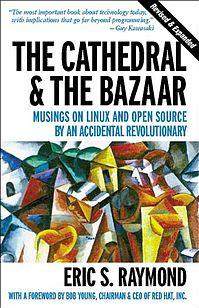
First up is The Cathedral and the Bazaar, which is less a book and more of a long essay on Linux, an open-source operating system — and specifically, how Linux’s bottom up, emergent order approach is much different from the controlling top-down approach of Microsoft and Apple.  I was interested because I recently used a boot disk with Ubuntu (a Linux variant)  to access a computer and extract files from it after it stopped booting Windows. I was pleasantly surprised by its intuitiveness, because I’d previously regarded Linux as something of interest chiefly to programmers and system administrators. Everything I had to do I managed through the graphical interface, just like Windows or Apple, and I made another boot disk with another Linux variant (Mint) to test next time.  An interesting quote from the book:
“The Linux world behaves in many respects like a free market or an ecology, a collection of selfish agents attempting to maximize utility which in the process produces a self-correcting spontaneous order more elaborate and efficient than any amount of central planning could have achieved. Here, then, is the place to seek the ‘principle of understanding’.
The ‘utility function’ Linux hackers are maximizing is not classically economic, but is the intangible of their own ego satisfaction and reputation among other hackers. Voluntary cultures that work this way are not actually uncommon; one other in which I have long participated is science fiction fandom, which unlike hackerdom has long explicitly recognized [ego-boosting] as the basic drive behind volunteer activity.”
Although a lot of the content of The Cathedral and the Bazaar is over my head (given my status as definitely-not-a-programmer),  I like the idea of the open source movement, and not just because it produces good programs that are free of cost, like VLC Media Player, LibreOffice, and the GNU Image Manipulation Program (GIMP), two of which I use.   Developers are becoming insanely clingy about controlling users, and about what they allow users to control; these days the proprietary software on computers isn’t so much owned as rented.  And some of the software produced by these places isn’t even that great: my favored music player, Winamp, makes it far more easy to build and edit playlists than iTunes or Groove, and it’s been using the same simple approach for all the 15+ years I’ve been using it.  


Also up is Coffee to Go, a truck-driving…journal from a Scottish author who drove principally between the UK and western Europe. This book was recommended to me on the basis that he travels to Russia, but no such trip was recorded here, with the farthest reaches being Austria and northern Scandinavia. (There may be multiple editions?) Although I like trucking memoirs generally, this one was….well, less a memoir and more of a journal. Hobbs records every bit of his trip, from how much he paid for coffee to what he said to the fellows as customs, and I found it tedious. The last fifth of the book are recollections of his trips from before he started keeping a diary, and those are much more interesting to read because of all the play-by-play action is absent, replaced by a general narrative with thoughts on traveling to tiny places like Andorra. Easily the most interesting chapter were his memories of driving into Western Berlin during the Soviet era, when  the western side of the city was a pocket surrounded by the dismal DDR.  Hobbs seems like a nice guy, but this wasn’t one I’ll remember much about, I’m afraid.


Posted in Reviews | Tagged , , , , | 11 Comments

Be thankful and repay

Posted in Reviews | 1 Comment

Big Damn Hero

Firefly: Big Damn Hero
© 2018 Nancy Holder and James Lovegrove
336 pages

“Well, look-at-this!  Seems we got here just in the nick of time. What does that make us?”
“Big damn heroes, sir.”
“Ain’t we just?”

I am a patient miser who almost never buys books new, preferring to wait until used copies hit the market. But when I learned that there was a Firefly novel scheduled for release, I preordered and didn’t blink.  Set during the run of the show, Big Damn Hero  delivers as close as we’ll get to another episode of the shiniest show that ever ran. At its opening, Mal Reynolds and the good ship Serenity are looking for work, trying to recover their reputation after the Niska disaster, and necessity compels them to take a questionable payload of explosives from the even-more questionable person of Badger.  Mal’s been asked to see a local businessman about a smaller delivery he can handle on the way, but something goes awry: emerging from an epic bar fight, Zoe and Jayne quickly realized the captain’s been kidnapped. With destabilizing explosives in the hold, and Mal in the hands of parties unknown, Zoe and the whole Serenity gang have to work double time to figure out what’s gone awry before matters get worse.  

Big Damn Hero offers a fast-moving plot (a two-day story) and all the flavor of the show that Browncoats should enjoy; Holder and Lovegrove have a good ear for the show’s peculiar mix of frontier drawls peppered with Chinese expressions,  and  none of the characters from the ship are overlooked in contributing to the resolution: it’s very much an all-hands on deck kind of story,  bringing even Book and Inara into the thick of things.  The show’s humor runs throughout, from Mal’s verbal harrying of his captors, to Zoe and Wash’s playful banter and Jayne’s mix of wiles and tactlessness.  River is…well, River,  playing a flute to calm the explosives down and providing just the right amount of insight to get the team out of tight corners. There are plenty, too;  with so many members of the crew separated in the search for answers.  Zoe, never a weak character — never — is in fine form hre, hobbling round town on a fractured leg, keeping  the crew focused despite River’s episodes and Jayne’s fits and Kaylee’s near panic at the idea of leaving the captain behind.  The only fly in the ointment is the questionable backstory about the Alliance and the Independents, as the settling of this system is portrayed simplistically with rich people buying the core planets and leaving the poor people to the frontier planets, and then there being some confusion about the independents “seceding” from the Union…which they were not part of to begin with.  That’s relatively minor, though,  perhaps on the scale of arguing about Klingon head makeup.    
Big Damn Hero will find an audience, I think, not just because it’s a new story in a beloved franchise, but because it also adds to that Firefly universe by fleshing out Mal’s past and the people he loved and fought by. I enjoyed it thoroughly and hope this series keeps flying. 
Posted in Reviews, science fiction | Tagged , | 11 Comments

H+

H+ Incorporated
© 2018 Gary DeJean
188 pages

Note: I read from an advanced review copy of this book sent to me by the author via Goodreads.

In the mid-21st century, Manila faced total destruction in the wake of hurricanes and rising seas,  but rose to the challenge — literally, by rebuilding upon floating platforms and throwing the doors open to foreign tech firms that wanted to explore the outer limits of what’s possible with as little outside prying as possible.  The result was an explosion of technological innovation, especially in the realm of cybernetics,  but not the kind of growth that absorbs a lot of people into the labor pool. While impoverished dissidents grumble and protest, the police are putting the fruits of innovation to the test, with exoskeletons that allow them to push back ever harder. But when someone within H+, the leading cybernetic warfare firm, goes rogue, a father  and his small son in a cybernetic body are caught in the middle of explosive confrontations between tech-hippies and corporate military police.

Although I’m not a transhumanist, I am very interested in the medical applications of bioengineering, and was  completely immersed in this novel from the start, as it opens with a father taking his son to a support group meeting for people sporting a variety of prosthetics — and not just limbs, but faces. Some of the people there were injured, and some are actively interest in augmenting themselves with technology. The little boy, Jake Patel, is almost completely artificial,  as most of his organic body was crushed in a building collapse. As the story develops, the young boy will be befriended by others at the meeting, most importantly a woman with a bionic eye, who introduces him to an underground community of bod-modders.  Another thread of the story follows a military vet who is invited to join a private security contracting group using exoskeletal suits, and the stories collide at a warehouse where a spectacular over-use of force against civilians sees young Jake lose his prosthetic body, and his father thrown in prison.  Jake himself, his brain — remains free and safe in the care of friends. There’s probably a college essay in that, the mind free despite the body imprisoned,  but Jake’s brain finds another home soon enough, in a purloined prototype that will make him less a victim and more a rebel himself.

Although H+‘s size keeps it from  being complex, the use of a security contractor as a viewpoint character prevents the villains from becoming faceless baddies. Although I principally read this out of interest for the cybernetic applications (which are varied — bodysuits, telepresence, and organ/limb replacement are a few), it moves quickly into an action-drama novel. According to the author,  it was  developed as a screenplay and then adapted into a novel as well.

Related:
Machine Man, Max Barry.

Posted in Reviews, science fiction | Tagged | 2 Comments

Quick admin note on comments

Reader mudpuddle recently mentioned that he and other users were finding themselves unable to comment on blogs without being Google users themselves.  I don’t know if that was a result of Google making a change, but I suspect it must have been since non-Googlers have been allowed to post here before.  I found the setting to enable anyone to post, including anonymous users. That may mean more spam, but we’ll see. I can always turn on that irritating  captcha thing if need be.

Posted in General | 3 Comments

The Arabian Nights

Tales from the Arabian Nights

“If you are not sleepy, tell us one of your lovely, little tales to while away the night.” Shahrazad replied, “With the greatest pleasure”:

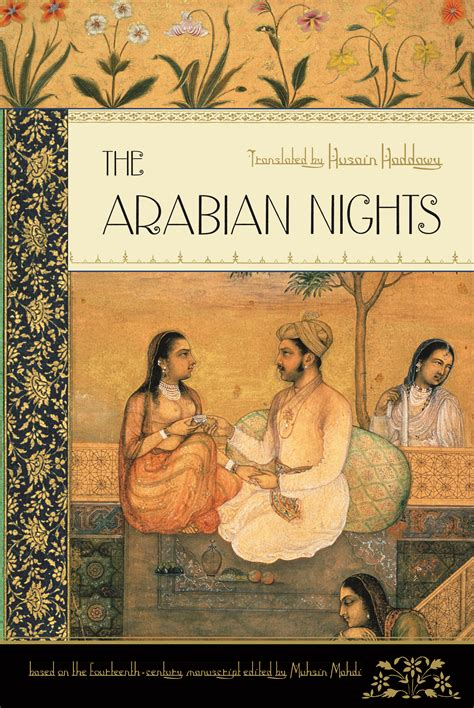
Tales from The Arabian Nights proved an interesting challenge, because most collections of them in English are only selections, and their contents are highly variable. The first  set I started didn’t mention Aladdin or Sinbad, the two stories which have the most name recognition in the west.  My reading of the Arabian nights was thus divided between two volumes, the respective translators being Hussein Hadaway and Edward William Lane.

The Arabian nights open with the framing story of two brother-kings in Persia and India visiting one another and discovering that both of their wives are cheating on them.  After retreating into the country to think things over,  they spy a demon who keeps his human wife locked in a box buried in the desert in an effort to keep her faithful,  only to have his efforts spoiled by her finding other men to sleep with  anyway. The brothers sleep with her before lamenting the unfaithfulness of womankind, and return to their respective realms, where one resolves to never keep a wife. Instead, each day he marries a virgin, sleeps with her, and then kills her after the fact. This goes on for quite some time until his vizier’s daughter, Shahrahzad,  volunteers herself for marriage with a plan in mind.  Using her extensive knowledge of literature and poetry,  on her wedding night she begins telling a story that so ensnares the mind of her husband that he begs her to continue, and night after night puts the thought  of killing her away until he can hear the end.

The tales of the Arabian nights are not one long story with many chapters like War and Peace; instead, one story will unfold to have many stories inside it, or a character introduced in one story will then be followed in another story, ensnaring the reader in a multitude of threads.  They’re replete with magic, of course; demons are as common as cattle, but I suspect the translation of that particular word  is awkward because the demons are not necessarily servants of a great evil power. The first one we meet is just a fellow burying his bride in a glass box in the middle of the wilderness, nothing diabolical there.  In the first collection I read, once the caliph Harun al-Rashid shows up in a story, most of the stories that follow involve his court.  (al-Rashid threatens his vizier Jafar with death every time they discover something untoward going on in the kingdom. Not exactly the happy little man from Disney’s Aladdin.)  There are a lot of surprises here: Aladdin is set in China, of all places, but I suppose he could have been one of China’s distant western minorities, like a Muslim  Uyghur.  Some of the stories are also far more salacious than I would have expected, given the image of Islam as straitlaced, but these stories emerge from popular culture which eludes heavy state censorship by its oral nature.

The Arabian Nights will probably rank among my favorite, or at least the most memorable, books in this Classics Club challenge.  The stories are rich in odd scenarios and characters, like the chance meeting of three one-eyed dervishes, or the discovery that the colorful fish in a pond introduced in one story are actually the citizens of a town which was cursed, and the stories-within-stories trick gets amusing, almost like a running joke. Of course each dervish, characters in a story, has to tell how they got there, and one of them has another story inside that story — Shahrazad’s ability to weave all these together is amazing.

Related:
The Canterbury Tales, G. Chaucer

Posted in Reviews | Tagged , , , , , | 3 Comments