Corona Diary #4

Although we in the United States are still steaming into the darkest part of this tunnel,  I’m bouyed by little flickers of hope abroad.  In Iran, for instance,  over half  of active corona cases are listed as recovered. The same is true in the Italian province of Lombardy,  and in Spain the growth rate of the virus is slowing. In the United States,  we are closer and closer to a uniform stay-at-home order:  to date, 41 of the 50 states have imposed them, Alabama being the latest.  The unfun starts tomorrow at five p.m.
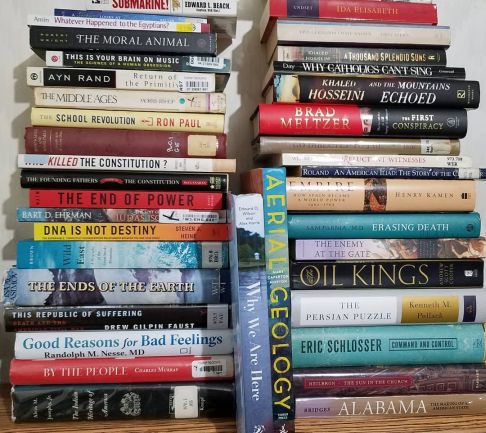
soprepared
Emergency stay at home stockpile. I think I’m prepared.

The library has continued its curbside service, and by the numbers we’re doing well:  the number of recorded services in the last five days is nearly equal the amount we served in the first ten days!   Of course, that may be change with the stay-at-home order. I don’t think much of our current traffic is discretionary, but  only time will tell.  We’ve implemented more hygienic precautions, restricting the number of librarians who do the curbside deliveries, and wearing masks when we’re outside.    I have a newfound appreciation for surgeons!
lorca

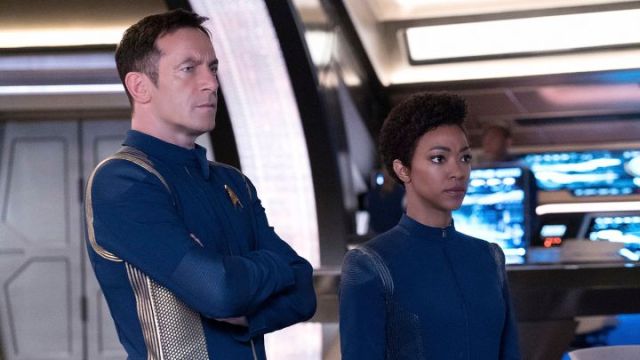
Personally, I’ve finished watching the first season of Star Trek Discovery (!), which…well, took me by surprise.  I wasn’t excited to learn about its creation, in part because I view the Abrams movies as little more than Marvel superhero movies with the addition of Trek jokes, colorful uniforms, and space lasers.  They’re not Star Trek in spirit, and I expected STD to be more of the same.   The first two times I started watching STD I gave up a few episodes in.   This time, however….well, I got attached. I was fascinated by Captain Lorca’s dark energy, Commander Burnham’s struggle to reconcile logic and humanity,  the promise of the spore drive, even Commander Suru’s attempts to grow beyond his scared-beast-of-prey genes.  Discovery centers itself on one character far more than the other shows, which were either ensembles (TNG, DS9) or ruled by a power trio (TOS, VOY), but over time I grew to appreciate how much the character in question (Commander Michael Burnham, the woman  in the shot above) had grown. If only they’d stop making me watch those Klingon-things, those offenses to the eyes and ears!      I found much to appreciate in the latter half of the first season, from Rainn Wilson doing a wonderful Harry Mudd to the intriguing Mirror Universe arc.  And now that Captain Pike is entering the scene in season 2, I’m hopeful about its future prospects. I’ve even……. bought a ST-D book.  Sure, it was only $0.99, but considering my salient attachment to the ‘real’ Trek’s extended bookverse, it’s a bit of shocker.    In time I may even stop calling ST-D by that name, and call it ST-DSC instead.  God willing I will not start referring to it as “Disco” the way so many fans do.(You may place your bets as to when I’ll start doing that. It’s…catchy.  Like…disco fever.)    When the first season ended with Burnham giving a tear-jerking speech about Starfleet not compromising on Federal ideals,  I texted a friend: “Now THIS is Trek!”

I will most likely not be watching Star Trek Picard, however.   I would love to just to see Jeri Ryan on screen again  (loved Seven of Nine!), but I prefer my Picard urbane, and from clips I’ve seen the show has as much language as your average hip-hop track.   Picard only swears in French, thank you. I’ll never accept the Abramsverse as a legitimate continuation of the Trek I love, and Picard is rooted in that red matter nonsense. Unfortunately, Pike and company are going on about ‘red clouds’ in season 2, so I fear that  the infection is everywhere.

I’ve a couple of reviews lined up, with another book with a review that needs to be written, so….stay safe and keep reading!



Posted in General | Tagged , | 8 Comments

Sean Bean on Waterloo


Posted in General | Leave a comment

Read of England 2020

Oyez! Oyez! It being the first of April, I declare Read of England 2020 to be officially begun!    I was concerned that the ongoing pandemic would disrupt my planning, but between stuff I bought well in advance, ebooks, and the library, I’ve got a solid set lined up.  Our starting course is history, naturally, and literature will follow.  No English biscuits this year, unfortunately, but I do have plenty of Earl Grey.

So, what shall we look forward to?
roe1

The White Horse King: The Life of Alfred the Great.  Lars Brownworth’s book on the Vikings got me really interested in Alfred, far more than Cornwell’s fictional depiction of him in the Saxon Stories.

roe5

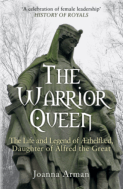
The Warrior Queen: The Life and Legend of Aethelflaed, Daughter of Alfred the Great.     Bernard Cornwell introduced me to Aethelflaed, of course, and to my amusement  the author (Joanne Arman) cites Cornwell as being responsible for stirring up modern interest in her.

roe2

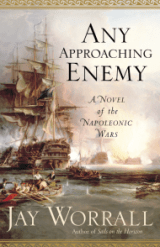
Any Approaching Enemy,  a new-to-me naval novel set during the Napoleonic Wars.  Other titles in the series have similarly evocative titles.

roe6

The True Soldier, a Jack Lark novel. This time Jack’s found himself involved in the American Civil War. But he’s English, so….good enough!  This one I read early.

roe3

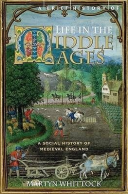
A Brief History of Life in the Middle Ages: Scenes from the Town and Countryside of Medieval England.    This may prove to be a little too much Ian Mortimer’s travel guide to medieval England,  but social histories are always my favorites.

roe4

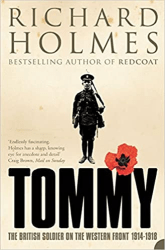
Tommy: The British Soldier on the Western Front,  Richard Holmes.    I previously read Holmes’ Redcoats, on the life of British soldiers in the days of horses and muskets.


There will be a few others, too:  expect Wodehouse to leg in at some point (wouldn’t be April without Bertie), I’d still like to try one of Dorothy Sayer’s mysteries, and I’ve been meaning to read a Tennyson poem for years.


Posted in General | 12 Comments

Eyeball-eating cats, an OB-GYN’s diary, and plague

Last week I read several titles that  I want to share without necessarily writing full reviews for, since they’re on the shorter side.  They are…

  • This is Going to Hurt: The Secret Diary of a  Junior Doctor, Adam Kay
  • Will My Cat Eat My Eyeballs?  Big Questions from Tiny Mortals about Death, Caitlin Doughty
  • American Plague: The True and Terrifying Story of the Yellow Fever Epidemic of 1793,  Jim Murphy

adamkay

When blogs first became a thing, I loved finding people who blogged about their workaday lives — especially cops —  and I often read these occupational accounts in book form when  I can find them. I’ve read a few ER ebooks, but never one by a doctor,  and figured a global pandemic would make for an ideal time to try  a medical diary.   It’s literally presented as a diary, with varied highlights —   moments that are particularly funny, harrowing, challenging, etc — over the course of a decade or so.   The book begins with Kay as a trainee, and by the time it ends, he’s several tiers up in the medical hierarchy, having specialized in obstetrics and gynecology.  Although the book matches sorrow with humor most of the time,   the incident that ends his medical career  also ends the book with such a saddening blow that all of the laughs from before are overshadowed.  The biggest takeaway is how insanely busy and stressful life as an operating physician in the UK can be — and it’s apparently not well compensated, either, as Kay references sharing a small flat with his partner, named only “H”.

yella

American Plague takes readers back to 1793 Philadelhpa, in the grips of a mood  quite like our own, with closed shops and a persistent mood of gloom, fear, and uncertainty. While I had heard about this outbreak before, I’d never considered it in full. Murphy is very effective at painting a picture of foul, fetid,  fuming, foggy, filthy Philadelphia(somebody oughta oooooopen up a window!)  and dropping readers in among the cesspits and darkened streets.  The outbreak utterly paralyzed government at all levels, as clerks and senior officials (the president included, since D.C. was still being planned) fled for the country.   Some individuals  displayed outstanding courage, if not wisdom (founding father Benjamin Rush was sickened twice while serving the afflicted; his cure involved copious bleeding and probably hurt more than it helped), as did some groups. The Free African Society, a philanthropic group that served the needs of Philadelphia’s blacks,   did outstanding work marshaling its members to serve as nurses and assistants to the afflicted citizen as a whole  — work that went largely unappreciated once the crisis was over.   Although this is intended for high school readers,   I found it very informative.

eyeballs

Last, but easily my favorite, Will My Cat Eat My Eyeballs features questions lobbed at youtube’s favorite mortician,  Caitlin Doughty, from young students. Doughty, known to her fans as the Death Mother,  answers them with her usual combination of compassion and wit.   The questions are all over the place, with kids asking about why we turn different colors after death, if swallowed popcorn pops during a cremation, if there are coffins for tall people, etc.  Although sourced from kiddie questions,   Doughty’s writing style hasn’t been altered here for the kids: her voice sounded exactly as it did when she wrote about her research into death customs around the world, or recounted her journey as a death-phobe turned mortician*.   I enjoyed it thoroughly, more so than From Here to Eternity, her global-death-customs book.  And will your cat eat your eyeballs?  …well, maybe eventually, but they prefer  more exposed bits like lips. Dogs, however,  will dig in like they’re at the buffet.

Next up….RoE will kick off with a review on Wednesday, and before then I should have this book on the many violent ways to die as a migrant in Mexico finished.  I had to pause because the constant misery was a little much.


*There’s a word for this, thanatophobe, but who would recognize it?


Posted in history, Reviews | Tagged , , , , , | 2 Comments

Corona Diary #3

An hour ago,  Alabama Governor Kay Ivey announced that certain non-essential businesses should close until April 17th by the end of day. This doesn’t include gas stations and grocery stores, but rather entertainment and leisure venues like bars,   salons, and the like.   This is not a shelter-in-place rule, but with increasingly fewer places to go to, we’re drifting in that direction.  Many businesses which had initially tried to sustain themselves through carryout orders have already closed, including my favorite Mexican restaurant (farewell, Vera Cruz enchiladas)  and my coffee shop.

The library has had an active week, as we’ve promoted our continuing service to the public  in the radio, on facebook, and with banners  and flags.  The building is closed to the public, of course, but  we’re faxing, scanning, making copies, and  doing all sorts of things, from proofreading resumes to   doing unemployment filings over the phone for people.  We’ve developed a system over the last couple of weeks, keeping different work sorted into different folders, and going down with an envelope of supplies — whenever we are outside making a delivery of documents,  people spot us and drive in, so we have to be prepared  with fax cover sheets, a helpful pen, etc, on the spot.   One bright side to this is that I’ve had more on-duty time in the fresh air the past week than I have in eight years!

Blogwise….I have three books waiting for reviews, one of which will kick off READ OF ENGLAND 2020.    Odds and ends, really — bit of birth, bit of death, bit of the in-between.  Yesterday I posted a review for The True Soldier, which I’d intended as a ROE entry, but is mostly about the Battle of Bull Run.

Stay safe!   Once this is all over it’ll make for a heck of a party.


Posted in General | Tagged | 9 Comments

The True Soldier

The True Soldier
© 2014 Paul Fraser Collard
496 pages

roe6

Jack Lark hadn’t intended to get involved in a civil war. He’d come to America bearing the letters from a friend who had fallen in combat, a man whose side he had stood by even when things grew grim and their unit was routed completely.    But his friend had a powerful father, and a beautiful sister, and …well,  things happen.  Before he knew it, Jack Lark found himself wearing the uniform of a sergeant in the Federal army,    there to serve as a bodyguard to the somewhat useless brother of his friend. Disliked by his largely Irish brigade and their  naive officers, who regard his battle-weary advice as British arrogance,  Lark finds himself marching with an army of fools into the first battle of the Civil War.     But Irish toughs and wars aren’t enough of a challenge for Jack Lark, no sir — he has to let two women, equally problematic, into the picture.

I started reading the Jack Lark novels a year or or so ago: they’re basically an imitation of Cornwell’s Sharpe novels (which Cornwell seems to appreciate- – he’s called them “Brilliant”) ,  featuring an up-from-the-ranks soldier thrust into the brass.   Previous books have seen Jack fighting in Crimea, India, Persia, and Lombardy, but this book brings him to familiar shores.   Lark has no ideological interest in the war;   questions of the Union, slavery, and states’ rights are little concern to him. Lark is a soldier; his talent is fighting, commanding, and killing.  He stands in contrast to some of the other characters in this novel, whose heads are filled with great ideals — or strange plots, in the case of the beautiful but  patently viperous Elizabeth.     Because Lark chaffs with so many of the other characters — the Irish toughs who assault him in the street and later realize he’s their officer (…Patrick Harper, get back to England!),  the other officers who are resentful and jealous — I assumed  things would go poorly for Lark here, and sure enough on the next book he’s wearing a Confederate uniform.

I enjoyed The True Soldier well enough, but it’s one of the weakest in the series for me — possibly because it involves a battle that I’m already roughly familiar with, so there’s none of that thrill of the unknown that I got when reading about Jack’s time in central Asia.   Some of the dialogue strikes me as unrealistic for 1861, particularly the fulsome rhetoric about the United States being a place for all races, creeds, etc.   Collard remarks in his historical note that he drew it from a speech of the time,   but it’s all over the place; his characters would be more at home in 1968 than 1861!    In the next book Lark evidently goes behind Confederate lines in disguise, and then later drifts into Mexico, so we’ll see if things get any more realistic.    Those who enjoy historical fiction purely for the combat should know that Bull Run appears late in the game here, around the 70% mark.    Stonewall Jackson’s brigade makes a guest appearance for those who know a little about the battle; Lark is amazed by their refusal to budge during the moment that gave Jackson and his brigadetheir obdurant nickname.

On a side note, Jack Lark really is  a Sharpe stand-in. Not only has he lost all of his money and Indian loot on a French woman, but he makes the same speeches to raw infantrymen about the importance of being able to Stand and fire three shots per minute. I don’t mind it in the least, but I keep giving Lark a Yorkshire accent that a London boy wouldn’t have!


Posted in historical fiction, Reviews | Tagged , , | 7 Comments

What the world needs now


Posted in General | Leave a comment

Corona Diaries #2

So begins week two of ….well, whatever this is, this strange moment in time we’re all experiencing together.    The library’s curbside service has been well received by the community, promoted by the paper and those of us on facebook, and so our mornings  have kept us busy on the run — fetching papers to fax/scan/etc, bringing out books, that sort of thing.   The library has maintained its regular hours throughout the weekday, but we’re now closed on Saturdays. They are normally a quieter day, save for peaks around lunch time (11-2), so I wasn’t surprised we’ve suspended them for the time being. We used to them as catch-up days to work on attention-heavy projects, but now most of our afternoons are that way.

Outside the library….the stores are still looking shellacked, as far as rice/flour/meat/TP go.  I haven’t heard of any supply chain interruptions, so I assume we’re merely continuing to enact Kay’s Law.  I can only wonder how much milk is being wasted by people who buying gallons at a time!  I’m not personally stressed about this; I’m a mild prepper, so I’ve canned goods and stuff in the freezer.   The crisis has prompted me to think about upping my mild-prepper game, though, after things start going back to normal.  I notice the stores have put out little signs urging people to only take one (Walmart), or advising customers that buying more than one bottle of medicinal alcohol per day is now forbidden by store policy (Winn-Dixie).  Of course,   people will circumvent that, but if prices on those goods were raised to force  people to think twice about buying three twelve packs of toilet paper, we’d scream price gouging.  Both of these stores are also closing earlier in the evening — at 7 and 8 instead of 10 and midnight.   According to the news, this is to allow for more time for stocking and sanitizing. I noticed on Saturday that buggies (er, shopping carts for those of you who weren’t born in the South) were being cleaned as they were returned.

On a personal note, I fail at social distancing.  On Saturday I went for  a walk in the park with a friend,  followed by an evening of card-playing at my sister’s house, and on Sunday I spent most of the day a friend’s house, yakking and watching movies.  I’ve been a proper recluse the rest of the week, though.  I’m almost finished with The Beast, a book about the migrant woes in Mexico, and  have been getting my Read of England books all lined up.    COVID-19 may kill my Sunday breakfasts with friends,  my  Wednesday book bunches, my gym time — but my literary visits to England, never!  So far  I have a mix of history and historical fiction….more details on the first!


Posted in General | Tagged | 7 Comments

Are We There Yet?

Are We There Yet? The American Automobile Past, Present, and Driverless
©  2019 Dan Albert
304 pages

cars

Are we there yet? I mean, at the end of the book?  Because it’s not fun.  Oh, sure, the author is trying to make it fun,  but….there’s such a thing as trying too hard.   When I picked this up, I was sold on the premise of a narrative history of American motoring which would end with a look at the prospects of autonomous vehicles. Just as in a tired, hungry mood I can be sold on a drive through burger and fries as a filling meal, though, once I finished this I was left feeling unsatisfied and annoyed at having spent money on it. At least in my case it was gift card money! 

So,  what’s the problem with Are We There Yet?   Well, imagine being in a car listening to someone talk non-stop, someone who is so frequently distracted that they’re constantly veering into the other lane or threatening to sail into a ditch.   Albert is constantly wandering off to yak about Freudian psychology, or Marxist economics,  or working in as many pop cultures jokes as he can so  the book will be painfully dated in a couple of years. We return to the road, moving in the expected path, from Ford to Volkswagens and Nissans and so on —     but the distractions come again and again – and  our distracted driver keeps jumping ahead to talk about autonomous cars, long before their time has come, and by the time  the book reaches the autonomous cars section, it’s so general that there’s no real content to be had.   

I read this wincing, grimacing, and sighing – and I say this as someone who loves reading about transportation history. Trains, canals, planes, the interstates, automobiles, horses, bicycles – if it moves, I’ll follow it and read a book about it!  But Are We There Yet   made me as bored and impatient as the child whose eternally-repeating question gave it a title.  A lot of its content was as sloppy as it was irrelevant, and I was astonished to read on the back cover that the author holds a PhD in history. I’d assumed he was a car guy pretending to be an historian.  I’m fairly certain I learned more about cars from Driving with the Devila book about  Prohibition and NASCAR, than this.

Although there are useful bits of history here about the technical revolution of cars, it’s a safe bet there are better books out there –  presumably the Smithsonian’s Drive: The Definitive History of Driving, or Steve Parissien’s The Life of the Automobile would serve the curious. And there are at least three books just about autonomous cars to consider beyond this one.  


Posted in history, Reviews | Tagged , , | 4 Comments

Tornadoes, the stars, and eternity

I aim to minimize the amount of un-commented-on books in 2020, so here follows some housekeeping!

bravingeleements

Back in February,  I read Braving the Elements: The Stormy History of American Weather.  It opened with the importance of climate to the various peoples of the American southwest,   shifted to the settlers’  growing appreciation of how diverse the North American continent was, and then trailed off with the growth of weather forecasting in the United States.   It falls into that dreaded “Interesting, but Forgettable” category.

letters

More recently, I read Neil deGrasse Tyson’s Letters from an Astrophysicist, which…boy, I’m glad I borrowed instead of bought. It’s a mix of the personal and the scientific, and though I bought it hoping for enough astrophysics commentary to justify filling my Astrophysics and Cosmology category for the 2020 Science Survey,    the only piece that really stood out were his letters penned in the wake of 9/11, as he shared his experience just four blocks away from the towers. There’s other content here, but it seems the sort of thing only of interest to people who really like Tyson.  I’ve read and listened to him for years, but whenever he leaves the planetarium and starts writing about history or anything else I have to grimace and bear it.   I still plan on reading his book about astrophysics and the military, though!

divorce

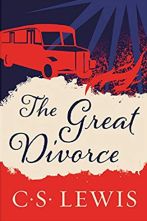
Lastly, C.S. Lewis’s The Great Divorce.  Gasp, you say?  Not reviewing properly something by Lewis? Well…I’ve read it before, y’see, and was reading it again for Lent.  For those who’ve never encountered it, it’s an allegory about God and eternity,  as a narrator finds himself wandering a grey city that is the residence of those who have not taken the hard road into paradise.  Although those experiencing the lackluster existence of the grey city all have various reasons for lingering where they all,   focused on their private idols, in the end it all comes down to self-worship. The intellectual who is more interested in making impressive speeches about truth instead  of acknowledging it, the artist who keeps insisting his painting of the heavenly paradise would be better than paradise itself, the woman whose morbid fixation on her dead son would  see her insist he be brought out of heaven and down to her — — all of them come down to the subject’s inability to get over themselves. At one point, a heavenly person who is trying to guide one of the lost into heaven asks wearily — “Could you, even for a moment, think if something OTHER than yourself?”  I found it much more interesting this time around than ten years ago,  largely because I’ve read a lot more of Lewis since then  and frequently made connections between this and his other works.  His The Four Loves frequently comments that the love we experience on Earth is merely a taste of God’s love for us — that we are seeing through a mirror only darkly, to borrow from one of Paul’s letters to the Corinthian church.  That comes up again here, when people  remain focused on their mortal attachments.

I’m really tempted to throw Are We There Yet? in here, because  it definitely won’t be getting a full, chatty review,   but I’ll give it a couple of days.

Posted in Reviews, science | Tagged , , , , , | 5 Comments