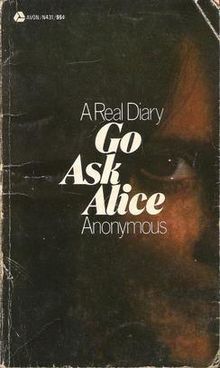
Go Ask Alice

© 1971 Beatrice Sparks
271 pages

Go ask Alice / I think she’ll know / When logic and proportion have fallen sloppy dead

Recently, while doing some cleaning to the sounds of the Vietnam War, I heard a song urging me to “Go ask Alice.” So that’s where that comes from, I thought, suddenly remembering a novel I read in my youth — read repeatedly, because it was my first glimpse into a vision of the 1960s that wasn’t romantic and idealized, but based instead on darker imaginings. Presented as a diary, and allegedly based on a real teenager’s actual experiences, it’s the story of a young woman who falls into drug abuse through the late sixties, a coming of age story where the subject grows in depravity instead of maturity — in the end, struggling with own sanity. Although it’s dismissed as a fabrication now, to a sheltered teenager like myself it did an excellent job at depicting the drug culture as a horrific thing to be avoided.

I read this novel repeatedly in high school, in part because it was my keyhole glimpse to the ‘real’ world. I knew enough to know I was sheltered, and was curious about the lives other teenagers lived — my own was wrapped up in a HP Pavilion, whose 9 gigs of hard drive space somehow held more than enough to keep me distracted for those years. Go Ask Alice is fabulous as anti-drug propaganda literature: it certainly worked on me: I suspect it’s the root of my own wariness regarding drug use many years after high school. As a story, it’s compelling enough; we witness a young woman struggling with insecurity get exposed to LSD at party. The experience makes her feel alive and sociable, in tune with the universe, and she enthusiastically explores every other substance she can get her hands on. In short order she becomes jaded and retreats from old influences to get her life back together, but finds herself stuck in a cycle of abstinence > temptation > indulgence > decadence > disgust > abstinence until ultimately….well, it’s a tragic ending. I wasn’t a teen in the sixties, and I’ve never consumed anything more interesting than single malt Scotch, so I can’t speak to the realism of this at all. It’s fascinating reading for someone who’s completely outside this world, though, and I still appreciate it for its look into the tumultuous world of the late sixties.

Posted in Reviews | Tagged | 2 Comments

Must….read…..faster…..

Science is having a banner year and I expect 2021 will be very similar.
Posted in General | 5 Comments

Headlong Flight

Star Trek TNG: Headlong Flight
© 2017 Dayton Ward
251 pages

A mysterious nebula and a rogue planet bring together three ships across the gulf of time and space. In our universe, the Enterprise-E can’t resist data that indicates there are lifeforms in distress somewhere on the strange planet’s surface; in other universes, an Enterprise-D with Captain Riker at the helm is conducting its own investigation, glad to finally be given something to put its mind on besides Captain Picard’s untimely death at the hands of the Borg shortly after Wolf 359. Likewise curious are the crew of a 23rd century Romulan vessel, eager to exploit the nebula’s strange energy and weaponize it against the Federation — proving themselves just as able as the ship that destroyed the Enterprise after a border raid.

Headlong Flight has one of the hookiest premises I’ve ever seen in a Star Trek novel. Take the Primeverse Enterprise-E, with all the character development we’ve seen in the last twenty years of novel, and have her encounter an Enterprise-D from a subtly altered past. Many of the crew see themselves, aged or younger by twenty years; others can’t help but notice missing faces among the other crews, or feel bittersweet joy at seeing comrades long lost alive again. Each crew sees the effects of different choices made manifest, and the reader can only imagine what it would be like for Picard to step foot aboard the Enterprise-D again, or the alter-Riker to find himself again in the presence of his mentor. Caught in a dimension-hopping planet’s wake, the three crews must work together to find a way to escape its hold and return to their respective places.

Although the scientific plot has its interest, the main event here is the premise itself, the interactions between different versions of these characters. There’s a huge nostalgia factor here for the reader as well as the characters (Picard deliberately beams over to the Enterprise-D just so he can see it in person again), and I especially liked that the two realities the E-D and Romulan ship came from were seperate ones we’ve not seen before, and not just another borrowing of the ‘mirror universe’. Each of them had subtle alterations that may paying attention to worth it.

In short, a fantastic little standalone novel.

Posted in Reviews | Tagged , , | 3 Comments

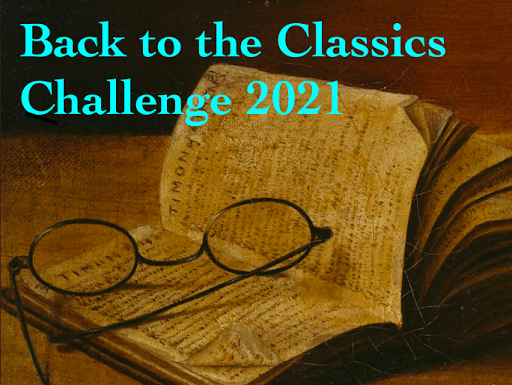
Back to the Classics Challenge

Next year I’ll be restarting the Classics Club challenge, with a scheduled list set to go live on January 1st, but some bloggers whom I follow are enrolling in a mini-classics challenge, with twelve categories. My CC list fills all the categories easily, so I’m dovetailing it with Books and Chocolate’s challenge. Here’s my list, a preview of my second CC run..

  1. A 19th century classic: Rebecca, Daphne de Maurier
  2. A 20th century classic: Of Mice and Men, John Steinbeck
  3. A classic by a woman author: Persuasion, Jane Austen
  4. A classic in translation: Resurrection, Leo Tolstoy
  5. A classic by by a non-white author: The Shahnameh, Ferdowsi
  6. A classic by a new-to-you author: Go Tell it on the Mountain, James Baldwin
  7. New-to-you classic by a favorite author: A Day in the Life of Ivan Denisovich, Aleksandr Solzhenitsyn
  8. A classic about an animal, or with an animal in the title: Black Beauty, Anna Sewell
  9. A children’s classic: Alice’s Adventures in Wonderland, Lewis Carroll
  10. A humorous or satirical classic: Northanger Abbey, Jane Austen. (A satire of Gothic novels, I’m given to understand..)
  11. A travel or adventure classic (fiction or non-fiction). Captains Courageous, Rudyard Kipling
  12. A classic play. Plays will only count in this category: The Crucible, Arthur Miller

Posted in General | Tagged , | 18 Comments

Saxon Chronicles Index

Ten years ago, having just discovered Bernard Cornwell and gone absolutely mad over him, I made it my mission to read everything I could of him. That included a new series called the Saxon Chronicles, following some dude named Uhtred as he fought to reclaim his family land from the Vikings. I had no interest in Vikings or the Anglo-Saxon period whatsoever, but it was sort of medieval and that I could appreciate. Swords, horses, big castles: what more do you need? Uhtred won me over immediately, and through him I developed a new fascination with the North cultures and pre-Norman England. Although the series grew long in the tooth after a while, it’s reliably entertained me like few others.

  1. The Last Kingdom. Introduces the story, and introduces the reader to those lovable heathens, the Danes, who as Uhtred said, “are not afraid of life”.
  2. The Pale Horseman. The last Saxon kingdom, Wessex, has fallen to the Norse, though a defiant king Alfred retreats to the marshlands rather than surrender. Uhtred sees the future of England through one of its darkest, most vulnerable moments.
  3. The Lords of the North. Spurned by an ungrateful king, Uhtred leaves Alfred’s service to pursue his own quest of killing Kjarten the Cruel and retaking his homeland. Cornwell delivers one shock after another, delivering Uhtred into his own darkest hour that will give him a lifelong friend and begin forging a lord’s soul of of a restless, angry warrior. Probably my favorite novel in the series!
  4. Sword Song. Alfred’s star is on the rise, but newly-arriving invaders mean that Uhtred must reclaim Lundene for the English.
  5. The Burning Land. This is classic, quintessential Saxon Stories: Uhtred has killed a priest for calling his wife a whore, and forced into exile rather than accept humiliation at the hands of a king he has to serve despite not liking. His hopes of continuing his quest to reclaim the castle are delayed when a woman and friend who he’s sworn an oath to pleads for his help. (Uhtred’s castle quest delayed by his oath-loyalty to friends is going to become almost a running joke in this series.)
  6. Death of Kings. Alfred lies on his death bed and needs Uhtred’s help to keep the peace.
  7. The Pagan Lord. I just have to quote from my review: “[to] lead the Saxons to triumph will involve a ship,  borrowed children, and a dead priest on a stick. That’s life in Anglo-Saxon Britain, and the tale of The Pagan Lord.”
  8. The Empty Throne. Aethelflaed, for whose love Uhtred spends many books scheming and killing folk, needs some more schemin’ and killin’ done on her behalf.
  9. Warriors of the Storm. Uhtred is THIS close to invading Northumbria and taking back his damn castle when there’s an invasion.
  10. The Flame Bearer. Uhtred is THIS close to invading Northumbria and taking back his damn castle when one of his friend needs him.
  11. War of the Wolf. Wessex’s growing ambition makes it a threat to Uhtred’s well-deserved gains, but he is bound by oaths to take his place yet again in the battlefield on the southerners’ behalf.
  12. Sword of Kings. Uhtred finally has his castle back and deserves a break, but Alfred’s successor is dying and there’s something rotten going on in the city of Lundene. Sword saw the welcome return of naval action, and genuine threat to Uhtred.
  13. War Lord. One last time, Uhtred must choose which enemy he trusts more.

Posted in General | Tagged | 7 Comments

Why I don’t watch the news (and why this journalist hates it)

I can’t remember the last time I watched televised news; it was around 2008, I believe. If I hadn’t stopped by the time I read Amusing Ourselves to Death, that would have been its death knell. The video in sum:

  1. The news’ focus on spectacular events — catastrophes, crimes, etc — creates for the regular viewer a distorted view of the world, one that is far more dangerous than it actually is.
  2. News is too “fun”: the drive to keep eyes constantly locked on it leads to sensational programming rather than serious, sober consideration. Because of the entertainment incentive, the news isn’t actually educational: it’s a giant gossip fast.
  3. The news tricks you into feeling informed. The constant barrage of psuedo-information prompts people to mentally check out. Watching people argue is not informative. You don’t leave news debates more informed; you leave it more charged in your own prior convictions.

For my own part, I try to stay informed through reputable print services like The Economist. If this journalist’s perspective resonates with some of your own doubts, check out Postman.

Posted in General | Tagged , | 8 Comments

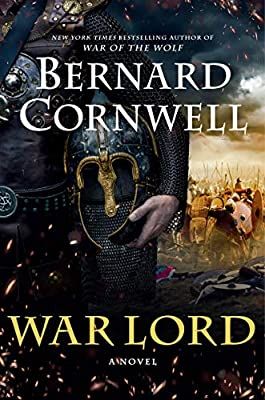
War Lord


War Lord
© 2020 Bernard Cornwell
352 pages

As a boy, Uhtred saw his father and brother slain by an invading enemy, an enemy who took his home from him. Unwilling to turn and run, the boy Uhtred attacked these ferocious warlords from the sea on his own, and amused by his audacity, they adopted him as their own. A Saxon prince raised by the Norse, Uhtred has always struggled with loyalties, forever balancing them and choosing whatever course took him closer to reclaiming his family home. Now, having retaken his fortress by the sea, Uhtred must defend it one last time. The kings of Britain are circling one another for war, and Bebbanburg is in the middle. War Lord offers a satisfying finale to the Saxon Chronicles series, culminating in one of the most impactful batttles in British history — though one few have ever heard of. (Google “Brunanburh” if you wish, but it may spoil part of the novel’s endgame for you.)

Uhtred of Bebbanburg has served the king of England most of his life, however unwillingly; he was with Alfred when England was only a dream, and that great king was a deposed royal hiding from the Norse in the marshlands. He protected Alfred and helped him forge a kingdom, and Uhtred raised his heir Aethelstan to become a powerful force in his own right. But Aethelstan isn’t satisfied with being king of England: he regards himself as King of All Britain, and is embarrassed to owe so much to an old pagan who has little regard for pompous churchmen and the useless, vain courtiers who surround Aethelstan. Rumors float of a northern alliance between the Scots, the Norse factions, and a potentially rebellious Northumbria, and Uhtred is caught between ambitious predators who want to use and discard him. Uhtred is an old man, valuable to them only as far as his men and castle go. Old and weary he may be, Uhtred still has his wiles — and playing king against king, he will forge his own path to keep Bebbanburg free.

Previous novels in the series have had more plot twists and more pitched battles, but in War Lord the stakes are as high as they get: not only do three kings in Britain want Bebbanburg for themselves, to assist in the inevitable epic battle between the northern alliance and Wessex/England, but even those who Uhtred has trusted previously are willing to betray him to get it — and this being the final novel, there’s really no telling what Uhtred’s fate might be. Will he die in battle, making a heroic sacrifice? Will he fall in the gates of his castle, defiant to the last, wielding his bloody sword Serpent-Breath? Or will he perish alone, betrayed and in enemy hands like Ragnar Lothbrok? I just didn’t know what to expect, either from that or from the other characters in the novel: by all rights Aethelstan should regard Uhtred with fililal affection, but he’s blinded by his own arrogance and fear of the Scots.

This being the thirteenth book in this series, there’s little I can say about Cornwell’s style that I’ve not said already: he is consistent in his strengths. Uhtred is still a lovable old grump with a mean backhand, and while he’s lost his strength he still has his wits — both in conversation and in combat — and those are well on display here. Cornwell’s gift for description that sucks the reader in, and his flair for dramatic oratory, used so well with Vikings as the subject, is present as well. I anticipated how the final battle would go, possibly because I’ve been reading Uhtred for ten years, but that didn’t make it any less engaging to read about.

Fare thee well, Uhtred; it’s been a great ride. I’ll be posting a series index soon after this for anyone who is interested in reading more about the series.

Posted in historical fiction, Reviews | Tagged , , , | 5 Comments

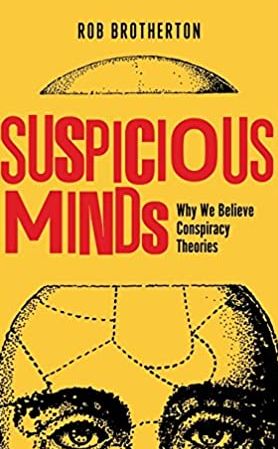
Suspicious Minds

Suspicious Minds: Why We Believe Conspiracy Theories
304 pages
© 2015 Rob Brotherton

We’re caught in a trap, and we can’t walk out*. Our brains orient us towards belief. No sex, no political leaning, no cultural demographic has a monopoly on conspiracy thinking — and while that can be either comforting or disturbing, depending on what implications we dwell on, it has to make a fella wonder: why? Why do we connect dots with lines that aren’t there, indue other people’s actions with purpose drawn straight from our heads, and crave above all some grand narrative that makes a tidy story out of our messy universe? The answer, Rob Brotherton argues, lies in our brain’s heavy reliance on mental shortcuts and biases. Conspiracism is the lens through which we see the world; the trick is that we all have slightly different prescriptions.

Brotherton opens by analyzing what makes a conspiracy theory different from any other explanation, reviewing pertinent characteristics of conspiratorial thinking. Brotherton holds there are six distinctive aspects of a conspiracy theory, and concludes: “The’prototypical conspiracy theory is an unanswered question; it assumes nothing is at it seems; it portrays the conspirators as preternaturally competent; and as unusually evil; it is founded on anomaly hunting; and it is ultimately irrefutable.” Interestingly, people who believe in one conspiracy theory are more likely to believe in others, and theories often interconnect to create ever-larger schemes, until eventually one’s wall is covered with pictures and documents with red yarn asserting connections between them.

Although Brotherton argues that we’re all born conspirators, conspiratorial thinking is more likely to dominate individuals who are in isolated, stressed conditions. The less materially comfortable and more socially isolated a person, the more likely they are to believe that things are set against them. When our sense of control is threatened, we are more likely to be paranoid. Brotherton suggests that dwelling on conspiracy theories is something of a comfort mechanism, ’empowering’ the theorist by making them believe they’re seeing through the lies, and explaining their disadvantages by blaming them on someone else. Stepping back from the specific subject at hand and thinking more generally — drawing on biology — the connection between comfort and paranoia makes perfect sense. An apex predator with no competition and plenty of food has no reason to be wary, but a stressed mouse at the bottom of the chain does. One is far more skittish than the other, more likely to interpret threats when there are none: it pays to be paranoid when you’re a mouse. While humans regard ourselves as being at the top of the heap these days, our ancestors lived in a far more dangerous world, filled with predators who were only happy to make a meal out of muscly bipeds.

Throughout the book, Brotherton reviews various other aspects of human cognition that make conspiracies easy to invent and latch on to. We’re a story-telling species whose brains are constantly involved in constructing the reality we live in — whose brains have been tailored by the stress of ages to look for and act on patterns immediately. Any connections are meaningful by default, unless we actively have a reason for doubting them, and that means we can interpret mere motive as evidence of wrongdoing. Other biases are at work: when something dramatic happens, like a presidential assassination that changes the world, we expect that drama to have been effected by an elaborate conspiracy with long-term goals, not a lone crank with a rifle. (Nearly 80% of Americans believe the JFK assassination involved more conspirators than Oswald.) We are not systematic, logical thinkers by default: without training, we look for evidence that supports a positive assertion, not evidence that can falsify something we already suspect — and we tend to interpret new information in the light of what we already believe. Brotherton also believes that the overwhelming complexity of the world, and frustrating loss of intellectual autonomy because of that, lures people into conspiracy theories: they offer the satisfaction of comprehensive knowledge with far less work: there’s just enough winnowing-out of the conspiracy’s secrets to satisfy the intellectually curious to make it fun.

Though thinking about thinking has its challenges, the influence of conspiracy theories on contemporary politics across the spectrum makes them important to understand. We’re all complicit in contributing to them, and a book like this is invaluable it not only understanding why sensible people can sometimes believe extraordinarily odd things, but to check ourselves from time to time.

* This book has been on my TBR list for three years, and every time I thought of it, I’d have Elvis in my head for the rest of the day. I sincerely hope my offering of that intro sentence appeases the gods and lets me escape the ear-worm of “Suspicious Minds“.

Related:
The Skeptic’s Guide to the Universe, Steven Novella et. al
The Believing Brain: How we Construct Beliefs and Reinforce Them as Truths, Michael Shermer

Posted in Reviews, science | Tagged , | 7 Comments

Scaling Mount Doom: November 2020

After three months of ruthlessly driving the enemy before me, my advance on the Pile of Doom has er…not been so advance-y. Here is hoping that I have not met my Marne.

TBR Books Read in November:
Defeat in the West, Milton Shulman
The Afghan Campaign, Steven Pressfield

TBR Scheduled for December
The Ends of the Earth: The Polar Regions of the World, Isaac Asimov
Silent Night: The Story of the World War I Christmas Truce, Stanley Weintraub

Reward Books Purchased:
In Search of Zarathustra: Across Iran and Central Asia to find the World’s First Prophet, Paul Kriawazek, This is one I’ve debated buying for years… I don’t think it has enough content to satisfy me, but I at least want to give it a shot.
The World-Ending Fire: The Essential Wendell Berry, ed. Paul Kingsnorth.

Posted in General | Tagged | 3 Comments

Monday musings: games, books, and hikes

Reading has slowed down as of late, between Thanksgiving, weekend hikes, and another round of computer upgrades. I’m now running on a SSD, and was able to resolve a power issue that prevented me from playing PC Building Simulator or Civilization 6. I also have a little drawer in my computer to use to hold flash drives now! In book news, regular reading was paused for some new library acquisitions, and I’m almost done planning my Classics Club Strikes Back bookist; I only need 1 more to complete the set of fifty, and I’m trying to decide between a few contenders. This one is less ambitious but more fun, with a lot of American and Southern lit, and a few SF reads. Next year’s science reading is already planned out, with no shortage of possibilities. Coming up this week: the last of the Saxon Chronicles, possibly something Adventy, and who knows?

Cahaba River Wildlife Refuge. I visited here in May to see the Cahaba lilies bloom; it’s rather different today!
You can see where some of the lilie stands were in this shot. They’ll be back in May…and so will I.
The view from atop a waterfall in Shelby County. Accessible from County Rd 22, but you have to know where you’re going as there’s no official trail here, just a known path through former logging roads and then an unmarked path through the woods.
A machine in the garden kind of image. This was on my first trip to the falls, when I’d found the path to the top but hadn’t found how to get to the bottom yet.

Posted in General | Tagged | 11 Comments