The end approaches

Earlier last year David Mack, one of Treklit’s leading authors, suggested that To Lose the Earth was the last planned book in the Treklit continuity, as future releases would be centered on the current shows. It appears that a finale of sorts is in the works. From TrekCentral:

Not only does the description of the trilogy sound ominous, but “Coda” literally refers to a concluding passage or section of a work. I can’t say I like the idea of an official ‘end’ to the Trek literary universe that’s grown over the last twenty years: at least if it had died by neglect we could always pretend they’d resurrect it. Now the authors sound like they’re being enlisted to snuff out their own creation.

Ah, well. At least we have The Orville.

Posted in General | 4 Comments

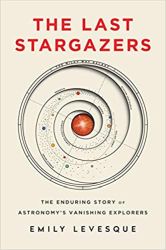
The Last Stargazers

The Last Stargazer: The Enduring Story of Astronomy’s Vanishing Explorers
© 2020 Emily Levesque
336 pages

Emily Levesque was drawn to the stars from childhood on. Having realized her dream of studying them for a living, in The Last Stargazers she offers readers a glimpse into the workday lives of astronomers across the spectrum (literally, in this case), and reflections on why we should study the stars to begin with.  Levesque draws on her own globe-hopping studies and interviews with other astronomers in the field to create this review of the practice and review of modern astronomy. 

Although the brain’s mental image of an astronomer might be someone like Galileo peering through a telescope, discovering the moons of  Jupiter,  precious few astronomers ever do any direct stargazing. It’s rare, Levesque writes, to find an astronomer who is intimately familiar with the night sky the way the public expects – instantly knowing what star is what.  Most astronomers today aren’t directly involved in the observation: even if they’re working at an observatory, they’re usually safely ensconced in another room all together, letting a computerized dome do its observations at their remote-controlled bidding. Instead of directly studying the skies, or plate photographs thereof, they’re receiving data and crunching numbers.   To a degree, they don’t even need to be there, and one modern practice allows multiple astronomers to timeshare an observatory by submitting research requests:  if there are different requests that dovetail nicely (two astronomers wanting to study the same area, but with different exposures, for instance),  the telescope can conduct both studies simultaneously and transmit the  respective data to their interested parties.   

To the stars’ innate ability to ensnare our imagination, and the fascinating ways scientists collect data (including from a flying observatory), Levesque adds colorful background . Because of the nature of their work, observatories are typically built in remote places where light and radio emissions from human activity are minimized, and in the case of optical observatories,  the higher they are the better the ‘seeing’ is.  This means astronomers often work in nearly undeveloped locations, with many natural hazards: snowstorms, volcanos,   wildlife,etc,   Astronomers who are physically present at the station are long removed from help, and have to be able to think on their feet in stressed conditions to make ad-hoc adjustments to save either the machines or their data from unexpected events.   

As someone perennially fascinated  by the stars and the study thereof,  I enjoyed The Last Stargazers thoroughly.  It’s rare to find a book that demonstrates how astronomy is done, rather than telling the reader what’s been discovered: Mike Brown’s How I Killed Pluto and Why It Had it Coming is the only other nonfiction title I’ve read that offers such insight. (Carl Sagan’s Contact got into the nuts and bolts, but it was fiction.)   I hope Levesque continues to write in the future:   we need more astronomer-authors!  

Posted in Reviews, science | Tagged , | 7 Comments

The death of Liberty

“Liberty never dies from direct attack. No man ever arises and says ‘Down with Liberty.’ Liberty has died in 14 countries in a single score of years from weakening its safeguards, from demoralization of the moral stamina of the people….If we examine the fate of wrecked republics throughout the world we find their first symptoms in the weakening of the legislative arm. Subservience in legislative halls is the spot where liberty and political morals commit suicide.” – Herbert Hoover, as quoted in The Hardest Job in the World

Posted in quotations | Tagged | 4 Comments

Cold Sassy Tree

Cold Sassy Tree
© 1984 Olive Ann Burns
391 pages

“I know now the difference between a writer and an author. A  writer writes, and an author speaks.”   Those words came from Leaving Cold Sassy, an unfinished sequel to this work which I first read in late middle school or early high school.  Over the years, most of the story was lost to me, aside from a few bits and bobs – an old widower scandalizing the town by marrying a young Yankee,  the family driving the town’s first ‘artermobile’ down main street – and my lingering affection for it. But  those words remained with me, and they came to mind all the more as I ventured again into Cold Sassy this past week. 

Cold Sassy Tree takes place in a small north-Georgia village at the crossroads of two centuries,  peopled by greying Confederate veterans and their children, who look to the future with excitement. Great things are going on in far away places in New York, but Cold Sassy seems as untroubled and deeply rooted as the sassafras tree downtown.  But then the Grand Duke of Cold Sassy’s wife dies, and the duke himself, Rucker Blakeslee, announces that he’s marrying his shop girl – a Yankee several decades too young for him.  Though the town is scandalized, ol’ Rucker Blakeslee is just getting started.  

When I read this as a child I suppose I was mostly enamored of it because it was the first ‘southern’ novel I’d encountered. As an adult, though, I noticed how much of the novel is driven by tensions in the characters’ relationships with one another.  There’s a slow-brewing family war between Rucker’s daughters, who view their new stepmother as a young usurper who has stolen their potential inheritance, bewitching their daddy in the process. The chief relationship is the main character Will’s bond with his grandfather:  he is as surprised by the marriage as anyone, but torn between loyalties and affections: he knows his folks don’t like the new Mrs. Blakeslee,  but he’s half in love with her himself.   Will is also growing up and developing his own personality: he has a friendship with a mill girl that everyone disapproves of, and his hopes for the future don’t involve the family store. 

Cold Sassy Tree is not an exciting, dramatic novel; this is not Gone with the Wind, with larger than life characters screaming at each other across the stage, and a war raging in the background. It is instead a cozy, intimate novel, where we see characters falling in love and grappling with the consequences, or trying to rise above old prejudices or make peace with novelties; it’s a tale of growing up, and learning wisdom from losses and growth along the way.  As with life, it mixes joys and sorrows: although tension is constant (Will is constantly stuck between his grandpa and his parents), so are the laughs:  Rucker  has plainly been waiting a lifetime to have this much fun, and now that he no longer has to fear scandalizing his wife of thirty years, all bets are off.    

Rereading Cold Sassy Tree is like visiting an old relative and finding out they’re more interesting than you remember. I’d forgotten much of the story, but the years between my readings has also made it possible to get more of out it; reading about a boy losing his grandfather is very different when you’ve actually done it. I suspect a novel like this isn’t for anyone; there’s no sweeping narrative, just family drama and the story of a town and a boy growing up, with an old man’s wit, wisdom, and cackling or grumbling in the background.

Selections

“Livin’ is like pourin’ water out of a tumbler into a dang Coca-Cola bottle. If’n you skeered you can’t do it, you cain’t. If’n you say to yourself, “By dang, I can do it!” then, by dang, you won’t slosh a drop.”

“T.R.’s real name was Theodore Roosevelt. He was just a puppy when Papa took me to Atlanta to hear the president speak; I named him Theodore Roosevelt when I got home that day—then shortened it to T.R. so folks wouldn’t think my dog was a Republican.”

“Well’m, faith ain’t no magic wand or money-back gar’ntee, either one. Hit’s jest a way a’livin’. Hit means you don’t worry th’ew the days. Hit means you go’on be holdin’ on to God in good or bad times, and you accept whatever happens. Hit means you respect life like it is – like God made it- even when it ain’t what you’d order from the wholesale house. Faith don’t mean the Lord go’n make lions lay down with lambs jest cause you ast him to, or make fire not burn. Some folks, when they pray to git well and don’t even git better, they say God let’m down. But I say that warn’t even what Jesus was a-talkin’ bout. When Jesus said ast and you’ll git it, He was givin’ a gar’ntee a-spiritual healin, not body healin’. He was sayin’ thet if’n you git beat down – scairt to death you cain’t do what you got to, or scairt you go’n die, ir scairt folks won’t like you- why, all you got to do is put yore hand in God’s and He’ll lift you up.”

Related:
Wendell Berry’s Port William books

Posted in Classics and Literary, Reviews | Tagged , , , | 5 Comments

Top Ten Books That Made Me Laugh

This week Top Ten Tuesday is looking at funny books, so I’m listing my ten favorite P.G. Wodehouse novels. Okay, I won’t go that far, but..

The Many Loves of Dobie Gillis, Max Shulman. I was given this collection of ’40s-era campus stories as a graduation present from my high school librarian, and fell for it instantly. It’s one of my Very Favorite Books, one I’ve rebought over the years as my reading copies have fallen apart. I’ve since read a lot more of Shulman but Many Loves is the vintage stuff.

Sharpe’s series ,Bernard Cornwell. I’m not going to pinpoint a particular book, because Cornwell’s gift for inserting humor into tense action sequences is consistent throughout the series. The humor is mostly Sharpe himself, who has little patience for pretentious higher-ups lecturing him (“I never invited him to a duel. I offered to beat the hell out of him.”) , but other characters like Hogan and Harper also provide smiles.

Saxon chronicles, Bernard Cornwell. The humor in the Saxon stories is again mostly in dialogue, but there’s also situational humor — as when Uhtred draws his sword to kill a man after the intended piously asks God to strike him down that instant if he’s ever lied. (“Lord Uhtred, NO!” cries Aethelflaed.) Other characters also help:

“Oh, lord, I am so many things! A scholar, a priest, an eater of cheese, and now I am chaplain to Lord Uhtred, the pagan who slaughters priests. That’s what they tell me. I’d be eternally grateful if you refrained from slaughtering me. May I have a servant, please?” (Death of Kings)

The Best Cook in the World, Rick Bragg. Stories around southern cooking, particularly behind Bragg’s mama’s best recipes. (“She does not cook chitlin’s, because she knows what God made them to do.”) . Bragg ‘s other works are replete with humor, too.

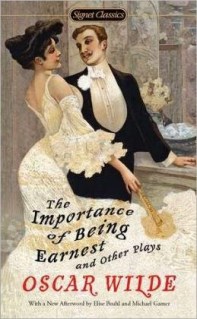
The Importance of Being Earnest, Oscar Wilde. This one had me roaring when I watched the stage production at Alabama Shakespeare Festival, and reading the play is almost as good:

“I hope you have not been leading a double life, pretending to be wicked and being good all the time. That would be hypocrisy.”

Pretty Much Anything By P.G. Wodehouse. I read Wodehouse because Isaac Asimov mentioned him so many times, and Asimov is my most-read author (70+ books). I’ve mentioned this many times since I first read Wodehouse in 2015, but you don’t know how funny English can be unless you have experienced him, especially in full form in the Jeeves & Wooster stories. Wodehouse’s narration is a ball, as is his dialogue. He’s a pick-me-up that’s unputdownable. The Wooster stories concern a lovable if useless young aristo who spends his days cavorting with the fellas, and putting his mind to work rescuing himself or his friends from precarious situations like gainful employment or marriage. Invariably he only makes matters worse, but his butler Jeeves is forever in the background pulling strings and playing the straight man to Wooster’s absurdism. I can’t help but hear Stephen Fry and Hugh Laurie when I read the novels, which makes it even funnier.

“And yet, if he wants this female to be his wife, he’s got to say so, what? I mean, only civil to mention it.”
“Precisely, sir.”

“It seems to me, Jeeves, that the ceremony may be one fraught with considerable interest.”
“Yes, sir.”
“What, in your opinion, will the harvest be?”
“One finds it difficult to hazard a conjecture, sir.”
“You mean imagination boggles?”
“Yes, sir.”
I inspected my imagination. He was right. It boggled.

Posted in General | Tagged | 8 Comments

Death and madness in China

The Cultural Revolution: A People’s History
© 2016 Frank Dikotter
433 pages

In twenty-five years of reading history, I know of no man who has instigated more human suffering and death at a broader scale than Mao Tse-tung, the rebel turned architect of a nightmare state. He is rivaled only by Lenin and Stalin, Hitler being a pale and overly medicated imitation, and any book on the cultural revolution serves an example as to why. I’ve long put off reading this title, because the Cultural Revolution horrifies and disturbs me like little else. Episodes like it have happened before; Byzantine iconoclasm, Puritanism, the French revolution — some zeal seizes the mob and its wrathful energy is poured out on the impure past, and beauty is destroyed to make society conform to an abstract ideal. But the cultural revolution was total, murderous bedlam, instigated by Mao to solidify his own position by turning the first generation of Chinese children raised under his regime against his interior rivals to shore up power after destalinization swept Russia.. But the fire he kindled consumed its own, and in A Cultural Revolution we receive not only the full scope of the endless, stupefyingly horrible brutality, but witness too flashes of hope — people’s growing alienation from the state, and their rebellion in the face of starvation. Although Dikotter’s dispassionate record of abuse after abuse doesn’t scourge the soul as effectively as say, The Rape of Nanking, or Wild Swans, it’s sufficient enough that I don’t want to dwell on it at length. The chaos and carnage are horrific, as is the realization that these were not just 20-somethings being set on teachers and the like, but schoolchildren — children given the whip by ideology and set on their elders. Wild Swans had already communicated much of the awfulness for me, but Dikotter’s broader review made me aware of how the Revolution wasn’t one frenzied episode, but rather a series of related outbreaks that finally exhausted themselves when Mao’s lieutenant mysteriously died after Mao caught wind that he was planning to murder the murderer-in-chief. Of particular interest to me were the brief looks at how man adapts to living in a tyrannical society, in which his neighbors are the agents of his oppression — the people who would turn him in for doing the wrong thing, or not having the wrong opinions.

SELECTIONS

“But in an odd twist of fate, the attempt to replace individual rewards with moral incentives during the Great Leap Forward had already produced a nation of entrepreneurs. People had not simply waited to starve to death. In a society in disintegration, they had resorted to every means available to survive. So destructive was radical collectivisation that at every level the population tried to circumvent, undermine or exploit the master plan, covertly giving full scope to the profit motive that the party was trying to eliminate. As the catastrophe unfolded, claiming tens of millions of victims, the very survival of an ordinary person came to depend on the ability to lie, charm, hide, steal, cheat, pilfer, forage, smuggle, trick, manipulate or otherwise outwit the state.”

“Zhai Zhenhua was one of the girls from an elite middle school who joined the Red Guards. The first time she saw a friend remove her belt to beat a victim until his clothes were drenched in blood, she recoiled. But she did not want to fall behind, so she persevered. At first she avoided eye contact with a human target, justifying the beatings by imagining how they were plotting the return of the old society. But after a few beatings she got the hang of it. ‘My heart hardened and I became used to the blood. I waved my belt like an automaton and whipped with an empty mind.’”

At one point a quiet man who was an expert in experimental phonetics was declared a counter-revolutionary in the middle of a study session. Everybody was stunned. The team leader used the occasion to announce triumphantly that even a person who had never spoken about political matters could be an enemy in his heart, and such inner convictions could no longer be concealed from the proletariat.”

“But despite the house raids, the book burnings, the public humiliations and all the purges, not to mention the ceaseless campaigns of re-education, from study classes in Mao Zedong Thought to May Seventh Cadre Schools, old habits died hard. The Cultural Revolution aimed to transform every aspect of an individual’s life, including his innermost thoughts and personal feelings, but in many cases it managed to exact only outward compliance. People fought deception with deception, lies with lies and empty rhetoric with empty slogans. Many were great actors, pretending to conform, knowing precisely what to say when required.

Related:
The Tragedy of Liberation, Frank Dikoetter
Wild Swans, Chang Jung. A memoir of the Revolution, which destroys the lives of the subject’s parents, despite their status as True Believers as far as Mao and the party went
The Rape of Nanking, Iris Chang. If you want to read about more death. Perhaps the suffering Chinese people endured at the hands of Japan hardened them and allowed them to be just as brutal to each other twenty years later.

Posted in history, Reviews | Tagged , , , , , | 13 Comments

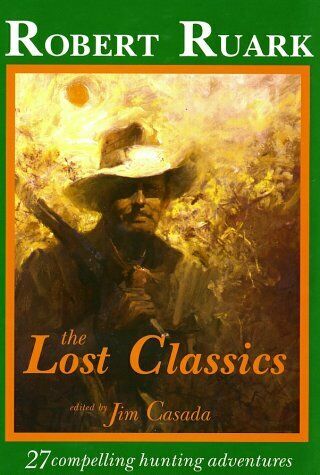
The Lost Classics

The Lost Classics
© ed. Jim Casada
1950s-60s pieces by Robert Ruark from Field & Stream and other magazines
260 pages

A hunt for southern literature outside the Faulkner/O’Connor domain brought me to the happy surprise that was The Old Man and the Boy, a collection of Field and Stream articles that combined outdoors adventures and sage advice on life. The stories, or reminiscences, were absolutely charming, and I’m not surprised to learn that Ruark considers them as having made his career as a writer. The Lost Classics is a posthumous collection of Old Man and the Boy stories which were not included in either of the two anthologies prepared by Ruark himself, in addition to many more pieces written by Ruark about his hunting adventures in the United States and broad, as well as a scattering of essays about Ernest Hemingway, to whom he was often compared. If I’d known how small the Old Man and the Boy section was, I may not have ordered this; as it was, though, I discovered that Ruark’s travel adventures beyond the fields and marshes of the Carolinas were fairly entertaining, even if they don’t hold a patch on the Old Man’s charm.

The Lost Classics opens with ten or so Old Man and the Boy stories, each just as delightful as those contained in the original collection. They are based off Ruark’s boyhood, spent with a lovable old codger who mixes down-home country wisdom with a surprisingly educated wit and a fun flair for the dramatic. Although hunting and fishing expeditions often frame a given story, there’s usually some broader point to be made. One memorable piece, “Of Buffalo and Bobwhites”, Ruark recounts how he proudly came home after bagging most of a covey of quail, only for his grandfather to scowl at him and deliver an entire lecture (“Sit down. I aim to declaim.”) on the history of North American bison, and how greedy and thoughtless over hunting had destroyed not just the buffalo population, but the entire lifestyle of the Plains natives. The lesson is plain: if you like shooting quail, respect them and only shoot a few, so the covey can renew itself next year. Although the Old Man claims to despair of having to preach and teach to his young ward (“You are turning me into a regular Billy Sunday”), the Boy’s passion for complaining offers ample opportunity for teaching moments. When the Boy complains that it’s cold, or rainy, the Old Man teaches him how to make the most of the opportunity those conditions afford: the cold, gloomy day proves to be perfect for duck-hunting, as so few spots of water are unfrozen that the ducks are drawn like magnets to the few open areas. That rainy day, in addition to giving everything that needed it a good wash, also allows time for cleaning guns, repairing nets, etc. The Old Man is a comic lecturer, though, gently mocking the Boy and providing grins along with the sage advice.

I was less interested, but pleasantly surprised by, the two-thirds of the book which were not Old Man stories. Many of them are simply hunting episodes set in Kenya and India, aside from one piece celebrating the fishing in New Zealand, but they sometimes integrate wisdom from the Old Man, both in terms of practical skills (leading targets to shoot accurately) and general life lessons. All of the pieces are slightly autobiographical, and Ruark grew more interesting with every essay; the Boy who hated school may have squirmed at regimentation, but he read Shakespeare at age 10 for fun, and paid his way through college with a little bootlegging. His life had several interesting parallels with Ernest Hemingway’s, and he and “Papa” struck up a friendship: Hemingway advised Ruark to just write things how they were, and to hell with the critics. If they could write, Papa huffed, they wouldn’t be critics. Ruark’s pieces on Hemingway and his writing were a wholly unexpected, but fascinating, aspect of this collection.

Regrettably, this will be a hard volume to get your hands on, if you are interested: there are no reasonably priced copies online, as far as I can tell, and I was fortunate to be able to order one through our interlibrary loan system. It’s not a huge loss for Ruark fans to not read this, as there’s far more Old Man and the Boy content readily available, and Ruark had African stories a-plenty. The Hemingway articles are the most unique among the lot.

Posted in Reviews | Tagged , , , , | 3 Comments

Double play: Mobile & Latin America

This past week has seen a little progress on the ol’ TBR front, as I knocked out three books from the list, including The Network and those below.

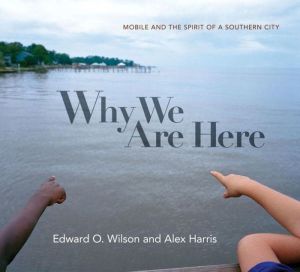
First up was E.O. Wilson’s Why We Are Here: Mobile and the Spirit of a Southern City, which proved interesting for the apparent mismatch between the author and the genre. Wilson is a legendary Alabama biologist, known for pioneering work in sociobiology and for his many books on insects. Why We Are Here, though, is not in that genre. The book itself doesn’t fall into any Dewey decimal category with ease; Wilson offers a hometown boy’s appreciation of the city’s culture and history, but his biography and other interests make it something else altogether: an early fascination with insects, even black widow spiders, made him a naturalist, and he offers a review of Mobile’s outstanding natural heritage as well as its human history. Wilson is joined by Alex Hill, a photographer, who smartly contributes full-page prints that show off the delta’s wild beauty and the people and places that have made Mobile over the years. Alabama’s port city is the Alabama metro that interests me most, but which I’ve spent the least time in.

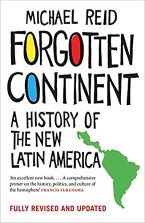
Further south than Mobile, this week I finished reading The Forgotten Continent, a history of Latin America. Reid bases the work off his previous reporting in the region, and focuses mostly on continental Latin America, with the Caribbean receiving only an occasional mention. Reid refers to Latin America as forgotten because aside from Mexico and chatter about migrant caravans, it’s rarely mentioned in American foreign policy: George W. Bush had intended to build on Clinton’s engagement with the region, but was derailed by the middle east, and Obama had the twin foreign policy issues of a booming China and his own mideast garbage fire. Reid begins with the pushes for independence in the 19th century, before tracking the tumultuous histories of Mexico and its southern neighbors. For the casual reader, some areas are easier to follow than others: I felt distinctly in over my head in the many chapters on the Americas’ monetary policy issues, especially where the IMF was concerned. Reid is optimistic that the populist fervor that led to so many dictatorships in the south has burned itself away, and that civil society is rebuilding itself in most places, with exceptions like Venezuela and Cuba. Forgotten Continent is information-dense, and the reader stays submerged: when Reid shifts topics he still stays firmly in the weedy details. As I make steady progress on the TBR and CC-2, I’m hoping to learn more about this area.

Coming attractions: a couple of years ago I donated money to Scott Horton to crowdfund his book-in-progress, which has been released as Enough Already: Time to End the War on Terrorism. A copy of it should materialize in my PO box any day now. Fool’s Errand, his history of the Afghan forever war, was intended to be part of this project but was separated and expanded. Horton is also turning the gist of each chapter into a youtube video, so check out the playlist here. Horton has a radio show and podcast and has interviewed thousands of people since 2003 on geopolitics and American foreign policy.

Posted in history, Reviews, World Affairs | Tagged , , , , , , | 15 Comments

“Love”

“Love is the only bow on Life’s dark cloud. It is the morning and the evening star. It shines upon the babe, and sheds its radiance on the quiet tomb. It is the mother of art, inspirer of poet, patriot and philosopher. It is the air and light of every heart – builder of every home, kindler of every fire on every hearth. It was the first to dream of immortality. It fills the world with melody – for music is the voice of love. Love is the magician, the enchanter, that changes worthless things to Joy, and makes royal kings and queens of common clay. It is the perfume of that wondrous flower, the heart, and without that sacred passion, that divine swoon, we are less than beasts; but with it, earth is heaven, and we are gods.”

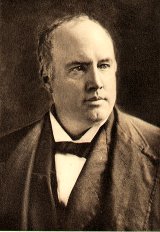
Robert G. Ingersoll was a famous orator of the 19th century, delivering lectures on religion, history, literature, etc. He is chiefly remembered today for his speeches against religion, but I took to him as a lay philosopher, a quintessential American who somehow fused the best of the 18th and 20th centuries together, preaching about love and liberty while firing broadsides against monarchy, superstition, etc. Back in 2010 I posted a brief biography about him online; a year before that I also posted a far more flowery tribute to him. I woke up with this quotation in my head, the old favorite brought to mind by Valentine’s Day.

Posted in quotations | Tagged | Leave a comment

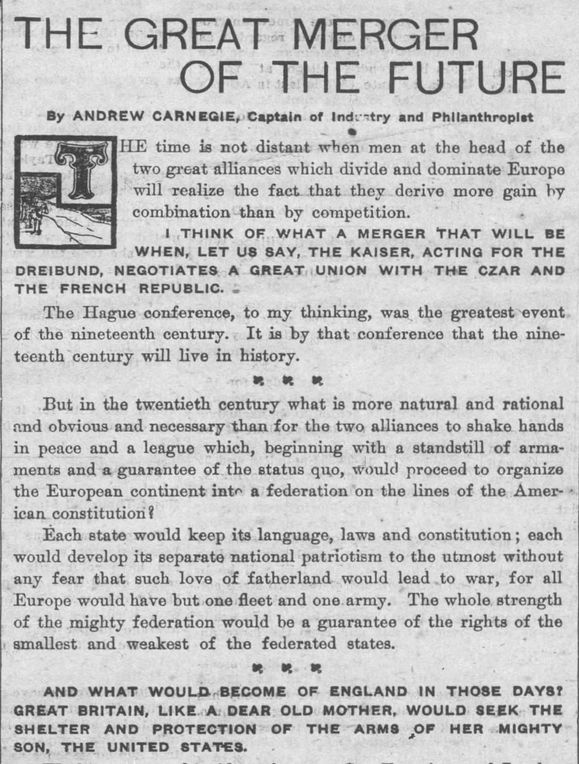
Yesterday’s News: Carnegie & Brexit circa 1902

Inspired by The Network, I’ve been perusing my local paper’s older archives and looking for mentions of Signor Marconi. I thought it might be interesting to see how his invention was received at the time. I was amused to find this huffy piece:

Whoopsie! On the same page was an interesting piece contributed by non other than Andrew Carnegie, who calls for a general European merger. Interestingly, the Scottish emigre doesn’t consider Great Britain a likely participant, writing that it should instead seek the companionship of its daughter-nation:

Posted in General | Tagged | 6 Comments