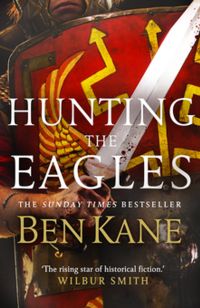
Six years ago, Rome was humiliated and a tenth of her army destroyed when a faithless auxiliary lured three legions into a boggy ambush in the Teutoburg forest. Centurion Tullus, one of the few survivors of the day, has cursed it since: demoted and barred from Italy, he can only mourn his fallen brothers and destroyed career. A chance encounter with Germanicus, newly appointed commander of the Rhine forces, offers him a chance to do more. Rome must punish the barbarians for their perfidy, and recover the eagles stolen from the men left to rot in Germany’s dark forests and rotten bogs. To avenge the fallen and restore the glory of Rome — this is Tullus’ mission.
As with Eagles at War we experience this summer through both Tullus’ and Arminius’ eyes. While Arminius devotes himself to the thankless task of keeping the German tribes united in their mission to defy Rome’s expansion (difficult, given how many German chieftans are headstrong and want to pursue their own targets), Tullus has the equally haunting mission of helping Germanicus confront a widespread mutiny in the ranks, followed by the dangerous business in German territory. With Tullus are a handful of his men from the now-lost 18th, who give us the infantryman’s perspective as well. We revisit (literally) the battleground of the ambush, as Germanicus wishes to pay his respects to the fallen and study the landscape his adversary so skillfully used. Although Germanicus is far wilier than Varus, Arminius presents no less a challenge.
Eagles at War is one of the best works of historical fiction I’ve ever read, and while Hunting the Eagles isn’t as stellar, it’s a case of shooting for the moon and landing in the stars; it’s still excellent reading. Kane presents us two opposing characters, both wholly sympathetic, and in the case of Tullus allows us to experience his strong bond with his men, as well. This is most effective when Tullus and Germanicus reach the hallowed ground where the dead lay, and Tullus and the others are overcome with grief for those who they had to abandon. It is their grief, distilled into determination for revenge, that allows Tullus and the others to survive Arminus’ continued efforts to destroy the morale of the Roman army and rout it once again. As with Eagles, I especially appreciate the way Kane integrates historical artifacts into the narrative; his characters exist not in a haze of memory and imagination, but are tied down to the real world — in objects of leather and metal, the remnants of which we can see today.
Expect quite a bit more of Kane this year; I have another book in this series, plus two in his Richard the Lionhearted series. Those two will arrive in April for Read of England.
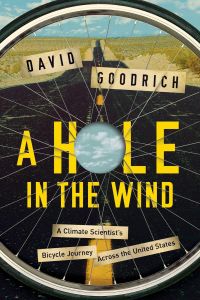
A Hole in the Wind features a retired climate scientist touring from Delaware to to Oregon, speaking with people along the way about how climate change is impacting their lives. Having studied climate and ocean dynamics for decades, Goodrich was disappointed at how politicized the subject became, and hoped to communicate the reality better from his informal, two-wheeled vantage point. Goodrich also connects some of his prior bike tours across parts of the US to the narrative, particularly when they’re relevant to his mission, as when he compares two fire seasons across the same stretch of road. Moving from Delaware to Oregon, Goodrich observes highly specific expressions of environmental impact: eroding barrier islands in the east, poisoned groundwater in the midwest, dying trees from beetles that short winters do not kill, declining aquifers, and the longer, more severe fire seasons in the west. Although this train of disasters might make the book sound gloomy, most of its content is based on Goodrich’s bicycle journey, particularly the friendly people he meets along the way, and the challenges inherent in biking thousands of miles, through rain and hail and fire season. (Only wind deters Goodrich: the flatlands of the American interior proved more challenging than Pennsylvania hill country, as headwinds stopped him in his tracks.) I think Goodrich is on the right track on communicating science; stories of how ordinary people’s lives are being challenged and stressed — not from potential threats but from a visibly deteriorating environment — work better to drive the point home.
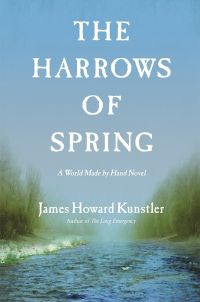
The long winter is ending, and the earth is growing green again, but it is still a time of hardship and sorrow. Food stores are limited, and predators — human and animal — stalk the land. Fourth in in Jim Kunstler’s World Made by Hand series, Harrows of Spring completes the seasonal progression and brings us back around to our beginning, this time forcing the people of Union Grove to rally together against and outside aggressor, even as they struggle to put food on the table and tend the sick. The fourth book ends on a hopeful note, and is stronger than The Witch of Hebron or A History of the Future.
We open to find the people of Union Grove in the ‘six weeks want’, the lean period when winter’s stores are nearly exhausted, and the earth hasn’t begun to deliver fresh bounty yet. Making matters worse is that no outside supplies are coming in: Stephen Bullock has stopped running his boat down the Hudson. Brother Jobe and Robert Earle think Bullock’s peevishness is the height of their problems, but they soon spy a group of tents on the outskirts — a traveling community of very peculiar young people, who speak with the zeal of missionaries but despise religion. They are traveling the width and breadth of the land, preaching Diversity, Inclusion, and Equality — and also, give us your money, because we’re here to restore the government. No one in the Grove is interested in what they’re selling, and these DIE-hards soon resort to every statist’s favorite tool: violence and theft. At the same time, the Grove has the usual problems: machines failing, people dying of diseases that the doctors understand but are powerless to remedy, and the odd bear attack.
Harrows of Spring is much stronger than World Made by Hand, focusing as it does on the real problems of the Union Grove village, instead of trying to make us care about some narrative history about the goings on far away. Even so, the outside antagonists, the Berkshire People’s Republic, border on preposterous when they’re not practicing violence: I get what Kunstler was doing, though, in trying to show the appeal of political ideologies in a time of stress. Fortunately, we don’t have to spend a lot of time hearing them preach, and they expose their true nature as brigands with a penchant for speeches soon enough.
So ends The World Made by Hand series, which I’ve enjoyed despite its quirks and weak spots. Any one of the books can be read in any other, since Kunstler always fills in background, and all have the same basic appeal: illustrating to us what the problems of the future may be, and offering hope that people are resilient enough to find ways to rise to the challenge. The result is a story seemingly set in the 18th century, but with odds bits of our world integrated into it: characters make a distant trek to Albany over the broken state highway, through the remains of old strip malls and decaying suburban homes, both of which have been stripped for usable materials. The main problem in this being a believable depiction of ‘the future’ is the way past culture re-appears: as I commented in either the World Made by Hand or Witch of Hebron novels, it’s implausible that clothing stores would suddenly be called haberdasheries, or that old folk songs would be the only thing played on people’s fiddles. Is there no one trying to recreate “All About that Bass” on the piano? (…I hope not, but wouldn’t people try to play the music they knew, and not just ‘old-timey’ music?) Still, I like experiencing this world, and partially because of that strong historic flavor. It’s not for everyone, admittedly, but despite the apparent rout of peak oil theorizing, I still think a harder, leaner world may be in store for us, and this series helps to imagine what may be demanded of us.
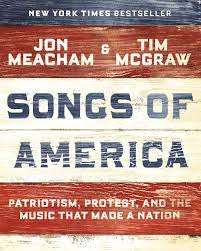
Songs of America is a partial history of America, illustrated by its music, one celebrating the progress of Americans toward greater political participation. The narrative opens with the War for Independence and moves through fits and jerks to the early seventies, unfortunately ignoring several periods of American history along the way. Most notably, the period between Reconstruction and The Great War has to make do with the brief mention of suffragists, which is appalling given how important music was to the early labor movement, for instance. As a story, it’s fine; think of the narrative Obama used in his “yes we can” speech and you’ll have the idea. It’s hopeful and sees the American ideal expanding to include more people. Obama’s speech managed to be more comprehensive, though, despite being far shorter.This makes the book’s focus politics and the state, though, not the American people and our many music traditions — traditions that have brought different ethnic groups and their individual musical heritages together, fusing them into diverse and rapturous styles. That’s a huge oversight and makes the book far less interesting that it could have been.
Christmas has arrived in Union Grove, and unlike their ancestors in days past – for whom the season was an exhausting, expensive enterprise involving frantic consumerism — the people of the village are enjoying a respite from their work. The harvest season is done and the long winter has begun, and these residents of a world made by hand – in a place that has slowly begun to regenerate after the collapse of the oil economy, epidemics, and blight – have each other. But while Brother Jobe celebrates his tavern’s opening, and a father welcomes his wandering son home, a voice cries in the darkness; a man and his son are dead.
A History of the Future is third in Jim Kunstler’s “World Made by Hand” series, depicting a year in the life of the community of Union Grove, a small village in upstate New York which survived the end of the old order. The future is very much like the distant past – the 18th century, say, but with curious fragments of the old world floating around. In previous books we have seen how the city of Union Grove is slowly restoring its fortunes, going beyond mere survival. Now we learn a little what lies beyond upstate New York, as young Daniel Earle has returned from travels along the Erie Canal, with news from what was once the Deep South. Unfortunately, what we learn from Dan comes from telling, not showing; at one point in his adventures he’s picked up by some remnant of the US Navy and given a full lecture on the collapse of nation-states across the globe and chaos at home, including a race war between white and black ethno-states in the old Midwest and Deep South. Kunstler’s depiction of Appalachia is worse than stereotypical, with no connection whatever to the region’s character or problems. I was surprised by the lack of imagination, frankly, and the depiction was too cartoonish to be offensive. That made the Union Grove thread, with its focus on the need for lawful order even amid stressful times, carry more of the weight of the book than intended. Dan’s adventures, which should be exciting and revealing, are more….tedious and ridiculous, culminating in his half-hardheartedly strangling some mix of Dolly Parton and Adolf Hitler while they’re in the throes of passion. (Women are….weird in this book. If they appear for more than two pages, they’re absolutely bonkers.)
A History of the Future is not a great novel, and definitely not one of the better World Made Hand novels. Those who enjoy reading Kunstler’s commentary on the meaningless of modernity and the insulting waste of resources that is modern development will find it here, woven into the fiction; this series exists more as an illustration of what might happen than because there’s a story that needs to be told. That said, I will be finishing the series….mostly because I found a used copy of the fourth book!
Related: A World Made by Handand The Witchof Hebron, the ‘summer’ and ‘autumn’ titles in this series. Lucifer’s Hammer, Larry Niven. Another ‘end of the world’ type book, this one based on an asteroid strike. One Second After, William Forschten. Another end-of-world book, this time following the aftermath of an EMP burst.
The first book still has a trailer on YouTube, which explains the premise of those who are curious:
The history of America as a country is quite different from that of America as a State. In one case it is the drama of the pioneering conquest of the land, of the growth of wealth and the ways in which it was used … and the carrying out of spiritual ideals. … But as a State, its history is that of playing part in the world, making war, obstructing international trade … punishing those citizens whom society agrees are offensive, and collecting money to pay for it all.
“The simple truth is that our businessmen do not want a government that will let business alone. They want a government they can use.” – Ed Abbey
“The most dangerous man, to any government, is the man who is able to think things out for himself, without regard to the prevailing superstitions and taboos. Almost inevitably he comes to the conclusion that the government he lives under is dishonest, insane and intolerable, and so, if he is romantic, he tries to change it. And even if he is not romantic personally [as Mencken clearly was not] he is very apt to spread discontent among those who are. . . .” – H.L. Mencken
From As We Go Marching Along, John T. Flynn:
“The great and glamorous industry is here—the industry of militarism. And when the war is ended the country is going to be asked if it seriously wishes to demobilize an industry that can employ so many men, create so much national income when the nation is faced with the probability of vast unemployment in industry. All the well-known arguments, used so long and so successfully in Europe … will be dusted off—America with her high purposes of world regeneration must have the power to back up her magnificent ideals; America cannot afford to grow soft, and the Army and Navy must be continued on a vast scale to toughen the moral and physical sinews of our youth; America dare not live in a world of gangsters and aggressors without keeping her full power mustered … and above and below and all around these sentiments will be the sinister allurement of the perpetuation of the great industry which can never know a depression because it will have but one customer—the American government to whose pocket there is no bottom. ” – John T. Flynn, 1944
“Fascism will come at the hands of perfectly authentic Americans … who are convinced that the present economic system is washed up … and who wish to commit this country to the rule of the bureaucratic state; interfering in the affairs of the states and cities; taking part in the management of industry and finance and agriculture; assuming the role of great national banker and investor, borrowing billions every year and spending them on all sorts of projects through which such a government can paralyze opposition and command public support; marshaling great armies and navies at crushing costs to support the industry of war and preparation for war which will become our greatest industry; and adding to all this the most romantic adventures in global planning, regeneration, and domination all to be done under the authority of a powerfully centralized government in which the executive will hold in effect all the powers with Congress reduced to the role of a debating society. There is your fascist. And the sooner America realizes this dreadful fact the sooner it will arm itself to make an end of American fascism masquerading under the guise of the champion of democracy. ” – John T Flynn, 1944.
Frank Chodorov, praising in his analysis a pamphlet issued by the National Council Against Conscription, wrote that “the State cannot intervene in the economic affairs of society without building up its coercive machinery, and that, after all, is militarism. Power is the correlative of politics.”
“In previous years, he added, it was assumed that the function of the Congress was to speak for the American people. But now it is the President, standing at the head of the Executive Government, who says: ‘I speak for the people’ or ‘I have a mandate from the people.’ . . Now much more than Congress, the President acts directly upon the emotions and passions of the people to influence their thinking. As he controls Executive Government, so he controls the largest propaganda machine in the world. The Congress has no propaganda apparatus at all and continually finds itself under pressure from the people who have been moved for or against something by the ideas and thought material broadcast in the land by the administrative bureaus in Washington.” – Garet Garrett
“The Roman Empire never doubted that it was the defender of civilization. Its good intentions were peace, law and order. The Spanish Empire added salvation. The British Empire added the noble myth of the white man’s burden. We have added freedom and democracy. Yet the more that may be added to it the more it is the same language still. A language of power.” – Garet Garrett
“As Kolko pointed out, all the various measures of federal regulation and welfare statism, beginning in the Progressive period, that Left and Right alike have always believed to be a mass movement against Big Business, are not only backed to the hilt by Big Business at the present time, but were originated by it for the very purpose of shifting from a free market to a cartelized economy. Under the guise of regulations ‘against monopoly’ and ‘for the public welfare.’ Big Business has succeeded in granting itself cartels and privileges through the use of government.”
Prior to the 20th century, Americans enjoyed the same rich diversity of housing options as anyone else: detached houses of varying sizes, granny flats, boarding houses, rented rooms, and apartment hotels only begin the list. By the mid-20th century, however, American cities were hard at work creating housing shortages for the future, by restricting residential development to either sprawling acres of single homes, or the odd apartment tower. As we move deeper into the 21st century, Diane Lind posits that the state-mandated tyranny of detached homes is being broken and that alternative housing options are making a comeback.
Lind begins with a quick and serviceable history of American housing, which covers how single-family dwellings became virtually the only permissible residential development allowed in the United States. Unsurprisingly for a contemporary author, she places heavy emphasis on racial drama, with less-charged economic and environmental factors taking a distant backseat. (Suburban Nation, Crabgrass Frontier, etc offer more detailed and less politicized analyses of the same trend.) More constructively, she demonstrates that the nuclear family, consisting of one couple and their children in a detached home, only became the norm as the 20th century opened, driven by both the state’s desire to expand homeownership, reform groups’ attempt to clean cities up by attacking shared living arrangements, and the shift of the American economy from agriculture to industry.
Social factors today are reversing that shift. Young people are entering adulthood already laden with debt baggage, and are delaying starting families, often well into their thirties. They often have neither the means nor the desire to buy a house in the suburbs — and even if they did, the large cities they prefer to live near all have enormous housing shortfalls (sometimes thanks to the city government itself squelching development, in the case of San Francisco). There’s a great deal of interest and energy in creating new ways to live, and the bulk of Lind’s book addresses three trends: co-living, accessory dwelling units, and multigenerational housing. She ends by arguing that housing should be reframed, and that housing and health policy should ruin together.
Two of the two trends are restorations of how people used to live before the suburban experiment, and allow people with different needs to serve one another: accessory dwelling units, which lumps approaches like garage apartments and tiny houses together, offer more affordable places to live for young people, while giving older landowners a source of income and companionship. Multigenerational homes are likwise mutually beneficial: not only are basic household costs shared, but the generations support one another: while Grandma is helping babysit the grands, her own children can likewise better monitor her health — and everyone benefits from companionship. While these revived approaches were created specifically to ease expense, Lind’s version of co-living is rather different. She addresses not young people living in homes together, but housing developments that were specifically created with a dorm-like plan in mind: small private living spaces, connected with more communal shared kitchens and living areas. These allow college grads to continue meeting interesting people and living in community, but are certainly not cheap: indeed, Lind writes that these young people are willing to pay a premium for the experience, which often includes doormen and planned recreation.
I greatly appreciated Lind’s emphasis on how our living spaces effect our total well-being, not just our financial standing: this is something I became aware of after reading Jim Kunstler’s Geography of Nowhere. The big flaw in Lind’s focus here is its emphasis on new developments: even when existing housing stock can easily be adapted to incorporate ADUs or multiple families, she devotes most of her focus to new construction that has multiple families in mind. The co-living chapter is the biggest offender here, because it’s more of a niche product , the dorms attractive to wealthy but single millennials. The problem with new developments is that by their nature they’re difficult to make affordable, since first-gen tenants are essentially helping pay for the building’s development, whereas tenants in later years are only covering maintenance and the landlord’s income. (Jane Jacobs wrote on the importance of old buildings for maintaining affordable stock.) Lind also emphasizes subsidies for making the dream of affordable housing happen, when zoning regs and state incentives were responsible for creating the housing dilemma in the first place. When bureaucrats are removed from the picture, industrious humans have a way of solving the problems at hand.
At 17 titles read, January has the year off to a running start, and there’s more in-bound, with some fun titles in the works — on fighting, creating better streets and places, and radical libertarian women. Science and the TBR project both had solid starts, though classics were a nonstarter. I still have four unreviewed titles for Jan and am steadily working to distill my thoughts on them.
SCIENCE SURVEY (Base Goal: 12 books) Bitch: On the Female of the Species, Lucy Cooke Nuclear Awakening, James McHaffey. StarTalk, Neil deGrasse Tyson
The Classics Club Strikes Back, Year II (Base Goal: 10 Books)
(crickets)
Readin’ Dixie (Base Goal: One Book Per Month) Alabama Footprints Exploration
Climbing Mount Doom (Base Goal: Read/Discard One TBR Book Per Week) Week 1: Discarded a library discard on hurricane history. Week 2: Read Live Not by Lies Week 3: Read Nuclear Awakening and Star Talk Week 4: Read The Secret Life of Groceries
February Plans: Ida Elizabeth, for CC. TBR shellacking will continue, dovetailing with science survey, plus the aforementioned Christmas/birthday haul.
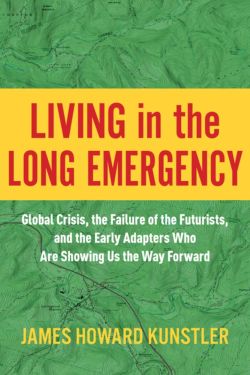
In 2005, James Howard Kunstler penned The Long Emergency, building on his earlier work as a critic of American urbanism to argue that in addition to being economically ruinous, the suburban experiment has placed the United States in a uniquely bad spot for the converging problems ahead, chiefly peak oil, climate change, and financial upheaval. When the housing bubble burst and Americans continued plowing along, he warned against the dangers of ‘technological narcissism’ and connected the Great Recession with his Long Emergency thinking. In Living in the Long Emergency, Kunstler responds to the apparent rout of peak oil theorists by fracking, and interviews people throughout the United States who have begun changing their lives (as he has) in anticipation of future trouble. Living marks a shift in Kunstler’s writing; Kunstler appears to no longer believe that Americans can respond to the threat as a nation, and has shifted his focus to individuals who are willing and able to adapt at the level of their own lives. As a book, Living in the Long Emergency doesn’t fully live up to its promise, as only a few of the interviewed individuals are overtly planning for collapse. Kunstler nevertheless proves worth the reading, however, especially in his endcap section in which he excoriates both wings of the political elite.
In Too Much Magic, I commented that Kunstler’s works have built one upon another much like a train: the preceding arguments are still there, but they’re followed and strengthened by additional, interconnected concerns. Kunstler’s introduction and ending here continue that trend, though not to the same scale: Kunstler summarizes his preceding arguments and then comments at length on the sad farce that passes for politics these days, as both parties are fully in the grips of unreality. Kunstler used to advocate for change at the national level, urging better uses of capital that would ameliorate the chaos to come — like accepting nuclear energy, for instance, instead of wasting money on short-lived wind farms that can’t support a base load. Now he doesn’t bother, seeing his estranged party (the Democrats) having descended to the level of Jacobins, more interested in destroying those who disagree with them and waging war on the past than preparing intelligently for the future. And Republicans? The portion of their party with energy is moored to the same vision of Happy Motoring that Kunstler condemned decades ago. The United States is a truck hurtling into the abyss with two tweeting, vainglorious idiots fighting for who gets to drive. What interests Kunstler now is people who have bailed from business as usual and started altering their lives in preparation, and it’s these people who he focuses on in the heart of Living. These interviews include an interesting range of individuals, from Alaska to Vermont. Several have created their own homesteads, where they grown much of their own foodstuffs and at the same time create products to sell outside, like liquor or bread. This isn’t a series of interviews with survivalists, though: what unites the guests is their disconnection from mass society, their belief that the future will be worse than the present, and their willingness to find ways to adapt to it. For some, that’s growing their own food; for others, it’s learning practical skills they can sell. A couple of the interviews seem out of place, though they’re no less interesting: a couple of extremely race-conscious men are interviewed, one black and one white. They both comment on the disintegration of culture, on growing consumer-passivity that sets people and their communities up for failure.
Living in the Long Emergency is a minor addition to Kunstler’s line of argument that also examines ways those who follow Kunstler’s arguments are taking them seriously. This includes Kunstler himself, who for the last decade has lived on a farm in upstate New York, keeping chickens a few minutes walk from a small village. There’s not as much of the long emergency adaptation as readers would want, but if you can’t get enough of Kunstler excoriating modernity, it’s here for the reading.
Some quotes:
“I am part of the most useless generation that’s ever existed in human history. Millennials know how to do less for themselves than anyone that’s ever existed on the planet Earth. [….] And most people who are under the age of forty don’t have a clue about where to even begin with that kind of stuff. We have been completely separated from any life of productivity, any knowledge of how to make anything or do anything. ” (From an interview with a Millennial turned farmer)
“In case you haven’t been paying attention to the hijinks on campus—the attacks on reason, fairness, and common decency, the kangaroo courts, diversity tribunals, assaults on public speech and speakers themselves, the denunciation of science—here is the key takeaway: It’s not about ideas or ideologies anymore. Instead, it’s purely about the pleasures of coercion, of pushing other people around, of telling them what to think and how to act.”
“A casual survey around America these days reveals shocking degrees of neuroticism, delusion, dishonesty, and functional failure in culture. The result is a political dwelling place that looks more and more like Kafka’s Castle, a techno-bureaucratic update of a particular kind of solipsistic Hell. The economically stranded former working class has devolved into a tribe of tattooed savages sunk in anomie. Those a rung up in the middle middle class are not far behind them, as vocations and incomes disappear, debts mount, and desperation creeps over the scene. Obesity and its by-product, diabetes, run at record levels thanks to “innovations” in the food-processing industry (another racket), and the absence of other traditional social satisfactions that have been destroyed by television and smartphones. Opiate addiction and suicide are the new normal in the flyover states. The triumphant completion of suburbia has produced yawning ugliness on the landscape, an epidemic of loneliness, family dysfunction, and a dismal cavalcade of mass shootings in public schools. Meanwhile, the upper rungs of society are enfogged in a contrived obsessive moral panic over race and sexual relations. Can a people recover from such an excursion into unreality?”
The Secret Life of Groceries opens at a fish counter and invites the reader to consider how much labor, creativity, money, pain, and devotion are required to fill its pans with fish for our grills. But this isn’t just a book about fish, or even about the logistics of aquaculture and food; instead, the author uses them to reflect, with the reader, on how we create meaning for ourselves through what and how we consume.
I never fail to be interested in microhistories, or in books that shed light on how a given industry or service works: human action and the world it creates continually awes me. The Secret Lifeof Groceries more than delivers in that area, as Lorr begins at the fish counter and then explores what happens before. How are food products conceived, marketed, and sold? What are the stories behind how fish, shrimp, and other goods come to market? The book originally began as a journalistic effort to understand the unique appeal of Trader Joes, but then grew into a larger examination of the grocery market. Separate chapter focus on the harried life of just-in-time trucking, where turnover can be as high as 112% in a given year, to the expensive and crushing battle of small entrepreneurs to get their products onto grocery shelves – and if they’re not tired of bleeding money, we also see what it takes for a product to be ‘certified’, for extra appeal to market niches. After considering brands and how we use the spaces of grocery stores, we then move to the high seas – -where Burmese slaves, trapped on trawlers that never dock because they offload their goods to support transports — gather the junk fish that keep the shrimp industry fed. Although this and the chapter on trucking are harrowing, this is not a Fast Food Nation esque expose to make the reader feel guilty about eating shrimp salad. We are reminded that cheapness comes at a price – to quality, to human lives — but we’re also warned that the wealthy western obsession with certified food products (“organic”, “free-range”, “fair trade”) creates its own distortions, and that to a degree conscious consumers are merely engaging in a modern kind of simony, paying extra prices to absolve themselves from perceived sins.
Lorr’s theme throughout Secret Life, inspired possibly by Trader Joe’s deliberate cultivation of itself — selling unique brands and experiences rather than doing a poor imitation of Walmart — is how people exercise their individuality and pursue meaning through what we buy, and the effect that has on the world around us. Our stories are all interconnected; the shrimper, the trucker, the woman spending her life pitching a combination of salsa and coleslaw (“It’s SLAWSOME!”). Some people try to consume ethically, and others are more interested in original experiences, in finding ‘authentic’ products that don’t seem so mass-produced. This took Secret Life into far more thoughtful territory than say,The American Way of Eating orGrocery: The Buying and Selling of Food in America, two similar works. This is easily one of the most fascinating books on food market I’ve read, possibly the most fascinating — but it’s been a decade since I first read Fast Food Nation orThe Omnivore’s Dilemma, so I don’t want to judge hastily.




 Reading Freely