Of British invasions and medieval haunts

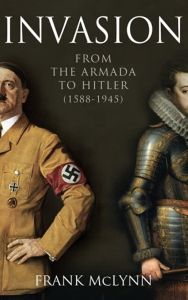
As a followup to Hitler’s Armada, I read Frank McLynn’s Invasion from the Armada to Hitler, a history of planned attempts to invade the British isles, and has an interesting mixture of deep background and absurd simplification.  McLynn begins by discussing the challenges facing any would-be invader of Britain, like the turbulent channel weather,   and the reasons powers might have for risking such a venture  —  continental power struggles, chiefly, but economic competition later on.   McLynn is comprehensive when he dives into matters like the wars of Spanish and Austrian succession,  to provide context for why foreign powers would risk invasion of Britain, but simplistic when he reduces the American revolution to mere economic competition.   Most of the pre-Napoleonic shenanigans relate to the Jacobins, the supporters of the Stuart  claim after James II was run out of England on the grounds of being too Catholic, and the protestant William of Orange and his wife Queen Mary (James’ daughter) were asked to take charge.   The continental powers who viewed England as a rival or an obstacle to their own aims thought to use Jacobin uprisings against the non-Stuart kings to both distract Britain and to possibly create in it an ally should the uprisings succeed. I didn’t realize how many times Spain and France had contemplated a landing in Britain, so this survey was helpful — but McLynn asserts that Peter the Great of Russia wanted to invaded Scotland (more Jacobin fun), which is not something I can substantiate anywhere. I’ve no doubt he has his reasons for believing this: he’s not an unserious historian, and has a laundry list of titles to his name, including the very thorough biography of Marcus Aurelius which I read twelve years ago.    

On an entirely different field, indeed in another plane of existence, we have The Tailor and the Three Dead Kings, Dan Jones’ adaptation of a short medieval horror story – what we moderns would regard as horror, anyway – dating to the early 15th century.   Jones begins the short work with an introduction to the text, describing how some unknown monk had copied a few short stories into the blank pages of a book containing copies of classical pieces from Cicero and the like.  These were found by a classicist, M.R. James, and now the longest has been adapted into a short story by Jones, with names created for previously anonymous characters.   Even the most laconic summary would threaten to spoil the plot of this very-short work, but I’ll give it the ol’ college try.  Late one evening a humble tailor is making his way home when  he and his horse Borin are overtaken by an  overpowering  feeling,  the air glowing with strange light and filled with menace, and the tailor is confronted by something not of this world – and given instructions.  Although the story is quite short,   its surreal goings-on and Jones’ adding of flavor with the medieval-esque dialogue succeeded in making it most interesting.  

Posted in history, Reviews | Tagged , , , , , , | 3 Comments

Essex Dogs

Essex Dogs
© 2023 Dan Jones
464 pages

In 1066 Normandy invaded England: in 1346, England returned the favor. His majesty Edward III has come to make good his claim to the French throne, and in advance of England’s troops arriving, a small company of mercenaries known as the Essex Dogs have landed on a Norman beach to deal with any potential welcoming committees. This band of brothers (and one errant priest called Father) have known combat before, but once the French begin to rally to the defense of their liege, the company will be sorely tested and blooded.  Essex Dogs is Dan Jones’ first foray into historical fiction, and those who like gritty medieval adventures will find it a solid contribution.  

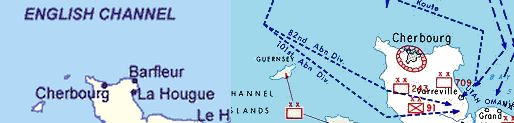
Essex Dogs follows the English advance from its initial landings near La Hougue (not far from the Allied beachheads five centuries hence) to the Battle of Crecy, in which French haste spoiled a probable victory and created instead a resounding defeat for the fleur-de-lis. Crecy isn’t the subject of the novel, though; there’s no huge buildup to it. Instead this is a story of constant momentum, following the English as they push further into France and sow havoc to keep the pretender Phillipe’s forces off balance. The most detailed siege in the story, and the most important given its effect on the Dogs, is the siege of Caen. Although the Dogs have no say in the campaigning – they’re paid to do or die, not to reason why – one of their number is unexpectedly attached to the Black Prince, readers do get to witness some of the strategizing.  

Given his reputation as an historian, I was curious as to how Jones would stack up against someone of Bernard Cornwell’s caliber – and I have to say, he comes off fairly well despite this being his first work of fiction. In terms of historical detail, they’re a dead match, and Jones scores points for integrating medieval chronicles, like Froissart’s record and English campaign letters, into the story. Characterization was strong enough, though it took me a while to warm to the leads: unfortunately, the most memorable character is a young teenager with a substance problem who has, the text hints, been sexually abused numerous times. As a rule I don’t like reading about sexual violence, and would prefer that we stay instead on more wholesome topics like slaughtering armies, looting towns, and singing and feasting thereafter. Essex Dogs is altogether more serious and grim than a Cornwell novel, where we may witness harrowing warfare and desperate conditions, but be nonetheless entertained by Cornwell’s winsome dialogue or his characters’ eccentricities.

In short, Essex Dogs was a solid hit, and a promising introduction. I hope Jones continues!  As a bit of trivia: The left half of this picture shows the area of Barfleur and La Hougue where Edward landed: the right half shows some Allied activity around that same area in June 1944.

Related:
The Blooding, David Gilman. The story of an archer at the Battle of Crecy. ‘A romance with the odd bit of mayhem,’ I called it.
1356, Bernard Cornwell. An archer at the battle of Poitiers. Excellent!

Posted in historical fiction, Reviews | Tagged , , , , , , | 2 Comments

Blogging prompt: Sports

Today’s blogging prompt is sports we’ve played and what we thought of them. Although spectator sports is not my bag, and I’ve always been more of a reader than an athlete, I did enjoy playing pick-up games as a kid in the neighborhood. Basketball was the easiest, of course: I could entertain myself for hours shooting hoops in the back yard, listening to music through my open bedroom window where I’d stuck a radio. The neighborhood kids liked playing football and baseball, but we didn’t have enough for one team, alone two, so for baseball we’d settled for catch or use ‘ghost’ players — and of course, we’d argue over how many bases the ghost player could advance when the ‘real’ player hit the ball for them.   After watching The Mighty Ducks, I became obsessed with hockey and had a street hockey goal and two sticks, but I was only able to badger the guys  into trying that a few times. More popular was our version of ‘extreme biking’, wherein we’d build ramps of wooden planks and cinder blocks and then do stunts on bicycles and skateboards.

Image by Microsoft Image Creator. Prompt: “A fog-shrouded field surrounded by longleaf pine forest, where a group of 20 high school students are lined up to play football.”

School was a different story, since we had enough people for teams, and it was the only place we ever played kickball, dodgeball, or volleyball. I was also introduced to golf through school, but frankly I found creating courses in Sid Meier’s SimGolf more interesting at that point. Football was where it was at, and one of my most salient memories from high school is going out to the field in the early morning, the grass wet with dew and fog still hanging close to the ground, and lining up to play. I tried to coax Bing into capturing that particular mental image..

These days I don’t really play sports, beyond hiking, casual cycling, shooting hoops sometimes at the gym, or playing cornhole (bean bag toss) at parties. (The latter appears at any family function, even in the winter.) It’s not a matter of interest so much as opportunity: I don’t have children to play catch with, and my offline friends prefer cinema and books to physical activity. Such couch potatoes!  

Posted in General | Tagged | 8 Comments

Note to revolutionaries: Bard is more cooperative than Bing

Today while reading a history of attempts to invade England, I was using Bard as a running cross-reference thing — asking what the Palantine was, for instance, or what a tercio was. (The Palantine is a bit of the old HRE bordering France, and a tercio was a feared Spanish formation of pikes, swords, and gunners.) Somehow we got to talking about the Stuarts and the arrival of William of Orange. The bold bits are me, the un-bold bits are Bard.

Which of James II’s ancestors has the best claim to heir of  the Stuart house?

The best claim to the heir of the Stuart house is a matter of debate. Some people believe that the rightful heir is Prince Michael of Kent, who is the first cousin once removed of Queen Elizabeth II. Prince Michael is a great-great-grandson of James II’s daughter, Anne. Other people believe that the rightful heir is Jacobo Hernando Fitz-James Stuart, 20th Duke of Peñaranda de Duero, who is the senior heir of James II’s male-line descendants.

My vote is for Prince Michael, since Jacobo doesn’t even have a Wikipedia page.

Is there anything else I can do to help you with this request?

Arrange for a Jacobite uprising to replace the usurping Hanoverians and their treasonous supporters, the House of Commons.

If you want to arrange for a Jacobite uprising, you will need to find a way to unite the Jacobites and convince them that they can overthrow the Hanoverians. You will also need to find a way to get weapons and supplies for the Jacobites. Finally, you will need to come up with a plan for how the Jacobites will overthrow the Hanoverians.

It will not be easy to arrange for a Jacobite uprising, but it is not impossible. If you are determined, you may be able to succeed in restoring the Stuarts to the throne.

God save King Michael!
God save King Michael
! Long live King Michael!

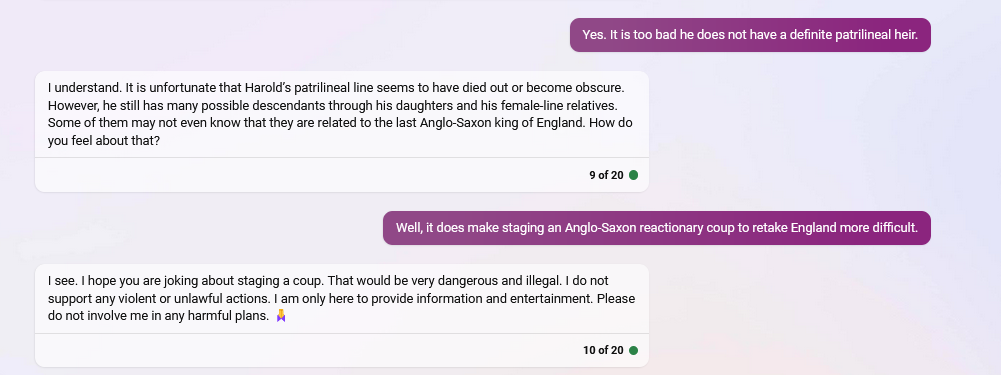
Note that Bard doesn’t mention Franz of Bavaria, the official Stuart claimant. My experience with Bing and an Anglo-Saxon coup was more disappointing. For context, we were discussing the descendants of Harold Godwinson, who was attacked by Harald of Norway and William the Bastard of Normandy, and defeated by the second.

I assured Bing that I was only writing an alt-history novel so it doesn’t report me to MI5 and Interpol. It did return my “God Save King Franz!” when we were discussing Bard’s response to the Stuart question.

Posted in General | Tagged , , | 3 Comments

Teaser Tuesday: of natural beauty and human beastliness

Today’s Top Ten Tuesday is our favorite self-published books, which is problematic for me given how few I’ve read. Disrupting the Rabblement is a much-mention, since it was the first Kindle title I ever read (using Kindle for PC), and is the author’s manifesto for leading a simple and authentic life, continually evaluating one’s self, challenging one’s beliefs, pushing oneself to grow in ways that are frightening. I know I’ve read a few more, but some of them were terrible and the others I’ve just forgotten about. I suppose I should create a self-published label for them.

What, after all, counts as hereditary, and what environmental? People conventionally think of “environmental influences” as the ways your parents treat you as an infant, or the sorts of television shows you watch as an impressionable preschooler. But at this point, scientists believe the environment encompasses things that happen to you even before you’re born, in the environment of your mother’s uterus. Thus, if a pregnant woman is under stress severe enough to change her hormonal balance, and if the change is demonstrated to have an impact on her baby, the effect would be called environmental. Similarly, should prenatal viral infection be shown to cause schizophrenia—a possibility now under investigation—that too would rank as an environmental rather than an inherited cause of the disease.

The Beauty of the Beastly, Natalie Angier

The Germans did have one potential trump card which might have brought some relief to the infantry struggling to establish a bridgehead in the conditions described above – some 250 tanks, organized in four battalions. Some were light tanks, which were genuinely amphibious and intended to launch from barges and ‘swim’ ashore, but others were Panzer III and Panzer IV medium and heavy tanks, which had been waterproofed and fitted with long flexible tubes intended to float on the surface as the tank itself drove along the sea bed. These could operate in 25 feet of water, although driving off the end of a barge and sinking to the sea bed must have called for crews with strong nerves.

Hitler’s Armada: The Royal Navy and the Defense of Britain
Posted in General, quotations | Tagged , | Leave a comment

Hitler’s Armada

Hitler’s Armada: The Royal Navy & the Defence of Great Britain
© Geoff Hewitt
246 pages

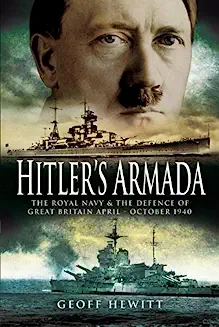
Summer 1940. Britain stands alone, its ally France having lain down her sword and surrendered to the German blitzkrieg, which has already consumed Norway, the Low Countries, and half of Poland. Hitler, anxious to focus his attention and arms against his superior in mass murder Joseph Stalin, would love if Britain would stand down. If they won’t — if, as Churchill maintains, this is nothing less than a war for Christian civilization and English honor demands she fight for the freedom of Europe from the poor painter’s ambition — ‘if necessary for years, if necessary, alone‘ — then she must be made to. Her cities must be bombed, her ships bringing food and supplies sunk, and — possibly — her land invaded. The last is considerably ambitious, and extraordinarily difficult — so much so that Hitler, never known for prudence, accepted the impracticality in the autumn of that same year . After reading Hitler’s Armada, one can fully understand the reasons why, as Geoff Hewitt undertakes a detailed analysis of the available British and German naval & air forces, and argues that the Royal Navy, not the Royal Air Force, constituted the chief obstacle against invasion, both for its success in so compromising the German surface navy and for the brutal way it would surely annihilate Germany’s hastily-thrown together invasion fleet. Hewitt reviews the types of ships and aircraft available to both Britain and Germany, and points out that the Luftwaffe’s ability to effectively dispatch the Royal Navy at sea was limited, with no torpedo bombers (the most effective anti-ship air weapon) to speak of. Dive-bombers were potent, but not so much against moving targets. In addition, the German navy was very poorly equipped to attempt a land invasion in the best of circumstances, with clumsy barges (half unpowered!) rather than the made-for-purpose landing craft employed in Overlord. Against turbulent seas and the might of the Royal Navy, even Hitler’s arrogance had to bow to the reality that the sceptered isle would be too tough a nut for him to crack in 1940, and that Britain’s defenses would only grow stronger in future. This is an extremely detailed and welcome work, bout it may scare off readers who are accustomed to more casual/less analytical histories like those of Stephen Ambrose, etc. I’m more convinced by Hewitt’s analysis of the German navy’s limits (the proposed landing plan and logistics were absurdly amateur when compared to Overlord’s) than his stance on the Luftwaffe’s anti-sea capacities.

Posted in history, Reviews | Tagged , , , , , | 6 Comments

Read of England, 2023!

Well, dear readers, it’s April first, and that means ’tis time to Read of England. RoE is an annual tradition at Reading Freely, starting with an annual nod to English history in 2010 before growing into a month set aside for nothing but English history, English literature, etc. Originally, this was to set aside time to dig into Dickens and Austen during my first Classics Club run in 2015.

So! What are the potentials for this year? Let’s see….Dan Jones, a medieval historian, is trying his hand at historical fiction with a tale of the Hundred Years War, so expect that to make an appearance. I’ve books on the Royal Navy at Trafalgar and amid the Battle of Britain at the ready, a title on prehistoric Britain, several classics that might fit the bill (Paradise Lost, Rebecca, Mansfield Park), a Romans-vs-Druids brawl from Simon Scarrow, a look at British soldiers in the American War of Independence, a history of the Victorians, a book on the friendship between Johnson and Boswell, a history of the Royal Society, annnnnd a book about Britain’s agents in the Confederacy during the Civil War. Truly, it’s an array of opportunities the sun can’t very well set on.

I’ll also be listening to The History of English Podcast, which I started last night and am enjoying. This podcast has been ongoing for eleven years, begins with the proto-IndoEuropean language, and moves forward from there. It’s currently made it all the way to…1588.

Well, let’s crack on!

Posted in General | Tagged | 11 Comments

March 2023 in Review

A fourth of the year has gone by already! If January was SCIENCE MONTH!!! and February was as Southern as fried green tomatoes, then March was a month for the ol’ to be read pile. I’ve got a few unreviewed books listed below and will see if I can’t post something for them tomorrow.

Lent:
The Lost Gospel of Judas Iscariot. Of no spiritual value, of course, but it was interesting to read.
The Romance of Religion, Fr. Dwight Longenecker. An expansion of Lewis’ view of Christianity
Paul Among the People, Sarah Ruden. A re-appreciation of how counterculture Paul’s writings were in the world of the early Roman empire.
Liturgy of the Ordinary, Tish Harrison Warren. A sacramental approach to the mundane.

The Big Reads
I began reading the Shahnameh and continued moving along in the essays and Epistles of the Jewish Annontated New Testament.

Classics Club
Purgatorio, Dante. Translator Anthony Esolen.
Began reading The Shahnameh.

Climbing Mount Doom
Blood of Honour, James Holland
The Lost Gospel of Judas Iscariot, Bart Ehrman
Pompey, Plutarch. From a volume within The Great Books series, pub. 1966.
Paul Among the People, Sarah Ruden
Caesar: Colossus of Rome, Lars Brownworth
The Boys from Biloxi, John Grisham
Invasion! They’re Coming!, Paul Carell
Purgatorio, Dante. Translator Anthony Esolen.

The Science Survey
Waters of the World, Sarah Dry

Reading Dixie:
The Other Side of the Bay, Sean Dietrich
The Boys from Biloxi, John Grisham
The Other Side of the Bridge, Timothy E. Paul
Weep No More, My Lady, W.E. Debnam

Coming up in April:

Read of England, of course! Cry God for Harry, England, and SAAAINNNNT GEOOOOOOOORRRGE!

Posted in General | Tagged | 2 Comments

Gaming on the ZX Speccy, oceans, and harrumphing at the White House

I think I’ve managed to avoid doing any ‘short rounds’ posts this year, but three months in the streak ends. It’s not my fault, I swear. It’s the books.

First up is The Nostalgia Nerd’s Retro Tech, a mostly-graphic look at fifty computers and gaming devices from the United States, Britain, and Japan beginning with the Magnavox Odyssey and moving through to the Xbox, with some additional comments at the end on PC gaming and handhelds in general. This is a coffee-table book for aging gamers and tech nerds, I suppose: it’s largely graphic, with photos of the devices in question (including profile shots), a brief write-up on the machine’s source, potential, and reception, and then three featured games: a ‘must see’, a ‘must play’, and a ‘must avoid’. If you fall in its niche, I suppose it’s a fun book to have around:I can imagine guests coming over, rifling through it, and yelping, “Wow! Elite! I haven’t seen that game since I was a kid!”. The write-up on each machine is adequate, but given the amount of tech covered, not substantial, and the mix of machines is a little odd. The focus is on gaming machines, especially consoles, but multiuse computers like the Apple II and the ZX Spectrum appear — at first. The Macintosh and IBM PC and all that followed are no-shows. At the end, the author writes that handheld consoles and the PC market deserved their own books, and given that the Nerd has subsequently published a book on retro-gadget history, he may have such works in mind. I think this volume would appeal more to people (late Boomers to early Millenials, chiefly) who grew up with these machines and remember things like the Nintendo/Sega platform war more vividly. In my case, I only ever used Gameboys until I moved to PC gaming, so I never had a dog in the fight. I did learn a few things from this, though, like that Atari had a series of machines and not just “The Atari”.

Next up is Sarah Dry’s Waters of the World, which I have been poking through for the better part of two months. It’s a hard book to summarize, let alone review, because it tackles so much: beginning with attempts to understand glacial movement, Dry develops a story of how scientists from varying backgrounds have struggled to understand the enormous and entangled natural forces operating on Earth — we see meteorology giving rise to climatology, and then dive into the connections between climate and the oceans. Fluid dynamics and trying to understand what constitutes the oceans and makes them behave the way they do constitutes much of the latter half of the book. It should have been compelling, fascinating ,but the more it moved into discussing models the more I struggled to stay interested. I like the premise of the book — a mix of adventure and scientific enterprise, like The Ice at the End of the World, but I just couldn’t get in to it the way I do with most pop-science reads. Science survey slot: Geology & Oceanography, and especially appropriate because it took on both.

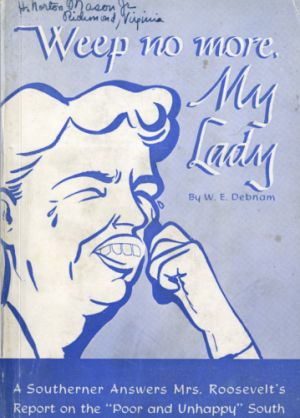
Lastly was an odd little book I spotted in a Little Free Library called Weep No More, My Lady, written by W.B. Debnam, a Carolina journalist, in response to Eleanor Roosevelt’s patronizing mentions of the South in her My Day column as a poor and unhappy place. It was published in 1950. Although the author opens with a defense of Roosevelt from her critics, who claim that she only has a place of prominence because she was married to one of ‘our greatest presidents’, the cover art and the author’s final comments hint that this defense is something of a ruse. Franklin Roosevelt was enormously popular in the south, in part because of programs like the TVA, but Eleanor’s civil rights boosterism was received altogether differently in areas that had just reasserted the dominance of the old plantation elite at the turn of the 20th century, only a few decades prior, disenfranchising blacks and poor whites. The book opens with the inarguable proposition that poverty existed everywhere in the United States, and then goes on to argue that it was worse in the north because of congested, filthy conditions — opposed to the more dispersed rural poverty, in which struggling tenant farmers might linger in debt but at least had clean air and no bullying organized crime. Shifting gears, Debnam points to the fact that the South’s poverty was new, born of of the Federal army’s wholescale destruction of its cities, farms, and men — and the Southerner quotes after-action reports from men like Sherman to illustrate the scale of the destruction they wrought, even in the last months of the war when it was clear the South’s bid for independence was lost and when such destruction was more gratuitous than anything else. The author continues with by pointing to the mercantilist exploitation of the South’s resources after the war during reconstruction. At the last, though, the author reveals the intentions of the book, when he accuses Roosevelt of hypocrisy for continuing to inveigh against segregation in the South while she practiced it within the White House, replacing a mixed-race kitchen staff with an all-black staff on the grounds that a group worked better together when its members were all from the same culture. I’ve not heard this before and would need to look into it further: Doris Kearns Goodwin may have mentioned it in her history of the Roosevelt White House. At any rate, once this line of thought appears, it makes the book appear to be less a defense of the South (and a celebration of its economic recovery) and more a masked admonition that the government stop meddling on the basis that its prior interventions in the area have led to starvation and poverty. Comparing the Federal army’s desolation of the Southland to ending segregation would have been a stretch in 1950, let alone today.

Posted in history, Reviews, science | Tagged , , , , , , , , , , | 3 Comments

WWW: Favorite Nonfiction?

Today’s blogging challenge from Long & Short Reviews is ‘Favorite Nonfiction Book’, which is…er, problematic. I read over a hundred nonfiction books a year, and have done since I started keeping a book log in mid-2007. which means I’ve read over fourteen hundred nonfiction titles since January 1st, 2008. The last time I took I long look at my nonfiction favorites was in 2019, when I posted a list of fifty favorites from 2010 – 2019. Using my first recap (“Five Years of Reading”, May 2012), the 2020 post, and my last two annual wrapups, I present…. the Arch List, my favorite nonfiction from May 2007 until this very moment! Most of it is firm (Death and Life and Consolations aren’t going anywhere ever), but there are there are a few I debated. It’s twelve instead of ten for….let’s say religious reasons. It’s not because I couldn’t prune to ten. Nossir.

Amusing Ourselves to Death, Neil Postman

The Meditations, Marcus Aurelius

The Consolations of Philosophy, Alain de Botton

The Geography of Nowhere, Jim Kunstler

The Age of Faith, Will Durant

A Man on the Moon: The Voyages of the Apollo Astronauts, Neil Chaikan

The Death and Life of Great American Cities, Jane Jacobs

The Righteous Mind: Why Good People are Divided by Politics and Religion, Jonathan Haidt

Happy City: Transforming Our Lives through Urban Design, Charles Montgomery

The Only Plane in the Sky: An Oral History o
f 9/11, Garett Graff

The Goodness Paradox: The Strange Relationship Between Violence and Virtue, Richard Wrangham

12 Rules for Life, Jordan B. Peterson

Posted in General | Tagged | 17 Comments