Of bones and marooned astronauts

© 2007
320 pages

Out of Orbit proved, despite the small scope of its subject, to be a most interesting and wide-ranging little history. When Columbia disintegrated in the skies above Texas and Louisiana in February 2003, it not only took with it seven lives, but left three men aboard the International Space Station in a heck of a fix. With the shuttle fleet grounded, how were they going to get home? …well, Soyuz. There’s literally a Soyuz parked to the station. This isn’t rocket science, guys. Er — this isn’t brain surgery, guys. Of course, it’s not quite that simple, and the book isn’t that short. It’s actually an ideal book for someone who has little to no knowledge or active interest in the space program, but who finds the thought of three men marooned in orbit sufficiently interesting to start reading — and then get the bug. Rather like Jim Lovell did with Lost Moon, Chris Jones works in partial looks back at the space program from both sides of the Iron Curtain to take us to the creation of the International Space Station, and the hopes of establishing a continuing human presence aboard it. This means not only visiting Apollo, but Skylab and Mir, as well. The result is a little history that begins with human interest hook, and then gets ya all excited and admiring about space exploration, using absorbing, descriptive writing that often puts the reader into the visor and boots of an astronaut facing a crisis far more quickly than the men and women themselves could. It’s good that Jones is able to do this, because the mission itself wasn’t terribly prolonged: another two months were tacked on, but considering that Expedition 6 had planned for a multi-month stay anyway, it’s not exactly the Shackleton expedition. More groceries from the Russians, a little belt-tightening, and bob’s your uncle. The main hitch is that the parked Soyuz available had never made a descent before, and that even if another crew were delivered to relieve Expedition 6, Russia’s Progress capsules weren’t enough to keep a crew supplied: shuttles might have been dismissed as trucks, but like their eighteen-wheeled counterparts on the ground, it was the shuttles that delivered the goods.

A coupla quotes:

Now, should something go wrong—a snapped tether, a hand or a foot restraint breaking free of the hull, the hatch door locking shut—there were only so many outcomes. Now, in all of that wide-open space, your range of possibility was terrifyingly narrow. It would begin, like all knowing deaths, with panic. Probably not a screaming, thrashing panic, because your years of training wouldn’t let you accelerate the process like that—and because you wouldn’t want the voices on the radio to sense the tremors in yours—but there would be panic nonetheless. Your heart rate would rise. Your breathing, as much as you tried to keep it slow and even, would pick up, become shallower. Despite the cold water still running through your long underwear, sweat would start coming out of your forehead, but without gravity it wouldn’t fall. If any drops were somehow shaken loose, they would float around inside your helmet, like the flakes inside a snow globe, until they had gathered enough steam to splash into your visor or bounce back into your face. That’s when you would taste the salt, when you would lick your lips and begin whispering to yourself, looking for angles, for oversights, hanging on to the last living moments of your reason, trying to find a way home.

In addition to its square footage, their home also boasted a gas fireplace, which, because it’s usually plenty hot in Houston, had found a place in the memory banks of each of the families who had seen it. It seemed to most of them like a loopy extravagance. It also had fake logs stuffed into it, which Don couldn’t abide: if he was going to watch something burn, he might as well watch something interesting burn. And so he set about replacing the logs with a diorama of a miniature village, complete with scorched rooftops and panicked residents jumping out of their windows. Whenever he flicked on the gas, the town would appear to go up in smoke—and so, too, did another wisp of his reputation each time a joyless visitor asked to see his latest creation.
© 2019
288 pages

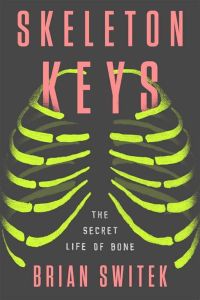
Next up is Brian Switek’s Skeleton Keys: The Secret Life of Bone. I’d originally intended for this to be an October science read (…last year…), along with Nine Pints, but it lingered like its subject, entombed within the murky depths of Mount Doom. Switek is a science blogger and paleontology buff who is usually interested in fossils and dino bones, but here turns his attention to humans. The book begins with a look at bones’ first appearance in the fossil record (chiefly, what would become the spinal column and jaws) before moving onto more underappreciated aspects of them, like their partial plasticity: our bodies can create bones where bones don’t need to be, like from our larynx tissue, and many human cultures have deformed their skeletons, particularly skulls. Although science content is definitely present in Skeleton Keys, Switek leans hard into cultural matters — which, unfortunately, drives the book into politics several times, the most obnoxious of which is when Switek spends several pages trying to insert gender identity ideology into archaeology, and then always tacking on “osteological” to every instance of male & female to attempt to snow the reader into thinking that the current wave of mental problems and hormone chaos (largely limited to middle-class whites) has been part of natural human history alllllllllllllllllllllllllllllllll along. Paging postmodern fauxosophy, your balderdash is leaking into the hard sciences. Switek is remarkably blind to this considering how often archaeology and related sciences’ misappropriation by other political motives (racism, for instance) comes up in the book. Enjoyable enough, but disappointing. The main thing I took away from it is that Richard III had an impressively brutal death.
Posted in Reviews | Tagged , , , , | 2 Comments

Wednesday blogging prompt: strange dreams

Today’s prompt is about a strange dream we’ve had recently. As I write this a week before the actual prompt, I’ve just woken up at three am after a series of odd ones that ran into each other as they do. The first involved attending a neighborhood lecture from Dr. Michael Sugrue, who I encountered over a decade ago. He had an excellent lecture on Marcus Aurelius’ Meditations, so good that I downloaded the audio to listen to on walks and such. I later found more of his work on western philosophy in general, and wish the demands of life didn’t prevent me from diving into his body of lectures in full. I haven’t listened to him recently, but my brain decided “Hey, let’s pretend we’re listening to him give a lecture on rhetoric and communication in that house down the street, and then you’ll play taxi driver to him and a couple of other students on a run for food and musings on nature, particularly flowers.” This shifted into me discovering that there was a sale on Wendell Berry books on Amazon, including one where he recollects his adventures putting various things (stones, cheese cubes, etc) on his neck, and ended up with an imaginary scene from The Sopranoes in which Tony, wearing a grey shirt with a white “W” on it, explains to Dr. Melfi that W stood for Winston, i.e. Winston Churchill, and that he admired Churchill as a leader.

So…yeah. This is Dr. Michael Sugrue if you’d like to listen to his voice, and then listen to the entire lecture because it’s so good.

Posted in General | Tagged | 7 Comments

Surviving Five Perilous Months Aboard Mir

© 2000
256 pages

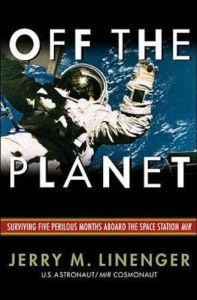
When Jerry Linenger first boarded the Space Station Mir for a five-month stint working with Russia’s finest, the master alarm was blaring. It was a sign of things to come. The aging space station had been continually modified and jury-rigged since its launch and looked nothing like the schematics Linenger was compelled to study in Star City, Russia, and was so unstable that constant user intervention was required to keep it in orbit. Linenger was so used to hearing the master alarm after only a month on board, that when a massive fire that burned so hot Mir itself was melting broke out, he wasn’t disturbed until he saw an entire passageway covered in dark smoke. Off the Planet is one extremely qualified American astronaut’s account of his and several cosmonaut’s months of living in one long emergency. The author is an uber-overachiever — a flight surgeon who trains with Navy SEALS and then becomes an astronaut – -but he’s likable for all that, and writes at a unique time, before the International Space Station became a joint project but when NASA was actively attempting to prepare for sustained cooperation with its former rival.

The mid-late nineties when Linenger was active was an interesting time in NASA’s history: the Shuttle program had recovered from the shock of Challenger and was once again becoming routine, though its work on the International Space Station had not yet begun: the first module would not be launched until 1998, by Russia. Such an undertaking required extensive preparation, and the United States had far less experience in space station operations than Russia: NASA’s two Skylab experiments had been smaller operations, created by using the hull of a Saturn tank. As Linenger quickly learned, living for months aboard a space station required an entirely different temperament than working in active spacecraft like shuttles. Linenger and other astronauts who took turns on Mir (working along with two cosmonauts) were given a crash course in both Russian and the technical specs of Soyuz, Progress, and Mir – – though in the latter case, Linenger found that the station had changed so much that the preparation was useless. Mir in 1997 was…a mess. A literal mess, filled with floating wires, cables, and used containers, despite continuing efforts to evacuate out trash. The onboard systems frequently failed, so inter-station communication was patchy and station-to-ground comms were even worse — and the crew often had to work every day wearing masks to prevent breathing in fumes and metallic particles. Worse yet, Russian ground control was extremely prone to micromanagement, and would often send up new orders on the fly. Linenger and his Russian colleagues were astounded to see the Progress craft that was meant to be burning up in the atmosphere (with their trash) returning to Mir: ground control had decided to test a new docking method without warning, Nevermind that Mir‘s cameras weren’t functioning and that they had no ability to guide the docking, not being able to see a thing. The Progress craft only narrowly missed Mir, and at the speed it was traveling it would have certainly killed the men aboard. Astonishingly, NASA was never informed of any of this, only told that the docking was ‘cancelled’. (Russia also downplayed the massive fire that could have destroyed the station earlier, one that resulted from the O2 containers the men were forced to rely on because of constantly failing environmental systems.) Months later, the experiment was re-attempted and the Progress M-34 did collide with Mir, plowing into the Spektr module and damaging it, a solar panel, and destabilizing Mir as a whole.

When Lineger returned to Earth, he reported being glad he had taken on the challenge, but didn’t enjoy it in the least. Living aboard Mir was five months of continual crisis management and never-ending work: he was even the subject of sleep experiments so that one way or another, he was delivering data 24/7. Off the Planet was enormously educational for me, knowing little about Mir: I was distantly aware of the Shuttle-Mir project, but didn’t know that NASA partially funded Mir modules to keep the Russian space program afloat in orbit. As dangerous and frustrating as Linenger and the other crew’s (American and Russian) jobs were here, I’m glad they stuck it out: learning how to work with one another’s equipment (and manage one another’s bureaucrats) was a necessary part of getting the International Space Station off the ground. If you’re a space fiend, Off the Planet marks itself as a book to find, not only for being a rare look at the Shuttle-Mir project, but also given the author’s unique perspective as a flight surgeon who was distinctly aware of the effects prolonged zero-G was having on his body.

Posted in Reviews | Tagged , , , | Leave a comment

Top Ten Tuesday: Barry and Joey solve a mystery

Today’s Top Ten Tuesday comes from Hope Never Dies, in which Barack Obama and Joe Biden get together to solve a mystery involving a dead Amtrak conductor. Yes, really. It’s goofy but entertaining.

“One call,” I said to my faithful companion, Champ. “Is that too much to ask?” The dog glanced up with indifference. He’d heard it all before. “Just one phone call,” I said. With a snap of the wrist, I sent the dart sailing across the room. It hit its mark, right between Bradley Cooper’s piercing blue eyes. “Eight years.” I plucked the darts from the shredded magazine cover taped to the board. “And not even a gosh-darned postcard.”

Posted in General | Tagged , | Leave a comment

Hope Never Dies

© 2018 Andrew Schaffer
305 pages

Joe Biden is roused by his faithful pooch, Champ, who hears something Nefarious going on outside. Sallying forth to investigate, Scranton Joe finds a lone (well, lone-ish — there are guards) figure standing in the woods waiting for him. It’s Barack Obama, and he has news to deliver. Joe’s favorite Amtrak conductor is dead, and as Obama snuffs out the last of his Marlboro red, they resolve to get to the bottom of the mysterious death. Sure, they’re not cops. They’re not even private investigators. They’re ex-politicians watching world events in impotent frustration, but maybe they can figure out why a good man is dead, and do so without getting themselves in trouble with Jill, Michelle, a biker gang, and — you know, the actual police.

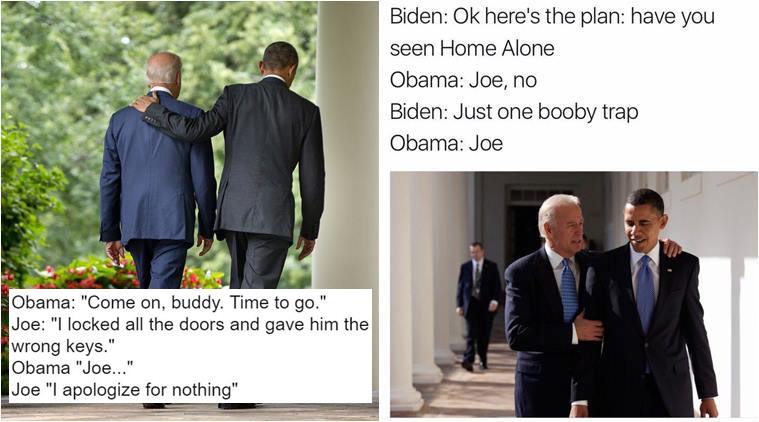
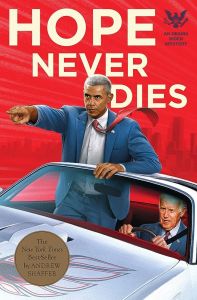
The novel’s cover alone tells the reader that this is a bit of a silly novel, as it has fun with the Biden-Obama dynamic and the inherent absurdity of high-level politicians doing private investigation. The novel opens with Biden brooding over the fact that Obama is off chumming with celebrities and the like, ignoring his former ally and weekly lunch buddy, and while Biden is excited to work with Obama again, he nurses a grudge throughout the story over his belief that neither Obama nor anyone else takes him very seriously. For him, finding out what happened to his friend is personal, so he pushes down his frustration and resentment to sneak through fences and into dodgy motel rooms. The clues keep telling him that his friend was mixed some genuine skulduggery, and Obama is willing to accept that — but Joe knew the man, gosh-darn it, and he’s not prepared to abandon the man to a line in a police blotter.

The book’s main characters are both its primary draw and its main limitation: without Biden and Obama, all of the book’s humor would be gone, and the author would need to work overtime to create the mix of tension and affection that marks much of the book. However, given that they’re political celebrities who most anyone in the United States is familiar with, Schaffer doesn’t have much liberty with their characters, and they overshadow any potential supporting characters – -though there is one who is interesting enough in her own right that a series about her might be worth reading. Despite the book’s main characters being political figures, there’s not that much politics in the novel itself, though when it does pop up it’s either used intentionally for comedic effect (like Obama’s Data-like tendency to lecture people) or can be used unintentionally for comedic effect as readers who have a longer attention span than the news cycle can laugh at Schaffer’s naivete and one-sidedness. It’s purely Biden-Obama fanfiction, though, so that’s to be expected. One non-political example of the authorial Biden protection comes when a secret service agent tells Biden he acted badly toward the service. . Biden’s response is to own up to it and declare that he didn’t want to get too close to anyone lest they actually die for him. It is entirely possible for a guy to be nice Scranton Joe part of the time, and a bit of a jerk part of the time. People are complicated and rarely consistent.

The ideal audience for this book would be people who liked the Obama/Biden memes, because that dynamic is fused here with a basic mystery-thriller. I found it enjoyable light reading, but if it weren’t for the two leads it would need more work to get into. The basic plot is fine — I could see Michael Connolly doing something with it by adding more muscle, better characters, etc — but it’s quick and shallow and largely just follows in the Biden-Obama wake.

Related:
Murder in the Lincoln Bedroom, Elliot Roosevelt. Part of a series of Roosevelt White House mysteries. I read this but didn’t posted a review beyond commenting on the inherent interest of the 1943 D.C. setting. I remember nothing about it except for the mention of temporary housing for all the new office ladies.

Posted in Reviews | Tagged , , , | 6 Comments

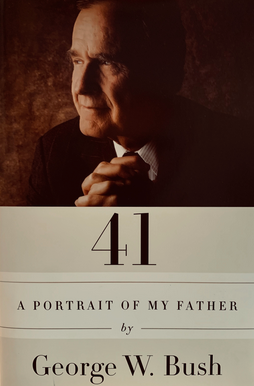
Selected quotes from “41: A Portrait of my Father”

41 is a biography of George H.W. Bush by his son, George W. Bush, and is written with affection, not objectivity. Bush offers that as a disclaimer at the very beginning. This is a tribute, written by a man who was not only the son of his subject, but an ally for decades. Because there’s so much overlap between this and The Last Republicans, I’m not going to precis the book but rather just share some quotations from it. One interesting thing I learned from this, though: George H.W. Bush met Babe Ruth while playing ball at Yale! (Also, fun fact: no vice president has ever pursued and won two full presidential terms. Adams, van Buren, and Bush all lost their reelection bids; Teddy Roosevelt served almost two terms but one of those was McKinley’s, who was shot by a left-anarchist; and LBJ declined to pursue a second term. ) One thing I will take away from this is increased admiration for 41 — who chose to serve in WW2 as an aviator, instead of using his status to escape service or find an easy spot, who struck out on his own, and who erred time and again on the side of principle rather than expediency, courting death threats and boos from his own party as a congressman for his stances against segregated housing and McCarthyism. Bush’s narrative has the usual establishment blinkers.

My grandmother tempered her zeal to win with genuine humility, and she demanded that all her children do the same. She expected grace in victory, good sportsmanship in defeat, and a commitment to “do your best” at all times. She instructed her children to downplay personal accomplishments and share credit with others. And her cardinal rule was that one must never brag. In her view, arrogance was unattractive, and a person with true self-confidence did not need to gloat. “No one likes a braggadocio,” she liked to say.

My father agreed to a first dance but warned Mother it would be the last time he danced in public. Obviously he never dreamed that he would one day have to dance at twelve inaugural balls.

Looking back on it, I can see that the frantic activity was his way of coping with the helplessness he felt. George Bush, the Navy pilot who swam to the life raft and paddled away from death, must have found it unbearable not to be able to do anything to help the girl he loved.

Not every risk my father took in those years paid off. That taught him another lesson: If you refuse to give up, opportunity can arise not only from victory, but also from defeat.

My grandfather considered McCarthy a demagogue and a bully. Prescott Bush was last to speak. “While we admire his objectives in the fight against communism,” he said, “we have very considerable reservations concerning the methods which he sometimes employs.” The crowd booed lustily, but my grandfather was not intimidated. He later rejected a campaign contribution from McCarthy. Years later, when I learned about my grandfather’s stance, I admired his willingness to stand up to extremism. Boston Mayor James Michael Curley once summarized the philosophy of many politicians as, “There go the people. I must follow them, for I am their leader.” Prescott Bush had the courage and integrity to reject that view.

My grandfather’s opponent in 1956 was Thomas J. Dodd, a Democratic Congressman and lawyer. Dodd took a populist line of attack against my grandfather. “I notice Senator Bush seems to have a lot of time to play golf,” he said. “I can’t afford to play golf.” Then someone asked Dodd what his favorite hobby was. He said it was horseback riding. Without missing a beat, my grandfather said, “Well, I congratulate my opponent. I’ve never been able to afford a horse.”

Taiwan lost its UN seat by a few votes, fifty-nine to fifty-five. Several delegates who had promised to support Taiwan either switched their position or abstained from the vote. In a show of sympathy, Ambassador Bush rose from his seat on the floor of the General Assembly and accompanied Taiwan’s disgraced Ambassador, Liu Chieh, out of the UN. They were heckled and jeered on the walk down the aisle. Mother, who had come with Dad to watch the historic vote, remembers delegates spitting at her. The UN, created as an idealistic forum to pursue peace, had become a venue of ugly anti-Americanism.

Mother was infuriated by the negative coverage, and eventually she snapped. After a reporter repeated the latest of many allegations that Dad was a rich elitist, she pointed out that Congresswoman Ferraro and her husband actually had a higher net worth. “That four-million-dollar—I can’t say it, but it rhymes with rich—could buy George Bush any day,” she said. It was a classic Barbara Bush blurt, and she regretted it the moment it left her lips. Mother called and apologized to Geraldine Ferraro, who immediately forgave her. My siblings and I weren’t quite so generous. We took great delight in calling Mother the “poet laureate” of the family.

Throughout his presidency, he had been portrayed on Saturday Night Live by the comedian Dana Carvey, who had honed an impression of Dad that exaggerated his speech patterns, hand gestures, and reputation for “prudence.” To the comedian’s astonishment, Dad called him a few weeks after the election and invited him and his wife, Paula, to stay in the Lincoln Bedroom and then appear at a White House event. The staff was told to gather for an important message from the President. As “Hail to the Chief” played, Dana Carvey walked into the East Room, took the podium, and regaled the audience with his trademark routine. Among other jokes, he created a scene of Dad informing the Secret Service that he planned to go jogging in the nude. The room roared with laughter. The idea was vintage George Bush: He was thinking of others, laughing at himself, and bringing joy to people who were hurting.

“Hi, George, how are you? And there’s Laura. Hi, beautiful.” He lay back contently as Barbara and Jenna rubbed his head. Then he reached out and gently put his hand on Jenna’s pregnant belly. “There’s death,” he said, “and there’s new life.” We all left the room sobbing.

Posted in Politics and Civic Interest, quotations, Reviews | Tagged , , , | Leave a comment

The Last Republicans

© 2017
484 pages

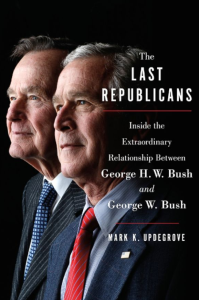
I was interested in reading this book even before my unexpected presidential reading tangent of this last month, in part because of my age: George H.W. Bush was the first president I remember, and holds that title somewhat fixedly in my brain: he is The President just as John Paul II is The Pope, and Elizabeth is The Queen. I came of age during his son’s administration, voting for him in 2004 and then (as I began developing ideas about politics independent of my parents and culture) becoming sharply critical of the expanding police state and the unending war in the middle east: to him I owe both my standing interest in geopolitics and my often strident libertarianism. A joint biography of these two men is somewhat special for me, then, unavoidably saturated with nostalgia from these two formative periods in my life, and the tension that comes from confronting that nostalgia with my adult perspective. It’s an unusual book because of the dual nature of its subject, and their unique relationship: while John Adams was alive to see his son John Quincy take office, he was in his last years during office and could never advise his young scion. Bush paterfamilias and George W., though, were intimately involved in one another’s political lives from the moment H.W. began earnestly seeking an elected office.

The Last Republicans is the story of a unique father and son, whose fraternal bond was made stronger by politics far before Bush the younger ran for office in 2000. Bush senior made history when he became the first vice president to be elected to the presidency since Martin van Buren, and further made history when he saw his son later follow him in office, which had not be done since John Adams’ son John Quincy became the sixth president. Although my grumpy libertarian side would like to dislike George H.W. Bush for his CIA tenure, I’ve never been able to manage it — and I was relieved to learn here that he had no long connection to that organization of spies, coup-installers, and general murderous mischief-makers, but was simply appointed to the top post by President Ford — a bit of a consolation prize for not being asked to join Jerry’s ticket as the vice presidential nominee. George H.W had a difficult time in the Republican party in the late sixties and seventies, as conservatism itself began changing — becoming more militant in response to both Soviet expansion and LBJ’s Great Society, and advancing the fortunes of men like Barry Goldwater, who were not from the respectable Taft-Bush sort of conservatism. The rising neo-cons looked askance at Bush’s breeding, but as I discovered here, he was no mere manor-born son of privilege. He and his wife were azure-blooded, to be sure, but set forth to make their own lives in Texas, where no one cared about their names — raising their small family in modest circumstances. Although Bush would eventually make a fortune in the oil business after learning the ropes as a clerk, he was not content to rest on his laurels and join the boys for cigars and brandy at the club: he was an aristocrat in the Adams-Washington sense, believing strongly in the need to serve the common good. This led him to politics and congressional runs, where his son George — rapidly nearing adulthood — watched and helped his father. Ultimately, Bush senior’s regard in D.C. would grow as a result of appointments (as UN Ambassador, CIA director, etc) before launching him onto the national spotlight alongside Ronald Reagan.

One striking aspect of The Last Republicans is how deeply the Bush children dote on their father: even as they matured into men and women of importance and prominence, they looked on him as a near-demigod. When George W. in his younger years was partying and getting into trouble, all it took from his father was a Look to put the fear of God into him. (George wouldn’t give up the drink entirely until his father began moving deeper into politics: although he’d known he needed to for a while, it was fear of embarrassing his father that really did the trick.) George W. did not have his father’s early drive and motivation: by Updegrove’s account, though he drifted between the worlds of business and politics. As a kid, he dreamt of playing baseball and flying planes, the latter like his father. He ran for office early, and lost (as did his father), but continued to enjoy the challenge and promise of politics despite despising D.C. itself. George W. had an interesting, almost paradoxical realationship with the east coast elite: raised in Texas, he was “more y’all than Yale”, self-conscious and proud about his rural beginning. At the same time, though, he was aware of and accepted his family’s privileged roots — and looked askance at those who were embarrassed about theirs. It was during his father’s presidential runs that George W. committed to politics, pursuing the governorship of Texas and putting him on a path to challenge Al Gore for the presidency in 2000.

As Updegrove tells these men’s stories, he comes back time and again to their father-son relationship. The Bush family was especially devoted to one another because of the death of George’s sister Robin, and her dying goodbye to her family — “I love you more than tongue can tell” — became a refrain when the Bushes were consoling one another, or were facing dire straits like when H.W. was effectively on his deathbed from pneumonia. W’s close attachment to his father only strengthened when he joined the elder Bush on the campaign trail, and their bond increased even further when George W. became president. That office is a responsibility and weight that only other presidents can understand, and the Bushes shared a similar problem with Saddam Hussein, though in W’s case it was more of a potential threat that took on false weight because of the 9/11 environment. (Updegrove uses Hussein merely as a stock villain and does not mention that DC supported his war against Iran throughout the 1980s, which is part of the reason Hussein thought he could get away with invading Kuwait.) George H.W. was, like his son, prepared to rout Hussein’s forces without congressional approval if need be — contra the usual story that H.W. was prudent and his son was impetuous and reckless. Updegrove’s account gives a good impression of how deeply both men sat with the choice to wage war — in George W.’s case, twiceover, and living with the responsibilities when it was revealed that DC’s intelligentsia had mislead the state into war on false pretenses. Though sharing similar burdens and sometimes differing in policy, George H.W. chiefly counseled his son as a father — not giving him advice as a former president, but offering him unwavering emotional support and an open ear.

The Last Republicans is a moving account of their bond, but as its title indicates, it’s not just about the Bushes. Trump is in the the background, always, and Updegrove points out that Trump has been entertaining the political arena for decades, and with a consistent message, and the point of the book is fairly clear: the Bushes were each different kinds of conservatives, George W. being closer to the Goldwater-esque brand that emerged in his youth, but they were in line with the Republican party over the years: they supported DC’s institutions and served as best they could with principle and compassion, believing and working towards the future — a view Updegrove contrasts against Trump’s “dystopian” vision. Updegrove appears to believe that just as the Republican party changed from Bush to Bush that it is continuing to evolve into a party dominated by the more populist nationalism that Trump has consistently championed since the eighties. Populism is an everpresent source of political activity in the United States, sometimes sparking into a roaring fire and then dying away — and while I’m tempted to say that the current populist wave will do that, it’s certainly persisting longer and creating more long-term effects, like the continuing pushback against foreign adventurism. The book ends with an interesting little look at George P. Bush, sometimes considered the next Bush with a bright future in politics, and who is alone among his family in supporting some of Trump’s policies. Although I would have preferred the focus of this book stay properly on the Bushes instead of the author trying to make a political point, they do maintain center stage until the very end. Updegrove’s frequent attempts to insert Trump, some skimming of context, and one fantastically bad misquote* drag down what is otherwise a really good book.

[*] Updegrove has Bush calling Putin on 9/11 to tell him he had better not try to use this as an excuse to declare war on the United States. Not only is this transparently absurd, but if one actually looks for the Andy Card remark this is based on, it’s nothing like that at all.

Coming up: Five Months on Mir, plus more Bush and Biden. I’ve just finished My Name is Asher Lev (what a novel!) but am thinking of posting its review along with a couple of others as part of a Jewish Literature series.

Posted in Politics and Civic Interest, Reviews | Tagged , , , , | 2 Comments

The Fight of his Life

© 2023
416 pages
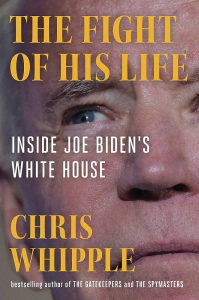
this is a terrible cover photo

“I’ll tell ya one thing, and I’m not ashamed to say it,” to borrow from my favorite Sopranoes antagonist, Phil Leotardo, “but my estimation of Chris Whipple as an author just plummeted. ” His Gatekeepers, a history and assessment of the office of chief of staff to the president, was one of the most informative and interesting books on the White House I’ve ever read, and I remarked that it was refreshingly nonpartisan. The Fight of his Life is not: it’s more like Bush Country: How George Bush Became the 21st Century’s First Great Leader — While Driving Liberals Insane, but written from the other side of the aisle. It’s essentially a retelling of how Biden responded to events in 2020 – 2022 and what he attempted to get done. I read this chiefly because my opinion of Biden became unhealthily charged after he took office, despite my having liked him as vice president, and my being relieved he was the Democratic nominee. Whipple’s account does a good job of reminding the reader of the humanity of the man behind the desk — but not for anyone else. Anyone opposed to Biden’s programs or policies is a Trump cultist, ‘reality-denier’, etc, and I continued reading only because Whipple had astonishing access to both Biden and his first chief of staff, conducting long interviews (in person and over email) with both, and I wanted to get a better sense of the man in office — not just the character in those golden Obama-Biden memes in the final months of Obama’s administration. It’s telling that of the 28 highlights I made in the Kindle version of this, 25 of them had my added notes, usually factual disputes or my snarky reactions to Whipple’s cavalier narrative. Whipple sharply criticizes the vaccine rollout in 2020, for instance, despite the fact that in March and April of that year, everyone was claiming it could be two years before vaccines were ready, and the fact that this was a novel event. I won’t ever argue that Trump’s administration was not disorganized to the point of incompetence, but I don’t know that any administration could have gotten its act together and started mass distribution so quickly and efficiently as to avoid any criticism whatsoever. Whipple also writes that Trump had transformed the Secret Service into some loyalist praetorian guard, so Biden was afraid to say anything around them — but as Ron Kessler noted in First Family Detail, Biden had an acrimonious relationship with the S.S. even as vice president.

The majority of the book sticks exactly to the establishment line, so unless you don’t watch or read any news at all, and hide away from the world in a remote cabin except for the sending the odd letter-bomb, you’re already aware of what Whipple has to say. The most interesting part of the book came at the beginning, where we find Trump and his supporters in denial about losing the election, so much so that there wasn’t a dedicated transition team: only one man (Chris Liddell) in the administration took on that responsibility, and out of feelings of public duty rather than personal preference. According to Whipple’s account, he wanted to resign repeatedly, especially after January 6, but was urged to remain to “land the plane”, so to speak. Despite Trump’s intransigence and general unhelpfulness, Liddel and the Biden team were able to get the next administration off smoothly on January 20. My next favorite part was Biden telling Putin he’d looked him in the eyes and believed he had no soul, and Putin responding, “We understand each other.” I don’t know if that’s remotely true or not (it sounds too similar to Bush looking Putin in the eyes in 2000 and believing they could work together), but it sounds hilarious. Anyhoo, if you watch CNN or read The Washington Pravda, you already know the majority of what Whipple has to say and how he feels about it.

This book has its merits — Biden trying to use his struggle about his own son’s death to minister to suffering parents, for instance — but they’re overshadowed and marginalized by Whipple writing purely for the MSNBC Book Club.

Posted in Politics and Civic Interest, Reviews | Tagged , , , | 2 Comments

Wednesday blogging prompt: a job I’d be bad at

Today’s prompt from Long and Short Reviews is “A Job You’d Be Bad At“.

I hate when my attention is demanded, especially by some electronic doo-dad.  Call it mindfulness for fixation, but I prefer doing one thing at a time: working on something intently, or reading something intently. I want to be focused, not made to bounce from thing to thing. My phone lives on silent mode,    notifications are disabled for nearly every app on it, and notifications are disabled for everything on Windows that I can find.  I truly,  madly, deeply hate dings and buzzes and the rest of the inescapable cacophony of modernity. I would make, therefore, a very unhappy president of the United States. (That’s assuming I got past the smiling glad-handing stage, which is unlikely. Making polite and meaningless smalltalk in uncomfortable clothes under fluorescent lights for decades? It’s a vision of hell!)

Posted in General | Tagged | 7 Comments

A tease, a tease, a Tues-day tease…

From The Last Republicans:

Afterward, the president-elect, Barbara, George W., Laura, and Barbara and Jenna boarded Air Force One to return to Washington. If Barbara Bush had any glamorous illusions about her new station as first lady in waiting, they dissipated when she rolled up her sleeves to remove wads of toilet paper her seven-year-old twin grandchildren had mischievously jammed into one of the plane’s toilets.

And from The Fight of his Life: The Biden White House:

Presidential transitions are herculean exercises. That’s why Biden’s team needed to start so early. More than 200 members of the incoming White House staff needed to be picked and readied to govern; 1,200 officials chosen and prepped for confirmation by the Senate; another 1,100, who don’t require confirmation, recruited, vetted, and hired; executive orders written, tabletop crisis exercises conducted. Kaufman explained: “If you went to a corporate CEO and said, ‘We’re going to take away the very top managers in your organization. And then we’re going to bring in a whole new team that has to go through an incredibly complicated selection process. Now let’s make it the most complex organization in the history of the world. And then let’s say that every one of your enemies around the world knows you’re at your most vulnerable when you’re turning it over.’ Are you kidding? They’d laugh at you.”

Yes, I’m afraid the presidential kick is still ongoing.

Posted in General | Tagged , | 2 Comments