We Will Prescribe You a Kitteh

Exploring Japanese literature has been a thing for me this year, and We Will Prescribe You a Cat is the latest in my explorations. It’s easily the strangest of the Japanese literature I’ve read this year, with an increasing level of surrealness that continues until the collection’s end. In structure, it reminds me very much of What You are Looking For is in the Library, as we begin with a series of short stories about people who have find themselves in a troubled time of life visiting a place they’ve been told might have answers — a clinic for the soul. Upon arrival, they are given…a cat. And a prescription for how to deal with said cat — feeding direction, notes about behavior. That’s all. Invariably the cats have some effect on their hosts: one man who hates his job but won’t admit it is sacked after the cat makes him late; another man who felt isolated at home, ignored and considered irrelevant by his family, finds in the cat a way to mix things up and come together again. As with What You are Looking For, as the book progresses we see characters in one story becoming part of another’s, but — there’s increasing surreality, too, as characters encounter The Doctor and The Nurse outside the clinic, only they don’t act like themselves, and they have no idea why people are confusing them for other persons. The clinic, too, is a mystery: sometimes there, sometimes not. It gets progressively weirder. I enjoyed this collection well enough, though the stories didn’t overwhelm me the way What You Are Looking For or Before the Coffee Gets Cold did. Serious cat people may enjoy it more than I did: I like cats but am definitely on the doggo side of the line.

Posted in Reviews | Tagged , , | 5 Comments

Social media: frenemy or foe?

Today’s prompt from Long and Short Reviews is “What are your thoughts on social media”, which is an interesting topic for me because I think about it quite a lot and consider myself a minimalist in regards to its use. I was lucky enough to read Neil Postman at an early age, particularly his Amusing Ourselves to Death and Technopoly, which made me aware that technology is not neutral — that it carries its own meanings sometimes. The idea that smart phones exist, for instance, allowing us to be contacted any time, lends itself to the idea that we should be contactable at all time — and the ability to share any and everything hastens this idea that everything can and should be turned into a sharable experience. Dave Eggers takes this attitude towards its logical extreme with the motto of his social media uber-company, The Every, in the book of the same name: Sharing is Caring, Privacy is Theft, Secrets are Lies.

I view social media as something that can be used in positive ways, but which has an inevitable orientation towards unhealthy behavior. I think someone has to be aggressively mindful to use social media is only good ways: for instance, I curate my facebook feed so that I’m only seeing updates from organizations I’m genuinely interested in, as well as my closest friends and family — and even some of them don’t make the list, because they post bumpersticker memes all day. I think ‘normal’ social media use deforms us in ways, making us too focused on things that don’t matter, and allowing our worse selves — angry selves, mopey selves, despairing selves, vicious selves — to dominate, because the nature of The Feed fertililizes and waters those selves far more easily than our better, disciplined angels.This is why my reddit feed is also curated so that I’m only following innocuous topics like PC gaming, bird photography, and the like — staying well clear of politics, though some people in literary subreddits love to introduce it.

Even when we’re chasing good things — trying to capture and share a wonderful experience — I fear we do it so much that we cheapen the experience, that seeing something wonderful becomes less of a soul-moment and more of a work moment, so that it becomes perfunctory, almost obligatory. Think of a concert full of people with their phones raised, more vested in Capturing the Moment than experiencing the moment — or someone who visits a cathedral like St. Augustine in Santa Fe, and instead of sitting in silence and letting the awe penetrate their marrow, instead goes around taking pictures of every single window and bob of decoration because It Has to Be Captured. Erich Fromm has written on this a bit in his To Have or To Be — not on social media, obviously, but the underlying impulse. I also make it deliberately harder for myself to access social media by not having any apps on my phone save for Instagram. All the foregoing, mind, is purely about the one-on-one experience, to say nothing of the way that phone addiction — which is often social media addiction — has completely transformed (i.e. brutally beaten into oblivion ) social occasions. I’d say call me a boomer, but these days the older adults are as bad as the kids about staring at phones while in company — or answering the phone at a table with people.

Anyhoo, if you are interested in this topic, I would recccommend Freya India’s piece on how social media use changes us, her piece “The World We Never Knew” on Gen-Z’s nostalgia for a world before chronic hyperstimulation, as well as books like The Chaos Machine or Hamlet’s Blackberry.

Posted in General | Tagged | 4 Comments

Top Ten Book Covers of 2024 – So Far

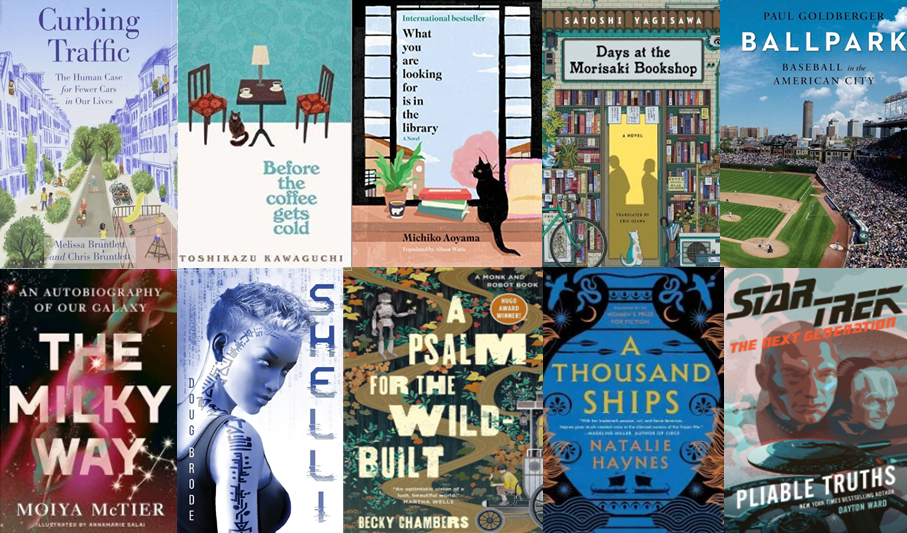
Today’s TTT is books with our favorite color on the cover, but I don’t have a favorite color, so I’m just going to go with my favorite covers for the year. But first, teases!

“This is interesting, meeting you here,” said Madred.
Placing his spoon next to his bowl, Garak clasped his hands on the table. “It was my understanding that being forced into exile meant never having to see people I don’t like. Leave it to Central Command to fail at something so simple.” Star Trek: Pliable Truths

A collage of ten book titles with diverse art styles,  depicting a cityscape, several striking scenes in Japan,  a ballpark,  and the cosmos. The book titles are "Curbing Traffic", "Before the Coffee Gets Cold", "What You Are Looking For Is in the Library", "Days at the Morisaki Bookshop", "Ballpark", "The Milky Way", "Shelli", "A Psalm for the Wild Built", "A Thousand Ships", and "Star Trek: Pliable Truths".

Mythos by Stephen Fry almost made it. I was eying Milky Way before deciding that I liked the collage better with that flash of red-purple.

Posted in General | Tagged , | 22 Comments

June 2024

Well, 2024 is half gone. My reading this year has been unusual — lots of novels — but quite enjoyable, with a lot of five-star titles. Trying to create my top ten list for the year in December will be difficult!

Classics Club:
Dune, Frank Herbert. And that the “Classic SF” section of my list done! I’ve read two CC for the year, so I’m really doing rather abysmal.

Science Survey:
8 of 12 categories filled, 10 titles read so far.

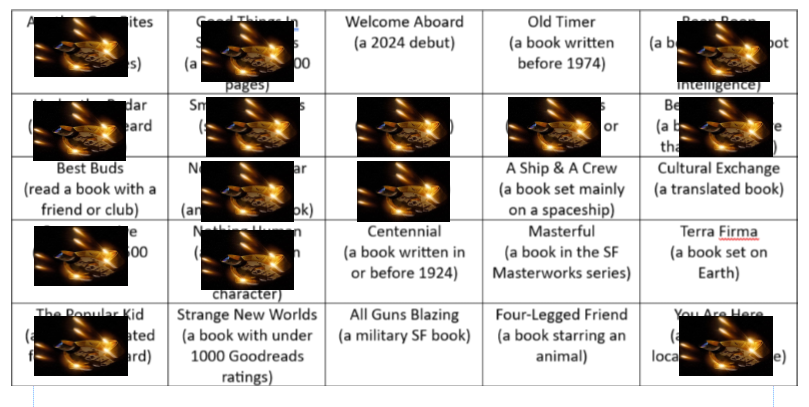
SF Book Bingo:

The Popular Kid: A Book Nominated for the Hugo Award. Psalm for the Wild-Built, winner of Hugo award.
Better Together: A Book with Multiple Authors. Counting the Dune adaptations for this.
Nothing Human: A Book with an Alien Main Character. ST Pliable Truths begins with a Bajoran lead whose viewpoint is woven through the book.
Supermassive: a book over 500 pages. Dune, of course. Was going to use it for the Masterworks slot but I plan on reading le Guin this year and she has several.
Free Space: ST Burning Dreams. Or maybe I’ll use it for Four-Legged Friend….Pike talked about his horse a lot.

The Unreviewed:
I’m going to short-round Scarcity Brain and We Will Prescribe You a Cat.

Coming Up in July:
No firm plans, to be honest. I usually do a nod to the American Revolution, plus Space Camp, but I’m weary/wary of politics and am running out of astronaut books (I’ve read over fifty of them at this point). I’m tempted to do a Blast from the Past repeat: that was a fun way to bridge July & August last year.

Posted in General | Tagged | 11 Comments

Moviewatch: June 2024

Apocalypse Now, which was…..different than I was expecting. Of course, I’ve seen Sheen’s son Charlie in Platoon and my Vietnam movie knowledge is very muddled.   Wonderful shots in the beginning, though:  as horrible as war is, they managed to make Hueys flying to deliver death beautiful. 

Mighty Aphrodite, 1995. Woody Allen is improbably married to Helena Bonham Carter, and they adopt a child who is so intelligent and charismatic that Woody feels compelled to seek out the mother. He finds that she divides her time between being a hooker and a porn actress, and — horrified for her and his son — befriends her with an eye toward helping her find a better life for herself. His growing emotional bond with the mother is happening at the same time that he’s increasingly alienated from his wife, who — again, improbably — is seduced by Peter Weller and focused solely on her career to the diminishment of everything else. (Woody is a sports writer, but is wholly focused on his family: we rarely see him on the job.) There is a recurring Greek chorus led by the singular talent that was F. Murray Abraham. My favorite Woody Allen movie to date, and I doubt it will be surpassed.

Trainspotting, 1996.
Friend: Hey, you like trains, right? And movies about trains?
Me: Oh, yeah! Loved Unstoppable. Great movie.
Friend: Let’s watch Trainspotting.
Me: Ok!
(an hour later)
Me: ….we’ve only seen like one train in this and it was a passenger car, not even an engine. This is just a bunch of Scottish dope fiends ruining each other’s lives. And there’s a dead baby!
Friend: (evil laugh)
Me: Let’s watch something funny tomorrow night. -_-

All the Boys Are Called Patrick, 1957.
A French horndog picks up two girls and makes weekend dates with them. They’re roommates. They find out.. Short film, an early Goddard.

The Thin Man, 1934. Oddly funny noir murder mystery. A young Cesar Romero shows up, looking more sinister than dashing. 

Love Lies Bleeding, 2024. Very violent thriller in which Kristen Stewart, whose father Ed Harris is a murderous criminal of some kind, falls in love with a female bodybuilder named Jackie. Their plans to visit a bodybuilder competition in Las Vegas are derailed after Stewart’s brother-in-law beats her sister up so badly that she’s hospitalized, and then Jackie — under the influence of steroids — absolutely destroys said brother-in-law’s skull in a graphic way. Stewart then makes the rash decision to dispose of the body in such a way as to draw attention to daddy dearest’s favorite dumping ground for bodies, which leads to lots of drama and casualties. Definitely riveting. My first time seeing Stewart: I know she caught a lot of flack for her acting in the Twilight movies, but she must have improved since. 

Dune, 2021. Beautiful interpretation of the first third of the book. My mental version of Paul was more like Christian Bale or young Keanu Reeves (Devil’s Advocate Reeves, specifically)

El Topo, 1970. I have no idea what this movie was about because it was in Spanish and had no subtitles, but a friend who was supposed to join me and a mutual friend to watch Dune was late, so we convinced him that this movie set in the desert with credible approximations to Paul and Lady Jessica was Dune. We spent the next hour spontaneously interpreting every scene in the context of Dune, like my pointing out the southwestern  fauna and emphasizing any mention of saguaro in the book,   It was hilarious.   I talked to our victim on Monday and he said he assumed since he was late, we’d started watching the original one first, and he had no idea what it was like so he just rolled with it.He’d figured it out by the time  the six-shooters and horses appeared.  (“Oh, well, yeah. In the seventies movie they were doing a space western setting, sort of like what they did with Firefly..”)

Dolemite, 1975.    Described to me as  hilariously bad, this one….was interesting. Our main character is a pimp and all around toughguy in LA, who is set up for an arrest so that his rival, a full-fledged criminal kingpin, can take over his club.   City cops are completely corrupted and in bed with the kingpin, but another party is interested in using Dolemite to expose them.  Dolemite is released and manages to get the baddies with help from his squad of karate-master club girls.   There’s a lot of great cars in this movie. Evidently, it was based off a character the main ‘actor” (he’s better than The Amazing Criswell but that’s as far as I can go) invented for his stand-up routines in which he tells stories in rhyming couplets.  Not a film to rewatch, but I enjoyed the cars, the music,  the frequently bad acting & directing, and that glorious mid-seventies fashion that could leave nothing to the imagination or absolutely boggle it. Why were so many people wearing mounds of furs in LOS ANGELES? 

What’s Up Doc, 1972. My introduction to the very striking Barbara Streisand. She plays a prototypical manic pixie dream girl who begins stalking a musicologist whose travel bag is the same as three other people’s — bags including lots of jewels, secret documents, and misc crap. Leads to a gloriously madcap comedy with an absolutely chaotic ending . Great writing, and SF was a wonderful city to stage auto chases in. 

Tremors, 1990. After I mentioned I’d watched Dune, a coworker said “I prefer the sand-worms in Tremors.” Upon learning that I’d never watched it, she gave me a 4-disc set with orders to watch at least the first one. Fun horror-comedy in which rednecks are the heroes. My country favorite Reba McEntire is a supporting character as part of a husband-wife prepper team. I never knew how much I needed to hear Reba talking about rifle and shotgun gauges. “BROKE INTO THE WRONG (GORRAM) REC ROOM, DIDN’TJA?!?!”

Sunset Boulevard, 1950.  Gloria Swanson, a movie star from the 1920s, plays Norma Desmond, an aging moving star from the 1920s who in 1949 has an idea to re-ignite her career: having a struggling writer edit her massive script for a personal biopic. Although he thinks it’s irredeemably awful,   working for her means living in a mansion with endless trinkets and clothes, and even though he’s at first offended by the notion of being kept like a pet,  his integrity is fighting a  hard battle against comfort. Ultimately, things don’t end well. The movie has one of the most famous lines in cinematic history.  Fascinating look into late ‘40s Hollywood, with a strong acting cast. 

Fannie Hill, 1964. The story of a sweet girl who gets connected to a brothel but somehow manages to survive two hours to the end of the movie without being deflowered until she’s married. Friend of mine wanted to watch this because it was Russ Myers, who he likes.

Faster, Pussycat! Kill! Kill!, 1965. Another Russ Myers film. Three crazy hotties who are into racing sports car murder a dude and then kidnap his girlfriend and drive into the boonies where they catch wind of an old handicapped man with a buried fortune and a mentally impaired son and decide hey, this guy is ripe for the plucking. Things do not go according to plan.  Beautiful cars, fun music.  Sleazy. 

Wilde, 1997. Stephen Fry plays Oscar Wilde in a biopic which also features Jude Law and Ioan Gruffud. I still prefer Jude Law in All the King’s Men, which has also monopolized my appreciation of Sean Penn.. He can only ever be Willie Stark.


Posted in General | Tagged | 7 Comments

Midyear Book Freakout

I saw this floating around the book-blogging world, so I figured I’d play along. 2024 has been a most unusual year, as long-time readers may know. I’ve been reading “in public” for seventeen years now, and while my approach to reviews and my opinions on certain ideas and topics have changed, the one great consistency is that I always read far more nonfiction than fiction. Some years nonfiction is ahead by 30 points! This year, however, fiction is leading at 56%, which is …interesting. Part of that owes to grad school and work stress, but I’ve also been loosening up in general the last year or so, and perhaps exploring the world of fiction beyond science fiction and historical military fiction is part of that. At any rate, it’s led to my finding quite a few new blogs this year, which I’m enjoying. As far as my annual projects go: the science survey is quite healthy, with 8 out of 12 categories filled, and my Classics Club reading is….dismal, with only two books for the year. Ebooks are well ahead of print media at this point, accounting for 62% of my reading to date.

I’m testing the table of contents block, which I had no idea was even a thing until I saw it over at Dark Shelf of Wonders.

  1. Best Book Read This Year:
  2. Best Sequel I’ve Read this Year:
  3. New Release You Haven’t Read Yet But Want to:
  4. Most Anticipated Release for the Second Half of 2024:
  5. Biggest Disappointment:
  6. Biggest Surprise:
  7. New Favorite Author:
  8. New Favorite Character:
  9. Book That Made You Cry:
  10. Most Beautiful Book You’ve Bought or Received This Year:
  11. What Books Do You Need to Read by the End of the Year

Best Book Read This Year:

Honestly, I loved What You are Looking for is in the Library.

Best Sequel I’ve Read this Year:

Warbow, Wayne Grant. I really liked falling into this medieval adventure series featuring a young bowman out to serve his lord and avenge his murdered father.

New Release You Haven’t Read Yet But Want to:

Anxious Generation, Jonathan Haidt, on mental illness & Gen Z.

Most Anticipated Release for the Second Half of 2024:

Living in Wonder, Rod Dreher. On disenchantment and reenchantment.

Biggest Disappointment:

Video Game of the Year, Jordan Minor. Not only were PC games consistently short-changed (including Civilization, Half-Life, and Starcraft), but several insignificant games were spotlit and there were a lot of irrelevant tangents.

Biggest Surprise:

How to Stay Married, the memoir of the author Harrison Scott Key and his wife working through the discovery that she was having an affair. I went for it because it received high praise from one of my favorite authors, and I’d just read Key’s memoir about growing up in rural Mississippi and enjoyed it. As a chronic bachelor I was surprised by how intense this was.

New Favorite Author:

Rachel Joyce!

New Favorite Character:

It’s hard to choose between Harold Fry, The Major, and Amelia from The Storied Life of A.J. Fikry.

Book That Made You Cry:

Men only cry at their mother’s funeral, their daughter’s wedding, or at the death of a dog. However, The Unlikely Pilgrimage of Harold Frye and How to Stay Married were both emotionally powerful.


Most Beautiful Book You’ve Bought or Received This Year:

If we’re talking about the beauty of the book’s contents, How to Stay Married was for me a testament to how challenging and meaningful love can actually be. What You Are Looking For Is in the Library is probably the prettiest cover.


What Books Do You Need to Read by the End of the Year

The Classics Club list is in dire need of attention. I’ve only managed two this year.

Posted in General | 5 Comments

Recoding History

A few years ago I read Broad Band, a history of women in early computing, which blew my mind. I’d taken for granted that computers and the early internet were wholly the domain of socially awkward dudes with glasses wearing pocket protectors and that only later had women begun exploring it. Instead, Claire Evans drew back the curtain and revealed how early programming was dominated by women, creating foundational programming languages like COBOL. Recoding History is a different approach to the same general subject, with a lot of overlap in the women it highlights, but very much worth experiencing for IT history geeks given that it’s not an author reading a history: it’s recordings of the women themselves, telling their own stories, either in interviews, lectures, or other recordings. Broad Band made me an instant fan of Admiral “Amazing Grace” Hopper, and I was delighted to hear her speak here. Recoding is a little broader in the women it highlights, as Broad Band had a focus on women who contributed to the Internet. Here, we meet women whose work support NASA’s mission, from designing rocket trajectories to creating the software that allowed lunar landing, or — away from the coding side and more into business management — had visions that led to products like the Palm Pilot. In addition to the quality recordings, this presentation has some background effects which I thought were a nice, subtle addition. The book ends with the designer of the first vocal robot, and offers her reflections on the world of AI. As a fan of IT history, I enjoyed this for the most part: the business-oriented chapters were less interesting to me than the tech, of course, but I know that sort of thing has its audience, and those who are mentoring young girls and want them to be ambitious builders of the future will definitely want to take a look at this as a possible spark for inspiration.

Posted in history, Reviews | Tagged , , , , , , | 1 Comment

ST: Pliable Truths

After a half-century of vicious occupation, the Cardassian Empire is finally cutting bait and withdrawing from Bajor, pushed by aggressive resistance movements. The Federation has been asked to meditate the terms of a peaceful withdrawal and settlement and has asked Picard to employ his delicate touch. This is not easy for the captain, so recently tortured by the Cardassians to obtain intelligence for a military attack they later aborted — but Duty compels. Pliable Truths is an excellent bridge novel that links TNG to DS9’s beginning and accomplishes a few minor coups like explaining how O’Brien transitioned from transporter dogsbody in TNG to Deep Space Nine’s chief engineer.

Pliable Truths opens with two concurrent and gradually intersecting stories. As the Enterprise crew begins working with the new Bajoran government and militia to repair Terok Nor — which is to host the peace conference — a group of Bajoran prisoners on a planet removed from maps by the Cardassian military learns that their labor camp is hiding a secret science lab, and that the Cardassians have orders to destroy every portion of the camp rather than risk the returning prisoners’ drawing any attention to the planet. Doctor Crusher and Keiko O’Brian are also investigating some water pollution near a labor camp on Bajor, while Garak verbally spars with everyone to my constant glee. Meanwhile, a series of terrorist incidents and acts of sabotage hinder efforts to repair the station and stabilize Bajoran-Cardassian relations, setting the stage for its shambled status in “Emissary”. The result is a good mix of different drama — personal, political, espionage, and direct combat. and they’re not strictly separated: the Cardassians send Gul Madred to upstage Gul Dukat and at the same time rattle Captain Picard, as Madred had literally been torturing Picard a few weeks prior. There’s also an excellent mix of TNG and future DS9 characters, though admittedly O’Brien is both so that’s cheating a bit. Still, any book that has both Kira and Ro is a winner even though they don’t get to be surly action heroes together.

As a die-hard Niner and a longtime reader of Dayton Ward, I expected to like this novel and wasn’t disappointed. Characterization was solid, the drama was varied and well-paced, and Ward does a good job of portraying the Bajorans’ mixed feelings over the Federation’s presence without beating the reader over the head.

Highlights:

“I read her the story she likes, but she told me she likes the way you read it better.”
“That’s because you don’t provide the sound effects. Or the music.”

“It’s no surprise that victory over an opponent allows one to craft whatever version of facts they feel best serves them,” said Picard. “It could be as complex as the history of one civilization’s subjugation of another, or as simple as determining how many viewing ports are set into that bulkhead.” He pointed to the quintet of windows dominating the wardroom’s far wall before leveling his gaze at Madred. “Are there five ports, or only four?” Picard watched with satisfaction as the Cardassian’s smile faded, replaced by a look of irritation before Madred leaned back in his seat.

How many lights do you see?

“This is interesting, meeting you here,” said Madred.
Placing his spoon next to his bowl, Garak clasped his hands on the table. “It was my understanding that being forced into exile meant never having to see people I don’t like. Leave it to Central Command to fail at something so simple.”

Related:
Day of the Vipers, Night of the Wolves, Dawn of the Eagles. The Occupation trilogy.
DS9 Millenium Trilogy, in which something that happened on the Day of Withdrawal is a key piece of the books’ plots

Coming up….kitties by prescription, hopefully a volcano, and Roman legal history.

Posted in Reviews | Tagged , , , | 2 Comments

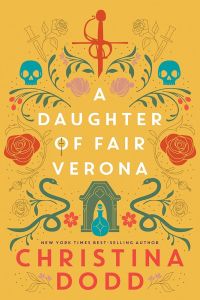
A Daughter of Fair Verona

The Tragedy of Romeo and Juliet was a cautious tale about the dangers of pride and unbridled passion. A Daughter of Fair Verona says phooey on that, tweaks Shakespeare so that our teenage lovers prove too incompetent to actually do themselves in, and instead live to marry and beget a litter that Abraham and Sarah would nod approvingly at. Romeo and Juliet’s oldest is the fair Rosaline, who — yes, is named after the girl Romeo was lusting for when he showed up at the Capulet party that night. Rosie has been betrothed four times in the past, but each time has managed to escape uninspiring men by marrying them off to someone else. Now, her parents have arranged a wedding with her and the foul Duke whose previous three wives all mysteriously died after he’d spent their dowries. Why? Well, this is Renaissance Italy, where family politics are particularly vicious. Fortunately, at the betrothal ball, the Duke developed an acute case of knife-in-chest — but now everyone thinks Rosie did it, mostly because she had a knife up her sleeve in case the Duke got fresh. Although the Prince vouches for her innocence, Rosie must discover the true killer to restore her name and save herself from those who might seek to avenge him. It’s a quirky take on Shakespeare with appeal that I imagine varies a lot on the audience.

This title caught my eye almost immediately because I have a particular fondness for The Sims 2 and one of its neighborhoods, Veronaville, in which players can retell the drama of Romeo and Juliet for themselves — or not. I have a “Sims 2 in Sims 4” save and have recently been replaying it, and so Verona was on my mind when I spotted this being cataloged. It’s a hard book to classify: it’s historical fiction, I suppose, but with a very loose Renaissance setting, with no real politicians or events to anchor it. The plot is straightforward: headstrong female protagonist gets betrothed, gets a messy escape when the boorish fiance dies, and then has to solve the mystery for various reasons At the same time, Rosie has fallen in love for the first time, at the advanced age of twenty — and inexplicably, she’s fallen for a silly ass from a rival family named Lysander. She finds some support in her cause from the Prince, who takes her intellect seriously (and who harbors a crush on her that’s obvious to the reader but which Rosie remains oblivious to), as well as pushback from those who don’t think this is any kind of business for a respectable woman to be involving herself in. The ending offers quite the twist, at least as far as the culprit goes. As is appropriate for a book inspired by Shakespeare, there are a few double entendres and a lot of Bard quotes, not necessarily from Romeo and Juliet itself. However, the language is almost wholly contemporary, as is the general feel of the book. There’s a fair bit of humor in here, either from the wordplay or Rosie’s exasperation at her parents’ constant pawing at one another.

I enjoyed this for the most part, though I began losing interest in the last third except for wondering that direction Rosie’s love life would go: her attraction to the pretty fool Lysander was inexplicable to me when the Prince was there being all Byronic, but as Mickey and Sylvia observed: love is strange.

Posted in historical fiction, Reviews | Tagged , , , | 5 Comments

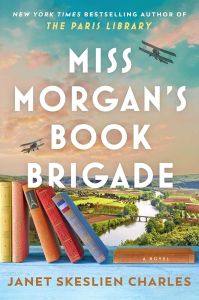
Miss Morgan’s Book Brigade

France, 1918: the Great War is almost over, but it doesn’t feel like it for civilians close to the lines, where the threat of a German resurgence hangs as close to the battered ground as the dust from the constant artillery. Two American socialites, Anne Morgan and Anne Murray Dike, have formed an organization of women to go to France and offer aid and assistance to suffering French civilians — people whose villages are razed, whose lives were destroyed. Among their number is Jessie “Kit” Carson, a librarian who intends to help establish children’s libraries in rural France. Her story is discovered over sixty years later by another librarian, Wendy Peterson — who finds articles about her in the NYC’s archives and is immediately obsessed, finding in the “CARDs” — the volunteer women — her inspiration to write. Miss Morgan’s Book Brigade tells each of their stories in turn, with alternating chapters. Through Jessie, we explore French civilian life amid the war, and find people struggling: they’re tired of death and war, haunted by their losses — and Jessie does her best to offer them reasons for hope through literature. Wendy’s journey involves archival detective work, where we learn about the CARDS and the two Annes in a more direct way. The result is enjoyable, but becomes all the more impressive after the revelation that Jessie is real and she transformed French library science.

Where this most succeeds is sharing the story of the two historic Annes and the real organization they formed together. as well as revealing how much of the Great War still marks France. I didn’t realize there are still exclusionary zones where human activity is forbidden due to the amount of poisonous or unxploded ordinance still buried there. Kit’s story is easily the better of the two threads in the book, as she works diligently to make a difference in the lives of those around her with literature, even in the midst of a war: through her we experience its final year, which was not a slow die-down but just as harrowing as the opening year, as Germany launched a spring offensive that seriously challenged the Entente powers. Despite the setting, though, I couldn’t quite buy the historicity — it didn’t feel like I was in 1918: Jessie and Wendy both feel like the same character, a thoroughly modern Millie, albeit with more interest in romance on Wendy’s part. (Speaking of, there are some quick but awkward sex scenes in here. I don’t think they add anything.) Not helping is the fact that even though Jessie speaks French, most of the titles she recommends are Anglo-American, with the exception of a Dumas title.* Granted, they’re all great titles (Tom Sawyer, Anne of Avonlea), and yes, she’s writing for an English-speaking audience who are probably oblivious to the world of French literature, juvenile or otherwise — but it sapped historical immersion for me, as did mentions of bombing raids and the American airman, who is sometimes a pilot and sometimes a mechanic.

The arrival of the Spanish flu did begin to build some historic tension (slightly spoiled by the author trying to work in some painfully obvious corona connections), as does the librarian characters arguing about the open-stack system in which patrons could browse and borrow at will, instead of requesting a title from the catalog and waiting for a librarian to achieve it. (This was a culture shock for me in reading The Many Loves of Dobie Gillis, learning that the stacks were closed!) I love the central idea of one person finding connections to another across the decades: it looks like the author has played with that in at least one more of her books, and according to the epilogue it was the author’s research for that book that led to this one. There were some standouts here, like the young French girl Marcelle who doesn’t hesitate to correct her “betters” French, who Kit mentors, and she plays a prominent part in bringing the novel to a close with a wonderful finish, one that bumped this up in my estimation.

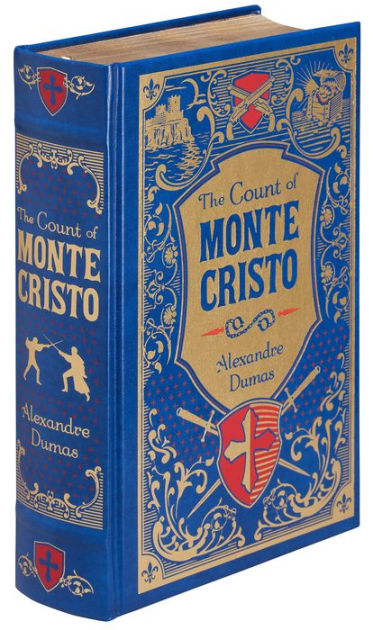
[*] My favorite moment is when a soldier slid a paperback copy of The Count of Monte Cristo in his shirt pocket. Have fun with that.

Related:
The French Connection“, American Libraries
Brief Wiki article on Jessie

Posted in historical fiction, Reviews | Tagged , , , , , | 1 Comment