Last year I closed out July with a special week of themed reading called “Blast from the Past”, in which I visited 1990s kidlit — or, in the case of the Henry & Beezus books, books I happened to read in the 1990s. It was mostly prompted by my desire to re-read the Matthew Martin books, but I enjoyed the week enough that I’m revisiting it. Consider this the totally tubular sequel — and a friend of the blog lent me a box of her childhood books, so I’m going to be reading some of what she read. In the spirit of sequels, I’m going to quote myself from last year, as I used up my ability to recall ’90s slang:
If you didn’t have the good fortune to be a kid in the nineties, this week’s postings may be wack or even lame but for readers my age, or for those who were otherwise exposed to these series (or shared them with your own mini-me’s), hopefully this will be a fun ‘blast to the past’. So…stick a straw in your CapriSun, grab your Fruit by the Foot, take off your sticky candy ring, and settle in for some reading that’s all that and a bag of chips. Feel free to share your own fun kid reads, especially those that were da bomb dot com.
(As far as I know, there are no ducks in the books I’m reading. The title references one of my very favorite movies growing up, D2: The Mighty Ducks. There’s a great sequence where the Ducks realize they’re in a sequel and have to get the band back together…)
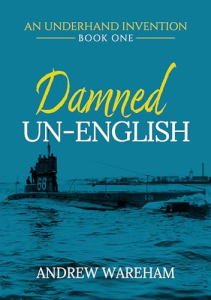
Yesterday I finished Damned Un-English, a novel about a fellow who joined the submarine service in the early 1910s and…er, just spends the novel talking to people about the big European war that’s looming. Interesting technical details, but the plot and characters were marginal.
WHAT are you reading now?
Fires of Vesuvius, Mary Beard. An examination (archaeological, historical, geological) of the Vesuvius eruption that destroyed Pompeii and other areas. I had no idea Pompeii had been hit by an earthquake a decade or so before, with much of its damage still lingering when the volcano began raining pumice.
WHAT are you reading next?
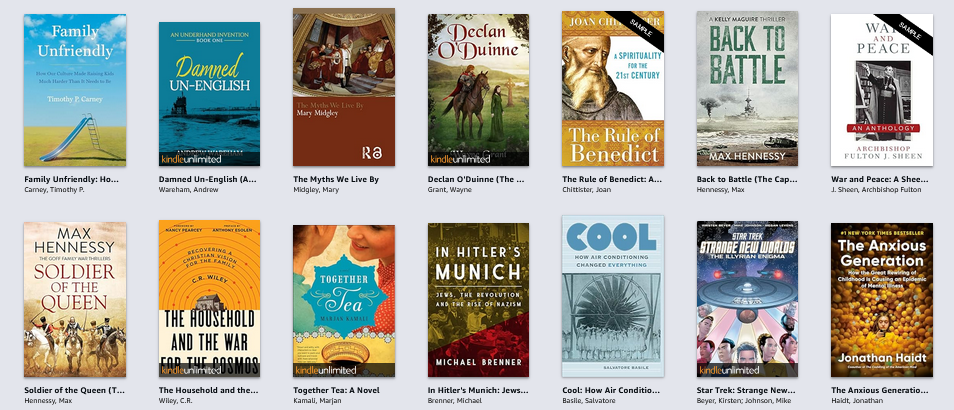
Oh, lord, who can say? I meant to kickstart Blast from the Past II, but keep dithering. Here’s the ol’ Kindle bookshelf at the moment:
Most probably, I’ll finally tackle-finish that volcanos book (Mountains of Fire) I’ve been pecking at for a few months.
“War, Gilbert? Are we going to have one? Shooting a few fuzzy-wuzzies out on the Frontier again?” “In Europe, Sidney. You know, that place the other side of the Channel?” “What do we want to get involved with them for, old chap? Full of Frogs and Proossians, ain’t it?”
Gilbert Maltravers, of His Majesty’s Ship Hindustan, has just been promoted to full lieutenant and has decided to jump ship. The Hindustan, anyway, not the Navy, though he has his doubts about his future there unless there’s a war. Gilbert has his eye on the growing submarine fleet, which appears to him to be where the action will be in the next war, not on Victorian relics. Speaking of, there are a great many Victorian relics in the Admiralty, who (in Wareham’s rendition) are utterly oblivious to the facts of modern navies: they expect the submarine crew to be armed with cutlasses for taking prizes, despite the fact that the submarines barely have room for their crews and basic equipment. Damned Un-English is set in the years leading up to the Great War, and as such contains almost no action beyond practice exercises: the book consists entirely of Gilbert learning about the service, being lectured to or lecturing others, and occasionally having stilted Regency-style conversations with his family and finance Miriam about his wicked brother or the future. Gilbert appears to be possessed by a specter from the future who not only knows that war is coming, but knows in great detail how it will play out — including the collapse of Russia and that it will be not only a general European war, but one with global scope despite a humble beginning in the Balkans. (Quote one character: “Do you think this war, if it eventuates, will be so great?”) Maltravers is generally anachronistic, and the characters he antagonizes are thoroughly caricatures. For the reader who is interested in the surfacing submarine service, there’s a wonderful amount of detail here on technical aspects, command structure, etc. As a story, though, it’s a dead loss, just lots of self-satisfied people talking to one another. I suspect if Wareham continues in the series then combat scenes will counter-balance the talking, as it did in the author’s Falling into Battle.
Today’s theme is interesting: our favorite books from ten different series. Have I read ten different series? But first, a tease!
“A thousand years! The Empire on Which the Sun Never Sets will last forever, Gilbert!” “It will need a better government than this current lot if that is to be so, sir.” (Damned Unenglish, Andrew Wareham)
(2) The Lords of the North, Bernard Cornwell. Third in the Saxon Chronicles series, this is the only Uhtred book I’ve both read and listened to an audiobook of. In it, Uhtred is betrayed and enslaved, but befriends an Irish prisoner and makes his escape: I remember lots of twists and an incredibly satisfying finish.
(3) California Diaries #2: Sunny. Ann M. Martin. Number 5, Ducky, was my first book in the California Diaries series, and originally I was going to highlight it here, but then I realized how important Sunny was to my really falling for this series. Sunny’s depressive angst over her mother’s cancer, her somewhat destructive attempts at escaping her life by running away to Venice with a copy of On the Road — this is the book that made me look for Palo City on a map of California. Nothing in my life looked like Sunny’s, and yet she nearly overshadows Ducky in my memory.
(4) Sharpe’s Prey, Bernard Cornwell. Sharpe and company do some sneaking-about and burn an entire fleet of Danish ships so Bonaparte can’t get them.
(5) The Jeeves and Wooster stories, P.G. Wodehouse. Dash it, Jeeves, you can’t expect me to pick a favorite. Might as well ask Aunt Agatha to stop foisting fiances on me!
(6) Roma sub Rosa / Gordianus the Finder, Steven Saylor. One of the earlier series I featured on the blog, this is late-Republic detective work!
(7) The Chronicles of Narnia. My favorite would be The Lion, the Witch, and the Wardrobe, of course, but I must mention The Silver Chair, if only for precious Puddleglum. Silver Chair has two of my favorite Narnia quotes:
“We’ve got to start by finding a ruined city of giants,” said Jill. “Aslan said so.” “Got to start by finding it, have we?” answered Puddleglum. “Not allowed to start by looking for it, I suppose?”
“I’m on Aslan’s side even if there isn’t any Aslan to lead it. I’m going to live as like a Narnian as I can even if there isn’t any Narnia. ”
(8) Tales of the Black Widowers, Isaac Asimov. Every month six men of varying professions gather in a small room to enjoy one another’s company over dinner and to confront a mystery presented to them by their guest. It always hinges on some bit of scientific, literary, historical, or geographical trivia, so readers can suss out the truth along with the Widowers.
(9) Bernard Cornwell’s King Arthur series, especially Enemy of God.
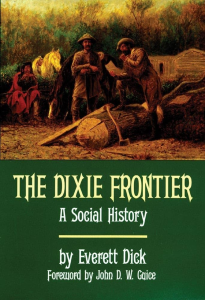
Everett Dick’s The Dixie Frontier offers a fascinating glimpse into the early days of the American Southwest, providing a colorful and informative account of life on the frontier. Following the end of the Revolutionary War, Americans poured westward, venturing all the way to the mighty Mississippi River. The Dixie Frontier is a highly enjoyable social history of that period (1780s – 1830s), as trappers were succeeded by aspiring settlers — some operating within the bounds of the law, sometimes out of it. Everett Dick focuses on the “old Southwest”, places later known as Alabama, Tennessee, and Kentucky, and explores different areas of life thereof, from the staking out of claims to the creation of law and order. The chapters are organized by subject, with different elements of frontier life considered in turn, as well as spotlights on certain kinds of settlers, including women and slaves. Although plantation money would find the Old Southwest eventually (after the Creek War made it safe), this is largely a book about smaller freeholders and other pioneers, and the life they were making for themselves.
Dick covers agriculture, food, home-building, and other material aspects as well as the growth of religion and frontier justice. A fundamental aspect of this book which underpins everything else is the sheer primitiveness. There was very little gold or silver in the frontier, so economic changes were barter-based, and were not limited to agricultural products: firearms and land were also used. Because of the general want of social infrastructure, events and buildings often serve multiple uses. Church, for instance, was not merely an opportunity for worship, or fellowship, but would become something of a market as farmers commenced to horse-trading or matchmaking. The chapter on justice was particularly fun given that lack of jails or basic legal infrastructure: one young couple was forced to travel for weeks looking for someone qualified to legally marry them, and one man who escaped a death verdict because of a badly written legal order was greeted outside the tavern where court had been held wih the announcement that while he had been “released by Judge Smith, he had not yet been tried by Judge Lynch!”. (The man was stuffed in a barrel and then thrown in the river, letting the currents and God decide his fate. Sending people down the river in a dugout or something similar was an amusingly frequent ‘corrections’ measure.) Dick also remarks that in a murder trial, jurists’ judgment of guilt owed more to whether the murdered man was a better citizen/neighbor than the accused. Similarly amusing is the chapter on social life, as people created game after game with the sole purpose of having an excuse to kiss each other. Kissing was also used as a reward for farm labor: at communal corn-shuckings, the man who could boast the largest pile could smooch the girl of his choosing. One wonders if the smoochee had any say in the matter! Although I think the book suffered a bit from the lack of a chapter to establish the political context, it was both enjoyable and informative. I’m glad Brutal Reckoning prompted me to finally take a look at it, as it’s been on my wanna-read list at the library for the longest. Dick has another book called The Sod House Frontier, on the western experience, which I’ll be looking for.
Have you seen Star Trek IV: A Voyage Home? It’s easy to remember — it’s the funny one, with whales and Admiral Kirk not recognizing 20th century slang. The Enterprise crew have to go back to 1986 to pick up some humpback whales because there are some aliens who used to talk to the whales, and now that they’re gone the aliens are sad and vaporizing Earth’s oceans. Kirk & company got the whales, but on their exit a cetologist named Gillian Taylor asked for a ride to the Future, because 1986 was dullsville and The Future would need a cetologist. No Gillian, no Cetacean Ops! But whatever became of this transparently obvious violation of the Temporal Prime Directive? Find out…..in the epilogue!
Star Trek: Lost to Eternity is an interesting TOS release, with stories across three different timeframes (2024, series-era TOS, movies-era TOS) developing and converging toward the very end. Greg Cox is no stranger to TOS writing, and as usual, the characterization and dialogue are spot-on, and his prior work playing with the integration of real history and Trek history comes in handy here, especially his authorship of the KHAAAAAAAAAAAN!!!trilogy. The divided timeframes can be a bit confusing on the TOS side, given that Kirk is quarreling with a female Klingon captain in both. The 2024 segment is distinct from the rest, and has the fun premise of a modern-day podcaster named Melinda doing some investigatory journalism into the disappearance of Gillian Taylor: the investigation plays with a lot of the chaos of A Voyage Home, as the Enterprise crew were doing everything from giving people magic kidney pills to covering Golden Gate Park in Bird of Prey-shaped dents. While her investigation is turning up all kinds of weirdness and attracting attention from suspicious quarters, Kirk in two different eras is dealing with crises that will prove interrelated — as will Melinda’s search or the truth. Oddly, Cox doesn’t try to connect Melinda’s 2024 to the 2024 of Star Trek history: Melinda is living in our San Francisco, not the San Francisco of “Past Tense”, with the Sanctuary district and the Bell Riots. Still, I was impresssed by the story Cox created that could connect all the ’86 shenanigans to a full-scale drama centuries later. Cox knows what he’s doing with TOS characters, capturing the chemistry of the power trio especially, and I appreciated his little jokes like having one of the Klingons quote Shakespeare — which, after all, you cannot appreciate until you’ve experienced it in the original Klingon. Given that I signed on for Gillian Taylor, I was disappointed by how utterly marginal a role she plays, but the investigation was fun and I thought the villain of the piece was an interesting character who I could stand to see in more stories.
Highlights:
“Thank heaven for small favors?” Doctor McCoy loitered within the command well, leaning on a railing. “How dicey is this whole get-together if it’s notable that nobody is shooting each other yet? Talk about a low bar.” Saavik had noted that the doctor seldom felt obliged to confine himself to his sickbay if more intriguing happenings were transpiring on the bridge.
Spock nodded. “Your own world’s devastating Eugenics Wars come immediately to mind.” “Not just ‘our’ world, Spock,” McCoy said. “Need I remind you that half your genes come from Earth as well?” Spock stiffened. “That is hardly necessary, Doctor, nor appreciated.”
“Sadly,” Plavius replied, “Romulan law and policy do not recognize the validity of… hunches.” McCoy rolled his eyes. “And they say Vulcans and Romulans have nothing in common anymore.”
July is the beginning of the Great Sticky Siege that is an Alabama summer, as we all flee inside to worship the freon god and hope our AC units can hold the line until relief breaks in October. It continued my unusual reading pattern this year, with a huge amount of fiction, but history did return fire a bit. We’ll see if it regroups and stages a counter-assault. I was also distracted by trying two ‘cozy’ games, Wylde Flowers and Sun Haven. They’re both a bit like Stardew Valley, which I tried a year ago and have played obsessively since, but markedly different despite both incorporating magic.
“This is interesting, meeting you here,” said Madred. Placing his spoon next to his bowl, Garak clasped his hands on the table. “It was my understanding that being forced into exile meant never having to see people I don’t like. Leave it to Central Command to fail at something so simple.” Star Trek: Pliable Truths
Classics Club:
……
Readin’ Dixie: While We Were Watching Downton Abbey, Wendy Wax. This is set in Atlanta, and some of the characters are deep-South aristocrats, so I’m claimin’ it. Brutal Reckoning, Peter Cozzens. A comprehensive history of the Creek War that would open Alabama to settlement.
Science Survey:
…..
Science Fiction Book Bingo:
Terra Firmer (A Book Set on Earth): Extinction, Douglas Preston.
New Acquisitions: A new Star Trek novel (which I’m already halfway finished reading, hah) and a history of colonial Pensacola. I keep wanting to do a weekend there outside of tourist season. In addition to the historic town, it also hosts a naval aviation museum!
The Unreviewed: None!
Coming up in August…
Next week I’m planning on doing a reprise of Blast from the Past, though there will be history & Star Trek as well. I’d like to focus a bit on NF before grad school opens again in the middle of the month, and I have a science series in mind that will have a rather obvious theme.
July was an unusal month in that I literally only watched one movie by myself, Father Stu. The rest were watched with (and chosen by) friends.
Manhattan Murder Mystery, 1993. Woody Allen’s wife Diane Keaton is suspicious about the death of their next-door neighbor when her widower is far too peppy to be in mourning. She and Hawkeye Pierce begin investigating and become obsessed with the prospect. Bit of a dark comedy, I suppose.
Grey Gardens, 1975. Apparently Jackie Kennedy had crazy relatives. This documentary just puts the camera on them. I have no idea why my friend wanted to watch this. I kept sneaking peeks at the Red Sox -Yankees game instead. Sox won 5-3. Then they lost 14-4. -_- Duran did really well in the All-Stars game, but it’s not been a good month for Boston.
Monkey Man, 2024. A REALLY interesting film about an Indian orphan whose mother was brutally killed by a cop, who burns for vengeance. He’s a boxer who starts working for a hotel so he can get close to the cop, but after his first attempt fails catastrophically, The Kid regroups at a temple of people who have been persecuted by the cop. Interesting look at modern Mumbai, good acting, all around good time, and rooted in Indian religious culture..
Blue Velvet, 1985. A young man finds an ear in a park. Things go downhill.
The Paperboy, 2012. Easily my least favorite film for this year. Watched it without knowing the premise or anything, we just saw Matthew McConaughey and decided to give it a shot. The premise is that two brothers and a reporter have come to a small town to investigate the death of a widely-loathed cop, which has been pinned on an alligator hunter who is now on death row. It’s set in 1969, so there are a lot of race-strife elements, and those factor in to McConaughey being raped and beaten. Nicole Kidman being present is the film’s only redeeming aspect.
Brewster McCloud, 1970. A young man named Brewster is working on a project to create a pair of working wings for individual humans. He is also suspected of strangling a series of people, and is guarded by Hotlips Hoolihan whose mysterious black bird is always involved in the stranglings. Unrelatedly, Brewster meets a young Shelly Duvall in her debut film (Duvall recently died, hence our watching this), who he falls in love with despite being told by Hotlips that his project will be doomed if he makes love with a woman. The ending is a bit surreal. A fun enough movie – great cars & car chases – but very strange. One of the early smothered victims is the Wicked Witch from Oz, and amusingly she’s wearing red heels. Rene Auberjoinis also appears as someone lecturing on bird behavior throughout the film.
Vicky Christina Barcelona, 2008. Two American women who are friends go to Barcelona for a little vacation. One is looking for Something Special, the other isn’t. One Spanish painter gets a relationship with both of them, though not (as he wishes) together. Interesting enough film, mostly because of Scarlett Johannson and Penelope Cruz. The architecture and landscape of Spain are gorgeous.
Boogie Nights, 1997. Star-filled cast involving Burt Reynolds trying to get Mark Wahlberg to do porn in the ‘70s/’80s. Appearances by a bunch of known actors. Nice music. Cars were tolerable. Dug the chick on rollerskates.
Mean Streets. 1973. Early Scorcese film about the New York Mafia, featuring a young Robert de Niro (pre-Taxi Driver), as well as a youngish David Proval, better known as Richie Aprile from The Sopranoes. I was surprised he was the only Sopranoes actor I recognized. Good music, NYC at night is pretty. Possible shot of WTC towers right after constrution, but not positive.
What Have I Done to Deserve This!, 1985. Pedro Almadovar. A….weird film about a Spanish housewife who tries to make ends meet as a cleaning lady, despite her grumpy husband’s wishes. He’s a taxi driver and a talented forger, but has some pride about being an honest man. He’s also obessed with an older German he used to date, though oddly they use Sie on the phone instead of du. Grumpy and Housewife have two kids, a young teenager who apparently deals smack in Madrid and another son who is a male prostitute. As the film develops we witness the general suckitude of her life until she lets a dentist “adopt” her youngest son, defends a neighbor’s telekinetic daughter from her abusive mother (this is never further explored, the housewife is just ‘Ah, cool, can you help me wallpaper my kitchen?’), kills her husband with a hambone, and is then deserted by her drug-dealer son and mother-in-law because they want to return to rural Spain and farm. Then the prostitute son comes back and the movie ends. (shrug)
The Death of Stalin, 2017. Rewatch for me of a favorite film which takes the death of one of the most odious people who ever lived and turns it into a comedy about the viciousness and loathsomeness of politics. Arguably worth watching for the scenery and Jason Isaac’s performance of Marshal Zhukov.
“Life’s gonna give you a gut full of reasons to be angry, kid. You only need one to be grateful.”
“I think God saw something in you worth savin’. It’s up to you to find out what you’ve got to offer.”
Father Stu, 2022. Mark Wahlberg plays Fr. Stuart Long, a boxer who begins hanging around the Catholic church for lust of a woman, but embraces it fully after a near-death experience in which he has a vision of the Virgin Mary who urges him to find purpose in his life. Despite his love for Carmen, he pursues a calling to the priesthood that becomes more difficult after he is diagnosed with a progressive muscle disease which renders the proud former boxer into a humble man in a wheelchair. Despite his suffering and limitations, he finds meaning and imparts that to others. Best movie I’ve seen this year. Based on a true story.
There’s a blogging event that happens on Wednesdays in which readers answer these questions three:
WHAT have you finished reading recently? I just finished A Brutal Reckoning.
WHAT are you currently reading? I’m about to start The Dixie Frontier, a social history of the “old Southwest”.
WHAT is the capital of Assyria? I mean, WHAT are you reading next? Most likely Star Trek TOS: Lost to Eternity, by Greg Cox.
Today’s prompt from Long and Short Reviews is, “Would you stay in a haunted house”, to which I say — sure, as I don’t believe in haunted houses. As a kid I loved reading ghost stories, but I never believed in ghosts themselves, though I did have an interesting conversation in high school with a friend who believed it was possible for human beings to leave some kind of ‘impression’ on the environment that was sometimes visible under strict circumstances. These visible or audible impressions — ghosts of emotionally charged events repeating themselves, like the sound of a woman crying for a fallen lover, or the sight of a doomed company’s last charge — were not the personalities themselves, just impressions or echoes. Anyhoo, I’ve never had any experiences that would prompt me to believe in ghosts, though a girlfriend of mine from a few years ago swore that the first house she ever bought she sold within a year because it was so haunted she couldn’t sleep, and she added that her brother had laughed at her, but after she challenged him to live there for a month, he moved out within a week. Frankly, I’d be curious about visiting that place myself. A friend of mine, who like me occupies an awkward place between science and faith, believes her late father is still present around her: he appears and talks to her in her dreams, she sees him in flashes around the house, just sitting or walking, that sort of thing. Personally, one thing I’ve learned in my 30+ years is that the human brain is a strange place. I can stand at the side door of a friend’s house and vividly smell the peppers that were growing in his yard the first summer I ever house-sat for him, regardless of the season and regardless of the fact that there’s now a swimming pool where that pepper patch was. At any rate, while I don’t believe in ghosts myself, I’ve grown to appreciate both the complexity of the human mind and the limits of our perceptions, enough that when people talk about ethereal encounters I try to listen to understand what they’ve felt and how that’s shaping their beliefs and actions now rather than just dismissing them as an overactive imagination. To return to the question: I would stay in a haunted house, both because I don’t believe in them and because I’d be interested in finding out what I might experience. I toured a ‘haunted’ place a year or so ago but encountered nothing but the gloom and dread of a decaying place that might have squatters. The closest I’ve come to this kind of experience is taking a cemetery tour with a group, and then hearing a music-box left at the grave of a child begin playing by itself, without any hint of wind. It died almost immediately but was sufficient to stop the entire group in its tracks. Readers interested in this kind of thing may want to check out Will Storr versus the Supernatural, his memoir of visiting haunted houses, exorcists, etc.
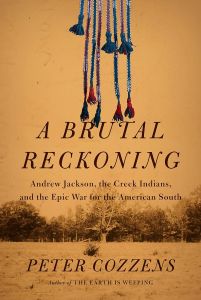
I live in a place named for people no longer present: the Alibamu[*], part of the Creek confederacy which was driven from the southeast after the Battle of Horseshoe Bend. I loved history even as a child, and it was fascinating and haunting to me to think that a people’s presence could simply be erased from where they had been. Brutal Reckoning is the story of how that came to be, which first establishes the historical background before giving a full history of the rise and collapse of the Creek Confederacy. Extensively documented and fair-minded, neither sparing grisly details nor marinating in them to shock the reader, it recommends itself easily to readers interested in the Creek peoples or the settlement of the Alabama-Mississippi territories.
Brutal Reckoning won me over in its opening pages, as it does a dive into the history and culture of the Creek Confederacy. The arrival of Hernando de Seto was calamitous for the native polities of the upper gulf region, not because of de Soto’s martial brand of tourism (what’s Latin for “I came, I saw, I grabbed some locals and left”?) but for the Old World diseases the New World’s immune system had no answer for. Cozzens covers how the Creek Confederacy emerged from that great devastation — not as an organized polity, but a highly decentralized, clan-based population of interrelated but often rivaling groups, with an economy based on hunting & some agriculture. Cozzens then tracks the ongoing effects of European trade and colonization, which created a growing number of Métis, or mixed, people — and accordingly, a mixed culture. After the British and the Creeks established regular relations, the Brits assigned a trader — to each Creek town, usually a Scots-Irish merchant who would marry into the local population. When Britain’s need for trade & tax increased, it offered more trading licenses — with deleterious results. A merchant who settled in a given town and had family ties to it felt some sense of kinship and responsibility towards its people: more mercenary traders had no compunction against soliciting as many deerskins as he could from the Creeks and rewarding them with as many ardent spirits as they’d buy. Cozzens’ account details how the Creek economy and society began reeling from this, at the same time as some Creeks were moving towards European-style agriculture and creating factionalism that would lead to civil war.
This first third of the book sets the stage for how complicated the rest of the book is, with very fuzzy and often chaotic lines between groups as both European and American & native powers vied for power on the continent. Despite the name of the Creek Confederacy, it was not an organized polity, and there were no central leaders: occasionally some talwas authority or religious figure would develop a following and inspire a movement, but if they were defeated their supporters would melt away in a moment. In addition to basic clan rivalries, there were talwas-specific rivalries. These were further complicated by the Creeks’ differing responses to European settlement, and later on the expansion of the American government: some might embrace colonial agriculture while at the same time opposing American expansion. European trade unsettled prexisting balances of power, as well as social structures, with a mixed-sex economy quickly becoming more dominated by male-led enterprises like ranching. The métis population plays an enormous role in this book, and across sides: this may owe to mixed-culture peoples having an advantage in leadership in diplomacy, with a foot in both camps, or because Cozzens draws so much on letters and memoirs from the métis themselves. Divided loyalties are a core part of what makes this history so interesting because boxed-up and convenient thinking don’t apply. Redstick leaders might militantly attack other Creeks and Americans, while at the same time maintaining their own plantations (complete with captive slaves, Creek and African) — far from being reactionaries living in the woods. William Weatherford, who led the Redstick assault on Fort Mims, didn’t even support the Redstick cause: he had been forced into it after his family was taken hostage by Redstick leaders, and then became increasingly saddled with its cause and bound in brotherhood with the men he led so that he became the man most associated with the Redsticks, so much so that it was he who surrendered himself to Andrew Jackson after the bloody Battle of Horseshoe Bend. Of course, a lot of this conflict also takes place within the context of the War of 1812: the Redsticks remained obdurate for so long, despite repeated defeats at the hands of Generals Claiborne and Jackson, in part because they believed the British would come to their aid. Both DC and London were preoccupied with the northern and eastern seaboard, though, so for the most part we have here American and Creek volunteers versus other Creeks, chiefly the Redsticks: once Jackson was able to secure regular Army troops, things come to a dramatic and bloody climax.
This is an impressively thorough history, and saturated with primary resource quotations from letters, memoirs, and reports. I suspected from the start that Cozzens would err on the side of Zinn-style history, given that he referred to the first European explorers of the region as intruders, but as the book developed I became impressed by his ability to render both the humanity and brutality of all parties involved. This is a book full of awful savagery on both sides, a grim reminder of how terrible a thing the human being at war is. Those who still subscribe to the patronizing noble savage myth will find here Creeks who delighted in taking captive brides from other Creeks long before Civilization descended upon them, and torturing male captives extensively until at least they perished — and they will shudder to read of women being raped and killed and their pregnant bellies spilled open. I’d liken it to nature red in tooth and claw, but given the human mind there’s something far more unsettling at work here: not passion, but deliberation, as victorious US Army soldiers burn towns and club children on the basis that they’ll grow up to be full-sized Indians one day. Speaking of violence, Andrew Jackson cuts a large figure here, but Cozzens does a good job of avoiding caricature. We find the backwoods orphan, coming to age amid poverty and climbing his way to respectability and authority, brooking no attack on his honor — quick to duel, and so utterly stubborn that he leads campaigns while wracked with pain and nausea and dealing with men who are unpaid and unfed. Although he’ll later catch opprobrium for the Trail of Tears, here he’s less easy to dismiss — a fierce, defiant, and resilient leader of men who — upon meeting William Weatherford — readily recognized him as a great and worthy opponent, more admirable than the men on the East Coast who Jackson supposedly answered to. (Quintessential Jackson: expressly told by President Madison to leave the Spanish alone, Jackson decides to take Pensacola regardless, because the Redsticks and Brits were using it.) He is at his worst when abandoning his former allies — all Creeks lost their lands following the Treaty of Fort Jackson, not just the Redsticks — on the basis that had the Redsticks won the inter-Creek war, those allies and their talwas would have been lost anyway.
This is substantial history, easily the most thorough treatment of the Creek War I have seen in my many years of searching for the same. I appreciate its balanced tone which does not shy away from injustice, but doesn’t attempt to turn itself into a political work; the saturation of primary source materials was especially helpful in seeing all individuals as they were, rather than heroes and villains in a narrative that excites the brain but does not have the substance of truth; the writing is easy to follow, and the illustrated plates were attractive. I will definitely be reading more of Cozzens, as he’s written several histories about the Indian Wars as well as the Civil War, including one on the Battle for Stones River which I encountered in God Rest Ye Merry, Soldiers.



 Reading Freely