
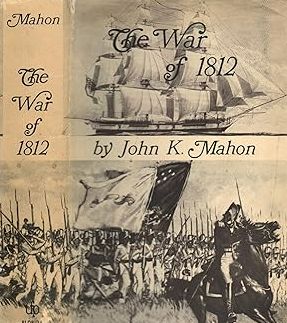
The war of 1812 has had a particular fascination for me in recent years, in part because of the complexity of the conflict: it began as an offshoot of the Napoleonic Wars, as Britain’s attempts to control the azure main meant seizing American cargo and American men, the latter of who were conscripted into the Royal Navy. It gave new energy to other conflicts, like the spats between American colonists and the Creek confederation in the upper Gulf region, that would erupt into more dramatic warfare. When reading The Other War of 1812, the history of one of early America’s strangest foreign policy events (the Georgian invasion of Spanish Florida), I was made aware of this comprehensive volume by John Mahon, which is a thorough history of the war that incorporates all its headwaters and tributaries. Mahon opens with an introduction that makes no apologies for its girthiness: the best way to really learn about anything is to dive right in and get cozy for a while, and Mahon gives the reader exactly that opportunity. Although supplemented with maps and the occasional illustration, those are merely finishing touches: the meat of this book is story and fact, and it takes us all over the early American republic.
Mahon’s bulk comes from how closely it chronicles combat on the ground, complete with maps. These were especially helpful for me in attempting to understand the action around the Great Lakes, because that region is such an unknown to me, and played an enormous role in the early republic. Although Mahon’s history is arranged chronologically (as history books are wont to do), he’s not married to this: in the section on the January 1815 Battle of New Orleans, for instance, not only does Mahon not spoil the fun by telling us that the Treaty of Ghent in December 1814 had ended the war, but he backtracks to the beginning of the war to follow how British interests in taking New Orleans had developed throughout the conflict. Although it’s easy to think of the war as a straightforward affair, round two between the naughty rebel child and the frustrated mother country, part of what makes it so interesting to me is its diplomatic complexity. The war is happening on every American coast — Gulf, Atlantic, and Great Lakes, and at this point the states united are surrounded by European colonies like Spanish Florida — not to mention the native tribes, a confederation of which will play a big part in the war with heavy encouragement and assistance from Great Britain (and a little from Spain). Although the war began in 1813, the Brits had Napoleonic priorities until l’empereur was nicely settled in on St. Helena. The US Navy distinguished itself early on, its six new frigates performing so well that the Admiralty handed out orders forbidding the Royal Navy from taking them on in single engagements. Mahon addresses smaller areas of the war that I wasn’t aware of, like Britain’s use of West Indian (black) troops in its coastal raids both to create a psychological edge, and to disrupt slavery by inspiring those so held to rebel and run away — and possibly join His Majesty’s forces. Native Americans are an enormous part of this story, both as attached to British troops (they helped seize Detroit and hold it for a year) and acting on their own accord, as did the Redsticks in what would be known as Alabama and west Florida. Mahon makes a slight nod to the funniest episode of the war (Georgians moving into Florida, then declaring Florida independence from Spain and swearing allegiance to the United States on behalf of …everyone else in Florida, including Anglo-Spainards and Minorcans), and shares another anecdote that amused me. Andrew Jackson, in preparing his defense of New Orleans, placed the town under martial law; when someone dissented, he imprisoned them, and when a judge issued a writ of habeus corpus Jackson imprisoned him. Jackson is at least consistent: years later, as president he harrumphed at a Supreme Court decision that would limit him, saying that the judge had made his decision; now let him enforce it.
I intend to explore this conflict more, given the sheer variety of contestants and its role in shaping the future of the United States, but Mahon strikes me as a solid foundation — and not only because it’s heftier than a brick!
Related:
The Other War of 1812, James Cusick
Battle for the Southern Frontier: The Creek War and the War of 1812, Mike Bunn and Clay Williams. A much abbreviated history of the war(s).
Andrew Jackson and the Miracle of New Orleans, Brian Kilmeade. Pop-history but fun.


The War of 1812 is an fascinating, and all too often forgotten, conflict. Like you I find it more than a little interesting! I think I have 2-3 books on the subject awaiting scheduling with a few more on my Wish List. As with everything else… Maybe NEXT year… [lol]
It was a war that both sides took very personally, from Mahon’s account.
So far I’ve only read ‘When Britain Burned the White House – The 1814 Invasion of Washington’ by Peter Snow, which was pretty good. I’m more interested in the naval side of things though…
C.S. Forester did a book just about the naval war. I think I read it last year but it fell into the “whoopsie, never reviewed it” category.
Pingback: Brutal Reckoning | Reading Freely