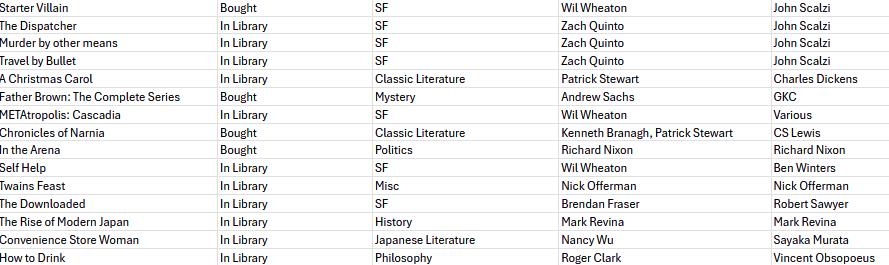
Audiobooks have become a regular part of my reading life in recent years, prompted by one of those free trials that resulted in me discovering how a strong narrator can transform a book. Since then I’ve been and on/off again subscriber, unsubscribing after more than two credits accumulate. I have over sixty titles in my audible library, and for some reason I decided to put them all in a spreadsheet so I could ponder the data. Some observations:
(1) 54% of my listened-to titles have been from Audible’s subscription library, compared to 46% being outright purchases. That surprised me, but it also counts “Audible originals”, which are often shorter than a conventional audiobook, especially the Christmas themed ones. (I’ve listened to several different versions of “A Christmas Carol”) The number of subscription titles would be even higher had I actually begun listening to everything I’ve “added to library”. I also noticed that a lot of the titles I’ve listened to, or started listening to, have since been removed from the subscription library, like the Great Courses History of Japan.
(2) To no one’s surprise, the most frequent narrator was Wil Wheaton, with Roger Clark second. If we were going by hours-listened-to, Wheaton would be even further ahead because some of the Clark titles have been rather short, like How to Tell a Joke. That is, unless we count my listening to Roger Clark in Red Dead Redemption 2….
(3) John Scalzi is the most common author, with Rhett C. Bruno & Jaime Castle a distant second. That tracks fairly well with Wheaton & Clark, because I’m experiencing Scalzi’s book on Audible for the Wheaton delivery. There are a few titles I’ve tried just because of the narration: that’s how I got into the Black Badge series and subsequently got into Rhett C. Bruno as an author. How could I resist Arthur Morgan narrating the story of an undead cowboy bounty hunting werewolves?
(4) There are ten authors who did their own audiobook recordings: Stephen Fry, Michael Malice, and Richard Nixon among them. (The Nixon one, In the Arena, was an abridged version of the real book.)
(5) Science fiction is the clear genre leader for the moment, with baseball closing in on its heels. (Baseball has already gotten a lead on Wil Wheaton-narrated books, which is impressive given that Wheaton is the reason I got into Audible to begin with.)
(6) While Star Trek is not a huge presence on the list, with only one title, its castmembers are: Wheaton, Patrick Stewart, Leonard Nimoy, Kate Mulgrew, Brent Spiner, and Zachary Quinto all feature as narrators, and two books had larger casts that included other Trek actors like Gates McFadden, LeVar Burton, etc. (The lone Star Trek title is Spock vs Q, featuring Nimoy and de Lancie, and yes, it’s fun.)
(7) Nonfiction enjoys a 60/40 lead somehow, despite all the Scalzi. Gotta be the baseball.
And as usual, by top ten I mean “the first ten that occurred to me”. But first, the customary tease:
The U.S. military is also a “self-licking ice cream cone,” as American GIs called it in Vietnam, dedicated to its own perpetuation at any cost, and conveniently, continually creating the disasters which are said to require their next intervention. PROVOKED, Scott Horton.
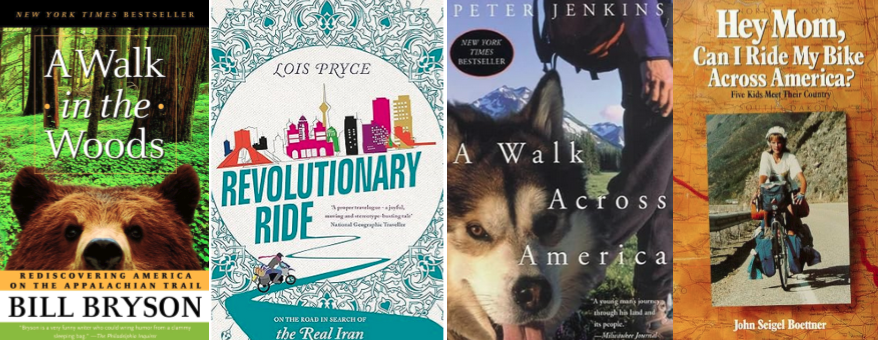
(1) The Unlikely Pilgrimage of Harold Frye, Rachel Joyce. An aging man receives news that someone from his past is dying, and as he begins a walk to the post office to deliver a letter to her, he stumbles into a walking journey across the whole of England.
(2) A Walk in the Woods, Bill Bryson’s humorous account of trying the Appalachian Trail, at least the most notable parts of it.
(5) Every single Rick Riordan book can be summarized thusly: MAIN CHARACTER and their TWO FRIENDS must DO AN EPIC ROAD TRIP to stop CHAOS MONSTER from destroying the universe on the SOLSTICE/EQUINOX.
(6) Cities of Gold. A horseback journey across the southwest, retracing Coronado’s path looking for “El Dorado”. The author, Douglas Preston, later penned a sequel in which he is joined by his wife and stepdaughter on another horseback trip to learn about the Navajo.
(8) Revolutionary Ride, Lois Pryce. A British lass experiences Rouhani-era Iran on a motorbike. Related:Neither East nor West, a 1970s travelogue, had the same premise.
(10) Travels with Charley, John Steinbeck. Steinbeck takes a RV trip with his dog through 1962 America and is distressed to find it increasingly plastic and homogenous.
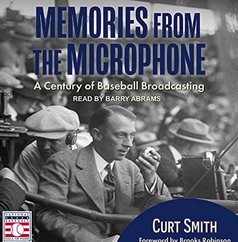
Memories from the Microphone is a history of baseball broadcasting that begins with primitive radio and follows broadcasting into the maturation of radio and television networks. In this, it’s also a partial history of how radio and television developed as media, from local stations and personalities to big networks and corporate deals. It’s roughly, but not strictly, chronological. Smith’s approach is to highlight a few announcers in a given decade, but follow their history well beyond the chapter’s titled limits, so we’re constantly getting stories from across three decades in any given chapter, but moving steadily forward on average. I listened to the audioversion, read by Barry Abrams, and enjoyed it on the whole — though as with most baseball books, I prefer the earlier content to the more contemporary.
Memories is interesting as a baseball history because while the sport’s stars definitely feature, the stars here are the radio announcers and later TV personalities. (The exception is when some ballplayers transition into being announcers, the biggest example being Dizzy Dean.) The early chapters were especially fascinating to me because they involved a lot of ‘announcing by wire’: radio broadcasters would receive news updates via telegraphy, and then use that information to pretend they were announcing the game live. Presumably some listeners knew that their Birmingham radio station certainly wasn’t broadcasting from say, Fenway Park, but some announcers would create sound effects to try to create the sense that they were. Because telegraphy could be interrupted, at least one station made a habit of broadcasting from an inning behind to mitigate that risk. Ronald Reagan, when left hanging during a broadcast, decided to ad-lib, creating fictitious foul balls and field interruptions for six minutes until updates started pouring back in. In these early chapters we also get a sense of radio as an emerging medium, as announcers realized that they were not simply dispensers of facts, but had to be performers: some created excitable vocal styles, inventing words like BLAMMO! to capture and hold the audience’s attention. Others would invent a persona to inhabit while they were alive: Dizzy Dean flanderized himself to a degree, laying on his Arkansas hick-ness as thick as molasses and creating folksy mispronunciations and expressions to charm the listening audience. (When questioned about his syntax, he replied: “They’re taxing that, too?!”) Once, purely to demonstrate this, he announced in his normal voice for a few minutes, then said “That’s enough of that” and “slud” back into his radio persona. Dean would also sing on mic, using the “Wabash Cannonball: to liven up dead air. He wasn’t the only singing announcer, but in the narrator’s voice he’s definitely the most memorable.
For some reason, I thought this would incorporate recordings from across the 20th century. It doesn’t, but narrator Barry Abrams does impersonations of some of baseball’s more impassioned voices, including one of a young Ronald Reagan from the 1930s announcing games. His voice was easy to listen to, and I enjoyed the variety: there are enough interviews and reenactments peppered in so that it never sounded dull. The only blip, audio-wise, is that as with all other Audible productions, the narrators read everything, including things that interrupt the flow of the narrative. This is most egregious in Ready Player One, when Wheaton was forced to read out scoreboards line-by-line, but here it mostly takes shape in parenthetical remarks, which are especially disruptive when Abrams is in the middle of an excited impersonation/reenactment. The remarks are never given in the same voice as the announcement, so what happens is deliveries like this: THE GIANTS WIN! THE GIANTS WIN THE NL (National League) PENNANT! It’s emotion, emotion, then a screeching halt into flat voice, then suddenly whiplash as we go back into emotion. This wasn’t chronic, but it was regular enough to be annoying.
This was a fun approach to the history of baseball that also served up some broadcasting history as well. Although the constant chronological mixing called for better editing, I didn’t find it as bothersome in the hearing as print readers did. It may be a consequence of growing up listening to southern storytellers, who often stagger drunkenly through timelines and sometimes into different stories altogether as the spirit moves. Although Abrams also did the audio for Smith’s The Presidents and the Pastime, a study of American presidents and baseball (something that pops up here a time or two, with Reagan, FDR, and JFK), I’m going to get the print edition of that to see if there’s a marked difference in how strong the narration is.
As a kid, my friends and I often pretended to be soldiers and play-acted in the woods and fields as we might were we actually being attacked. We crawled on our bellies through the grass, took cover behind trees, looked for places snipers might be, and threw pinecone grenades at imaginary foes. Assault by Fire reminds me of that, not because it involves characters having fantasies, but it seems like the result of someone thinking, “Hey, what if Russians were attacking my neck of the woods? How would I fight them?” The novel is by a veteran, Rip Rawlings, who has advised author Mark Greaney on military matters, and I’m thinking he should have gotten Mark to advise him on plot matters because this novel struggles. It opens with a sneak-attack by the Russians, who have decided to invade the continental United States. Why? Because a supercomputer told them they could get away with it, evidently. A combination of the US having the majority of its active forces deployed near Iran to forestall their invading Iraq (????) and a president who seized all “assault weapons” leaves the homeland weak and we’re told that the US is being outright annexed. (?!) After this rather dramatic opening, we dive right into West Virginia’s valleys: the drama and story are all hyperlocal, which is positively jarring given the earth-shaking opening. We’re not talking about forts and metropolises here, but small towns with inexplicably arrogant mayors and lazy police chiefs one can just see giving heavy sighs and hitching up their pants to trundle after these armed nogoodniks. Every part of the novel that’s not direct military tactics made me groan and wince. Here’s some dialogue:
“This is it?” said Major Quico, careful to keep his voice low so Kolikoff wouldn’t hear him. “It just looks like Russia . . . I mean, where are the discos and the girls?” “They are not here at the airport, you idiot,” said Major Pavel. “But where is the Statue of Liberty?” asked Major Drugov. “Idiot!” said Pavel. “That is in Boston.”
Look, this isn’t Red Alert 2. An author can’t just make Russians this stupid and have them work as serious antagonists. It’s a bit like watching a Wile E. Coyote vs the Roadrunner cartoon: it doesn’t matter how menacing Wiley appears to be, you know he’s going to do something stupid like charge into a brick wall or walk off a cliff with a dumb look on his face. I mean…disco? Really? What’s next, cocaine and go-go boots? This was Rip Rawlings’ debut novel, and I hope he continues developing his craft: there were some pluses like the practical tactics and some characters, but the worldbuilding and tension were way off.
Similarly, I picked up a P.T. Deutermann novel for the first time. I’ve heard rave reviews about his WW2 naval fiction, but when I began The Second Sun and saw that Deutermann has (1) Franklin Roosevelt dead, (2) Hitler dead (3) and the European war over in MARCH 1945, I put it down and returned to one of my ebooks. Maybe he meant to type May 1945. I’ve heard nothing but good about Deutermann, so I’ll probably give him another shot.
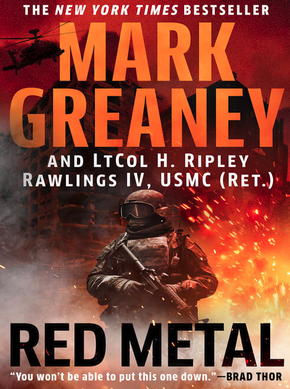
Something wicked this way comes. In Taiwan, the pro-China candidate has been assassinated, ostensibly by militants who want to protect the current anti-China candidate from not being reelected. China is threatening war and loading troopships as a reprisal. The Russians are playing war games in Iran, and suddenly all of Europe’s communications infrastructure — including NATO’s — has gone dark. And now there are Russians running amok in Eastern Europe! What on Earth is going on here? The reader begins Red Metal a few steps ahead of NATO, as the Russian viewpoint chapters have already told us the plan: the attack into Europe is a raid to destroy DC’s “Africa Command” in Stuttgart and slow western response to the main thrust of the Russian assault: the seizure of an area of Kenya with enormous rare-earth mineral deposits, an area Russian corporate interests had formerly owned but been forced to turn over to Kenyan authorities. However cleverly planned the assault, though, once action is engaged and the fog of war descends, there’s no telling what may happen. Red Metal is the first modern military/technical thriller I’ve read in perhaps twenty years, and I picked it up out of curiosity given the current state of eastern Europe. I found it unexpectedly absorbing, clipping through a hundred pages a day despite the sheer amount of technical detail and subsequent googling. The constant flux of action helped considerably, but so did the characterization.
The Russians have, on paper, a great plan of coordinated assaults. But, as both von Molkte and Evander Holyfield noted, no plan survives contact with the enemy. Who can predict their actions? The theme of War and Peace finds an interesting echo here: while the Russian general might seek to impose his will on the world and redraw it to his liking, moving both Allied and Russian parts to achieve that end, in the end the cumulative actions of the game pieces themselves have an unpredictable and rippling affect. Say a French diplomat decides to disregard precaution and stay put, reporting on troop numbers instead of retreating for shelter with the rest of his office — or that a young militia woman who’s the Polish equivalent of a National Guard weekend warrior might choose to fight instead of run. Or an American sub captain, knowing she’s wholly outnumbered, seeing a brief window of opportunity to “shoot her shot”. I’m not studied up on modern warfare at all — not the infantry equipment, the motorized vehicles, the missiles, the jets. My most ‘modern’ military references are from..um, In the Army Now, and I somehow doubt a Pauly Shore movie is terribly accurate. (Though, interestingly, it also involved Kenya.) I can’t therefore comment on how accurate the technical aspects of this are, though given that it’s coauthored by a Lieutenant Colonel I’m happy assuming they’re on point. What I can say works is the characterization here, as we alternate between a series of Allied and Russian characters and witness the unfolding action directly. Some of the characters I was very much rooting for, and this being a war they don’t all survive — and some survive but in broken bodies. Most of the characters are likable to a degree, but especially the Polish woman whose refusal to give up when her unit had been crushed turned her into a propaganda hero. She’s oblivious to this, absorbed by the fight, but it gives her a sense of authority that other characters recognize, and so she becomes the nucleus of a never-say-die group of partisans. She will stop at nothing to continue the attack on Russians within Poland, including pressing a wounded American pilot into helping her use America air units to pull off an ambush.
Although this book is dated today in terms of some geopolitical aspects (Russia doesn’t appear to be wanting for rare earth minerals), and technology has presumably marched on from this period where the Russians were still using some cold war equipment, but the big actors remain the same — as do their desires. China is still fixated on taking over Taiwan — surely there’s a parable written somewhere about a mighty creature that ruins itself by obsessing over something it could let go? — and Russia is…well Russia, jealous of its place in the world and willing to fight to regain its former status as a world power to be reckoned with. It appears that Greaney has been literal-ghostwriting Tom Clancy novels the last few years or so, and I’m curious as to what kind of plots he’s spinning up. As far as Rip Rawlings, he’s struck out on his own with a book that sounds like a modern Red Dawn, so I may give that shot.
WHAT have you finished reading recently? Fenway 1912, a history of Fenway Park’s first year in action as the Red Sox had a really good year, facing off the New York Giants in a World Series .
WHAT are you reading now? I’m two three hundred pages into Red Metal, a modern military/technical thriller in which Russia ‘s desire for rare-earth minerals begins the first major war in Europe in a generation while Red China threatens to invade Taiwan. An easy ceasefire in Europe is defied by some Zielinski fella. Ah, the wacky plot lines these authors can come up with.
WHAT are you reading next? Black Badge #3, Ace in the Hole, just dropped, so I’ve picked that up and will either read it on Kindle Unlimited or listen to Arthur Morgan read it — or both, as I’ve done with the previous two. (Bascially I listen to the Audible version until I get so interested in the story I need to find out what happens, then switch to KU.) The Black Badge series features an undead outlaw who has been saved from death/hell in return for doing missions for the White Throne, destroying creatures like werewolves, vampires, and lawyers roaming the wild west. It’s an interesting genre — western and dark fantasy. Alternatively, there’s also It’s a Beautiful Day for Baseball, a social history of baseball in the 1960s.
Here, just listen to Roger Clark /Arthur Morgan introducing the series:
Most folks who see a demon beast like the Yeti tuck tail and run, hopin’ someone else will deal with it. Problem is….I’m that someone. Nothin’s ever easy for a Black Badge.
(1) A Series of Unfortunate Events deserves pride of place: it’s one of my favorite movies to watch & rewatch, and it led me to devouring the entire book series in 2009 and then watching the Netflix adaptation years later.
Fun fact: my Netflix user icon is Klaus Baudelaire.
(2) Harry Potter: these books were coming out as I grew up, and the movies were still being released into my early twenties. While I didn’t get into Potterdom until 2007, it quickly became one of my favorite series/fandoms. I’m mildly interested in the series that’s currently being developed: it’s hard to think anyone can hold a candle to actors like Alan Rickman and Maggie Smith.
(3) Foundation, one of those golden-age SF stories (a collection of five stories, rather) that I frequently go back to, became an AppleTV series. I started watching it but couldn’t get into it.
(4) Roswell High (Roswell). You know, for this year’s Blast from the Past I may have to revisit this series like I did California Diaries last year. Roswell High is a SF/teen drama series about several aliens-in-disguise teenagers whose identities are partially exposed after one, Max, saves the life of a girl he loves. I loved this series in middle school and was dismayed when the covers began reflecting random teenagers from some TV show: it had been adapted! Although the WB show was not an especially faithful adaptation of the books, I grew to enjoy it on its merits as something distinct. They still did Alex dirty, though. The same is not true of the more recent Roswell, New Mexico show: I saw one episode of it and decided, “That’s enough of that”.
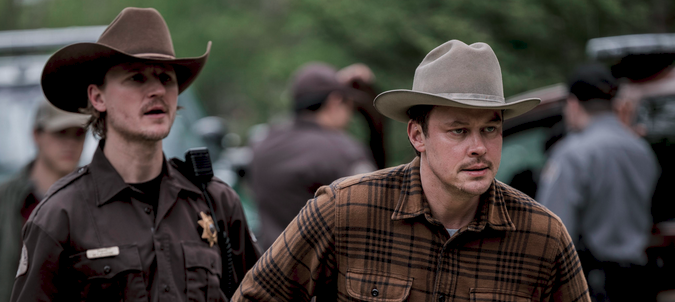
(5) Joe Pickett. Ooh, I haven’t done a reads-to-reels post for this, I now realize. The Amazon series Joe Pickett adapts several of CJ Box’s Saddlestring game warden stories to the silver screen, and does it in a creative way that accommodates the fact that every single Box book advances the timeline by one year. Plotlines from multiple books are woven in together in way that I thought worked quite well. Casting was…interesting. The sheriff and McClanahan were well chosen, especially McClanahan: his actor plays the swaggering bumpkin to perfection. My high school experience was littered with Skoal-chewing good ol’ boys like him. The biggest casting and characterization error for me was “Nate”: despite being consistently described as a cold Pole with a long blonde ponytail, they basically cast someone for Geronimo (one of Nate’s allies from later in the series) and called him Nate. He doesn’t read like the character at all, especially when he uses Mary-Beth in a hostage crisis to get away from the cops.
(6) The Brave Cowboy. This was turned into a movie called Lonely Are the Brave, and it’s arguably better than the book in some minor ways. This is a story about conscience and the state — and the plight of individuals against armed modernity.
(7) The Martian, Andy Weir. This curious mix of science fiction, survivalism, and absurd humor was one of my favorite books in its release yet, and I enjoyed the movie perfectly.
(8) Saxon Stories / The Last Kingdom. Bernard Cornwell’s Uhtred books have provided some of my favorite reading over the years, bringing Cornwell’s distinctive humor and gift for narration to plots brimming with medieval detail and politics. The series — which I only bothered with the first season of — was distinctly underwhelming in comparison, lacking that strong narrative voice. It probably didn’t help that I’d seen the History Channel’s Vikings before, and before Ragnar died, that show was awesome.
(9) Ready Player One. No movie could ever do justice to RPO, which — if you’re an eighties baby or kid — was a fantastic tribute to the era’s pop culture and tech. I enjoyed the movie well enough, though, especially the Shining allusions.
(10) The Circle. The Dave Eggers book was brilliant satire of our social media age. The movie was…well, it has Emma Watson doing an American accent, so that was fun. The movie’s ending completely missed the point of the book, though.
I forgot Tom Hanks was in this, but his casting was genius. I mean, if you want to have an evil company that disguises itself as virtuous normalcy, Tom Hanks is your best bet.
Fenway Park in Boston is the oldest continually operating major-league ballpark in the United States, and has developed into a character or an attraction in its own right for that reason. Fenway has not lasted as long as it has by being change-resistant, Glenn Stouts offers: instead, it has continually altered itself so much so that save for the outside ticket-office facade, the Fenway of 1912 would be unrecognizable to current-day fans. Fenway 1912 is a history of the ballpark’s creation, its hurried opening for the 1912 baseball season, and of that year Red Sox team’s storied World Series bid.
The season was marked by two exciting events: the rise of Smokey Joe Wood, who became a record-setting pitcher and was regarded as the best in baseball after his pitching duel with Walter Johnson; and of course, the World Series run, which was split between Fenway and the New York Giants’ Polo Grounds. Both events forced park changes: the pitching duel attracted so many spectators that they filled the seats, the grass, and then began spilling into the field itself, even encroaching upon the field of play before policemen intervened. (They took over the dugouts, leaving the players to sit on the field like schoolboys waiting for their turn at bat!) It is thought that some 40,000 people were present at that game, something remarkable when the reader realizes that modern Fenway can accommodate that number, but only after a century of finding ways to add more seats – like seating people on top of the Green Monster, the legendary left-field wall. More wooden bleaches were added for subsequent games and the World Series, but even so the ballpark was so jammed that the Red Sox’ unofficial fanclub, the Royal Rooters, were denied places to sit after arriving late – despite having tickets- – and nearly created a brawl.(Not surprisingly, the Red Sox’ other World Series games in the 1910s often happened at the larger Braves Field.) The world series itself was exciting, marked by a game declared a tie – it became too dark to see – and several shifts in momentum between the Red Sox and Giants as it wore on. The alterations changed the overall shape of the field, creating more quirks and substantially altering several plays.
Stout ends the book with a brief history of Fenway since, and points out that Fenway did not become The Fenway, a park with significant sentimental power over its Fenway faithful, until the 1970s or so. This was around the same time that the left field wall became known as the Green Monster. Perhaps the destruction of places like Ebbetts Field and the Polo Grounds in the 1960s prompted more attention on Fenway’s historic status? Whatever the reason, Fenway survives — even though its seats are the most expensive in the MLB.
Although it has become a cliché to make the claim that Fenway Park is still recognizable today as the same park that opened in 1912, that is true only in the most limited sense. If a contemporary Red Sox fan were somehow sent back in time and deposited in Fenway Park on April 9, 1912, it is unlikely that any but the most knowledgeable rooter would recognize it at all. For while Fenway Park still occupies the same basic footprint today as it did in 1912, virtually every other notable structure and feature of the ballpark has been removed, recast, renovated, or otherwise changed.
Fenway has survived not because it has been preserved in the original, but because it has not been preserved, because until quite recently it was never treated as special enough to preserve, and because the ball club has rarely hesitated to make practical changes to extend its useful life.
At the reception at the bride’s home the guests were entertained by the Red Sox Quartet, a barbershop singing group made up of Buck O’Brien, first baseman Hugh Bradley, and pitchers Marty McHale and minor leaguer Bill Lyons, who were filling in for occasional tenor Larry Gardner, already back home to Vermont. Later that fall the quartet played the New England vaudeville circuit, including B. F. Keith’s theater in Boston, where a receptive reviewer noted that “if they wish to foreswear baseball as a livelihood there is a rosy career awaiting them as singers.”
As Wood toed the rubber Cobb danced off first, feinting toward second again and again. A flustered Wood threw to first base over and over, a little harder each time, getting more distracted and angrier by the second. When Cobb finally took off Wood was so disconcerted that he never even threw the ball but watched helplessly as Cobb took second unimpeded.
Just before the ticket office opened at 9:00 a.m., the line stretched some twenty blocks—nearly two miles—down Eighth Avenue to 155th Street, then down Broadway to 145th, then on Edgecombe to 138th Street.
Nearly three hundred baseball writers were ensconced at the Hotel Imperial. Over the past twenty-four hours they had discovered that in order to get an interview, as the New York Tribune reported, “some of the long green has to be flashed.” The going rate was $2 a word. Even Christy Mathewson refused to part his lips unless paid to do so. It was cheaper for the writers to make the quotes up, and many did.
When the gates opened shortly after noon the crowd spilled into the Polo Grounds in a flood. News that war had broken out in the Balkans drew only disinterested shrugs—fans were far more concerned about the impending war between the Red Sox and Giants than a conflict halfway around the world.
Boston’s best hope for vanquishing the Giants and winning the World’s Series came down to only one man, Joe Wood. If Wood could pitch in October the way he had pitched from April through September, it did not matter at all who the Giants pitched opposite him, or even who Wood faced. Wood, at his best, was the best. It was that simple.
As the players hurriedly dressed and rushed to South Station to catch the Gilt Edge Express to New York, the two clubs, both exhausted but one also exhilarated and the other exasperated, were spent. They had just played three games in which every pitch in every inning had mattered and in which the fortunes of both teams had swung back and forth so many times that fans had nearly gotten whiplash just from watching.
Today’s TTT is ways our blogging or review style has changed over the years. I’ve been book-blogging for nearly twenty years — 18 next week — so I’m sure there’s been a lot of changes. I’m not sure, though, that I’m aware of those changes. Readers who have been with me a while are probably better able to comment than I! First up, though, the tease:
As Wood toed the rubber Cobb danced off first, feinting toward second again and again. A flustered Wood threw to first base over and over, a little harder each time, getting more distracted and angrier by the second. When Cobb finally took off Wood was so disconcerted that he never even threw the ball but watched helplessly as Cobb took second unimpeded. (Fenway 1912)
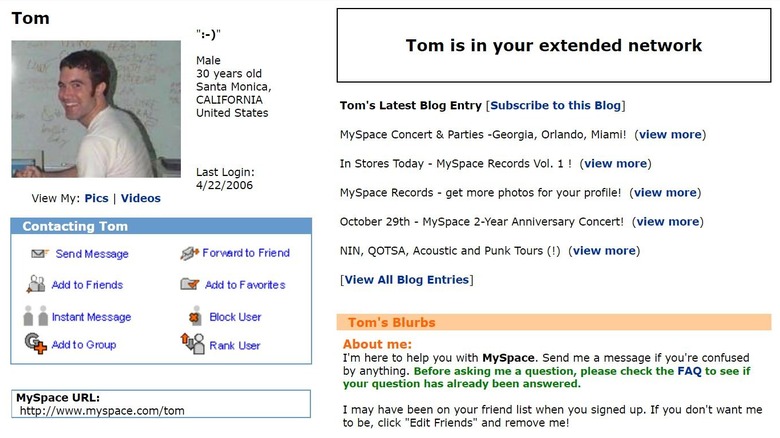
(1) In the beginning, this blog was a series of posts on MySpace in the summer of 2007.
Now, back then, boys and girls, “MySpace” was an early social networking website that allowed for a lot of customization of your profile page, but more relevant to this post is the fact that it let users post blog posts. You can see how that looked in the right of the aforelinked picture. I was between community college and university and was itching to write, so I began chronicling my weekly visits to the library. I found I liked doing it, both for the writing and for the journal-like aspects, so when I realized MySpace was going to start eating my older posts, I created a Blogger blog called….”This Week at the Library.”
(2) This Week at the Library, which is the name I used until 2019, was at first very literal, consisting of a long post in which I wrote about my trip to the library — what I saw on the way, who I talked to, etc. I would reflect on my prior week’s reading and then share what I was interested in for the coming week. The result was a wall of text, punctuated only by a “Pick of the Week” in which I’d pick a favorite.
(3)I switched to individual reviewsin October 2008, a move prompted by the fact that my comments about Voices of the Titanic were far too long — even by themselves — for a weekly wall o’ text to accommodate. Individual reviews have remained the norm since, aside from occasional “short round” posts where I dispatch a handful of books with single paragraphs because I wasn’t feeling inspired enough for a proper review.
(4)By and large, I dislike reading my early reviews. I find them painfully formal and devoid of interest. They’re not fun to read in themselves, only useful to the degree that those 2007-era posts capture some of my intellectual and cultural development. These days I’m much more comfortable writing with personality, and write reviews that I like going back and reading for the jokes, puns, allusions, and so on.
(5) For most of the blog’s tenure, I had a fairly standard format to begin reviews: title, author & copyright date, page numbers. In recent years I’ve switched to diving right in after the cover — or rather, alongside the cover. There’s no UX thinking behind it, just laziness.
(6) In 2019, I changed the blog’s name to Reading Freely and migrated to wordpress, where I’d registered thisweekatthelibrary.wordpress.com years before in case Google turned to evil. (Which it did.). As part of the move, I changed the domain to its present one.
(7) I’ve gotten much more comfortable connecting books to outside media — linking to articles, interviews, that sort of thing, or integrating images and video into review posts.
(8) For a lark, I selected five random reviews from 2007 to 2025 on this blog and asked ChatGPT for an analysis. It said I began with “utilitarian, academic, and reserved” writing, then began writing ‘layered reviews’ comfortable with metaphor and humor, and by 2025 had become “more reflective and authoritative”, critiques “more fluid and personal”.. I repeated this a few times to mitigate sample bias (slightly — we’re talking fifteen posts from nearly four thousand) and the analysis was the same.
(9) Although I’d intended for Reading Freely to combine book reviews with essays on the themes I was writing about — since historically, I’m a nonfiction dominate reader, and I often read on subjects to inform how to live more wisely and humanely — that’s yet to happen.
(10) Over the years I’ve incorporated more of a local element in the blog, with more posts about my town in particular, and an intention to read more southern literature. That’s happened to a slight degree — when I find an author like Rick Bragg or Sean Dietrich — but it’s still not as a regular as I’d like. I’ve sometimes thought about resurrecting “This Week at the Library” as a post title or series title, and commenting on what’s going on at the library I’ve worked in since 2012, but I’m leery about combining work & RF.
Baseball Between the Lines is a direct sequel to Don Honig’s Baseball When the Grass was Real, being an oral history of baseball in the 1940s and 1950s, recounting interviews with ballplayers of the era. This was an time of upset and change: not only were ballplayers being taken away by the war, but the war would bring its own social changes along with technological progress. The color barrier finally fell, for instance, in ‘47, leading to Jackie Robinson and other great players joining the ranks. Baseball parks began employing lights and inaugurated night games – which would become a primary attraction, allowing for working men to attend more games and enjoy them more in the cool of the evening. Television, too, brought major league baseball to increasingly more people, and celebrity to more ball players — but television would have its negative effects like reducing the audience for minor league games. Before television, they were the only ‘game in town’ for many audiences outside the northeastern US, which in this era before the Dodgers had bolted for Plasticland, and the Braves had flown south to Atlanta — still had a monopoly on MLB clubs.
As with Baseball When the Grass Was Real, the men interviewed here are not necessarily superstars – there’s no Ted Williams here – but greats like Williams and Ruth are frequently talked about. One notable difference in the Audible versions of When the Grass was Real and this is that the narrator Ben Bartolone doesn’t change his voices for different players. While Stephen McLaughlin would use different accents and cadences – including several southern accents and one attempt at the Mid-Atlantic accent – Bartolone reads every player exactly the same, whether they’re from south Bahston or the Mississippi delta. He has a good voice for reading, but it lessens the immersion when everyone sounds identical. One amusing aspect of this particular collection was learning how frequently Army officers would meddle in ballplayers’ assignments because they wanted to have strong baseball teams at their bases: one soldier was scheduled to be medically discharged, but his CO refused to sign off because he didn’t want to lose such a valuable member of his team! (This CO was effectively keeping the soldier in uniform just as a ballplayer: he had a 6 am to 6 pm daily pass, and no assigned duties whatsoever.) There are lots of good stories here, like a man who pitched two no-hitters back to back and was relieved when someone finally scored a base run on him because the pressure had gotten to be so intense. Another player, when traded from the Yankees, was surprised when his mother said thank God – she was a member of the Red Sox Nation and hated having a son who played for the Evil Empire, but had never voiced her opinion for his sake.
This collection was quite fun to listen to, but I say that as someone who enjoyed both Honig’s prior work and the Ritter classic that inspired it. (Speaking of, you can pick up Ritter’sThe Glory of their Times on Kindle for $2. I did, just to see if it has more interviews than the audiobook original, which I think it does.)
“So, last night, you watched a speedboat run over a swimmer, retrieved a dismembered arm from a lake, and located a dead body in the dark by skin-diving until you felt a corpse?” “That about sums it up.” “Never change, Grasshopper. Never change.”
Game Warden Mike Bowditch is not on duty. He is at a party. His engagement party. He is not on duty. He is not on duty. Yes, there’s someone jet-skiing at night and that’s illegal and every bone in his body wants to find some boat to commandeer so he can go read the merry miscreant the riot act, but he’s not on duty. His fiance he’s at the party with is very firm about this subject. But THAT sudden noise was definitely the sound of a boat propeller hitting a human body. Now he’s on duty. Dead Man’s Wake is a mystery set around a pond in Maine, where a man has been killed and lost an arm to a propeller. Upon investigation, Mitch and others discover that the man was a wealthy cheat: he had evidently been entertaining a very young lady at his wife’s private island, where they’d both gotten sloppy drunk and ‘drowned’. Why those quotation marks, you ask? Well, it wouldn’t be much of a mystery if the man’s death was that easy, would it? There’s skulduggery afoot! One interesting element of this book is the presence of a harbor cop who keeps ping-ponging from some gung-ho eager beaver to suspicious and sulky throughout the book, like he has two personalities. Mike’s mentor Charley and his daughter Stacey, a wildlife biologists, have prominent parts and there’s a fair bit of plane action, too. I enjoyed this well enough, especially the evolving Mike-Stacey relationship, but it’s telling that I stopped reading it for a week to read several other things, instead.





 Reading Freely