This week: TBR progress

This past week I was positively underwhelmed by The Bishop in the West Wing, a mystery novel by Andrew Greeley, a Catholic priest.  I’d hoped the novelty of a priest writing about a priest solving mysteries could make for an interesting read, but as with other Greeley novels I’ve tried, I just couldn’t get into it.  I finished this one because it was short, the book is being discarded, and the plot unfolded in the White House.  Essentially the President is an Irish Bill Clinton from Chicago, who is being plagued by a poltergeist and invites his buddy from the old days, now a bishop serving the cardinal of Chicago, to drive it away.  Blackie Ryan, the lead, doesn’t do a lot of sleuthing; he just spends several days hanging around the White House while the president eats and has mock-abrasive arguments with his precocious teenage daughters, until eventually Ryan decides the poltergeist is being generated by the malicious lady vice-president.

Well, OK then.   This week I’ll be reading a history of steam transportation that I bought a couple of years ago pursuing an interest in steamships.   It’s a to-be-read extra. I’m also getting back into Richard Fortey’s Earth, a geological history of the planet.

Posted in General | Tagged , | 1 Comment

Drink

Drink: A Cultural History of Alcohol
© 2008 Ian Gately
546 pages


“We should thank God for beer and burgundy by not drinking too much of them.” 
– G.K. Chesterton, Orthodoxy

A substance that a third of the world institutionalizes as a religious sacrament and another third expressly forbids  on religious grounds is one to be reckoned with. Since time immemorial, humans have been getting themselves sloshed in one way or another, putting their ingenious minds to work creating alcoholic beverages from whatever plants were available.  Drink is a sweeping history of the potent brew in its many forms, created and consumed by every culture and on nearly every continent.  It’s a social history of a sociable subject — for when people drink, they rarely do so alone. 

Alcohol’s roots extend to the beginnings of civilization itself;  where there were grains, there was booze. Wheat rendered beer and rice, sake, and both beverages were the staple of many civilizations’ diets. This owes not only to the human race’s fondness for getting itself knackered,  but to the fact that bacteria-killing alcoholic content made beer a safer source of water than water itself.  Processing wheat products into potable beverages extended their lives, and sometimes gave people an edge, especially as distillation created drinks with long shelf lives. 

Beyond economic contributions, the communal consumption of alcohol created social ties as well. Not only was wine considered a doorway to inspiration from the muses — a place later assumed by absinthe — but drinking it together at feasts loosened tongues and allowed for more honest conversation. Not for nothing did the Romans say “in wine, there is truth.”   Not that true and alcohol were steady partners; mead-drinking also went hand and hand with vigorous boasting about deeds in battle. 

Abuse of alcohol has existed since  its cultivation,  something it lends itself to in affording an escape. Early industrial mill workers steeled themselves with ale to ensure the day, and the Romans were absolutely riotous. While the prevailing  view expressed by people throughout the book is that alcohol is an exquisite complement to life, in moderation,  in view of its power some have attempted to ban it altogether. Islam, for instance, forbids it, and has for centuries. Far less successful was the west’s own attempt at prohibition, which led to the rise of organized crime and contempt for government.  

Drink, like those who have imbibed a bit too much, is outstandingly ambitious in trying to render a comprehensive history of alcohol and culture. While he’s most thorough covering  the western world,   recurring chapters also address alcohol in China,  Japan, the middle east, and South America.  A ‘cultural’ history verges on the literal, as Gately examines alcohol’s depiction and relationship with art, literature, and the movies.  Yet for all the ground to be covered, Gately does rather well;   the book’s bar is well-stocked with stories, and if one doesn’t suit your taste another setting and different subject are right behind it.


Related:
A History of the World in Six Glasses, Tom Standage.  A history of the world as told over wine, beer,  coffee, tea, rum, and Coca-Cola.


Posted in history, Reviews | Tagged , , , , , , , | Leave a comment

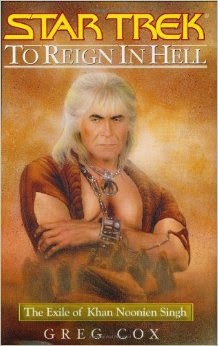
To Reign in Hell (Rise and Fall of KHAAAAAAAAAAN #3)

To Reign in Hell: the Exile of Khan Noonien Singh
©  2006 Greg Cox
384 pages

“No! This is not the end!  Khan Noonien Singh will never surrender, not to this accursed planet and not to the treacherous vagaries of fate. Hear me now! I shall show you that the superior man never bends before the cruelties of fate, no matter how hopeless the odds. Let this entire planet die a slow and miserable death. Let Kirk and Starfleet forget us entirely. I will keep you and the rest of my people alive — this I swear upon my sacred honor.”
He shook his fist at the dust-shrouded sky.
“Do you hear me, Kirk? I will survive!”   p. 269

Khan Noonien Singh is the most outstanding individual villain in all of Trek lore, a man who took from Kirk his dearest blood. An escaped superman from Earth’s violent past, Khan failed in attempts to take over the world and then the USS Enterprise before Kirk exiled him to a harsh planet in the Mutara Sector to build his own civilization. Such a dream wasn’t to be, however, as only months into exile astronomical phenomena destroyed the planet’s chances of sustaining life for very long.   His last hope wrecked, his people dying,  a man bred to be an emperor was left to preside over nothing more than the apocalypse. To Reign in Hell is an exceptional tie-in to “Space Seed” and The Wrath of Khan,  and an expert conclusion to the Khan trilogy, depicting the demise of a dream and the descent of a man into madness.

The story picks up a year after the events of The Wrath of Khan.  Kirk and his comrades have decided to pay a visit to the hellhole that was Khan’s world in order to find out what went wrong;  what happened to make the colony fail so catastrophically, and why did Khan blame a man who had been a  model of mercy towards him?  Soon after landing, Kirk and company discover the underground shelters that Khan and his people fled to when the surface was exposed to the blistering sun and fierce winds that turned grasslands into desert. Within the caverns are historical records, provided by the Starfleet historian who was seduced by Khan and joined him in exile — Marla McGivers. The novel unfolds as Kirk delves in, and the story that Cox builds works wonderfully to iron out “Space Seed” and TWOK’s wrinkles.

To Reign in Hell performs admirably in every aspect; as piece connecting two different Trek stories, as a thriller in its own right, and as the finale of Khan. Khan has never been as human, nor as remotely sympathetic, as he is here. He has no one to villainize, he has only his hopes and ambition, those dreams of creating a world for his people, and it is the environment that renders him a victim. He is doubly human in proving to genuinely love the historian who he took as a wife, Marla; perhaps because the story is told in her voice,  readers are given a more tender appreciation of his character. Certainly the warlord is still there — he is called the Tyrant by some on the planet — but here we see aspects of him, like that of a loving spouse, that make him even more fascinating.  It’s even possible to feel sorry for him, left to a world washed over in violent storms, with starvation constantly haunting him.  Ultimately the book closes in hope, at least for Kirk — who discovers in the ruins one last chance to do good by Khan’s people.

Posted in General | Tagged , , , | 4 Comments

Thank You For Smoking

Thank You for Smoking
© 1994 Christopher Buckley
272 pages

Nick Naylor may be one of the most hated men in America, because his job is to serve as the legal guardian and advocate of Big Tobacco –and he is very, very good at his job. Nick Naylor is a man who can be invited onto Oprah, and turn an ambush with a teenage cancer patient into a triumph for his own side.   Thank You For Smoking is a story of business intrigue as Naylor  wrestles victory from looming defeat, only to  be subjected to cold-blooded revenge.  A work of political satire, it bloodies noses all around.
 Naylor, like most modern protagonists, is not the model hero; there are few admirable things about him, other than his devotion to his son’s education. That education is financed by him lying through his teeth on national television on a daily basis, sure, but it’s impressive lying.  Although he does his part to prepare, staying abreast of medical reports and the like, most of his finessing the truth is impromptu. His fleet-footedness is impressive, even if he is a scoundrel with the discretion of a randy chimp. Eventually he has his private moment of reckoning, a bit of soul-searching that ends the novel.
The in-between is fun, a look into the lifestyle of the rich and infamous. This is a dark comedy,  which would be more comedic than dark were it not for the main character’s job occupation. He meets with a few friends every week for lunch, companions who represent the alcohol and firearms lobbies. Their tongue-in-cheek name for themselves is the MOD squad – for they are the merchants of death. Fun with names is a common trope here; Nick refers to nicotine, of course, and a stop-smoking group uses the acronym NOMAS, which is ‘no more’ for Spanish speakers.  If characters take themselves seriously, it is only in a pompous way that makes them easier targets for the reader to laugh at. Even an attempt at murder involves worldplay. The laughter stops after Nick is threatened with death on live TV, and then assaulted after he cheerfully loses his security detail.  The book quickly becomes a thriller at that point.
 Thank You for Smoking is not nearly as depressing as They Eat Puppies, Don’t They?, and the characters offer much less room for melancholy. They’re an awful bunch, but have their moments. It’s a fast read, and I enjoyed the fact that while Buckley doesn’t shy away from sinister goings-on within the camp of big tobacco, he doesn’t take sides with the neo-Puritans who blame tobacco for every medical catastrophe under the sun, and use shame-based advertising to make smokers feel like rapists who simultaneously carry the Black Death.

Altogether it’s a fun read.

Posted in Politics and Civic Interest, Reviews | Tagged , , | 2 Comments

This week: demon rum

This week I finally finished Huckleberry Finn, though I’m not sure why it’s generally ranked higher than Tom Sawyer.  Presumably its assumed merit comes from it dealing with more serious themes, as a boy on an adventure has to choose between doing what he is told is “good” (turning in an escaped slave)  and doing what he knows is right (protecting his friend).  Morality aside, to my mind Tom Sawyer is a more enjoyable story.  My next ‘American classic’ will be Little Women or Up from Slavery.

I’m currently having too much fun reading Ian Gatley’s Drink: A Cultural History of Alcohol. I was going to combine it with a few other books to do a quick review of Prohibition-era America, but my university library was closed last week.  I’m hoping to see To Reign in Hell, the finale of the rise and fall of Khan Noonien Singh, arrive in the mail at some point this week, and I really should mount an attack on one of my to-be-read books to finish off the list.

To be Read Takedown Challenge

  1. Antifragile, Nassim Nicholas Taleb (7/18/14)
  2. The Vikings, Robert Ferguson (6/7/14)
  3. Power, Inc; David Rothkopf (6/14/14)
  4. An Edible History of Humanity, Tom Standage (7/8/2014)
  5. Small-Mart Revolution, Michael Shuman (7/12/2014)
  6. The World Until Yesterday, Jared Diamond (5/29/14)
  7. Fighting Traffic: the Dawn of the Motor Age in the American City, Peter Norton (7/21/14)
  8. Earth, Richard Fortey
  9. Good Natured, Frans de Waal (6/27/14)
  10. Galileo’s Finger, Peter Atkins
Posted in General | Tagged | Leave a comment

Tending the Epicurean Garden

Tending the Epicurean Garden
© 2014 Hiram Crespo
185 pages

Stoicism is not the only Greco-Roman school of practical philosophy experiencing a revival these days. Epicureanism, long reduced to a synonym for food-and-wine-snobs,  has found an audience within the increasingly secularized west,  among people who cannot countenance traditional religious claims, but do not wish to dismiss all of their accumulated wisdom. In Tending the Epicurean Garden, Hiram Crespo explains  that wisdom tradition that was Epicureanism, and offers ways it might be practiced today.

Epicureanism is a novelty among classical schools of philosophy in being largely materialistic; its four-sentence credo begins with the assertion that there is nothing to fear from the gods. They may exist, but they have nothing to do with us. They certainly do not watch over us and create punishments and pleasures for us after life. After life there is nothing, for in death we no longer exist; there is no ‘us’ to experience anything.  What good there is must be obtained in life — and it can be found, and what evil exists can be endured. The Epicureans believed that atarexia, a kind of imperturbable happiness, was the only good in life, and that it could be achieved through mindfulness, the cultivation of genuine friendships, and self-reliance.

Tending the Garden mixes Greek philosophy, Zen Buddhism, and some generic self-help advice together in a mix that might spark some interest in its subject. Key to understanding and practicing Epicureanism is the practice of mindfulness; while Epicureans might be regarded today as hedonistic libertines,  prudence was their mainstay. Epicureanism bears a closer resemblance to simple living than it does to living it up.  Crespo doesn’t delve into the aspect of moderating pleasure a great deal,  but the idea is to be content with little. It is the longing after things that makes us truly unhappy, and here Crespo makes frequent connections to Buddhism and its contention that desire is the root of suffering. Mindfulness is a superb practice, but what makes Tending interesting is the attention given to community life and autarky.   Driven into unemployment by the 2008 blowup,  Crespo advocates an ownership society in which capital is widely dispersed among private owners and cooperatives.  Although the Epicurean and Stoic approaches to mindfulness are quite similar, especially in the habit of mentally girding oneself for bad news,  the only reference Crespo makes to Stoicism is to dismiss it as a false philosophy, being too theistically based.

Tending the Garden is a enthusiastic introduction to Epicureanism, but problematic; Crespo doesn’t seem grounded in the world of the Greeks; because he is chiefly concerned with reviving Epicureanism, he doesn’t examine its  historical context. There is no survey of the lives of professed Epicureanisms, for example, except to mention distant personalities like Thomas Jefferson who admired it. This is certainly not the Epicurean answer to Stoicism’s  A Guide to the Good Life, but it may inspire moderns to look into it. There are an awful lot of eclectic ideas under the Greek tunic, though.

Posted in Reviews | Tagged , , , , | 5 Comments

The Men Who Lost America

The Men Who Lost America: British Leadership, the American Revolution, and the Fate of an Empire
© Andrew Jackson O’Shaughnessy
480 pages

The Men Who Lost America is a rare history of the American Revolution, one which follows not the revolutionaries, but their opponents: the British leadership of the late 18th century. Although largely till a military history, it offers a greater survey of the war than most, covering the European battles for power in the Caribbean and South America.

I requested this volume primarily to learn about British politics at the time of the revolution, since for all the rage fixed on George III,  Great Britain was already more ruled by Parliament than executive command. The sovereign, like the prime minister, emerge from the volume not as villains, but as politicians doing their job. While George disapproved of many of the measures being applied against the colonies, once they had revolted he favored a strong response. Parliament, too, was of mixed opinion; many felt a strong response was warranted, others demurred, and a slight minority even favored American independence. Complicating matters for the politicians and the generals was the fact that investing too strongly in one theater meant leaving others ill-defended. Why wage war in America if it put the more profitable island colonies in the Caribbean at risk?  The American Revolution, once it brought in France and then her ally Spain, forced Britain to cover a lot of ground with relatively few troops, and the war in America was altogether different from European struggles. Even as men like Clinton and Cornwallis were being tasked with ‘winning the hearts and minds’ of the colonists, they were also expected to support the defense of the Caribbean. While American histories of the war depict a pitiful few colonists pitched against the Imperial Might of the British Empire,  that empire was sorely overtaxed.  The result reminds one of modern American adventurism.

The Men Who Lost America was definitely worth the wait for me, despite not delving into British politics as much as I had expected. In focusing on the lives and trials of Cornwallis, Clinton, the Howes, Burgoyne, and others, they become  much more interesting characters. Cornwallis, for instance, opposed the various taxes levied against the colonies, as well as the war, but once he was asked to pitch in, he took it as his duty to do his best.  Military campaigns considered questionable in hindsight make more sense when we realize that the British generals were also testing the waters of the American people, invading loyalist-held areas to see how many proper subjects would actually come to the defense of the Crown.  In short this is a very commendable history of the American Revolution,  one which demonstrates how understandable the cause of both sides could be, and offers plenty of room to respect the British leadership — who, for all their troubles and their ultimate inability to woo back the colonists or conquer them — kept the Empire afloat in other domains.

Posted in history, Reviews | Tagged , , , , | 1 Comment

And now, for something completely different:

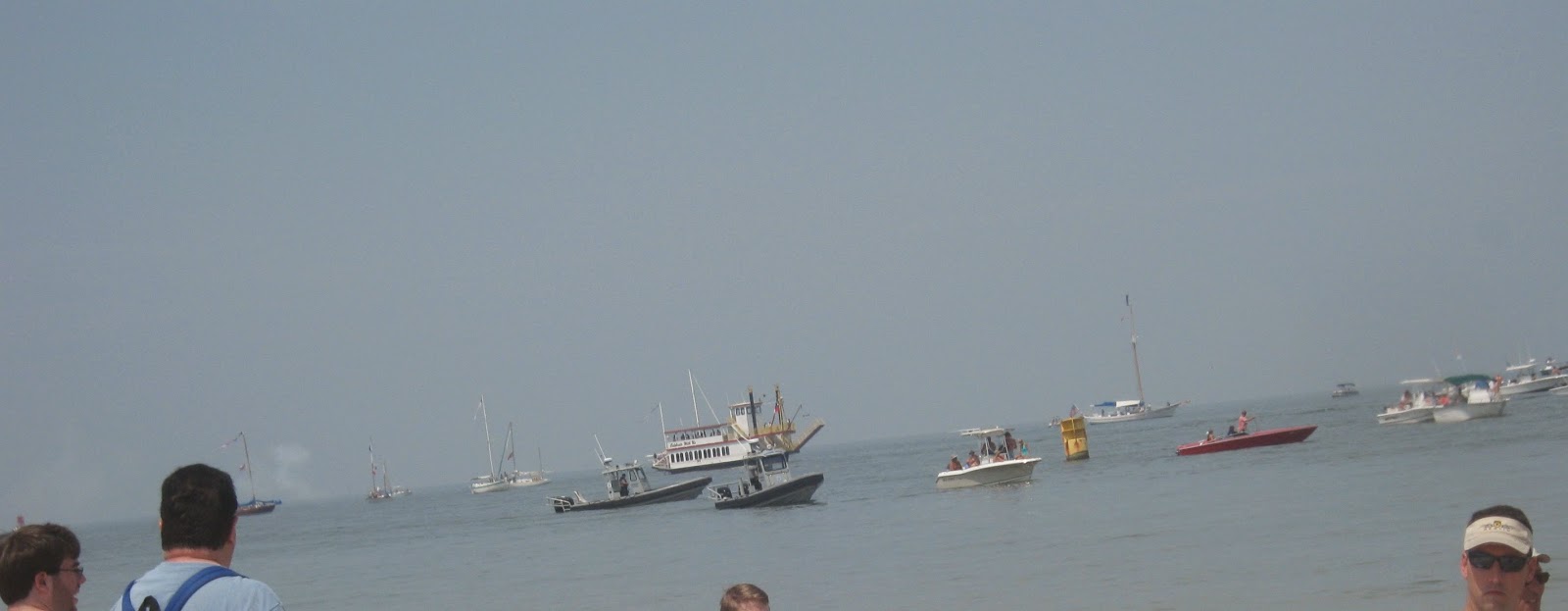
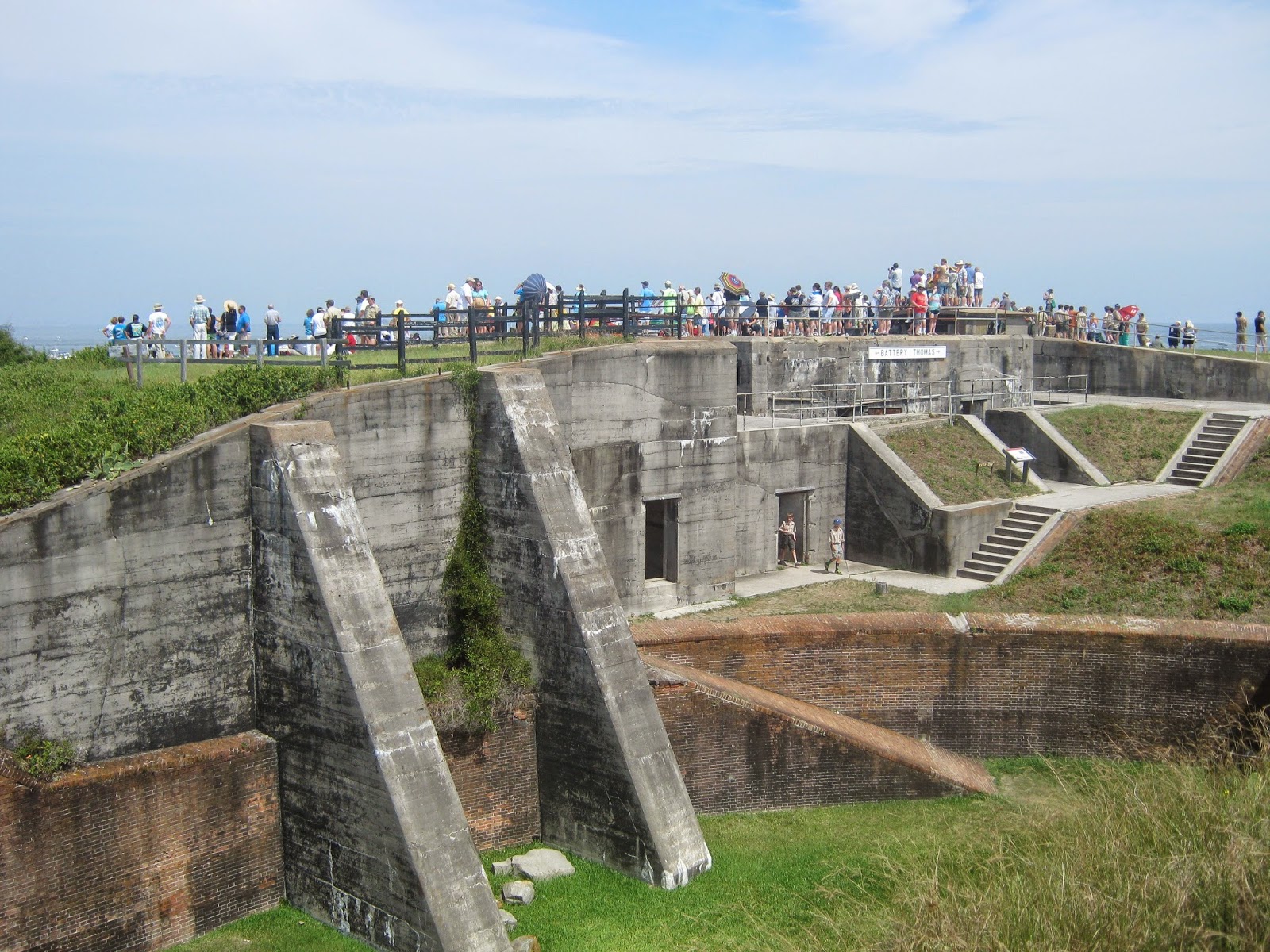
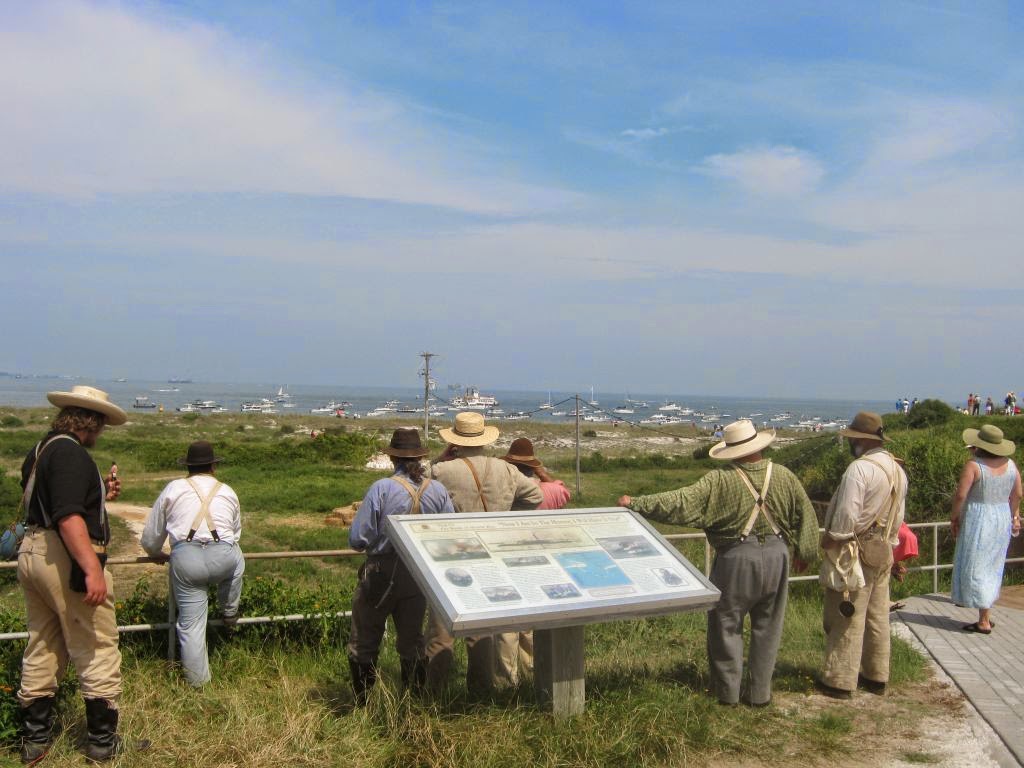
Yesterday I spent the day in the area of Mobile, Alabama, and Dauphin Island, the latter of which is breathtakingly beautiful. I’ve never been to Mobile, but I wanted to visit because it seems so strange; a city technically part of Alabama, but so far away from the rest of the state, and so very different from it, that it might as well be a world away. Click on these for a larger view..

A ship that participated in a naval skirmish reenactment in the bay. 
Part of the naval action, though it’s hard to tell given all the pleasure craft. 
The USS Alabama, a WW2-era battleship parked in the bay. I didn’t visit on this day, since I plan on making a slightly more extended Mobile visit in the future.
Yours truly, mooning over the sight of the ocean and ships while taking a ferry.
Part of the battlements of Fort Morgan
Watching a naval battle take place between oil derricks,  beyond a fleet of pleasure boats, and underneath flying tour helicopters is a little surreal.  I’m used to reenactments because Selma hosts one every year, but our park has the advantage of seclusion; the only outside element that intrudes is a water tower. 

Posted in General | Tagged | 5 Comments

Castles of Steel

Castles of Steel
© 2004 Robert K. Massie
880 pages

Everyone’s recipe for cooking up the First World War is slightly different, but one essential ingredient is that of the arms races between various countries,  especially the Anglo-Germanic quest for naval supremacy.  England’s island status and naval tradition meant possessing the mightiest navy in Europe, if not the world, was a must, but Kaiser Bill’s fondness for boats meant his empire kept  acquiring bigger and faster dreadnaughts. What’s worst, all of them were parked right outside Germany, within staring distance of London – and its own fleet had a global empire to defend.    Castles of Steel picks up where Robert K. Massie’s Dreadnaught left off, detailing how the arms rivalry of the United Kingdom and Germany continued in open war. Castles is a naval history of the great war that focuses almost exclusively on the North Sea,  brimming over with detail and delivered with the enthusiasm of an author who plainly enjoys his subject.

     The twilight years of the 19th century, and the opening of the 20th, were to be the Age of the Battleship, an era of naval warfare marked by thickly armored titans sporting enough guns to bring a city to heel on its own.   Rather than seizing the spotlight during the Great War, however, the fleets of goliaths never have the Battle of the Ages, the gods vs titans duel everyone dreamt about. Instead, action in the north sea is principally one of attritive warfare, of both Germany and England imposing blockades on the other and playing a delicate game of diplomacy so to  not offend too many neutral nations.  There are, of course, minor skirmishes featuring the gunships, and Massie milks them for all they are work, uplifting minor spats into feuds that shake the Earth.  Naval buffs will no doubt find the spellbinding accounts that seem to mention every turn of the rudder in battles of interest.  Massie doesn’t limit his history to ships, however; in the interests of thoroughness he devotes chapters to airships and airplanes over the seas as well. Zeppelin warfare seems like fantasy now, but for the people of England it was a real threat for a time. This is also a book of personalities;   men of consequence merit chapter-length biographies in miniature, most notably Admirals Fisher and Beatty.  Churchhill is a heavy player, too, of course,  but so colorful is the cast that he doesn’t dominate.  The action sometimes moves away from the North Sea and the Atlantic,  as it does in the beginning to follow running battles through the Mediterranean and the Pacific Ocean.

Castles is impressive, for both exhaustive detail and  a narrative voice that never seems to run out of steam. The size might intimidate, but the storytelling makes it a suitable and informative choice for someone who wants to know more about how the war over the seas was fought.

Posted in General | Tagged , , , , | 3 Comments

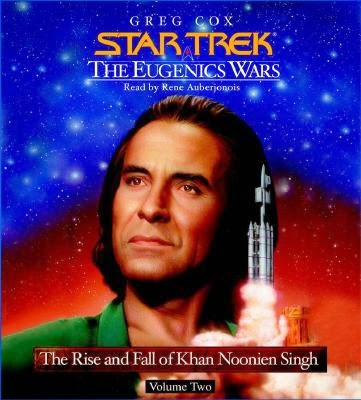
The Rise and Fall of KHAAAAAAAN! Volume II

The Eugenics Wars: the Rise and Fall of Khan Noonien Singh, Volume II
© Greg Cox 2001
434 pages

 Having seized power in India and cultivated a network of spies and yes-men who will do his bidding throughout Asia, genetically engineered and predestined ruler of the world Khan Noonien Singh is ready for expansion. Having experienced his first difficulty in politics (people), Khan hopes that joining forces with his fellow augments will expedite his dreams of world domination. Enter sibling rivalry…with biogenic weapons.  The second volume of The Eugenics Wars tries to fit the wars themselves into the geopolitical events of the early 1990s,  rather like stuffing a gorilla into a tuxedo. It doesn’t work out too well, but it’s still entertaining to witness.

As with the first volume, this is a Gary Seven story. Seven,   for whom thwarting Khan has turned into a full-time job,  will be remembered as the Secret Agent Man from Space in “Assignment: Earth”.  Having saved the child Khan from the explosion of his insane mother’s underground base, Seven feels some responsibility for having turned him loose onto the world. Their perennial feud is first marked by professional respect for the others’ skills, but later grows personal when Khan learns that Seven blew up mommy.  Also personal is the grudgemath between Khan and his kin, who really don’t like one another.  None of them are quite powerful enough to  war openly, however, so they resort to terrorist attacks on the people their counterparts wish they were ruling. Two manage to buy submarines and they have a little torpedo tête-à-tête in the east Med, but ‘real’ warfare is nonexistent.

Unfortunately for the plot, there aren’t enough real-world dead people in the small window of time canon allows for the coexistence of the Eugenics Wars with our own history, at least not if the Wars are to be given their “bad-as-WW3” feel experienced in “Space Seed”.   That these events could have happened is believable, but why would Kirk and company be fussed about it several centuries from now?    But explanations can be found;  considering that genetic engineering reared its head several more times, perhaps the historians of Kirk’s time have come to believe a more legendary version of Eugenics history, that Khan’s escape marked the end of the beginning, but not the end altogether. At any rate, the established character-based portions are terrific as usual, as are the little connections and allusions to greater Trek. Even Star Trek Voyager gets a nod, unavoidable given that it had an episode set in the 1990s.  The supermen themselves aren’t an asset to the book, consisting of caricatures (a Marxist revolutionary and a man-hating chieftess with an army of ‘amazons’, for starters) who don’t help general believability.  While the sequel isn’t quite as terrific as the first novel promised it might be,  the third – To Reign in Hell – will – will be freed of having to conform to real world history, so I imagine the series will end on a strong note.

Related:

  • From History’s Shadow, Dayton Ward. Another impressive and fun  integration of ST canon and real-world history
  • Assignment: Eternity, possibly my first ST novel, and another Gary Seven tale by Greg Cox. 

Posted in General | Tagged , , | 3 Comments