Hack

Hack: How I Stopped Worrying About What to do with my Life and Started Driving a Yellow Cab
© 2008 Melissa Plaut
256 pages
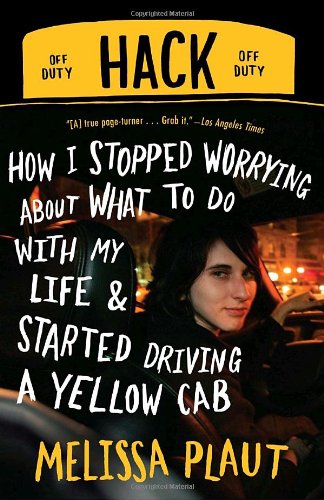
At the age of twenty-nine, Melissa Plaut was let go from her job at an ad agency. She found the layoff liberating instead of terrifying, freeing her as it did from a safe but utterly meaningless job where she felt distinctly like a sell-out. Having spent most of her twenties spinning her wheels at one safe job or another, she opted this time to pursue adventure.   So it was that she braved the labyrinth of New York bureaucracy and the warren of traffic to become a New York City cabbie.Hack collects stories from her blog about working the city streets, and as they are arranged she becomes progressively more miserable, eventually downshifting to the point that driving the cab is a part-time hobby instead of a career.

Although her stories behind the wheel constitute the bulk of the book (the exception being frequent breaks to chat about her social life) there is not a lot of revealed about the inner workings of taxi services in general. A combination of customer service, chronic traffic jams, and steady physical deterioration, taxi driving quickly loses its allure and becomes a daily grind for her. Working with the public at large is not for the faint of heart, and quickly takes an emotional toll on Plaut as she endures all kinds of abuse and contempt from her patronage. Soon she is bypassing types  (teenagers and grizzly men) who she suspects will be fare-jumpers or trouble-makers, and feeling guilty for not being as trusting and open as she once was.  Driving a cab for twelve hours a day also wrecks her physically; the human body was not meant to spend half its time sitting in an odd-shaped seat, one leg constantly working the gas or brakes and the rest comparatively inactive while the driver deals with the constant stress of traffic, hunting fares, and restraining her bladder. One of Melissa’s coworkers routinely soils himself, his continence wrecked by years of trying to hold it until demand slowed down.  Being the result of only a year or so behind the wheel, not much is said about the taxi industry in general: readers get a feel for how her particular company’s practices work, but that’s about it. There are moments of broader import, as when she weighs whether or not to make the most of a transit strike; ultimately, sheer fatigue at trying to work at all overwhelms any thoughfulness. Most of the book consists of stories about abusive customers, pushy cops, and her social life,  rendered with ample vulgarity. As one takes in her growing frustration — and her inability to find anything outside of work that will meet her needs for meaning or happiness — sympathy grows, especially when she witnesses a brutal traffic accident that reminds her all too much of her own near-miss, when a car struck her as a pedestrian and she was hospitalized.

Hack is interesting, though often ugly and not particularly useful about learning the ins and outs of the taxi service. It is good exposure to the raw experiences of drivers, especially New York cabbies who find the city government nearly as hostile to them as the public.
Posted in Reviews | Tagged , , , | 1 Comment

We Band of Angels

We Band of Angels
© 2001 Elizabeth M. Norman
325  pages


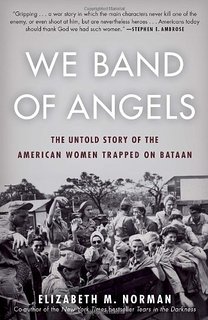
When Japan invaded the Philippines and besieged the Bataan peninsula,  the Filipino-American army wasn’t the only entity enduring months of dwindling supplies and attritive warfare. Stationed alongside soldiers and sailors were nurses, farm girls from the United States who never intended to go to war, but found themselves in the middle of one. We Band of Angels uses letters, diaries, and interviews with still-living nurses to recount  their increasingly desperate experience, as they set up emergency medical stations behind the lines, a few dozen women tending to thousands of patients as bombs fell and monkeys helped themselves to the scant food and medicine available. It is unusual and attractive in being a non-military memoir of the fall of the Phillipines, the siege of Corregidor, and later imprisonment, and rather lively.

On Bataan and Corregidor, there were no secure rear quarters; the warzone was everywhere, and bombs were just as liable to fall into hospitals as they were vehicle pools. Unlike the soldiers, these nurses — civilians, really, whose programs were nationalized — had never trained for conditions this hostile, but they took them on just the same. They tended the injured after every bombardment and raid, and did their best to keep disease from utterly destroying their comrades despite being the walking wounded themselves,  caught in the grips of malaria but attempting to do what good they could. When forced to evacuate, they left part of their hearts behind in the patients abandoned in beds. Some would return to the United States following the fall of Bataan and Corregidor, while others would spent years held prisoner by the Japanese.  Those who returned were aghast to find themselves hailed as saintly heroes; what they they done, other than stick to their duty and make the best of an awful situation?  After the Philippines were liberated, those imprisoned met the same fate, idolized and put to good use selling war bonds and inspiring an increasingly war-fatigued populace.

Their irritation at being used is shared by a sometimes prickly author who resents women being treated any differently than men. When nurses were evacuated to Corregidor shortly before Bataan was abandoned, she fumes against the male egotism that wanted to protect the women, a bizarre judgment given that she had just shared everyone’s speculation about a Nanking-style desecration, and the fact that soldiers were being evacuated. (The judgment is proven  tragically faulty when later a nurse is raped by the imperials, and others endure deliberate sexual taunting by the swaggering invaders.)   Norman’s scorn for her subject culture doesn’t manifest itself too often, however, and the story of the nurses themselves is so fascinating that misplaced political griping does’t diminish it. Her core grievance is that the women were idolized as Women — tender, doting nurses or damsels in distress  — and not given their proper respect as working professionals, ladies of intelligence, skill, and steadfast devotion to their vocation. It would be a fairer complaint if levied against modern audiences, but for those living the world crisis, seeing all of Eurasia under the command of totalitarian governments, no doubt legends carried more traction than staid reports. There is a time for stories about knights fighting dragons, sustaining faith in a fight against monstrosity.  Norman’s book does give them that respect, taking a fuller measure of their character, one we are now safe to appreciate far from the peril of the hour.

Posted in history, Reviews | Tagged , , , , | 1 Comment

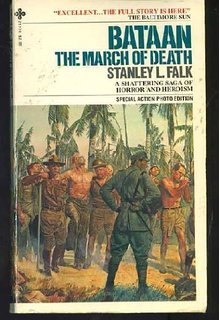
Bataan: March of Death

Bataan: March of Death
© 1962 Stanley J. Falk
256 pages


Japan’s strike at Pearl Harbor was not a solitary military move, but the opening play in a Pacific strategy. Having disabled the American Pacific Fleet,  Japanese forces would be free to sweep down on Anglo-American holdings in southeast Asia and create its own empire. The plan went into effect with such rapidity that the Philippines,  seized from Spain in the late 19th century,  fell under attack on the  very day of Pearl Harbor. The Rising Sun found stiffer resistance in the Philippines than it met at Wake Island and Guam, however, and not until early spring 1942 did American forces there surrender.  They survived a siege, the weeks of bombardment and short rations, but  the most hellish hours were yet to come.

The defense found endurance in retreating to the rocky Bataan peninsula, where for months they held without support or supplies. Increasingly ravaged by disease and malnutrition, however, eventually they had to accept the inevitable.  Even in defeat, however, they remained a nuisance to the Japanese:  Bataan was the ideal site to launch an attack on the Pacific Gilbralter, the little island fortress of Corregidor whose guns barred Manila Harbor.  The defeated needed to be moved out, immediately, and so began a hike of the damned.  Though the siege offered plenty of time to plan for dealing with P.O.W.s,  Japan’s itinerary of short hikes and feeding/rest areas fell apart almost immediately, overwhelmed by both the sheer number of prisoners and their deteriorated status.   The two factors worsened the effect:  food and supplies were simultaneously much reduced and much more needed.  Every mile of the march saw physically exhausted and disease-ravaged men fall out, and those who did not succumb to injury or infirmity were dispatched with indifferent bayonets .  Though the Death March is regarded in propagandized history as an act of cold malice by the Japanese empire, intent on humiliating and destroying those who surrender instead of fighting to the last and dying honorably,  Falk here builds a case that the atrocity was more a symptom of the chaos and hell of war aggravated but not initiated by Japan’s severe militarism.  The Japanese commanders remained ignorant of both the amount and condition of prisoners headed their way, possibly through errors in translation but also owing to the confused state of American defense: as at Dunkirk, few units were intact; the massed body of ailing defenders were a confused patchwork of commands.   

All this is not to say that Bataan was merely a tragic accident. It was the stage of many a war crime, some casual and others more deliberate.  Early on, an entire division was beheaded for reasons still obscure.  Individual Japanese soldiers practiced chronic and petty acts of cruelty that further bled an already wasted body of men, like the man who amused himself by knocking off the helmets of prisoners who marched by him. Unable to slow down or stop on pain of beating or death, the troops had to leave their precious headgear behind, further exposing them to the roasting tropical sun.  Prisoners were robbed not just of equipment and personal items, expected losses in war, but of what little food they had retained or were given. The Japanese were despairingly inconsistent;  the food given to men by one command might be  taken from them by another.  Some Imperials dispensed cooked rice; others  forced the prisoners to be content with raw grain.  The dehumanization of Japanese military training – in which beatings for small infractions were commonplace – manifested itself in their treatment of the Filipino and American soldiers under their power, but the Japanese government deserves direct scrutiny and condemnation for the “rest areas”, which would have been dangerously overcrowded and wholly unsanitary even if the men shoved into them not been desperately ill with dysentery, constantly soiling themselves and the environment.  Campsites were open latrines in which men were forced to lay in a miasma of rotting bodies and feces.  The quarter of men who were allowed to ride  in trains to the final camp instead of march found  it a more torturous alternative, for the cars were nearly completely sealed, permitted standing room only, and collected such heat that the men inside could not touch the walls for fear of scalding themselves.

In a war of genocide, fire-bombings, and mass starvation,  the competition for horror is fierce.  Though much less severe than the wholesale murder at Dachau and Auschwitz,  Bataan is no less grim in its own right. Here are men as the detritus of war, cut off from every resource, given nothing but abuse and mockery, and left to die. Some 20,000 men perished from disease, execution, exhaustion, live burial, or hunger in the sixty-five mile march.  Stanley Falk’s history is admirable, neither softening the blows nor attempting to propagandize them. He diligently seeks for the causes of the catastrophe, and finds it a bad situation merely made worst by martial brutishness, instead of being an act of deliberate evil.  Bataan is invaluable not just for its information, but for its measured tone.


Posted in history, Reviews | Tagged , , , | 2 Comments

Horse

Horse: How the Horse Has Shaped Human Civilization
© 2006 J. Edward Chamberlin
288 pages

How do I love thee, O horse? Let me count the ways.   J. Edward Chamberlin’s Horse begins with one lonely native American mare separated from her tribe  recounting, from long memory, the many centuries that horses and humans have traveled together. Even after moving to more conventional historical narrative, the book remains highly storied, drawing much from art and poetry and   never far removed from recollections of Blackfoot, Greek, Chinese, or other horse-related mythology.  In terms of history, war and sports predominate, with the scant mention made to an actual workhorse   appearing and vanishing in the last chapter like the twinkling of a star.  The history itself sits under the shadow of mythology;  the author’s claim that chariots were used more to taxi infantry to the battle than as weapons themselves is illustrated with nothing more than The Illiad, and he manages to put the cart before the horse (ho, ho) by referring to Islamic expansion as a reaction to the Crusades. Say again?   There’s useful information here – on the evolution of  different breeds, saddles,  riding styles – but  it’s altogether very general.  It’s a loving tribute to creatures that inspire awe and have been at the center of human history for thousands of years, but shouldn’ t be approached for too much substantial history.

Posted in history, Reviews | Tagged , , , , , | 4 Comments

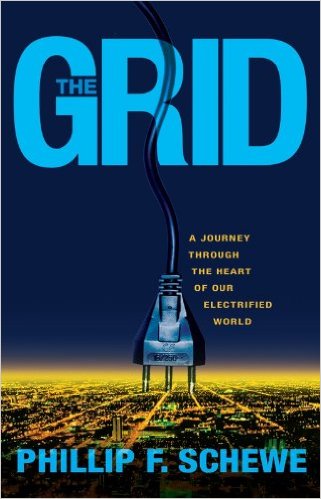
The Grid

The Grid: A Journey Through the Heart of Our Electrified World
© 2007 Phillip Schewe
310 pages

In every room there sits a caged beast waiting to cause mischief, but which most of the time  is put to honest work, instead.  When Thomas Edison began selling electrical service for artificial illumination in the close of the 19th century, did he realize how radically he would transform the world?  Steam engines went a long way, but they never took up residence in the house.  At the opening of the 21st century, homes are linked together not just by ribbons of asphalt but by buzzing wires overhead, and those are only the first part of a complicated apparatus that can sink an economy for days if it hiccoughs.  Phillip Schewe’s The Grid is a layman’s introduction to the world of the electrical grid,  an educational sampler.  He lightly touches on the grid’s early history,   moves into the social relevance of electricity,  writes about some of the aspects of electrical infrastructure, and then looks to the future.

 It is as the author describes it, a “journey” — rather like passing through a city on a bus and catching a sight of very interesting things but not being able to get out to spend time studying them. The early book is quite jumpy, as the reader passes from early electrical enterprise straight to electricity being seen as vital infrastructure that the government can’t leave to the hands of the people who paid to create it.  The latter half is more integrated, especially as Schewe uses his chapter on the home’s internal electric works to argue that the future of electricity may be more distributive,  with solar-paneled homes supplying much of their own electricity and sometimes contributing their excess into the grid. This is followed by a chapter on nuclear plants, the concentrated alternative.  The Grid has a frustrating lack of focus, though, and this is worsened by the author’s creative gifts.  His subject may be mechanical infrastructure, but Schewe waxes lyrical about it — literally,  at one point offering commentary in verse form and filling another paragraph with so many allusions to Hamlet that one wonders if he had a quota. Although electricity is regarded by most everyone in the book as an unmitigated good, Schewe vainly includes Lewis Mumford and Henry David Thoreau as counters, both being technological critics, but neither really bares their teeth;  it’s as impact as someone musing on how over-much we depend on electricity when there’s an outage, and then forgetting about it as soon as the lights pop back on.   It was a nice gesture, though.   The Grid is thus  tantalizingly incomplete,  offering just a taste and then charging ahead into China or Africa to look for different things to sample.

Related:

Posted in history, Politics and Civic Interest, Reviews | Tagged , , , , , , | 2 Comments

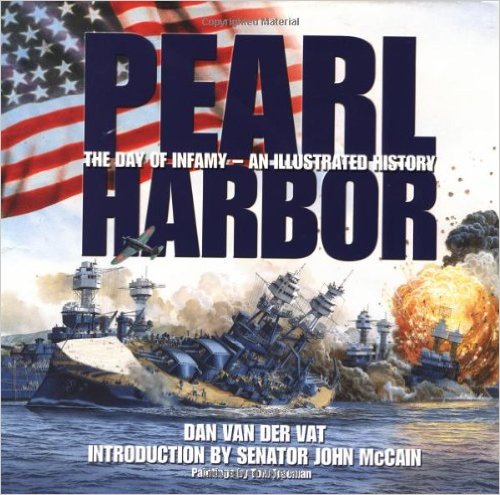
Pearl Harbor

Pearl Harbor: The Day of of Infamy — an Illustrated History
© 2001 Dan van der Vat,  illustrations by Tom Freeman
176 pages

Seventy-four years ago,  the Pacific Ocean became awash in the blood of war. Six carriers, operating for days under radio silence, parked north of Hawaii and unleashed a complete airborne arsenal — fighters, torpedo bombers, dive bombers, and conventional straight line bombers at the small island of Oahu. Their target was the US Pacific Fleet, moored in Pearl Harbor. though the island’s US Army defenders would also be savaged by the surprise attack, and the ordinary citizens of Honolulu would be stung by the debris of war. The day following, Franklin Roosevelt declared December 7 to be a day which would live in infamy — and so it has, to a degree.  Being one of the greatest military disasters in American history, it has at least not been forgotten, ‘inspiring’ a movie as recently as 2001, and serving as the subject of scores of books.  Dan van der Vat’s textual history is light, but rich,delivering on the ‘illustrated history’ premise. Like the Japanese, van der Vat works Pearl Harbor over location by location, focusing in turn on the key targets: Battleship Row, Hickham Field, Wheeler Field, and so on.  Firsthand accounts from Japanese airmen, US servicemen, and Hawaiian civilians appear with photographs of events as they unfolded, and pictures of artifacts — the sword of a captured Japanese submariner, the scorched Red Cross patch worn by an aide worker, that sort of thing. Fulls-spread photographs of the Navy’s mighty battleships crumbling under bombs and torpedoes abound, but the book also features art by Tom Freeman.  Despite generally depicting scenes of destruction, these pieces fetching to the eye and impressive in their detail, especially near Battleship Row.  There are also full-page spreads of Pearl Harbor itself, which — given the book’s proportions —   make it an excellent visual reference. The author included many “then and now” shots; it’s surprising how much of the base has survived since the 1940s.  This illustrated history serves quite well as an overview for the Pearl Harbor attack,  especially given the first hand accounts and the ending chapter which points out that despite the loss of life, for Japan ultimately December 7 was a strategic flub.   The third wave against oil tanks and repair facilities was called off, and most of the ships damaged were revived. Even those which were never restored, like the Arizona and Utah, contributed parts to repair other ships. Within six months the Japanese fleet had been checked and reversed, and the long and grim work of rooting the Empire out island by island had begun.  The extravagant amount of visual media makes the book quite attractive to WW2 buffs, as well.

Posted in Reviews | Tagged , | 3 Comments

Yamamoto

Yamamoto: The Man Who Planned Pearl Harbor
© 1990 Edwin Hoyt
271 pages


Isoroku Yamamoto was the indispensable man of the Japanese navy,  the author of the surprise attack on Pearl Harbor and an object of such interest to the United States that it nearly spoiled its ability to read Japanese codes in order to shoot him from the skies.  He is an intriguing character to study;  as a subject of the emperor, he was loathe to think of Japan at war with the United States. He knew America, had traveled and studied there, and regarded the thought of military contest with her a joke.  As a soldier, however, he strengthened Japan’s ability to make war, guiding the strategic development of her fleet into the future, helping create a carrier-focused force that would outmatch the western powers’ dreadnought mindset. When he was asked to use that weapon against the United States, he did his best to make it a killing blow.   Yamamoto takes readers through Japan’s percolation as an imperial state, from its first tepid expansion in Asia at the turn of the 20th century, to its maturation as a major power who sought not just equality with, but triumph over, the west.   On the sea, Yamamoto develops quickly as an officer to be revered and reckoned with — a strict, audacious, and strangely humble man who saw that the future of global war lay in aviation.  On land, Yamamoto is tugged reluctantly behind waves of militarism as Japan sees cabinet after cabinet fail. Every attempt to reconcile the military with the less bellicose intentions of the emperor fails and brings the nation as a whole closer to jingoism,  with one attempted coup and a rash of assassinations.  For most of the book, Japan seems mired in China,  its every martial action stressed by a fuel supply that requires constant attention.  Title aside, Pearl Harbor receives little attention here, as Yamamoto receives its results from afar. Hoyt gives generous consideration to the extended brawl for Guadacanal, however, the battle which draws Yamamoto closer to the front lines and eventually exposes him to an assassination by fighter plane soon thereafter.  Various military events are recorded here, Midway included, but none receive the treatment of Guadacanal, and for the most part military content is very general, and is included more to show the book’s subject at war, frequently frustrated by his subordinates’ timidity in pressing forward.  Although Yamamoto’s talents as a commanding officer made him a fearful enemy to the United States, he is despite his ambush not villainous. Surprise was a meager advantage to be pressed; disarm the United States quickly and it might leave Japan to its new empire.  Instead he merely drew blood, incited wrath, and fell prey to it himself.   In Yamamoto we thus see the the death of man at the hand of a war he did not want — but out of a sense of duty, he had to fight.

Posted in Reviews | Tagged , , , , , | Leave a comment

December 6

December 6
© 2002 Martin Cruz Smith
400 pages

Between his girlfriend and a samurai intent on revenge, Harry Niles isn’t sure who will try to kill him first.  Raised in Japan to American parents, Harry is a misfit who trouble would find even if he didn’t seem to court it, earning money through less-than-licit gambling and currency exchanges. Yet he does, altering Naval ledgers to provoke suspicion and — hopefully —  ward the Japanese away from attacking the west, and pursuing the wife of a married man despite having his own very jealous mistress, one with a penchant for honor killings.  Though Harry has no overt reason to think his adopted country is about to wage war against his parents, there’s a certain something in the air– indignation and the will to fight.   December 6 takes place over the course of a couple of days; as Harry, pursued by both the military police and  a frustrated  army officer he last saw (and stymied) in Nanjing,  looks for a plane  out. As much as he loves Japan,  he is not Japanese; his heart may give the emperor loyalty, Tokyo may have been his home for decades, but he will never be accepted as anything other than gaijin, an outsider .  Flashback scenes fill out the book and delivers a sense of Harry’s sincere love of the Japanese nation despite his status as a perpetual resident alien, and the growing militarism of the state.  As the hour of Japan’s great gamble draws near, the police grow desperately bold, needing to know what exactly Harry knows, and eventually a rash of beheadings ensues. December 6 is most interesting for its setting, pre-war Tokyo, here alive with passion and intrigue, streets filled with laughter and the clamor of trade. Soon it will be a wasteland, consumed in fire after Japan chooses to live by the sword.  Harry is an interesting character, sympathetic for his man–of-both-but-neither-world status if for nothing else.  The man who hunts him is also fascinating, though not at first; he starts off as a psychopath, an agent of the wanton murder  in Nanjing, but his violence proves to have less to do with passion, being filled with dark purpose.   I rather liked the un-expected role he took on in the ending. The writing, too, is lovely at times, much more so than the contents.

Posted in historical fiction, Reviews | Tagged , , , , | 2 Comments

This week: yep, still at war

I don’t know how most people spend Thanksgiving, but after a day with family eating sweet potatoes and admiring chickens and a late-fall collard garden, I’ve been reading nonstop about World War 2.  I’m moving closer to the end of 1941, and the war is shifting east, as Hitler’s panzers and Hirohito’s carriers are on the move.

I’ve read two more Time-Life histories of the war: The Rising Sun and Russia Besieged.  I picked up The Rising Sun in hopes that it would address Japan’s rise as an industrial and colonial power, but that is mentioned as mere prologue. Time-Life’s history is principally about the high point of Japanese power, from the December 7 attacks on the Allies in the Pacific,  to the battles of the Coral Sea and Midway, where Japan was first stopped and then reversed.  Russia Besieged concerns Operation Barbarossa, in which Germany launched the largest land invasion ever witnessed into the heart of Russia. There’s a lengthy section on the brutal siege of St. Petersburg, then called Leningrad,  and the book ends with German retreat at Moscow, driven back by “General Winter”.  (Fickle, that one. Wasn’t he just helping the Finns fight the Russians?!)   
The Sino-Japanese war is a massive gap for me; I’m familiar with the outlines from a survey course, but otherwise, I know little. That’s why I read  The Rape of Nanking, which exacted a psychological toll. In hopes of countering it, I read Flying Tiger: Chennault of China,  which is part-memoir, part-tribute. One of the few stories from the Chinese front that I’m familiar with is that of the Flying Tigers, a group of volunteer American pilots who flew old P-40s and harassed the Japanese as best they could.  I read a particularly fun book on these highs in high school, but this wasn’t it.  The Tigers are touched on only briefly here, the book mostly being about the author’s role in China’s American air force (later America’s air force in China), and his adulation of Chennault, the Tigers’ leader who created the guerilla air tactics they used to counter the Japanese.

In the coming week or two, expect at least one book on the Eastern front, followed by our first forays into the Pacific!  It won’t be exclusively war material, of course, as I’ll throw other works just as a break. Cities, livestock, science,  Korean philosophy, murder mysteries — you never know.  I’d like to be done with this WW2 series by the New Year, but it’ll probably bleed over depending on how many books about the air war seduce me.

Posted in history, Reviews | Tagged , , , , , , , , , | 2 Comments

The Devils’ Alliance

The Devils’ Alliance: Hitler’s Pact with Stalin, 1939 – 1941
© 2014 Roger Moorhouse
432 pages

On August 23rd, 1939, Nazi Germany and the Soviet Union shocked the world by entering into a nonaggression pact.  They were not merely neighbors and rival powers ruled by domineering men who loathed one another: their respective ideologies viewed the other as the chief menace to civilization.  Yet now, the fists which shook in anger were now extended in friendship, and Europe seemed doomed. Within weeks of the pact’s signing, German and Soviet armies had both swept into Poland, igniting the Second World War. The Devils’ Alliance is an admirable history of a marriage of convenience, recording why it happened, its effect on the beginning of the war its reception among the party faithful and a horrified Europe, and the breakup that saved civilization. The Devils’ Alliance exposes the cynicism of the agreement, and the very nature of the totalitarian state.

Since its creation at the end of the Great War, the Soviet Union had been a European pariah, with a special enmity existing between it and the Nazi state after it came to power. The party line of Nazism was expressly anti-Soviet, viewing Bolshevism as a conspiracy;  fears of communist takeovers were very life of National Socialism, birthing it and giving it strength. The Soviets were no less contemptuous of the counterrevolutionary Nazis, scoffing at their worship of nation and race.  Ultimately, however, each had more in common where it mattered than not. They were the continental outlaws who rejected the political and economic systems of free Europe; both were totalitarian regimes in which the State reigned supreme, with every institution which might have softened or sapped its control either broken or rendered subservient. To regard Nazism and Communism as opposites on a left-right spectrum is inaccurate, for both supported state command of the economy: they merely disagreed on who should be in control. Each man,  Hitler and Stalin, had ambition, and for a time found his ‘enemy’ an ally to pursue them with. One hand washed the other. Between them, Russia and Germany divided eastern Europe, each invading Poland in turn, and each seizing a third of Scandinavia.  Russia needed help continuing to industrialize; Germany needed raw materials.  The fact that each state had more in common than not is born out by their identical treatment of the Polish, with shootings and deportations fleeing the arrival of the conquests. Poles fleeing from Nazi occupation passed their countrymen fleeing from Soviet occupation, each wondering if the other was not crazy.

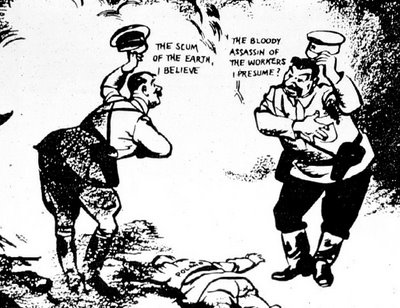
“The scum of the Earth, I believe?”
“The bloody assassin of the workers, I presume?”

The same reaction could be had from communists and Nazi sympathizers the world over. Overnight,  Stalin and Hitler’s seemingly impulsive decision to play nice translated  into movies in both countries being pulled for demonizing the other;  for years the party faithful had been schooled in the evils of the other, and now they were instructed and propagandized to regard the other as a brother-in-arms against western liberalism.  Some, sheepishly followed, like the American communist party answering to Moscow; other fellow travelers began experiencing cognitive dissonance. How could the ideals of the party — Nazi or Communist — be taken seriously if it made concordance with the adversary so easily?  No doubt Moscow’s turnabout demands influenced George Orwell:  Eurasia has always been at peace with Eastasia?  The communists ranks in particular would be thinned in Britain and France as people reacted to the absurdity.    Once the tree of diplomacy had stopped producing fruit, of course, Hitler would have Barbarossa hew it down. Successive chats failed to convince the Soviets to stop looking at the Balkans so hungrily, and to go bother British India instead, and since the west had by and large been reduced as a threat,  who was left to destroy but the Bolshevik menace?   Enter the panzers rolling into the Soviet Union fueled by Russian oil, attacking tanks produced with German industrial expertise.  The world breathed a sigh of relief,  from a Britain who was no longer the sole object of Nazi malice, to Germany’s fellow Axis members who found Joe and Adolf a very odd couple. Ultimately,  the divorce made in heaven would lead to the downfall of Hitler’s regime,  as a rebuffed Joe had to pitch woo with the Allies instead.

Juvenile history books may count the Soviet Union among the Allies, but the postwar conflict between the west and Stalin was not a tragic falling-out between brothers.  When Britain stood alone, the Nazi knife at her neck, “Uncle Joe” yawned and admired his new takings.  Nazism and Bolshevism were houses alike in infamy, both responsible for murder at industrial proportions in the millions,  and both intent on spreading the gospel of death throughout the world. They were gangsters who  agreed to stop shooting one another long enough to take care of their mutual enemies, but happily human malice is a two-edged sword, and evil ever self-destructs.  Devils’ Alliance is an utterly fascinating history of realpolitik,  which extends not only to the two titular monsters but to the Allies as well.  It would have been easy for Churchill to be contemptuous of the Soviet plea for help, and when he urged Parliament to send such relief in resources as it could afford, he did so not to expand Britain’s own power, but in recognition that Hitler waged war not just on Stalin and his army, but on the innocent Russian populace, whose livelihood and lives would be destroyed by the battle between the beasts.    The Devils’ Alliance is an excellent take on one of the most dangerous periods in European history.  and stir readers to reflect on how much contemporary politics is driven not by idealism, but the pure lust for greater power.  How many devilish alliances have been crafted between the west and the warren of woeful powers in the middle east?

Posted in history, Reviews | Tagged , , , , , | 1 Comment