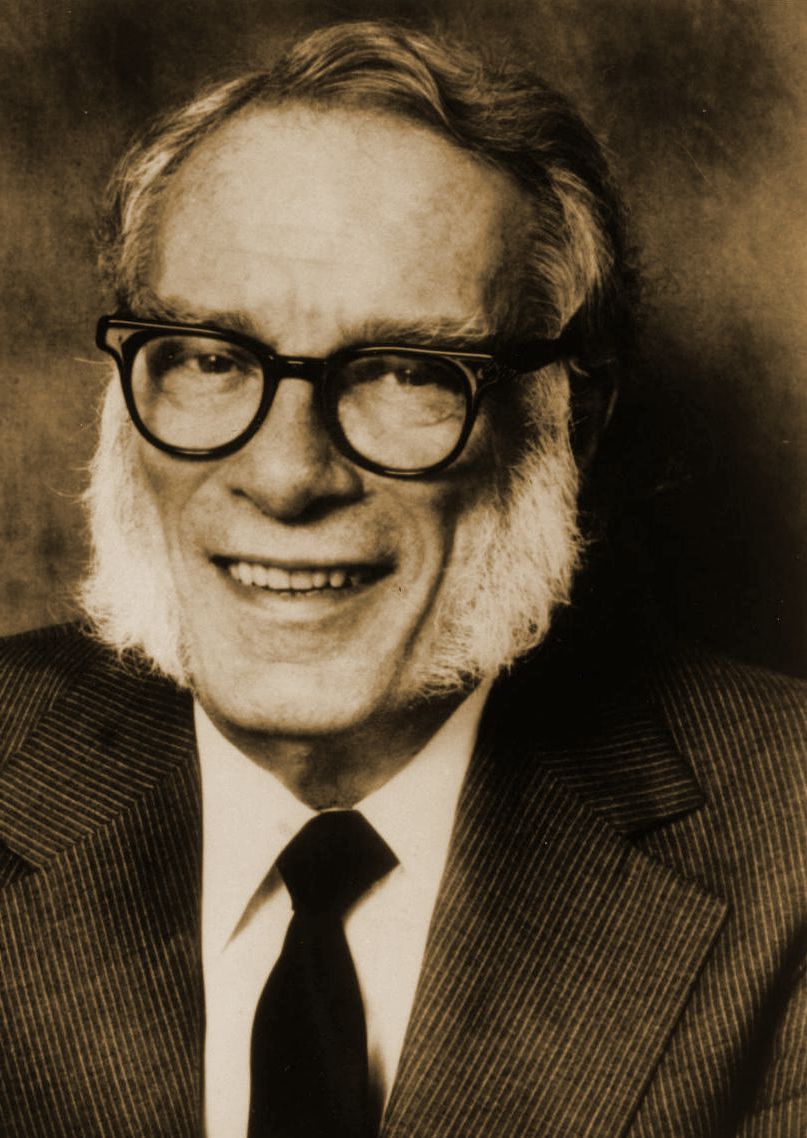
Ten Stories by Isaac

Back in 2007, I discovered Isaac Asimov’s short stories and became a trifle obsessed with him, to the point that I have an entire bookcase devoted to his short stories, essays, novels and books.  Lately I’ve been feeling the itch to read some old-fashioned SF, and that vein have thought back to some of the dear doctor’s more memorable pieces:

1. “The Feeling of Power”

In the near-distant future, Earth suddenly achieves a revolution in space warfare when a rogue scientist invents…math. Those fellows on the other side will find their mere automatons outmatched!

2.  “Nightfall”

On a planet with several suns,   night never falls.  Or…does it?  Lately archaeologists have begun to see a pattern in sites through the world, as if global civilization destroys itself in spectacle of fire every  two thousand years.

3. “Gentle Vultures”

They’ve seen it before. An intelligent society comes of age, invents nuclear arms, and then destroys itself.  After the collapse, however, our gentle main characters, aliens, step in to help rebuild a nuclear-free future  — for a fee. Now Earth has achieved nuclear arms, and …well, they haven’t gotten around to destroying themselves. Surely they will. Perhaps they need a little..push?  Best to get it over with so the rebuilding can start, right?

4. “The Obvious Factor”
The Black Widowers are a club of six professional men who meet once a month at a New York restaurant and enjoy dinner in a private room. Each month, a guest joins them, and invariably the guest has a mystery. But now comes a mystery that — seemingly —  defies logic and rationality.

5. “Bicentennial Man”

My first encounter with Asimov was watching the Robin Williams movie inspired by this tale of an android who seeks to be human.  (This is not to be confused with Positronic Man, also an Asimov story.)

6. “Reason”

One of a series of stories about two human engineers who trouble-shoot mining robots, this one features artificial intelligence gone awry. That’s unusual for Asimov, because he believed from the beginning that robots were human tools, and would be by design created for safety.  All of the stories about these two engineers are favorites, but “Runaround Sue” is another worth naming.

7. “Profession”

On their seventh birthday, boys and girls learn to read by being hooked up to a machine. On their sixteenth birthdays, they are analyzed by the machine again and given the knowledge they need for whatever career the machine decides Earth needs. But what if someone can’t be molded so easily?

8. “Sally”

A self-driving car? Hah! Try a self-aware car.

9. “It’s Such a Beautiful Day”

Something is wrong with little Johnny. He wants…to go outside. Outside! In the open air , without any climate control, with no roof nor walls about him, where insects and mud lie in waiting around every corner.  Kids these days!

10. “Franchise”

The future of voting? In 2008, elections have become so computerized, so influenced by the planet-master MULTIVAC computer, that only one man’s input is needed. Every year, the computer in its wisdom finds The Average Voter, the one man or woman who most epitomizes what Americans want in the election, and asks them a few questions.  From such an interview, the next president is chosen.

Now, time to see if there’s an Asimov short story I haven’t read! Let the hunt begin.

Posted in Reviews, science fiction | Tagged , | 6 Comments

Top Ten Tuesday: Historical Fiction, Half Off!

This week, the Broke and the Brookish inquire: what are your favorite settings for historical fiction?

1. Medieval


Castles, lyres,  armies of armored men on horseback,  columns of swords-, spear- and bowmen…what’s not to like? Besides plagues, I mean. And..the lack of dentistry and various other things that stave off death.

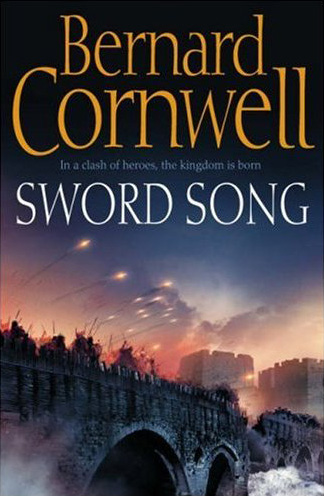
Mostly I’ve read from Bernard Cornwell (The Last Kingdom, Agincourt, etc), with the only recurring author being Alison Weir (The Lady Elizabeth).

2. Republican Rome

Rome becomes decidedly less interesting after the rise of the Empire.  Several authors of interest: Robert Harris, for his political-legal thrillers based on the life of Cicero, plus his Pompeii; Steve Saylor, for his late-republic detective novels;  John Stack, for a naval trilogy between Rome and Carthage;  and Simon Scarrow, whose series about the invasion of Britain by Rome I am currently ankle-deep in.

3. Gilded Age America

In the late 19th century, the cities swelled with immigrants and displaced farmers alike, and the products of the industrial age saw the cities transformed in response. Here is the age of trolleys,  the rise of mass spectator sports, mass politics, the early years of the Mafia…all sorts of things of interest!

4. Early America


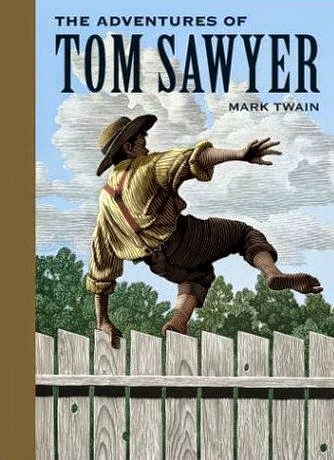
Let’s say this covers everything from novels set during the colonial period, up to the Civil War.  Most of the books I’ve read in this category are ‘classics’ like The Scarlet Letter and Tom Sawyer, but Bernard Cornwell also penned a few Revolutionary War novels. (Redcoat, The Fort), and David Liss has his The Whiskey Rebels.

5. World War 2


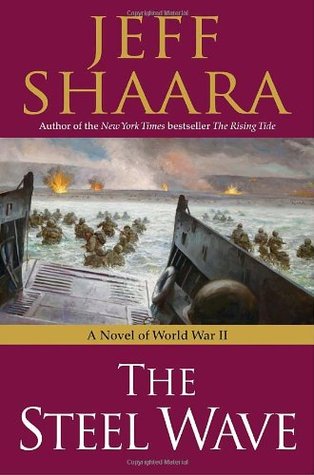
I don’t especially like reading World War 2 fiction, I just…happen to do it a lot.  Jeff Shaara would have started me on that, with his European trilogy, but in recent years I’ve also read a lot of Phillip Kerr’s mysteries set in 1930s-1940s Europe. As much as I like Kerr’s thriller-crafting and humor,  they are dark to the point that I’ve considered not reading him anymore. Perhaps one once in a while, though.

I know the title says “Top Ten” Tuesday, but my historical fiction reading isn’t all that diverse. It’s the middle ages and Rome, really.

Posted in General | Tagged | 6 Comments

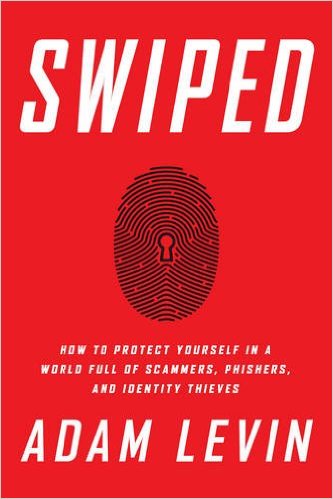
Swiped: How to Protect Yourself in a World Full of Scammers, Phishers, and Identity Thieves
© 2015 Adam Levin
288 pages


 Looking for a growth industry? Try identity theft. Over a third of Americans have experienced some degree of outside use of their accounts, and that number will only rise as our personal data is collected in more and more places.  News reports may have alerted citizens to the need to destroy physical mail carrying their social security number and other personal information, but  even the most vigilant of privacy-protectors can’t stop outside forces from sacking institutions that use that data. Big box stores, transnational health insurance providers, even the federal government: all are vulnerable.  In Swiped, Levin maintains that if a given reader hasn’t already experienced identity theft, the odds are good that they will in the near future.   Instead of consoling oneself with the pleasant notion that such a crime can’t happen to them, he urges readers to minimize their risk, monitor their accounts, and take precautions to manage the damage.

Personal cybersecurity, covered in only a chapter of books like Future Crimes, takes center stage here, and with chapters especially devoted to identity theft arising from tax fraud and healthcare systems,  it makes for an especially pertinent read for tax season. The heaviest burden for action against identity theft is laid on the individual, for we are much more quick-footed about adapting behavior to threats than institutions, and have the most control over releasing information. Regardless of the precautions taken — the savvy exercised — at some point Levin believes that most people’s personal accounts will be compromised.  He recommends constant scrutiny of personal records: daily bank check-ins, thorough examinations of “benefits received” from insurance companies, etc.  Finally, Levin urges readers to have an action plan for when — not if — they are compromised.  Know what accounts you need to freeze, what forms to file — and don’t think it stops with your death, either, because there are plenty of operators who comb the obituaries for accounts to borrow. While his emphasis is on personal vigilance, Levin also has chapters detailing ideas for business security culture, and national-level legislation.   Swiped is fast and abounding with ideas on ‘data hygiene’, and its emphasis on action rather than alarm makes it an welcome follow-up to Data and Goliath and Future Crimes.

Related:
Ten Don’ts On Your Digital Devices, Daniel G. Bachrach, Eric J. Rzeszut

Posted in General | Leave a comment

Ain’t My America

Ain’t My America:  The Long and Noble History of Antiwar Conservatism and Middle Class Antimperialism
©  2008 Bill Kauffman
304 pages

“You can have your hometown, or you can have the empire. You can’t have both.”

You don’t have to be a punk kid to rage against war. In fact, for most of American history, waging war in foreign quarters was considered radical — not protesting it. The student war protesters of the 1970s were johnny-come latelys compared to the steady  and historic denunciation of imperial adventures from more established quarters. Bill Kauffman’s Ain’t My America revisits a score of personalities — politicians, poets, proles and potentates — reviewing their stands against expansion, and warmongering from 1812 to the present, and concludes with a few arguments of his own. All the while he argues for a return to a homelier vision of America, a vision shared by this diverse multitude. The resulting narrative is a saucy challenge to today’s conservatives, a reminder of a tradition which has been forgotten…and forgotten rather quickly.

The American Republic was a new thing, an experiment, and for its first century of life its citizens well appreciated the fragility of it. They saw in every legislative novelty a peril to what had been created by the transformation of colonies into a Republic, whether that was Jefferson’s extralegal acquisition of the Louisiana Territory, or Madison’s war and those which followed.   What unites the multitude of men here — the speech-making politicians, the biting wits and mournful ballads of writers and poets — is fear for the life of that Republic, imperiled by the prospect of expansion and war.  Campaigns of glory and idealism, so dear to the hearts of presidents like Teddy Roosevelt and Wilson, threatened to corrupt a nation committed to harmony and peaceful discourse with all nations,into yet another state fallen from grace, forever  brawling with its neighbors in the Old World fashion.  America enjoys a providential situation, safeguarded from foreign invasion by ocean, with a continent bounding in resources. What need have we of wandering into other people’s wars?  The only fights are those we go abroad and pick.. The greater danger is that the American dream will be destroyed by the demands of war itself, through the centralization of authority, the militarization of society.  The American constitution was written in part to check dreams of militarism, like the precautions against the power of a standing army.

The evidence bears their fears out. What have been the fruits of participating in foreign wars?  A president whose title of Commander in Chief expects to apply to all Americans, not simply those in the armed services;  the wastage of million of lives, and incalculable resources;  the intrusion of the central government into every aspect of American lives.  Many aspects of the Empire in which we live were born during wartime: the income tax, for instance, conscription, and automatic withholding. Some wartime abuses heal over time, like the archfiend Wilson’s loyalty campaigns. Imagine the hypocrisy of a man who runs for office on the slogan that he kept us out of the war, who then has war declared and imprisons people for so much as applauding an anti-war speech!  War makes the nation itself a hypocrite, as it did in the late 19th century when the United States stretched its imperial wings over Cuba and the Phillipines, inciting a fight with Spain and pretending to be fighting for another people’s liberation, and then waging war against those people when they declined acceptance into the “Empire of Liberty”.  War’s ravages have been worse diplomatically: a region like the middle east, which once admired the United States as an amicable partner far different than the imperial English and Russians, now boils over with loathing for it.  Every excursion, martial or secretively effected — seems to lead to more, and the corruption of the military-industrial complex waxes worse and worse.

These are not leftist criticisms; the Democratic party is no less the Party of War than modern Republicans, and indeed presidents like Wilson, Truman, and Johnson have been responsible for as much if not more overseas mischief than their ‘rivals’. These are the criticisms of prudent men who had studied history, who absorbed its lessons into their very bones, and knew the United States was not so exceptional that it could defy the rule of human nature.  Most of the criticism Kauffman collects focuses on war as a corrosive force, turning a Republic into an Empire, but in an additional section Kauffman throws his own punches.  The bulwark of conservatism is defense of the family, which the military state destroys — not merely by keeping young men abroad for months and years at a time, but by constantly shuffling military families around and denying them roots.  The increase of men in uniform went hand in hand with rising divorce and juvenile delinquency, especially during World War 2.   Denied the opportunity to invest in a local community, the only loyalty that can be mustered up by the family is to an abstraction — the State.   Imperialism bids the flag go where the Constitution cannot follow — and, “severed from its staff, [waves] in any vagrant breeze”.

Ain’t My America rebuts foreign excursion as it champions the local.  Kauffman’s America is a republic of front porches, a collection of intimate communities united by a common dream, but loyal firstly to their neighbors.  Kauffman’s America is the town, the countryside where we grew up, the places that nurture and support us — the places that gain our affection and love through time, as do our homes.  In the Republic, men and women are sustained by the connections, finding meaning in the work they do for and with their neighbors. Kauffman’s America ain’t the Empire. In the Empire, meaning is searched for from without —  embarking on crusades to “fight” terror or “make the world safe for democracy”, each person and each community’s character subsumed by the collective. It’s a criticism not far from Chris Hedges’ observation that “war is a force that gives us meaning”.

All this history and scathing commentary is rendered in Bill Kauffman’s singular style. If Wendell Berry’s defense of the local is rendered in a grandfatherly fashion, in tones of warm comfort, Kauffman is more of a slightly rebellious uncle, the kind who is willing to stay up past three a.m. rattling off colorful stories. There is much color to be hand in Kauffman’s vocabulary, not necessarily profanity. Kauffman is a colorful character himself, who describes himself as the lovechild of Dorothy Day and Henry David Thoreau, a wild spirit with the blood of Crazy Horse and Zora Neal Hurston in his veins. His expressions are his own, energetic and archaic, like  “fossicking about in tramontane sinkholes”. He threatens the reader with his own poetry, and in a section hailing Grover Cleveland as the 19th century’s sole classical liberal, begins “let us now praise corpulent men”.  The book rebounds with an affectionate wit, often barbed. After recounting the life of a Congressional solon named Hoar, who a contemporary thought would be celebrated in statuary for standing against imperialism, Kauffman notes “Alas, the statues are all dedicated to Hoar’s homonyms.”

What a piece of work is Kauffman, and an eye-opening piece of work this is! Kauffman’s style and championing of the little way  give him considerable appeal both in what he says and his delivery thereof.  He is funny and rebuking,  a man of no party and wholly genuine.  Ain’t my America succeeds as a reminder of what the American experiment was — is — at its best, and as a scattering of  birdshot fired at our aviary of warhawks on the Potomac.

Related:

Posted in history, Politics and Civic Interest, Reviews | Tagged , , , , , , | 10 Comments

Taxi!

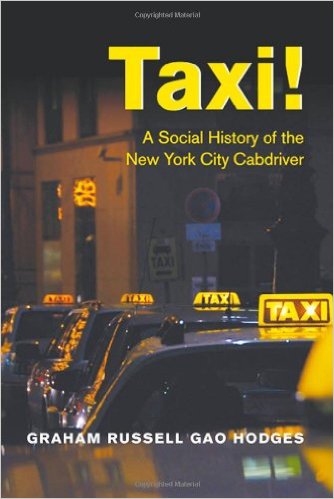
Taxi! A Social History of the New York City Cabdriver
©  2007 Graham Russell Gao Hodges
225 pages

No film set in New York City is complete without scenes of Manhattan traffic, dense with yellow cars — the patrolling ranks of the cabs, shuttling a third of the city hither and yon.  Taxi! is exactly as it describes itself, a social history of New York cabbing.  The author begins in the early days of the automobile and moves forward to 2001.  Much of it is predictable but as-yet unexplored, the tale of cabdrivers’ woes throughout the economic turbulence of the 20th century, their struggling to make ends meet against declining social status.  The author has a keen interest in unionization, devoting an entire chapter to it and touching on it several other times.   He sees a failure to successfully unionize as part of static or declining fortunes among cab drivers, although the failure is less political than structural. Cabs are not factories, and the abundance of independent owner-operators sapped what strength was found in bringing together the drivers for the large taxi fleets.  When economic pressures prompted the fleets to reduce their men to independent contractors, the attraction of cab-driving was further diminished as a career, and it became more the occupation of those looking for part-time work, or (in the case of immigrants) for any entrance into the American economy.  That grim economic trend is slightly offset by the author’s continued examination of cab drivers in popular media, from the first days of film on. Who knew Babe Ruth once did a cameo in a taxi film?   The films tend to portray cab drivers as lonely commentators on the social scene, and sometimes shed light on cabbys’ interesting connections with the criminal world.  In the roaring twenties and the Depression, cabbies sometimes earned extra money by connecting interested passengers to prostitutes and liquor.  The contentious relationship between cabs and cops that Melissa Plaut commented on in her Hack evidently has a long history, though where it begins is a chicken and egg quandary.  Taxi! is  quick read, dry in parts but largely informative and entertaining on the whole, aided by the author’s latent passion for a job he once undertook himself.

Related:
Hack: How I Stopped Worrying About My Life and Started Driving a Yellow Cab, Melissa Plaut

Posted in history, Reviews | Tagged , , , , , , | 4 Comments

Fresh Air and a Fresh Look

It’s a new look for This Week at the Library! I’ve been yearning to get away from that dark theme for nearly two years now, but just couldn’t find the quintessential background. Then I realized: my old philosophy blog has a look I really like, so I’m borrowing it. In back we have the Stoa of Attalos, and the image not only makes for a brighter experience, but one that brings to mind the life of the classical tradition. In my search for wisdom and the humane life, it is ideal.  I’ve also played with things a bit so there’s more room in the middle for text.  The desire end is that this is easier for people to read.

For posterity’s sake, there’s the old look. It ran from Oct 2011. My Shelfari gadget sticks out now, but Shelfari is merging with Goodreads, so I don’t know if that will even be supported for long.

Posted in General | 2 Comments

Warriors of the Storm

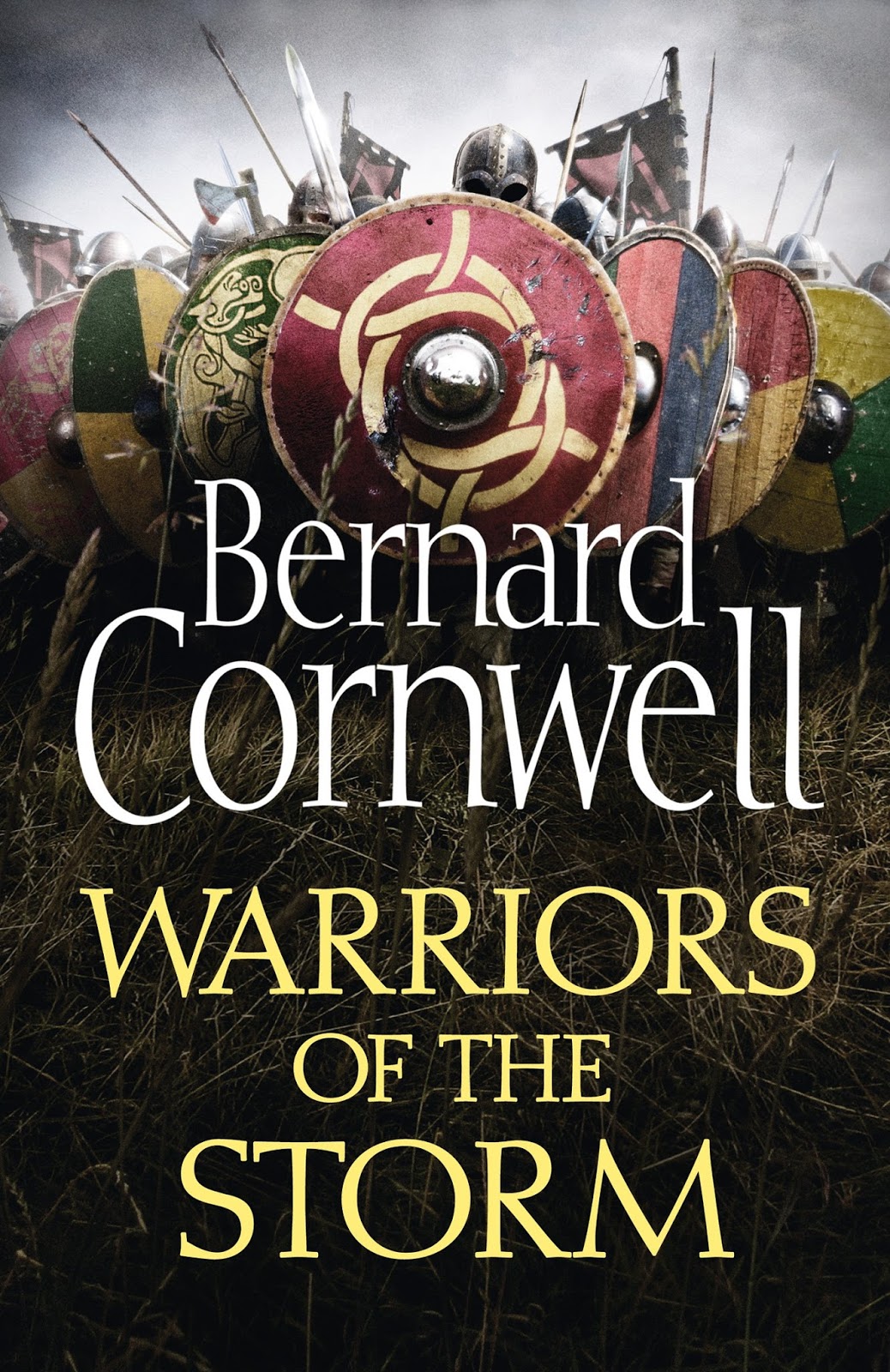
Warriors of the Storm
© 2016 Bernard Cornwell
320 pages

“May God strike me dead this moment if I lie!”
I drew Serpent-Breath, her blade scraping loud and fast on her scabbard’s throat.
“Lord Uhtred!” Æthelflaed called out in alarm. “No!”

Uhtred of Bebbanburg is a lord of war, a Saxon prince raised by conquering Danes, a pagan who nontheless serves the sole remaining Christian kingdoms of Wessex and Mercia.  He is a man loyal not to tribes nor institutions, but to his friends, and for love of a woman — Æthelflaed, Queen of Mercia —  he patiently waits for an opportunity to invade Dane-held Northumbria and return to his ancestral home. It has been a quest long frustrated by the constant scheming of both Danish and Saxon politics, but now….now, the Danes are quarreling, the Saxons are united ,and NOW is the time to seize Northumbria.  So naturally,  the Irish invade.

It’s not really the Irish, of course, just a few hundred mercenaries accompanying an even larger horde of Danes who have recently quit Ireland in favor of easier takings and better fields in Britain.  Warriors of the Storm opens with an invasion and will see Uhtred again taking to the field despite his age, somehow wresting defeat from death by refusing to play his enemies’ games and attacking them when it is plainly suicidal. But Uhtred isn’t just lucky, he’s long-seasoned.  He can see weaknesses in a shield wall or a political alliance hidden from everyone else, and he’s daring enough to exploit them.  So when an Irish-Danish horde invades  Mercia, by the gods he invades them right back!

I didn’t expect Warriors of the Storm. In the last novel,  The Empty Throne, Uhtred was withering away from age, gravely wounded on his deathbed, seeing shades of long-dead friends beckoning him to join them in the beyond to an eternity of sacking and feasting, and leaving his son Uhtred to do some of the narration. But now…he’s back! He’s grey, sure, but he’s not weak, and the only long-gone friends showing up are those quite alive who have just been missing a good long while.  This series is plainly tacking toward the home port, however,  featuring the dispatch of old enemies and the re-appearances of both Uhtred’s oldest son, who he disowned for becoming a priest;  and his first lover and companion, Brida. Another sign of the end,  is a bit of poetry as Uhtred rescues a boy who charges into battle to save his dying father.  The circle is now complete.  

Need I give the usual praise? Dramatic prose of thunder flashing as armies trudge through the mud to meet destiny,  quick wits amusing each other in conversation, bombastic speeches and a few sly jokes.  All the usual Cornwell strengths are here, though it’s a quick book so they’re over more quickly. The twists and turns aren’t as sharp here, possibly because once the reader has marched with Uhtred for so long, one gets used to his sudden bolts of inspiration, like paying a visit to the Irish. The book ends poised for the conclusion, however, and unlike the old man standing on death’s door from last book, Uhtred appears to be going into it strong and fierce. As much as I’ll miss him, it is high time he went home.

Next stop, BEBBANBURG!

Posted in General | Tagged , , , , , , , | 6 Comments

Future Crimes

Future Crimes; Everything is Connected, Everyone is Vulnerable, and What We Can Do About It
Paperback subtitle: Inside the Digital Underground and the Battle for Our Connected World 
© 2015 Marc Goodman
608 pages

“It’s not safe out here. It’s wondrous, with treasures to satiate desires both subtle and gross. But it’s not for the timid.”  (Q, ST TNG)

 The future is arriving more quickly than we think,  the world being re-formed beneath our feet. Ten years ago, the fact that a presidential candidate was glued to his ‘BlackBerry’ was an oddity;  now, smartphones are the very way we interface with our environment.   The transformation of the world from material to digital is total, providing new avenues for the darker instincts of  mankind to exercise themselves alongside entertainment, commerce, and education. Future Crimes is an astonishing review of the myriad of ways that this brave new world is making us not only more productive, but more vulnerable to malicious attack – and offers insight into the dangers we will face tomorrow.  This is a book without  rival.

 Goodman writes as a law enforcement official who specialized in cyber security as computers left warehouses to become basic infrastructure. Now, after decades of experience, he shares extensive research and personal encounters with the reader. He begins by treading familiar ground at first, by reviewing  the state of overwhelming exposure people now live in. As learned in Data and Goliath, virtually everything we do generates data that is collected and evaluated by someone, whether it’s our phone company keeping a history of where our phone travels, apps within the phone transferring our information to marketing agencies, or our interactions with the online world being monitored and recorded, as Google sifts through our email – and our websearches, and our YouTube viewing history, and our web activity on Android and Chrome – ostensibly to sell ‘better ads’.   It’s not just Google, of course: facebook is another major data distributor, but practically every website that depends on adspace is complicit.

 Adding to this, however, is the threat of outside attack: criminal elements corrupting apps or creating their own to collect data for more malicious purposes, like emptying our bank accounts – or entities across the globe, looking for secrets.  The fact that a person is an American or German national won’t stop Chinese companies from having an interest in their personal business if they are involved in technical enterprises of interest.   Blueprints of the US president’s personal aircraft, for instance, were obtained by the Chinese after a defense worker’s laptop was infected with targeted malware.  It’s not just smartphones, either: as computers undergird our very homes, surveillance no longer requires a group of fictional plumbers poking around installing cameras into  ceiling fans.  These days, even the power outlets can have ears.

 Data collection isn’t just a problem for privacy issues: the concentration of so much information invites crime.  When heist extraordinaire Willie Sutton was asked why he robbed banks, he replied simply – that’s where the money is. Why penetrate Target’s databanks? That’s where the information is  —  high-value credit card information.   The exposure isn’t all about profit, either, though the information superhighway has already helped far-distant predators steal and skedaddle. The early hackers practiced their craft for laughs, and so they still do – but the odds at stake are higher than simply wiping out computer drives.   Future Crimes documents one case of a young teenager whose laptop was infected with software that allowed an outside party – a teenager at her school who was not even reasonably clever, but purchased a kit – to  turn on her webcam,  collect photographs of her in states of undress, and then attempt to blackmail and humiliate her. Even after she switched schools,  the photos became the arsenal of bullies there,  their hounding continued after a failed suicide attempt, and eventually ended only when she succeeded in killing herself.  Secure in anonymity, able to meddle in the lives of others from safety, humans are willing and capable to do all matter of wretched things.

The fun will continue as the 21st century develops. Our digital world is in its infancy, a mere golf ball of connectivity compared to the solar-sized scale of tomorrow.  In the years to come,  it is possible that most every object in our home will be connected to an internet of things, and even if paranoiacs and luddites like myself object, regulation and market availability may force some level of IoT integration.  The systems that control our lives – traffic management, electrical grids, financial markets – are managed online, and each of them has already been tampered and manipulated by tech-savvy hoods.  As the world continues to become more automated,  services performed by machines running on software that can be manipulated,  our danger grows.  Military drones have already been touched by malefactors – insurgents can watch a drone’s feed as it approaches, or skew its navigation so that it blows up the wrong neighborhood. (Assuming it had the right neighborhood to begin with…)   Manufacturing robots have already proven themselves lethal,  sometimes mistaking human laborers for parts to be manipulated, and if their software is tampered with, accidents could be effected on purpose.

Future Crimes is a daunting, eye-opening book.   Even after reading other books on cyber-security,  Goodman provides case after case I hadn’t heard of. This is five hundred pages of disturbing reporting and evaluation,   dense and powerful.   Like any security auditor, Goodman doesn’t leave readers shocked but helpless: the last fifth of the book offers some ideas into protecting ourselves.   Part of the problem is that culture has not caught up to technological change yet: as smartphones ease  un-informed adults into the digital world, people unprepared for vigilant defense of their information expose themselves to a burgeoning number of thieves and opportunists.   Not even those who should know better are ready; many of the instances document here come from military or security officials not being fastidious enough, with the result that a virus intended for an Iranian offline network traveled to the International Space Station.   In addition to arguing for regulations that force private enterprises to take more fiscal responsibility for safeguarding the information they collect,  Goodman shares more interesting ideas, like crowdsourcing better digital security systems.

Two things are certain: we’re in for a ride in the next decade, and I won’t find a more eye-opening book this year.  This book delivers reams of eye-opening information. It would make for an interesting exposure of crime merely by itself,  but goes beyond that to brief readers on the multitude of security challenges we face now, and will face tomorrow, threats to our personal, corporate, and national security.  Future Crimes is well worth your time: it, and the world it opens one’s eyes to, are incredible.

Related:

I have a few more titles in this vein that will appear later this year, like Richard Clark’s Cyberwar and Glenn Greenwald’s No Place to Hide.  They may succeed, but they won’t surpass….

Posted in General | Tagged , , , , , , , , | 2 Comments

Demonic Males

Demonic Males: Apes and the Origins of Human Violence
© 1996 Dale Peterson and Richard Wrangham
350 pages

Why is the world run by violent men?  Demonic Males  argues that human males are by violent by nature,  a trait we share with other primates, and that this aggressive behavior is sustained through sexual selection.   Males are not uniquely violent, nor is our inherited penchant for bloodshed  inescapable,  but we can only begin to look for remedies by understanding the scope of the problem.  To combat violence is to war against human nature itself.

Contrary to popular opinion, human beings are not the only creatures who wage war against ourselves. Demonic Males opens an account of a band of chimpanzees moving through the forest as though on a hunt, only to choose at their target an isolated member of a neighboring band of chimps.  After a gruesome ambush  that left the target dead, the war-band then retreated into its own territory – its sole accomplishment having been the deliberate murder of a neighbor.   The authors follow up with many other such field reports, from Africa to Asia, spanning the primates, and find casual and ‘political’ violence in each class of the great apes, and from this argue that the domination of the planet by aggressive men owes not to a vast culture of patriarchy, but to the desperate straits our ancestors came of age in.

Small orangutans chase down unwilling females and force them to copulate,  chimpanzees brutally attack one another when vying for power, and even the mostly-peaceful gorillas practice infanticide.  In every primate species, it’s the men doing all of this fighting – and fighting with tooth and claw.  Do humans seem like improbable creatures of war? We have no tusks, no claws, no powerful tails.  Our methods of carnage are simply different:  human males specialize in fisticuffs, common to long-limbed apes.   The authors’ research indicates that the difference between highly aggressive species like humans and chimpanzees, and the more peaceable groups, lay in the social dynamics of food sourcing. the gorillas and bonobos observed  had ranges that allowed for large, stable troops, while the chimpanzees had to roam for food in much smaller bands fighting for survival. The woodland fringe where humans first appeared would have relegated us to that raiding behavior as well. The authors draw parallels between chimpanzee warfare and the small band raiding observed historically across the world, and lingering today in the depths of South America and the streets of Los Angeles.

Though violent behavior is regarded as self-defeating in the modern world, at the primeval level it serves certain purposes.   The story begins with food, but eventually circles back to sexual selection. The small variant of orangutan males could never challenge large males for mating opportunities, so they seize them. A silverback gorilla  has the responsibility for protecting every female and their young in his troop;  like a lion, he has little interest in safeguarding some other gorilla’s progeny. For chimpanzees, beating their fellows into submission is just as effective as bribing them with food.   Females are involved in the continuation of aggression, too, sometimes against their will (in the case of rape) and sometimes complicitly, as when they throng a rising star, eager for his protection against the other aggressors.

Though the argument of Demonic Males is that humans are fundamentally aggressive,  the authors demonstrate that there are alternatives.  Chimpanzees, for instance, have cousins across the river who are very different:  isolated from competition and with an abundance of food, aggression has withered, and large alliances of females rein in throwbacks.    While human nature has a violence cast now, in the future, the sustained institutional suppression of violence might allow us to grow away from ours as well.  

Demonic Males covers a lot of territory —  dismantling the myth of the noble savage, weighing anthropologists and primatologists’ field reports against one another — and presents a serious challenge to those who those who believe that man can simply be ‘retrained’ in the matter of the New Soviet Man.  Frans de Waal’s own extensive experience observing chimpanzees is not nearly as pessmetic; in Chimpanzee Politics, for instance, he argued that despite surges of violence against political rivals in high-stakes situations, most of the time the daunting strength of males is not unleashed, the contenders pulling their punches.  The gorillas’ practice of infanticide, so similar to that of lions,  indicates it is not a recent, primate-specific tactic.  The authors did draw on a much broader range of activity,  however, so this certainly merits consideration.


Related:
Chimpanzee Politics, Frans de Waal

Posted in science | Tagged , , , , , | 8 Comments

Loose Tweets Fry Gunships

“‘Is a badge on Foursquare or a check-in worth your life?’ That question, now commonly asked by the U.S. Army of its soldiers, is not rhetorical when even terrorists are taking advantage of geo-tagged data. For instance, when American military forces received a new fleet of AH-64 Apache helicopters at their base in Iraq, some deployed soldiers uploaded photographs of themselves in front of their new choppers to facebook.  Unbeknownst to them, their phones had accidentally embedded their GPS coordinates in the photographs. Not only were insurgents monitoring the soldiers’ Facebook postings, but they were also downloading the photographs and analyzing them for useful intelligence. The longitude and latitude information embedded in the photos allowed the terrorists to launch a series of precise mortar attacks that directly targeted and destroyed four of the newly arrived Apaches on the compound.”

p. 143-144, Future Crimes.  Marc Goodman

Posted in quotations | Tagged | 3 Comments