SCIENCE! ..and other stuff

Dear readers:

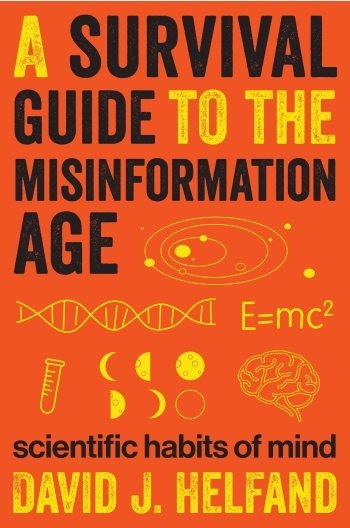
 I am still scratching an itch for science and science fiction, both in books and on the screen.  Over the weekend I read A Survival Guide to the Misinformation Age,  on inculcating scientific habits of mind.  It’s rather like The Demon-Haunted World, in presenting the virtues of the scientific method and skepticism, but is much more detailed. The author hails from a technical profession, astronomy, and in addition to teaching the reader to think critically about numbers and fault-check claims,  he attempts to guide readers through interpreting statistics and reading graphs.  It thus combines more general practices (scrutinizing a claim to see how it might be falsifiable) with training in more detailed analysis. The skills involved have much broader use than just in  thinking critically about science journalism; they apply just as well to evaluating economic charts. I am not nearly as optimistic as the author that people can be prompted to start giving news reports more scrutiny, but even learning that million, billion, and trillion are not synonyms for “a lot” would be a help.  He ends the book with an argument for a scientific claim that uses the mental ‘apps’ taught prior.  His passionate for science will carry over well, even if readers don’t respond to the challenge of breaking out paper and pencil to break down every graph for what the data really means.

The weeks to come will see more science and science fiction, though I’ll throw in other material as well –as I did this weekend, with Lost to the West, a  brief survey of the eastern Roman empire. I just received The Asimov Chronicles in the mail; it’s an anthology of Asimov’s first fifty years of storytelling, one story for each year. Surely there’s one in this 832 pg book I haven’t read.

Posted in Reviews, science | Tagged , | 1 Comment

Reads to Reels: The Time Machine

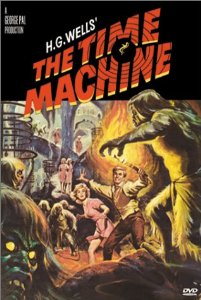
Showing up late for a dinner is bad enough, but when a man is the host? Still worse, he stumbles in looking like he’s been run down by a carriage, and with a wild tale of having traveled through time to boot. That’s the start of H.G. Well’s The Time Machine, the story of a scientist-inventor who creates a way to move through the “fourth dimension”, time.   This 1960 dramatization is fairly faithful to the original, though the tenor of the story is delivered differently.  It’s an old enough book that most readers will know the plot: a man is thrown forward in time and discovers the descendants of man, a race of dim but happy Barbie people lolling about and eating fruit by day….and being occasionally dragged underground by hairy industrial Morlocks by night.  After many scenes of wonder and peril, the unnamed Time Traveler escapes to the future, where he watches the sun die before returning home, in dire need of mutton.  Here,  any travel past the age of Eloi and Morlocks is dropped, and “George’s” entire story becomes one about fleeing man’s penchant for fratricidal wars.

Although the  movie’s general theme changes from scientific wonder to bemoaning war, in truth the viewer loses nothing in the dropped scenes or the added message.  Had the original novel been filmed scene for scene, we would have seen at best a rude model of a swollen sun, one that would surely appear dated now. In contrast, the time-lapse videography that so astounds George —  the sight of flowers blooming and folding, of the sun roaring across the sky in seconds – these still have power to amaze, even in an age of Planet-Earth-type visuals.  There is almost some humor in George’s misfortune at the outset: his first forays take him first to England amid the Great War, then World War 2, and then – so help me – the beginning of World War 3.  His arrival among the Eloi is the result of attempting to escape a nuclear bomb, the resulting fallout, and geologic upheaval.  George is a man of H.G. Well’s sensibility, who believed that scientific progress would be not only material, but societal as well, leading to global peace and prosperity. Seeing material progress still plagued by war – and then destroyed by it – makes George an unhappy camper, especially when he sees that humans have become docile vegetables, happy to bake in the sun and then be eaten.  He injects some much-needed spirit  in their little lives to resist the Morlocks, before returning home to fulfill his dinner obligation (a very polite gentleman is George) and then going back for the girl he left behind.

You can almost hear the ST TOS fight music.

There are dated elements, especially the other visual effects: the Morlocks’ costumes, Weena’s classic fifties hair, and odd shots like the ‘recording discs’ that are played by being spun like a top.  Altogether, though, it ages tolerably well, and is a delightful, old-fashioned story…quite a nice change of pace from today’s ‘gritty reboots’.  (Speaking of: Wells fans may like Time After Time, in which H.G. Wells builds his time machine and promptly loses it to Jack the Ripper.  Horrified at the idea of a beast running around in the utopia that will be The Future, Wells pursues him only to arrive in 1979 San Francisco.  Paradise, it ain’t.)

There’s a fun little joke on one of the props: the machine bears a plate that identifies it as having been manufactured by one H. George Wells. And so it was!

Posted in Reviews, science fiction | Tagged , , | 2 Comments

Reads to Reels: 2001 A Space Odyssey

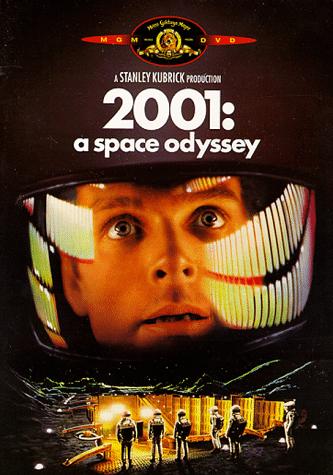
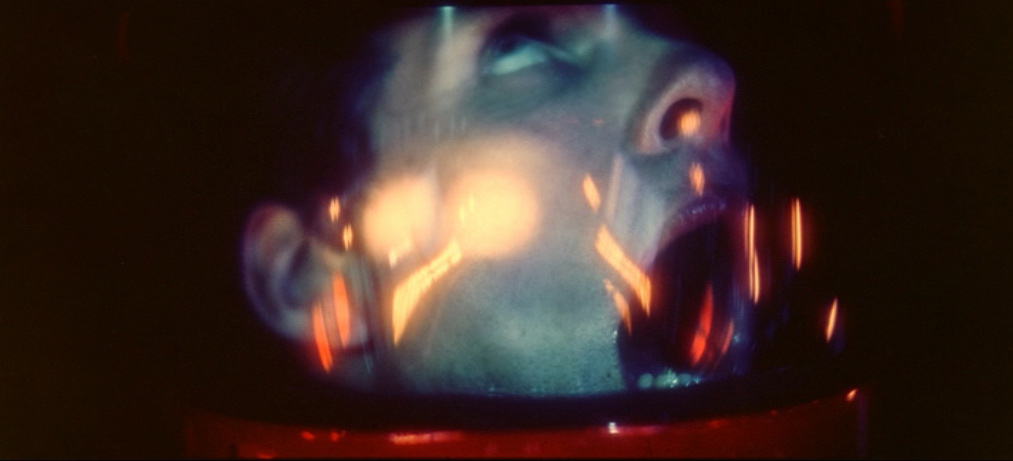
 “You can tell who read the book (2001) before they watched the movie”, said a friend of mine, because they’re the only ones in the theater who aren’t asking, ‘What was THAT?'” at its end.   2001: A Space Odyssey is one of the two strangest films I’ve seen, but one of the most impressive technically. My first hint of the strangeness came in watching a ship from Earth travel to an orbiting space station, docking with it at the speed of tectonic drift and then later slowly cruising to the Moon to settle in there.  Reflecting on the year it was created, however, I realized this may have been one of the very first times human actions in space was ever modeled before cameras.  No doubt they wanted to savor the accomplishment, especially considering that this was filmed during the Apollo program, when man’s foot had yet to step down upon the moon.  As a piece of craftsmanship, it’s impressive in many other ways; the ships and stations do not scream “obvious model”, and some of the video effects were stunners.  In the last section of the film, for instance, the lead character is taken into a hyperspace tunnel, both he and the reader bombarded with a light show that makes one think of acid trips. What sells the experience are interspersed shots of the astronaut’s face in increasing flashes of wrenching terror and panic.
These accomplishments withstanding,  2001 does present some issues.  There is virtually no exposition, for instance, so when another mysterious light show accompanied by wailing ends with a cock-eyed giant baby hovering around Earth,  and the credits roll, the only people who have any idea what was happening are those who read the book. (The rest, presumably, look a bit like the man in the hyperspace tunnel.)  This is  problem that dogs the entire film,  because without that narrative it seems to consist of four completely different sequences with little connection to one another,  all of which consist of preposterously long tracking shots. These feature ten minutes of an astronaut drifting in space and breathing, as well as many scenes with spacecraft moving seemingly in real time.  Even the hyperspace scene was marred by this, because terror loses its edge if it is prolonged. I commented afterward that half the film seemed to be tracking visuals and music, with a spoken script that might have fit on a pocket notebook.  It is if nothing else  a unique film, one that left me wondering what on earth the producers were on while they created it.  Its classic status is well merited. 

Posted in Reviews, science fiction | Tagged , | 7 Comments

The Cult of the Presidency

The Cult of the Presidency: America’s Dangerous Devotion to Executive Power
© 2008 Gene Healy
264 pages
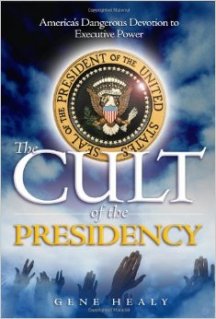
Every four years, men and women with permanently-fixed smiles assure us that they will end corruption in D.C, get the economy moving, and end our trouble overseas, if only we will elect them President.  The claims are bold – who could budge the vast federal bureaucracy or find a solution to the hornet’s nest that is the middle east? Yet a third of the American public seems willing to believe these and greater claims, from across the political spectrum. Throughout the 20th century, the  presidency has taken on great challenges, willfully or at the urging of the public, and gathered around itself the power to take on those challenges — or try to.   In The Cult of the Presidency, David Healy argues that not only this is a significant departure from the Constitutionally-sanctioned purpose of the president, but such centralization constitutes a malignant force.  Not only is investing such power and hope in one man dangerous, but the breadth of ambitious and responsibilities we heap upon the president’s shoulders is self-defeating.

Healy begins with the Constitution and revisits the intentions of the Founders through the Federalist papers. The republic existed in its Congress, which was granted the bulk of powers, including levying taxes and declaring war. What no one wanted was an elected king, even if Alexander Hamilton did bat around the idea that the president might serve for life.  There were fears, however, that Congress might amass too much power, and thus the executive’s responsibility would be to not just carry out Congress’ will, but refuse to do so if said will violated the Constitution.  The presidential oath is made not to care for and advance the needs of The People, but to protect the Constitution. For most of the 19th century,  executives held to their constitutional limits; Abraham Lincoln was an obvious exception, serving as he did in extraordinary circumstances. But most of the 19th century executives were forgettable men; how many Americans could even identify men like Franklin, Garfield, and Hayes as presidents?  The opening of the 20th century, however,  revealed a very different presidency. Wealth and power were increasing, and as money and science transformed the nation, they created a distinctly modern mindset. It declared that the power to create the future was in its hands; no institution was spared from novel attempts at completely restructuring them, sometimes in response to the new dangers of the modern era. The presidency, too, empowered not just by wealth but by the ideology of progress, escaped its constitutional bounds to become new creature.   Although lapses in presidential restraint had already happened during the administrations of McKinley and Theodore Roosevelt,  Wilson was the architect of a new order.  An academic who believed the Constitution  had outlived its effective use, saw it as the president’s duty to conduct the Will of the People into action.  The president alone was voted in by the whole of the people; his was the voice that should guide the nation into the future, and the technology of the day allowed he and his successors to project their voice and exercise their will more ably, constitutional limits be damned. (And to the prisons with dissent!)

The world wars did great damage to the American political constitution, in focusing the public’s attention through the radio onto the leader — the leader, who  towered in imaginations, who could view the global conflict and distill all the information, creating a  battle plan.  As the twentieth century progressed, the ambitions of the presidency became ever more ambitious. The president was not merely spearheading a war against a particular foreign power; he was the Leader of the Free World,  casting a watchful eye over the entire globe to save it from the spectre of communism. At home, ambitions were no less awe-inspiring,  as Nixon, Johnson, Reagan and others sought to rid American society of substance abuse and poverty,  companions of the human race from the word go.  Now, when a shooting erupts, or a hurricane  washes over a city, the president is expected to arrive and say soothing things, like daddy reassuring frightened children.  Because one of the few active roles allotted to him by the Constitution is that of Commander-in-Chief,  presidential ambition has been matched by growing and inappropriate use of the military, both abroad and at home.  Although the Vietnam war and Nixon’s resignation did tremendous damage to the esteem of the presidency, “Superman Returned” after 9/11, when George W. Bush became the defiant face of the nation toward terrorism.  Whatever he did, he was doing it to Make America Safe, and he didn’t need a permission slip to do it — L’état est George.
The problem with all this power accruing to the presidency isn’t just that it is merely unconstitutional, or manifestly dangerous in the abuses that have already occurred and continue to occur. (There’s no shortage: the freewheeling ability to call anyone a terrorist and make them disappear, tried only in secret by the military;  drone assassinations without explicit congressional sanction, even of American citizens;  widespread data collection, and it goes on and on.)   There are limits in nature itself that ensure that the presidency is never as effective as it desires.  American foreign policy in the middle east, for instance, seems to be nothing more than a self-perpetuating stream of debacles. We meddle in Iran, and made an enemy; we used Iraq to attack them, and armed a madman; we attacked the madman, and created ISIS.  Nearer to home, the president may be the object of all our hopes and fears, but he can’t stop hurricanes and the economy is not a machine to be manipulated. Like nature, it fights back.   Even when things seem to be going merrily, it’s of little avail: the public only cares what fresh triumphs Caesar has wrought. If the economy tanks right before an election, woe to the incumbent party.  All this assumes the president is making competent decisions to begin with, when throughout the 20th century the office-holder has become increasingly isolated from reality — surrounded by the party faithful and underlings who are awed by the office or have no incentive to tell him he’s erring. So much power and adulation is not only dangerous to governance, but to the mental health of the occupant,  held in godlike awe and expectation to fix all the problems, and offer or at least project strength and comfort when a crisis erupts.
What’s the solution? Well, there isn’t one, really. Congress can impose limits on the president, as it did with the War Powers act, but it has to be willing to hold him accountable. These days, Congress’ chief function seems to be to pay lobbyists and run for office.  Ultimately, reigning in the cult may lie in waking up the cultists, the American people, who instead of being Egyptians genuflecting before Pharoah,  should return to their 18th century roots of viewing with deep suspicion any man presuming to order their lives about.  The current slate of men and women offers little hope in that regard, however, as the adulating masses cheering on Trump and Sanders obviously believe that one man can overcome reality itself.  There may be hope, however, in the fact that two figures with no real affiliation or loyalty to their party have populist support; it is a signal that Americans are weary of business as usual and might respond to third-party approaches.
(Happy president’s day.)
Related:Recarving Rushmore: Ranking the Presidents on Peace, Prosperity, and Liberty, Ivan Eland.
The Once and Future King: The Rise of Crown Government, F.H. Buckley. Argues that an over-responsible president or prime minister is a problem not only for the United States, but for the United Kingdom and Canada as well.  I read this last July and will read it again this year in hopes of giving it a proper review. Cult of the Presidency was read last January and again last July.
Posted in history, Politics and Civic Interest, Reviews | Tagged , , , , , , , , | 5 Comments

Lost to the West

Lost to the West: The Forgotten Byzantine Empire that Rescued Western Civilization
© 2009 Lars Brownsworth
329 pages

The Roman empire not not fade quietly into history in 474, when a Gothic warlord decided to run the city of Rome directly instead through a faux-imperial proxy. It went out in a blaze of glory, in an epic battle in which an Emperor himself stood in the line and bid a massing enemy to do its worst.  For Rome continued long after the Empire faded from Italy, and it not only prevailed but flourished against a host of enemies until finally falling a millennium later.  Lost to the West is highly storied introduction to the eastern Roman empire, one that reduces eleven hundred years of war, politics, and religion to three hundred pages. I learned of this book through the author’s podcast, “Twelve Byzantine Rulers“, and Lost to the West improves on it. Instead of having twelve distinct episodes, Brownsworth moves smoothly through an entire epoch, lingering on leaders and events which were especially impactful. It’s essentially a shorter Short History of Byzantium,  even more storied.

For those completely in the dark, the ‘eastern’ Roman story begins in the third century A.D., when the Emperor Diocletian decided that an empire that wrapped around the entire Mediterranean was more trouble than it was worth, and divided it into administrative halves. His intentions were good, but the move didn’t save Rome from the curse of dynastic wars, and when Constantine the Great seized total command, he transformed the entire Empire. Not only did he established a new capital in the east (Constantinople), the better to focus on the realm’s Persian foes, but he began the process that turned classical Rome into Christian Rome. His unity didn’t hold for long;  distracted by the constant problems of the Balkans and Persia, the Emperor was unable to come to the rescue of the badly-led western realm. Weakened by its own civil wars, the west fell easy prey to rampaging barbarians.  Constantinople would reclaim bits of Italy later on, only to lose them again as the centuries passed, but the heart of the Empire, the heart of western civilization, was fixed in the east.  In comparison, old Italy was a dump, and Europe little more than a wilderness with a few wooden forts occupied by belching brutes.

Religious unity took longer to destroy.  The Bishop of Rome held an esteemed place in Christendom, being one of the five great metropolitans of the Empire with Jerusalem, Antioch, Alexandria, and Constantinople. After the first three fell to the Arabs, however,  Rome and Constantinople were a rivalry of two. While their respective Latin and Greek cultures were different, eventually it was politics that sundered Christendom. The iconoclastic epidemic, for instance, saw the eastern emperor attempting to order Christians throughout the empire to destroy their religious art, either by breaking it or whitewashing murals.  This originated in the emperor’s belief that the Empire had become idolatrous, and was being punished by God. To regain divine favor,   Christians should purge themselves of representational art in the manner of the triumphant Muslims and in the ancestral way of the Jews.   The eastern church was coerced into going along with the emperor, but the Roman bishop was incensed that a secular figure would dictate doctrine to the church — and order the destruction of soul-edifying art, to boot!  So began a merry round of excommunication and growing hostility between east and west, politically and religiously, that was made permanent when a western army sacked Constantinople on its way to redeem Jerusalem yet again.  That tragedy, the Fourth Crusade, came after the ‘official’ schism, but the eastern Romans suffered so at the hands of the west that they would never submit to the Roman papacy. “Better the Turk’s turban,” they snarled, “than Rome’s miter.”

Lost to the West is a story of long, gradual decline, occasionally arrested by great leaders like Justinian, and occasionally hasted by abysmal ones and the plague.  The sporadic maps tell the story; from an empire that appeared to be united Rome at its height, the east declined under constant outside attack and civil war to controlling the  city of Constantinople, a bit of Greece, and bits and pieces of Asia Minor’s shoreline. Constantinople would beat foes again and again, but so long lived was it that it would have to face them as they revived, zombie-like.  Eventually woe came from the east: despite surviving the Persians, Arabs, Mongols, and Seljuk Turks,  the Ottoman Turks were able to wear down the great walls of the city with cannon and seize a prize lusted after for centuries by the Islamic world.  New Rome went down fighting, however, achieving an end far more glorious than both  western Rome and the Ottoman Empire which succeeded it.

This is a fast run through a millennium, and for me it was mostly review. I enjoyed Brownsworth’s voice, though his title is curiously chosen. He hints at the topic from time to time; in both the defense of Europe against eastern armies and  Constantinople’s preservation and increase of knowledge lost to the west during its brooding Gothic phase, but never devotes a lot of attention to a thesis that Byzantium ‘saved’ the east.  Influence is  covered a little more in books like Sailing from Byzantium, though.

Related:

Posted in Reviews | Tagged , , , , , , , , , | 1 Comment

2001: A Space Odyssey

2001: A Space Odyssey
© 1986 Arthur C. Clark, Stanley Kubrick
316 pgs

At the dawn of the twenty-first century, mankind makes an extraordinary discovery: unmistakable evidence of life outside the environs of Earth. An object on the moon makes plain the fact that three million years ago, extraordinary and intelligent creatures were present…but who they were, and what their interest or relationship was with Earth, is a mystery with clues as far removed as Saturn. 2001: A Space Odyssey, is both the story of a physical journey through the Solar System in search of answers, and a fatalistic view of mankind’s evolution.

Surely there is a word for completely misinterpreting the plot of a story based on pop culture references. It would apply to my experience with 2001, which was far as I was concerned was wholly about an astronaut named Dave’s struggle with the sentient artificial intelligence running his ship – and running amok. As it turns out, HAL-9000 is dispatched in one chapter here, and the story is mostly about mankind’s progress toward…oblivion? Clark combines technological optimism and Cold War fatalism in such a way that the ending really threw me. Admittedly, I was poised to be thrown: a sequence in which the main character is taken on a journey through the Cosmos by a greater lifeform reminded me of similar voyages in Contact and Star Trek: The Next Generation. Suffice it to say, in 2001 the main character does not return to Earth with a transcendental view of the universe to share with his fellows for their betterment. It’s more like the ending to Beneath the Planet of the Apes; though considering that the book begins with ape-men learning to use tools to smack around their neighbors, I suppose it’s appropriate.

2001 is dated in its optimistic predictions about our establishing sizable, stable outposts on Mars and the Moon. There’s not a lot of science actually mentioned, though, so once one ignores the date, anachronisms almost cease. (Okay, so the Soviet Union isn’t still around, and ‘tablets’ are around a few years before their time…) As an adventure set in space, it’s great fun, I knew what was coming with HAL, and even so the so realization by Dave that his computer was listening and moving against him succeeded. While there’s not a lot of hard science, 2001 does touch on a few heady topics, like the volatility of intelligence; considering the difficulties in managing human-made AI, the lead characters how we can reasonably expect to communicate with completely foreign intelligences. As unexpectedly grim as the ending was, I do appreciate Clarke for hinting that superior intelligence does not necessarily bring with it a “more evolved sensibility”. Naturally, I share Carl Sagan’s hope that if there are other intelligences out there, those with powers greater than ours, that their survival past ‘technological adolescence’ indicates they have their CRUSH KILL DESTROY instincts in check. That doesn’t mean they would recognize us as beings whose life merits respect, though. We might be as incidental to them as flies upon an interstellar windshield.

Posted in Reviews, science fiction | Tagged , , , , , , , , , | 5 Comments

Genome

 Genome: The Autobiography of a Species in 23 Chapters
© 1999 Matt Ridley
317 pages


  The human genome is a recipe book, divided into 23 chapters, but considerably larger than Matt Ridley’s Genome. Were it to scale, he writes, a genuine version of the genome in book form would be closer to the size of a stack of bibles.  Genome visits each of the human cell’s 23 chromosomes in turn to learn a little something about human nature. This is not An Ancestor’s Tale in miniature, as Ridley addresses the entire natural history of human kind in the first chapter.   Subsequent chapters cover subjects as diverse as the genetic basis for language and sex differentiation, and as ambitious as free will.  Health and disease occupy much of Ridley’s attention; after genetic disease is covered by itself,  these diseases  are used to illustrate other subjects.    One oft-used example is that of the prevalence of sickle-cell anemia among people of immediate African ancestry;   carrying one allele for it greatly reduces exposure to malaria, a scourge of the continent.  For the genes, losing a few carriers to sickle-cell anemia is a better bargain than losing a greater number to malaria. In evolution, as in economics, there are no solutions – only trade-offs.  Nothing is simple; many conditions like asthma are caused not by one gene flubbing, but by different genes in different populations. Genetics is a subject that can quickly get too detailed for lay readers to enjoy, but Ridley finds the right balance between narrative and specifics, and he has an sly wit.  In a chapter on the sinister history of eugenics, he notes that the Soviet Union never adopted a eugenics program; they were more interested in murdering clever people than limited ones.  The take-home lesson is the human body is not one thing with a becraniumed control tower;   even our flesh is dynamic,  our genes warring with one another and vying for control between themselves and the brain they forged and maintain.   Though it may lose something in being slightly dated, Genome is an eye-opening bit of popular science that offers plenty of insight into history, as well. There was a reprint in 2006 that may have more current information.

Related:

Posted in Reviews, science | Tagged , , , , , | 4 Comments

Onward to the Edge

“Science is like a hungry furnace that must be fed logs from the forests of ignorance that surround us. In the process, the clearing we call knowledge expands, but the more it expands, the longer its perimeter and the more ignorance comes into view. Before the discovery of the genome, we did not know there was a document at the heart of every cell three billion letters long, of whose content we knew nothing. Now, having read parts of that book, we are aware of myriad new mysteries. […] A true scientist is bored by knowledge. It is the assault on ignorance that motivates him — the mysteries that previous discoveries have revealed. The forest is more interesting than the clearing.”

p. 271, Matt Ridley.  Genome: The Autobiography of a Species in 23 Chromosomes


(It’s a servicable metaphor, though a clear-cut forest is hardly picturesque. I give you the Sandwalk instead.   I borrow the post title from Symphony of Science’s “Onward to the Edge“, which features Neil deGrasse Tyson, Richard Feynman, and Brian Cox.)


Posted in quotations, Reviews, science | Tagged , | 1 Comment

This week: the usual suspects

Well, dear readers, it’s another month! I have a serious itch for science and science fiction at the moment, so I have no less than five potential science reads stacked up now, and three potential SF books. Among the numbers…Domesticated: Evolution in a Man-Made World, and Genome: The Autobiography of a Species in 23 Chromosomes.   What about science fiction? Well, there’s some of H.G. Wells’ less well known novels, and  perhaps something newer.

I recently finished The War of the Three Gods: Romans, Persians, and the Rise of Islam.   It is a brief but highly detailed history of the last Romano-Persian war, one in which the great powers of the classical world mauled each other.  Rome nearly perished here, because while the Persians were sweeping into Syria and Judea, tribes in the Balkans began raiding against Constantinople. Eventually the Persians would be stopped, and even subjected to raids in their heartland, and the statuo quo ante bellum stored.  No sooner had the armies retired, however, than came armies from Arabia…and by the time the ancients realized these weren’t just the usual Bedouin raids, all of Persia was falling and the Romans were again stripped of most of their territory outside of Anatolia. The second half of the book is dedicated to Islam’s early military victories, with abundant maps that showcase the solid maneuvering of commanders like Khalid.  The book is chiefly about combat, with some politics mixed in as the Persians weakened themselves through civil war.  I intend on reading a fair few more books about the ‘middle world’ later on.

Since I am in the area, I may as well mention a book I read a few weeks ago, Facing East by Frederica Mathewes-Green. recounts a year in the life of a small Orthodox mission, one created by six families that include the author’s newly-minted priest of a husband. The M-Gs, as the author refers to her family later on, are both converts to the faith, and throughout this piece she reflects on the way her experience has changed in the last three years, as she and her husband begin to soak in the liturgy and live the Orthodox life more deeply. While this is not a formal introduction to Orthodoxy, or even a conversion testimonial, Mrs. M-G often provides exposition about the what and why of service. Like the faith itself, however, this tale is more experiential than epistemological. We encounter the sacraments — Baptism, for instance — not through lectures but through the lives of the congregants, communicated in the intimate and awe-filled style of the author. Short though it may be, Facing East provides a hint of how deep a well the Orthodox tradition is. The mission of Holy Cross may be small and relegated to renting a space that has to be evacuated every Sunday afternoon to make room for the weekday tenants, but in their religious life they are as firmly established as any of the grandest metropolitan seats or parishes across the world.    I’ll probably have couple of more books about Eastern Orthodoxy as the year goes on.  For the moment, however…SCIENCE!

Posted in history, Reviews | Tagged , , , , , , , , , , | 9 Comments

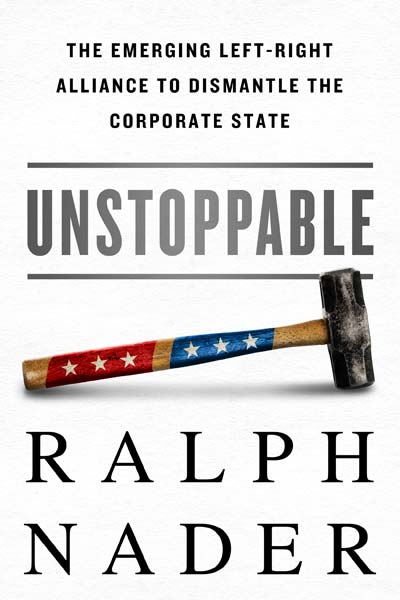
Unstoppable

Unstoppable: the Emerging Left-Right Alliance to Dismantle the Corporate State
© 2014 Ralph Nader
224 pages

George Carlin groused that when he heard the word bipartisanship, he knew a larger than usual deception was in the works. Ralph Nader’s Unstoppable offers a different kind of bipartisanship — cooperation, not conspiracy. Written primarily to a progressive audience, Nader draws on his reading of Russell Kirk and F.A. Hayek to share the good news:  there are people who share the similar values in both political wings, and plenty of room to work together against a common enemy. What common enemy? The crony-capitalist state, the nemesis of both progressives who fear the power of modern-day robber barons, and of libertarians and conservatives who value free markets, the rule of law, and civic order.

Nader opens Unstoppable with a victory several decades old: the termination of a particular nuclear project based on a alliance between progressive environmentalists and fiscal conservatives.  Although joining forces with conservatives was initially a pragmatic move, in the decades that followed, Nader familiarized himself with both conservative and libertarian literature.  Nader deserves kudos, for while it’s not unusual for those passionate about politics to learn their opponents’ arguments merely to demonstrate to them while they are wrong, Nader seems to have gained a genuine sense of empathy for those on the other side. Humanistic concern runs through each political camp considered here, a commonality that can be the basis of cooperative action.  What most progressives think of as conservatism, Nader writes, is a new thing, the product of decades of slow corporate corruption of the political state.  Its subsidies to multinationals, the benefaction rendered by regulations that smother competition, conserve nothing — and nor do they promote liberty. Nader may still disagree those on the right, but underneath the ideology, he writes, we are still human beings who, when confronted with abuses, want to help one another.

The alliances that can be created vary. Progressivism’s opponents may agree on opposing the State’s growing activity in everyday life, but they don’t agree with one another.  Take the environment: some of the United States’ most sweeping conservationist legislation was enacted by presidents like Theodore Roosevelt and Richard Nixon, and environmentalism lends itself well to the language of conservatism; think ‘stewardship’.  Progressive horror at the inroads consumerism is making in the lives of children can find kindred spirits in the ranks of social conservatives, especially the religious who fear their children becoming selfish and materialistic.  Libertarians who swear more by the market than moral order may object to progressive-conservatives limiting choice by barring certain kinds of advertising, for instance, but when it comes to forswearing money given to corporations they’re stalwart allies. Another area of progressive-libertarian camaraderie is ending the drug war, which even Old Right types could be convinced to join if shown how the war has completely destroyed civil law enforcement in favor of pseudo-military police enforcement.  Free trade is a particularly thorny issue: libertarians may be for it, and paleo-conservatives against it, but there’s a fuzzy thin line between protectionism (which progressives might  back) and cronyism.

In the latter half of his book, Nader puts forth a list of twenty-five issues that progressives can work with either libertarians or paleo- and populist conservatives on, or both. Some of them involve the federal government doing more, which I don’t think will sell well in allying with groups who view federal overreach as the entire point of opposition. It’s a let’s-get-the-Wehrmacht-out-of-Paris-before-we-strengthen-it-against-Stalin situation.  Others involve a heart dose of localism. like promoting ‘community self reliance’, and distributive electrical grids. At one point Nader quoted Who Owns America?, the classic agrarian-distributist critique of the then- nascent plutocracy, and I may have swooned.  Considering that two of the major contenders for the presidency have nebulous connections to their respective parties — the independent socialist Sanders and the populist Trump —  Americans’ frustration with the reigning RepubliCrat scheme seems ripe for this kind of cooperation. I only wish Nader had put more emphasis on local cooperation, which is further removed from ideology, and more motivated by  having to work with the facts at hand. Non-progressives will find Nader’s repeated assertion that progressives have less interest in ideology than facts to be  dubious, and  for the record I think that comes a little too close to holding that the ends are more important than the means.  It’s not enough to take steps to take care of what ails us:  we should have some idea of where we are going. If we allow power to accrete in the name of “doing something”, then we’ll simply pave the way for future abuses.

Quarrels withstanding I found Unstoppable to be an immensely heartening book, a reassuring dose of civility and cooperation. I think if more Americans read it — progressives, liberals, conservatives, and even those power-enabling rascals in the middle, the liberals and neocons, we might see each other more as people with genuine convictions, and not merely wrongheaded enemies who need to be defeated and driven from the field.   When the talking heads on TV, both the announcers and the candidates, drive one to despair, consider Nader’s humane rebuttal. Genuine hope for America may not be forlorn.

(And where else are you going to find a book with a Green party progressive hailing decentralism and lamenting over the problems of regulatory capture and bureaucratic quagmire?)

Related:
Crunchy Cons, Rob Dreher
Citizen Power, Mike Gravel
What’s Wrong with the World?, G.K. Chesterton
We Who Dared Say no to War, ed. Murray Polner and Tom Woods. (Men of the left and right, respectively.)

Posted in Politics and Civic Interest, Reviews | Tagged , , , , , , | 2 Comments