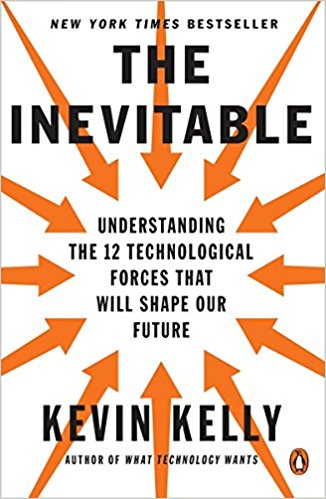
The Inevitable: Understanding the 12 Technological Forces That Will Shape Our Future
© 2016 Kevin Kelly
336 pages
No one can say where exactly a ball thrown in the air will land, but at least on Earth it’s a certainty that a thrown ball will land. Kevin Kelly, formerly of Wired magazine, can’t say exactly what the future will look like, but he is confident enough to predict what trends will continue based on present technology. Our global civilizations have been radically transformed from the 1970s til now, but computers weren’t the catalyst for all the change we see around us. Networked computers were. By themselves, the first computers were house-sized calculators and overpriced filing cabinets; when they began exchanging information freely, magic happened. What world-changing wonders can we expect from the current trends in technology?
First, says Kelly, is “becoming”: In the late eighties, Zygmunt Bauman introduced the term liquid modernity to our sociological lexicon. In previous generations, changes happened slowly enough that our societies were able to digest them and establish a new normal. As the 19th gave way to the 20th century, however, the rate of change has quickened to the point that a new normal is impossible: societiy is revolutionized multiple times within a single generation, with the effect that there is no stable ground to be had, no new normal to be reached. Now our products are no longer discrete products, but services that are continually being changed — think of Office 365, or even Windows 10. Windows 10 is rumored to be the last Windows, not because Microsoft is retiring from the OS business, but because Windows 10’s frequent updates constantly add new features that would have otherwise been developed and delivered in a new Windows. Our phones, too, are not merely the device that came out of the original box: as we add apps and accessories, we change their nature.
The second big-ticket item in here is “cognifying”, by which Kelly means using machine intelligence for everything. There won’t be a master AI that controls every aspect of our lives, he says; instead, we”ll develop multiple machine intelligences for different suites of needs, and they”ll be utterly mundane — and already are. When we execute a google search for recipes or ask it for directions, we are in fact helping train and benefit Google’s machine-learning algorithisms: we are teaching them what we’re most likely to be looking for. Those “Related Products” that Amazon helpfully shows you are also an early example of machine intelligence, as Amazon’s database learns your shopping preferences and attempts to predict what you would like next.
Two more concepts from the book worth sharing quickly here are Accessing and Tracking. Tracking sounds obvious, but Kelley isn’t just talking about website cookies or Google & Apple recording your movements through your phone’s GPS. By tracking, Kelly means that the door is open to quantifying every aspect of our lives. People can already use their phone’s apps to track how much they walk per day, how well they asleep, and record their diets; they can already use phones to monitor their heartbeat; phones in the near future will be able to monitor blood pressure and blood sugar, as well. Cheap cameras and cloud storage mean that we can record more moments of our lives, and later poke through them at our leisure as if they were files in a drawer. The cloud is a key aspect of much of what Kelly covers, but it is especially prominent in the “Accessing” chapter, in which he writes that we’re moving away from an ownership society. We no longer need to own a car; we just need access to one. Apps and tech allow us to share resources, and in some cases the resources are becoming so cheap that they can be offered for free: no one needs to struggle with an ersatz Office clone when they can use the freely available OfficeOnline.
There are ten real concepts in total (there are two more chapters, “questioning” and “becoming”, but they’re less about content than thinking about our relationship with content), and the author purposely avoids mentioning any downsides. He takes it for granted that everything can be used to malicious purposes, but that would be another book entirely. (A book like Future Crimes II, perhaps...) I also liked the chapters on Interacting and Screening; one addressed the future mundane role of virtual reality and augmented reality, in that games and movies will become more “real”, and our travels in the real world will have a digital overlay adding more information — the ubiquity of screens dovetails with that rather nicely. One disturbing possibility Kelly mentions is having glasses or ocular implants with different apps installed; one can read people’s faces and match them to a driver’s license database. The other concepts in the book are extensions of minor things happening now, like remixing and filtering.
As someone who can be both entranced and repelled by the promises of technological — completely fascinated on a abstract level, distantly horrified at a human level — I found The Inevitable enthralling reading. The author is sloppy with language, however, using “socialism” and “collective” when ‘cooperative’ would have been more accurate. For some reason he thinks libertarian individualism is contradicted by Wikipedia , when it’s merely individuals voluntarily working together toward a common goal. Socialism makes me think more of involuntary mass actions, like taxes and slavery.

















 Reading Freely