The Birth of Britain

History of the English Speaking Peoples, Vol 1: The Birth of Britain
521 pages
© 1956 Sir Winston Churchill

I’ve been reading from Sir Winston Churchill’s History of the English Speaking Peoples the last few Read of Englands, but didn’t previously have access to the first volume in the series.   The Birth of Britain covers the most storied aspect of British and English history, beginning with the invasion of the island by Rome and continuing to the end of the Hundred Years War.  We begin, then, with an island at the “end of the world” being invaded and connected to continental civilization, and developing through until at the end of the long conflict with France, England is again its own sceptered isle,  left to chart its own course. Although Celtic, Roman,  and Anglo-Saxon Britain all receive full attention here, most of the really memorable characters appear after the arrival of William the Bastard, the Duke of Normandy whose conquest of England would create a loosely bound cross-channel  empire — later made greater by one of the Bastard’s progeny marrying a French princess and creating the Angevin Empire. More than once, however, Churchhill comments that the Angevin realm was not a coherent state at all, but a loose collection of several with their own laws. The evolution of English law, and particularly the common law and the conviction that no one was above the law — not tven the king —  is an important theme of Churchill’s work,  and along with it is the rise of Parliament.  Not surprising given that Churchhill researched and wrote this amid the anticipation and then memory of World War 2, antagonism toward England’s favorite enemy, France, is minimal, and Joan of Arc is celebrated just as Boudica is.   Churchill’s skillful oratory still translates into historic narrative here.

Posted in history, Reviews | Tagged , , , , | 11 Comments

I’m baaaaaaaaaaaaaaaaaaaack

Hello, dear readers! For the past week I’ve secretly been running around northern Arizona, leaving you with some scheduled posts in my absence.  I’m afraid I’ve read sod all in the last week, as after busy days hiking in the Grand Canyon and such I tended to collapse into bed around eight pm. If I read anything at all, it was only while eating or nursing old fashioneds in Flagstaff’s downtown hotels.  I’ve got mounds of photos to process and sort, and will be sharing them in the days and weeks ahead. Expect comments for Churchill’s first volume in his History of the English Speaking Peoples fairly soon, and then I’m on to A Time Traveler’s Guide to Elizabethan England. Hurrah!    I’ll be sharing photos and such in the days and possibly weeks to come, but in the meantime here is a sneak peek.

Grand Canyon!

Hoover Dam!
Walnut Canyon!
Painted Desert!
Pretty Flagstaff!
Posted in General | 8 Comments

A Hobbit, A Wardrobe, and a Great War

A Hobbit, A Wardrobe, and a Great War
© 2014 Joseph Loconte
256 pages

When some future Gibbon writes of the Decline and Fall of Western Civilization, he will have to devote a great deal of attention to the Great War.  However more numerous the deaths of its daughter, the Great War’s damage was more foundational, destroying as it did not only an entire generation of young men and leveling empires, but in derailing the western dream of unstoppable progress.  Western faith in itself and its ideals was fractured, and more damage would follow in the decades to come. The generation that followed was understandable cynical and lost, believing in nothing and pursuing only fleeting pleasures; a war opened with religious zeal ended in despair.  A Wardrobe, a Hobbit, and a Great War  examines the lives and work of two young men who fought in the war, but who survived it with their spirits intact — who neither entered it as a crusade, or came out of it as jaded warriors.

The book is effectively a brief history of the war as experienced by Lewis and Tolkien, expressed as a two-part biography  that focuses on how the war shaped their writing.  The primary difficulty in supporting the authors’ thesis, that Tolkien and Lewis developed ideas about heroism amid their war experience and later applied it to the worlds and stories they later created, is that neither man wrote a great deal about their war experiences.  What few references exist in their letters from the time, and their recollections later, are connected by Jenkins to passages or themes in their stories: Lewis’ descriptions of combat in his own life and the depiction of the same in his Narnia stories; Tolkiens’ description of Mordor and the corpse-filled bog around it are connected to the horrifying spectacle that was a trench warzone — where men lived among the dead and the engorged rats that fed on them, sometimes seeing past battles’ dead unearthed by artillery strikes.

Loconte’s general thesis is that Lewis and Tolkien both rejected the ‘myth of progress’, that society was growing Better and that men were evolving to become superior beings. They did not counter this with a theory that things were growing worse, but rather shared the conviction of GK Chesterton that things simply were, that the nature of fallen man was such that he could never become anything  new– he only exist to make his choices day by day, for good or ill.  Heroism, as described by Jenkins and illustrated through the Narnia and Middle Earth novels,  meant ever pushing to do the right choice, even when it was not easy, wise, or safe.

Ultimately, I don’t know that there’s enough evidence to support the authors specifically being inspired by the war to create the kinds of stories they did. However, I also don’t know if there’s an upper limit to how much I can read about Tolkien and Lewis, because they were old fogeys in their own time and thereby my countrymen. I thoroughly enjoyed reading this.

Posted in Reviews | Tagged , , , , , , , | 5 Comments

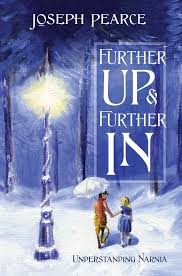
Further Up and Further In

Further Up and Further In: Understanding Narnia
© 2018 Joseph Pearce
200 pages

”The further up and the further in you go, the bigger everything gets.” – The Last Battle

Christendom and Narnia are never far removed from one another, and in Further Up and Further In, Joseph Pearce takes us through the thin veil between them. He pores over the literary and theological references that deepen the world of Narnia, relying on his previous research into the life of Lewis, as well as his work on Lewis’ influences, Tolkien and Chesterton. Both are companions not just of Lewis, but of the reader here, as the three dwelt in the same moral and literary universe.

Most anyone who has visited Narnia in The Lion, the Witch, and the Wardrobe realizes its Christian connection. Aslan’s deliberate self-sacrifice to destroy the power of Death and revive not only Narnia, but redeem the withered soul of young Edmund, makes that obvious — as does the Garden of Eden story seen in The Magician’s Nephew where the same white witch leads to the corruption of Narnia seven hours into its creation. And if anyone was missing the point, then in Voyage of the Dawn Treader Aslan explicitly tells the children that he is known by another name in their world, and that they were brought to Narnia so that they would know him better there.

Although Pearce expands on the multitude of links to Christian culture — Aslan’s repeated use of “I am”, a la God’s reply to Moses in the desert, his treble use of the same phrase and other sets of three to bring to mind the Trinity, and so on — Pearce also understands Lewis as a man deep in history, and particularly in medieval history. He points out Lewis’ allusions to other figures, like El Cid and Charlemagne, based not on dry history but on legends about these men, like “The Song of Roland”. Commentary stretches to the modern age, too, as Pearce points out how Eustace Scrubbs’ parents are caricatures of George Bernard Shaw, who loved “humanity” but disliked most people, and believed in progress for its own sake, rather than people for theirs.

More than anything else, Pearce shines a light on the moral universe that was Lewis’ made ‘physical’ in the land of Narnia. There delivered were his convictions about heroism and temptation, of the self-defeating nature of evil, of the dignity of creatures both great and small, both simple and clever. In The Magician’s Nephew we see condemned the will to dominate; in Voyage of the Dawn Treader we experience again Tolkien’s “dragon sickness”, the madness brought on by fixating on materials — gold, in Eustace’s case, and secret knowledge in Susan’s. Each book has its lessons, and those who have experienced Narnia’s story and loved it will almost surely appreciate his look deeper into the wardrobe.

Posted in Reviews | Tagged , , , , , | 5 Comments

The Letters of CS Lewis

Letters of C.S. Lewis
© 2017 Harper Collins
Edited by Warren Lewis and Walter Hooper
688 pages

After the death of his younger brother, Warren Lewis released a collection of his letters for posterity’s sake. Perhaps it was to repay a debt, as Jack spent much of his adult years trying to keep Warren from drinking himself to death. The collection is rather a selection, a sampling of Lewis’ vast correspondence that reveals his captivity by literature, his wrestling with ideas, his debates and warm exchanges with friends. The original edition produced by Warren included his active mark as an editor, with improvements to word choice;  this edition by Lewis’ secretary Walter Hooper presents the original. It also incorporates excerpts from Lewis’ diary where correspondence was slight, as well as editorial comments in brackets to provide context for particular letters. 

Casual Lewis fans who are expecting something like Surprised by Joy will be in for more work than they anticipate, because the first half of this is a bit of a slog, really.  It’s tremendously helpful if you’re writing a paper on Lewis and want to incorporate something like first-hand sources,  but it’s lots of minutiae: Lewis talking about outings with friends, or going on and on and on about the virtues of taking this approach in school rather than that approach, and the English uni system at that time bewilders me — it’s almost medieval, with students seeming choosing day by day if they want to go to this lecture by Dr. Waugh or that lecture by Dr. Granthum. The Great War is curiously muted, with the exception of its effect on Oxford. Even when Lewis is deployed in France, he mostly writes about books. 

Lewis is most famous for his reluctant conversion to Christianity, and thereafter becoming one of the foremost defenders of Christianity in the modern age until his death in November 1963 — a death overshadowed by another Jack the same day —  but these letter don’t reveal much about his conversion. An early Lewis comments to his friend that of course all religions are alike, just made-up stories, and a later Lewis dashes off to his friend that some metaphysical concept in his head is quickly becoming rather like God, and if something isn’t done quickly he’s going to find himself in a monastery.  And then he’s a bestselling author and receiving letters asking for religious and personal advice.   This familiar Lewis enters about halfway through the volume, and then religious discussion mixes with the usual literary stuff and social banter.

If one only knows Lewis as the author of beloved stories and apologia, the letters here reveal the more human one — and a very long suffering one.  He spends much of his adulthood caring for the mother of a friend who perished in the Great War (they’d promised the other that in the event of their dying, the survivor would look after the other’s parent);   once she passes, he has an alcoholic brother and a cancer-stricken wife to tend to. The few years of his marriage were among his happiest, however, and a brief respite from her pain allowed them both to visit Greece. He writes to a friend that the ancient splendor had him worried he might become a pagan once more and pray to Apollo.

I for one find “Jack” to be extremely pleasant company, with the effect that I often re-read his autobiography. After clearing the hurdle of his university days, the letters here were largely engaging or amusing,, particularly his advice to young students on writing, and his eternal literary discussion with his friends.

 This collection is of great interest to devoted Lewisians.

Posted in Reviews | Tagged , , , | 5 Comments

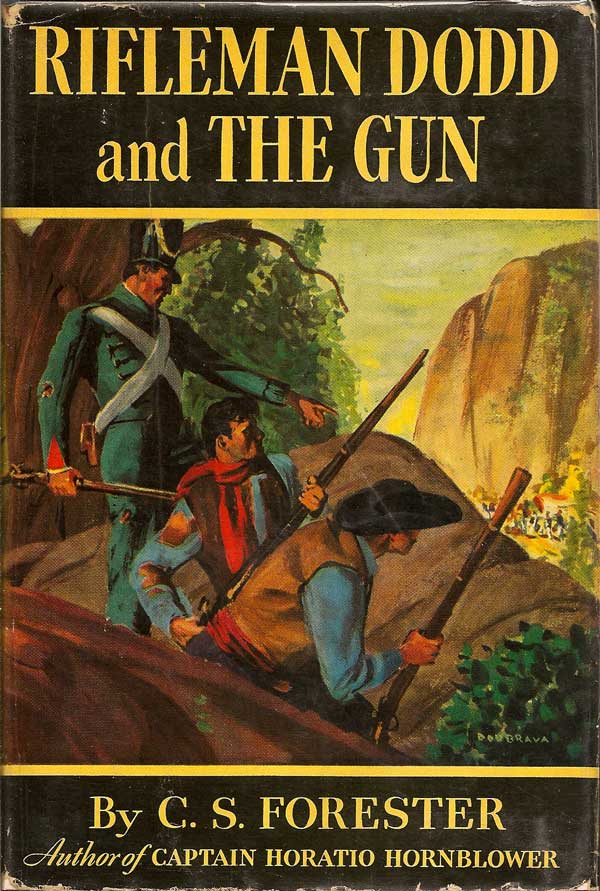
Rifleman Dodd and The Gun

The Gun, and Rifleman Dodd
© 1933 C.S. Forester
311 pages

“There was sorrow in Dodd’s heart as he looked down on the pitiful scene, but it did not prevent him from turning away and setting himself to survey the next adventurous quarter of a mile of his route. There are many who give up, and many who procrastinate, but there are some who go on.”

C.S. Forester is best known for his Horatio Hornblower stories,  naval adventures set in the Napoleonic Wars.   These two short works, The Gun and Rifleman Dodd, are less known but equally entertaining and detailed. Both are set in Napoleonic Iberia, as both a peasant resistance and the shattered remnants of the old Bourbon Army fight for Spain and Portugal’s liberty from Napoleon,  with the generous support of English seapower and the Duke of Wellington.

The first story, The Gun,  follows an eighteen pound siege gun which abandoned on the field after a crushing Spanish defeat, but recovered by a priest and a few farmers, The gun passes from hand,  as many realize its incredible potential and attempt to shift it to the best place — and those who particularly value it seize it by force. It does get put into action, however, fomenting rebellion on the plains and sending the French into retreat for the first time.

Rifleman Dodd pieces together the adventure of the eponymous rifleman after he is cut off from a retreat, and lost behind enemy lines. A hard-worn veteran of five campaigns, Dodd knows how to soldier and stay alive, and so when he encounters a group of Portuguese irregulars, he becomes their leader and becomes a phantom menace to the French, who are haunted by visions of a green Englishmen.  Even as they methodically begin sweeping and scouring the hills to destroy his hiding places, Dodd and a couple of survivors — and finally, Dodd alone — endeavor to put flames to Bonaparte’s plans.

Although a sketch of their plots gives both of these novels an air of romantic air,  they’re not fanciful in the least.  Forester does not shy from the brutal behavior of both parties, French and irregulars, as they fight tooth and claw with one another.  Forester also does not reduce the French to a distant enemy:  in Rifleman Dodd, he tells their story in alternate chapters, and every person Dodd kills is named as he falls.   There’s no denying the adventurous drama of the last bit of Rifleman Dodd, however, as he beards the French lion in its den.  Good stuff!

As a bit of trivia, Bernard Cornwell mentions a missing rifleman named Dodd in one of his Sharpe novels, also set in Spain.   This is a deliberate reference to Rifleman Dodd, and one of Cornwell’s stories about becoming a writer involves trying to find more stories like Dodd, and then realizing he’d have to write them himself.  Three cheers, then, for Rifleman Dodd, which was not only a great little story by itself, but one that gave us the force of nature that is Sharpe.

Rifleman Dodd was originally known as Death to the French. I speculated that the title was changed after the outbreak of World War 2, but Rifleman Dodd seems to have just been the American title.

Related:
Cornwell’s Sharpe books
Forester’s Horatio Hornblower sea stories

Posted in historical fiction, Reviews | Tagged , , , , | 5 Comments

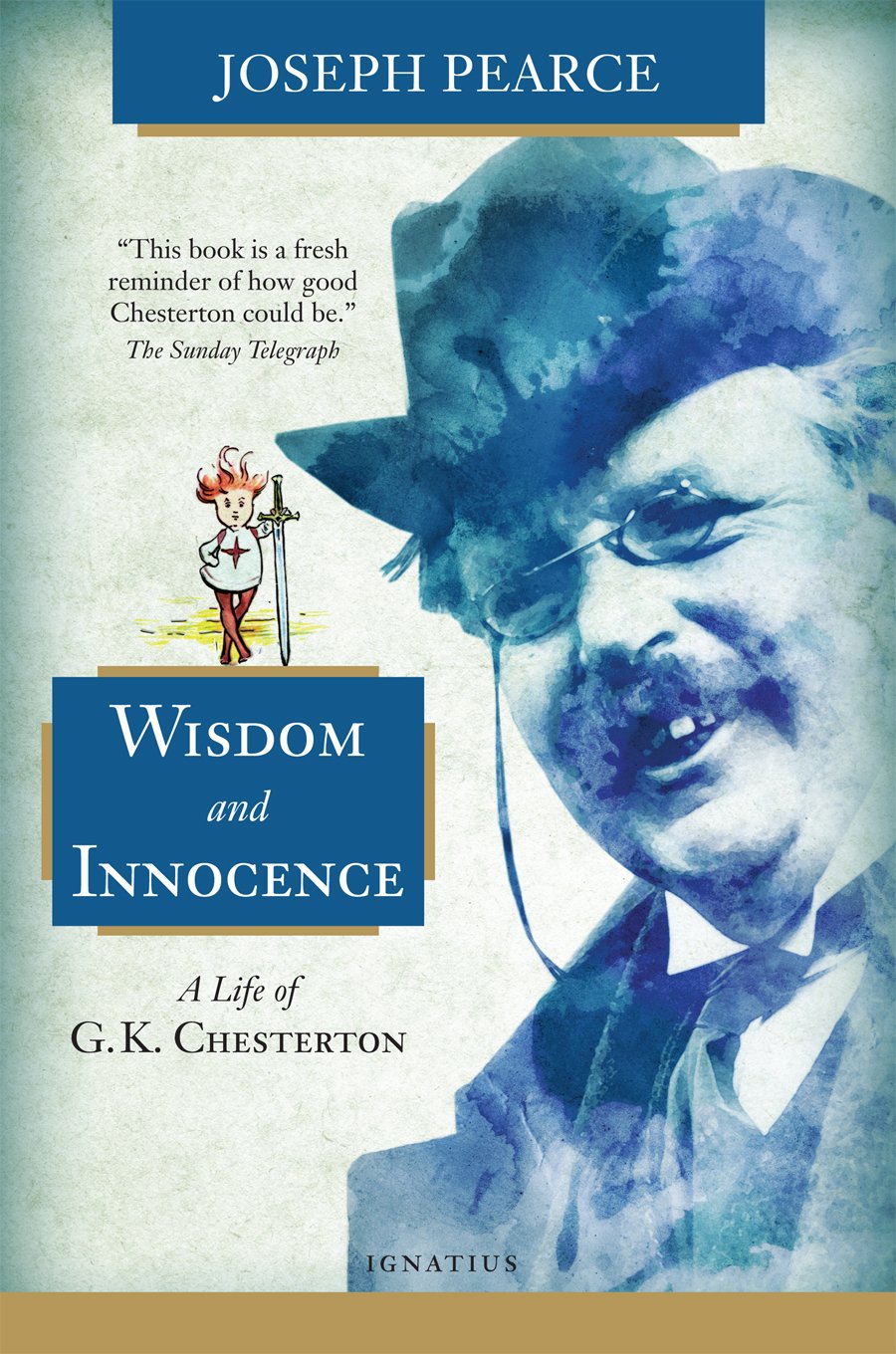
Wisdom and Innocence

Wisdom and Innocence: A Life Of G.K. Chesterton
© 1996 Joseph Pearce
540 pages

“I cannot help but thinking you were England — the Merry, chivalrous, simple-hearted, fearless England that I loved.” – an old friend’s letter to Chesteron
Mention the name G.K. Chesterton today, and most who have a glimmer of recognition will venture that he was a Christian apologist. Chesterton was no theological pendant, however; at the peak of his career, which he still occupied at the time of his death, he was a bestselling author, editor, and journalist  recognized by many as something unique.  More than that, however, he was fun, with an amiability that led even his antagonists to maintain warm relations with him even as they heatedly debated through public newspapers. Pearce’s title, Wisdom and Innocence alludes to a core dynamic expressed in the life of Chesterton — the embrace of romance and reality, wonder and wisdom, faith and reason. The same man who could earn praise from medieval scholars for his biography of St. Thomas Aquinas and hold public debates against H.G. Wells and Bertrand Russell might just as easily entertain a house of small children single-handedly the same night, with equal joy.
Although Chesterton was baptized into the Anglican church, his parents were  merely bowing to social convention when they brought him before the fount and priest;  they were hazy Unitarians and spiritualists. In his youth, Chesterton experimented with the occult, becoming convinced that there was something more than the material world, and had a distinct appreciation for what we might now call the divine feminine.  Chesterton did not write a Surprised by Joy equivalent about his embrace of Christianity via the Anglican church, but the tipping point occurred when he was beginning to teach and met a young nihilist who believed in nothing, not even the possibility of truth. Judging by letters Chesterton wrote thereafter, encountering this man was a staring-into-the-abyss movement that set him searching for meaning and order. He found it in the Anglo-Catholic movement of the Anglican church, and his sympathy for Catholicism would only strengthen over the years, until he finally converted and became one of the Church’s most vocal champions.
Chesterton didn’t unsheath his pen only to defend the Church on  theological grounds, however. For him, the Catholic faith undergirded western civilization, and even the material expression of society – the organization of the means of production, for instance – -had a religious importance. From an early age Chesterton held the large industrialists of the day in contempt, and critiqued capitalism first from the left, and then later from Catholic theology.  Marx may have cheered the fact that the family had been destroyed as an economic unit, but for Chesterton this was the crux of the problem.  He objected and resented to the fact that so much land and property were pooling into the hands of a few titanic industrialists and their bankers. To take away a man’s economic independence, to reduce him to a proletarian laboring for nothing but money – to force him  and his children to abandon a home for a hovel, and spend their energy for another besides improving their own home and familial enterprise, was to undermine human dignity and tarnish a creature made in the image of God.  In general, Chesterton found modernity absurd, unhealthy, and (in the case of fascism) regressive.   He regarded the strident nationalism of the early 20 century as a return to tribal barbarism, and a betrayal of the cosmopolitan aura of the Roman and Catholic world.   His early denouncement of Hitler, at a time before democratic leaders were eying the ill-shaven Austrian with envy for his energy, earned Chesterton kudos after the evils of Hitler’s regime became apparent.
Wisdom and Innocence is an incredible biography, a review of not only GKC’s life, but his work.  Pearce is exhaustive, poring into Chesterton’s poetry and smaller stories as well. Pearce also visits Chesterton in the company of his friends and rivals.  Chesterton and an Anglo-French writer named Hillaire Belloc were especially close, united in their love for their faith, literature,  and wine, and Chesterton himself inspired many who became friends  His two chief friendly antagonists were George Bernard Shaw and H.G. Wells, who shared his concern about the power of tycoons but little else.  This book is nearly as big as its subject, and well worth reading for anyone who has a serious interest in Chesterton.  The depth which it goes into may be a little much for very casual readers, however:  it had chops scholarly enough to merit Aleksandr Solzhenitsyn  granting Pearce an interview for his later biography, Solzhenitsyn: A Life in Exile.
Posted in Reviews | Tagged , , , , , | 6 Comments

Right Ho, Jeeves!

Right Ho, Jeeves
© 1934 P.G. Wodehouse
284 pages

What ho, readers all!  What better way to start off a new month than a Wodehouse story, featuring our favorite lovable idiot Bertie Wooster and his impeccable valet, Jeeves?   Unlike previous laughs with Wodehouse, this is a full novel and not just a collection of short stories. The premise is ever familiar:  Bertie would like nothing more than to drink and cavort, but he has pals in the soup and an aunt sending increasingly threatening telegrams. There’s nothing to do but be a sport and leg it down to Brinkley House, there to fix the woes of the world — and by “fix”, I mean “make them worse until Jeeves arrives to put things in order again”.  After studiously ignoring the attempts of his hand to get him to travel into the country and lend at a hand at an awards dinner, Bertie is forced to do so anyway to lend relationship advice to a few friends (who will wind up engaged to the wrong people), and after some spirits are added, general merriment follows.

The chief appeal of a Wodehouse/Wooster novel is not the familiar plots or even the comedy that ensues when Bertie tries to finesse social situations and make matters worse for the wear of his subtle touches,  but Wodehouse’s use of language.  I would venture to say that a reader can’t appreciate how funny English can be until they’ve read Wodehouse.  All of the Wooster stories are rendered in the first person, through a narrator who is a ball to listen to. He’s brimming with opinions, so full of them that he has to abbreviate things at random., trusting that you know perfectly well what he meant. Mix this in with physical comedy, like drunken speeches and  frequent chases through the halls and grounds of places like Highclere Castle (used for Totleigh Towers in the television series), and it’s a hoot all around.   This one features a bit of comeuppance against Bertie; ever resentful of people preferring Jeeves’ schemes to his, Bertie spends most of the novel  trying to take over. Jeeves has his revenge when he uses Bertie in the grand plan at the end to resolve everything at a stroke.

Ultimately, however, Wodehouse’s language has to speak for itself:
———————————————————————————–
“And yet, if he wants this female to be his wife, he’s got to say so, what? I mean, only civil to mention it.”
“Precisely, sir.”

“In this  life, you can choose between two courses. You can either shut yourself up in a country house and stare into tanks, or you can be a dasher with the sex. You can’t do both.”

“Well, Gussie.”
“Hullo, Bertie.”
“What ho.”
“What ho.”
These civilities included, I felt the moment had come to touch delicately on the past.

“I’m not saying I don’t love the little blighter,” he said, obviously moved. “I love her passionately. But that doesn’t alter the fact that I consider that what she needs most in this world is a swift kick in the pants.”
A Wooster could scarcely pass this. “Tuppy, old man!”
“It’s no good saying ‘Tuppy, old man!'”
“Well, I do say ‘Tuppy, old man!’. Your tone shocks me. One raises the eyebrows.

“I can never forget Augustus, but my love for him is dead. I will be your wife.”
Well, one has to be civil.
“Right ho,” I said. “Thanks awfully.”

“You are falling into your old error, Jeeves, of thinking that Gussie is a parrot. Fight against this. I shall add the oz.”

“It seems to me, Jeeves, that the ceremony may be one fraught with considerable interest.”
“Yes, sir.”
“What, in your opinion, will the harvest be?”
“One finds it difficult to hazard a conjecture, sir.”
“You mean imagination boggles?”
“Yes, sir.”
I inspected my imagination. He was right. It boggled.

Posted in Reviews | Tagged | 13 Comments

The World as Stage

Shakespeare: The World as Stage
© 2007 Bill Bryson
245 pages

Shakespeare: The World as Stage surprised me when it arrived. Such a slender little volume for a man whose legacy is strong even today!  Bryson’s aim is not to deliver a volume of literary criticism, or even to fix on some minor detail and create an revisionist vision of Shakespeare, but to stick to the facts.  As it turns out, there aren’t that many.  While we know bounds more about Shakespeare than many of his contemporaries — and more of his works have survived him than them as well —  the man didn’t leave much documentation.    In creating a narrative that connects the few facts we have  — birth,  employment as an actor, success as a  playwright, death —  Bryson also supplies background information about Elizabethan and Jamesian England, and concludes that Shakespeare’s greatest accomplishment was not “Hamlet”, but rather managing to survive childhood.   England was plagued by disease after disease, so much so that public records sometimes inserted the phrase (in Latin), “here begins plague”, as if to assure future historians that no, this isn’t an error, that many people really did die in that April with its shoures soote. 

If a reader is looking for a light history of Shakespeare that won’t lead them off the road into some niche theory of the bard,  Bryson here provides a concise, cautious, and enjoyable biography of the man and his times that will fill the bill admirably.

Posted in Reviews | Tagged , , | 8 Comments

Read of England, 2018!

At long last it’s April, my favorite time of the year — a time of perfect weather, budding flowers, and reading of England! Well…it’s the last week of March, anyway, and I can’t wait anymore.   If you’re new, every April I like to devote my reading entirely to English history, English literature, and English personalities.  Why April?  April 23rd is the feast day of England’s patron, St. George, and the anniversary of William Shakespeare’s death.   Every year brings a different mix of history and literature, and some years I strike the balance better than others.  This year I’ve already amassed a proper pile of potential books to go after, not including the English lit on my classics club liist, and I’m chomping at at the bit. Let’s start the fun!

Posted in General | 12 Comments