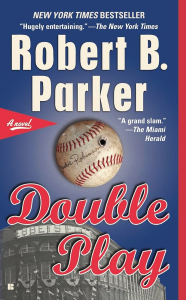
Burke has returned home from World War 2 with a body full of scars and a mind even more disturbed. He arrived home not to hugs and kisses, but to a letter from his wife telling him that she’d run off with another man. Considering how torrid and fast his own courtship is with her, that wasn’t much of a surprise. Once fully healed — physically, anyway — Burke finds work for himself as a tough guy of sorts, working as a bodyguard. He’s hired by Branch Rickey, general manager of the Brooklyn Dodgers, with a special client: Jackie Robinson. The former Monarch is being brought into the Major Leagues, breaking the ‘color line’ that has kept baseball segregated. Ricky anticipates trouble: that’s why he chose Robinson, a man who was not only talented but who can keep his head, and it’s why he wants someone watching Robinson. Robinson needs protection from those who might try to assault him, yes, but he also needs someone to hold him back if provocations make him lose his cool.
This is the set up of Double Play, a novel that is more baseball adjacent than about baseball. Burke doesn’t care whether he lives or dies, and in the course of his work he angers or shoots dead several mooks who are in the pay of New York’s criminal elements. Burke’s lack of fear, tolerance of pain, and skills with his Colt 1911 come in handy a few times, and his relationship with Robinson is interesting. Because this is 1947 and segregation is as much a thing de jure if not de facto in New York, the pair find themselves struggling together: cabbies of either color ignore them out of fear, and when Burke accompanies Robinson in black restaurants and the like he’s glared at with contempt and hatred. There are at least two sets of baddies to deal with, and one possible femme fatale. This was a fast, punchy novel: while there’s not as much content on baseball or Jackie as one might expect, the game is never far away. There were some odd chapters following a young man named “Bobby” who grew up watching Jackie, and readers all appear to believe that these are the author (Robert/Bobby) being autobiographical and sharing the story of how he was inspired as as a kid. Some scenes were ‘racier’ than I’d like, no pun intended: Parker didn’t fade to black as quickly in the bedroom scenes as I’d personally prefer. The setup was fascinating, though, and the writing drew me in immediately. I’ve already gotten two more Parker & baseball novels checked out.
Today’s TTT is “books with ordinal numbers in the title”. Mmkay…..
But first, a tease from Robert Parker’s Double Play:
“We need to work this out,” Burke said. “I don’t want to have to keep shooting people.” “We got plenty.”
(1)One No, Many Yeses, Paul Kingsnorth. On global resistance to corpo-homogenity in favor of local economies. Oh, wait, “One” isn’t ordinal, it’s cardinal…
(2) The Last Man in Europe, Dennis Glover. If first is ordinal then by gosh and by golly last oughta be ordinal.
(3) The Eighth Continent, Rhett C. Bruno and Felix Savage. Hard SF on the moon. A bonafide ordinal!
I lived in lies all my life And I’ve been living here for a long, long time And I know its been coming down a while now… (Deer Tick, “Art Isn’t Real”. Original opening song to the KC.)
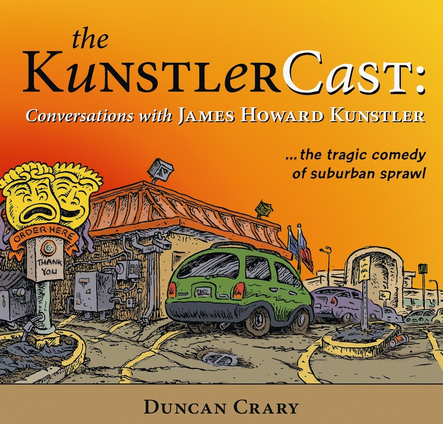
Almost twenty years ago I attended a guest lecture at my university and heard a talk that would prove to be exceptionally influential on my thinking. The talk, by Jim Kunstler, was on how American urban design – the built environment – had become not only ugly and injurious to human happiness, but fundamentally unsustainable. This was an iteration of a talk he’d been giving for a few years, but for the audience that night – who were going home to more dire reports of banks and businesses closing and jobs being lost and a global economy in peril – his diagnosis was particularly dire. He gave me a lot of food for thought; a vocabulary to articulate things about traditional city design versus modern city design; and an interest in energy, housing, and transportation policies that would fundamentally alter my politics and indeed my entire political orientation. Back then, Kunstler was in the middle of a sequence of books with a common theme – essentially, the imminent consequences of our refusal to live within limits, our conviction that the cheap oil era would last forever, and our faith that technology would always save us from said consequences – and as part of his profile, he had a podcast called the KunstlerCast. It’s changed much over the years – these days Kunstler interviews other people, but back then a young journalist was interviewing him about various topics that fell within this wheelhouse. The young journalist, Duncan Crary, turned the early years of the podcast into a book, which i devoured. Recently while looking for a break from St. Augustine, I saw the fun cover of this one on my shelf and decided to revisit it. I have reviewed the book before, so this review will incorporate reflections on what’s changed in 15+ years or so. If you want my original take, head here.
Because of its source, The KunstlerCast is a more varied book than Kunstler’s solo works. Each of those was written with a particular topic in mind, and as I commented in my review of his last nonfiction work, they were a bit like railroad cars: each book connected to the other but all were part of the same train of thought. These interviews reflect that train of thought, but they also have more miscellaneous content that allows Kunstler to broadcast his inner curmudgeon. Kunstler identifies himself as a jovial, upbeat guy, but one who despises the triviality and superficiality of late-2000s American culture. The first half of the transcripts here include discussions on topics within the Geography of Nowheretrainshed: the origins of suburban sprawl, the cheap and performative nature of the buildings and architecture associated with it, and on. If you’ve never encountered Kunstler before, here’s an elevator speech: he is a strong critic of postwar American urbanism who believes that the ugliness of early industrial cities created a hyper-reaction of people not only fleeing the cities, but adopting zoning and building methods that would ensure that those escaping to suburbia would never live anywhere near factories again. This new approach at the built environment reduced all human urbanism to three general categories (Residential, Commercial, and Industrial) and then made pains to separate them far from each other: as a result, urbanism became profoundly car-oriented, and fundamentally anti-human. This anti-humanness is expressed not only by the fact that it reduces everyone to being reliant on cars to do anything, but because it destroys the public realm completely, creating a nation of consumers who get and spend and then go home to watch advertisements for buying more stuff while surrounded by plastic crap they don’t need. To this add Kunstler’s later criticisms that all this is unsustainable because the cheap oil age won’t last forever, and that no, energy-intensive tech is not going to solve the problem because it itself is dependent on cheap energy.
Within Kunstler’s original argument in Geography of Nowhere there were elements that might seem like digressions, but which to Kunstler are still key parts. He often objects to things on aesthetic grounds, like the fake shutters applied to suburban homes that he reviews as cartoony imitations of actual country homes in themselves. The digressions show up more here, because Crary and Kunstler’s conversations are far more informal than a lecture hall. Thus we get remarks on how cartoony Americans themselves are becoming — obese ‘land whales’ shuffling around, dressed like kids who have no respect for themselves because they grew up in a culture that does not take anything seriously, from the built environment to sober evaluation of our future issues. Kunstler can easily come off as a grouch to those who aren’t familiar with him as a person or who don’t share some of his grievances; I’ve been listening to the man since that lectures and have to roll my eyes at some of his substack tirades. He is a fun grump to listen to, though.
How does this stand up, twenty years later? Kunstler these days doesn’t write much about the built environment; he maintains a website with a blog and a monthly feature called “Eyesore of the Month”, but most of his writing is about political culture in general. The fracking revolution of the 2010s appears to have silenced much of the peak oil commentariat: TheOilDrum, which was the biggest peak oil news aggregator back in the day, has been silent and still for many years. Kunstler panned the prospects of fracking back then and in ways it’s a challenge of his argument that technology will not save us — only returning to sane development patterns will, and these development patterns will allow us to recreate something of communal and public life. That said: even if technology allows us to tap into oil sources that we didn’t have access to before, it doesn’t mean that the supply of oil is infinite. Given that the entire damn world seems intent on becoming more dependent on the oil ecosystem — from car-oriented infrastructure to the proliferation of plastic everything — it seems to me that we are driving faster and faster down a road whose endpoint we cannot see, and at such a pace that if we encounter obstacles we’ll have no time to dodge them. The current oil spike as a result of Gulf War II (or whatever future historians wind up calling the Iran War) is one such obstacle. Unfortunately, I imagine we will forget its lessons as readily as we did the OPEC problems of the 1970s once peace is made and the global economy begins to revive in five years or whenever.
Fundamentally, I think this book still holds up because of Kunstler’s original, foundational argument: suburban design spits in the face of thousands of years of urban thought and design, and it has nothing to recommend it unless you are a developer who takes delight in destroying meadows and forests to put up mini-McMansions that now offer the insult of half-mill price tags while at the same time forcing people to live just as cheek-by-jowl as they would in an apartment building that they wouldn’t spend their entire working lives to pay for. The built environment plays a huge role in human happiness along multiple factors — on our ability to get places easily, on our connections with our neighbors, etc — and I think the disintegration of the American city plays a huge role in many of our social maladies. I think many of Kunstler’s convictions are still applicable today, and for me this was a fun visit back to where a lot of my thinking about these topics derives. Kunstler’s particular brand of pugnacious criticsm may not be for everyone, but he’s no lone Jeremiah: StrongTowns has been arguing on the fiscal unsustainability of urbanism for decades itself. This was a fun trip back for me.
Jim: The problem in America is not that we’re driving the wrong kind of car. The trouble is we’re driving every kind of car incessantly. And we’ve got to find a way out of the incessant motoring — not a punishing way to live without it, but a happy way to live without it. And it means a completely different paradigm for everyday life.
Duncan Crary: Even when [vinyl siding’s] brand new, I don’t like it. To me, it’s just not real. Jim: Well, it ISN’T real. It’s just pretending to be something else. Duncan Why do I care that it’s not real? Why does that bug me so much? Jim: I think that we are disturbed by the inauthentic. Vinyl siding pretends to be wood, and we know it’s not wood, and it pisses us off that we’re being lied to by a physical object.
Jim: The thing that astonishes me the most about my generation is how this generation that espoused free thinking and free inquiry and freedom of everything ended up becoming the thought police.
Jim: One thing the American public doesn’t realize is that when you don’t negotiate the circumstances that the universe sends your way, you get assigned a new negotiating partner called Reality. And then it negotiates for you. You don’t even have to be in the room. You can go watch Internet porn, or play poker online, or eat Cheez Doodles and drink Pepsi, or watch TV. And then your life will be negotiated for you.
Duncan: I think a lot about our sense of entitlement to convenience in America. Take all the throwaway plastic bags and plastic spoons out there — we are a people who are so lazy and entitled that we can’t be bothered wiping off a metal spoon and saving it for tomorrow. We create utensils for one-time use, and now the spoon that you ate one plastic cup of yogurt with, and the plastic bag they came in, are all going to be around for eternity in some landfill.
Jim: It’s scary at that at the highest level of American corporate high-tech enterprise, they don’t know the difference between technology and energy. Do you know how fundamental that is, and how dangerous that is, to not understand the difference? Most Americans don’t understand that technology and energy are different — that they’re not interchangable. That if you run out of one, you can’t just swap it out with the other one. You can’t just plug in technology where you were using energy.
Fifteen years ago, I read The Confessions; I am not sure what prompted me to do so, other than perhaps a desire to read The Classics, and my belief that St. Augustine was like Cicero, a brother in avid pursuit of philosophy. My past self was not particularly impressed by the book, finding “Gloomy Gus’s” penchant for self-abasement depressing, and his particular focus on philosophy far too academic for my tastes. Then as now, when I read philosophy it is with an eye toward practical living – which why I like the Stoics. I was amused to learn later on that the translation I read, by Mr. Pine-Coffin, is “aptly named, for it is a dead translation”. When I decided to re-read The Confessions, now fourteen years a Christian in a very liturgical tradition, I chose to read Anthony Esolen’s translation. Not only do I enjoy Esolen as a writer and speaker in general, but it was his translations that took me through Hell,Purgatory, and finally Paradise. On having finished this a second time, I found it somewhat more enjoyable than my first go-round, especially once I realized that Augustine’s work was not merely woolgathering, but one volley fired in a battle of ideas — in this case, Christianity vs Manicheanism.
Confessions is frequently hailed as the first autobiography, but this is not an attempt by Augustine to give himself the Plutarch treatment. It is a spiritual biography, and Augustine’s growth as a man — from a selfish boy to a selfish youth to a young adult caught between the agonies of desire and the thirst for meaning — develops in tandem with his growth as a spiritual being. I noticed immediately there were elements from my original reading that I found far more compelling this round: when Augustine agonizes over stealing a fruit as a child, he is not being a self-flagellating puritan. However scrupulous he might have been, the moment is more than beating himself up: it’s a questioning of why we delight in transgressive behavior. He stole the fruit not because he was hungry or because he didn’t have the means to buy food, or even to spite the fruit-owner: he did it for the thrill of the steal. The older I get the more aware I am of that transgression for transgression’s sake and how pervasive it is in modern western society — from alt-right personalities embracing Hitler to activists defacing art with slogans. It strikes me, candidly, as Satanic — the spiteful decision to attack the good in creation in an attempt to frustrate the Creator.
The early sections can be compelling or boring depending on the topic at hand: Augustine’s greatest temptation appears to have been sexual appetite, not surprising for a young man, and his earnestness was such that he sent his mistress of many years packing away to Africa…only to relapse and find himself sleeping with both a new girl and his self-loathing. I could hear him echoing Paul — “the good I would do, I do not; and the evil which I would not do, I do.” These come along with discussions of Plotinus and neo-Platonic thought and there frankly my eyes would glaze over. These are not merely academic, though: just as Stoic praxis is grounded in Stoic cosmology, so too was Augustine’s perception of sin guided by his philosophical background. Critically, he regarded sin as originating not from inherently corrupt flesh, as the Manicheans and Gnostics did, but from a disordered soul. A disordered soul could be mended, but not through sheer force of will, as Augustine found out with his libido: grace was also needed, and there we move from philosophy to theology. For Augustine, grace breaking through was especially salient when he heard a voice urging him to “Take! Read!”, and then opened his Bible to a verse that cut his heart to the quick and made it clear that it was time for him to make a decision.
It’s fascinating to read this and then my old review, because past-me was very hostile toward the bishop. Although I became obsessed with philosophy, religion, and meaning in the late 2000s, I suspect parts of Confessions touched on parts of my being that were very sensitive — specifically, the memory of constant fear and self-loathing of my Pentecostal youth. When Augustine expressed humility, I reacted from the memory of constant condemnation — of myself, of the world, for every petty thing. Twenty years removed from Pentecostalism now, I can read Augustine as he is, and not some distorted version of him. There were some parts of my original review that indicate how poorly I understood what I was reading. I condemned Augustine for endorsing the ‘hateful split’ between the world of the body and spirit simply because he writes honestly on his problems with the passions. In fact, Augustine defends the body by arguing that it is the spirit that is disordered; the body itself is what God declared it to be in the first chapters of Genesis: ‘very good’. Gnosticism, Manicheanism, and many iterations of Protestant thinking are guilty of my condemnation, but not Augustine. At this point I’m also far more theologically aligned with Augustine on certain points that I would maintain even on secular grounds — particularly the notion of being curved in on ourselves, and of that being a source of much of our own inner poverty and social disorder. Although this is theologically dense, I enjoyed Augustine’s prayerful reflection on his life for the most part. It’s not a devotional text per se, but chronicles an important era of late-classical era thinking, and despite its age still speaks — though not necessarily on topics moderns dwell on today outside of college philosophy classes. This is a dense read — both of my priests looked askance at me when I said I was reading it — and some parts are just as opaque to me as they were in 2011. Now, though, I appreciate Augustine’s spirit more.
A note on the translation: Esolen as ever has expository footnotes, the text reads very cleanly, and some of the phrases chosen (“made myself a kingdom of want”) will echo in my head long after I’ve put this book back on the shelf. Given that all translation is interpretation, I have to wonder how much of my appreciation of this owed to Esolen’s translation. Who can read “Drunkenness is far from me; you will have mercy on me, so that it may never draw near. But feasting, well, that has sometimes crept up on your servant.” and not laugh?
Quotations
“[…]for you have made us for yourself, and our heart is restless until it rests in you.”
The house of my soul is too cramped for you to enter: make it more spacious. It is falling to ruin; repair it. Much inside it offends your sight; I know it and I confess it.
But I, I slipped away in the days of my youth, and wandered from you, my God, far afield from your steadfastness. And I made of my own self a kingdom of want.
Begone from my soul, then, those who say to it, “It all depends on what you take joy in. That beggar took joy in being drunk, but you, in glory.” What glory, O Lord? As his was no true joy, so mine was no true glory. No, it turned my mind to consider things more closely. That night, he would digest his drunkenness, but I had fallen asleep with mine and had risen in the morning with it, as I was going to do again—and look how many days!
For he wanted nuptials with death, and he who loves peril shall fall into it.
Drunkenness is far from me; you will have mercy on me, so that it may never draw near. But feasting, well, that has sometimes crept up on your servant.
WHAT have you finished reading recently? The Confessions, St. Augustine.
WHAT are you reading now? 2/3rds through Augustine: A Very Short Introduction, by Henry Chadwick. Also starting a re-read of The KunstlerCast: Conversations with James Howard Kunstler about the Tragic Comedy of Suburban Sprawl. I began it more or less because my reading had become becalmed, and I thought it would be interesting to revisit this after 15 years.
WHAT are you reading next? Science, baseball, who knows?
Today’s topic is a TTT genre freebie. I was going to do something like “My Favorite Historical Fiction Books of the Last Five Years”. Instead, I am going to do…..ten songs to pair with ten books.
(1) Jayber Crow, Wendell Berry. This is my favorite novel, and it’s….about a lot of things. Primarily it’s about a man searching for meaning, and some of Jayber’s meaning is found in loving a woman he knows will never return his love. I’m pairing it with Tim McGraw’s “Just To See You Smile”.
When you said time was all you really needed I walked away and let you have your space ‘Cause leaving didn’t hurt me near as as badly As the tears I saw rollin’ down your face And yesterday I knew just what you wanted When you came walkin’ up to me with him So I told you I was happy for you And given the chance, I’d lie again Just to see you smile — I’d do anything that you wanted me to And when all is said and done It’s worth all that’s lost Just to see you smile
(2) The Nineties, Chuck Klosterman. Fun fact: I have not read The Nineties. If I did, I’d probably hear a different song. Considering how much nineties country lives in my mind, you’d expect ‘The Nineties’ to trigger Joe Diffie, Tim McGraw, Shania Twain, etc. But instead….I hear this, and when it comes on I am on a school bus playing cards with Jennifer and Matt, and I have no idea what the future holds for us.
Don’t suppose I’ll ever know What it means to be a man It’s something I can’t change I’ll live around it
(3) “Midnight, the Stars, and You”. Ray Noble and his Orchestra. The Shining, Stephen King. If you know, you know. If you don’t, click here for pete’s sake.
Good evening, Mr. Torrance. Good to see you. What’ll it be, sir? Hair of the dog that bit me, Lloyd…
(4) The Wide Window, Lemony Snicket. “The Wide Window”, Thos. Newman. I love the spirit of this piece — the sense of adventure it awakens.
(5)While We Were Watching Downton Abby, Wendy Wax. A novel about female friendship that’s very loosely organized by a season of eating dinner and watching Downton.
Props to Audra McDonald. Larceny is good stuff.
(6) Harry Potter and the Philosopher’s Stone, JK Rowling. “Gryffindor Rocks”, Harry and the Potters.
It was this or “Voldemort Can’t Stop the Rock”, and that song’s lyrics are 90% “Voldemort can’t stop the rock” and 10% “unexpected Tipper Gore”.
(7) “The Ballad of Tom Joad”, Woody Guthrie. The Grapes of Wrath, John Steinbeck.
Now a deputy sheriff fired loose at a man, Shot a woman in the back. Before he could take his aim again, Preacher Casey dropped him in his track, poor boy, Preacher Casey dropped him in his track. They handcuffed Casey and they took him in jail; And then he got away!
And he met Tom Joad on the old river bridge, And these few words he did say, poor boy, These few words he did say. “I preached for the Lord a mighty long time, Preached about the rich and the poor. Us workin’ folkses, all get together, ‘Cause we ain’t got a chance anymore. We ain’t got a chance anymore.”
(8) Anything in Connelly’s Harry Bosch series.
The Bosch take on noir always brings this piece to mind; specifically, I see a police cruiser driving dark streets and sending rainwater puddles splashing into the sidewalk.
(9) The entire Eagles series by Simon Scarrow
Verti est sua aeterni Corda nostra solum tibi Verti est sua aeterni Vita nostra solum tibi
February was an odd month for reading, opening with another Box binge (this time reading through his other series, featuring a sheriff’s deputy turned private investigator) before drifting back a little into history. It was not a strong month for reading or watching films, though: a burst of inspiration for short stories and academic demands meant that I spent a lot of my evenings writing or doing schoolwork. It was also a weird month for weather: usually, February is consistently cold, but we had cold, then spring, then cold, then spring again. I anticipate a bit more cold in March — local folk wisdom insists there’s always a freeze before Easter — but we’re probably closer to tornado season than winter at this point.
Following the Ascension program conducted by Fr. Mike Schmitz, I finished reading Genesis, Exodus, Jonah, and Leviticus. Also, halfway through Confessions as mentioned.
Coming up in March…
I’ll be continuing with The Confessions, trying to balance history, science, and the classics, and of course — getting ready for Opening Day. If you enjoy podcasts I’ve found a compelling one called The Midnight Library of Baseball, which is about the ‘human’ side of baseball: recent episodes I’ve listened to have been about how baseball has been used for storytelling, and a history of advertising’s intrusion into the sport. It’s a peaceful, contemplative, and smartly edited show if my listening experience to date is any indicator. Also, recent events in Iran (tongue placed firmly in cheek) may lead to me finally reading Trita Parsi’s Treacherous Alliance, on DC-Israeli-Iranian relations. They’re more complex than most people realize.
Nonbook Commmonplace Quotes
For those of us who still want to live a quiet and meaningful life, away from the seemingly ubiquitous rot and decay of modern America, we learn to live life in the ruins. We do not need an “alternative” right political answer to the nation’s ills: we must seek an alternative way of living, one that can ignore the cultural decay as much as possible. I don’t think the decay can be arrested at this point. I don’t think things are going to get better, at least not in my lifetime. This does not mean that one must seek out a commune to live in, or waste your life away becoming a doomsday prepper. It means that I have the power to say no to the mainstream cultural paradigm. Divorce, cities, slothfulness, indifference, historical illiteracy, rudeness, consumerism, industrialism, public education, trends, fads, glyphosate, and modern country music: these are some of the things I can say no to. – “America is Actively Dying“, Alan Harrelson
Each Lent, I walk a little further away from ‘the world’ and its concerns, which also means walking a little further away from my false image of myself, and all of my selfish concerns. Walk far enough away, and there is nothing left to shelter you but the Presence who lies outside the world, and is waiting for you to come home. – Paul Kingsnorth, “The Monthly Salon“.
Stanley Hauerwas has said that Christians will have done well if, in a hundred years, we are known as the people who don’t kill our unborn or our elders. That is true. But Kriss make me wonder if even that is too rosy an assessment of the situation we are facing: Perhaps Christians will have done well if, in a hundred years, we are known as people who still talk to each other face to face and without the aid of a machine, as people who still try to build worthy and beautiful things with their hands. Perhaps, assuming we ourselves can manage so much, we will be amongst the few that still do. – Jake Meador, “Confronting the Unman“
Moviewatch
Mr. Baseball, 1992. Tom Selleck is an aging Yankee traded to a Japanese team mid-season. He has to learn how to be an outsider in Japan – both on and off the field. As a former star of ‘the show’, Selleck’s character is very bad at basic social graces, to say nothing of those the Japanese hold in high esteem – like a preference for cooperation and harmony. Much of the film is him wading in like an ugly American, sometimes making honest mistakes (like leaving his chopsticks up-ended in a dish, invoking funerary rites) to just being a jerk in general. His ability to start adapting to Japanese culture is facilitated by a woman who turns out to be his coach’s daughter. This reveal – to both men – is hilarious. It’s ultimately a sweet story.
Selleck: Japanese way: shut up and take it! Hiroko: [Selleck’s]’s Way: me, me, me! Sometimes acceptance and cooperation are strengths.
Selleck: Four things I accept about myself: problems with authority, the attention span of a gnat, a bad right knee, and an inability to understand women. Hiroko: Acceptance is only the first step.
Selleck: (sticks chopsticks upright in bowl) Party crowd: (screams) Me: THAT’S BAD LUCK, JACK!
Selleck: There any reason you couldn’t tell me they were from the same gene pool? Translator: I told you, Jack-san. I said ‘Many difficulties surround her’. Selleck:….just because you know English does NOT mean we speak the same language.
Richard Jewell, 2019. A drama based on a true story: a security guard at the 1996 Olympics in Atlanta finds a mysterious backpack filled with pipe bombs, and is accused by the media and the Fibbies as having planted the packages himself. Part of the tragic drama of this movie is that Jewell, who wanted to be a cop and respects federal agencies, is unwittingly supporting their attempt to railroad him: in fact, it takes an hour and a half before he starts getting mad at their obvious abuses of power in their pursuit to get a conviction rather than justice. I watched some original 1990s footage of Jewell and must say that the actor got him pretty well, though the actor’s accent and belly were more accentuated.
“I was raised to respect authority, sir.” “Son, authority’s what’s outside that door waiting to eat you alive.”
Lawyer: And stop calling them ‘sir.’ No more deference than they’re due. Jewell: They’re still the United States Government. Lawyer: No, they’re three pricks who work for the US Government. There’s a difference.
Tom & Viv, 1994. This is one of the most uniquely unsettling movies I have ever watched: beautifully done, wretchedly sad in many ways. The last shot has haunted me for twelve years. It’s a drama about the rise of T.S. (“Tom”) Eliot, and his first wife – and specifically, the part she played in his rise, to his embrace of England and his flowering as a poet – but then, how he fails her when her mental and hormonal disorders so overwhelm him in his newfound focus on his career that he effectively puts her away in the loony bin. I know that sounds awful, but the execution of the movie is such that the viewer is hooked and tortured along with Tom and Viv, and left feeling both sadness for the couple and a slight contempt for Tom. Great movie, will leave you miserable. This was my…fourth viewing in twelve years, I think. Seeing Tom yearn for more stability and purpose even as his wife becomes progressively more unhinged is such excellent emotion-wracking.
Morris: Are you a virgin, Bertrand? Bertrand Russell: …not exactly. Morris: Do you suppose Tom is? Bertrand Russell: …very probably. Morris: I am. Awful business, the sex thing. Bertrand Russell: ….forgive me, Morris, but are you doing some sort of survey?
(This scene is unintentionally funny because you’ve two very well-dressed chaps drinking wine on a picnic blanket while they wait for Tom and Viv to stop making out on a little gondola thingy in the bulrushes.)
Bertrand Russell: “I’m sure Tom’s intentions are entirely honorable.” Morris: “Hm. Not sure about Vivie’s, though.”
Stardust, 2007. My first movie-with-a-friend for this year! To think I used to do three in a week. This is a…fantasy/romance film about a star falling from the heavens into England, only when she’s in England she’s a blonde woman. To my disappointment there was no “Did it hurt when you fell from heaven” type pickup line. My favorite element was the ghosts who kept hanging around and commenting on things. Robert de Niro had an…um, unusual role.
The Children’s Hour, 1961. A ten-year old ruins two women’s lives and drives one to suicide after she accuses them of being lesbians. Shirley MacClaine, who I primarily know as a silly drunk in Ocean’s Eleven, is quite impressive here, and of course I love Audrey. That’s how I found this movie, actually. I was checking to see if she was in any films I hadn’t yet seen. Truly a terrible way to follow Tom and Viv, for reasons I won’t disclose but which are obvious to anyone who has seen the film. I was very surprised at the premise of this film, given the time setting: I wouldn’t have expected such a compassionate take in ‘61. One thing that stands out is how insidiously permanent and fecund the “J’accuse!” mentality is in humanity – the eager, lusty desire to ostrascize people not on evidence of wrongdoing, but on mere suspicion. It made me think of Wrangham’s The Goodness Paradox.
“The wicked very young….and the wicked very old. Let’s go home.”
“God will punish you.” “He’s doing all right.”
“There are lots of people in this world who have trouble. We happen to be three of those. We could sit on that trouble for the rest of our lives, and get to where we had nothing else, because we wanted nothing else.”
As much as I want to watch more Kore-Eda, after the deep tragedy of Tom & VIv and Children’s Hour, I’m probably going to open March with light-hearted stuff.
Camp, 2003. Anna Kendrick. Musical theater. That one time at band camp. Continuing to watch movies I should have seen as a teenager but didn’t. Comic Sans. I needed a mood break after the last few movies. (Also: Stephen Sondheim cameo.) I don’t know that this movie has a plot beyond ‘musical pieces and teenage drama’.
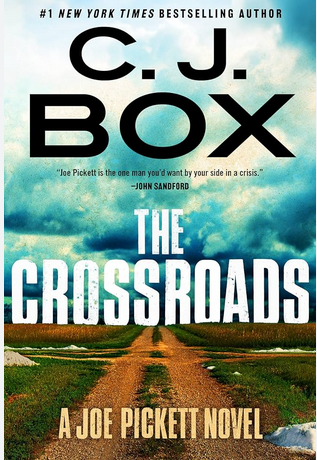
Joe Pickett’s body lies in a bullet-ridden Game Warden pickup truck, with no indication of where he was going or who he expected to find. As he’s airlifted to a hospital and specialists go to work on him, his three daughters know what to do. Find out who did this — and get western on them. Although this book primarily follows the girls’ efforts to find out whodunit, with a little help from the young sheriff who is sweet on Sheridan, readers still get a bit of Joe through flashback chapters that follow an investigation of his that took him to that crossroads. I’ve been looking forward to this book, not just because I become a Pickettholic last year, but because the later books in that series often featured Sheridan or April playing strong parts, and I especially like Sheridan — who was partially mentored by her crazy libertarian ‘uncle’, Nate Romanowski, and schooled by him in the ways of falconry. The book lived up to expectations, though it was distressingly short: I hate it when Box books just surprise me with a back cover when I am fully prepared to sink into the world of literary Wyoming for hours more.
All three of the Pickett women get a good share of the spotlight here, I think, though Sheridan and April both have stronger ‘edges’: Sheridan, as mentioned, is a tough bird who has held a sheriff at gunpoint before, and April has a lot “Well, yeah, I smashed a whisky glass into his face, but I didn’t know he was a cop and HE HAD IT COMING” energy. She’s the one who dated the rodeo star who proved to be a jackal in human form. Lucy, who played the sweet princess to Sheridan’s tomboy and April’s chaos monster, also has a good showing here. Fortunately, there are three different ranching families in the area that Joe was shot in, so each Pickett takes one on — and all three of them turn out to be sketchy as hell. Box doesn’t bring in Nate until far later, using his off-grid lifestyle to make getting the word to him about Joe to good effect. When he does arrive, though, people start losing ears in keeping with tradition. This allows the book to be about the Pickett women, and not Nate’s roaring rampage of revenge. Sheridan and April performed to expectations, and Lucy was a nice surprise. As usual, Box sprinkled in a fair bit of humor despite the grim circumstances: the only downside is that Marybeth had a very subdued role, as the girls didn’t want their mom knowing they were putting themselves in danger. (I mean, more than usual. April works for a private detective and Sheridan deals with raptors.)
Wonderful as usual: I suppose I shall have to return to Doiron now, there being no more Box to sustain my addiction to game warden drama. Honestly, if Box writes April into more Dewell novels and she finds a way to bring Sheridan on board, I’d be up for that as a series itself.
WHAT have you finished reading recently? Harry Potter and the Goblet of Fire, full cast audio edition.
WHAT are you reading now? CJ BOX’S THE CROSSROADS! IT CAME OUT YESTERDAY! MORE JOE PICKETT! I would have read it through yesterday but I had those nuisances –“work” and “class” to tend to.
WHAT are you reading next? A biography of Ulysses Grant, probably.
Today’s TTT is quotations about…books. But first, a tease!
Back in Washington, Lincoln came down with what doctors diagnosed as “varioloid,” a mild form of smallpox. So now he and Tad both were sick—though Tad at least was improving. Where were the office seekers? Lincoln quipped. Now he had something he could give everybody. – WITH MALICE TOWARD NONE
1. “A house without books is a house without windows. A man that has a few books, the best works of the great and the good, is in the best of company. He can sit in his chair and call before him the great spirits of the past. He can talk with Shakespeare; he can listen to the music of Milton; he can see the philosophy of Bacon; he can hear the wit of Sheridan.” — Robert G. Ingersoll, attributed
2. “What an astonishing thing a book is. It’s a flat object made from a tree with flexible parts on which are imprinted lots of funny dark squiggles. But one glance at it and you’re inside the mind of another person, maybe somebody dead for thousands of years. Across the millennia, an author is speaking clearly and silently inside your head, directly to you. Writing is perhaps the greatest of human inventions, binding together people who never knew each other, citizens of distant epochs. Books break the shackles of time. A book is proof that humans are capable of working magic.” — Carl Sagan, Cosmos
3. “Literary experience heals the wound, without undermining the privilege, of individuality. There are mass emotions which heal the wound; but they destroy the privilege. In them our separate selves are pooled and we sink back into sub-individuality. But in reading great literature I become a thousand men and yet remain myself. Like the night sky in the Greek poem, I see with a myriad eyes, but it is still I who see. Here, as in worship, in love, in moral action, and in knowing, I transcend myself; and am never more myself than when I do.” — C.S. Lewis
4. “What Orwell feared were those who would ban books. What Huxley feared was that there would be no reason to ban a book, for there would be no one who wanted to read one. Orwell feared those who would deprive us of information. Huxley feared those who would give us so much that we would be reduced to passivity and egotism. Orwell feared that the truth would be concealed from us. Huxley feared the truth would be drowned in a sea of irrelevance. Orwell feared we would become a captive culture. Huxley feared we would become a trivial culture, preoccupied with some equivalent of the feelies, the orgy porgy, and the centrifugal bumble puppy. As Huxley remarked in Brave New World Revisited, the civil libertarians and rationalists, who are ever on the alert to oppose tyranny, “failed to take into account man’s almost infinite appetite for distractions.” In 1984, people are controlled by inflicting pain. In Brave New World, they are controlled by inflicting pleasure. In short, Orwell feared that what we fear will ruin us. Huxley feared that our desire will ruin us.” — Neil Postman, Amusing Ourselves to Death
5. “If you have a garden and a library, you have everything you need.” — Marcus Tullius Cicero, attributed
6. “I explained — with the excessive exposition of a man spending a lonely week at the airport — that I was looking for the sort of books in which a genial voice expresses emotions that the reader has long felt but never before really understood; those that convey the secret, everyday things that society at large prefers to leave unsaid; those that make one feel somehow less alone and strange. Manishankar wondered if I might like a magazine instead.” — Alain de Botton, A Week at the Airport
7. “Those of us who have been true readers all our life seldom fully realise the enormous extension of our being which we owe to authors. We realise it best when we talk with an unliterary friend. He may be full of goodness and good sense but he inhabits a tiny world. In it, we should be suffocated. The man who is contented to be only himself, and therefore less a self, is in prison. My own eyes are not enough for me, I will see through those of others. Reality, even seen through the eyes of many, is not enough. I will see what others have invented.” — C.S. Lewis
8. “The books are to remind us what asses and fools we are. They’re Caesar’s praetorian guard, whispering as the parade roars down the avenue, ‘Remember, Caesar, thou art mortal.’ Most of us can’t rush around, talk to everyone, know all the cities of the world, we haven’t time, money or that many friends. The things you’re looking for, Montag, are in the world, but the only way the average chap will ever see ninety-nine per cent of them is in a book. Don’t ask for guarantees. And don’t look to be saved in any one thing, person, machine, or library. Do your own bit of saving, and if you drown, at least die knowing you were headed for shore.” — Ray Bradbury, Fahrenheit 451
9. “Naturally, since I myself am a writer, I do not wish the ordinary reader to read no modern books. But if he must read only the new or only the old, I would advise him to read the old. And I would give him this advice precisely because he is an amateur and therefore much less protected than the expert against the dangers of an exclusive contemporary diet. [….] A new [theology] book is still on its trial and the amateur is not in a position to judge it. It has to be tested against the great body of Christian thought down the ages, and all its hidden implications (often unsuspected by the author himself) have to be brought to light.” — C.S. Lewis
10. “We may be sure that the characteristic blindness of the twentieth century—the blindness about which posterity will ask, ‘But how could they have thought that?’—lies where we have never suspected it, and concerns something about which there is untroubled agreement between Hitler and President Roosevelt or between Mr. H. G. Wells and Karl Barth. None of us can fully escape this blindness, but we shall certainly increase it, and weaken our guard against it, if we read only modern books. Where they are true they will give us truths which we half knew already. Where they are false they will aggravate the error with which we are already dangerously ill. The only palliative is to keep the clean sea breeze of the centuries blowing through our minds, and this can be done only by reading old books. Not, of course, that there is any magic about the past. People were no cleverer then than they are now; they made as many mistakes as we. But not the same mistakes. They will not flatter us in the errors we are already committing; and their own errors, being now open and palpable, will not endanger us. Two heads are better than one, not because either is infallible, but because they are unlikely to go wrong in the same direction.” — C.S. Lewis