
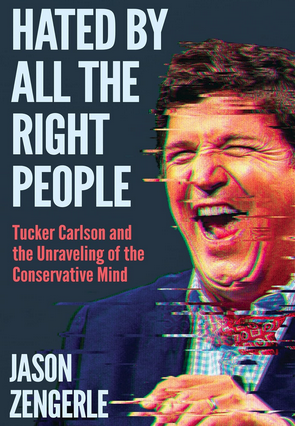
“What’s happened to Tucker?”, Rod Dreher may have asked himself in not so many words. Since Carlson aired an interview with a young troll whose name I’ll not give further mention, and failed to press the boy on his antisemitic and generally racist reviews, Dreher and Carlson have had a falling out. Dreher cannot understand what he reads as antisemitism from Carlson’s camp: personally, I don’t equate criticism of Israel with antisemitism, but platforming the troll without asking him any hard questions was damned strange, if not outright vile. When Senator Ted Cruz was on, evincing his total support for Israel and antagonism towards Iran, Tucker mercilessly grilled him: that was, in fact, the reason I listened to my first TC show. I’m not much for TV personalities, but seeing a neocon get put on the spot was a dish too tempting not to try. “What’s Happened to Tucker?” is also the subject of Hated By all the Right People, which tracks Carlson’s journalistic career from being a ‘young tyro’ at The New Republic through his TV heights, broadcasting every night into a president’s ears – and beyond.
Hated is also already slightly dated, given that the general “Tucker sold his soul to the Devil to be near Trump” premise is now completely moot. Because of Carlson’s refusal to roll over on the Epstein files or aggressive support for Israel and its Highlander approach towards Iran, Tucker has been denounced by the Donald as a loser with a “low IQ”. Of course, the Donald being who he is, they may be holding hands and skipping through the tulips before his second term is up. Hated by all the Right People is an interesting book, a history of a man who saw changes in journalism coming and made leaps of courage accordingly, struggling at first but then making a success of himself after an unexpected breeze blew in from south Florida. The author has an obvious distaste for his subject, which is never promising, and this manifests itself through a multitude of quotes that are framed to diminish him. One example: the author says Carlson evinced antisemitic views by claiming that the Jewish Zelensky had attacked Christian churches. Zelensky’s government has in fact attacked Orthodox churches within Ukraine, but for nationalist rather than religious reasons.
I knew very little about Carlson before reading this: he was not someone I paid attention to until he announced he was going to interview Vladimir Putin. That struck me as novel and potentially interesting, but I wouldn’t wind up listening to one of Carlson’s interviews in full until the aforementioned Cruz roast. I enjoyed learning about his life, even from someone who was sharply critical of Carlson’s work. I was interested in journalism in high school, so reading about Carlson’s beginnings as a newspaper and magazine reporter were especially interesting. Tucker thought that televised journalism had a lot of potential and transitioned early, despite the advice of friends and peers. While he did struggle, eventually he began getting traction – but Marshall McLuhan’s admonition that the medium is the message started doing its work, and soon Carlson was engaged in projects where arguments and outrage were more salient than measured discussion. When Carlson launched his own online news project in The Daily Caller, he openly admitted that he was chasing clicks – and while he wanted to create a right-of-center equivalent to The Huffington Post, his desire for that monster ‘engagement’ led to sloppier, more provocative headlines. Breitbart would run as a rival and eclipse the Caller in clickbait, leading to the Caller trying to outdo it.
It was when Tucker returned to the big screen, though, that he really took off. He landed a show on Fox that rode the wave of the Trump upset, and Carlson rode it well in part because he was not one of the party faithful. He presented himself as someone wary of Trump himself, but outright antagonistic toward Trump’s opponents. While it’s easy to read that as insincere, speaking from personal experience it sounds legitimate: I know a lot of Republicans and conservatives who don’t like Trump, will actively disparage him, but they so loathe who he speaks against – the ‘woke’, the DC elite, etc – that they’ll rally around the flag, anyway. Tucker’s teasing evidently intrigued Trump, tickling his ego but denying him satisfaction just enough: the Donald began calling Tucker to chat about the show, and after Carlson recovered from the oddity of the President watching his show faithfully, he began using it to speak directly to the president: ultimately, however, Carlson’s deeply rooted convictions against foreign wars and resentment of Israel’s influence on foreign policy – combined with whatever leverage Netanyahu has over Trump – have resulted in a falling out since Carlson spoke out against the Iran strikes of last year that “totally demolished” Iran’s nuclear program. Ultimately, Tucker continues to ride high: he may have been banished from Fox News, but just as he jumped from magazines to TVs and then took advantage of new online-only papers, so now he is an independent media personality with a podcast that rivals and sometimes outstrips other leading podcasters like Joe Rogan.
This is definitely a mixed bag of a book: the author’s dislike for his subject leads to a lot of misrepresentation, but the man and the currents he’s been involved with are interesting subjects in themselves – especially if you’re a libertarian with strong foreign policy views yourself! I thought the story was most interesting from the journalistic angle, since we’re watching the field evolve over the course of thirty years. I don’t think that evolution has been a good one, either: one reason Tucker was not on my radar until last year or so is that I don’t ‘watch’ news, either on TV or on my computer; I prefer reading it, in part because Neil Postman made me think critically about information and how its presentation affects how we are able to process it. We have all seen news degenerate from long thinkpieces to clickbait titles with little substance: it entertains without informing, and unfortunately Carlson has been part of that transformation.
Next up: I am closing in on the end of Lincoln, and am still working on my review of Maverick by Jason Riley. The problem with the latter is that it’s an intellectual biography of a man, so it’s not easy to precis.


I gave up watching the nightly news at 19 and turned to magazines. since then I’ve turned to online news sources. I have found that not having 24/7 yammerings in my ears and mind has helped my peace of mind a lot.
However, news “personalities” have never done it for me. I listened to Rush Limbaugh in the 90’s and as soon as I realized that he wasn’t presenting solutions, just problems to get people upset (so they’d support him), I was done with talk radio. So the likes of Carlson have never attracted me because of the format 🙂
I’m about the same — I stopped in my early twenties. There’s too much performance and emotional stimulation and not enough substance. I enjoy podcasts, but the only news one I listen to is Tom Woods.
I’m assuming that is a different Tom Wood than the one who writes the Victor the Assassin books 🙂
Very different! This Tom Woods is an historian and nonfiction author turned libertarian podcaster. Fairly prominent name in the liberty movement — his online learning platform, Liberty Classroom, is where I’ve found several authors like Brad Birzer and Kevin Guztman.
Oh, Tom WoodS.
Note to self, a single letter makes a difference 😉
He has the distinction of being one of my least favorite people, mainly because I’ve seen the damage his polemics and catastrophizing have done on certain family members, especially when he was on Fox. Needless to say, he is certainly a successful provocateur who holds a disproportionate amount of influence. And from his younger years, there is a clip of him from Dancing with the Stars that I will never be able to successfully erase from my consciousness. 😆
This book mentions that! He evidently hired a coach and practiced as much as he could between his work gigs, but still didn’t make it past the first cut.
Agreed. He is a *horrible* excuse for a human being. I still can’t make out if he’s faking ignorance or is really THAT stupid…
I’d like to think such people start out with good intentions. When I was more right of center, I listened to Shapiro occasionally because he used to be a voice of critique to left-wing excesses. I viewed his (then relatively new) media platform as bringing some balance to public discourse. But in just a few years, his messages became more and more harsh, plus he platformed individuals like Matt Walsh who were even more extreme. Later I learned he had expressed some questionable views early on, so it seems I was just unaware of his full perspective. I’m not sorry to hear the Daily Wire isn’t doing well, but it really is a result of its own faults IMHO. I do think a lot of these guys (and gals) view themselves as virtuous and consistent, but hubris and ideological religiosity expose the holes in their moral fabric (as it can do to all of us, tbh).
My most charitable interpretation is that fame & fortune get to radio personality / podcasters’ heads, and they start to sacrifice any principles they once had for clicks and clout. Don’t really know the situation with Tucker, though. Based on Stephen’s review of this book, it sounds like he got too interested in outrage rather early in his career.
To add to the above – There’s also some sense in which they “need” to continue to generate outrage. Because they’ve already won (Trump, Project 2025 etc). But without further fear and outrage, how will they continue to make a living? Kinda makes sense that Tucker would continue to change his tune. If things are going well, he doesn’t really have a show…
I wouldn’t say “they’ve” won: Trump won, but little of what his followers were promised has manifested into lingering action, save for the border being more adequately controlled. DOGE cuts weren’t put into action, for instance, despite a Republican-controlled congress, and despite the fact that one of Trump’s singular virtues was his disinterest in foreign interventions, his second term has been whack-a-mole with foreign adventures. Trump rode to power on hatred of the establishment, but whereas for him it’s more or less a name-calling contest, for some of his base, it’s real. They are LIVID about Trump turning on them over Epstein, for instance. They truly, madly, deeply hate the political class. Once the Boomers begin dying out in greater numbers — and they were the ones who unseated Thomas Massie, NOT the young — the Republican party is going to change. I think it’s going to become a lot more vicious. If someone comes along who can both channel that energy and wield it ably — Trump does one but not the other — it’s going to be a game changer. I don’t think that person will be NF, the aforementioned troll, because he’s such a smarmy little git that even I want to give him a swirlie.
As far as Tucker: I have not listened to enough of him to speak with much confidence, but if he grew sour on foreign intervention because of Iraq, as this critical book suggests, then I can see his cynicism of Israel and its influence over DC’s foreign policy being entirely legitimate. However, I think Carson DOES tack into weirdness either for views or because he enjoys the thrill of the arcane/dangerous. Recently, for instance, he did some interview with an ex-freemason who claimed to have been delivered of demon possession. The guy sounded VERY new agey and Carlson was eating it up — and TC talked to Candace Owens about Mme. Macrone’s alleged transgender status.
In what ways is Matt Walsh extreme? He recently pushed back against the Iran war, which I thought was ….courageous, even that he works for Ben Shapiro who is as “Make Israel Great Again” as you can ask. Of course, he and Michael Knowles lost a LOT of my regard when they retweeted some post that said Massie votes in line with jihadis. I’ll be a Ron Paul / Thomas Massie man to the grave.
I guess I’m one of the right people, then. And you’re right criticism of Israel is NOT antisemitism, just like criticism of the US isn’t anti-American. Bad governments are bad governments, the people sometimes make bad decisions, but that doesn’t mean that everyone in each of those countries are bad people because who their leaders are.